Adhyaya 95
Vāmadeva’s Counsel on Rooted Kingship and Non-violent Victory (वामदेवोपदेशः—दृढमूलराजधर्मः)
Upa-parva: Rājadharmānuśāsana (Instruction on the Duties of Kings)
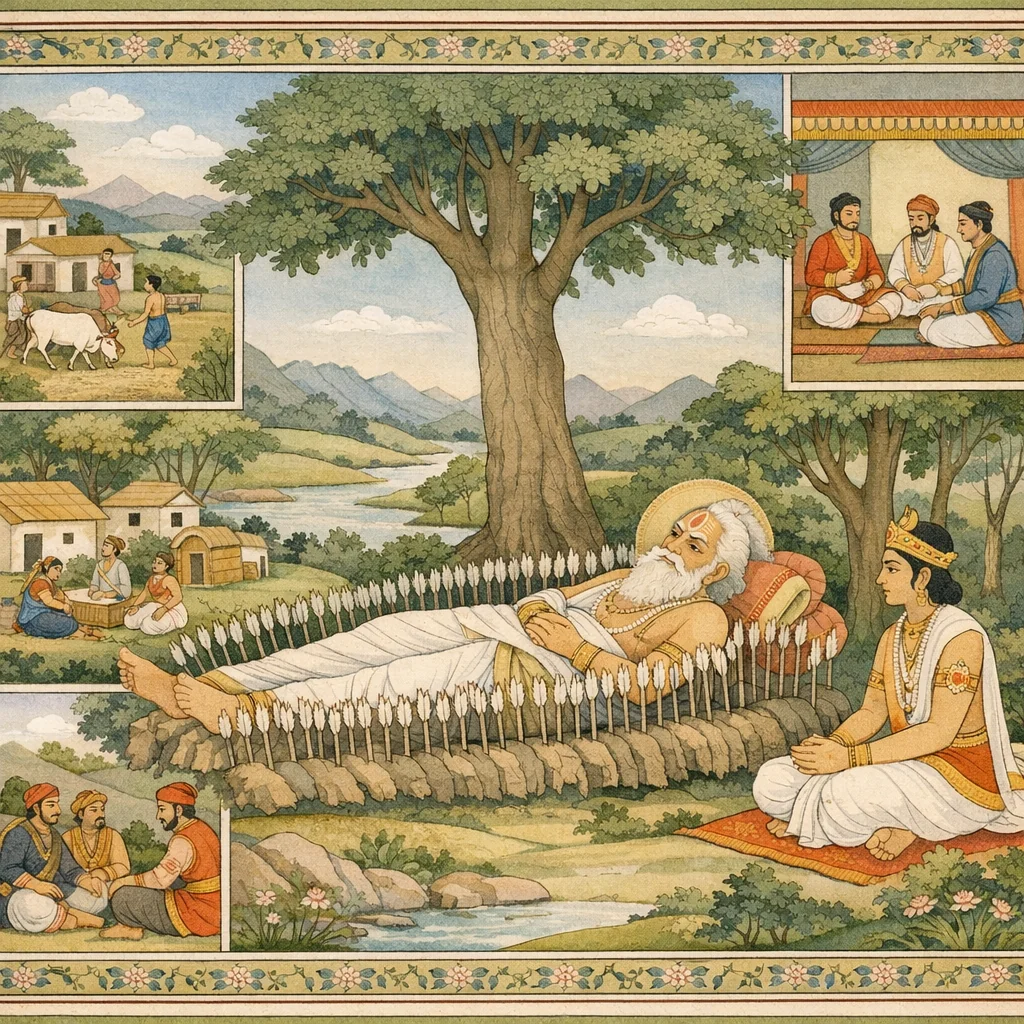
Chapter 95 presents Bhīṣma reporting Vāmadeva’s rājadharma counsel to a king: durable victory is best expanded without resorting to continual armed engagement, since conquest by force is characterized as an inferior form of success when compared with consolidation through legitimacy and administrative strength. The discourse warns against seeking new gains when the ‘root’ of the polity is weak—i.e., when institutions, resources, and civic confidence are insufficient. A ‘well-rooted’ ruler is defined by a flourishing territory, content and well-nourished ministers, satisfied and properly reassured troops, and townspeople and rural communities who are respected, loyal, and materially secure. Expansion (acquisition of land and wealth) is advised only when the ruler accurately judges his own influence and the appropriate time-window for action. Ethical self-regulation is treated as strategic: compassion in enjoyments and toward living beings, avoidance of misguided conduct in one’s own well-ordered affairs, and especially the governance of anger. The chapter concludes with a behavioral criterion: the wise avoid actions disliked by the noble and commit themselves to beneficial aims; such governance yields respect, inner non-remorse, and a form of ‘victory’ extending to both worldly stability and posthumous merit. Bhīṣma affirms that a ruler who follows this model attains secure success without doubt.
Chapter Arc: भीष्म युधिष्ठिर को वामदेव-गीता के राजधर्म का सूत्र पकड़ाते हैं—राज्य-लाभ की दौड़ से पहले ‘मूल’ (राज्य की जड़) को दृढ़ करो, अन्यथा प्राप्ति भी विनाश का कारण बनती है। → उपदेश क्रमशः कठोर यथार्थ पर टिकता है: दुर्बल-मूल राजा को लाभ नहीं ठहरता; समृद्ध जनपद, संतुष्ट सचिव, प्रिय-याजक/हितैषी, और तृप्त सैनिक—ये सब मिलकर राज्य की जड़ बनते हैं। राजा का दण्ड भी तभी प्रभावी है जब प्रजा-तंत्र भीतर से पुष्ट हो; अन्यथा दण्ड क्रूरता बन जाता है। → चरम बिंदु आत्म-शासन का तीखा विधान है—राजा को अपने ही आचरण को ‘वन के परशु’ की तरह तराशना चाहिए; जो अपने सदाचारी स्वजनों के प्रति मिथ्या व्यवहार करता है, वह स्वयं अपनी जड़ काटता है। साथ ही निर्णायक कसौटी रखी जाती है: जिसे श्रेष्ठ पुरुष निंद्य मानें, वह कर्म राजा न करे; जो सबके कल्याणकारी हो, उसी में स्वयं को लगाए। → भीष्म निष्कर्ष देते हैं कि जो राजा प्रजा के प्रति ऐसा धर्मयुक्त व्यवहार करता है, वह इहलोक-परलोक दोनों में विजय पाता है। वामदेव के उपदेश को मानकर पूर्व नृप ने सब वैसा ही किया—यह उदाहरण बनकर युधिष्ठिर के लिए मार्ग प्रशस्त करता है।
Shlokas
Verse 1
इस प्रकार श्रीमह्याभारत शान्तिपर्वके अन्तर्गत राजध्ानुशासनपर्वमें वामदेवगीताविषयक तिरानबेवाँ अध्याय पूरा हुआ ॥/ ९३ ॥। (दाक्षिणात्य अधिक पाठका १ श्लोक मिलाकर कुल ४० श्लोक हैं) अपन क्ाा छा 2 चतुर्नवतितमो< ध्याय: वामदेवके उपदेशमें राजा और राज्यके लिये हितकर बर्ताव वामदेव उवाच अयुद्धेनैव विजयं वर्धयेद् वसुधाधिप: । जघन्यमाहुर्विजयं युद्धेन च नराधिप,वामदेवजी कहते हैं--नरेश्वर! राजा युद्धके सिवा किसी और ही उपायसे पहले अपनी विजय-वृद्धिकी चेष्टा करे; युद्धसे जो विजय प्राप्त होती है, उसे निम्न श्रेणीकी बताया गया है
Vāmadeva said: “O lord of the earth, a king should seek to expand his victories by means other than war. Victory gained through war, they say, is the lowest kind of victory.”
Verse 2
न चाप्यलब्धं लिप्सेत मूले नातिदृढे सति | न हि दुर्बलमूलस्य राज्ञो लाभो विधीयते,यदि राज्यकी जड़ मजबूत न हो तो राजाको अप्राप्त वस्तुकी प्राप्ति--अनधिकृत देशोंपर अधिकारकी इच्छा नहीं करनी चाहिये; क्योंकि जिसके मूलमें ही दुर्बलता है, उस राजाको वैसा लाभ होना सम्भव नहीं है
Vāmadeva teaches that a king should not crave what he has not yet secured—such as coveting new territories—when the very foundation of his rule is not firmly established. For a ruler whose base is weak, the hoped-for gains cannot truly be brought about.
Verse 3
यस्य स्फीतो जनपद: सम्पन्न: प्रिययाजक: । संतुष्टपुष्टसचिवो दृढमूल: स पार्थिव:,जिस राजाका देश समृद्धिशाली, धनधान्यसे सम्पन्न, राजाको प्रिय माननेवाले मनुष्योंसे परिपूर्ण और हृष्ट-पुष्ट मन्त्रियोंस सुशोभित है, उसीकी जड़ मजबूत समझनी चाहिये
Vāmadeva said: That king is to be regarded as firmly rooted whose realm is flourishing, rich and well-provisioned, filled with people devoted to him and eager to honor him, and adorned with ministers who are both content and well-nourished. Such prosperity and satisfied governance indicate a stable foundation of rule.
Verse 4
यस्य योधा: सुसंतुष्टा: सान्त्विता: सूपधास्थिता: । अल्पेनापि स दण्डेन महीं जयति पार्थिव:
That king whose warriors are well-content, properly reassured, and firmly established in good discipline and support—such a ruler conquers and holds the earth even with only a small measure of punishment. The teaching is that just governance rests more on the morale, care, and orderly organization of one’s forces than on harsh coercion.
Verse 5
जिसके सैनिक संतुष्ट, राजाके द्वारा सान्त्वना-प्राप्त और शत्रुओंको धोखा देनेमें चतुर हों, वह भूपाल थोड़ी-सी सेनाके द्वारा भी पृथ्वीपर विजय पा लेता है ।। (दण्डो हि बलवानू् यत्र तत्र साम प्रयुज्यते । प्रदानं सामपूर्व च भेदमूलं प्रशस्यते ।। जिस स्थानपर शत्रुपक्षकी सेना अधिक प्रबल हो, वहाँ पहले सामनीतिका ही प्रयोग करना उचित है। यदि उससे काम न चले तो धन या उपहार देनेकी नीतिको अपनाना चाहिये। इस दाननीतिके मूलमें भी यदि भेदनीतिका समावेश हो अर्थात् शत्रुओंमें फूट डालनेकी चेष्टा की जा रही हो तो उसे उत्तम माना गया है ।। त्रयाणां विफल कर्म यदा पश्येत भूमिप: । रन्ध्र॑ ज्ञात्वा ततो दण्डं प्रयुज्जीताविचारयन् ।।) जब राजा साम, दान और भेद--तीनोंका प्रयोग निष्फल देखे, तब शत्रुकी दुर्बलताका पता लगाकर दूसरा कोई विचार मनमें न लाते हुए दण्डनीतिका ही प्रयोग करे--शत्रुके साथ युद्ध छेड़ दे ।। पौरजानपदा यस्य भूतेषु च दयालव: । सधना धान्यवन्तश्न दृढ्मूल: स पार्थिव:
Vāmadeva said: That king whose soldiers are content, comforted by their ruler, and skilled in deceiving the foe, wins victory over the earth even with a small army. Where the enemy’s force is stronger, one should first employ sāma (conciliation); if that fails, resort to dāna (gifts of wealth). If, at the root of that dāna, bheda (sowing division) is also applied, it is praised as best. But when sāma, dāna, and bheda all prove fruitless, then the king, having found the enemy’s weakness, should without hesitation use daṇḍa (forceful punishment)—that is, open war. And that king is firmly founded whose townsmen and countryfolk are devoted to him, who is compassionate toward all beings, and whose realm is rich in resources and grain.
Verse 6
जिसके नगर और जनपदमें रहनेवाले लोग समस्त प्राणियोंपर दया करनेवाले और धन-धान्यसे सम्पन्न होते हैं, उस राजाकी जड़ मजबूत समझी जाती है ।। (राष्ट्रकर्मकरा होते राष्ट्रस्य च विरोधिन: । दुर्विनीता विनीताश्न सर्वे साध्या: प्रयत्नतः ।। ये नगर और जनपदके लोग राष्ट्रके कार्यकी सिद्धि करनेवाले और उसके विरोधी भी होते हैं। उद्ण्ड और विनयशील भी होते हैं। उन सबको प्रयत्नपूर्वक अपने वशमें करना चाहिये ।। चाण्डालम्लेच्छजात्याक्ष पाषण्डाक्ष विकर्मिण: । बलिनश्षाश्रमाश्नैव तथा गायकनर्तका: ।। यस्य राष्ट्र वसन्त्येते धान्योपचयकारिण: । आयवृद्धौ सहायाश्च दृढमूल: स पार्थिव: ।।) चाण्डाल, म्लेच्छ, पाखण्डी, शास्त्र-विरुद्ध कर्म करनेवाले, बलवान, सभी आश्रमोंके निवासी तथा गायक और नर्तक--इन सबको प्रयत्नपूर्वक वशमें करना चाहिये। जिसके राज्यमें ये सब लोग धन-धान्यकी वृद्धि करनेवाले और आय बढ़ानेमें सहायक होकर रहते हैं, उस राजाकी जड़ मजबूत समझी जाती है ।। प्रतापकालमधिकं यदा मन्येत चात्मन: । तदा लिप्सेत मेधावी परभूमिधनान्युत,बुद्धिमान् राजा जब अपने प्रतापको प्रकाशित करनेका उपयुक्त अवसर समझे, तभी दूसरेका राज्य और धन लेनेकी चेष्टा करे
Vāmadeva said: People living in towns and countryside are of many kinds—some advance the work of the realm, while others oppose it; some are undisciplined, others well-trained. A king should, through sustained effort, bring all such groups under effective governance. Even those regarded as marginal or heterodox—Caṇḍālas, foreigners (mlecchas), sectarians, doers of unlawful acts, the strong, residents of all āśramas, and also singers and dancers—should be managed so that they become contributors to prosperity. The ruler in whose kingdom these groups reside as producers of grain-surplus and as helpers in increasing revenue is said to have firm roots. Further, when a wise king judges that the time is especially favorable for displaying his power, only then should he attempt to seize another’s land and wealth.
Verse 7
भोगेषूदयमानस्य भूतेषु च दयावत:ः । वर्धते त्वरमाणस्य विषयो रक्षितात्मन:,जिसके वैभव-भोग दिनोंदिन बढ़ रहे हों, जो सब प्राणियोंपर दया रखता हो, काम करनेमें फुर्तीला हो और अपने शरीरकी रक्षाका ध्यान रखता हो, उस राजाकी उत्तरोत्तर वृद्धि होती है
Vāmadeva teaches that a king’s dominion steadily expands when his prosperity and enjoyments are on the rise, when he is compassionate toward all living beings, when he acts with prompt energy in his duties, and when he maintains disciplined care of his own person. Such a ruler’s power and realm grow progressively through ethical conduct joined with effective governance.
Verse 8
तक्षेदात्मानमेवं स वन॑ परशुना यथा । यः सम्यग वर्तमानेषु स्वेषु मिथ्या प्रवर्तते,जो अच्छा बर्ताव करनेवाले स्वजनोंके प्रति मिथ्या व्यवहार करता है, वह इस बर्तावद्वारा कुल्हाड़ीसे जंगलकी भाँति अपने आपका ही उच्छेद कर डालता है
Whoever deals falsely with his own kinsmen who are themselves acting rightly, by that very conduct cuts down his own self—like a forest felled by an axe.
Verse 9
नैव द्विषन्तो हीयन्ते राज्ञो नित्यमनिध्नत:ः । क्रोधं निहन्तुं यो वेद तस्य द्वेष्टा न विद्यते,यदि राजा कभी किसी द्वेष करनेवालेको दण्ड न दे तो उससे द्वेष करनेवालोंकी कमी नहीं होती है; परंतु जो क्रोधको मारनेकी कला जानता है, उसका कोई द्वेषी नहीं रहता है
Vāmadeva said: “If a king never punishes, those who bear hatred do not diminish; hostility keeps arising against such unchecked rule. But the one who knows how to slay anger itself has no enemy—because anger, once mastered, no longer provokes enmity in others.”
Verse 10
यदार्यजनविद्धिष्टं कर्म तन्नाचरेद् बुध: । यत् कल्याणमभिशध्यायेत् तत्रात्मानं नियोजयेत्
Vāmadeva said: A wise person should not undertake any action that is censured by the noble and cultured. Rather, having clearly discerned what is truly beneficial and auspicious, one should commit oneself to that course alone.
Verse 11
जिसे श्रेष्ठ पुरुष बुरा समझते हों, बुद्धिमान राजा वैसा कर्म कभी न करे। जिस कार्यको सबके लिये कल्याणकारी समझे, उसीमें अपने आपको लगावे ।। नैनमन्ये5वजानन्ति नात्मना परितप्यते । कृत्यशेषेण यो राजा सुखान्यनुबुभूषति,जो राजा अपना कर्तव्य पूर्ण करके ही सुखका अनुभव करना चाहता है, उसका न तो दूसरे लोग अनादर करते हैं और न वह स्वयं ही संतप्त होता है
Vāmadeva said: A wise king should never undertake a deed that noble people judge to be blameworthy. He should devote himself only to that work which is understood to bring welfare to all. The king who seeks to enjoy happiness only after completing what must be done is neither despised by others nor tormented within himself.
Verse 12
इदं वृत्तं मनुष्येषु वर्तते यो महीपति: । उभौ लोकौ विनिर्जित्य विजये सम्प्रतिष्ठतते,जो राजा प्रजाके प्रति ऐसा बर्ताव करता है, वह इहलोक और परलोक दोनोंको जीतकर विजयमें प्रतिष्ठित होता है
This is the established rule of conduct among human beings: the king who behaves in this manner toward his subjects conquers both worlds—this one and the next—and becomes firmly established in victory.
Verse 13
भीष्म उवाच इत्युक्तो वामदेवेन सर्व तत् कृतवान् नृप: । तथा कुर्वस्त्वमप्पेती लोकौ जेता न संशय:,भीष्मजी कहते हैं--राजन्! वामदेवजीके इस प्रकार उपदेश देनेपर राजा वसुमना सब कार्य उसी प्रकार करने लगे। यदि तुम भी ऐसा ही आचरण करोगे तो निः:संदेह लोक और परलोक दोनों सुधार लोगे
Bhishma said: “O king, thus instructed by Vamadeva, King Vasumana carried out everything accordingly. If you too act in the same way, then without doubt you will be victorious in both this world and the next.”
Verse 94
इति श्रीमहाभारते शान्तिपर्वणि राजधर्मानुशासनपर्वणि वामदेवगीतासु चतुर्नवतितमो<ध्याय:
Thus, in the Śrī Mahābhārata, within the Śānti Parva—specifically in the section on instruction concerning the duties of kings (Rājadharmānuśāsana Parva)—ends the ninety-fourth chapter of the Vāmadeva-gītās.
Frequently Asked Questions
The chapter contrasts coercive success with legitimate consolidation: whether a ruler should pursue victory through continual force or prioritize non-violent stabilization by strengthening institutions, civic loyalty, and administrative competence.
Self-governance is treated as statecraft: a ruler who restrains anger, avoids conduct condemned by the noble, and protects the welfare of subjects creates a stable ‘root’ from which prosperity and influence can safely expand.
A concluding evaluative claim functions as meta-commentary: a king who embodies this conduct is said to ‘conquer both worlds’—signaling that ethical governance yields both durable political success and broader merit-based outcomes.