Adhyaya 6
द्रोणसेनापत्यं, व्यूहविन्यासः, उत्पातदर्शनं, आरम्भयुद्धम् (Droṇa’s Command, Battle-Formations, Omens, and Opening Engagement)
Upa-parva: Droṇābhiṣeka (Appointment of Droṇa and Battle-Array Accounts)
Saṃjaya reports that Droṇa, having obtained the office of senāpati, advances after arranging the Kaurava host. The right wing is held by Jayadratha (Saindhava), the Kaliṅga leader, and Vikarna; Śakuni rides with Gāndhāra forces, while Kṛpa, Kṛtavarmā, Citraseṇa, Viviṃśati and others protect the left. Additional allied groupings—Kāmbojas led by Sudakṣiṇa, along with Śakas and Yavanas—are positioned as supporting elements; other regional contingents are enumerated to indicate breadth of mobilization. Karṇa, celebrated as Rādheya/Vaikartana, advances prominently, and Kaurava morale rises with claims about his battlefield efficacy. The text then contrasts vyūha doctrine: the Kauravas adopt a śakaṭa-vyūha designed by Droṇa, while the Pāṇḍavas deploy a krauñca-vyūha attributed to Dharmarāja Yudhiṣṭhira. At the head of the Pāṇḍava formation stand Arjuna with the Vānaradhvaja and Kṛṣṇa with Sudarśana, presented as concentrated ‘tejas’ on a single chariot. Karṇa and Arjuna visually appraise one another as mutual adversaries. As Droṇa moves, the battlefield is marked by severe utpātas: dust obscuring the sky, unnatural ‘rain’ imagery of gore and fragments, predatory birds circling, jackals crying, a blazing meteor, and a solar halo with thunder and lightning—conventional epic indicators of mass mortality. Combat begins with intense reciprocal arrow exchanges; Droṇa presses the Pāṇḍava–Sṛñjaya line with divyāstras, scattering formations. Dhṛṣṭadyumna (Yājñaseni/Pārṣata) counters with his own arrow-storms, briefly checking Droṇa’s advance, after which Droṇa regroups and renews pressure, moving through the enemy host with the described dynamism of a whirling firebrand and a carefully engineered war-chariot.
Chapter Arc: कर्ण के वचन सुनकर दुर्योधन सभा-सम राजा-समुदाय के बीच द्रोणाचार्य की ओर मुड़ता है—अब युद्ध की दिशा बदलने के लिए उसे एक ऐसे सेनापति की आवश्यकता है, जिसके नाम मात्र से पाण्डवों का उत्साह डगमगा जाए। → दुर्योधन द्रोण की महत्ता को क्रमशः गिनाता है—कुल-श्रेष्ठता, श्रुति-ज्ञान, आयु, बुद्धि, वीर्य, दाक्ष्य, अजेयता, अर्थ-नीति और तप-बल; फिर उपमाओं की माला से उन्हें सर्वोच्च ठहराता है (वसिष्ठ, सूर्य, धर्मराज, इन्द्र, कुबेर आदि के समान)। यह प्रशंसा केवल स्तुति नहीं, एक राजनीतिक आग्रह है: भीष्म के बाद कौरव-सेना को नया ध्रुव चाहिए। → दुर्योधन का निर्णायक वचन—यदि द्रोण सेनापति बनें तो वह युधिष्ठिर को ‘सानुबन्धं सबान्धवम्’ सहित जीत लेने का दावा करता है; साथ ही संकेत देता है कि द्रोण को अग्रगामी देखकर अर्जुन भी प्रहार करेगा। इसी क्षण सभा में सिंहनाद उठता है और राजागण ‘जय’ कहकर द्रोण के अभिषेक-सम समर्थन में एकमत हो जाते हैं। → राजाओं और सैनिकों की हर्ष-ध्वनि के बीच द्रोण को दुर्योधन के आगे रखकर प्रार्थना की जाती है; द्रोण दुर्योधन से प्रत्युत्तर देने के लिए वचन आरम्भ करते हैं—सेनापतित्व की स्वीकृति/शर्तों की ओर कथा बढ़ती है। → द्रोण का उत्तर क्या होगा—क्या वे सेनापति बनकर अर्जुन-वध/युधिष्ठिर-जय की प्रतिज्ञा को स्वीकार करेंगे, और किस मूल्य पर?
Shlokas
Verse 1
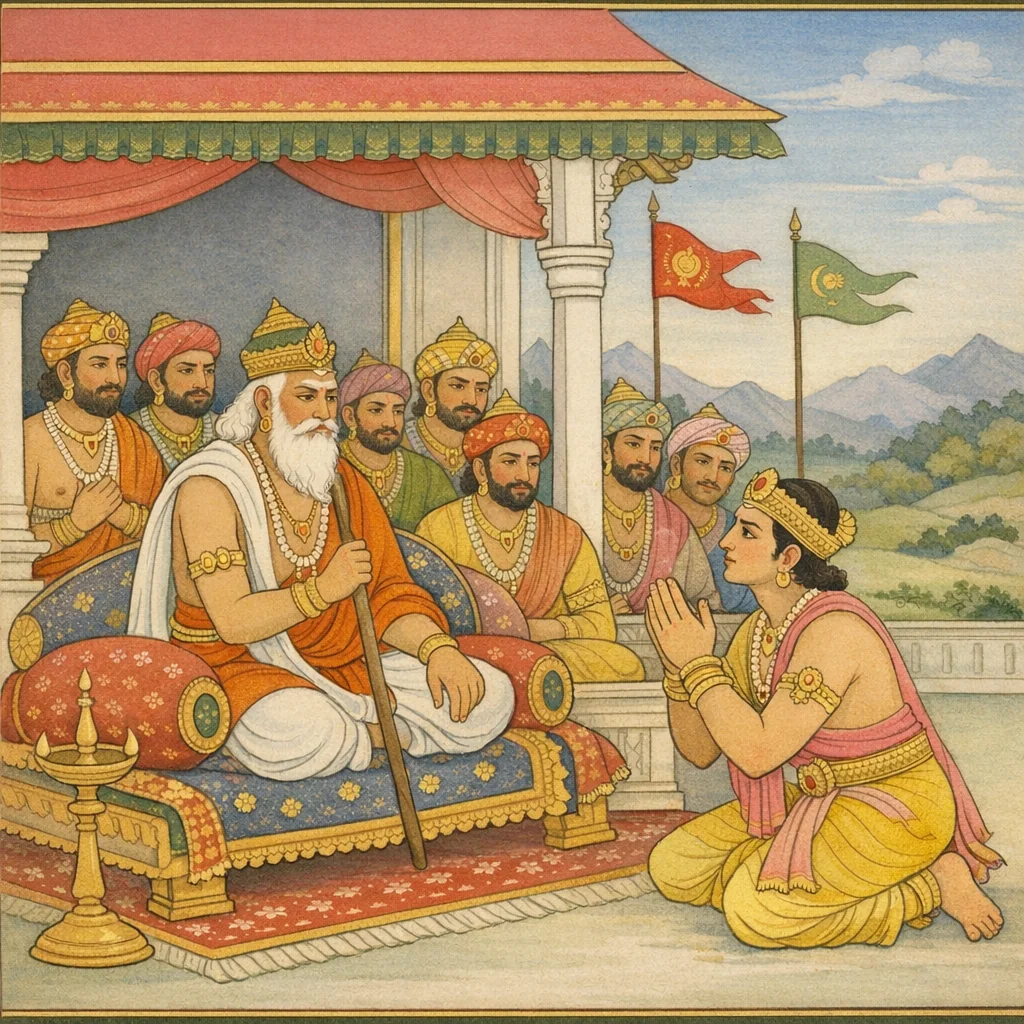
/ अप ह< बक। ] अत काए: षष्ठो 5 ध्याय: दुर्योधनका द्रोणाचार्यसे सेनापति होनेके लिये प्रार्थना करना संजय उवाच कर्णस्य वचन श्रुत्वा राजा दुर्योधनस्तदा । सेनामध्यगतं द्रोणमिदं वचनमत्रवीत्,संजय कहते हैं--राजन्! कर्णका यह कथन सुनकर उस समय राजा दुर्योधनने सेनाके मध्यभागमें स्थित हुए आचार्य द्रोणसे इस प्रकार कहा
Sanjaya said: O King, having heard Karna’s words, Duryodhana then addressed Acharya Drona, who stood in the midst of the army. The scene frames a decisive ethical moment in war-leadership: counsel is weighed, authority is invoked, and command is sought not merely for victory but for the legitimacy and cohesion of the Kaurava host.
Verse 2
दुर्योधन उवाच वर्णश्रैष्ठयात् कुलोत्पत्त्या श्रुतेन वयसा धिया । वीर्याद् दाक्ष्यादधृष्यत्वादर्थज्ञानान्नयाज्जयात्
Duryodhana said: “By excellence of social standing, by noble birth, by learning, by maturity of years, and by intelligence; by valor, by skill, by being unassailable, by knowledge of resources, by statesmanship, and by victory—by such measures a man is to be recognized as foremost.”
Verse 3
तपसा च कृतज्ञत्वाद वृद्ध: सर्वगुणैरपि । युक्तो भवत्समो गोप्ता राज्ञामन्यो न विद्यते
Duryodhana said: “By your austerity and your gratitude, and by your seniority and every virtue besides, you are fit to be a protector equal to yourself; among kings there is no other guardian to be found like you.”
Verse 4
स भवान् पातु नः सर्वान् देवानिव शतक्रतुः । भवन्नेत्रा: पसजउ्जेतुमिच्छामो द्विजसत्तम
Duryodhana said: “May you protect all of us, as Śatakratu (Indra) protects the gods. O best of Brahmins, we wish to take our stand under your guidance and leadership.”
Verse 5
इस प्रकार श्रीमह्गाभारत द्रोणपर्वके अन्तर्गत द्रोणाभिषेकपर्वमें कर्णवाक्यविषयक पॉचवाँ अध्याय पूरा हुआ,दुर्योधन बोला--द्विजश्रेष्ठ] आप उत्तम वर्ण, श्रेष्ठ कुलमें जन्म, शास्त्रज्ञान, अवस्था, बुद्धि, पराक्रम, युद्धकौशल, अजेयता, अर्थज्ञान, नीति, विजय, तपस्या तथा कृतज्ञता आदि समस्त गुणोंके द्वारा सबसे बढ़े-चढ़े हैं। आपके समान योग्य संरक्षक इन राजाओंमें भी दूसरा नहीं है। अतः जैसे इन्द्र सम्पूर्ण देवताओंकी रक्षा करते हैं, उसी प्रकार आप हमलोगोंकी रक्षा करें। हम आपके नेतृत्वमें रहकर शत्रुओंपर विजय पाना चाहते हैं | २-- ४।। ४. ७ ७... 03330 [. 42 हा 5 | ५ हि (2 । १. ८.० ॥ 0७> रुद्राणामिव कापाली वसूनामिव पावक: । कुबेर इव यक्षाणां मरुतामिव वासव:
Thus, in the Mahabharata, within the Drona Parva, in the Dronabhisheka Parva, the fifth chapter concerning Karna’s words is concluded. Duryodhana said: “O best of Brahmins! By noble varna, by birth in an eminent lineage, by knowledge of the shastras, by age and intelligence; by valor, by skill in war, by invincibility, by knowledge of resources, by policy, and by victory; by austerity and by gratitude—by all these qualities you surpass all others. Among these kings there is no second protector fit to equal you. Therefore, as Indra protects all the gods, so do you protect us. We wish, under your leadership, to win victory over our foes. And you are—among the Rudras like Kapālī (Śiva), among the Vasus like Pāvaka (Agni), among the Yakṣas like Kubera, and among the Maruts like Vāsava (Indra). By these comparisons, the speaker exalts the invoked guardian as foremost in every class—implying that such a leader should naturally assume the duty of safeguarding allies and securing victory in a righteous yet perilous war.”
Verse 6
वसिष्ठ इव विप्राणां तेजसामिव भास्कर: । पितृणामिव धर्मेन्द्रो यादसामिव चाम्बुराट्,इति श्रीमहाभारते द्रोणपर्वणि द्रोणाभिषेकपर्वणि द्रोणप्रोत्साहने षष्ठो5ध्याय: ।। ६ || इस प्रकार श्रीमह्ा भारत द्रोणपर्वके अन्तर्गत द्रोणाभिषेकपर्वमें द्रोणको उत्साह- प्रदानविषयक छठा अध्याय पूरा हुआ
Duryodhana extols Droṇa through a chain of lofty comparisons: “As Vasiṣṭha stands foremost among brahmins, as the Sun among sources of radiance, as Yama (the Lord of Dharma) among the ancestors, and as the ocean-king among aquatic beings—so are you.” The praise is meant to kindle Droṇa’s resolve for battle, framing martial leadership as a matter of eminence, authority, and dharma-like governance within one’s sphere.
Verse 7
नक्षत्राणामिव शशी दितिजानामिवोशना: । श्रेष्ठ: सेनाप्रणेतृणां स नः सेनापतिर्भव
Duryodhana says: “As the moon outshines the stars, and as Uśanā (Śukra) stands foremost among the Daityas, so are you the best among commanders. Therefore, be our commander-in-chief.” In the moral atmosphere of the war, the line reveals Duryodhana’s reliance on prestige and prowess—seeking legitimacy and victory through an eminent leader rather than through righteous conduct.
Verse 8
रुद्रोंमें शंकर, वसुओंमें पावक, यक्षोंमें कुबेर, देवताओंमें इन्द्र, ब्राह्मणोंमें वसिष्ठ, तेजोमय पदार्थोमें भगवान् सूर्य, पितरोंमें धर्मराज, जलचरोंमें वरुणदेव, नक्षत्रोंमें चन्द्रमा और दैत्योंमें शुक्राचार्यके समान आप समस्त सेनानायकोंमें श्रेष्ठ हैं; अतः हमारे सेनापति होइये ।। अक्षौहिण्यो दशैका च वशगा: सनन््तु तेडनघ । ताभि: शत्रून् प्रतिव्यूह्द जहीन्द्रो दानवानिव,अनघ! मेरी ग्यारह अक्षौहिणी सेनाएँ आपके अधीन रहें। उन सबके द्वारा शत्रुओंके मुकाबलेमें व्यूह बनाकर आप मेरे विरोधियोंका उसी प्रकार नाश कीजिये, जैसे इन्द्र दैत्योंका नाश करते हैं
Duryodhana said: “As Śaṅkara is foremost among the Rudras, Pāvaka among the Vasus, Kubera among the Yakṣas, Indra among the gods, Vasiṣṭha among the Brahmins, the Sun among radiant beings, Dharmarāja among the Pitṛs, Varuṇa among water-dwellers, the Moon among the constellations, and Śukrācārya among the Daityas—so are you the best of all commanders. Therefore, become our commander-in-chief. Let my eleven akṣauhiṇīs be under your control, O blameless one. With them, array the battle-formations against the enemy and destroy my opponents, just as Indra destroys the Dānavas.”
Verse 9
प्रयातु नो भवानग्रे देवानामिव पावकि: । अनुयास्यामहे त्वाजी सौरभेया इवर्षभम्,जैसे कार्तिकेय देवताओंके आगे चलते हैं, उसी प्रकार आप हमलोगोंके आगे चलिये। जैसे बछड़े साँड़के पीछे चलते हैं, उसी प्रकार युद्धमें हम सब लोग आपके पीछे चलेंगे
Duryodhana said: “May you go in front of us—like Pāvaki (Kārttikeya) leading the gods. We shall follow you in this battle, as the calves of Surabhi follow the bull.” In ethical and narrative terms, he frames obedience to the commander as the army’s duty, using sacred and pastoral similes to intensify loyalty and to legitimize aggressive resolve through the language of reverence.
Verse 10
उग्रधन्वा महेष्वासो दिव्यं विस्फारयन् धनु: । अग्रेभवं त्वां तु दृष्टवा नार्जुन: प्रहरिष्यति,आपको अग्रगामी सेनापतिके रूपमें देखकर भयंकर धनुष धारण करनेवाले महाधनुर्धर अर्जुन अपने दिव्य धनुषकी टंकार फैलाते हुए भी प्रहार नहीं करेंगे
Duryodhana said: “Arjuna—fierce with his bow, a great archer—may be making his divine bow resound; yet on seeing you standing in front as the leading commander, he will not strike.”
Verse 11
ध्रुवं युधिष्ठिरं संख्ये सानुबन्धं सबान्धवम् | जेष्यामि पुरुषव्यात्र भवान् सेनापतियदि,पुरुषसिंह! यदि आप मेरे सेनापति हो जाय॑ँ तो मैं युद्धमें निश्चय ही भाइयों तथा सगे- सम्बन्धियोंसहित युधिष्ठिरको जीत लूँगा
Duryodhana said: “Surely, in the press of battle I shall defeat Yudhiṣṭhira—together with all his supporters and his kinsmen—if you, tiger among men, will become my commander. With you as my general, I am confident of victory over him along with his brothers and allied relations.”
Verse 12
संजय उवाच एवमुक्ते ततो द्रोणं जयेत्यूचुर्नराधिपा: । सिंहनादेन महता हर्षयन्तस्तवात्मजम्,संजय कहते हैं--राजन! दुर्योधनके ऐसा कहनेपर सब राजा अपने महान् सिंहनादसे आपके पुत्रका हर्ष बढ़ाते हुए द्रोणसे बोले--“आचार्य! आपकी जय हो”
Sañjaya said: When Duryodhana had spoken thus, the assembled kings cried out, “Victory to Droṇa!” With a great lion-roar they sought to heighten the joy and confidence of your son, rallying around the commander they had chosen for the coming battle.
Verse 13
सैनिकाश्न मुदा युक्ता वर्धयन्ति द्विजोत्तमम् दुर्योधन पुरस्कृत्य प्रार्थयन्तो महद् यश: । दुर्योधनं ततो राजन् द्रोणो वचनमब्रवीत्,दूसरे सैनिक भी प्रसन्न होकर दुर्योधनको आगे करके महान् यशकी अभिलाषा रखते हुए द्रोणाचार्यकी प्रशंसा करके उनका उत्साह बढ़ाने लगे। राजन्! उस समय द्रोणाचार्यने दुर्योधनसे कहा
Sañjaya said: The soldiers, filled with delight, praised the foremost of the twice-born (Droṇa) and sought to raise his ardour. Putting Duryodhana at their head and longing for great renown, they extolled Droṇa. Then, O King, Droṇa addressed Duryodhana with these words.
Frequently Asked Questions
Droṇa’s role as guru and as state-commander creates a structural dharma-tension: the chapter frames his duty to execute Kaurava strategy despite prior pedagogical bonds, showing how institutional obligation can override personal affiliation in wartime governance.
The passage teaches that outcomes are shaped not only by individual heroics but by formation logic—frontage control, flank security, and concentration of elite assets—illustrated by Droṇa’s engineered array and Yudhiṣṭhira’s counter-array anchored by Arjuna–Kṛṣṇa.
No explicit phalaśruti appears here; instead, meta-significance is conveyed through utpāta imagery and narrative framing, signaling the gravity of actions and the interpretive weight of consequences within the epic’s moral architecture.