Adhyaya 9
Ruru’s Lament and the Lifespan Exchange for Pramadvarā (रुरु–प्रमद्वरा आयुर्विभागः)
Upa-parva: Ruru–Pramadvarā Upākhyāna (Episode)
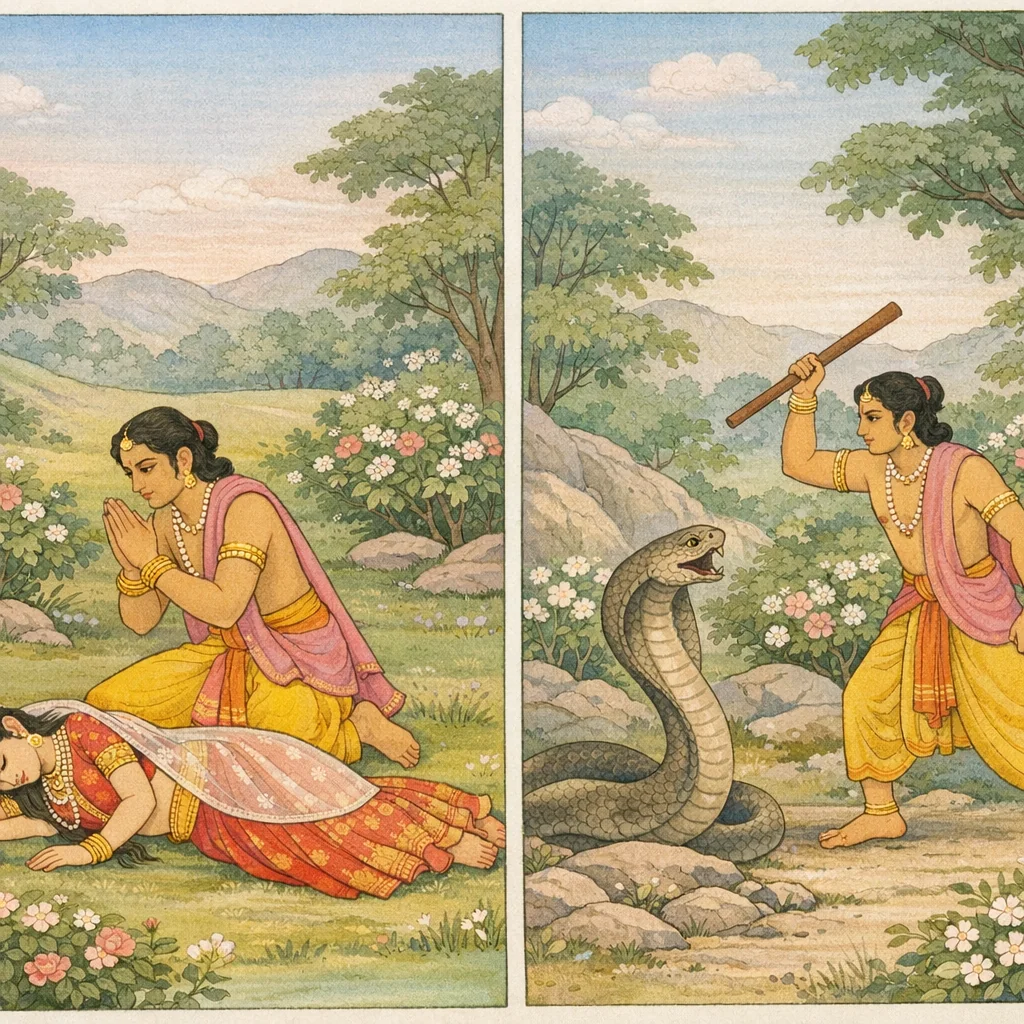
Chapter 9 presents a tightly structured sequence: (1) Sauti narrates Ruru’s acute lamentation in the forest as he contemplates Pramadvarā lying lifeless; (2) a devadūta refutes the efficacy of mere speech against death and states that her allotted lifespan has ended; (3) the messenger offers a pre-established divine remedy—lifespan transfer—contingent on Ruru’s consent; (4) Ruru requests the precise method and agrees to give half his life; (5) Gandharvarāja and the devadūta approach Dharmarāja, who authorizes the exchange; (6) Pramadvarā rises, as if from sleep, restored by half of Ruru’s lifespan; (7) the narrative notes this as a foreseen destiny for Ruru, whose long life is reduced for his spouse’s sake; (8) the parents conduct the marriage rites; (9) Ruru, now bound by a trauma-informed resolve, undertakes a vrata aimed at destroying serpents and acts aggressively toward them; (10) the chapter closes with an encounter: Ruru raises a staff against an aged ḍuṇḍubha, who protests innocence and questions the ethics of violence motivated by generalized anger. The chapter’s thematic lesson is the movement from legitimate sorrow to ethically risky overgeneralization, setting up a critique of indiscriminate harm.
Chapter Arc: पिछले अध्याय के विषाद-धुएँ से कथा उठती है: प्रमद्वरा सर्पदंश से भूमि पर निश्चेष्ट पड़ी है, और रुरु शोक से आहत होकर करुण विलाप करता है। → रुरु अपने जीवन-भर के दान, तप, गुरु-सेवा और संयम को साक्षी बनाकर प्रार्थना करता है कि यदि उसमें सत्य-बल है तो प्रमद्वरा जीवित उठे; फिर वह विष्णु/हृषीकेश में अपनी अचल भक्ति का स्मरण कर जीवन-दान की याचना करता है। → धर्म-बल और भक्ति-बल की चरम पुकार—रुरु का संकल्प-भरा वचन कि उसके पुण्य और निष्ठा का फल अभी, इसी क्षण, प्रमद्वरा के प्राणों में लौटे। → इष्ट-दिन पर दोनों के माता-पिता हर्ष से विवाह कराते हैं; रुरु और प्रमद्वरा परस्पर हितैषी होकर दाम्पत्य में रमते हैं—शोक का रूपांतरण मंगल में हो जाता है। → कुछ समय बाद वन में रुरु एक वृद्ध डुण्डुभ (सर्प) को देख क्रोध में दण्ड उठाता है; सर्प प्रश्न करता है—“मैंने तुम्हारा क्या अपराध किया है कि तुम मुझे मारने को उद्यत हो?”
Shlokas
Verse 1
इस प्रकार श्रीमहाभारत आदिपव॑ीके अन्तर्गत पौलोगपर्वमें प्रमद्वराके सर्पदेंशनसे सम्बन्ध रखनेवाला आठवाँ अध्याय पूरा हुआ ॥/ ८ ॥ (दाक्षिणात्य अधिक पाठका ३ श्लोक मिलाकर कुल २७३ “लोक हैं) नील + () आस नवमो<्ध्याय: रुरुकी आधी आयुसे प्रमद्वराका जीवित होना, रुरुके साथ उसका विवाह, रुरुका सर्पोंको मारनेका निश्चय तथा रुरु- डुण्डुभ-सवाद सौतिर्वाच तेषु तत्रोपविष्टेषु ब्राह्मणेषु महात्मसु । रुरुश्लुक्रोश गहनं वन॑ं गत्वातिदुःखित:,उग्रश्रवाजी कहते हैं--शौनकजी! वे ब्राह्मण प्रमद्वराके चारों ओर वहाँ बैठे थे, उसी समय रुरु अत्यन्त दुःखित हो गहन वनमें जाकर जोर-जोरसे रुदन करने लगा। शोकसे पीड़ित होकर उसने बहुत करुणाजनक विलाप किया और अपनी प्रियतमा प्रमद्वराका स्मरण करके शोकमग्न हो इस प्रकार बोला--“हाय! वह कृशांगी बाला मेरा तथा समस्त बान्धवोंका शोक बढ़ाती हुई भूमिपर सो रही है; इससे बढ़कर दुःख और क्या हो सकता है?
Śaunaka said: “While those great-souled brāhmaṇas were seated there around Pramadvarā, Ruru—overwhelmed by grief—went into a dense forest and cried out loudly.”
Verse 2
शोकेनाभिहत: सो5थ विलपन् करुणं बहु । अब्रवीद् वचनं शोचन् प्रियां स्मृत्वा प्रमद्धराम्,उग्रश्रवाजी कहते हैं--शौनकजी! वे ब्राह्मण प्रमद्वराके चारों ओर वहाँ बैठे थे, उसी समय रुरु अत्यन्त दुःखित हो गहन वनमें जाकर जोर-जोरसे रुदन करने लगा। शोकसे पीड़ित होकर उसने बहुत करुणाजनक विलाप किया और अपनी प्रियतमा प्रमद्वराका स्मरण करके शोकमग्न हो इस प्रकार बोला--“हाय! वह कृशांगी बाला मेरा तथा समस्त बान्धवोंका शोक बढ़ाती हुई भूमिपर सो रही है; इससे बढ़कर दुःख और क्या हो सकता है?
Struck down by grief, he lamented at length in a piteous manner. Remembering his beloved Pramadvārā, and overwhelmed with sorrow, he spoke these words.
Verse 3
शेते सा भुवि तन्वज्गी मम शोकविवर्धिनी । बान्धवानां च सर्वेषां कि नु दुःखमत: परम्,उग्रश्रवाजी कहते हैं--शौनकजी! वे ब्राह्मण प्रमद्वराके चारों ओर वहाँ बैठे थे, उसी समय रुरु अत्यन्त दुःखित हो गहन वनमें जाकर जोर-जोरसे रुदन करने लगा। शोकसे पीड़ित होकर उसने बहुत करुणाजनक विलाप किया और अपनी प्रियतमा प्रमद्वराका स्मरण करके शोकमग्न हो इस प्रकार बोला--“हाय! वह कृशांगी बाला मेरा तथा समस्त बान्धवोंका शोक बढ़ाती हुई भूमिपर सो रही है; इससे बढ़कर दुःख और क्या हो सकता है?
Śaunaka said: “She lies there upon the earth—slender-limbed—only increasing my grief and the grief of all our kinsmen. What sorrow could possibly be greater than this?”
Verse 4
यदि दत्तं तपस्तप्तं गुरवो वा मया यदि । सम्यगाराधितास्तेन संजीवतु मम प्रिया,“यदि मैंने दान दिया हो, तपस्या की हो अथवा गुरुजनोंकी भलीभाँति आराधना की हो तो उसके पुण्यसे मेरी प्रिया जीवित हो जाय
Śaunaka said: “If I have truly given in charity, if I have practiced austerity, or if I have properly served and honored my teachers, then by the merit of that righteousness—may my beloved be restored to life.”
Verse 5
यथा च जन्मप्रभृति यतात्माहं धृतव्रत: । प्रमद्वरा तथा होषा समुनत्तिष्ठतु भामिनी,“यदि मैंने जन्मसे लेकर अबतक मन और इन्द्रियोंपर संयम रखा हो और ब्रह्मचर्य आदि दव्रतोंका दृढ़तापूर्वक पालन किया हो तो यह मेरी प्रिया प्रमद्वरा अभी जी उठे”
“If, from my very birth onward, I have truly restrained my mind and senses and have steadfastly upheld my vows—such as brahmacarya—then let my beloved Pramadvārā, this radiant lady, rise up alive at once.”
Verse 6
(कृष्णे विष्णौ हृषीकेशे लोकेशे<सुरविद्धिषि । यदि मे निश्चला भक्तिर्मम जीवतु सा प्रिया ।।) “यदि पापी असुरोंका नाश करनेवाले, इन्द्रियोंके स्वामी जगदीश्वर एवं सर्वव्यापी भगवान् श्रीकृष्णमें मेरी अविचल भक्ति हो तो यह कल्याणी प्रमद्वरा जी उठे'। एवं लालप्यतस्तस्य भार्यार्थे दु:खितस्य च । देवदूतस्तदाभ्येत्य वाक्यमाह रुरुं वने,इस प्रकार जब रुरु पत्नीके लिये दुःखित हो अत्यन्त विलाप कर रहा था, उस समय एक देवदूत उसके पास आया और वनमें रुरुसे बोला
Śaunaka said: “If my devotion is unwavering toward Śrī Kṛṣṇa—Viṣṇu, Hṛṣīkeśa (Lord of the senses), the Lord of the worlds, the foe of the asuras—then may my beloved Pramadvarā live again.” As Ruru, stricken with grief for his wife, lamented intensely, a divine messenger approached him in the forest and addressed him.
Verse 7
देवदूत उवाच अभिधत्से ह यद् वाचा रुरो दुःखेन तन्मृषा । यतो मर्त्यस्य धर्मात्मन् नायुरस्ति गतायुष:,देवदूतने कहा--धर्मात्मा रुक! तुम दुःखसे व्याकुल हो अपनी वाणीद्वारा जो कुछ कहते हो, वह सब व्यर्थ है; क्योंकि जिस मनुष्यकी आयु समाप्त हो गयी है, उसे फिर आयु नहीं मिल सकती। यह बेचारी प्रमद्वरा गन्धर्व और अप्सराकी पुत्री थी। इसे जितनी आयु मिली थी, वह पूरी हो चुकी है। अतः तात! तुम किसी तरह भी मनको शोकमें न डालो
The divine messenger said: “O righteous one, what you utter in your grief, lamenting aloud, is futile. For a mortal whose allotted lifespan has ended cannot obtain life again.”
Verse 8
गतायुरेषा कृपणा गन्धर्वाप्सरसो: सुता । तस्माच्छोके मनस्तात मा कृथास्त्वं कथंचन,देवदूतने कहा--धर्मात्मा रुक! तुम दुःखसे व्याकुल हो अपनी वाणीद्वारा जो कुछ कहते हो, वह सब व्यर्थ है; क्योंकि जिस मनुष्यकी आयु समाप्त हो गयी है, उसे फिर आयु नहीं मिल सकती। यह बेचारी प्रमद्वरा गन्धर्व और अप्सराकी पुत्री थी। इसे जितनी आयु मिली थी, वह पूरी हो चुकी है। अतः तात! तुम किसी तरह भी मनको शोकमें न डालो
The divine messenger said: “Her allotted lifespan is finished; she is a pitiable one, the daughter of a Gandharva and an Apsaras. Therefore, dear one, do not let your mind sink into grief in any way. When a person’s span of life has run out, it cannot be regained.”
Verse 9
उपायश्षात्र विहित:ः पूर्व देवैर्महात्मभि: । त॑ यदीच्छसि कर्तु त्वं प्राप्स्यसीह प्रमद्धराम्,इस विषयमें महात्मा देवताओंने एक उपाय निश्चित किया है। यदि तुम उसे करना चाहो तो इस लोकमें प्रमद्धवराको पा सकोगे इति श्रीमहाभारते आदिपर्वणि पौलोमपर्वणि प्रमद्वराजीवने नवमो5ध्याय:
The divine messenger said: “Here, a means has already been laid down by the great-souled gods of old. If you wish to carry it out, you will obtain Pramaddharā in this very world.”
Verse 10
रुस्स्वाच क उपाय: कृतो देवैब्रूहि तत्त्वेन खेचर । करिष्ये5हं तथा श्रुत्वा त्रातुमहति मां भवान्,रुरु बोला--आकाशचारी देवदूत! देवताओंने कौन-सा उपाय निश्चित किया है, उसे ठीक-ठीक बताओ? उसे सुनकर मैं अवश्य वैसा ही करूँगा। तुम मुझे इस दुःखसे बचाओ
Ruru said: “O sky-ranging divine messenger, tell me truthfully what remedy the gods have devised. Having heard it, I will act exactly so. You are able to rescue me from this sorrow—please save me.”
Verse 11
देवदूत उवाच आयुषोउर्ध प्रयच्छ त्वं कन्यायै भुगुनन्दन । एवमुत्थास्यति रुरो तव भार्या प्रमद्वरा,देवदूतने कहा--भृगुनन्दन रुरु! तुम उस कन्याके लिये अपनी आधी आयु दे दो। ऐसा करनेसे तुम्हारी भार्या प्रमद्वरा जी उठेगी
The divine messenger said: “O descendant-delight of Bhṛgu, give half of your lifespan to that maiden. If you do so, your wife Pramadvarā will rise again to life.”
Verse 12
रुरुख्वाच आयुषो<र्ध प्रयच्छामि कन्यायै खेचरोत्तम । शृज्भाररूपाभरणा समुत्तिष्ठतु मे प्रिया,रुरु बोला--देवश्रेष्ठ! मैं उस कन््याको अपनी आधी आयु देता हूँ। मेरी प्रिया अपने शंगार, सुन्दर रूप और आभूषणोंके साथ जीवित हो उठे
Ruru said: “O best of the sky-going beings, I give half of my lifespan to this maiden. Let my beloved rise again to life, adorned with beauty, ornaments, and the marks of bridal adornment.”
Verse 13
सौतिर्वाच ततो गन्धर्वराजश्च देवदूतश्न॒ सत्तमौ । धर्मराजमुपेत्येदं वचन प्रत्यभाषताम्,उग्रश्रवाजी कहते हैं--तब गन्धर्वराज विश्वावसु और देवदूत दोनों सत्पुरुषोंने धर्मराजके पास जाकर कहा--
Sauti said: Then the king of the Gandharvas and the divine messenger—both eminent and virtuous—approached Dharmarāja and addressed him with these words.
Verse 14
धर्मराजायुषो<र्धेन रुरोर्भार्या प्रमद्धरा । समुत्तिषठतु कल्याणी मृतैवं यदि मन््यसे,“धर्मराज! रुरुकी भार्या कल्याणी प्रमद्वरा मर चुकी है। यदि आप मान लें तो वह रुरुकी आधी आयुसे जीवित हो जाय”
The divine messenger said: “O Dharmarāja, Ruru’s wife, the virtuous Pramadvarā, lies dead. If you consent, let the auspicious lady rise again to life by taking half of Ruru’s lifespan.”
Verse 15
धर्मराज उवाच प्रमद्धरां रुरोर्भार्या देवदूत यदीच्छसि । उत्तिष्ठत्वायुषो<र्धेन रुरोरेव समन्विता,धर्मराज बोले--देवदूत! यदि तुम रुरुकी भार्या प्रमद्वराको जिलाना चाहते हो तो वह रुरुकी ही आधी आयुसे संयुक्त होकर जीवित हो उठे
Dharmarāja said: “O divine messenger, if you wish to restore Pramadvarā, the wife of Ruru, then let her rise again to life—yet only by being joined with half of Ruru’s own lifespan.”
Verse 16
सौतिरुवाच एवमुक्ते ततः कन्या सोदतिष्ठत् प्रमद्धरा । रुरोस्तस्यायुषो<र्धेन सुप्तेव वरवर्णिनी,उग्रश्रवाजी कहते हैं--धर्मराजके ऐसा कहते ही वह सुन्दरी मुनिकन्या प्रमद्वरा रुकी आधी आयुसे संयुक्त हो सोयी हुईकी भाँति जाग उठी
Sauti said: When Dharmarāja had spoken thus, the maiden Pramadvarā at once rose up. As if awakening from sleep, that fair-complexioned girl returned to life, joined again with half of Ruru’s allotted lifespan.
Verse 17
एतद् दृष्टं भविष्ये हि रुरोरुत्तमतेजस: । आयुषो&तिप्रवृद्धस्य भार्यार्थेडर्थधमलुप्पत,उत्तम तेजस्वी रुरुके भाग्यमें ऐसी बात देखी गयी थी। उनकी आयु बहुत बढ़ी-चढ़ी थी। जब उन्होंने भायके लिये अपनी आधी आयु दे दी, तब दोनोंके पिताओंने निश्चित दिनमें प्रसन्नतापूर्वक उनका विवाह कर दिया। वे दोनों दम्पति एक-दूसरेके हितैषी होकर आनन्दपूर्वक रहने लगे
Dharmarāja said: “This had indeed been foreseen in the future in the case of Ruru, a man of excellent splendor. Though his lifespan was very great, for the sake of obtaining a wife he then gave away half of his life. Thereafter, on an auspiciously fixed day, both their fathers joyfully arranged their marriage; and the two, devoted to each other’s welfare, lived together in happiness.”
Verse 18
तत इष्टेडहनि तयो: पितरौ चक्रतुर्मुदा । विवाहं तौ च रेमाते परस्परहितैषिणौ,उत्तम तेजस्वी रुरुके भाग्यमें ऐसी बात देखी गयी थी। उनकी आयु बहुत बढ़ी-चढ़ी थी। जब उन्होंने भायके लिये अपनी आधी आयु दे दी, तब दोनोंके पिताओंने निश्चित दिनमें प्रसन्नतापूर्वक उनका विवाह कर दिया। वे दोनों दम्पति एक-दूसरेके हितैषी होकर आनन्दपूर्वक रहने लगे
Then, on the auspicious appointed day, the two fathers joyfully arranged their marriage. After the wedding, the couple lived together in happiness, each sincerely seeking the other’s welfare—an image of household life grounded in mutual goodwill and dharma.
Verse 19
स लब्ध्वा दुर्लभां भार्या पद्मकिज्जल्कसुप्र भाम् । व्रतं चक्रे विनाशाय जिह्मगानां धृतव्रत:,कमलके केसरकी-सी कान्तिवाली उस दुर्लभ भार्याको पाकर व्रतधारी रुरुने सर्पोंके विनाशका निश्चय कर लिया
Having obtained that rare wife, radiant like the pollen-filaments of a lotus, the steadfast Ruru undertook a vow aimed at the destruction of serpents.
Verse 20
स दृष्टवा जिद्दागान् सर्वास्तीव्रकोपसमन्वित: । अभिहन्ति यथासत्त्वं गृह प्रहरणं सदा,वह सर्पोको देखते ही अत्यन्त क्रोधमें भर जाता और हाथमें डंडा ले उनपर यथाशक्ति प्रहार करता था
Seeing all those creatures, he would be seized by fierce anger; taking up a household weapon (a staff), he would strike at them with all the strength he had—acting from impulsive wrath rather than measured restraint.
Verse 21
स कदाचिद् वन विप्रो रुरुरभ्यागमन्महत् । शयानं तत्र चापश्यद् डुण्डुभं वयसान्वितम्,एक दिनकी बात है, ब्राह्मण रुक किसी विशाल वनमें गया, वहाँ उसने डुण्डुभ जातिके एक बूढ़े साँपको सोते देखा
Once, the Brahmin Ruru went into a vast forest. There he saw an aged serpent of the Dundubha kind lying asleep—an encounter that sets the stage for reflection on how one ought to treat even seemingly helpless creatures and what consequences follow from one’s conduct.
Verse 22
तत उद्यम्य दण्डं स कालदण्डोपमं तदा । जिधघांसु: कुपितो विप्रस्तमुवाचाथ डुण्डुभ:,उसे देखते ही उसके क्रोधका पारा चढ़ गया और उस ब्राह्मणने उस समय सर्पको मार डालनेकी इच्छासे कालदण्डके समान भयंकर डंडा उठाया। तब उस डुण्डुभने मनुष्यकी बोलीमें कहा--
Then, in a surge of anger, the brahmin lifted a staff—terrible like the rod of Death itself—intending to strike and kill. At that moment, the creature called Ḍuṇḍubha addressed him in human speech, intervening before violence could be carried out.
Verse 23
नापराध्यामि ते किज्चिदहमद्य तपोधन । संरम्भाच्च किमर्थ मामभिहंसि रुषान्वित:,“तपोधन! आज मैंने तुम्हारा कोई अपराध तो नहीं किया है? फिर किसलिये क्रोधके आवेशमें आकर तुम मुझे मार रहे हो'
“O ascetic rich in austerity, today I have committed no offense against you at all. Why then, seized by a sudden surge of anger, do you strike at me?”
Frequently Asked Questions
The chapter stages a dilemma between personal devotion (saving Pramadvarā at great personal cost) and the later ethical hazard of grief converting into indiscriminate hostility, as Ruru’s vow against serpents risks punishing the uninvolved.
Legitimate suffering does not automatically justify generalized retaliation; dharma requires discrimination (viveka) in assigning responsibility, and disciplined vows must remain ethically bounded by proportionality and innocence.
No explicit phalaśruti is stated here; the chapter instead provides narrative meta-commentary through the ‘foreseen destiny’ remark about Ruru’s lifespan reduction and through the ḍuṇḍubha’s protest, which functions as an internal ethical check.