Adhyaya 80
शिवार्चनविधिः — देवतानां पाशुपतव्रतप्राप्तिः तथा पशुपाशविमोक्षणम् (अध्याय ८०)
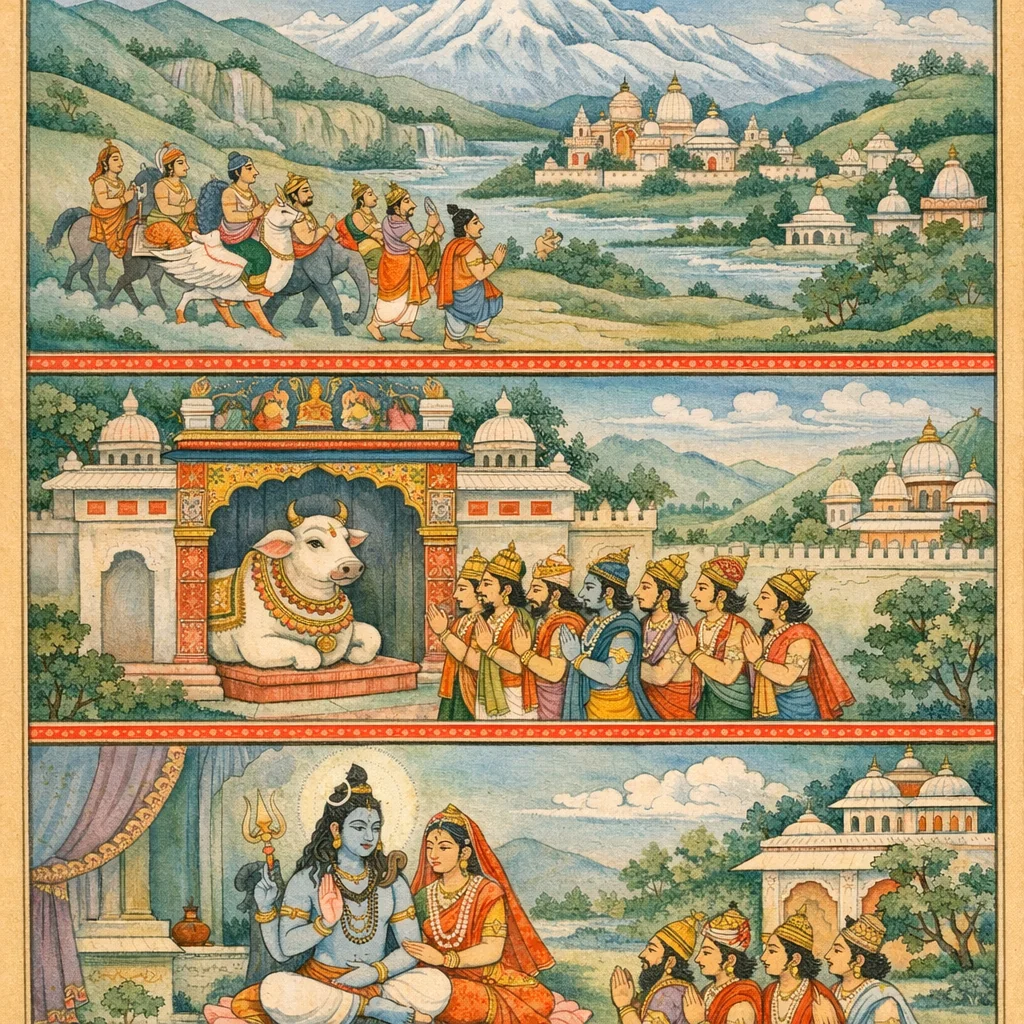
The sages ask Sūta how the gods, on beholding Paśupati, cast off “beastliness” (paśutva) and were freed from the bonds of paśupāśa. Sūta replies: long ago the devas, with Brahmā and Hari (riding Garuḍa), went to the Meru–Kailāsa region. After describing Mount Meru and Śiva’s divine city, they enter Śiva-dhāma, splendid with jewel ramparts, vimānas, apsarās’ song and dance, gaṇa-dwellings, shrines of Gaṇeśa, and ponds and wells. At the gate of Parameśvara’s vimāna they behold Nandin (son of Śilāda), bow to him, and beg for Mahēśvara’s darśana to gain release from paśupāśa. Nandin reveals the secret of the Pāśupata-vrata: by this vow paśutva does not remain; practiced for twelve days/months/years, it cuts the bond. He then leads them to Śambhu; Mahēśvara purifies their paśutva and personally teaches the Pāśupata-vrata. Bhava, with Ambā, bestows grace and makes the gods Pāśupatas; at the end of twelve years they are unbound and return to their own abodes. The chapter establishes the sequence of Śiva-worship, dīkṣā, and prasāda, and affirms the vow’s role as a means toward mokṣa in the ensuing Śaiva observances.
Shlokas
Verse 1
इति श्रीलिङ्गमहापुराणे पूर्वभागे शिवार्चनविधिर् नामैकोनाशीतितमो ऽध्यायः ऋषय ऊचुः कथं पशुपतिं दृष्ट्वा पशुपाशविमोक्षणम् पशुत्वं तत्यजुर्देवास् तन्नो वक्तुमिहार्हसि
Thus, in the Śrī Liṅga-Mahāpurāṇa, in the Pūrva-bhāga, begins the eighty-ninth chapter called “The Procedure for Worship of Śiva.” The sages said: “How did the gods, upon beholding Paśupati, gain release from the bonds of the paśu and cast off the state of paśutva (bonded condition)? Please tell us here.”
Verse 2
सूत उवाच पुरा कैलासशिखरे भोग्याख्ये स्वपुरे स्थितम् समेत्य देवाः सर्वज्ञम् आजग्मुस्तत्प्रसादतः
Sūta said: Formerly, on the summit of Kailāsa, in his own city called Bhogya, the gods assembled and—by his gracious favor—approached the Omniscient Lord (Śiva) who abides there.
Verse 3
हिताय सर्वदेवानां ब्रह्मणा च जनार्दनः गरुडस्य तथा स्कन्धम् आरुह्य पुरुषोत्तमः
For the welfare of all the Devas, Janārdana—together with Brahmā—mounted Garuḍa’s back; thus the Supreme Person set forth to accomplish the divine purpose. In the Liṅga Purāṇa’s Śaiva vision, even such exalted gods act within the cosmic order upheld by Pati (Śiva), for the protection and restoration of dharma.
Verse 4
जगाम देवताभिर् वै देवदेवान्तिकं हरिः सर्वे सम्प्राप्य देवस्य सार्धं गिरिवरं शुभम्
Hari, accompanied by the gods, went to the presence of the God of gods. All of them, having reached the Lord together, arrived at the auspicious best of mountains.
Verse 5
सेन्द्राः ससाध्याः सयमाः प्रणेमुर् गिरिमुत्तमम् भगवान् वासुदेवो ऽसौ गरुडाद् गरुडध्वजः अवतीर्य गिरिं मेरुम् आरुरोह सुरोत्तमैः
With Indra, the Sādhyas, and the Yamas, the gods bowed before that supreme mountain. Then Bhagavān Vāsudeva—bearing Garuḍa as his emblem—alighted from Garuḍa and, with the foremost of the devas, ascended Mount Meru.
Verse 6
देस्च्रिप्तिओन् ओफ़् म्त्। मेरु सकलदुरितहीनं सर्वदं भोगमुख्यं मुदितकुररवृन्दं नादितं नागवृन्दैः मधुररणितगीतं सानुकूलान्धकारं पदरचितवनान्तं कान्तवातान्ततोयम्
Mount Meru is free from every stain of sin; it grants all attainments and is foremost in bestowing noble enjoyments. It resounds with joyous flocks of birds and is echoed by hosts of nāgas. Its song is sweet and ringing; its shade is pleasantly cool. Its forest-glades are traced by well-trodden paths, and it is graced with delightful breezes and refreshing waters.
Verse 7
भवनशतसहस्रैर् जुष्टम् आदित्यकल्पैर् ललितगतिविदग्धैर् हंसवृन्दैश् च भिन्नम् धवखदिरपलाशैश् चन्दनाद्यैश् च वृक्षैर् द्विजवरगणवृन्दैः कोकिलाद्यैर्द्विरेफैः
It was graced by hundreds of thousands of mansions, radiant like suns, and enlivened by flocks of swans skilled in graceful movement. It was adorned with trees such as dhava, khadira, palāśa, and sandalwood, and filled with hosts of noble birds—cuckoos and others—together with bees humming all around.
Verse 8
क्वचिदशेषसुरद्रुमसंकुलं कुरबकैः प्रियकैस्तिलकैस् तथा बहुकदम्बतमाललतावृतं गिरिवरं शिखरैर्विविधैस् तथा
In some places, that excellent mountain was densely filled with every kind of divine tree, adorned with kurabaka, priyaka, and tilaka blossoms; elsewhere it was wrapped in many kadamba and tamāla creepers, and rose with peaks of varied forms. Such a consecrated landscape is fit for Śiva’s presence—the Pati—where the paśu-souls find calmness and the paśa-bonds begin to loosen through sacred sight and remembrance.
Verse 9
देस्च्रिप्तिओन् ओफ़् शिवस् चित्य् ओन् म्त्। मेरु गिरेः पृष्ठे परं शार्वं कल्पितं विश्वकर्मणा क्रीडार्थं देवदेवस्य भवस्य परमेष्ठिनः
Upon the back of Mount Meru, Viśvakarman fashioned the supreme Śārva city as a divine playground for Bhava—the God of gods, the transcendent Lord (Parameṣṭhin).
Verse 10
अपश्यंस्तत्पुरं देवाः सेन्द्रोपेन्द्राः समाहिताः प्रणेमुर्दूरतश्चैव प्रभावादेव शूलिनः
Beholding that divine city, the gods—together with Indra and Upendra—became inwardly composed; and even from afar they bowed down, compelled solely by the majesty of the Trident-bearing Lord, Śiva.
Verse 11
सहस्रसूर्यप्रतिमं महान्तं सहस्रशः सर्वगुणैश् च भिन्नम् जगाम कैलासगिरिं महात्मा मेरुप्रभागे पुरमादिदेवः
The Primordial Deva, great-souled, went to Mount Kailāsa—to that vast city shining on the flank of Meru, radiant like a thousand suns and distinguished in countless ways by every excellence: the śivadhāma, the supreme sphere of auspiciousness beyond worldly measure.
Verse 12
ततो ऽथ नारिगजवाजिसंकुलं रथैर् अनेकैर् अमरारिसूदनः गणैर्गणेशैश् च गिरीन्द्रसंनिभं महापुरद्वारमजो हरिश् च
Then the Slayer of the foes of the gods advanced with many chariots, thronged with women, elephants, and horses; and Hari too—Aja, the Unborn as the supreme principle—came with hosts of gaṇas and their lords, reaching the great city-gate, towering like the king of mountains.
Verse 13
अथ जांबूनदमयैर् भवनैर्मणिभूषितैः विमानैर्विविधाकारैः प्राकारैश् च समावृतम्
Then it was seen as enclosed on every side—by dwellings made of jāmbūnada-gold, adorned with gems; by aerial mansions (vimānas) of many wondrous forms; and by surrounding ramparts—radiant like a perfected realm, fit for the Pati who dissolves all bondage (pāśa).
Verse 14
दृष्ट्वा शंभोः पुरं बाह्यं देवैः सब्रह्मकैर्हरिः प्रहृष्टवदनो भूत्वा प्रविवेश ततः पुरम्
Beholding the outer precincts of Śambhu’s city, Hari—together with the Devas and Brahmā—became radiant with joy; then, with a delighted countenance, he entered that divine city.
Verse 15
हर्म्यप्रासादसम्बाधं महाट्टालसमन्वितम् द्वितीयं देवदेवस्य चतुर्द्वारं सुशोभनम्
The second divine structure of the Lord of gods was crowded with mansions and lofty palaces, furnished with a great watch-tower, and beautifully adorned with four gates.
Verse 16
वज्रवैडूर्यमाणिक्यमणिजालैः समावृतम् दोलाविक्षेपसंयुक्तं घण्टाचामरभूषितम्
It was covered with nets of gems—diamond, vaiḍūrya (cat’s-eye), and ruby—furnished with the swaying motion of a hanging swing, and adorned with bells and yak-tail fans.
Verse 17
मृदङ्गमुरजैर्जुष्टं वीणावेणुनिनादितम् नृत्यद्भिर् अप्सरःसंघैर् भूतसंघैश् च संवृतम् देवेन्द्रभवनाकारैर् भवनैर् दृष्टिमोहनैः
It was filled with the rhythms of mṛdaṅga and muraja drums, resonant with the sounds of vīṇā and flute; surrounded by troupes of dancing apsarases and by hosts of bhūtas, and adorned with enchanting mansions fashioned in the likeness of Indra’s celestial palaces.
Verse 18
प्रासादशृङ्गेष्वथ पौरनार्यः सहस्रशः पुष्पफलाक्षताद्यैः स्थिताः करैस्तस्य हरेः समन्तात् प्रचिक्षिपुर्मूर्ध्नि यथा भवस्य
Then, upon the pinnacles of the palaces, the city-women stood in their thousands, holding flowers, fruits, akṣata (unbroken rice) and the like; and from all sides they showered them upon the head of Hari—just as one would cast auspicious offerings upon the head of Bhava (Śiva).
Verse 19
दृष्ट्वा नार्यस्तदा विष्णुं मदाघूर्णितलोचनाः
Then, seeing Viṣṇu, the women—their eyes reeling as if intoxicated by delusion—became inwardly unsteady, overcome by that bewildering power of māyā.
Verse 20
विशालजघनाः सद्यो ननृतुर्मुमुदुर्जगुः काश्चिद्दृष्ट्वा हरिं नार्यः किंचित् प्रहसिताननाः
Some women, broad-hipped, the very moment they beheld Hari, began to dance at once; they rejoiced and sang, their faces breaking into gentle smiles.
Verse 21
किंचिद् विस्रस्तवस्त्राश् च स्रस्तकाञ्चीगुणा जगुः चतुर्थं पञ्चमं चैव षष्ठं च सप्तमं तथा
With their garments slightly loosened and the cords of their girdles slack, they sang on—likewise the fourth, the fifth, the sixth, and the seventh in due order. In this disciplined rite, devotion is shaped into worship of Pati (Śiva), loosening the pasha of worldly restraint through sacred song rather than mere display.
Verse 22
अष्टमं नवमं चैव दशमं च पुरोत्तमम् अतीत्यासाद्य देवस्य पुरं शंभोः सुशोभनम्
Crossing beyond the eighth, the ninth, and also the tenth—those excellent citadels—they finally reached the splendid city of the God, the radiant abode of Śambhu (Śiva).
Verse 23
सुवृत्तं सुतरां शुभ्रं कैलासशिखरे शुभे सूर्यमण्डलसंकाशैर् विमानैश् च विभूषितम्
On the auspicious peak of Kailāsa it was perfectly well-formed and exceedingly radiant—adorned with celestial vimānas whose splendor resembled the orb of the Sun.
Verse 24
स्फाटिकैर् मण्डपैः शुभ्रैर् जांबूनदमयैस् तथा नानारत्नमयैश्चैव दिग्विदिक्षु विभूषितम्
It was adorned in every direction and intermediate quarter with radiant pavilions of crystal, with structures fashioned of Jāmbūnada gold, and with many kinds of jewel-built ornamentation—revealing the resplendence of the Lord’s sacred Linga-abode.
Verse 25
गोपुरैर्गोपतेः शंभोर् नानाभूषणभूषितैः अनेकैः सर्वतोभद्रैः सर्वरत्नमयैस् तथा
It was adorned with many gopuras of Śambhu, the Lord and Protector, embellished with diverse ornaments—numerous, auspicious on every side, and fashioned wholly of every kind of gem.
Verse 26
प्राकारैर्विविधाकारैर् अष्टाविंशतिभिर् वृतम् उपद्वारैर्महाद्वारैर् विदिक्षु विविधैर्दृढैः
It was encircled by twenty-eight ramparts of varied design, and furnished with subsidiary gates and great gates set in the intermediate directions—diverse in form and firmly built.
Verse 27
गुह्यालयैर्गुह्यगृहैर् गुहस्य भवनैः शुभैः ग्राम्यैर् अन्यैर् महाभागा मौक्तिकैर् दृष्टिमोहनैः
It was adorned with Guhā’s sanctuaries—his secret halls and auspicious mansions—together with other splendid dwellings and quarters; and, O noble ones, it was further beautified by pearl-like ornaments and lustrous embellishments that utterly enchanted the gaze.
Verse 28
गणेशायतनैर् दिव्यैः पद्मरागमयैस् तथा चन्दनैर्विविधाकारैः पुष्पोद्यानैश् च शोभनैः
It was adorned with divine sanctuaries of Gaṇeśa, fashioned of ruby; with sandalwood of many forms; and with splendid gardens of flowers—an auspicious arrangement that supports Śiva-worship by removing obstacles and purifying the pāśa, the bond that binds the paśu (soul) to saṃsāra.
Verse 29
तडागैर् दिर्घिकाभिश् च हेमसोपानपङ्क्तिभिः स्त्रीणां गतिजितैर् हंसैः सेविताभिः समन्ततः
All around were lotus-lakes and long reservoirs, lined with rows of golden steps, and attended on every side by swans whose graceful movement surpassed that of women—an auspicious scene befitting the Lord (Pati), whose presence purifies all places.
Verse 30
मयूरैश्चैव कारण्डैः कोकिलैश्चक्रवाककैः शोभिताभिश् च वापीभिर् दिव्यामृतजलैस् तथा
It was adorned with peacocks, kāraṇḍa waterfowl, cuckoos, and cakravāka birds, and likewise made radiant by lotus-ponds filled with divine waters, nectar-like as amṛta.
Verse 31
संलापालापकुशलैः सर्वाभरणभूषितैः स्तनभारावनम्रैश् च मदाघूर्णितलोचनैः
They were skilled in alluring conversation and playful speech, adorned with every ornament; their bodies bent slightly under the weight of their breasts, and their eyes rolled unsteadily with intoxication—an image of sense-delusion that binds the paśu through pāśa and turns awareness away from Pati, Śiva.
Verse 32
गेयनादरतैर्दिव्यै रुद्रकन्यासहस्रकैः नृत्यद्भिर् अप्सरःसंघैर् अमरैरपि दुर्लभैः
There were thousands of divine Rudra-maidens, delighting in song; and hosts of Apsarās dancing—wondrous sights, rare even among the immortals—adorning the sacred presence of Rudra.
Verse 33
प्रफुल्लांबुजवृन्दाद्यैस् तथा द्विजवरैरपि रुद्रस्त्रीगणसंकीर्णैर् जलक्रीडारतैस् तथा
That divine place was graced by clusters of fully blossomed lotuses, and also by eminent twice-born sages; it was filled with Rudra’s women and gaṇas, all delighting in sportive play in the waters.
Verse 34
रतोत्सवरतैश्चैव ललितैश् च पदे पदे ग्रामरागानुरक्तैश् च पद्मरागसमप्रभैः
At every step were graceful devotees, ever engaged in joyous festivals and sacred observances, attached to sweet village melodies, and radiant with a lustre like that of the ruby, padmarāga.
Verse 35
स्त्रीसंघैर् देवदेवस्य भवस्य परमात्मनः दृष्ट्वा विस्मयमापन्नास् तस्थुर्देवाः समन्ततः
Beholding Bhava—the Supreme Self, the God of gods—encircled by multitudes of women, the Devas were seized with wonder and stood all around in amazement.
Verse 36
तत्रैव ददृशुर्देवा वृन्दं रुद्रगणस्य च गणेश्वराणां वीराणाम् अपि वृन्दं सहस्रशः
Right there, the Devas beheld the multitude of Rudra’s gaṇas, and likewise—by the thousands—the companies of heroic gaṇa-lords, the gaṇeśvaras.
Verse 37
सुवर्णकृतसोपानान् वज्रवैडूर्यभूषितान् स्फाटिकान् देवदेवस्य ददृशुस्ते विमानकान्
They beheld the aerial mansions of the God of gods—crystal-bright, with stairways wrought of gold and adorned with diamond and vaidūrya gems—radiant with the Lord’s own splendor.
Verse 38
तेषां शृङ्गेषु हृष्टाश् च नार्यः कमललोचनाः विशालजघना यक्षा गन्धर्वाप्सरसस् तथा
Upon their lofty peaks, lotus-eyed women rejoiced; and there too were broad-hipped Yakṣas, along with Gandharvas and Apsarases—delighting in that auspicious manifestation ordained by Śiva.
Verse 39
किन्नर्यः किंनराश्चैव भुजङ्गाः सिद्धकन्यकाः नानावेषधराश्चान्या नानाभूषणभूषिताः
Kinnarīs and Kinnaras as well, serpent-beings, and the maidens of the Siddhas—others too, in many kinds of attire and adorned with many varieties of ornaments—were present in that divine gathering.
Verse 40
नानाप्रभावसंयुक्ता नानाभोगरतिप्रियाः नीलोत्पलदलप्रख्याः पद्मपत्रायतेक्षणाः
Endowed with manifold splendors and powers, delighting in many kinds of enjoyments and pleasures, they shone like the petals of the blue lotus, their long eyes resembling lotus-leaves.
Verse 41
पद्मकिञ्जल्कसंकाशैर् अंशुकैरतिशोभनाः वलयैर्नूपुरैर्हारैश् छत्रैश्चित्रैस्तथांशुकैः
They were exceedingly resplendent—clad in garments radiant like the pollen of lotuses, adorned with bracelets, anklets, and necklaces, and attended by ornate parasols and richly patterned silks.
Verse 42
भूषिता भूषितैश् चान्यैर् मण्डिता मण्डनप्रियाः दृष्ट्वाथ वृन्दं सुरसुन्दरीणां गणेश्वराणां सुरसुन्दरीणाम् जग्मुर्गणेशस्य पुरं सुरेशाः पुरद्विषः शक्रपुरोगमाश् च
Adorned with ornaments and further embellished—delighting in decoration—when they beheld the multitude of celestial maidens belonging to Gaṇeśvara, the lords of the Devas, led by Śakra (Indra) and accompanied by the foe of the Tripura-cities (Śiva), proceeded to the city of Gaṇeśa.
Verse 43
दृष्ट्वा च तस्थुः सुरसिद्धसंघाः पुरस्य मध्ये पुरुहूतपूर्वाः भवस्य बालार्कसहस्रवर्णं विमानमाद्यं परमेश्वरस्य
Beholding it, the hosts of Devas and Siddhas—foremost among them the much-invoked Lord Indra—stood still in the midst of the city, gazing upon the primordial aerial palace of Parameśvara: Bhava’s vimāna, radiant like a thousand rising suns.
Verse 44
अथ तस्य विमानस्य द्वारि संस्थं गणेश्वरम् नन्दिनं ददृशुः सर्वे देवाः शक्रपुरोगमाः
Then, at the doorway of that celestial palace (vimāna), all the gods—led by Śakra (Indra)—beheld Nandin, the lord of Śiva’s gaṇas, standing as the gate-guardian.
Verse 45
तं दृष्ट्वा नन्दिनं सर्वे प्रणम्याहुर् गणेश्वरम् जयेति देवास्तं दृष्ट्वा सो ऽप्याह च गणेश्वरः
Seeing Nandin, all bowed in reverence and addressed him as the Lord of the Gaṇas. The Devas, beholding him, cried, “Victory!” and that Gaṇeśvara too, on seeing them, spoke in reply.
Verse 46
भो भो देवा महाभागाः सर्वे निर्धूतकल्मषाः सम्प्राप्ताः सर्वलोकेशा वक्तुमर्हथ सुव्रताः
“O revered Devas, greatly fortunate ones—cleansed of every taint—since you have all assembled here, O lords of the worlds, you who are steadfast in sacred vows: now it is fitting that you speak.”
Verse 47
तमाहुर्वरदं देवं वारणेन्द्रसमप्रभम् पशुपाशविमोक्षार्थं दर्शयास्मान् महेश्वरम्
They said: “Show us Mahēśvara—the boon-bestowing Deva, radiant like the lord of elephants—so that the paśu, the bound souls, may be released from pāśa, the bonds that bind.”
Verse 48
पुरा पुरत्रयं दग्धुं पशुत्वं परिभाषितम् शङ्किताश् च वयं तत्र पशुत्वं प्रति सुव्रत
“Formerly, when the burning of the three cities (Tripura) was spoken of, ‘paśutva’—the condition of the bound soul—was defined. And there, we too grew anxious concerning that paśutva, O you of excellent vows.”
Verse 49
व्रतं पाशुपतं प्रोक्तं भवेन परमेष्ठिना व्रतेनानेन भूतेश पशुत्वं नैव विद्यते
“The Pāśupata vow was proclaimed by Bhava, the Supreme Lord. By undertaking this very vow, O Lord of beings, the state of ‘paśutva’—the soul’s condition as a bound creature—no longer remains.”}]}
Verse 50
अथ द्वादशवर्षं वा मासद्वादशकं तु वा दिनद्वादशकं वापि कृत्वा तद् व्रतम् उत्तमम्
Then, having undertaken that excellent vow—whether for twelve years, or for twelve months, or even for twelve days—such disciplined observance purifies the paśu (the bound soul) and turns it toward Pati, the Lord, making one fit for the higher fruit of Śiva-worship.
Verse 51
मुच्यन्ते पशवः सर्वे पशुपाशैर्भवस्य तु दर्शयामास तान्देवान् नारायणपुरोगमान्
“All paśus (bound souls) are released from the pāśas (bondages) belonging to Bhava (Śiva).” Then he caused those Devas—led by Nārāyaṇa—to behold that truth and vision.
Verse 52
नन्दी शिलादतनयः सर्वभूतगणाग्रणीः तं दृष्ट्वा देवमीशानं सांबं सगणम् अव्ययम्
Nandī, the son of Śilāda—foremost among the hosts of all beings—beheld Lord Īśāna: the divine, imperishable One, accompanied by His gaṇas and united with Śambā (Śakti).
Verse 53
प्रणेमुस् तुष्टुवुश् चैव प्रीतिकण्टकितत्वचः विज्ञाप्य शितिकण्ठाय पशुपाशविमोक्षणम्
Thrilled with devotion—their skin bristling with rapture—they bowed down and praised Him, and then submitted to Śitikaṇṭha, the Blue-throated Lord, their petition for the release of the paśus from the pāśas (fetters).
Verse 54
तस्थुस्तदाग्रतः शंभोः प्रणिपत्य पुनः पुनः ततः सम्प्रेक्ष्य तान् सर्वान् देवदेवो वृषध्वजः
They stood before Śambhu, bowing down again and again. Then the God of gods, Vṛṣadhvaja—He whose banner bears the Bull—looked upon them all and turned His attention to them.
Verse 55
विशोध्य तेषां देवानां पशुत्वं परमेश्वरः व्रतं पाशुपतं चैव स्वयं देवो महेश्वरः
Having purified those devas of their condition as bound souls (paśutva), the Supreme Lord—Mahādeva himself, Maheshvara—personally established for them the Pāśupata observance, the discipline that leads the paśu toward Paśupati, the Lord of beings.
Verse 56
उपदिश्य मुनीनां च सहास्ते चांबया भवः तदाप्रभृति ते देवाः सर्वे पाशुपताः स्मृताः
Having instructed the sages, Bhava (Śiva), together with Ambā (Śakti), remained there. From that time onward, those devas were all remembered as Pāśupatas—devotees established in Pati and aligned with the path that loosens the pāśa (bondage) of the paśu (soul).
Verse 57
पशूनां च पतिर्यस्मात् तेषां साक्षाद्धि देवताः तस्मात्पाशुपताः प्रोक्तास् तपस्तेपुश् च ते पुनः
Because He is Pati, the Lord of all paśus (bound souls), those very gods stand directly under His divinity. Therefore they are called “Pāśupatas,” and they again undertook tapas (austerity) in devotion to Him.
Verse 58
ततो द्वादशवर्षान्ते मुक्तपाशाः सुरोत्तमाः ययुर्यथागतं सर्वे ब्रह्मणा सह विष्णुना
Then, at the end of twelve years, the foremost of the gods—freed from their bonds (pāśas)—all departed, returning to their respective abodes, together with Brahmā and Viṣṇu.
Verse 59
एतद्वः कथितं सर्वं पितामहमुखाच्छ्रुतम् पुरा सनत्कुमारेण तस्माद्व्यासेन धीमता
All this has been told to you—heard long ago by Sanatkumāra from the mouth of Pitāmaha (Brahmā), and from him received in transmission by the wise Vyāsa.
Verse 60
यः श्रावयेच्छुचिर् विप्राञ् छृणुयाद्वा शुचिर्नरः स देहभेदमासाद्य पशुपाशैः प्रमुच्यते
A pure man who causes pure brāhmaṇas to hear this teaching, or who himself listens in purity—when the body falls away, is released from the pāśas (bonds) that bind the paśu (the individual soul).
Frequently Asked Questions
They fear the condition called ‘paśutva’ (bonded limitation) and approach Shiva as Pashupati. Liberation is framed as removal of pāśa through Shiva’s upadeśa and grace, not merely celestial privilege.
The text presents graded observance—twelve days, twelve months, or twelve years—stating that by completing the vow, beings are freed from Shiva’s pāśa (bondage) through purification and divine instruction.
Nandi appears as the gatekeeper and foremost of Shiva’s gaṇas, mediating access to Maheshvara and articulating the vow’s doctrine—showing the Shaiva model where entry into Shiva’s presence is guided by dharmic protocol and lineage of instruction.