Adhyaya 65
वासिष्ठकथनम् (आदित्य–सोमवंशवर्णनम् तथा रुद्रसहस्रनाम-प्रशंसा)
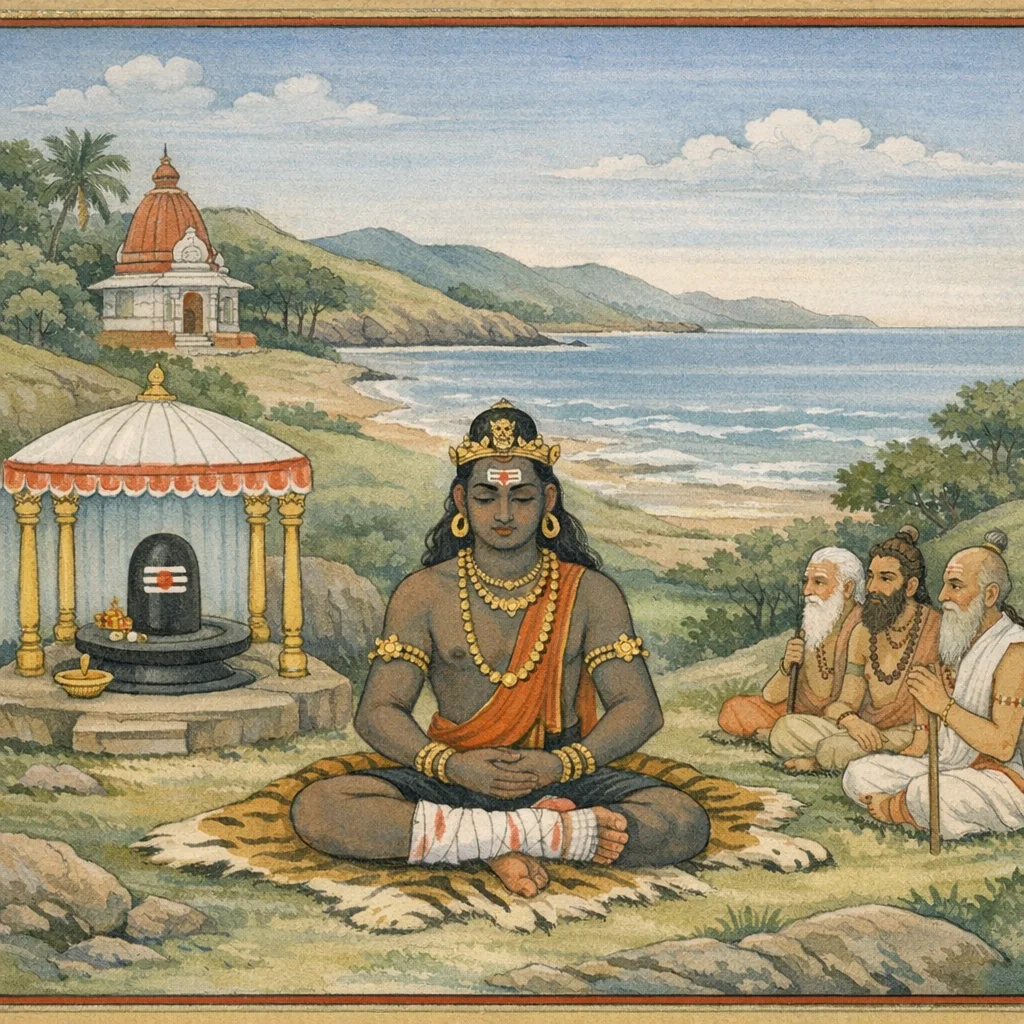
In Naimiṣāraṇya the sages ask Sūta Romaharṣaṇa to relate, in brief, the Solar (Āditya) and Lunar (Soma) dynasties. Sūta begins from Kaśyapa and Aditi, describing Āditya (Sūrya) and the tale of his three consorts—Saṃjñā, Chāyā, and Prabhā. When Chāyā shows partiality to her sons, Yama strikes her in anger and is cursed so that his foot becomes afflicted; later at Gokarṇa he worships Mahādeva, is freed from the curse, and gains the status of Lokapāla and lordship over the Pitṛs, revealing Śiva’s grace as the establisher of dharmic order. The narrative includes Saṃjñā’s mare-form episode leading to the birth of the Aśvinīkumāras, and the account of Tvaṣṭṛ fashioning the Sudarśana-cakra in connection with Rudra’s favor. It then unfolds the descendants of Vaivasvata Manu, Ilā/Sudyumna’s alternation of female and male form, and the rise of the Somavaṃśa through Budha and Aila Purūravas, along with the Ikṣvāku line such as Māndhātā and Purukutsa. Concluding with the episode of Taṇḍin, the chapter extols japa of the “Rudra-sahasranāma” as granting Gaṇapatya status, equaling the fruit of a thousand Aśvamedhas, and destroying great sins—serving as a bridge to the forthcoming Śaiva stotra and vrata-centered teachings.
Shlokas
Verse 1
इति श्रीलिङ्गमहापुराणे पूर्वभागे वासिष्ठकथनं नाम चतुःषष्टितमो ऽध्यायः ऋषय ऊचुः आदित्यवंशं सोमस्य वंशं वंशविदां वर वक्तुमर्हसि चास्माकं संक्षेपाद् रोमहर्षण
Thus, in the Śrī Liṅga Mahāpurāṇa, in the Pūrvabhāga, ends the sixty-fourth chapter called “Vāsiṣṭha’s Account.” The sages said: “O Romaharṣaṇa, best among those who know the lineages, please tell us—briefly—the Solar dynasty and the Lunar dynasty.”
Verse 2
सूत उवाच अदितिः सुषुवे पुत्रम् आदित्यं कश्यपाद्द्विजाः तस्यादित्यस्य चैवासीद् भार्या त्रयम् अथापरम्
Sūta said: O twice-born sages, Aditi bore a son—Āditya—by Kaśyapa. And that Āditya, moreover, had three wives.
Verse 3
संज्ञा राज्ञी प्रभा छाया पुत्रांस्तासां वदामि वः संज्ञा त्वाष्ट्री च सुषुवे सूर्यान्मनुमनुत्तमम्
Saṃjñā, the queen, and also Prabhā and Chāyā—listen as I declare to you the sons born of them. Saṃjñā, the daughter of Tvaṣṭṛ, bore to Sūrya the supreme Manu, foremost among the Manus.
Verse 4
यमं च यमुनां चैव राज्ञी रेवतमेव च प्रभा प्रभातम् आदित्याच् छायां संज्ञाप्यकल्पयत्
From the Sun-god she brought forth Yama and Yamunā, and also the queen Revatī; likewise Prabhā and Prabhāta. Then, for Āditya, she fashioned a substitute—Chāyā—having instructed her to assume her own role.
Verse 5
छाया च तस्मात्सुषुवे सावर्णिं भास्कराद्द्विजाः ततः शनिं च तपतीं विष्टिं चैव यथाक्रमम्
O twice-born ones, from Bhāskara, the Sun-god, Chāyā bore Sāvarṇi; thereafter, in due order, she also gave birth to Śani, to Tapatī, and to Viṣṭi.
Verse 6
छाया स्वपुत्राभ्यधिकं स्नेहं चक्रे मनौ तदा पूर्वो मनुर्न चक्षाम यमस्तु क्रोधमूर्छितः
Then Chāyā showed to Manu an affection exceeding even that for her own sons. The former Manu did not perceive the truth, while Yama, overcome by wrath, became bewildered.
Verse 7
संताडयामास रुषा पादमुद्यम्य दक्षिणम् यमेन ताडिता सा तु छाया वै दुःखिताभवत्
Roused to wrath, Yama lifted his right foot and struck; and when Chāyā (the shadow-form) was beaten by Yama, she indeed became sorrowful.
Verse 8
छायाशापात् पदं चैकं यमस्य क्लिन्नमुत्तमम् पूयशोणितसम्पूर्णं कृमीणां निचयान्वितम्
By the curse of Chāyā, one foot of Yama became grievously ulcered—oozing and foul—filled with pus and blood, and swarming with heaps of worms.
Verse 9
सो ऽपि गोकर्णमाश्रित्य फलकेनानिलाशनः आराधयन्महादेवं यावद्वर्षायुतायुतम्
He too, taking refuge at Gokarṇa, lived on a mere plank and sustained himself only on air; and he worshipped Mahādeva for ten thousand times ten thousand years.
Verse 10
भवप्रसादाद् आगत्य लोकपालत्वमुत्तमम् पितॄणामाधिपत्यं तु शापमोक्षं तथैव च
By the grace of Bhava (Śiva), he attained the exalted office of a Lokapāla (guardian of the worlds), sovereignty over the Pitṛs (ancestral beings), and likewise release from the bondage of a curse—thus were these boons conferred.
Verse 11
लब्धवान्देवदेवस्य प्रभावाच्छूलपाणिनः असहन्ती पुरा भानोस् तेजोमयम् अनिन्दिता
By the might of the God of gods—Śiva, the trident-bearer—she had obtained that radiant, fiery state. In former times, the blameless one could not endure the Sun’s blazing effulgence.
Verse 12
रूपं त्वाष्ट्री स्वदेहात्तु छायाख्यां सा त्वकल्पयत् वडवारूपमास्थाय तपस्तेपे तु सुव्रता
From her own body, Tvāṣṭrī brought forth a form called Chāyā. Assuming the form of a mare, that virtuous woman performed austere tapas, steadfast in her vow, seeking the divine ordinance that loosens the pāśa (bondage) and turns the paśu (bound soul) toward Pati, Lord Śiva.
Verse 13
कालात्प्रयत्नतो ज्ञात्वा छायां छायापतिः प्रभुः वडवामगमत्संज्ञाम् अश्वरूपेण भास्करः
In due course, by careful effort, the Lord—the master over Chāyā—came to recognize her. Then Bhāskara (the Sun), assuming the form of a horse, went to Saṃjñā, who had taken the form of a mare.
Verse 14
वडवा च तदा त्वाष्ट्री संज्ञा तस्माद्दिवाकरात् सुषुवे चाश्विनौ देवौ देवानां तु भिषग्वरौ
Then Saṃjñā, the daughter of Tvaṣṭṛ, assumed the form of a mare; and from that Divākara (the Sun) she gave birth to the two Aśvin deities, foremost physicians among the gods. In the Śaiva vision, even such divine lineages unfold under Pati’s ordinance, while the paśu-souls remain bound by karmic pāśa until grace dawns.
Verse 15
लिखितो भास्करः पश्चात् संज्ञापित्रा महात्मना विष्णोश्चक्रं तु यद्घोरं मण्डलाद्भास्करस्य तु
Thereafter Bhāskara (the Sun) was inscribed by the great-souled father of Saṃjñā; and from the Sun’s own maṇḍala (orb) there manifested that terrible discus of Viṣṇu. Here the Purāṇa intimates that even Vaiṣṇava weapon-power arises within the cosmic order upheld by the supreme Pati (Śiva), the inner ruler of all luminaries.
Verse 16
निर्ममे भगवांस्त्वष्टा प्रधानं दिव्यमायुधम् रुद्रप्रसादाच्च शुभं सुदर्शनमिति स्मृतम्
By Rudra’s gracious favor, the blessed Lord Tvaṣṭṛ fashioned a foremost, divine weapon—remembered in tradition as the auspicious Sudarśana.
Verse 17
लब्धवान् भगवांश्चक्रं कृष्णः कालाग्निसन्निभम् मनोस्तु प्रथमस्यासन् नव पुत्रास्तु तत्समाः
Blessed Kṛṣṇa obtained the discus, blazing like the fire of cosmic dissolution. And of the first Manu there were nine sons, equal to him in stature and worth—upholders of the cosmic order under Pati (Śiva). By the Lord’s will, the paśu (bound soul) moves through the cycles of creation.
Verse 18
इक्ष्वाकुर् नभगश् चैव धृष्णुः शर्यातिरेव च नरिष्यन्तश् च वै धीमान् नाभागो ऽरिष्ट एव च
Ikṣvāku and Nabhaga; likewise Dhṛṣṇu and Śaryāti; and the wise Nariṣyanta; as well as Nābhāga and Ariṣṭa—these are declared rulers in that illustrious royal line. In the Purāṇic vision, such dhārmic kings uphold the order that ultimately supports devotion to Pati (Śiva); through right conduct and worship, the paśu may loosen the fetters of pāśa.
Verse 19
करूषश् च पृषध्रश् च नवैते मानवाः स्मृताः इला ज्येष्ठा वरिष्ठा च पुंस्त्वं प्राप च या पुरा
Karūṣa and Pṛṣadhra—thus these are remembered as the nine “Mānava” (children of Manu). Among them, Ilā was the eldest and most eminent; she too, in former times, attained manhood by divine ordinance.
Verse 20
सुद्युम्न इति विख्याता पुंस्त्वं प्राप्ता त्विला पुरा मित्रावरुणयोस्त्वत्र प्रसादान्मुनिपुङ्गवाः
O best of sages, Ilā—formerly—became renowned as Sudyumna, having attained manhood there through the gracious favor of Mitra and Varuṇa.
Verse 21
पुनः शरवणं प्राप्य स्त्रीत्वं प्राप्तो भवाज्ञया सुद्युम्नो मानवः श्रीमान् सोमवंशप्रवृद्धये
Returning again to Śaravaṇa, the illustrious human king Sudyumna—by Bhava’s (Śiva’s) command—assumed womanhood, for the expansion of the Soma (Lunar) dynasty.
Verse 22
इक्ष्वाकोरश्वमेधेन इला किंपुरुषो ऽभवत् इला किंपुरुषत्वे च सुद्युम्न इति चोच्यते
By Ikṣvāku’s Aśvamedha sacrifice, Ilā became a Kiṃpuruṣa. And when Ilā abided in that Kiṃpuruṣa-state, the very same being is also spoken of as Sudyumna.
Verse 23
मासमेकं पुमान्वीरः स्त्रीत्वं मासमभूत्पुनः इला बुधस्य भवनं सोमपुत्रस्य चाश्रिता
For one month the valiant one was a man, and again for a month became a woman. Thus Ilā took refuge in the dwelling of Budha, the son of Soma, the Moon.
Verse 24
बुधेनान्तरमासाद्य मैथुनाय प्रवर्तिता सोमपुत्राद्बुधाच्चापि ऐलो जज्ञे पुरूरवाः
Having approached Budha at an opportune time, she was moved toward conjugal union; and from Budha—son of Soma—was born Purūravas, Ilā’s son (Aila). In the Purāṇic flow, such lineage unfolds under the all-overseeing lordship of Pati (Śiva), while embodied beings (paśu) continue within saṃsāra through the bonds (pāśa) of desire and destiny.
Verse 25
सोमवंशाग्रजो धीमान् भवभक्तः प्रतापवान् इक्ष्वाकोर्वंशविस्तारं पश्चाद्वक्ष्ये तपोधनाः
The foremost scion of the Lunar dynasty was wise, devoted to Bhava (Śiva), and radiant with valor. O ascetics rich in tapas, later I shall also recount the full expansion of Ikṣvāku’s lineage.
Verse 26
पुत्रत्रयमभूत्तस्य सुद्युम्नस्य द्विजोत्तमाः उत्कलश् च गयश्चैव विनताश्वस्तथैव च
O best of the twice-born, Sudyumna had three sons—Utkala, Gaya, and Vinatāśva.
Verse 27
उत्कलस्योत्कलं राष्ट्रं विनताश्वस्य पश्चिमम् गया गयस्य चाख्याता पुरी परमशोभना
For Utkala, the famed realm called Utkala is spoken of; to the west lies the region of Vinatāśva. Gaya too is celebrated as the splendid city of Gaya—supremely beautiful and renowned as a sacred seat.
Verse 28
सुराणां संस्थितिर्यस्यां पितॄणां च सदा स्थितिः इक्ष्वाकुज्येष्ठदायादो मध्यदेशम् अवाप्तवान्
That land in which the Devas have their established abode, and in which the Pitṛs ever remain—there the eldest heir of Ikṣvāku’s line attained and came to rule the Madhyadeśa.
Verse 29
कन्याभावाच्च सुद्युम्नो नैव भागमवाप्तवान् वसिष्ठवचनात् त्वासीत् प्रतिष्ठाने महाद्युतिः
Because he had assumed the state of a maiden, Sudyumna did not obtain a rightful share in kingship. Yet, by the command of Vasiṣṭha, that radiant one came to dwell and rule at Pratiṣṭhāna.
Verse 30
प्रतिष्ठा धर्मराजस्य सुद्युम्नस्य महात्मनः तत्पुरूरवसे प्रादाद् राज्यं प्राप्य महायशाः
Pratiṣṭhā, the illustrious daughter of the righteous king Sudyumna, having attained sovereignty, bestowed the kingdom upon Purūravas, thereby upholding the dharma of royal succession.
Verse 31
मानवेयो महाभागः स्त्रीपुंसोर्लक्षणान्वितः इक्ष्वाकोरभवद्वीरो विकुक्षिर्धर्मवित्तमः
From Manu’s lineage there arose the greatly fortunate hero Vikukṣi, born of Ikṣvāku—endowed with the distinguishing marks of manhood and womanhood, and foremost among those who know Dharma.
Verse 32
ज्येष्ठः पुत्रशतस्यासीद् दश पञ्च च तत्सुताः अभूज्ज्येष्ठः ककुत्स्थश् च ककुत्स्थात्तु सुयोधनः
Among the hundred sons of Putraśata, the eldest was Jyeṣṭha, and he had fifteen sons. Among them, the eldest was Kakutstha; and from Kakutstha was born Suyodhana.
Verse 33
ततः पृथुर्मुनिश्रेष्ठा विश्वकः पार्थिवस् तथा विश्वकस्यार्द्रको धीमान् युवनाश्वस्तु तत्सुतः
Thereafter came Pṛthu, foremost among sages; and also Viśvaka, a king. From Viśvaka was born the wise Ārdraka, and his son indeed was Yuvanāśva.
Verse 34
शाबस्तिश् च महातेजा वंशकस्तु ततो ऽभवत् निर्मिता येन शाबस्ती गौडदेशे द्विजोत्तमाः
And Śābasti, endowed with great splendor, was followed by Vaṃśaka. It was by him, O best of Brahmins, that the city of Śābastī was founded in the land of Gauḍa.
Verse 35
वंशाच्च बृहदश्वो ऽभूत् कुवलाश्वस्तु तत्सुतः धुन्धुमारत्वमापन्नो धुन्धुं हत्वा महाबलम्
From that lineage arose Bṛhadaśva; his son was Kuvalāśva. Having slain the mighty Dhundhu, Kuvalāśva attained the famed state of Dhundhumāra, becoming renowned as the destroyer of Dhundhu.
Verse 36
धुन्धुमारस्य तनयास् त्रयस्त्रैलोक्यविश्रुताः दृढाश्वश्चैव चण्डाश्वः कपिलाश्वश् च ते स्मृताः
Dhundhumāra had three sons, famed throughout the three worlds: they are remembered as Dṛḍhāśva, Caṇḍāśva, and Kapilāśva.
Verse 37
दृढाश्वस्य प्रमोदस्तु हर्यश्वस्तस्य वै सुतः हर्यश्वस्य निकुम्भस्तु संहताश्वस्तु तत्सुतः
From Dṛḍhāśva was born Pramoda; and Haryaśva was indeed his son. From Haryaśva came Nikumbha; and Saṃhatāśva was the son of Nikumbha.
Verse 38
कृशाश्वो ऽथ रणाश्वश् च संहताश्वात्मजावुभौ युवनाश्वो रणाश्वस्य मान्धाता तस्य वै सुतः
Then were born Kṛśāśva and Raṇāśva—both sons of Saṃhatāśva. From Raṇāśva was born Yuvanāśva, and to him was born Māndhātṛ as his son.
Verse 39
मान्धातुः पुरुकुत्सो ऽभूद् अम्बरीषश् च वीर्यवान् मुचुकुन्दश् च पुण्यात्मा त्रयस्त्रैलोक्यविश्रुताः
From Māndhātṛ was born Purukutsa; and Ambarīṣa, mighty in valor; and Mucukunda, a king of virtuous soul—these three became renowned throughout the three worlds. In the Purāṇic vision, such fame is the fruit of dharma aligned with the Lord (Pati); through righteous kingship and devotion to Śiva, the bound soul (paśu) loosens the fetters (pāśa).
Verse 40
अंबरीषस्य दायादो युवनाश्वो ऽपरः स्मृतः हरितो युवनाश्वस्य हरितास्तु यतः स्मृताः
From Ambarīṣa there arose an heir named Yuvanāśva, remembered as another (of that name). From that Yuvanāśva came Harita; and it is from Harita that the Haritas are traditionally known.
Verse 41
एते ह्यङ्गिरसः पक्षे क्षत्रोपेता द्विजातयः पुरुकुत्सस्य दायादस् त्रसद्दस्युर् महायशाः
These indeed are the descendants aligned with the Aṅgirasas—twice-born men endowed with kṣatriya power. They are the heirs of Purukutsa; and Trasaddasyu, of great renown, stands among them.
Verse 42
नर्मदायां समुत्पन्नः सम्भूतिस्तस्य चात्मजः विष्णुवृद्धः सुतस्तस्य विष्णुवृद्धा यतः स्मृताः
In the land of the Narmadā arose Sambhūti; and his son was Viṣṇuvṛddha. From that Viṣṇuvṛddha, the descendants are remembered as the Viṣṇuvṛddhas.
Verse 43
एते ह्यङ्गिरसः पक्षे क्षत्रोपेताः समाश्रिताः सम्भूतिरपरं पुत्रम् अनरण्यमजीजनत्
These indeed belonged to the Aṅgiras line and were established in the Kṣatriya order; and Sambhūti then begot another son—Anaraṇya.
Verse 44
रावणेन हतो यो ऽसौ त्रैलोक्यविजये द्विजाः बृहदश्वो ऽनरण्यस्य हर्यश्वस्तस्य चात्मजः
O twice-born ones, the one slain by Rāvaṇa during the conquest of the three worlds was Bṛhadaśva, son of Anaraṇya; and in that royal line he is also reckoned in the descent of Haryaśva.
Verse 45
हर्यश्वात्तु दृषद्वत्यां जज्ञे वसुमना नृपः तस्य पुत्रो ऽभवद्राजा त्रिधन्वा भवभावितः
From Haryaśva, on the banks of the Dṛṣadvatī, King Vasumanas was born. His son became the ruler Tridhanvā, whose being was shaped by Bhava (Śiva)—the Pati who frees the paśu (bound soul) from pāśa (bondage).
Verse 46
प्रसादाद् ब्रह्मसूनोर् वै तण्डिनः प्राप्य शिष्यताम् अश्वमेधसहस्रस्य फलं प्राप्य तदाज्ञया
By the grace of Brahmā’s son, he indeed attained discipleship under Taṇḍin; and by his command he obtained merit equal to a thousand Aśvamedha sacrifices—fruit directed to the path where Pati (Śiva) grants the paśu release from pāśa.
Verse 47
गणैश्वर्यमनुप्राप्तो भवभक्तः प्रतापवान् कथं चैवाश्वमेधं वै करोमीति विचिन्तयन्
Having attained lordship among Śiva’s gaṇas, that valorous devotee of Bhava (Śiva) reflected: “How indeed shall I perform the Aśvamedha sacrifice?”
Verse 48
धनहीनश् च धर्मात्मा दृष्टवान् ब्रह्मणः सुतम् तण्डिसंज्ञं द्विजं तस्माल् लब्धवान्द्विजसत्तमाः
Though impoverished, that righteous man beheld Taṇḍi, the twice-born—said to be a son of Brahmā; and from him, O best of Brāhmaṇas, he obtained the sought-for benefit, born of Dharma.
Verse 49
नाम्नां सहस्रं रुद्रस्य ब्रह्मणा कथितं पुरा तेन नाम्नां सहस्रेण स्तुत्वा तण्डिर्महेश्वरम्
In former times, Brahmā proclaimed the thousand names of Rudra. With that very Sahasranāma, Taṇḍi praised Maheśvara (the Lord), honoring Pati—the Supreme—through the power of divine Name-recitation.
Verse 50
लब्धवान्गाणपत्यं च ब्रह्मयोनिर्द्विजोत्तमः ततस्तस्मान्नृपो लब्ध्वा तण्डिना कथितं पुरा
O best of the twice-born, the Brahmā-born sage obtained the Gaṇapatya teaching; thereafter the king received it from him, just as Taṇḍin had related of old. Thus the lineage of mantra is preserved, and through right transmission the bound soul (paśu) gains fitness for Śiva’s grace (pati-anugraha).
Verse 51
नाम्नां सहस्रं जप्त्वा वै गाणपत्यमवाप्तवान् ऋषय ऊचुः नाम्नां सहस्रं रुद्रस्य ताण्डिना ब्रह्मयोनिना
Having indeed recited the Thousand Names, he attained the status of a Gaṇapati (chief among Śiva’s attendants). The sages said: “The Thousand Names of Rudra—revealed by Tāṇḍin, the one born from Brahmā—(are to be proclaimed).”
Verse 52
कथितं सर्ववेदार्थसंचयं सूत सुव्रत नाम्नां सहस्रं विप्राणां वक्तुम् अर्हसि शोभनम्
O Sūta of excellent vows, you have spoken the compendium that gathers the purport of all the Vedas. Now you should fittingly recite—beautifully—the thousand sacred names of the Brāhmaṇas.
Verse 53
सहस्रनामन् ओफ़् शिव सूत उवाच सर्वभूतात्मभूतस्य हरस्यामिततेजसः अष्टोत्तरसहस्रं तु नाम्नां शृणुत सुव्रताः
Sūta said: O you of noble vows, listen to the thousand-and-eight names of Hara—Shiva of immeasurable splendor—who abides as the very Self within all beings.
Verse 54
यज्जप्त्वा तु मुनिश्रेष्ठा गाणपत्यमवाप्तवान् ॐ स्थिरः स्थाणुः प्रभुर्भानुः प्रवरो वरदो वरः
O best of sages, by repeating this japa he attained the state of being a Gaṇapati (leader among Śiva’s gaṇas). “Oṁ—(Śiva is) the Steadfast, the Immovable Pillar (Sthāṇu), the Sovereign Lord, the Radiant Sun (Bhānu), the Supreme Excellence, the Giver of boons, the Best.”
Verse 55
सर्वात्मा सर्वविख्यातः सर्वः सर्वकरो भवः जटी दण्डी शिखण्डी च सर्वगः सर्वभावनः
He is the Self within all beings, renowned everywhere; He is the All. As Bhava, He is the doer of all. He is the matted-haired ascetic, the staff-bearing renunciate, and the one adorned with the crest-mark. All-pervading, He brings all states of existence into manifestation and maturity.
Verse 56
हरिश् च हरिणाक्षश् च सर्वभूतहरः स्मृतः प्रवृत्तिश् च निवृत्तिश् च शान्तात्मा शाश्वतो ध्रुवः
He is Hari, and Hariṇākṣa; he is remembered as the Withdrawer of all beings. He is both the Path of engagement (pravṛtti) and the Path of withdrawal (nivṛtti). His Self is peace; he is eternal and unshakably steadfast.
Verse 57
श्मशानवासी भगवान् खचरो गोचरो ऽर्दनः अभिवाद्यो महाकर्मा तपस्वी भूतधारणः
The Blessed Lord Śiva dwells in the cremation-ground; He moves through the sky and also walks upon the earth. He is the subduer of bondage, worthy of reverent salutations, the accomplisher of mighty acts, the great ascetic, and the sustainer of all beings.
Verse 58
उन्मत्तवेषः प्रच्छन्नः सर्वलोकः प्रजापतिः महारूपो महाकायः सर्वरूपो महायशाः
He wears the guise of a mad ascetic, yet remains hidden beyond ordinary recognition. He is the very world of all beings, Prajāpati, Lord of progeny. Vast in form and cosmic in body, He assumes every form; His glory is immeasurable—Śiva, the Pati who transcends and pervades all.
Verse 59
महात्मा सर्वभूतश् च विरूपो वामनो नरः लोकपालो ऽन्तर्हितात्मा प्रसादो ऽभयदो विभुः
He is the Great-Souled One, present within all beings; beyond all form, yet assuming the guise of the dwarf Vāmana and the man. He is the Guardian of the worlds, whose Self remains hidden; He is pure Grace itself, the Giver of fearlessness, the all-pervading Lord (Pati).
Verse 60
पवित्रश् च महांश्चैव नियतो नियताश्रयः स्वयंभूः सर्वकर्मा च आदिरादिकरो निधिः
He is the Pure and the Great; self-disciplined and the refuge of the disciplined. Self-born, self-existent (Svayambhū), He is the doer of all acts—both the Primordial One and the source that sets beginnings in motion, the inexhaustible Treasure of all powers and meanings.
Verse 61
सहस्राक्षो विशालाक्षः सोमो नक्षत्रसाधकः चन्द्रः सूर्यः शनिः केतुर् ग्रहो ग्रहपतिर्मतः
He is the Thousand-Eyed One, the Wide-Eyed; He is Soma, accomplisher and governor of the lunar mansions (nakṣatras). He is the Moon and the Sun; He is Śani (Saturn) and Ketu. He is the very principle of the Grahas and is regarded as their Lord—Pati over all planetary powers.
Verse 62
राजा राज्योदयः कर्ता मृगबाणार्पणो घनः महातपा दीर्घतपा अदृश्यो धनसाधकः
He is the Sovereign Lord; the upsurge of true dominion; the doer who brings all to completion. To him is surrendered the hunter’s arrow-offering; he is the dense, all-pervading One. He is the great ascetic, the long-enduring ascetic; the invisible Lord, and the accomplisher of prosperity.
Verse 63
संवत्सरः कृतीमन्त्रः प्राणायामः परंतपः योगी योगो महाबीजो महारतो महाबलः
He is the Year, the Lord of time-cycles; the efficacious sacred mantra; the discipline of prāṇāyāma; the subduer of foes. He is the Yogi and Yoga itself; the Great Seed, the supreme causal source; the supremely devoted practitioner; and the One of immeasurable power.
Verse 64
सुवर्णरेताः सर्वज्ञः सुबीजो वृषवाहनः दशबाहुस्त्वनिमिषो नीलकण्ठ उमापतिः
He whose creative potency is golden and auspicious; the All-knowing Lord; the One of excellent seed, the flawless source of manifestation; the Rider of the Bull. Ten-armed, the unblinking Witness; the Blue-throated One; the Consort of Umā—this is Śiva, the Pati who frees the paśu from pāśa.
Verse 65
विश्वरूपः स्वयंश्रेष्ठो बलवीरो बलाग्रणीः गणकर्ता गणपतिर् दिग्वासाः काम्य एव च
He whose form is the universe; self-supreme and unsurpassed; the mighty hero and the foremost among the strong. The maker of the gaṇas and the Lord of the gaṇas; the Sky-clad One; and the fulfiller of worthy desires.
Verse 66
मन्त्रवित्परमो मन्त्रः सर्वभावकरो हरः कमण्डलुधरो धन्वी बाणहस्तः कपालवान्
Śiva is the knower of mantras and the Supreme Mantra itself; he is Hara, who brings forth all states of being. Bearing the ascetic’s water-pot (kamaṇḍalu), he is also the archer, holding bow and arrow; yet ever the skull-bearer, the Lord who dissolves bondage for the paśu (soul).
Verse 67
शरी शतघ्नी खड्गी च पट्टिशी चायुधी महान् अजश् च मृगरूपश् च तेजस्तेजस्करो विधिः
He is the wielder of the spear; the slayer with the śataghnī; the bearer of the sword and the battle-axe—indeed the Great Lord, armed with all weapons. He is Unborn; He assumes the form of the deer; He is splendor itself and the increaser of splendor; and He is the very Ordinance (Vidhi) that upholds right order.
Verse 68
उष्णीषी च सुवक्त्रश् च उदग्रो विनतस् तथा दीर्घश् च हरिकेशश् च सुतीर्थः कृष्ण एव च
He is the One who wears the noble head-ornament; the Beautiful-faced; the Exalted and the Humble; the Vast and Far-reaching; the Lord of tawny-golden hair; the Sanctifier who becomes a holy ford (tīrtha) for beings; and the Dark-hued One—Śiva alone.
Verse 69
शृगालरूपः सर्वार्थो मुण्डः सर्वशुभङ्करः सिंहशार्दूलरूपश् च गन्धकारी कपर्द्यपि
He assumes the form of a jackal; He is the very meaning and goal of all aims. He is the Shaven-Headed Ascetic, the Bestower of all auspiciousness. He takes the form of a lion and a tiger; He is the Fragrance-Maker, and He is Kapardī, the Lord with matted, coiled locks.
Verse 70
ऊर्ध्वरेतोर्ध्वलिङ्गी च ऊर्ध्वशायी नभस्तलः त्रिजटी चीरवासाश् च रुद्रः सेनापतिर् विभुः
He whose vital power is ever directed upward, and who bears the uplifted Liṅga; who reclines aloft in the sky; the three-braided one; the wearer of bark-garments; Rudra—the commander of the divine hosts—the all-pervading Lord.
Verse 71
अहोरात्रं च नक्तं च तिग्ममन्युः सुवर्चसः गजहा दैत्यहा कालो लोकधाता गुणाकरः
He is Day-and-Night themselves, and also the Night; He is fierce in wrath and radiant in splendor. He is the slayer of the elephant-demon and the destroyer of the Daityas; He is Time (Kāla), the Sustainer of the worlds, the very mine of all virtues and powers.
Verse 72
सिंहशार्दूलरूपाणाम् आर्द्रचर्मांबरंधरः कालयोगी महानादः सर्वावासश्चतुष्पथः
Śiva assumes the forms of lion and tiger; He wears a garment of moist hide. He is the Yogi of Time (Kāla), the Great Sound (Mahānāda). He abides in all as the indwelling sanctuary, and stands at the fourfold crossroads—present in every path and every state of being.
Verse 73
निशाचरः प्रेतचारी सर्वदर्शी महेश्वरः बहुभूतो बहुधनः सर्वसारो ऽमृतेश्वरः
He is the Night-wanderer and the companion of the hosts of spirits (preta); the all-seeing Mahēśvara, the Great Lord. He becomes manifold and is rich in countless powers; He is the very essence of all, and the Lord of amṛta—immortality.
Verse 74
नृत्यप्रियो नित्यनृत्यो नर्तनः सर्वसाधकः सकार्मुको महाबाहुर् महाघोरो महातपाः
He delights in the sacred dance; He is the Ever-Dancing Lord; He is the very Tattva of Dance that sets all in motion. He accomplishes all siddhis and all aims of beings. Bearing the bow, mighty-armed, supremely awe-inspiring, He is the Great Ascetic whose tapas burns away the pāśa (bondage) of the paśu (soul)—for He alone is Pati, the Lord.
Verse 75
महाशरो महापाशो नित्यो गिरिचरो मतः सहस्रहस्तो विजयो व्यवसायो ह्यनिन्दितः
He is the Great Arrow and the Great Noose (pāśa); the Eternal One, renowned as the Mountain-roamer. Thousand-handed, He is Victory itself—undaunted resolve, wholly blameless.
Verse 76
अमर्षणो मर्षणात्मा यज्ञहा कामनाशनः दक्षहा परिचारी च प्रहसो मध्यमस् तथा
He is unenduring of insult, yet His very nature is forbearance; He overthrows sacrifice (yajña) when it is driven by ego, and He destroys craving. He strikes down Dakṣa’s pride; He moves about, ever attending all beings; He is the radiant Laugher; and He abides as the Middle—balanced and central in every state.
Verse 77
तेजो ऽपहारी बलवान् विदितो ऽभ्युदितो बहुः गंभीरघोषो योगात्मा यज्ञहा कामनाशनः
Pati, the Linga-born Mahādeva: He who draws all radiance back into Himself; the Mighty One; the Well-known; ever risen and exalted; the Manifold. Of deep, thunderous voice; whose very essence is Yoga; the Overruler of yajña; the Destroyer of desire.
Verse 78
गंभीररोषो गंभीरो गंभीरबलवाहनः न्यग्रोधरूपो न्यग्रोधो विश्वकर्मा च विश्वभुक्
Pati: He whose wrath is profound; He who is unfathomably deep; He whose power and vehicle are deep and irresistible. He who assumes the form of the Nyagrodha (banyan) and who is the Nyagrodha itself; Viśvakarmā, Architect of the universe; and Viśvabhuk, who sustains and enjoys the cosmos—Lord of all paśu, the bound souls.
Verse 79
तीक्ष्णोपायश् च हर्यश्वः सहायः कर्मकालवित् विष्णुः प्रसादितो यज्ञः समुद्रो वडवामुखः
He is the One of keen and unfailing means; the Lord of swift steeds; the ever-present Helper; the Knower of the proper time for every rite and action. He is Viṣṇu, the All-pervading; the Graciously Propitiated One; the very yajña; the Ocean; and the Mare-faced Fire (Vaḍavāmukha) that consumes the depths.
Verse 80
हुताशनसहायश् च प्रशान्तात्मा हुताशनः उग्रतेजा महातेजा जयो विजयकालवित्
He is the ally of Agni, the sacred Fire, and His inner being is perfectly pacified. He Himself is the Fire that consumes impurity. Fierce in splendour and vast in radiance, He is Victory itself, and He knows the right time for triumph.
Verse 81
ज्योतिषामयनं सिद्धिः संधिर्विग्रह एव च खड्गी शङ्खी जटी ज्वाली खचरो द्युचरो बली
He is the course and refuge of all luminaries; He is Siddhi, Accomplishment itself. He is Concord and also Contest; the Sword-bearer and the Conch-bearer. Matted-haired and blazing with spiritual radiance, He moves through the sky and traverses the heavens—ever the Mighty One.
Verse 82
वैणवी पणवी कालः कालकण्ठः कटंकटः नक्षत्रविग्रहो भावो निभावः सर्वतोमुखः
He is Vaiṇavī and Paṇavī—the indwelling power of sacred sound and rhythm. He is Time itself, and the One whose throat is Time. He is the indomitable, awe-striking Lord. His form embodies the constellations; He is Bhāva (Being) and Nibhāva (the ground of becoming); and He is the All-faced One who beholds and pervades every direction.
Verse 83
विमोचनस्तु शरणो हिरण्यकवचोद्भवः मेखलाकृतिरूपश् च जलाचारः स्तुतस् तथा
He is Vimocana, the Liberator; Śaraṇa, the Refuge. He is the One who manifests through the golden armor, and whose form is like a girdle. He is also Jalācāra, the One who moves within the waters—thus is He praised.
Verse 84
वीणी च पणवी ताली नाली कलिकटुस् तथा सर्वतूर्यनिनादी च सर्वव्याप्यपरिग्रहः
He is the vīṇā and the drum, the rhythm and the piping note; He is also the sharp, piercing sound. He is the resonance of every kind of musical instrument, and the all-pervading Lord who encompasses all within Himself.
Verse 85
व्यालरूपी बिलावासी गुहावासी तरंगवित् वृक्षः श्रीमालकर्मा च सर्वबन्धविमोचनः
He assumes the form of the mighty serpent; He dwells in caves and hollow places; He knows the movements of waves and currents. He stands as the cosmic Tree; His sacred work is auspicious and radiant; and He liberates the paśus from every bond (pāśa).
Verse 86
बन्धनस्तु सुरेन्द्राणां युधि शत्रुविनाशनः सखा प्रवासो दुर्वापः सर्वसाधुनिषेवितः
He is the Bond (and also the Binder) of the lords of the gods; in battle He is the destroyer of enemies. He is the Friend, the One who abides in holy withdrawal, the Hard-to-attain Lord, and the One revered and resorted to by all saints.
Verse 87
प्रस्कन्दो ऽप्यविभावश् च तुल्यो यज्ञविभागवित् सर्ववासः सर्वचारी दुर्वासा वासवो मतः
He is Praskanda, and also Avibhāva. He is Tulyā—the Equal in all and to all. He knows the divisions of the sacrificial rites (Yajña). He is Sarvavāsa, dwelling in everything; and Sarvacārī, moving everywhere. He is Durvāsā, the austere one of difficult abode; and he is revered as Vāsava, the lord who bestows spiritual power.
Verse 88
हैमो हेमकरो यज्ञः सर्वधारी धरोत्तमः आकाशो निर्विरूपश् च विवासा उरगः खगः
He shines like gold and is the maker of gold; he is Yajña itself, the Sacrifice. He supports all and is the Supreme Upholder. He is the vast Ether (Ākāśa), and he is formless. He is ever-luminous; he moves as serpent and as bird, pervading every mode of existence as Pati, beyond all bonds.
Verse 89
भिक्षुश् च भिक्षुरूपी च रौद्ररूपः सुरूपवान् वसुरेताः सुवचस्वी वसुवेगो महाबलः
He is the mendicant (bhikṣu) and the very form of the mendicant. He is fierce in Rudra-form, yet supremely beautiful. His vital essence is radiant and steadfast; his speech is auspicious and true. His power surges with the force of prosperity itself, and his strength is vast beyond measure.
Verse 90
मनोवेगो निशाचारः सर्वलोकशुभप्रदः सर्वावासी त्रयीवासी उपदेशकरो धरः
He is swifter than the mind; he moves in the night, beyond ordinary sight. He bestows auspiciousness upon all worlds. Dwelling in every abode, he abides in the triad of the Vedas. He is the giver of instruction, the Sustainer who upholds all.
Verse 91
मुनिरात्मा मुनिर् लोकः सभाग्यश् च सहस्रभुक् पक्षी च पक्षरूपश् च अतिदीप्तो निशाकरः
He is the Sage (Muni) as the very Self; he is the Sage who pervades the worlds. He is auspicious and grants fortunate destiny; he is the enjoyer of a thousand offerings. He is the Bird, and also the One whose form is winged—supremely radiant, the maker of the night: the Moon (Niśākara).
Verse 92
समीरो दमनाकारो ह्य् अर्थो ह्यर्थकरो वशः वासुदेवश् च देवश् च वामदेवश् च वामनः
He is Samīra, the vital Wind that sets all beings in motion; the Subduer whose very form disciplines the bonds of bondage. He is the Meaning and the Giver of true purpose; the Lord of mastery. He is also Vāsudeva, the radiant Deva; Vāmadeva, the auspicious Lord of gentle countenance; and Vāmana, the One who measures and contains the worlds within Himself.
Verse 93
सिद्धियोगापहारी च सिद्धः सर्वार्थसाधकः अक्षुण्णः क्षुण्णरूपश् च वृषणो मृदुर् अव्ययः
He withdraws even yogic attainments (siddhis) from the unfit; He is Siddha, ever Perfect, the accomplisher of every true aim. Unbroken and undecaying, yet for the sake of līlā appearing in forms that seem broken and crushed; the mighty Bull, gentle in grace, and imperishable—such is Śiva, the Pati revealed in the Liṅga Purāṇa.
Verse 94
महासेनो विशाखश् च षष्टिभागो गवां पतिः चक्रहस्तस्तु विष्टम्भी मूलस्तम्भन एव च
He is Mahāsena and Viśākha; He is the Sixty-fold Portion (Ṣaṣṭibhāga), the all-pervading regulator of measures and divisions. He is the Lord and protector of cattle (and of all creatures). He bears the discus; the cosmic Support who upholds all, and the very Root—He who stabilizes the foundation of existence.
Verse 95
ऋतुरृतुकरस्तालो मधुर्मधुकरो वरः वानस्पत्यो वाजसनो नित्यमाश्रमपूजितः
He is Ṛtu, the Season itself, and the maker of seasons; He is Tāla, rhythm and measure. He is sweetness itself and the maker of sweetness, like the bee that gathers it; the Supreme Excellent. He is the Lord of vegetation and forests, the giver of sacrificial nourishment; ever is He worshipped in the āśramas—Pati, the refuge of all paśus (souls).
Verse 96
ब्रह्मचारी लोकचारी सर्वचारी सुचारवित् ईशान ईश्वरः कालो निशाचारी ह्यनेकदृक्
He is the Brahmacārin, the divine celibate who moves among all worlds; moving everywhere, the knower of right conduct. He is Īśāna, the Supreme Lord (Īśvara); He is Kāla, Time itself. He moves in the night as well, and He is the One of manifold vision, seeing all in countless ways.
Verse 97
निमित्तस्थो निमित्तं च नन्दिर् नन्दिकरो हरः नन्दीश्वरः सुनन्दी च नन्दनो विषमर्दनः
He abides within the instrumental cause, and He Himself is the Cause. He is Nandi, the Giver of ānanda; He is Hara, Lord of Nandi—Sunanndi, Nandana, the Auspiciously Joyful—Bestower of delight and Destroyer of viṣa, the poison.
Verse 98
भगहारी नियन्ता च कालो लोकपितामहः चतुर्मुखो महालिङ्गश् चारुलिङ्गस्तथैव च
He is the Seizer of all lordly powers, the Supreme Regulator. He is Kāla—Time itself—the Pitāmaha, Grandfather of the worlds. He is the Four-faced One; He is the Mahā-Liṅga, and likewise the Beautiful Liṅga.
Verse 99
लिङ्गाध्यक्षः सुराध्यक्षः कालाध्यक्षो युगावहः बीजाध्यक्षो बीजकर्ता अध्यात्मानुगतो बलः
He is the Overlord of the Liṅga, the Overlord of the Devas, the Overlord of Time, and the Bearer of the Yugas. He is the Overlord of bīja, the seed, and the very Maker of the seed; He is bala—the Power that follows the inner Self—the Pati who governs all from within.
Verse 100
इतिहासश् च कल्पश् च दमनो जगदीश्वरः दम्भो दम्भकरो दाता वंशो वंशकरः कलिः
He is Itihāsa, sacred History, and Kalpa, the cosmic ordinance; the Subduer and Jagadīśvara, Lord of the universe. He is dambha—self-asserting pride—and also the maker of dambha; He is the Giver. He is lineage and the begetter of lineages; and He is Kali, the dark age itself—yet over it He remains the sovereign Pati.
Verse 101
लोककर्ता पशुपतिर् महाकर्ता ह्यधोक्षजः अक्षरं परमं ब्रह्म बलवाञ्छुक्त एव च
He is the Maker of the worlds; He is Paśupati, the Pati, Lord of the paśu—the bound souls. He is the Great Doer, Adhokṣaja, transcendent beyond the reach of the senses. He is Akṣara, the Imperishable—Supreme Brahman itself—mighty, and truly the well-spoken, true Word.
Verse 102
नित्यो ह्यनीशः शुद्धात्मा शुद्धो मानो गतिर्हविः प्रासादस्तु बलो दर्पो दर्पणो हव्य इन्द्रजित्
He is eternal and ever unconditioned—the Pure Self and purity itself. He is the measure of all, the supreme refuge, and the sacred oblation (havis). He is the lofty temple, strength, and even the power called pride; He is the mirror wherein all is reflected, the One worthy of offerings, and the Conqueror of Indra-like powers.
Verse 103
वेदकारः सूत्रकारो विद्वांश् च परमर्दनः महामेघनिवासी च महाघोरो वशीकरः
He is the Composer of the Vedas, the Author of the Sutras, and the supreme Knower. He is the Overpowerer who crushes bondage; He dwells within the great cloud, is the Great Terrifier of ignorance, and the Lord who brings all beings under His sovereign mastery.
Verse 104
अग्निज्वालो महाज्वालः परिधूम्रावृतो रविः धिषणः शङ्करो नित्यो वर्चस्वी धूम्रलोचनः
He is the Flame of fire, the Great Blaze; He is the Sun veiled by encircling smoke. He is the Innate Intelligence (Dhiṣaṇa), the ever-auspicious Śaṅkara—eternal, resplendent in spiritual splendor, and the Smoke-eyed Lord whose gaze consumes bondage.
Verse 105
नीलस् तथाङ्गलुप्तश् च शोभनो नरविग्रहः स्वस्ति स्वस्तिस्वभावश् च भोगी भोगकरो लघुः
He is the Dark-Blue One; the One whose limbs are veiled from ordinary sight; the Auspicious and Splendid One who assumes a human-like form. He is well-being itself, and His very nature is benediction. He is the Enjoyer (Pati) and the Giver of enjoyments, and yet He remains light and unburdened—unbound by all experience.
Verse 106
उत्सङ्गश् च महाङ्गश् च महागर्भः प्रतापवान् कृष्णवर्णः सुवर्णश् च इन्द्रियः सर्ववर्णिकः
He is Utsaṅga, the all-supporting lap of the cosmos; Mahāṅga, of immeasurable form; Mahāgarbha, the vast womb from which all worlds arise; and Pratāpavān, radiant with sovereign power. He is Kṛṣṇavarṇa, the dark-hued mystery beyond grasp, and Suvarṇa, the golden splendor of pure consciousness. He is Indriya, the inner ruler of the senses, and Sarvavarṇika, manifesting as every hue and mode of being—while remaining the one Pati beyond all qualities.
Verse 107
महापादो महाहस्तो महाकायो महायशाः महामूर्धा महामात्रो महामित्रो नगालयः
He whose feet are vast, whose hands are mighty, whose form is immense, and whose glory is supreme; whose head is great, whose measure is beyond measure, whose friendship is boundless—He who abides in the mountains, the Lord of Kailāsa.
Verse 108
महास्कन्धो महाकर्णो महोष्ठश् च महाहनुः महानासो महाकण्ठो महाग्रीवः श्मशानवान्
He whose shoulders are vast, whose ears are great, whose lips and jaws are mighty; whose nose is prominent, whose throat and neck are immense—He is the Lord who abides in the cremation-ground, the Pati who transcends fear and grants liberation to bound paśus.
Verse 109
महाबलो महातेजा ह्य् अन्तरात्मा मृगालयः लम्बितोष्ठश् च निष्ठश् च महामायः पयोनिधिः
He is of immense power and vast splendor; indeed He is the Inner Self. He is the One whose abode is among the beasts, the Lord of all creatures. With pendulous lips, steadfast and unwavering, He is Mahāmāyā, the oceanic source from which all flows.
Verse 110
महादन्तो महादंष्ट्रो महाजिह्वो महामुखः महानखो महारोमा महाकेशो महाजटः
He is the Great-toothed One, the One of mighty fangs; of vast tongue and immense mouth; with great nails, abundant body-hair, luxuriant locks, and mighty matted tresses—Mahādeva, whose awe-inspiring form transcends all measures.
Verse 111
असपत्नः प्रसादश् च प्रत्ययो गीतसाधकः प्रस्वेदनो ऽस्वेदनश् च आदिकश् च महामुनिः
He is the Unrivalled One; Grace itself; the sure ground of trust; the accomplisher of sacred chant and song. He is both the One who causes perspiration through tapas and the One beyond perspiration, untouched by bodily afflictions. He is the Primordial Beginning, and the Great Sage—Mahāmuni.
Verse 112
वृषको वृषकेतुश् च अनलो वायुवाहनः मण्डली मेरुवासश् च देववाहन एव च
He is Vṛṣaka and Vṛṣaketu; He is Anala, the blazing Fire; He is Vāyuvāhana, borne upon the Wind; He is Maṇḍalī, Lord of the cosmic cycles; He abides on Meru; and He alone is the divine bearer who carries and upholds the gods.
Verse 113
अथर्वशीर्षः सामास्य ऋक्सहस्रोर्जितेक्षणः यजुः पादभुजो गुह्यः प्रकाशौजास्तथैव च
His head is Atharva (Veda), His face is Sāman; His mighty gaze is a thousand Ṛks; His feet are Yajus—He is the Hidden One, and likewise the One whose radiance is luminous power.
Verse 114
अमोघार्थप्रसादश् च अन्तर्भाव्यः सुदर्शनः उपहारः प्रियः सर्वः कनकः काञ्चनस्थितः
His grace never fails in its purpose; He is the indwelling Lord to be realized within; the Beautiful-Visioned One; the very offering in worship; dear to all; the Golden One, established in radiant splendor.
Verse 115
नाभिर् नन्दिकरो हर्म्यः पुष्करः स्थपतिः स्थितः सर्वशास्त्रो धनश्चाद्यो यज्ञो यज्वा समाहितः
He is Nābhi, the cosmic center; the Giver of auspicious joy; the Lofty Abode; Puṣkara, the sacred lotus-lake; the Architect (Sthapati) and the Ever-Established. He is the Knower of all Śāstras, Wealth itself and the Primal One; the Sacrifice and the Sacrificer, perfectly gathered in yogic equipoise.
Verse 116
नगो नीलः कविः कालो मकरः कालपूजितः सगणो गणकारश् च भूतभावनसारथिः
He is Naga, mountain-like; Nīla, dark-hued; Kavi, the seer-poet; Kāla, Time itself; the Lord marked by Makara; worshiped as Time; ever attended by the Gaṇas; the creator and leader of the Gaṇas; and the charioteer who guides and uplifts all beings.
Verse 117
भस्मशायी भस्मगोप्ता भस्मभूततनुर्गणः आगमश् च विलोपश् च महात्मा सर्वपूजितः
He who lies upon sacred ash; the guardian of the ash; whose hosts (gaṇas) are as though embodied in ash; who is the very Āgama, the revealed Śaiva doctrine, and also the Dissolver who withdraws all into Himself—the Great-Souled One, worshipped by all.
Verse 118
शुक्लः स्त्रीरूपसम्पन्नः शुचिर्भूतनिषेवितः आश्रमस्थः कपोतस्थो विश्वकर्मा पतिर्विराट्
He is Śukla—the radiant and pure; endowed with the power that manifests as the feminine form, Śakti. He is Śuci, the stainless One, served even by the hosts of beings. Abiding in the sacred āśrama, the inner seat of disciplined practice, established in dove-like peace, He is Viśvakarmā, the cosmic architect; He is Pati, Lord of the paśu; and Virāṭ, the all-pervading Cosmic Being.
Verse 119
विशालशाखस् ताम्रोष्ठो ह्य् अम्बुजालः सुनिश्चितः कपिलः कलशः स्थूल आयुधश्चैव रोमशः
He whose branches are vast; whose lips are copper-hued; who is the lotus-net that draws beings upward; who is unwaveringly resolute; tawny-hued; the sacred Vessel (Kalaśa) itself; massive in form; bearing weapons; and clothed in hair—such is the Lord Pati, who subdues the pāśa and steadies the paśu by His power.
Verse 120
गन्धर्वो ह्यदितिस्तार्क्ष्यो ह्य् अविज्ञेयः सुशारदः परश्वधायुधो देवो ह्य् अर्थकारी सुबान्धवः
He is the celestial Gandharva; He is Aditi, the boundless all-pervading ground; He is Tārkṣya, Garuḍa-like—swift and victorious. He is the Unknowable, yet perfectly wise and discerning. Bearing the axe as His weapon, He is the radiant Deva who accomplishes true purpose and stands as the noble kinsman of all beings.
Verse 121
तुम्बवीणो महाकोप ऊर्ध्वरेता जलेशयः उग्रो वंशकरो वंशो वंशवादी ह्यनिन्दितः
He is the player of the tuṃbā-vīṇā; the Great Wrath that destroys impurity; the Ūrdhvareta, whose vital seed flows upward, established in brahmacarya; the Lord who lies within the waters; the Fierce One; the maker of lineages; the lineage itself; the revealer of the sacred lineage through teaching and recitation; and the Blameless (Anindita), the stainless Pati beyond all fault.
Verse 122
सर्वाङ्गरूपी मायावी सुहृदो ह्यनिलो बलः बन्धनो बन्धकर्ता च सुबन्धनविमोचनः
He whose form is all-encompassing, the wielder of Māyā, the benevolent friend; He is the Wind and the very Power. He is the Bond and the maker of bondage—and He is also the liberator who releases beings from even the most firmly fastened fetters.
Verse 123
राक्षसघ्नो ऽथ कामारिर् महादंष्ट्रो महायुधः लम्बितो लम्बितोष्ठश् च लम्बहस्तो वरप्रदः
He is the slayer of rākṣasas; the foe of Kāma; the One of mighty fangs and great weaponry. He is the Lofty One, with long lips and long arms—bestower of boons.
Verse 124
बाहुस्त्वनिन्दितः सर्वः शङ्करो ऽथाप्यकोपनः अमरेशो महाघोरो विश्वदेवः सुरारिहा
He is the Mighty-Armed One, blameless in every way; He is Śaṅkara, and yet ever free from anger. He is the Lord of the Immortals, the Great Terrifier (of bondage and ignorance), the God of the entire cosmos, and the slayer of the enemies of the Devas.
Verse 125
अहिर्बुध्न्यो निरृतिश् च चेकितानो हली तथा अजैकपाच्च कापाली शं कुमारो महागिरिः
Ahirbudhnya; Nirṛti; Cekitāna; Halī; Ajaikapād; Kāpālī; Śaṃ; Kumāra; and Mahāgiri—these too are invoked as epithets and manifestations within Rudra’s sacred thousandfold naming, revealing the Lord (Pati) as the many-formed power who subdues bondage (pāśa) and protects the bound souls (paśu).
Verse 126
धन्वन्तरिर्धूमकेतुः सूर्यो वैश्रवणस् तथा धाता विष्णुश् च शक्रश् च मित्रस्त्वष्टा धरो ध्रुवः
He is Dhanvantari (the divine healer), Dhūmaketu (the comet-like portent), the Sun, and Vaiśravaṇa (Kubera). He is Dhātā (the cosmic supporter), Viṣṇu (the all-pervading preserver), and Śakra (Indra). He is Mitra (the lord of harmony), Tvaṣṭā (the celestial artisan), Dhara (the bearer of the worlds), and Dhruva (the fixed, unwavering pole).
Verse 127
प्रभासः पर्वतो वायुर् अर्यमा सविता रविः धृतिश्चैव विधाता च मान्धाता भूतभावनः
He is Prabhāsa, radiant splendor; He is the Mountain, steadfast support; He is Vāyu, the life-breath; He is Aryamā, noble guardian of cosmic order; He is Savitṛ and Ravi, the impeller and the Sun. He is Dhṛti, inner firmness, and Vidhātṛ, the Ordainer; He is Māndhātṛ, upholder of sovereignty; and He is Bhūta-bhāvana, the Pati who brings all beings into manifestation and nourishes them as their Lord.
Verse 128
नीरस्तीर्थश् च भीमश् च सर्वकर्मा गुणोद्वहः पद्मगर्भो महागर्भश् चन्द्रवक्त्रो नभो ऽनघः
He is Nīrastīrtha, whose sanctity is not confined to any single ford or shrine; He is Bhīma, the awe-inspiring Lord. He is Sarvakarmā, the doer and inner ordainer of all acts; Guṇodvaha, the bearer and transcendent support of the guṇas. He is Padmagarbha, the lotus-wombed source of manifested order; Mahāgarbha, the vast cosmic womb of all worlds; Candravaktra, whose face is moon-like, cooling and gracious; and Nabhaḥ, the all-pervading firmament—Anagha, the stainless Pati beyond all taint of karma.
Verse 129
बलवांश्चोपशान्तश् च पुराणः पुण्यकृत्तमः क्रूरकर्ता क्रूरवासी तनुरात्मा महौषधः
He is mighty and perfectly tranquil; the Ancient One (Purāṇa), the supreme accomplisher of merit. He is the stern ordainer and the dweller among the stern; subtle in essence; and the Great Medicine that heals the soul’s bondage by paśa.
Verse 130
सर्वाशयः सर्वचारी प्राणेशः प्राणिनां पतिः देवदेवः सुखोत्सिक्तः सदसत्सर्वरत्नवित्
He is the indwelling refuge of all, moving everywhere; the Lord of the life-breath, the Pati of all living beings; the God of gods, ever overflowing with bliss; the knower of both being and non-being, and the knower of every precious essence.
Verse 131
कैलासस्थो गुहावासी हिमवद्गिरिसंश्रयः कुलहारी कुलाकर्ता बहुवित्तो बहुप्रजः
He abides on Kailāsa; He is the Cave-dweller; He is sheltered in the Himavat ranges, the Himalaya. He removes impure lineages and also establishes the true kula; He is Lord of abundant wealth and the giver of abundant progeny.
Verse 132
प्राणेशो बन्धकी वृक्षो नकुलश् चाद्रिकस् तथा ह्रस्वग्रीवो महाजानुर् अलोलश् च महौषधिः
He is Prāṇeśa, Lord of the life-breaths; He is Bandhakī-vṛkṣa, the binding and sheltering Tree. He is Nakula and also Ādrika, the Mountain-born. He is Hrasva-grīva, the Short-necked; Mahā-jānu, the Great-kneed; Alola, the Unwavering; and Mahauṣadhi, the Supreme Healing Herb—Śiva, the Pati who loosens the pāśas that bind the paśu.
Verse 133
सिद्धान्तकारी सिद्धार्थश् छन्दो व्याकरणोद्भवः सिंहनादः सिंहदंष्ट्रः सिंहास्यः सिंहवाहनः
He is the establisher of the Siddhānta and the fulfiller of all aims (Siddhārtha); from Him arise the Vedic metres and the science of grammar. He is Siṃha-nāda, the Lion-roar; Siṃha-daṃṣṭra, the Lion-fanged; Siṃhāsya, the Lion-faced Lord; and He whose vehicle is the lion—terrifying to the pāśas that bind the paśu, and triumphant as the supreme Pati.
Verse 134
प्रभावात्मा जगत्कालः कालः कम्पी तरुस्तनुः सारङ्गो भूतचक्राङ्कः केतुमाली सुवेधकः
He is Prabhāvātmā, whose very Self is sovereign splendor; He is Jagat-kāla, the Time of the cosmos, and He is Kāla, Time itself. He is Kampī, the Trembler who sets all worlds in motion; His body is the very form of trees and vegetation (Taru-stanu). He is Sāraṅga, the Deer—swift and elusive to the bound paśu; His mark is the revolving circle of bhūtas under His lordship (Bhūta-cakrāṅka). He is Ketumālī, garlanded with celestial comets and banners; and He is Suvedhaka, the perfect Piercer, who cuts through pāśa with flawless discernment.
Verse 135
भूतालयो भूतपतिर् अहोरात्रो मलो ऽमलः वसुभृत् सर्वभूतात्मा निश्चलः सुविदुर् बुधः
He is Bhūtālaya, the abode of all beings, and Bhūtapati, the Lord of beings; He is day-and-night (Ahōrātra) itself. He is mala and also amala—impurity and the stainless beyond impurity. He upholds all riches (Vasubhṛt), is the very Self within every creature (Sarvabhūtātmā), unmoving and steadfast—yet known with clarity by the truly wise.
Verse 136
असुहृत्सर्वभूतानां निश्चलश्चलविद्बुधः अमोघः संयमो हृष्टो भोजनः प्राणधारणः
He is Asuhṛt, the well-wisher of all beings; Himself unmoving (Niścala), yet the knower of all that moves (Cala-vid), the wise (Budha). Unfailing (Amogha), He is self-restraint itself (Saṃyama), ever-joyful (Hṛṣṭa). He is the very nourishment (Bhojana), and the sustainer of life-breath (Prāṇa-dhāraṇa)—the Pati who upholds the prāṇas of all paśu.
Verse 137
धृतिमान्मतिमांस्त्र्यक्षः सुकृतस्तु युधांपतिः गोपालो गोपतिर्ग्रामो गोचर्मवसनो हरः
He is Hara (Śiva), endowed with steadfast fortitude and luminous intelligence; the Three‑Eyed Lord; the very embodiment of meritorious action; and the sovereign of warriors. He is the Cowherd and the Lord of cattle, the sustaining center of the village‑community; He who wears a garment of cowhide; and Hara, the Remover who takes away bondage and sorrow.
Verse 138
हिरण्यबाहुश् च तथा गुहावासः प्रवेशनः महामना महाकामश् चित्तकामो जितेन्द्रियः
He is Hiraṇyabāhu, the Golden‑armed; He who dwells in the secret cave of the heart; He who grants entry into the inner truth and into liberation. Great‑minded, great in desire whose will is sovereign, His desire is pure consciousness itself; and He has mastered the senses.
Verse 139
गान्धारश् च सुरापश् च तापकर्मरतो हितः महाभूतो भूतवृतो ह्य् अप्सरोगणसेवितः
He is Gāndhāra; and also the drinker of surā—for grace’s sake He accepts even what is offered in ignorance. He is intent on austerities and disciplined practice, ever benevolent. He is Mahābhūta, the Great Elemental Reality, surrounded by hosts of beings and attended by companies of Apsarās.
Verse 140
महाकेतुर् धराधाता नैकतानरतः स्वरः अवेदनीय आवेद्यः सर्वगश् च सुखावहः
He is Mahāketu, the Great Banner of auspiciousness; the supporter and sustainer of the earth. He delights in single‑pointed absorption and is the primal Sound. Unknowable by ordinary means, yet to be realized through sacred revelation and inner awakening, He is all‑pervading and the bestower of bliss.
Verse 141
तारणश्चरणो धाता परिधा परिपूजितः संयोगी वर्धनो वृद्धो गणिको ऽथ गणाधिपः
He is Tārana, the Savior who ferries beings across bondage; Caraṇa, the Refuge at whose feet one takes shelter; Dhātā, the Sustainer of all; and Paridhā, the Encompassing One who forms the sacred boundary and protective circle. Universally worshipped, He is Saṃyogī, who yokes the paśu (soul) to the path of Pati (the Lord); Vardhana, who nourishes and increases; and Vṛddha, the Ancient ever‑mature Reality. Present among the Gaṇas, He is also Gaṇādhipa, the sovereign Lord of all Śiva’s hosts.
Verse 142
नित्यो धाता सहायश् च देवासुरपतिः पतिः युक्तश् च युक्तबाहुश् च सुदेवो ऽपि सुपर्वणः
He is Eternal—the Sustainer and Ordainer, the ever-ready Helper. He is Lord of devas and asuras alike, the supreme Pati, Master of bound souls. Perfectly established in Yoga, He bears mighty, disciplined arms; truly Divine, He whose joints and transitions are auspicious—sovereign of all ordered measures and sacred divisions.
Verse 143
आषाढश् च सुषाढश् च स्कन्धदो हरितो हरः वपुरावर्तमानो ऽन्यो वपुःश्रेष्ठो महावपुः
He is Āṣāḍha and Suṣāḍha—steadfast and perfectly steadfast; the giver of strength and support; the green-hued One, and Hara, the Remover of bonds. He turns and transforms all bodies, becoming “other” by assuming many forms; yet He is the supreme Form itself—the Great-bodied Lord whose vast manifestation pervades all.
Verse 144
शिरोविमर्शनः सर्वलक्ष्यलक्षणभूषितः अक्षयो रथगीतश् च सर्वभोगी महाबलः
He is the One who gently lays His hand upon the head, bestowing grace; adorned with every auspicious mark and sign. He is imperishable; praised in the chariot-hymn; the enjoyer of all as the inner Lord of every experience, and He is of immense power.
Verse 145
साम्नायो ऽथ महाम्नायस् तीर्थदेवो महायशाः निर्जीवो जीवनो मन्त्रः सुभगो बहुकर्कशः
He is Samnāya itself—the Vedic tradition—and Mahāsamnāya, the Great Tradition; the presiding Deity of the sacred tīrthas, of vast renown. Though beyond inertness, He is the very Giver of life; He is the Mantra—auspicious and bestowing fortune, yet exceedingly stern, hard to transgress.
Verse 146
रत्नभूतो ऽथ रत्नाङ्गो महार्णवनिपातवित् मूलं विशालो ह्यमृतं व्यक्ताव्यक्तस्तपोनिधिः
He is the very essence of jewels, His limbs radiant like gems; the Knower of the descent into the great cosmic ocean. He is the Root-cause, the Vast One; the Deathless Nectar, Amṛta itself. He is both manifest and unmanifest; the treasure-house of tapas—such is that Pati, Lord Śiva.
Verse 147
आरोहणो ऽधिरोहश् च शीलधारी महातपाः महाकण्ठो महायोगी युगो युगकरो हरिः
He is the Ascent, and the One who lifts all beings upward; the bearer of virtuous discipline; the Great Ascetic. He is the Great‑Throated Lord (Mahākaṇṭha), the supreme Yogin; He is the very Yuga and the Maker of the Yugas—Hari, the Remover of bondage and sorrow.
Verse 148
युगरूपो महारूपो वहनो गहनो नगः न्यायो निर्वापणो ऽपादः पण्डितो ह्यचलोपमः
He whose form is the very Yugas; whose form is vast and supreme; the Bearer and Carrier of the worlds; unfathomable and deep; the Mountain—immovable and exalted. He is the Principle of Justice (Dharma and Nyāya); the Extinguisher who cools the fires of bondage; the Footless One—beyond motion and limitation; the true Sage, steadfast like an unmoving mountain.
Verse 149
बहुमालो महामालः शिपिविष्टः सुलोचनः विस्तारो लवणः कूपः कुसुमाङ्गः फलोदयः
Adorned with many garlands, the wearer of the great garland; He who pervades all forms (Śipiviṣṭa), the Beautiful‑Eyed. He is the infinite expanse, the savour and the essence, the wellspring from which all is drawn. His limbs are flower‑like in auspiciousness, and from Him arises the fruition of all results.
Verse 150
ऋषभो वृषभो भङ्गो मणिबिम्बजटाधरः इन्दुर्विसर्गः सुमुखः शूरः सर्वायुधः सहः
He is Ṛṣabha, the Bull; Vṛṣabha, the righteous and virile One; Bhaṅga, the dissolver of bonds and forms; the Bearer of matted locks radiant like jeweled spheres. He is the Moon and Visarga, the sacred emission. He is fair‑faced, heroic, armed with every weapon, and enduring—He who bears all.
Verse 151
निवेदनः सुधाजातः स्वर्गद्वारो महाधनुः गिरावासो विसर्गश् च सर्वलक्षणलक्षवित्
He is Nivedana, the One to whom all offerings are surrendered; Sudhājāta, the nectar‑born Lord who bestows immortality. He is Svargadvāra, the very gate to heaven and higher states; Mahādhanuḥ, the wielder of the great bow. He is Girāvāsa, the Dweller in the mountains, and Visarga, the sacred outflow by which creation is set forth—He who knows the mark and meaning of every sign and characteristic.
Verse 152
गन्धमाली च भगवान् अनन्तः सर्वलक्षणः संतानो बहुलो बाहुः सकलः सर्वपावनः
Bhagavān Śiva wears the garland of sacred fragrance; the Infinite One, adorned with every auspicious mark. He is the source of all continuity and progeny, the Abundant, the many-armed Lord; the all-encompassing Whole, and the purifier of all beings and all bonds.
Verse 153
करस्थाली कपाली च ऊर्ध्वसंहननो युवा यन्त्रतन्त्रसुविख्यातो लोकः सर्वाश्रयो मृदुः
He bears the palm-leaf bowl in his hand and wears the skull as his emblem. Upright in form and ever youthful, he is renowned as the master of yantras and tantras; he is the world itself, the refuge of all, and gentle in grace.
Verse 154
मुण्डो विरूपो विकृतो दण्डी कुण्डी विकुर्वणः वार्यक्षः ककुभो वज्री दीप्ततेजाः सहस्रपात्
He is the Shaven-Headed One, the Many-Formed and the Transformed; the Bearer of the Staff, the One with the bowl, the Lord who freely assumes manifold appearances. His gaze is like water; he upholds the quarters; he wields the vajra; his splendor blazes forth; and he is the Thousand-footed—Pati, the Lord beyond all limiting forms, praised through these names.
Verse 155
सहस्रमूर्धा देवेन्द्रः सर्वदेवमयो गुरुः सहस्रबाहुः सर्वाङ्गः शरण्यः सर्वलोककृत्
He is the thousand-headed Lord, the true Indra among the gods—the Guru in whom all deities are contained. Thousand-armed, present as every limb of the cosmos, he is the Refuge of all, the Maker and Sustainer of all worlds.
Verse 156
पवित्रं त्रिमधुर्मन्त्रः कनिष्ठः कृष्णपिङ्गलः ब्रह्मदण्डविनिर्माता शतघ्नः शतपाशधृक्
He is the Supreme Purifier; the mantra whose sweetness is threefold. He is the “Youngest,” the dark-tawny One; the fashioner of Brahmā’s staff of authority; the slayer of a hundred foes; and the bearer of a hundred bonds—who binds the paśu through the pāśa, and, as Pati, also grants release from bondage.
Verse 157
कला काष्ठा लवो मात्रा मुहूर्तो ऽहः क्षपा क्षणः विश्वक्षेत्रप्रदो बीजं लिङ्गमाद्यस्तु निर्मुखः
He is Time itself—kalā, kāṣṭhā, lava, mātrā, muhūrta, day, night, and the moment. He bestows the field of the universe (viśva-kṣetra) and is the seed (bīja): the primordial Liṅga, the beginningless One, without a manifest face, transcending all limited forms.
Verse 158
सदसद्व्यक्तमव्यक्तं पिता माता पितामहः स्वर्गद्वारं मोक्षद्वारं प्रजाद्वारं त्रिविष्टपः
He is being and non-being; the manifest and the unmanifest. He is father, mother, and grandsire. He is the gateway to heaven, the gateway to liberation (mokṣa), and the gateway to progeny—the very realm of the gods, Triviṣṭapa, itself.
Verse 159
निर्वाणं हृदयश्चैव ब्रह्मलोकः परा गतिः देवासुरविनिर्माता देवासुरपरायणः
He is Nirvāṇa itself and the inmost Heart; He is Brahmaloka and the supreme Goal. He is the creator of both Devas and Asuras, and the final refuge sought by Devas and Asuras alike.
Verse 160
देवासुरगुरुर् देवो देवासुरनमस्कृतः देवासुरमहामात्रो देवासुरगणाश्रयः
He is the God who is the Guru of both Devas and Asuras, worshipped and bowed to by Devas and Asuras alike. He is the supreme governing power over Devas and Asuras, and the refuge of all the hosts of Devas and Asuras.
Verse 161
देवासुरगणाध्यक्षो देवासुरगणाग्रणीः देवाधिदेवो देवर्षिर् देवासुरवरप्रदः
He is the overseer of the hosts of Devas and Asuras, the foremost leader among those hosts. He is the God beyond the gods (devādhideva), the divine seer (devarṣi), and the bestower of boons upon both Devas and Asuras.
Verse 162
देवासुरेश्वरो विष्णुर् देवासुरमहेश्वरः सर्वदेवमयो ऽचिन्त्यो देवतात्मा स्वयम्भवः
Viṣṇu is the overlord of Devas and Asuras alike, the Great Lord who presides over both. He is made of all the gods, inconceivable, the very Self dwelling within the deities, self-born. In Śaiva Siddhānta, such lordship and indwelling power ultimately point to Pati—the Supreme Śiva—who appears as the inner ruler (antar-yāmin) and ordains all divine functions.
Verse 163
उद्गतस्त्रिक्रमो वैद्यो वरदो ऽवरजो ऽम्बरः इज्यो हस्ती तथा व्याघ्रो देवसिंहो महर्षभः
He is the Ever-Risen One; Trivikrama, the Three-Striding Lord; the Divine Physician; the Giver of boons; the Younger One, ever fresh; the all-pervading One like the sky; the One worthy of sacrificial worship; the Lordly Elephant; the Tiger; the Lion among the gods; and the Great Bull—Mahāṛṣabha.
Verse 164
विबुधाग्र्यः सुरः श्रेष्ठः स्वर्गदेवस्तथोत्तमः संयुक्तः शोभनो वक्ता आशानां प्रभवो ऽव्ययः
He is foremost among the wise, the best of the devas, the supreme lord of heaven, the highest. He is perfectly integrated in Himself, auspicious and radiant, the true Speaker of revelation, the source of all directions and hopes, and the imperishable One.
Verse 165
गुरुः कान्तो निजः सर्गः पवित्रः सर्ववाहनः शृङ्गी शृङ्गप्रियो बभ्रू राजराजो निरामयः
He is the Guru, the Beloved; one’s own true source of emanation. He is the Purifier and the Support of all conveyances, all that carry beings. Horned in power and fond of the horned, he is the tawny-brown One, the King of kings, free from disease and affliction.
Verse 166
अभिरामः सुशरणो निरामः सर्वसाधनः ललाटाक्षो विश्वदेहो हरिणो ब्रह्मवर्चसः
He is the Delightful One, the sure Refuge; the stainless Lord, free from disease; the means for accomplishing all aims. He bears the Eye upon his forehead; his body is the universe itself; he is tawny-golden radiance; and he shines with the splendour of Brahman—pure spiritual brilliance.
Verse 167
स्थावराणां पतिश्चैव नियतेन्द्रियवर्तनः सिद्धार्थः सर्वभूतार्थो ऽचिन्त्यः सत्यः शुचिव्रतः
He is the Pati, Lord of all immovable beings, whose conduct is guided by senses perfectly restrained. Ever-fulfilled in purpose, He is the inner meaning and true aim of all beings— inconceivable, ever-truthful, and steadfast in pure vows.
Verse 168
व्रताधिपः परं ब्रह्म मुक्तानां परमा गतिः विमुक्तो मुक्तकेशश् च श्रीमाञ्छ्रीवर्धनो जगत्
He is the Lord of sacred vows, the Supreme Brahman, and the highest goal of the liberated. Ever-Free, with unbound hair, He is the Auspicious and Glorious One—who increases prosperity and sustains the world.
Verse 169
यथाप्रधानं भगवान् इति भक्त्या स्तुतो मया भक्तिमेवं पुरस्कृत्य मया यज्ञपतिर्विभुः
In accord with what is foremost, I praised the Lord with bhakti as “Bhagavān.” Thus, placing devotion in the front, I extolled the all-pervading Yajñapati—Śiva, Lord of sacrifice.
Verse 170
ततो ह्यनुज्ञां प्राप्यैवं स्तुतो भक्तिमतां गतिः तस्माल्लब्ध्वा स्तवं शंभोर् नृपस्त्रैलोक्यविश्रुतः
Then, having obtained Śiva’s permission—He who, when thus praised, becomes the refuge and final way of the devoted—the king, famed throughout the three worlds, received that hymn of Śambhu.
Verse 171
अश्वमेधसहस्रस्य फलं प्राप्य महायशाः गणाधिपत्यं सम्प्राप्तस् तण्डिनस्तेजसा प्रभोः
Having gained the merit equal to a thousand Aśvamedha sacrifices, the greatly renowned Taṇḍin attained lordship over the Gaṇas—through the radiant tejas and grace of the Lord, Śiva, the Pati.
Verse 172
यः पठेच्छृणुयाद् वापि श्रावयेद्ब्राह्मणानपि अश्वमेधसहस्रस्य फलं प्राप्नोति वै द्विजाः
O twice-born ones, whoever recites this, or hears it, or even causes the Brahmins to hear it, truly attains the merit equal to that of a thousand Aśvamedha sacrifices; for Śiva, the Pati who frees the paśu from pāśa, is pleased through śravaṇa and pāṭha.
Verse 173
ब्रह्मघ्नश् च सुरापश् च स्तेयी च गुरुतल्पगः शरणागतघाती च मित्रविश्वासघातकः
The slayer of a brāhmaṇa, the drinker of intoxicants, the thief, the violator of the guru’s bed, the killer of one who has sought refuge, and the betrayer of a friend’s trust—these are counted among grievous offenders, bound by pāśa (bondage) and in need of purifying expiation and Śiva’s grace for release.
Verse 174
मातृहा पितृहा चैव वीरहा भ्रूणहा तथा संवत्सरं क्रमाज्जप्त्वा त्रिसंध्यं शङ्कराश्रमे
Even one who has slain a mother or a father, a hero, or an embryo—having performed the prescribed japa for a full year, in due order, at the three daily junctions (dawn, noon, and dusk) while dwelling in Śaṅkara’s āśrama—becomes purified through devotion to Pati (Śiva), as the bonds (pāśa) of grievous sin are cut by His mantra-discipline.
Verse 175
देवम् इष्ट्वा त्रिसंध्यं च सर्वपापैः प्रमुच्यते
Having worshiped the Lord at the three sacred junctions of the day (trisandhyā), one is released from all sins—thus the bound soul (paśu) is purified of its pāśa through devotion to Pati, Śiva.
Frequently Asked Questions
That even a cosmic judge (Dharma/Yama) becomes purified and empowered through Shiva-upasana: penance at a Shaiva kshetra (Gokarna) and devotion to Mahadeva lead to śāpa-mokṣa, lokapālatva, and rightful authority—showing Shiva as the ultimate refuge and purifier.
The vamsha narrative establishes dharmic continuity, while the Rudra/Shiva Sahasranama demonstrates the practical soteriology of Shaivism: nāma-japa and stuti function as accessible means that can equal great sacrifices (Ashvamedha) and remove even mahāpātakas when performed with discipline (tri-sandhyā, āśrama context).
The chapter states that one who reads, hears, or causes Brahmanas to hear it attains the merit equivalent to a thousand Ashvamedha sacrifices, and with sustained tri-sandhyā japa and worship, even grave sins are cleansed.