Adhyaya 52
Adhyaya 52: सोमाधारः, पुण्योदानदी, मेरुप्रदक्षिणा, जम्बूद्वीपनववर्षवर्णनम्
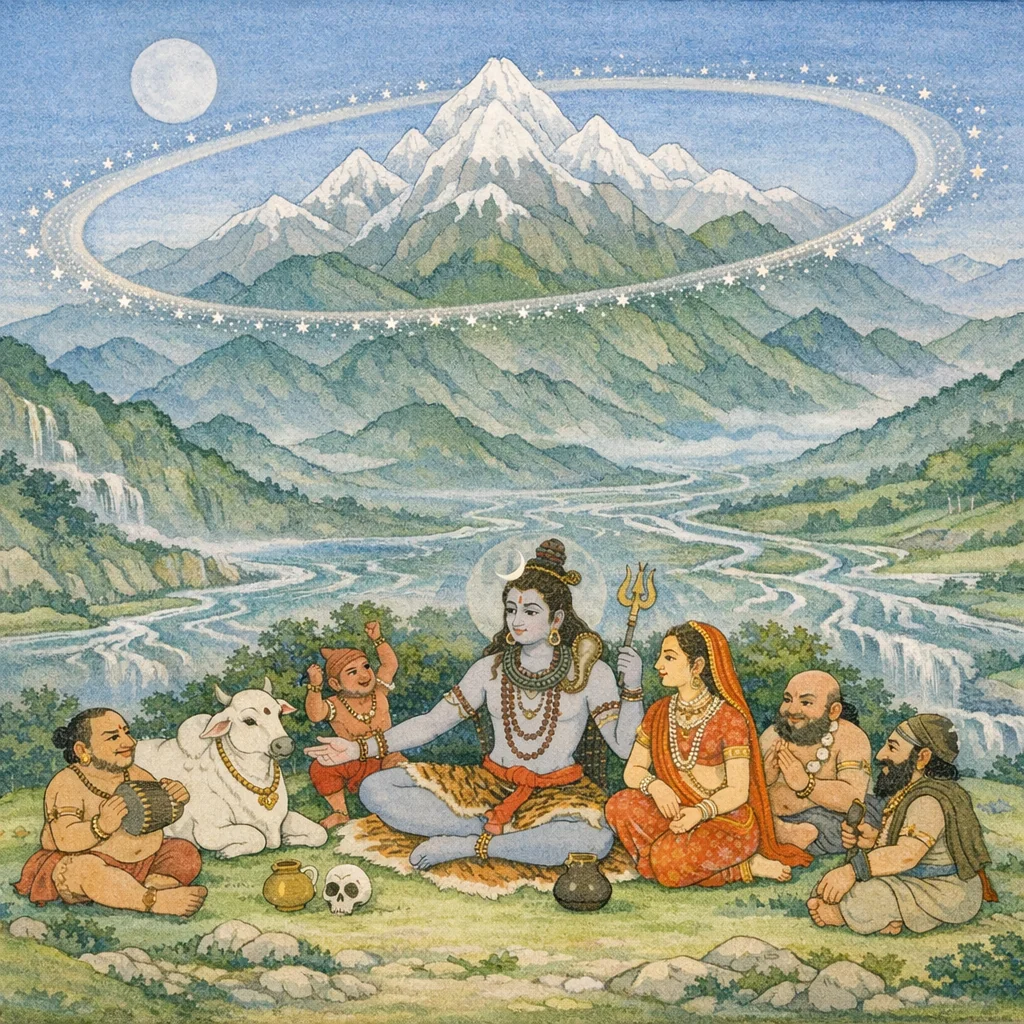
Continuing the Purva Bhaga’s Shiva-centered cosmology, Suta tells how countless auspicious rivers arise from lakes and flow in ordained directions. He then presents “Soma” as an aerial ocean and the source of amrita that sustains beings and gods. From Soma issues the heavenly river Punyoda, moving through the sky with the constellations and circulating ceaselessly like Soma itself. It encircles Mount Meru, where Shiva (ShriKantha/Sharva) sports with the ganas; by Shiva’s command its waters divide, descend among Meru’s inner ridges, and finally enter the great ocean, giving rise to hundreds and thousands of rivers across islands, mountains, and varshas. The chapter then surveys Jambudvipa’s nine varshas, describing the inhabitants’ colors, lifespans, diets, and temperaments, and contrasting divine-like regions with Bharatavarsha, where mortals live by karma, varna-ashrama duties, and the pursuit of dharma-artha-kama aimed ultimately at svarga and apavarga. It concludes by naming key mountain realms and affirming Shiva’s all-pervading presence, grounding all worlds in his governance and preparing the next cosmographic and tirtha framework.
Shlokas
Verse 1
इति श्रीलिङ्गमहापुराणे पूर्वभागे एकपञ्चाशत्तमो ऽध्यायः सूत उवाच नद्यश् च बहवः प्रोक्ताः सदा बहुजलाः शुभाः सरोवरेभ्यः सम्भूतास् त्व् असंख्याता द्विजोत्तमाः
Thus, in the Śrī Liṅga Mahāpurāṇa, in the Pūrvabhāga, the fifty-first chapter concludes. Sūta said: “Many rivers have been spoken of—ever abundant in waters and auspicious. Born from sacred lakes, they are indeed countless, O best of the twice-born.”
Verse 2
प्राङ्मुखा दक्षिणास्यास्तु चोत्तरप्रभवाः शुभाः पश्चिमाग्राः पवित्राश् च प्रतिवर्षं प्रकीर्तिताः
Those facing the east are said, in their efficacy, to be as though south-facing; those originating from the north are auspicious; those whose ‘tip’ is toward the west are purifying—thus it is proclaimed, year after year.
Verse 3
आकाशांभोनिधिर् यो ऽसौ सोम इत्यभिधीयते आधारः सर्वभूतानां देवानाममृताकरः
He who is the ocean of waters in the sky is called “Soma”; he is the support of all beings and the source of amṛta, immortality for the Devas.
Verse 4
अस्मात्प्रवृत्ता पुण्योदा नदी त्वाकाशगामिनी सप्तमेनानिलपथा प्रवृत्ता चामृतोदका
From this divine source arose the sacred river Puṇyodā, moving through the sky. Flowing along the seventh path of the wind, she proceeds with nectar-like waters.
Verse 5
सा ज्योतींष्यनुवर्तन्ती ज्योतिर्गणनिषेविता ताराकोटिसहस्राणां नभसश् च समायुता
She, moving in harmony with the heavenly lights, was attended by hosts of luminous beings; and the sky itself, filled with tens of thousands of crores of stars, accompanied her.
Verse 6
परिवर्तत्यहरहो यथा सोमस्तथैव सा चत्वार्यशीतिश् च तथा सहस्राणां समुच्छ्रितः
As the Moon continually waxes and wanes day after day, so too does that measure revolve. It is reckoned as eighty-four and rises to a total of thousands—marking the ordered cycles of time (kāla) under Pati, the Lord who governs all change.
Verse 7
योजनानां महामेरुः श्रीकण्ठाक्रीडकोमलः तत्रासीनो यतः शर्वः साम्बः सह गणेश्वरैः
Mahāmeru, measured in yojanas, is a gentle playground of Śrīkaṇṭha, the blue-throated Lord. There, Śarva—Śiva united with Śakti (Sāmba)—is seated together with the lords of his gaṇas.
Verse 8
क्रीडते सुचिरं कालं तस्मात्पुण्यजला शिवा गिरिं मेरुं नदी पुण्या सा प्रयाति प्रदक्षिणम्
For a very long time she sports there; therefore the auspicious river Śivā—holy with meritorious waters—goes on to circumambulate Mount Meru in pradakṣiṇa, the clockwise course.
Verse 9
विभज्यमानसलिला सा जवेनानिलेन च मेरोरन्तरकूटेषु निपपात चतुर्ष्वपि
That mass of water, being split and driven onward by the force of the wind, fell into the four inner peaks of Mount Meru, and thus was distributed to the four directions.
Verse 10
समन्तात्समतिक्रम्य सर्वाद्रीन्प्रविभागशः नियोगाद्देवदेवस्य प्रविष्टा सा महार्णवम्
Spreading out on all sides and passing beyond all the mountains in their various divisions, she—by the command of the God of gods—entered the great ocean.
Verse 11
अस्या विनिर्गता नद्यः शतशो ऽथ सहस्रशः सर्वद्वीपाद्रिवर्षेषु बहवः परिकीर्तिताः
From her, rivers have issued forth—by the hundreds and even by the thousands—many of which are celebrated throughout all continents (dvīpas), mountains, and regions (varṣas).
Verse 12
क्षुद्रनद्यस्त्वसंख्याता गङ्गा यद्गाङ्गताम्बरात् केतुमाले नराः कालाः सर्वे पनसभोजनाः
Countless are the minor rivers; and the Gaṅgā—arising from the celestial region of the Gaṅgā—flows forth. In Ketumāla, the people are dark-hued, and all of them live on jackfruit as their staple food.
Verse 13
स्त्रियश्चोत्पलवर्णाभा जीवितं चायुतं स्मृतम् भद्राश्वे शुक्लवर्णाश् च स्त्रियश्चन्द्रांशुसंनिभाः
In that region, the women are said to be lotus-hued, and their lifespan is remembered as ten thousand years. In Bhadrāśva, the people are white-complexioned, and the women shine like the rays of the moon.
Verse 14
कालाम्रभोजनाः सर्वे निरातङ्का रतिप्रियाः दशवर्षसहस्राणि जीवन्ति शिवभाविताः
All of them, nourished by dark mangoes, are free from fear and fond of delight; suffused with contemplation of Śiva, they live for ten thousand years.
Verse 15
हिरण्मया इवात्यर्थम् ईश्वरार्पितचेतसः तथा रमणके जीवा न्यग्रोधफलभोजनाः
In that delightful, enchanting region, the embodied souls—having wholly offered their minds to Īśvara—shone exceedingly, as if made of gold, and lived on the fruits of the banyan tree.
Verse 16
दशवर्षसहस्राणि शतानि दशपञ्च च जीवन्ति शुक्लास्ते सर्वे शिवध्यानपरायणाः
Those ‘white’ (pure) ones live for ten thousand years—indeed, for one thousand one hundred and fifteen more—because all of them are wholly devoted to meditation upon Lord Śiva, the Pati who loosens the pāśa-bonds of the paśu (soul).
Verse 17
हैरण्मया महाभागा हिरण्मयवनाश्रयाः एकादश सहस्राणि शतानि दशपञ्च च
They were of golden radiance, greatly fortunate, dwelling in the Hiraṇmaya (golden) forest—eleven thousand, and one hundred and fifteen in number.
Verse 18
वर्षाणां तत्र जीवन्ति अश्वत्थाशनजीवनाः हैरण्मया इवात्यर्थम् ईश्वरार्पितमानसाः
There they live for many years, sustaining themselves by eating the leaves of the sacred aśvattha tree. Shining as if golden, they are wholly absorbed—minds offered to Īśvara (Śiva), the Pati who frees the paśu from the bonds of pāśa.
Verse 19
कुरुवर्षे तु कुरवः स्वर्गलोकात् परिच्युताः सर्वे मैथुनजाताश् च क्षीरिणः क्षीरभोजनाः
But in Kuruvarṣa, the Kurus are all those who have fallen from the heavenly realm. They are all born through sexual union, and they live sustained by milk—milk-nourished and feeding on milk.
Verse 20
अन्योन्यमनुरक्ताश् च चक्रवाकसधर्मिणः अनामया ह्यशोकाश् च नित्यं सुखनिषेविणः
They were mutually devoted to one another, living like the cakravāka birds in faithful companionship; free from disease and truly without sorrow, they constantly partook of well-being—signs of a life in harmony with Pati (Śiva) and of the bonds of pāśa loosening upon the paśu.
Verse 21
त्रयोदशसहस्राणि शतानि दशपञ्च च जीवन्ति ते महावीर्या न चान्यस्त्रीनिषेविणः
Those great-potent ones live for thirteen thousand, one hundred and fifteen years; and they do not consort with other women.
Verse 22
सहैव मरणं तेषां कुरूणां स्वर्गवासिनाम् हृष्टानां सुप्रवृद्धानां सर्वान्नामृतभोजिनाम्
Even for those Kurus who dwell in heaven—joyful, greatly prospered, and feeding on all manner of ambrosial foods—death comes all the same. Thus, the paśu bound by pāśa cannot secure permanence through enjoyment; only refuge in Pati, Śiva, leads beyond decay.
Verse 23
सदा तु चन्द्रकान्तानां सदा यौवनशालिनाम् श्यामाङ्गानां सदा सर्वभूषणास्पददेहिनाम्
They are ever moon-radiant, ever endowed with youthful freshness—dark-limbed in hue, and possessed of bodies that are constant abodes fit for every ornament.
Verse 24
जंबूद्वीपे तु तत्रापि कुरुवर्षं सुशोभनम् तत्र चन्द्रप्रभं शम्भोर् विमानं चन्द्रमौलिनः
In Jambūdvīpa, there too is the splendid land called Kuruvarṣa. There stands Candraprabha—the radiant celestial palace of Śambhu, the Lord whose crest is the Moon.
Verse 25
वर्षे तु भारते मर्त्याः पुण्याः कर्मवशायुषः शतायुषः समाख्याता नानावर्णाल्पदेहिनः
But in the land of Bhārata, mortals are meritorious; their span of life is governed by karma. They are said to live for a hundred years, and are of diverse social classes and generally of smaller bodily frames.
Verse 26
नानादेवार्चने युक्ता नानाकर्मफलाशिनः नानाज्ञानार्थसम्पन्ना दुर्बलाश्चाल्पभोगिनः
Engaged in the worship of many deities, feeding on the varied fruits of many actions, furnished with assorted aims of knowledge, they become weakened—and their enjoyments remain meagre.
Verse 27
इन्द्रद्वीपे तथा केचित् तथैव च कसेरुके ताम्रद्वीपं गताः केचित् केचिद्देशं गभस्तिमत्
Some went to Indra-dvīpa; likewise others to Kaseruka. Some departed for Tāmra-dvīpa, while others went to the radiant land called Gabhastimat—thus beings were distributed among regions according to the cosmic order.
Verse 28
नागद्वीपं तथा सौम्यं गान्धर्वं वारुणं गताः केचिन्म्लेच्छाः पुलिन्दाश् च नानाजातिसमुद्भवाः
Some—born of many different tribes—such as the Mlecchas and the Pulindas, went to Nāgadvīpa, and likewise to Saumyadvīpa, to Gāndharvadvīpa, and to Vāruṇadvīpa.
Verse 29
पूर्वे किरातास्तस्यान्ते पश्चिमे यवनाः स्मृताः ब्राह्मणाः क्षत्रिया वैश्या मध्ये शूद्राश् च सर्वशः
To the east, at its farthest end, are remembered the Kirātas; and to the west, the Yavanas. In the middle are the Brāhmaṇas, Kṣatriyas, and Vaiśyas, and the Śūdras as well—spread everywhere. Thus is the worldly arrangement described; within it, the bound soul (paśu) must purify conduct and turn toward Pati, Lord Śiva, for release from the pāśa of bondage.
Verse 30
इज्यायुद्धवणिज्याभिर् वर्तयन्तो व्यवस्थिताः तेषां संव्यवहारो ऽयं वर्तते ऽत्र परस्परम्
Steadfast in their appointed stations, they sustain their lives through worship (sacrificial service), righteous warfare, and trade; and thus, among them, this mutual system of dealings and obligations proceeds here, each with the other.
Verse 31
धर्मार्थकामसंयुक्तो वर्णानां तु स्वकर्मसु संकल्पश्चाभिमानश् च आश्रमाणां यथाविधि
One should engage in the prescribed duties of the varṇas, harmonized with dharma, artha, and kāma; and, in accordance with the proper rule of the āśramas, maintain saṅkalpa (right intention) and abhimāna (disciplined self-regard), so that the paśu (individual soul) is steadied for the path that leads toward Pati, Lord Śiva.
Verse 32
इह स्वर्गापवर्गार्थं प्रवृत्तिर्यत्र मानुषी तेषां च युगकर्माणि नान्यत्र मुनिपुङ्गवाः
Here, in the human realm, the human being’s purposeful engagement is for the sake of heaven and for apavarga (liberation); and the duties proper to each Yuga belong to them alone—nowhere else, O best of sages.
Verse 33
दशवर्षसहस्राणि स्थितिः किंपुरुषे नृणाम् सुवर्णवर्णाश् च नराः स्त्रियश्चाप्सरसोपमाः
In the Kimpuruṣa region, the human lifespan endures for ten thousand years. The men are golden-hued, and the women are as beautiful as apsarases.
Verse 34
अनामया ह्यशोकाश् च सर्वे ते शिवभाविताः शुद्धसत्त्वाश् च हेमाभाः सदाराः प्लक्षभोजनाः
Indeed, they are free from disease and sorrow; all are permeated with Śiva’s nature. Their being is of pure sattva, radiant like gold; they dwell with their consorts and are sustained by the food of the plakṣa, the sacred fig.
Verse 35
महारजतसंकाशा हरिवर्षे ऽपि मानवाः देवलोकाच्च्युताः सर्वे देवाकाराश् च सर्वशः
In Harivarṣa too, human beings shine like great silver. All are said to have descended from the world of the Devas, and everywhere they bear forms like the gods themselves.
Verse 36
हरं यजन्ति सर्वेशं पिबन्तीक्षुरसं शुभम् न जरा बाधते तेन न च जीर्यन्ति ते नराः
Worshipping Hara—the Lord of all—and drinking the auspicious juice of sugarcane, those men are not afflicted by old age; by its merit they do not wither or decline.
Verse 37
दशवर्षसहस्राणि तत्र जीवन्ति मानवाः मध्यमं यन्मया प्रोक्तं नाम्ना वर्षमिलावृतम्
There, human beings live for ten thousand years. That central region which I have described is known by the name Ilāvṛta-varṣa.
Verse 38
न तत्र सूर्यस्तपति न ते जीर्यन्ति मानवाः चन्द्रसूर्यौ न नक्षत्रं न प्रकाशम् इलावृते
In Ilāvṛta the sun does not scorch, and the people there do not wither with age. There are neither moon nor sun, neither constellations nor any ordinary light, for that realm is illumined by a higher radiance centered on Śiva, transcending all worldly luminaries.
Verse 39
पद्मप्रभाः पद्ममुखाः पद्मपत्त्रनिभेक्षणाः पद्मपत्त्रसुगन्धाश् च जायन्ते भवभाविताः
Those whose inner being is permeated by Bhava (Śiva), the Pati, are born radiant like lotuses—lotus-faced, lotus-petal-eyed, and fragrant like lotus petals—manifesting the purity that arises when the paśu is touched by the Lord’s grace.
Verse 40
जम्बूफलरसाहारा अनिष्पन्दाः सुगन्धिनः देवलोकागतास्तत्र जायन्ते ह्यजरामराः
There, living on the nectar-like juice of jambu fruits, unshaken and serene, fragrant in their very being, those who have come from the world of the Devas are born as ageless and deathless.
Verse 41
त्रयोदशसहस्राणि वर्षाणां ते नरोत्तमाः आयुःप्रमाणं जीवन्ति वर्षे दिव्ये त्विलावृते
In the divine Ilāvṛta-varṣa, those best of men live for the full measure of life—thirteen thousand years—sustained by that ordained lifespan.
Verse 42
जंबूफलरसं पीत्वा न जरा बाधते त्विमान् न क्षुधा न क्लमश्चापि न जनो मृत्युमांस् तथा
Having drunk the juice of the Jambū fruit, these beings are not afflicted by old age; neither hunger nor fatigue troubles them, and such persons likewise do not become subject to death. In the Purāṇic vision this signals a realm where the pāśa-like limitations of the embodied paśu are thinned, reflecting proximity to the Lord (Pati) and the fruit of a more sāttvic, dharma-aligned existence.
Verse 43
तत्र जाम्बूनदं नाम कनकं देवभूषणम् इन्द्रगोपप्रतीकाशं जायते भास्वरं तु तत्
There, a gold known as Jāmbūnada arises—fit for the ornaments of the gods—brilliantly radiant, with a hue like the indragopa insect. In the Śaiva vision, such resplendent matter belongs to the ordered manifestation (sṛṣṭi) upheld by Pati (Śiva), and is sanctified when offered in Śiva’s worship.
Verse 44
एवं मया समाख्याता नववर्षानुवर्तिनः वर्णायुर्भोजनाद्यानि संक्षिप्य न तु विस्तरात्
Thus have I explained—briefly and not in elaborate detail—the matters that follow the nine Varṣas: their social orders (varṇa), spans of life, modes of sustenance and food, and related customs. In all of these, the wise should discern the governance of Pati (Śiva), while the bound soul (paśu) moves within its allotted conditions under the force of pāśa.
Verse 45
हेमकूटे तु गन्धर्वा विज्ञेयाश्चाप्सरोगणाः सर्वे नागाश् च निषधे शेषवासुकितक्षकाः
On Hemakūṭa are to be understood the Gandharvas and the hosts of Apsaras; and on Niṣadha are all the Nāgas—Śeṣa, Vāsuki, and Takṣaka.
Verse 46
महाबलास् त्रयस्त्रिंशद् रमन्ते याज्ञिकाः सुराः नीले तु वैडूर्यमये सिद्धा ब्रह्मर्षयो ऽमलाः
There the mighty Thirty-three gods—nourished by Vedic sacrifice—sport in delight. And in the blue, vaidūrya-like realm dwell the Siddhas and stainless Brahmarṣis, perfected and pure.
Verse 47
दैत्यानां दानवानां च श्वेतः पर्वत उच्यते शृङ्गवान् पर्वतश्चैव पितॄणां निलयः सदा
For the Daityas and Dānavas, the mountain called Śveta is spoken of as their domain; and likewise the mountain Śṛṅgavān is ever the abiding residence of the Pitṛs (ancestral beings).
Verse 48
हिमवान् यक्षमुख्यानां भूतानाम् ईश्वरस्य च सर्वाद्रिषु महादेवो हरिणा ब्रह्मणांबया
Himavān (the Himalaya) is the foremost abode of the Yakṣas and the Bhūtas; and in every mountain Mahādeva is present—together with Hari and Brahmā—as the one Lord who pervades all holy peaks.
Verse 49
नन्दिना च गणैश्चैव वर्षेषु च वनेषु च नीलश्वेतत्रिशृङ्गे च भगवान्नीललोहितः
Accompanied by Nandin and by the Gaṇas, the Blessed Lord Nīlalohita abides in the sacred regions and in the forests, and also upon the three-peaked mountain known as Nīla-and-Śveta—ever the Pati (Lord) who moves freely beyond all bonds.
Verse 50
सिद्धैर्देवैश् च पितृभिर् दृष्टो नित्यं विशेषतः नीलश् च वैडूर्यमयः श्वेतः शुक्लो हिरण्मयः
Beheld always—most especially—by the Siddhas, the Devas, and the Pitṛs, the Liṅga is seen in manifold appearances: as deep-blue, as made of vaidūrya (cat’s-eye gem), as white and radiant, and as golden—revealing the Lord (Pati) through diverse luminous forms.
Verse 51
मयूरबर्हवर्णस्तु शातकुंभस् त्रिशृङ्गवान् एते पर्वतराजानो जंबूद्वीपे व्यवस्थिताः
Mayūrabarha—hued like a peacock’s plume—and Śātakuṃbha, along with Triśṛṅgavān (the three-peaked one): these are the sovereign mountains established in Jambūdvīpa.
Frequently Asked Questions
Here ‘Soma’ is presented as an ākāśāmbhonidhi—an aerial ocean-like reservoir and amṛta-source, a cosmic support (ādhāra) for beings and gods. While Soma can denote the Moon elsewhere, this passage emphasizes Soma as a sustaining, amrita-bearing cosmic principle from which the divine river proceeds.
It symbolizes cosmic order under Shiva’s command: the single divine flow becomes many life-giving streams for all regions, showing how unity (one sacred source) manifests as multiplicity (many rivers) without leaving Shiva’s governance. Devotionally, it also frames tīrtha and sacred waters as Shiva-empowered means of purification supporting dharma and liberation.
Bharatavarsha is portrayed as the karma-field where lifespan and experiences are shaped by action, worship, and knowledge pursuits. This contrast highlights the Purāṇic teaching that human life—though limited—is uniquely suited for disciplined dharma and Shiva-oriented sadhana leading to apavarga (moksha).