Adhyaya 2
ईशानकल्पवृत्तान्तः तथा लैङ्गपुराणस्य संक्षेप-सूची
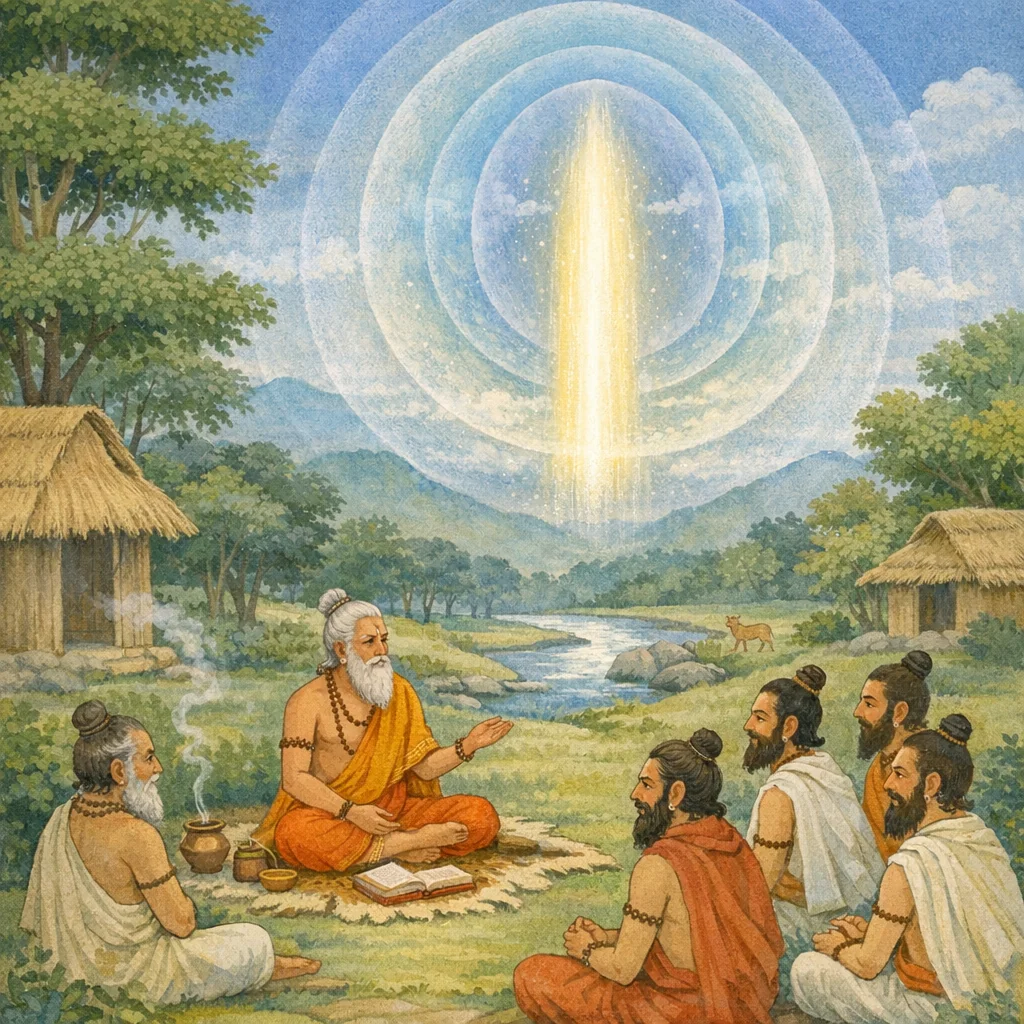
Sūta introduces the Liṅga Purāṇa as an “uttama” Mahāpurāṇa, first conceived by Brahmā in connection with the Īśāna-kalpa and later condensed by Vyāsa for human transmission. He states the work’s scope and gives a sweeping thematic catalogue: modes of creation (prādhānika/prākṛta/vaikṛta), the cosmic egg and its coverings, guṇa-based divine functions, prajāpati-sarga, the uplifting of the earth, Brahmā’s day–night and lifespan calculations, yuga–kalpa measures, and frameworks of dharma. The outline then foregrounds Śaiva pillars—recurrent Liṅgodbhava, the special excellence of the liṅga-mūrti, Vārāṇasī and other sacred sites, Pāśupata-yoga, the pañcākṣara mantra, and ritual-ethical systems (śrāddha, dāna, prāyaścitta, food codes). Mythic episodes (Dakṣa, Vṛtra, Dadhīci, Jālandhara, and the destruction of Kṛṣṇa’s clan) are set forth as exempla of cosmic order and divine grace. The chapter closes with the phalaśruti: knowing and teaching this saṅkṣepa brings purification and ascent to higher realms, preparing the reader for the detailed narratives and practices of the following adhyāyas.
Shlokas
Verse 1
इति श्रीलैङ्गे महापुराणे प्रथमो ऽध्यायः सूत उवाच ईशानकल्पवृत्तान्तम् अधिकृत्य महात्मना ब्रह्मणा कल्पितं पूर्वं पुराणं लैङ्गम् उत्तमम्
Thus, in the revered Liṅga Mahāpurāṇa, the first chapter concludes. Sūta said: Formerly, the great-souled Brahmā composed the supreme Liṅga Purāṇa, taking as its central theme the account of the Īśāna-kalpa—revealing Pati, who through Śiva-tattva and its sacred emblem, the Liṅga, frees the paśu (bound soul) from pāśa (bondage).
Verse 2
ग्रन्थकोटिप्रमाणं तु शतकोटिप्रविस्तरे चतुर्लक्षेण संक्षिप्ते व्यासैः सर्वान्तरेषु वै
Its textual measure is said to be a crore of verses; in its full expansion it reaches a hundred crores. Yet in every Manvantara the Vyāsas condense it into a concise form of four hundred thousand verses.
Verse 3
व्यस्तेष्टा दशधा चैव ब्रह्मादौ द्वापरादिषु लिङ्गमेकादशं प्रोक्तं मया व्यासाच्छ्रुतं च तत्
In the Dvāpara and other ages, among Brahmā and the rest, the rites were set forth in a tenfold, differentiated manner; and the eleventh—namely, the doctrine of the Liṅga—has been declared by me, exactly as I heard it from Vyāsa.
Verse 4
अस्यैकादशसाहस्रे ग्रन्थमानमिह द्विजाः तस्मात्संक्षेपतो वक्ष्ये न श्रुतं विस्तरेण यत्
O twice-born sages, the measure of this scripture here is eleven thousand verses. Therefore I shall teach it in concise form—what has not been heard in full detail—so that the essential purport concerning Pati (Śiva) and the liberation of the paśu may be grasped without prolixity.
Verse 5
चतुर्लक्षेण संक्षिप्ते कृष्णद्वैपायनेन तु अत्रैकादशसाहस्रैः कथितो लिङ्गसम्भवः
When the work of four hundred thousand verses was abridged by Kṛṣṇa Dvaipāyana (Vyāsa), the account of the origin of the Liṅga was set forth here in eleven thousand verses.
Verse 6
सर्गः प्राधानिकः पश्चात् प्राकृतो वैकृतानि च अण्डस्यास्य च सम्भूतिर् अण्डस्यावरणाष्टकम्
There is first the Prādhānika creation (arising from Pradhāna), then the Prākṛta and the Vaikṛta creations; thereafter come the manifestation of this cosmic egg (brahmāṇḍa) and the eightfold enclosures that sheath the egg.
Verse 7
अण्डोद्भवत्वं शर्वस्य रजोगुणसमाश्रयात् विष्णुत्वं कालरुद्रत्वं शयनं चाप्सु तस्य च
By resorting to the rajo-guṇa, Śarva (Śiva) assumes the condition of being born from the cosmic egg; and in that same divine līlā he also takes on the state of Viṣṇu, the form of Kāla-Rudra, and even the posture of lying upon the waters.
Verse 8
प्रजापतीनां सर्गश् च पृथिव्युद्धरणं तथा ब्रह्मणश् च दिवारात्रम् आयुषो गणनं पुनः
It further describes the emanation of the Prajāpatis, the lifting up of the Earth, Brahmā’s day and night, and again the reckoning of the span of life (cosmic time).
Verse 9
सवनं ब्रह्मणश्चैव युगकल्पश् च तस्य तु दिव्यं च मानुषं वर्षम् आर्षं वै ध्रौव्यमेव च
“These are the measures of time: the savana (ritual day-measure), the day of Brahmā, and for him the yuga and the kalpa; likewise the divine year, the human year, the ṛṣi-year, and also the Dhruva (sidereal) reckoning.”
Verse 10
पित्र्यं पितॄणां सम्भूतिर् धर्मश्चाश्रमिणां तथा अवृद्धिर्जगतो भूयो देव्याः शक्त्युद्भवस्तथा
From Her arises the ancestral order of the Pitṛs and their sacred rites; from Her also arises the dharma that upholds those established in the āśramas. Moreover, by Her power the worlds are sustained and do not decline; thus again and again the Goddess’s Śakti becomes the source of manifestation.
Verse 11
स्त्रीपुम्भावो विरिञ्चस्य सर्गो मिथुनसम्भवः आख्याष्टकं हि रुद्रस्य कथितं रोदनान्तरे
From Viriñci (Brahmā) arose the differentiation into female and male, and creation proceeded through the birth of pairs. In that very interval of Rudra’s lamentation, the Eightfold appellation—the sacred eight names—of Rudra was also declared.
Verse 12
ब्रह्मविष्णुविवादश् च पुनर्लिङ्गस्य सम्भवः शिलादस्य तपश्चैव वृत्रारेर्दर्शनं तथा
It also recounts the dispute between Brahmā and Viṣṇu, and again the manifestation of the Liṅga; likewise, Śilāda’s austerities (tapas), and the sacred darśana granted to Vṛtrāri (Indra).
Verse 13
प्रार्थना योनिजस्याथ दुर्लभत्वं सुतस्य तु शिलादशक्रसंवादः पद्मयोनित्वमेव च
Then comes the account of Brahmā’s supplication (yoni-ja), the rarity of obtaining a worthy son, the dialogue between Śilāda and Indra (Śakra), and also the matter of Brahmā’s lotus-birth (padma-yoni).
Verse 14
भवस्य दर्शनं चैव तिष्येष्वाचार्यशिष्ययोः व्यासावताराश् च तथा कल्पमन्वन्तराणि च
It also describes the darśana of Bhava (Śiva), the teacher–disciple tradition among the Tiṣyas, the incarnations of Vyāsa, and likewise the cycles of creation (kalpas) and the reigns of the Manus (manvantaras).
Verse 15
कल्पत्वं चैव कल्पानाम् आख्याभेदेष्वनुक्रमात् कल्पेषु कल्पे वाराहे वाराहत्वं हरेस् तथा
Thus, the very status of a “Kalpa” is determined by the successive order of its various appellations. Accordingly, in the sequence of Kalpas, in the Varāha-Kalpa, Hari (Viṣṇu) assumes the state and form of Varāha as well.
Verse 16
मेघवाहनकल्पस्य वृत्तान्तं रुद्रगौरवम् पुनर्लिङ्गोद्भवश्चैव ऋषिमध्ये पिनाकिनः
In the midst of the sages, Pinākin (Śiva, bearer of the bow Pināka) again proclaimed the sacred account of the Meghavāhana Kalpa—revealing the majesty of Rudra and the renewed manifestation of the Liṅga.
Verse 17
लिङ्गस्याराधनं स्नानविधानं शौचलक्षणम् वाराणस्याश् च माहात्म्यं क्षेत्रमाहात्म्यवर्णनम्
It sets forth the worship of the Liṅga, the ordained rite of sacred bathing, and the marks of purity; and it proclaims the greatness of Vārāṇasī, describing the glory of the holy pilgrimage-fields (kṣetra).
Verse 18
भुवि रुद्रालयानां तु संख्या विष्णोर्गृहस्य च अन्तरिक्षे तथाण्डे ऽस्मिन् देवायतनवर्णनम्
Here is described the enumeration of Rudra’s shrines upon the earth, and also the abode of Viṣṇu—together with an account of the divine sanctuaries in the mid-region (antarikṣa) and within this cosmic egg (brahmāṇḍa).
Verse 19
दक्षस्य पतनं भूमौ पुनः स्वारोचिषे ऽन्तरे दक्षशापश् च दक्षस्य शापमोक्षस्तथैव च
It tells of Dakṣa’s fall to the earth, and again—during the Svārociṣa Manvantara—of the curse upon Dakṣa, and likewise of Dakṣa’s release from that curse.
Verse 20
कैलासवर्णनं चैव योगः पाशुपतस् तथा चतुर्युगप्रमाणं च युगधर्मः सुविस्तरः
It also contains a description of Kailāsa, the Pāśupata Yoga, the measure of the four yugas, and an extensive exposition of the dharmas proper to each age.
Verse 21
संध्यांशकप्रमाणं च संध्यावृत्तं भवस्य च श्मशाननिलयश्चैव चन्द्ररेखासमुद्भवः
He (Bhava, Lord Śiva) is measured by the subtle “portion of twilight”, beyond ordinary reckoning; His mode is the twilight-state itself. He abides in the cremation-ground, and from Him arises the mark of the crescent moon.
Verse 22
उद्वाहः शंकरस्याथ पुत्रोत्पादनमेव च मैथुनातिप्रसङ्गेन विनाशो जगतां भयम्
Then they sought Śaṅkara’s marriage and, indeed, the begetting of a son; for when sexual union becomes excessive, it brings the dissolution of worlds—this is a terror to all beings.
Verse 23
शापः सत्या कृतो देवान्पुरा विष्णुं च पालितम् शुक्रोत्सर्गस्तु रुद्रस्य गाङ्गेयोद्भव एव च
Formerly, Satyā pronounced a curse upon the gods, and Viṣṇu was also restrained by it. And as for Rudra—there was the emission of his seed, from which the one born of the Gaṅgā indeed arose.
Verse 24
ग्रहणादिषु कालेषु स्नाप्य लिङ्गं फलं तथा क्षुब्धधी च विवादश् च दधीचोपेन्द्रयोस् तथा
At times such as eclipses and other portentous occasions, bathing the Liṅga yields its proper fruit. Likewise, agitation of the mind and disputes arise—such as the contention between Dadhīci and Upendra—(all of which are to be pacified by turning to the Liṅga).
Verse 25
उत्पत्तिर्नन्दिनाम्ना तु देवदेवस्य शूलिनः पतिव्रतायाश्चाख्यानं पशुपाशविचारणा
Here is described the origin of Nandī—of Śūlin, the God of gods—along with the sacred account of the pativratā (the chaste, vow-steadfast wife), and an inquiry into the paśu and the pāśa: the bound soul and the bonds that fetter it.
Verse 26
प्रवृत्तिलक्षणं ज्ञानं निवृत्त्यधिकृता तथा वसिष्ठतनयोत्पत्तिर् वासिष्ठानां महात्मनाम्
This chapter sets forth knowledge characterized by pravṛtti—the path of engaged action—and also that which is authorized for nivṛtti—the path of renunciation; and it further relates the origin of Vasiṣṭha’s sons, the great-souled Vāsiṣṭhas.
Verse 27
मुनीनां वंशविस्तारो राज्ञां शक्तेर्विनाशनम् दौरात्म्यं कौशिकस्याथ सुरभेर्बन्धनं तथा
It teaches the widening of the sages’ lineages, the ruin of kings’ power when misused, the wickedness of Kauśika, and the binding of Surabhī as well—showing how adharma tightens the pāśa (bond) upon the paśu (soul) until it turns back to Pati, Lord Śiva.
Verse 28
सुतशोको वसिष्ठस्य अरुन्धत्याः प्रलापनम् स्नुषायाः प्रेषणं चैव गर्भस्थस्य वचस् तथा
It describes Vasiṣṭha’s grief for his son, Arundhatī’s lament, the sending forth of the daughter-in-law, and the utterance spoken by the child still in the womb—events that prepare the scene for Pati, the Lord, to loosen the pāśa (bond) of the afflicted paśu (soul).
Verse 29
पराशरस्यावतारो व्यासस्य च शुकस्य च विनाशो राक्षसानां च कृतो वै शक्तिसूनुना
Indeed, by the son of Śakti, Parāśara was born as an incarnation; Vyāsa and Śuka were also brought forth; and the destruction of the Rākṣasas was accomplished—thus Dharma was safeguarded by Śiva’s providence as Pati, the Lord who loosens the pāśa (bond) of the paśus (souls).
Verse 30
देवतापरमार्थं तु विज्ञानं च प्रसादतः पुराणकरणं चैव पुलस्त्यस्याज्ञया गुरोः
Through divine grace, the highest purport concerning the Deity and vijñāna—realized knowledge—were attained; and thus, by the command of the guru Pulastya, the composition of the Purāṇa was undertaken.
Verse 31
भुवनानां प्रमाणं च ग्रहाणां ज्योतिषां गतिः जीवच्छ्राद्धविधानं च श्राद्धार्हाः श्राद्धमेव च
“[It teaches] the measures of the worlds; the courses of the planets and luminaries; the ordinance of śrāddha performed while one is living; who is qualified to receive śrāddha; and śrāddha itself.”
Verse 32
नान्दीश्राद्धविधानं च तथाध्ययनलक्षणम् पञ्चयज्ञप्रभावश् च पञ्चयज्ञविधिस् तथा
It also sets forth the rite of the Nāndī-śrāddha, the proper marks of Vedic study, the spiritual efficacy of the five great sacrifices (pañca-yajñas), and likewise the correct method for performing those five sacrifices.
Verse 33
रजस्वलानां वृत्तिश् च वृत्त्या पुत्रविशिष्टता मैथुनस्य विधिश्चैव प्रतिवर्णमनुक्रमात्
In due sequence, it teaches the conduct to be observed for menstruating women, the distinctions of offspring arising from such conduct, and the proper rule of conjugal union—each according to the respective varṇa. Thus dharma, as a purifying discipline, steadies the bound soul (paśu) by regulating desire, and turns household life toward auspicious order under the Lord (Pati).
Verse 34
भोज्याभोज्यविधानं च सर्वेषामेव वर्णिनाम् प्रायश्चित्तम् अशेषस्य प्रत्येकं चैव विस्तरात्
He also set forth, in detail, the rules of what is fit to be eaten and what is unfit for all the varṇas, and likewise the complete expiations (prāyaścitta) for every fault—each one explained separately and at length.
Verse 35
नरकाणां स्वरूपं च दण्डः कर्मानुरूपतः स्वर्गिनारकिणां पुंसां चिह्नं जन्मान्तरेषु च
He also explains the very nature of the hells, and the punishments that arise in exact accordance with one’s karma; and he describes the distinguishing marks by which those who have gone to heaven or to hell are recognized in subsequent births.
Verse 36
नानाविधानि दानानि प्रेतराजपुरं तथा कल्पं पञ्चाक्षरस्याथ रुद्रमाहात्म्यमेव च
It sets forth many kinds of charitable gifts; it also describes the city of the Lord of the departed (Yama). Further, it teaches the ritual procedure of the five-syllabled mantra (Namaḥ Śivāya) and proclaims the supreme greatness of Rudra—Pati, the Lord who loosens the paśu (bound soul) from pāśa (bondage).
Verse 37
वृत्रेन्द्रयोर्महायुद्धं विश्वरूपविमर्दनम् श्वेतस्य मृत्योः संवादः श्वेतार्थे कालनाशनम्
Next, the text recounts the great battle between Vṛtra and Indra, the slaying of Viśvarūpa, the dialogue between Śveta and Death, and—on Śveta’s behalf—the destruction of Kāla (Time/Death).
Verse 38
देवदारुवने शम्भोः प्रवेशः शंकरस्य तु सुदर्शनस्य चाख्यानं क्रमसंन्यासलक्षणम्
This section recounts Śambhu’s entry into the Devadāru forest; it also tells the account of Śaṅkara’s Sudarśana and sets forth the marks of krama-sannyāsa—progressive, disciplined renunciation that purifies the bound soul (paśu) and leads it toward Pati, the Lord.
Verse 39
श्रद्धासाध्यो ऽथ रुद्रस्तु कथितं ब्रह्मणा तदा मधुना कैटभेनैव पुरा हृतगतेर्विभोः
Then Brahmā declared that Rudra is attained through śraddhā—steadfast sacred faith—recalling how, in ancient times, Madhu and Kaiṭabha confounded the Lord’s discernment and course.
Verse 40
ब्रह्मणः परमं ज्ञानम् आदातुं मीनता हरेः सर्वावस्थासु विष्णोश् च जननं लीलयैव तु
To receive Brahmā’s supreme knowledge, Hari assumed the form of a fish; and in every condition and state, Viṣṇu’s manifestations arise solely as līlā, divine play.
Verse 41
रुद्रप्रसादाद्विष्णोश् च जिष्णोश्चैव तु सम्भवः मन्थानधारणार्थाय हरेः कूर्मत्वमेवच
By Rudra’s grace, the manifestation of Viṣṇu—also called Jiṣṇu—came to be; and to support the churning of the ocean, Hari indeed assumed the form of the Tortoise (Kūrma).
Verse 42
संकर्षणस्य चोत्पत्तिः कौशिक्याश् च पुनर्भवः यदूनां चैव सम्भूतिर् यादवत्वं हरेः स्वयम्
It recounts the birth of Saṅkarṣaṇa, the rebirth of Kauśikī, the arising of the Yadus, and how Hari Himself assumed the state of being a Yādava. In the Śaiva vision, such divine descents occur by the Lord’s sanction, while Pati (Śiva) remains the transcendent regulator of manifestation and dissolution.
Verse 43
भोजराजस्य दौरात्म्यं मातुलस्य हरेर्विभोः बालभावे हरेः क्रीडा पुत्रार्थं शंकरार्चनम्
It speaks of the wickedness of King Bhoja—Hari’s maternal uncle, the mighty Lord—of Hari’s playful deeds in his childhood, and of the worship of Śaṅkara performed for the sake of obtaining a son.
Verse 44
नारस्य च तथोत्पत्तिः कपाले वैष्णवाद्धरात् भूभारनिग्रहार्थे तु रुद्रस्याराधनं हरेः
Thus too occurred the manifestation of Nara—from the Vaiṣṇava skull (kapāla), from the Earth—so that the burden of the earth might be checked; and for that very purpose Hari performed worship of Rudra.
Verse 45
वैन्येन पृथुना भूमेः पुरा दोहप्रवर्तनम् देवासुरे पुरा लब्धो भृगुशापश् च विष्णुना
Formerly, Pṛthu—the son of Vena—set in motion the ‘milking’ of the Earth, drawing forth her sustenance for the world. And in ancient times, when the Devas and Asuras contended, even Viṣṇu came to bear the curse of Bhṛgu—showing that the workings of dharma and cosmic law bind all embodied powers beneath the supreme Lord (Pati), the inner ruler of all.
Verse 46
कृष्णत्वे द्वारकायां तु निलयो माधवस्य तु लब्धो हिताय शापस्तु दुर्वासस्याननाद्धरेः
When Hari assumed the state of Kṛṣṇa, Mādhava obtained his dwelling in Dvārakā. And for the sake of the world’s welfare, the curse of Durvāsas—issued because Hari had not been duly honored—came to pass.
Verse 47
वृष्ण्यन्धकविनाशाय शापः पिण्डारवासिनाम् एरकस्य तथोत्पत्तिस् तोमरस्योद्भवस् तथा
For the destruction of the Vṛṣṇis and the Andhakas, the curse of the dwellers of Piṇḍāra arose; likewise the eraka-reed sprouted forth, and the iron club (tomara) came into being.
Verse 48
एरकालाभतो ऽन्योन्यं विवादे वृष्णिविग्रहः लीलया चैव कृष्णेन स्वकुलस्य च संहृतिः
When the destined time arrived, the Vṛṣṇis turned upon one another in mutual strife; and by Kṛṣṇa’s own divine līlā his very clan was gathered back into dissolution—showing that all embodied beings (paśu) move under the bond of Time (pāśa), while the Lord remains sovereign as Pati.
Verse 49
एरकास्त्रबलेनैव गमनं स्वेच्छयैव तु ब्रह्मणश्चैव मोक्षस्य विज्ञानं तु सुविस्तरम्
By the very power of the Erakāstra there is movement at will; and there is also the higher knowledge of Brahman and of liberation (mokṣa), expounded in full detail.
Verse 50
पुरान्धकाग्निदक्षाणां शक्रेभमृगरूपिणाम् मदनस्यादिदेवस्य ब्रह्मणश् चामरारिणाम्
Of Purāndhaka, Agni, and Dakṣa; of Śakra (Indra), the elephant, and those who assumed the form of a deer; of Madana, the Primal God, and of Brahmā—(He, Śiva) stands beyond the gods, the supreme Pati who subdues all pride and all bondage.
Verse 51
हलाहलस्य दैत्यस्य कृतावज्ञा पिनाकिना जालंधरवधश्चैव सुदर्शनसमुद्भवः
How the demon Hālāhala was humbled by the Pināka-bearing Lord, how Jālandhara was slain, and how the Sudarśana discus came into manifestation—these are proclaimed as deeds arising from Śiva’s sovereign power as Pati, the remover of the pāśa that binds the worlds.
Verse 52
विष्णोर्वरायुधावाप्तिस् तथा रुद्रस्य चेष्टितम् तथान्यानि च रुद्रस्य चरितानि सहस्रशः
Also to be told is how Viṣṇu obtained his most excellent divine weapons, and the mighty workings of Rudra—indeed, countless other deeds of Rudra in their thousands. Here Rudra is revealed as Pati, the sovereign Lord, whose līlā and śakti govern the cosmos and loosen the pāśa (bondage) of the bound souls, the paśu.
Verse 53
हरेः पितामहस्याथ शक्रस्य च महात्मनः प्रभावानुभवश्चैव शिवलोकस्य वर्णनम्
This section describes the majesty and realized splendor of Hari (Viṣṇu), of the Grandfather (Brahmā), and of the great-souled Śakra (Indra), and also recounts Śivaloka—the transcendent realm of Śiva, the Pati who frees the paśu from the pāśa (bondage).
Verse 54
भूमौ रुद्रस्य लोकं च पाताले हाटकेश्वरम् तपसां लक्षणं चैव द्विजानां वैभवं तथा
On the earth is described the realm of Rudra; and in Pātāla, the Lord Hāṭakeśvara. Likewise are taught the defining marks of tapas (austerity) and, in the same manner, the true splendor of the dvija (twice-born), when aligned with dharma and devotion to Pati, Śiva.
Verse 55
आधिक्यं सर्वमूर्तीनां लिङ्गमूर्तेर्विशेषतः लिङ्गे ऽस्मिन्नानुपूर्व्येण विस्तरेणानुकीर्त्यते
The supreme excellence of all divine forms—most especially of the form of the Liṅga—is now proclaimed in this very Liṅga, in due sequence and in full detail.
Verse 56
एतज्ज्ञात्वा पुराणस्य संक्षेपं कीर्तयेत्तु यः सर्वपापविनिर्मुक्तो ब्रह्मलोकं स गच्छति
Whoever, having understood this, recites the concise summary of this Purāṇa becomes freed from all sins and attains Brahmaloka—moving onward on the path where the paśu (bound soul) is released from the pāśa (bondage) by devotion to the Pati, Śiva.
Frequently Asked Questions
Not as a full narrative here, but as a recurring doctrinal centerpiece: the chapter lists ‘punar-liṅgasya sambhavaḥ’ to signal that the manifestation of the Liṅga (and its supremacy) will be revisited across contexts, anchoring cosmology and devotion in Śiva’s aniconic revelation.
It explicitly points to liṅga-ārādhana, snāna-vidhāna, and śauca-lakṣaṇa, along with broader dharma modules such as śrāddha-vidhi, pañca-yajña, dāna-prakāra, and prāyaścitta—indicating that ritual purity and disciplined practice accompany theological exposition.