Adhyaya 103
उमास्वयंवरः / भवोद्वाहः, गणसमागमः, अविमुक्तक्षेत्रमाहात्म्यम्, तथा विनायक-उत्पत्तिसूचना
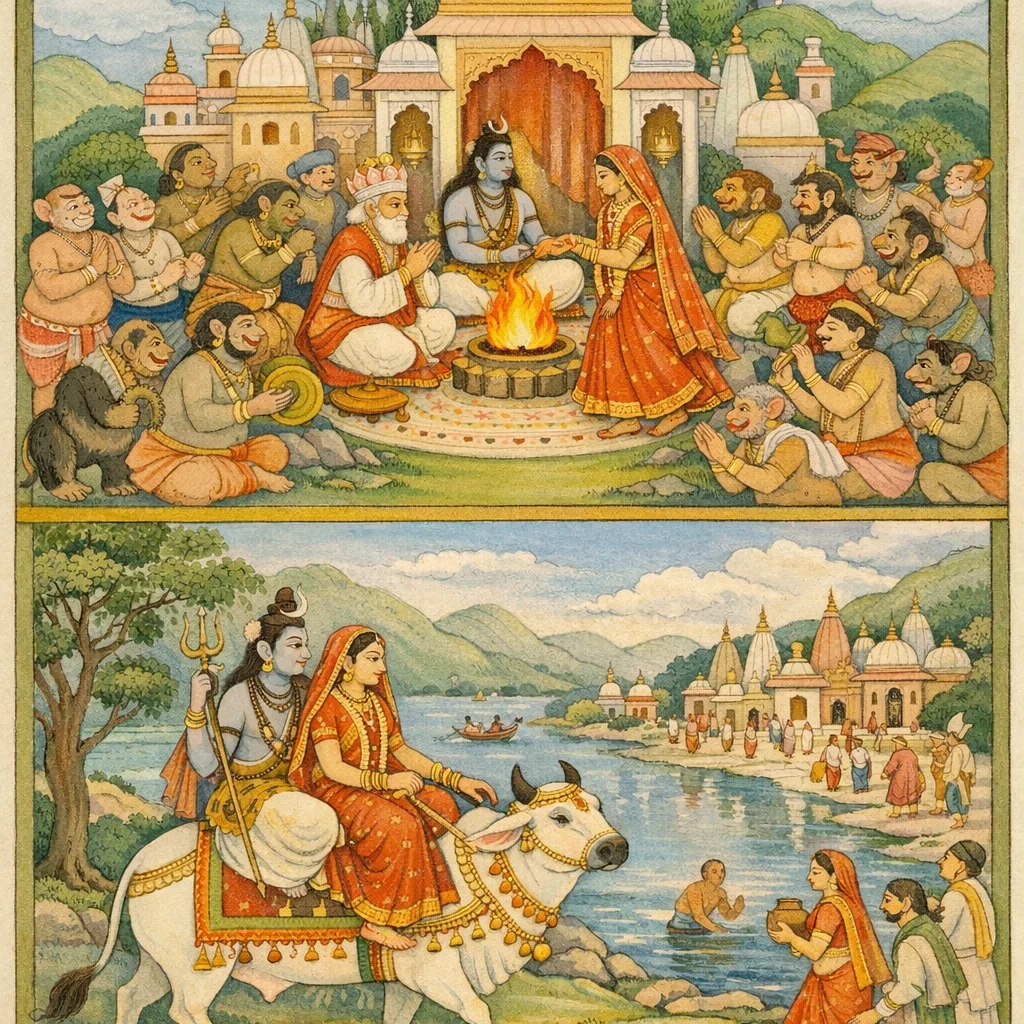
Sūta relates that Brahmā, with folded hands, petitions Mahādeva to begin the wedding (udvāha). Śiva agrees, and Brahmā instantly creates a divine jeweled city as the ritual venue. A vast procession arrives—mothers and consorts of the gods, nāgas, garuḍas, yakṣas, gandharvas, kinnaras, oceans, mountains, clouds, months and years, Vedas, mantras, yajñas, and countless apsarases—showing the marriage as a cosmic event. Innumerable Gaṇeśvaras and named gaṇas assemble, marked by Śaiva signs such as jaṭā, the crescent moon, trinetra, and nīlakaṇṭha. Viṣṇu brings the adorned Girijā into the city and proclaims a theological genealogy: Brahmā and Viṣṇu arise from Rudra’s sides, and the world is constituted by Rudra’s forms. Brahmā officiates with Agni present, Vedic mantras, circumambulation, and offerings, ritually uniting the divine couple. Afterward Śiva, with the gaṇas and Nandin, proceeds to sacred Vārāṇasī (Avimukta). Asked by Pārvatī about its greatness, Śiva declares Avimukta’s mokṣa-giving power: sins are removed and the dead attain non-return. He also points to the holy garden where Gaṇeśa (Gajavaktra Vināyaka) manifests to obstruct demons and ensure the gods’ aims are fulfilled without hindrance, preparing the way for the Kāśī-māhātmya and Vināyaka’s role in dharma.
Shlokas
Verse 1
इति श्रीलिङ्गमहापुराणे पूर्वभागे उमास्वयंवरो नाम द्व्यधिकशततमो ऽध्यायः सूत उवाच अथ ब्रह्मा महादेवम् अभिवन्द्य कृताञ्जलिः उद्वाहः क्रियतां देव इत्युवाच महेश्वरम्
Thus, in the Śrī Liṅga Mahāpurāṇa, in the Pūrva-bhāga, begins the one-hundred-and-third chapter called “Umā’s Svayaṃvara.” Sūta said: Then Brahmā, having bowed to Mahādeva with folded hands, addressed Maheśvara, saying, “O Deva, let the sacred marriage be solemnized.”
Verse 2
तस्य तद्वचनं श्रुत्वा ब्रह्मणः परमेष्ठिनः यथेष्टमिति लोकेशं प्राह भूतपतिः प्रभुः
Hearing that statement of Brahmā, the Supreme Ordainer, the Lord—Bhūtapati, master of all beings—said to the Lord of the worlds: “So be it, as you desire.”
Verse 3
उद्वाहार्थं महेशस्य तत्क्षणादेव सुव्रताः ब्रह्मणा कल्पितं दिव्यं पुरं रत्नमयं शुभम्
O steadfast-vowed ones, for the sake of Mahādeva’s sacred wedding, Brahmā at that very instant fashioned a divine and auspicious city, resplendent and made of jewels.
Verse 4
अथादितिर्दितिः साक्षाद् दनुः कद्रुः सुकालिका पुलोमा सुरसा चैव सिंहिका विनता तथा
Then (the narration continues): Aditi and Diti indeed; Danu, Kadru, Sukālikā, Pulomā, Surasā, Siṃhikā, and likewise Vinatā—these are the revered divine mothers in the line of creation, through whom embodied beings (paśu) enter saṃsāra under the bonds (pāśa) until they turn toward the Lord (Pati), Śiva.
Verse 5
सिद्धिर्माया क्रिया दुर्गा देवी साक्षात्सुधा स्वधा सावित्री वेदमाता च रजनी दक्षिणा द्युतिः
She is Siddhi (spiritual attainment), Māyā (the power that veils and manifests), and Kriyā (the force of sacred action). She is Durgā, the Goddess herself—truly Sudhā (nectar) and Svadhā (the oblation offered to the Pitṛs). She is Sāvitrī, the Mother of the Vedas, and also Rājanī (Night), Dakṣiṇā (the sacrificial gift), and Dyuti (radiance).
Verse 6
स्वाहा स्वाहामतिर् बुद्धिर् ऋद्धिर् वृद्धिः सरस्वती राका कुहूः सिनीवाली देवी अनुमती तथा
Svāhā; the resolve that utters “svāhā”; insight and discerning intellect; prosperity and increase; Sarasvatī; Rākā and Kuhū; Sinīvālī; the Goddess; and Anumatī as well—these divine powers are invoked as Śiva’s Śakti, aiding the bound soul (paśu) through rite and knowledge toward the Lord (Pati).
Verse 7
धरणी धारणी चेला शची नारायणी तथा एताश्चान्याश् च देवानां मातरः पत्नयस् तथा
Dharanī, Dhāraṇī, Celā, Śacī, and Nārāyaṇī—these and other goddesses are likewise spoken of as the mothers and also the consorts of the Devas.
Verse 8
उद्वाहः शङ्करस्येति जग्मुः सर्वा मुदान्विताः उरगा गरुडा यक्षा गन्धर्वाः किन्नरा गणाः
Hearing, “This is the wedding of Śaṅkara,” they all set forth filled with joy—serpents, Garuḍas, Yakṣas, Gandharvas, Kinnaras, and the hosts of attendants.
Verse 9
सागरा गिरयो मेघा मासाः संवत्सरास् तथा वेदा मन्त्रास् तथा यज्ञाः स्तोमा धर्माश् च सर्वशः
Oceans, mountains, clouds, the months and the years; the Vedas, the mantras, the sacrificial rites, the Vedic chants (stomas), and all forms of dharma—everything, in every way, stands pervaded by that Supreme Lord (Pati), Śiva.
Verse 10
हुङ्कारः प्रणवश्चैव प्रतिहाराः सहस्रशः कोटिरप्सरसो दिव्यास् तासां च परिचारिकाः
There are the mystic Huṅkāra and the sacred Praṇava (Oṁ) themselves; and thousands upon thousands of divine gate-guardians. A koṭi of celestial apsarases are present—along with their attendant handmaids.
Verse 11
याश् च सर्वेषु द्वीपेषु देवलोकेषु निम्नगाः ताश् च स्त्रीविग्रहाः सर्वाः संजग्मुर्हृष्टमानसाः
And whatever rivers flow downward across all the continents and in the divine worlds—those too, all assuming feminine forms, gathered together with minds uplifted in joy, to partake in the Lord’s Śaiva rite and auspicious presence.
Verse 12
गणपाश् च महाभागाः सर्वलोकनमस्कृताः उद्वाहः शङ्करस्येति तत्राजग्मुर्मुदान्विताः
And the hosts of Gaṇas—great-souled and revered by all the worlds—hearing, “This is Śaṅkara’s wedding,” went there filled with joy.
Verse 13
अभ्ययुः शङ्खवर्णाश् च गणकोट्यो गणेश्वराः दशभिः केकराक्षश् च विद्युतो ऽष्टाभिर् एव च
Then there advanced the Gaṇa-lords—countless in crores—among them the conch-colored hosts, white as the sacred śaṅkha, with Abhyayu and others; and also Kekarākṣa with ten companies, and Vidyut with eight alone.
Verse 14
चतुःषष्ट्या विशाखाश् च नवभिः पारयात्रिकः षड्भिः सर्वान्तकः श्रीमान् तथैव विकृताननः
By sixty-four names he is praised as Viśākhā; by nine names as Pārayātrika, the One who carries beings across; by six names as Sarvāntaka, the Lord who brings all to their destined end; and likewise as Śrīmān, the Auspicious One, and Vikṛtānana, He whose form and visage transcend all ordinary measures.
Verse 15
ज्वालाकेशो द्वादशभिः कोटिभिर् गणपुङ्गवः सप्तभिः समदः श्रीमान् दुन्दुभो ऽष्टाभिर् एव च
Jvālākēśa, foremost among the Gaṇas, is said to be attended by twelve crores of followers. The illustrious Samada is attended by seven crores; and Dundubha likewise by eight crores.
Verse 16
पञ्चभिश् च कपालीशः षड्भिः संदारकः शुभः कोटिकोटिभिर् एवेह गण्डकः कुंभकस् तथा
With five manifestations He is praised as Kapālīśa, the Lord who bears the skull; with six, as the auspicious Saṃdāraka, remover of afflictions. And with countless crores of manifestations here, He is also renowned as Gaṇḍaka and as Kumbhaka—He whose power contains, sustains, and gathers all within Himself.
Verse 17
विष्टम्भो ऽष्टाभिर् एवेह गणपः सर्वसत्तमः पिप्पलश् च सहस्रेण संनादश् च तथा द्विजाः
Here, the gaṇa-chief Viṣṭambha—foremost among all beings—stands attended by eight hosts. Likewise Pippala is attended by a thousand, and so too Saṃnāda, along with the twice-born sages who praise and uphold the Lord.
Verse 18
आवेष्टनस् तथाष्टाभिः सप्तभिश्चन्द्रतापनः महाकेशः सहस्रेण कोटीनां गणपो वृतः
He is Āveṣṭana, and also Candratāpana, attended by the hosts of eight and of seven. He is Mahākeśa—“the Great-Haired Lord”—surrounded by a gaṇa-leader amid thousands and crores of Śiva’s attendants.
Verse 19
कुण्डी द्वादशभिर् वीरस् तथा पर्वतकः शुभः कालश् च कालकश्चैव महाकालः शतेन वै
He is Kuṇḍī; He is the Twelvefold One; He is the Hero; He is Parvataka, the auspicious Mountain-Lord. He is Time (Kāla) and also Kālaka; and as Mahākāla, the Great Time, He is praised a hundredfold.
Verse 20
आग्निकः शतकोट्या वै कोट्याग्निमुख एव च आदित्यमूर्धा कोट्या च तथा चैव धनावहः
He is Āgnika—the Lord present as the very Fire; He is the One with countless mouths as blazing flames; He is the One whose head is the Sun itself; and He is Dhanāvaha, the bearer and bestower of prosperity. Thus the Pati is praised as the inner ruler of all luminous powers, the source of both sacrificial radiance and worldly abundance.
Verse 21
संनामश् च शतेनैव कुमुदः कोटिभिस् तथा अमोघः कोकिलश्चैव कोटिकोट्या सुमन्त्रकः
He is Saṃnāma, praised by the hundred; Kumuda, adored by millions; Amogha, whose grace never fails; Kokila, sweet-voiced in revelation; and Sumantraka, invoked by countless crores through auspicious mantras.
Verse 22
काकपाटो ऽपरः षष्ट्या षष्ट्या संतानकः प्रभुः महाबलश् च नवभिर् मधुपिङ्गश् च पिङ्गलः
He is also Kakapāṭa; He is Apara, the “Other” beyond all measures. He is the Lord counted by the sixty and the sixty, the Sustainer of continuity (saṃtāna). He is Mahābala, Great-strength itself, reckoned by the nine; and He is Madhupiṅga and Piṅgala—of tawny, honey-hued radiance.
Verse 23
नीलो नवत्या देवेशः पूर्णभद्रस्तथैव च कोटीनां चैव सप्तत्या चतुर्वक्त्रो महाबलः
He is the Blue-hued One, the Lord of the Devas. He is also Pūrṇabhadra, perfectly auspicious and protective. He is counted in tens of crores and likewise in the seventies, as measures of countless manifestations. He is Four-faced, and of immense power.
Verse 24
कोटिकोटिसहस्राणां शतैर् विंशतिभिर् वृताः तत्राजग्मुस् तथा देवास् ते सर्वे शङ्करं भवम्
Surrounded by hosts in hundreds and twenties, numbering in crores upon crores and thousands, all the Devas came there together and approached Śaṅkara—Bhava, the auspicious Lord (Pati) who frees the bound souls (paśus) from their bonds (pāśas).
Verse 25
भूतकोटिसहस्रेण प्रमथः कोटिभिस्त्रिभिः वीरभद्रश्चतुःषष्ट्या रोमजाश्चैव कोटिभिः
With a thousand crores of Bhūtas, with three crores of Pramathas, with sixty-four (crores) led by Vīrabhadra, and with crores of the Romajas as well—thus were the hosts of Rudra gathered for the Lord’s divine undertaking.
Verse 26
करणश्चैव विंशत्या नवत्या केवलः शुभः पञ्चाक्षः शतमन्युश् च मेघमन्युस् तथैव च
He is Karaṇa, and also “Twenty” and “Ninety”; He is the One alone, the Auspicious. He is Pañcākṣa, Lord of the five-syllabled mantra (pañcākṣarī); He is Śatamanyu, and likewise Meghamanyu.
Verse 27
काष्ठकूटश् चतुःषष्ट्या सुकेशो वृषभस् तथा विरूपाक्षश् च भगवान् चतुःषष्ट्या सनातनः
In the sixty-fourfold cycle of names, He is praised as Kāṣṭhakūṭa, as Sukeśa, as Vṛṣabha, and as Virūpākṣa; and again, in that same sixty-fourfold enumeration, He is the Blessed Lord—Sanātana, the Eternal.
Verse 28
तालुकेतुः षडास्यश् च पञ्चास्यश् च सनातनः संवर्तकस् तथा चैत्रो लकुलीशः स्वयं प्रभुः
Tālūketu, the Six-faced One, the Five-faced One, Sanātana the Eternal, Saṃvartaka, and also Caitra—all these are Lakulīśa himself, the Lord in person.
Verse 29
लोकान्तकश् च दीप्तास्यस् तथा दैत्यान्तकः प्रभुः मृत्युहृत् कालहा कालो मृत्युञ्जयकरस् तथा
He is Lokāntaka, the Ender of worlds; Dīptāsya, whose countenance blazes; the Lord who brings the Daityas to their end; the Remover of death; the Slayer of Kāla; Time itself; and Mṛtyuñjaya, the Bestower of victory over death.
Verse 30
विषादो विषदश्चैव विद्युतः कान्तकः प्रभुः देवो भृङ्गी रिटिः श्रीमान् देवदेवप्रियस् तथा
He is Viṣāda and Viṣada; He is Vidyut, radiant as lightning; He is Kāntaka, the subduer of all obstacles; He is Prabhu, the sovereign Lord—Deva himself. He is Bhṛṅgī, ever attendant upon the Great Lord; He is Riṭi, upholder of sacred order; He is Śrīmān, endowed with auspicious splendour; and He is Devadevapriya, beloved of the God of gods.
Verse 31
अशनिर् भासकश् चैव चतुःषष्ट्या सहस्रपात् एते चान्ये च गणपा असंख्याता महाबलाः
Aśani and Bhāsaka, and also Sahasrapāt with sixty-four thousand (followers)—these and many other Gaṇapa chiefs were innumerable and of tremendous power. They stood as the commanded hosts of Pati, Śiva, carrying out His will to protect dharma and restrain the bonds of pāśa.
Verse 32
सर्वे सहस्रहस्ताश् च जटामुकुटधारिणः चन्द्ररेखावतंसाश् च नीलकण्ठास् त्रिलोचनाः
All of them were thousand-armed; they bore crowns of matted locks, were adorned with the crescent-moon emblem, and appeared as blue-throated, three-eyed ones—manifesting the marks of the Supreme Pati, Śiva.
Verse 33
हारकुण्डलकेयूरमुकुटाद्यैर् अलंकृताः ब्रह्मेन्द्रविष्णुसंकाशा अणिमादिगुणैर्वृताः
Adorned with necklaces, earrings, armlets, crowns, and the like, they shone with a splendor akin to Brahmā, Indra, and Viṣṇu, and were encompassed by powers such as aṇimā and the other siddhi-qualities.
Verse 34
सूर्यकोटिप्रतीकाशास् तत्राजग्मुर्गणेश्वराः पातालचारिणश्चैव सर्वलोकनिवासिनः
Then the lords of the Gaṇas arrived there, radiant like ten million suns; and along with them came the beings who move in Pātāla, as well as those dwelling throughout all the worlds—gathering as witnesses to the supremacy of Pati, Śiva.
Verse 35
तुंबरुर्नारदो हाहा हूहूश्चैव तु सामगाः रत्नान्यादाय वाद्यांश् च तत्राजग्मुस्तदा पुरम्
Then Tumburu, Nārada, and the Sāma-singing Gandharvas—Hāhā and Hūhū—took jewels and musical instruments and at that time proceeded to that city.
Verse 36
ऋषयः कृत्स्नशस्तत्र देवगीतास्तपोधनाः पुण्यान् वैवाहिकान् मन्त्रान् अजपुर् हृष्टमानसाः
There, the sages—abounding in austerity and fully versed in the divine hymns—joyfully recited in full the sacred marriage-mantras, their minds uplifted in gladness.
Verse 37
तत एवं प्रवृत्ते तु सर्वतश् च समागमे गिरिजां ताम् अलंकृत्य स्वयमेव शुचिस्मिताम्
When matters had thus proceeded and a great assembly had gathered from all directions, the Lord Himself adorned Girijā—she whose smile was pure and radiant—manifesting the auspicious concord of Pati (Śiva) and Śakti for the welfare of all beings.
Verse 38
पुरं प्रवेशयामास स्वयम् आदाय केशवः सदस्याह च देवेशं नारायणमजो हरिम्
Keśava himself led (him) into the city; and the assembled ones addressed the Lord of the gods—Nārāyaṇa, the Unborn, Hari—honoring him as the sovereign protector who, in accord with Śiva’s will (Pati), safeguards the bound souls (paśu) within the order of dharma.
Verse 39
भवानग्रे समुत्पन्नो भवान्या सह दैवतैः वामाङ्गादस्य रुद्रस्य दक्षिणाङ्गादहं प्रभो
You were born first, together with Bhavānī and the host of gods. From the left side of this Rudra you arose; from his right side arose I, O Lord—thus is the divine ordering of manifestation from the one Pati beyond all bonds.
Verse 40
मन्मूर्तिस्तुहिनाद्रीशो यज्ञार्थं सृष्ट एव हि एषा हैमवती जज्ञे मायया परमेष्ठिनः
Indeed, the Lord of the Snowy Mountain—manifest as my very form—was brought forth for the sake of the sacrifice. Thus this daughter of Himavat was born through the māyā of Parameṣṭhin (Brahmā).
Verse 41
श्रौतस्मार्तप्रवृत्त्यर्थम् उद्वाहार्थम् इहागतः अतो ऽसौ जगतां धात्री धाता तव ममापि च
He has come here to uphold the course of Śrauta and Smārta duties, and also for the sake of marriage. Therefore, that One is the Support of the worlds—the Ordainer and Sustainer of both you and me.
Verse 42
अस्य देवस्य रुद्रस्य मूर्तिभिर् विहितं जगत् क्ष्माबग्निखेन्दुसूर्यात्मपवनात्मा यतो भवः
This entire world is fashioned through the manifested forms of that God Rudra. From Him arises Bhava, whose very self is earth, water, fire, space, moon, sun, and wind—revealing the Lord (Pati) as the inner ruler of the elements and luminaries.
Verse 43
तथापि तस्मै दातव्या वचनाच्च गिरेर्मम एषा ह्य् अजा शुक्लकृष्णा लोहिता प्रकृतिर्भवान्
Even so, she must be given to him—because of the word I have spoken and by the command of the Mountain. For this Ajā is indeed Prakṛti: white, black, and red—O revered one.
Verse 44
श्रेयो ऽपि शैलराजेन संबन्धो ऽयं तवापि च तव पाद्मे समुद्भूतः कल्पे नाभ्यंबुजादहम्
This connection of yours with the King of Mountains is auspicious; indeed, it is truly bound to you as well. For I, in this aeon, arose within your lotus—born from the navel-lotus.
Verse 45
मदंशस्यास्य शैलस्य ममापि च गुरुर्भवान् सूत उवाच बाढम् इत्यजम् आहासौ देवदेवो जनार्दनः
“You are the guru of this mountain—an extension of Me—and you are also My guru.” Thus spoke the Sūta. Then the Unborn One replied, “So be it,”—so said Janārdana, the Lord of gods.
Verse 46
देवाश् च मुनयः सर्वे देवदेवश् च शङ्करः ततश्चोत्थाय विद्वान्सः पद्मनाभः प्रणम्य ताम्
Then all the Devas and the sages—together with Śaṅkara, the God of gods—stood present. Thereupon the wise Padmanābha rose and, bowing to Her in reverence, offered salutations.
Verse 47
पादौ प्रक्षाल्य देवस्य कराभ्यां कमलेक्षणः अभ्युक्षद् आत्मनो मूर्ध्नि ब्रह्मणश् च गिरेस् तथा
Having washed the feet of the Deva with his own hands, the lotus‑eyed one sprinkled that sanctifying water upon his own head—and likewise upon the heads of Brahmā and the Mountain (Himālaya) as well.
Verse 48
त्वदीयैषा विवाहार्थं मेनजा ह्यनुजा मम इत्युक्त्वा सोदकं दत्त्वा देवीं देवेश्वराय ताम्
Saying, “This Menajā—my younger sister—is for you in marriage,” he performed the gift with water and thus bestowed that Goddess upon Deveśvara, the Lord of the gods.
Verse 49
स्वात्मानमपि देवाय सोदकं प्रददौ हरिः अथ सर्वे मुनिश्रेष्ठाः सर्ववेदार्थपारगाः
Hari (Viṣṇu), offering water in due form, presented even his own self to the Deva (Śiva). Then all the best of sages—those who had crossed to the far shore of the meaning of all the Vedas—(likewise assented and followed that act of surrender).
Verse 50
ऊचुर्दाता गृहीता च फलं द्रव्यं विचारतः एष देवो हरो नूनं मायया हि ततो जगत्
They said: “When we reflect discerningly on the giver, the receiver, the offering-substance, and the resulting fruit, it is surely this God—Hara—who, by His māyā, becomes all this world.”
Verse 51
इत्युक्त्वा तं प्रणेमुश् च प्रीतिकण्टकितत्वचः ससृजुः पुष्पवर्षाणि खेचराः सिद्धचारणाः
Having spoken thus, they bowed down to him; their skins bristled with joy. Then the sky-ranging Siddhas and Cāraṇas showered down rains of flowers—an auspicious sign that the Pati (Lord Śiva) has been pleased and that the pious act is confirmed.
Verse 52
देवदुन्दुभयो नेदुर् ननृतुश्चाप्सरोगणाः वेदाश् च मूर्तिमन्तस्ते प्रणेमुस्तं महेश्वरम्
The divine kettledrums resounded; the hosts of Apsarās danced; and even the Vedas—manifest in embodied form—bowed down to that Mahēśvara. Thus the cosmos itself proclaimed the supremacy of Pati, the Lord who loosens the bonds of the paśu.
Verse 53
ब्रह्मणा मुनिभिः सार्धं देवदेवमुमापतिम् देवो ऽपि देवीमालोक्य सलज्जां हिमशैलजाम्
Together with Brahmā and the sages, the Devas approached the God of gods, Umāpati (Śiva). Even that Deva (Śiva), beholding the Goddess—the Himālaya-born Pārvatī—who stood in modesty, looked upon her with reverent attention.
Verse 54
न तृप्यत्यनवद्याङ्गी सा च देवं वृषध्वजम् वरदो ऽस्मीति तं प्राह हरिं सो ऽप्याह शङ्करम्
That flawless-limbed goddess did not find satisfaction. She addressed the god Vṛṣadhvaja (Śiva). He declared, “I am the giver of boons.” She then approached Hari, and he in turn directed her toward Śaṅkara.
Verse 55
त्वयि भक्तिः प्रसीदेति ब्रह्माख्यां च ददौ तु सः ततस्तु पुनरेवाह ब्रह्मा विज्ञापयन्प्रभुम्
“May devotion to You be firmly established; be gracious,”—so he spoke, and he bestowed the designation ‘Brahmā’. Thereafter Brahmā again addressed the Lord, submitting his petition.
Verse 56
हविर्जुहोमि वह्नौ तु उपाध्यायपदे स्थितः ददासि मम यद्याज्ञां कर्तव्यो ह्यकृतो विधिः
Standing in the office of the preceptor, I pour the oblation (havis) into the sacred fire. If you grant me leave, then the rite not yet completed must indeed be duly performed, according to injunction.
Verse 57
तमाह शङ्करो देवं देवदेवो जगत्पतिः यद्यदिष्टं सुरश्रेष्ठ तत्कुरुष्व यथेप्सितम्
Then Śaṅkara—the God of gods, the Lord of the worlds—said to that Deva: “O best among the Suras, whatever you desire, do it exactly as you wish.”
Verse 58
कर्तास्मि वचनं सर्वं देवदेव पितामह ततः प्रणम्य हृष्टात्मा ब्रह्मा लोकपितामहः
“O God of gods, O revered Grandsire, I shall carry out all your words.” Having spoken thus, Brahmā—the grandsire of the worlds—bowed down with a gladdened heart and accepted the Lord’s command.
Verse 59
हस्तं देवस्य देव्याश् च युयोज परमं प्रभुः ज्वलनश् च स्वयं तत्र कृताञ्जलिरुपस्थितः
The Supreme Lord joined the hand of the God and the Goddess in sacred union; and there Agni (Jvalana) himself stood present with folded palms, bearing witness.
Verse 60
श्रौतैरेतैर्महामन्त्रैर् मूर्तिमद्भिर् उपस्थितैः यथोक्तविधिना हुत्वा लाजानपि यथाक्रमम्
Then, using these Vedic (śrauta) great mantras—present as embodied presences standing near—one should offer the oblations by the stated procedure, and also offer the parched grains (lājā) in their proper sequence.
Verse 61
आनीतान्विष्णुना विप्रान् सम्पूज्य विविधैर्वरैः त्रिश् च तं ज्वलनं देवं कारयित्वा प्रदक्षिणम्
Having had the Brahmin sages brought by Viṣṇu and having honored them with many excellent gifts, he then caused the blazing Deity, Agni, to be circumambulated three times in reverence.
Verse 62
मुक्त्वा हस्तसमायोगं सहितैः सर्वदैवतैः सुरैश् च मानवैः सर्वैः प्रहृष्टेनान्तरात्मना
Having released the joined-hands gesture of reverent salutation, and accompanied by all the deities—together with the gods and all human beings—he proceeded with an inward self filled with gladness.
Verse 63
ननाम भगवान्ब्रह्मा देवदेवमुमापतिम् ततः पाद्यं तयोर् दत्त्वा शंभोराचमनं तथा
Then the venerable Brahmā bowed down to Devadeva—Śiva, the Lord of Umā. Thereafter, offering water for the feet (pādya) to them both, he also duly presented Śambhu with sipping-water (ācamanīya) in accordance with ritual propriety.
Verse 64
मधुपर्कं तथा गां च प्रणम्य च पुनः शिवम् अतिष्ठद्भगवान्ब्रह्मा देवैरिन्द्रपुरोगमैः
Having offered the madhuparka and a cow, and having bowed again to Śiva, the blessed Brahmā stood there, accompanied by the Devas with Indra at their head.
Verse 65
भृग्वाद्यमुनयः सर्वे चाक्षतैस्तिलतण्डुलैः सूर्यादयः समभ्यर्च्य तुष्टुवुर्वृषभध्वजम्
All the sages headed by Bhṛgu—together with Sūrya and the other deities—worshipped the Bull-bannered Lord (Vṛṣabhadhvaja), Śiva, with unbroken grains (akṣata), sesame, and rice, and then praised Him with hymns.
Verse 66
शिवः समाप्य देवोक्तं वह्निमारोप्य चात्मनि तया समागतो रुद्रः सर्वलोकहिताय वै
Śiva, having fulfilled what the gods had enjoined, drew the sacred fire, Agni, into his own Self; then Rudra went forth with it indeed, for the welfare of all the worlds.
Verse 67
यः पठेच्छृणुयाद्वापि भवोद्वाहं शुचिस्मितः श्रावयेद्वा द्विजाञ्छुद्धान् वेदवेदाङ्गपारगान्
Whoever, with a pure heart and gentle smile, recites—or even listens to—the account of Bhava’s sacred rite, the Bhavodvāha, or has it recited to purified twice-born brāhmaṇas skilled in the Vedas and Vedāṅgas, gains sanctifying merit; by Śiva’s grace the paśu is led toward the Pati.
Verse 68
स लब्ध्वा गाणपत्यं च भवेन सह मोदते यत्रायं कीर्त्यते विप्रैस् तावदास्ते तदा भवः
Having attained the state of Gaṇapati, he rejoices together with Bhava (Śiva). Wherever brāhmaṇa sages recite this glory, Bhava abides there for just so long as the recitation endures.
Verse 69
तस्मात् सम्पूज्य विधिवत् कीर्तयेन्नान्यथा द्विजाः उद्वाहे च द्विजेन्द्राणां क्षत्रियाणां द्विजोत्तमाः
Therefore, O twice-born, having duly worshipped the Lord according to the prescribed rite, one should recite this sacred proclamation and praise—never otherwise. And at the marriage-rite of eminent Kṣatriyas, O best of the twice-born, this rule too is to be observed.
Verse 70
कीर्तनीयमिदं सर्वं भवोद्वाहमनुत्तमम् कृतोद्वाहस्तदा देव्या हैमवत्या वृषध्वजः
This entire account of Bhava’s unsurpassed wedding is to be recited and celebrated. Thus Vṛṣadhvaja—Lord Śiva, whose banner bears the bull—completed the marriage with the Goddess Haimavatī (Pārvatī), daughter of Himavat.
Verse 71
सगणो नन्दिना सार्धं सर्वदेवगणैर्वृतः पुरीं वाराणसीं दिव्याम् आजगाम महाद्युतिः
Radiant with mighty splendor, he came to the divine city of Vārāṇasī, accompanied by his gaṇas, together with Nandin, and surrounded by the hosts of all the gods.
Verse 72
अविमुक्ते सुखासीनं प्रणम्य वृषभध्वजम् अपृच्छत्क्षेत्रमाहात्म्यं भवानी हर्षितानना
In Avimukta, Bhavānī—her face radiant with joy—bowed to Lord Śiva, the Bull-bannered One, as he sat at ease, and asked him about the sacred greatness of that holy field (kṣetra).
Verse 73
अथाहार्धेन्दुतिलकः क्षेत्रमाहात्म्यमुत्तमम् अविमुक्तस्य माहात्म्यं विस्तराच्छक्यते नहि
Then Āhārdhendutilaka, adorned with the crescent moon, described the unsurpassed greatness of the sacred field; for the glory of Avimukta cannot truly be set forth in full detail.
Verse 74
वक्तुं मया सुरेशानि ऋषिसंघाभिपूजितम् किं मया वर्ण्यते देवी ह्य् अविमुक्तफलोदयः
O Goddess, O Lady of the gods—what can I truly describe of Avimukta, whose fruits are ever manifest and whose greatness is revered and worshipped by the assemblies of sages?
Verse 75
पापिनां यत्र मुक्तिः स्यान् मृतानाम् एकजन्मना अन्यत्र तु कृतं पापं वाराणस्यां व्यपोहति
In that sacred place, even sinners who die there attain liberation within a single lifetime; and sins committed elsewhere are wiped away in Vārāṇasī by the grace of Pati (Lord Śiva).
Verse 76
वाराणस्यां कृतं पापं पैशाच्यनरकावहम् कृत्वा पापसहस्राणि पिशाचत्वं वरं नृणाम्
Sin committed in Vārāṇasī leads to the hell of a piśāca-like state. Even after thousands of sinful acts, for men, becoming a piśāca is still deemed the preferable outcome—so exceptionally severe is the karmic consequence in Kāśī.
Verse 77
न तु शक्रसहस्रत्वं स्वर्गे काशीपुरीं विना यत्र त्रिविष्टपो देवो यत्र विश्वेश्वरो विभुः
Not even the status of a thousand Indras in heaven is comparable without Kāśīpurī. For there indeed is the divine Triviṣṭapa; there abides Viśveśvara, the all-pervading Lord (Pati).
Verse 78
ओंकारेशः कृत्तिवासा मृतानां न पुनर्भवः उक्त्वा क्षेत्रस्य माहात्म्यं संक्षेपाच्छशिशेखरः
Thus Śaśiśekhara (Śiva), having concisely proclaimed the greatness of that sacred kṣetra, declared: “Om̐kāreśa, Kṛttivāsā—for those who die here there is no return to rebirth.”
Verse 79
दर्शयामास चोद्यानं परित्यज्य गणेश्वरान् तत्रैव भगवान् जातो गजवक्त्रो विनायकः
Having revealed that sacred garden and setting aside the hosts of Gaṇa-lords, the Blessed One manifested there itself as Vināyaka, the elephant-faced Lord.
Verse 80
दैत्यानां विघ्नरूपार्थम् अविघ्नाय दिवौकसाम् एतद्वः कथितं सर्वं कथासर्वस्वमुत्तमम्
So that the Daityas might take on the very form of obstacles, and so that the dwellers in heaven might become free from obstacles, I have told you all this—this supreme essence of the whole sacred account.
Verse 81
यथाश्रुतं मया सर्वं प्रसादाद्वः सुशोभनम्
By grace, I have conveyed to you—exactly as I heard it—this entire sacred account, made radiant for you.
Frequently Asked Questions
Because the text frames Shiva as the ontological center: rivers, Vedas, yajñas, time-cycles, and innumerable gaṇas gathering signifies that dharma, ritual order, and cosmic functions converge upon Shiva, and the marriage ritually stabilizes that universal order.
Avimukta is presented as Shiva’s special liberation-field where sins are removed and the dead attain ‘na punarbhava’ (no return). The narrative ties sacred geography to Shaiva soteriology, implying that Shiva’s grace operates through both worship and tīrtha.
Brahmā performs the officiant role, Agni is invoked as witness, and mantras are described as ‘mūrtimat’ (embodied). This frames Vedic rite as a vehicle through which Shiva’s cosmic status is affirmed and the divine union is ritually enacted.
After describing Avimukta, Shiva points to a sacred garden where Gajavaktra Vinayaka manifests to become ‘vighna-rūpa’ for demons and ‘avighna’ (obstacle-remover) for the gods—foreshadowing subsequent tīrtha and deity-focused discourse.