Adhyaya 100
दक्षयज्ञध्वंसः—वीरभद्रप्रेषणं, देवविष्ण्वोः पराजयः, पुनरनुग्रहः
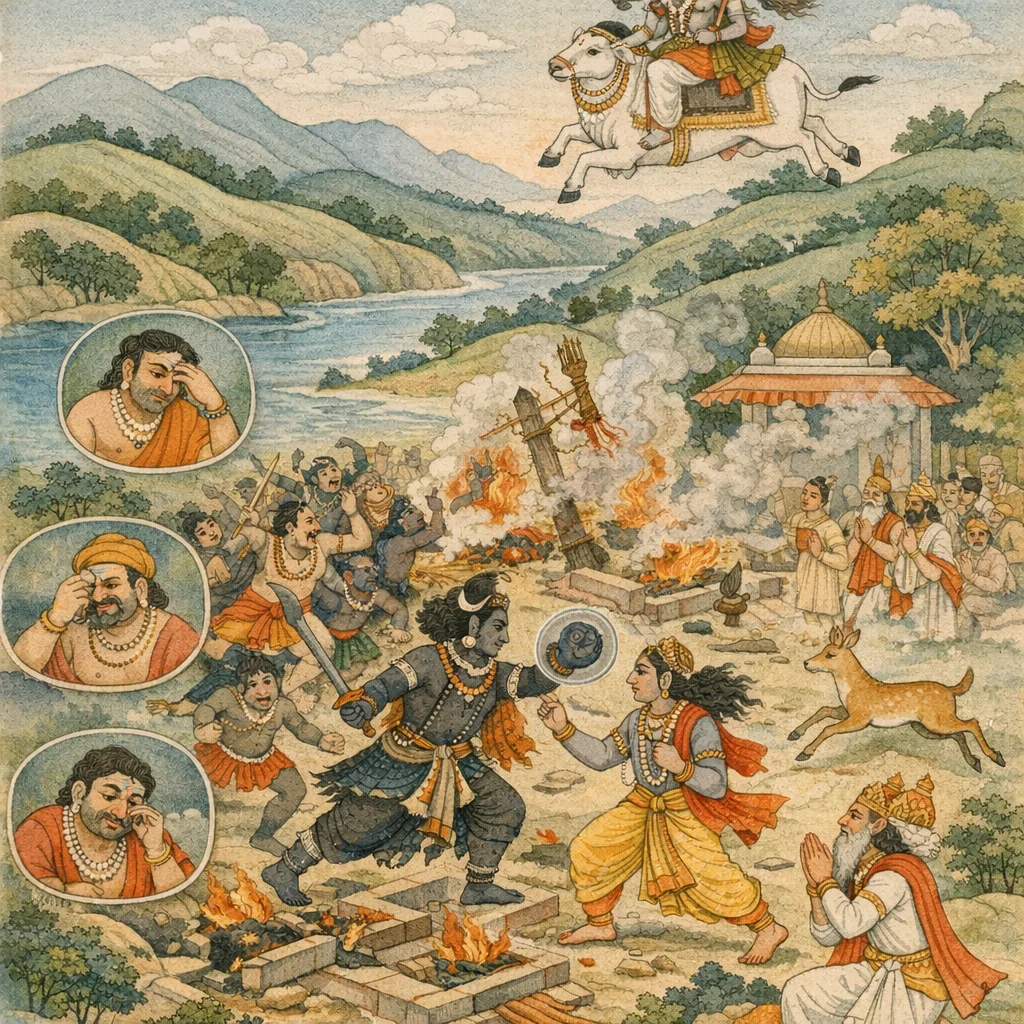
The sages ask Sūta: recalling Dadhīca’s words, if Maheśvara had already “prevailed” together with Viṣṇu, how and why did He later engage with the sacrifice? Sūta recounts the episode of Dakṣa’s yajña: Rudra burns the devas and bands of munis; then, by Parameṣṭhin (Brahmā)’s direction, Vīrabhadra is dispatched. Entering the sacrificial enclosure at Kanakhala with his hosts, Vīrabhadra shatters the yūpas and ritual apparatus, maims the gods (Bhaga’s eye torn out, Pūṣan’s teeth broken, and the like), and defeats Indra, Agni, Yama, and others. A dreadful battle follows with Viṣṇu; even the many divine bodies manifested from Viṣṇu’s yogic power are subdued, and the cakra is checked. Yajña flees in the form of a deer; Dakṣa is beheaded and burned in the fire. Brahmā then prays to quell the wrath; Śiva appears in the sky with the bull-banner and His gaṇas, restores the devas to their former bodies, replaces Dakṣa’s head, and grants boons. Dakṣa offers praise and attains a place among the gaṇas. The chapter bridges to what follows: the purification of sacrificial dharma, the re-establishment of the gods, and the Śaiva path centered on Śiva’s gracious anugraha.
Shlokas
Verse 1
इति श्रीलिङ्गमहापुराणे पूर्वभागे देवीसंभवो नाम नवनवतितमो ऽध्यायः ऋषय ऊचुः विजित्य विष्णुना सार्धं भगवान्परमेश्वरः सर्वान्दधीचवचनात् कथं भेजे महेश्वरः
The sages said: “After the Blessed Supreme Lord Maheśvara, together with Viṣṇu, had conquered all the opposing hosts, how did that Great Lord then act in accordance with the words of Dadhīca?”
Verse 2
सूत उवाच दक्षयज्ञे सुविपुले देवान् विष्णुपुरोगमान् ददाह भगवान् रुद्रः सर्वान् मुनिगणान् अपि
Sūta said: In Dakṣa’s vast sacrificial rite, the Blessed Rudra burned the gods—led even by Viṣṇu—and also all the assembled hosts of sages. Thus the Pati (Lord) shattered the pride of ritualism and revealed that sacrifice bereft of Śiva-bhakti becomes a bond (pāśa) rather than a means to freedom.
Verse 3
भद्रो नाम गणस्तेन प्रेषितः परमेष्ठिना विप्रयोगेन देव्या वै दुःसहेनैव सुव्रताः
Then, by Parameṣṭhin (Brahmā), a gaṇa named Bhadra was dispatched. O steadfast ones, the Goddess’ separation—truly unbearable—had brought about this urgent mission.
Verse 4
सो ऽसृजद् वीरभद्रश् च गणेशान्रोमजाञ्छुभान् गणेश्वरैः समारुह्य रथं भद्रः प्रतापवान्
Then Vīrabhadra brought forth auspicious Gaṇa-hosts, born from the hairs of his body; and that mighty, glorious one—attended by the chiefs of the Gaṇas—mounted his chariot.
Verse 5
गन्तुं चक्रे मतिं यस्य सारथिर्भगवानजः गणेश्वराश् च ते सर्वे विविधायुधपाणयः
He resolved to depart, and for him the venerable Unborn Lord, Aja, served as charioteer; and all those chiefs of the Gaṇas accompanied him, their hands bearing weapons of many kinds.
Verse 6
विमानैर्विश्वतो भद्रैस् तमन्वयुरथो सुराः हिमवच्छिखरे रम्ये हेमशृङ्गे सुशोभने
Then the Devas followed Him in splendid, all-auspicious aerial chariots, and they arrived at a delightful peak of the Himalaya—radiant and beautiful, crowned with a golden summit.
Verse 7
यज्ञवाटस् तथा तस्य गङ्गाद्वारसमीपतः तद्देशे चैव विख्यातं शुभं कनखलं द्विजाः
Near that sacred Gaṅgādvāra there is also the Yajñavāṭa; and in that very region, O twice-born ones, the auspicious place named Kanakhala is renowned.
Verse 8
दग्धुं वै प्रेषितश्चासौ भगवान् परमेष्ठिना तदोत्पातो बभूवाथ लोकानां भयशंसनः
Sent forth by Parameṣṭhin (Brahmā) to burn, that divine being went; and then a portent arose—an ominous sign foretelling fear for all the worlds.
Verse 9
पर्वताश् च व्यशीर्यन्त प्रचकम्पे वसुंधरा मरुतश् चाप्य् अघूर्णन्त चुक्षुभे मकरालयः
Mountains shattered; the earth trembled; the winds whirled in confusion; and the ocean—abode of the makaras—heaved in agitation. Thus the very elements convulsed, as the bonds (pāśa) of the cosmos were shaken before the supreme Pati, Śiva.
Verse 10
अग्नयो नैव दीप्यन्ति न च दीप्यति भास्करः ग्रहाश् च न प्रकाश्यन्ते न देवा न च दानवाः
There the fires do not blaze, nor does the Sun shine; the planets give no light, and neither the devas nor the dānavas appear radiant. Thus is shown the transcendence of the Supreme Liṅga—Pati (Śiva)—beyond all created luminosity and beyond the reach of the paśu bound in pāśa.
Verse 11
ततः क्षणात् प्रविश्यैव यज्ञवाटं महात्मनः रोमजैः सहितो भद्रः कालाग्निरिवचापरः
Then, in an instant, Bhadrā—accompanied by the Romajas—entered that great-souled one’s sacrificial enclosure, blazing like kālāgni, the final fire of Time, irresistible and fearsome.
Verse 12
उवाच भद्रो भगवान् दक्षं चामिततेजसम् संपर्कादेव दक्षाद्य मुनीन्देवान् पिनाकिना
The auspicious Lord Bhadrā spoke to Dakṣa of immeasurable splendor; and by mere association with Pinākin (Śiva, bearer of the bow Pināka), Dakṣa and the foremost sages and gods were purified and uplifted.
Verse 13
दग्धुं संप्रेषितश् चाहं भवन्तं समुनीश्वरैः इत्युक्त्वा यज्ञशालां तां ददाह गणपुङ्गवः
Saying, “I too have been dispatched by the lordly sages to burn you,” the foremost of Śiva’s gaṇas set that sacrificial hall ablaze.
Verse 14
गणेश्वराश् च संक्रुद्धा यूपानुत्पाट्य चिक्षिपुः प्रस्तोत्रा सह होत्रा च दग्धं चैव गणेश्वरैः
And the lords of the gaṇas, inflamed with wrath, uprooted the yūpas (sacrificial posts) and hurled them away; and the priests—the Prastotṛ along with the Hotṛ—were likewise burned by those Gaṇeśvaras. Thus the outward ritual, divorced from reverence to Pati (Śiva), was shattered.
Verse 15
गृहीत्वा गणपाः सर्वान् गङ्गास्रोतसि चिक्षिपुः वीरभद्रो महातेजाः शक्रस्योद्यच्छतः करम्
The Gaṇas seized them all and hurled them into the rushing current of the Gaṅgā. And Vīrabhadra, blazing with mighty splendor, struck down the upraised arm of Śakra (Indra) as he surged forward.
Verse 16
व्यष्टम्भयद् अदीनात्मा तथान्येषां दिवौकसाम् भगस्य नेत्रे चोत्पाट्य करजाग्रेण लीलया
The undaunted Lord checked and subdued the other dwellers of heaven as well; and, in mere sport, He plucked out Bhaga’s eyes with the tip of His fingernail—revealing the effortless supremacy of Pati over all the devas.
Verse 17
निहत्य मुष्टिना दन्तान् पूष्णश्चैवं न्यपातयत् तथा चन्द्रमसं देवं पादाङ्गुष्ठेन लीलया
With His fist He smashed Pūṣan’s teeth and struck him down; and likewise, with playful ease, the Lord felled the Moon-god (Candra) with the great toe of His foot.
Verse 18
घर्षयामास भगवान् वीरभद्रः प्रतापवान् चिछेद च शिरस्तस्य शक्रस्य भगवान्प्रभोः
The glorious and mighty Vīrabhadra, the Lord’s commanding power, crushed him down—and he severed the head of Śakra (Indra), the lord of the gods.
Verse 19
वह्नेर्हस्तद्वयं छित्त्वा जिह्वामुत्पाट्य लीलया जघान मूर्ध्नि पादेन वीरभद्रो महाबलः
Having cut off both hands of Agni and playfully torn out his tongue, the mighty Vīrabhadra struck him upon the head with his foot—thus subduing the fire-god in the wake of Śiva’s wrath.
Verse 20
यमस्य दण्डं भगवान् प्रचिछेद स्वयं प्रभुः जघान देवमीशानं त्रिशूलेन महाबलम्
The Blessed Lord—self-sovereign and the supreme Pati—cut down Yama’s rod of punishment; and with His mighty trident He struck down the powerful lord among the gods, Īśāna.
Verse 21
त्रयस्त्रिंशत्सुरानेवं विनिहत्याप्रयत्नतः त्रयश् च त्रिशतं तेषां त्रिसाहस्रं च लीलया
Thus, having slain the thirty-three gods without any exertion, he likewise, playfully, struck down three hundred and three of them, and even three thousand.
Verse 22
त्रयं चैव सुरेन्द्राणां जघान च मुनीश्वरान् अन्यांश् च देवान् देवो ऽसौ सर्वान्युद्धाय संस्थितान्
That very Deva struck down three of the lords of the gods, and also the foremost sages; and he assailed the other devas as well—every one of them who had stood ready for battle.
Verse 23
जघान भगवान् रुद्रः खड्गमुष्ट्यादिसायकैः अथ विष्णुर्महातेजाश् चक्रम् उद्यम्य मूर्छितः
Then the Blessed Lord Rudra struck with his weapons—sword, fist, and other missiles. Thereupon Vishnu, though of immense splendor, raised his discus, yet fell into a swoon—showing that even the paśu’s might is checked when it stands before Pati, the supreme Lord.
Verse 24
युयोध भगवांस्तेन रुद्रेण सह माधवः तयोः समभवद्युद्धं सुघोरं रोमहर्षणम्
Then the Blessed Mādhava fought together with that Rudra. Between the two, a battle arose—exceedingly terrible and hair-raising—revealing the awe-inspiring power of the Supreme Lord (Pati) beyond the reach of bound souls (paśu).
Verse 25
विष्णोर्योगबलात्तस्य दिव्यदेहाः सुदारुणाः
By the force of Viṣṇu’s yogic power, his divine embodiments became exceedingly formidable—terrifying in their overwhelming splendor and might.
Verse 26
शङ्खचक्रगदाहस्ता असंख्याताश् च जज्ञिरे तान्सर्वानपि देवो ऽसौ नारायणसमप्रभान्
Countless beings were born, bearing conch, discus, and mace in their hands; and that Deva beheld them all as radiant—equal in splendor to Nārāyaṇa. Yet in the Shaiva understanding, such godly forms and powers arise within the field of Māyā, while Pati (Śiva) alone remains the independent Lord beyond all measures.
Verse 27
निहत्य गदया विष्णुं ताडयामास मूर्धनि ततश्चोरसि तं देवं लीलयैव रणाजिरे
Having struck Viṣṇu down with a mace, he then smote him upon the head; thereafter, on the battlefield, he struck that Deva upon the chest as well—treating the combat as a mere sport. In this, the Purāṇa signals that even the highest deities move under the will of Pati (Śiva), while the bound beings (paśu) remain subject to pāśa until grace arises.
Verse 28
पपात च तदा भूमौ विसंज्ञः पुरुषोत्तमः पुनरुत्थाय तं हन्तुं चक्रमुद्यम्य स प्रभुः
Then the Supreme Person fell to the earth, senseless. Rising again, that mighty lord lifted up his discus, intent on slaying him.
Verse 29
क्रोधरक्तेक्षणः श्रीमान् अतिष्ठत् पुरुषर्षभः तस्य चक्रं च यद्रौद्रं कालादित्यसमप्रभम्
With eyes reddened by wrath, that illustrious bull among men stood firm. And his discus—terrible in its fury—shone with a radiance equal to Time and the Sun, as if embodying the irresistible power that, under the Lord (Pati), subdues all bondage (pāśa).
Verse 30
व्यष्टम्भयद् अदीनात्मा करस्थं न चचाल सः अतिष्ठत् स्तम्भितस्तेन शृङ्गवानिव निश्चलः
Undaunted in spirit, he braced himself; though held fast in the hand, he did not move. Arrested by that power, he stood immobilized—steady and unmoving, like a horned bull.
Verse 31
त्रिभिश् च धर्षितं शार्ङ्गं त्रिधाभूतं प्रभोस्तदा शार्ङ्गकोटिप्रसङ्गाद् वै चिछेद च शिरः प्रभोः
Then the Lord’s Śārṅga bow was assailed by the three and was split into three parts. And by the very contact with the bow’s tip, the Lord’s head was indeed severed—showing how, under the governance of Pati (Śiva), even the might of a ‘lord’ is rendered powerless when bound by pāśa (limitation).
Verse 32
छिन्नं च निपपातासु शिरस्तस्य रसातले वायुना प्रेरितं चैव प्राणजेन पिनाकिना
Severed, his head fell down into Rasātala; and it was indeed driven onward by the life-breath, made into a wind by Pinākin (Śiva, bearer of the bow).
Verse 33
प्रविवेश तदा चैव तदीयाहवनीयकम् तत् प्रतिध्वस्तकलशं भग्नयूपं सतोरणम्
Then he entered that very āhavanīya (sacred fire-altar) of his, and saw it desecrated—its ritual vessels shattered, its sacrificial post broken, and its gateway-ornaments torn down—signifying that outward Vedic form, when severed from devotion to Pati (Śiva), becomes powerless and collapses.
Verse 34
प्रदीपितमहाशालं दृष्ट्वा यज्ञो ऽपि दुद्रुवे तं तदा मृगरूपेण धावन्तं गगनं प्रति
Seeing that vast hall blazing in fiery brilliance, even Yajña fled in terror; and then, taking the form of a deer, he ran—rushing upward toward the sky.
Verse 35
वीरभद्रः समाधाय विशिरस्कमथाकरोत् ततः प्रजापतिं धर्मं कश्यपं च जगद्गुरुम्
Then Vīrabhadra, having made himself ready, struck and made them headless; thereafter he subdued Prajāpati Dharma and Kaśyapa, the preceptor of the world. Thus the Lord’s gaṇa-force shattered the yajña-born pride that binds the paśu in pāśa, establishing Pati’s supremacy over all ritual power.
Verse 36
अरिष्टनेमिनं वीरो बहुपुत्रं मुनीश्वरम् मुनिम् अङ्गिरसं चैव कृष्णाश्वं च महाबलः
That mighty and heroic Lord (Pati), possessed of great power, is also known as Ariṣṭanemi; as Bahuputra, the Father of many spiritual lineages; as Munīśvara, the Lord of sages; as Aṅgirasa, the blazing seerly fire of sacred insight; and as Kṛṣṇāśva, He whose dark steed signifies mastery of the senses and the swift movement of consciousness toward liberation.
Verse 37
जघान मूर्ध्नि पादेन दक्षं चैव यशस्विनम् चिछेद च शिरस्तस्य ददाहाग्नौ द्विजोत्तमाः
Then he struck the illustrious Dakṣa upon the crown of his head with his foot; he severed Dakṣa’s head and cast it into the sacrificial fire—O best of the twice-born—thus bringing the yajña to ruin through the irresistible ordinance of the Lord (Pati).
Verse 38
सरस्वत्याश् च नासाग्रं देवमातुस्तथैव च निकृत्य करजाग्रेण वीरभद्रः प्रतापवान्
Then the mighty Vīrabhadra, with the tip of his fingernail, sliced off the tip of Sarasvatī’s nose—and likewise that of Devamātā—thereby subduing the devas’ pride in the sacrificial arena.
Verse 39
तस्थौ श्रिया वृतो मध्ये प्रेतस्थाने यथा भवः एतस्मिन्नेव काले तु भगवान्पद्मसंभवः
He stood in the midst, encircled by splendor—like Bhava (Śiva) in the cremation-ground. And at that very time, the Blessed One, Padma-sambhava (Brahmā, born of the lotus), also appeared/arrived.
Verse 40
भद्रमाह महातेजाः प्रार्थयन्प्रणतः प्रभुः अलं क्रोधेन वै भद्र नष्टाश्चैव दिवौकसः
The mighty, radiant Lord spoke to Bhadra. Bowing down and pleading, he said: “Enough, O Bhadra, of this wrath—truly the dwellers of heaven have already been destroyed.”
Verse 41
प्रसीद क्षम्यतां सर्वं रोमजैः सह सुव्रत सो ऽपि भद्रः प्रभावेण ब्रह्मणः परमेष्ठिनः
“Be gracious; forgive everything—together with the Romajas, O man of noble vow.” And Bhadra too became auspicious, through the majesty of Brahmā, Parameṣṭhin, the Supreme Ordainer.
Verse 42
शमं जगाम शनकैः शान्तस्तस्थौ तदाज्ञया देवो ऽपि तत्र भगवान् अन्तरिक्षे वृषध्वजः
Gradually he returned to calm; pacified, he stood still in obedience to that command. And there, in the mid-sky, the Blessed Lord—Śiva, whose banner bears the Bull—also remained present.
Verse 43
सगणः सर्वदः शर्वः सर्वलोकमहेश्वरः प्रार्थितश्चैव देवेन ब्रह्मणा भगवान् भवः
Ever attended by his gaṇas, he is the Giver of all boons; he is Śarva, the all-destroying Lord; the Great Lord of all the worlds. That Blessed Bhava (Śiva), too, was entreated by the god Brahmā.
Verse 44
हतानां च तदा तेषां प्रददौ पूर्ववत्तनुम् इन्द्रस्य च शिरस्तस्य विष्णोश्चैव महात्मनः
Then, for those who had been slain, he restored their bodies as before; and he also restored the head of Indra, and likewise the well-being of great-souled Viṣṇu—thus re-establishing the devas through the Lord’s gracious power (Pati’s anugraha).
Verse 45
दक्षस्य च मुनीन्द्रस्य तथान्येषां महेश्वरः वागीश्याश्चैव नासाग्रं देवमातुस्तथैव च
Maheshvara also touched and marked the tip of the nose of Daksha, that lord among sages, and of others; likewise He did so to Vāgīśī and to Devamātā. By this sign, the Lord Pati established His sovereign power to bind or to release the paśus in accordance with dharma.
Verse 46
नष्टानां जीवितं चैव वराणि विविधानि च दक्षस्य ध्वस्तवक्त्रस्य शिरसा भगवान्प्रभुः
The Blessed Lord, the sovereign Prabhu, the Pati, restored life to those who had perished and granted many kinds of boons; and to Daksha—whose face had been destroyed—He gave life again by setting a head upon him.
Verse 47
कल्पयामास वै वक्त्रं लीलया च महान् भवः दक्षो ऽपि लब्धसंज्ञश् च समुत्थाय कृताञ्जलिः
Great Bhava (Śiva), in the free play of His līlā, fashioned a face for him. Daksha too, having regained consciousness, rose and stood with folded hands in añjali, in reverence.
Verse 48
तुष्टाव देवदेवेशं शङ्करं वृषभध्वजम् स्तुतस्तेन महातेजाः प्रदाय विविधान्वरान्
He praised Śaṅkara, Lord of the gods, whose banner bears the Bull. Pleased by that hymn, the mighty and radiant Lord bestowed various boons—grace that loosens the pāśa, the bondage of the paśu (the individual soul), through the favor of Pati, Śiva.
Verse 49
गाणपत्यं ददौ तस्मै दक्षायाक्लिष्टकर्मणे देवाश् च सर्वे देवेशं तुष्टुवुः परमेश्वरम्
To Daksha—whose actions were unwearied and resolute—He granted the rank of Gaṇapati, lordship over the gaṇas. Then all the gods praised the Lord of the Devas, Parameśvara—the supreme Pati who loosens the bonds of the paśus.
Verse 50
नारायणश् च भगवान् तुष्टाव च कृताञ्जलिः ब्रह्मा च मुनयः सर्वे पृथक्पृथगजोद्भवम्
With hands folded in reverence, the blessed Nārāyaṇa offered praise; and Brahmā too—along with all the sages—each in his own way extolled that self-born, unoriginated Manifestation.
Verse 51
तुष्टुवुर् देवदेवेशं नीलकण्ठं वृषध्वजम् तान् देवान् अनुगृह्यैव भवो ऽप्यन्तरधीयत
The gods praised the Lord of gods—Nīlakaṇṭha, whose banner bears the Bull. Having shown grace to those devas, Bhava (Śiva) then disappeared from their sight.
Frequently Asked Questions
Ritual (yajna) without reverence becomes hollow and ego-driven; Shiva’s destruction represents dharma-correction, while his later restoration shows that divine grace (anugraha) is the final purpose—leading beings back to order, devotion, and the moksha-oriented path.
The narrative depicts Vishnu’s martial and yogic power (multiple divine forms, Sudarshana) being checked and subdued, emphasizing Shiva’s transcendence over even the highest deities, followed by reconciliation through restoration—signaling hierarchy resolved by Shiva’s grace rather than permanent enmity.
Kanakhal near Gangadwara (Haridwar region) is named as the yajna site; this anchors the Purana’s narrative to a pilgrimage landscape, useful for searches combining ‘Daksha yajna’, ‘Kanakhal’, ‘Haridwar’, and ‘Linga Purana’.