Adhyaya 43
Naimittika-pralaya and the Theology of Kāla: Seven Suns, Saṃvartaka Fire, Flood, and Varāha Kalpa
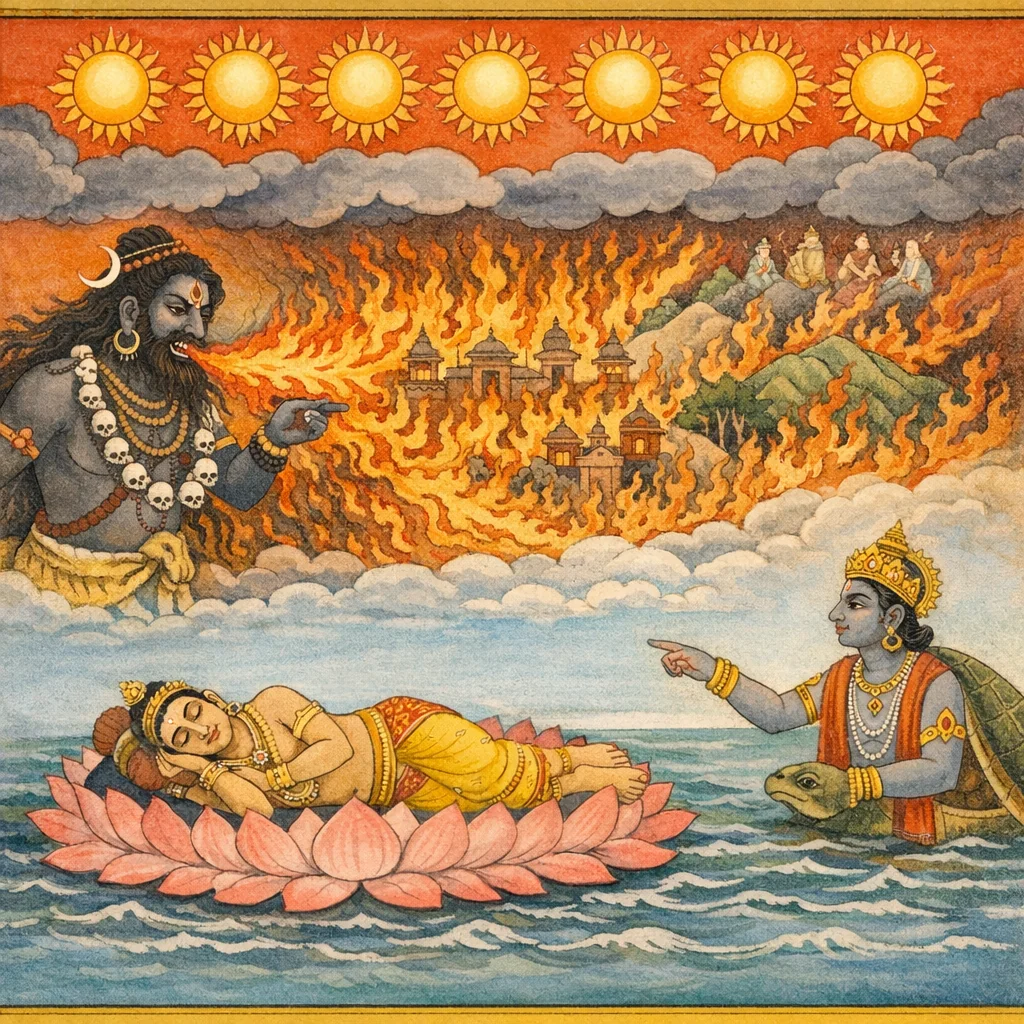
After the previous chapter, the sages—already taught liberating knowledge and the cosmic accounts of creation, lineages, and Manvantaras—ask Kūrma-Nārāyaṇa to explain pratisarga (secondary creation). The Lord classifies pralaya (dissolution) into four: nitya (constant), naimittika (occasional, at a kalpa’s end), prākṛta (elemental, the dissolution of evolutes from Mahat down to the viśeṣas), and ātyantika (absolute, liberation through knowledge). Having noted ātyantika as the yogin’s final absorption into the Supreme Self, he details naimittika-pralaya: a hundred-year drought, the rise of seven suns, and the Saṃvartaka fire—empowered by Rudra and Kālarudra—burning the worlds up to Maharloka until the cosmos becomes a single radiance. Storm-clouds then arise, quench the fire, and flood the universe for hundreds of years until only one ocean remains, while Prajāpati enters yogic sleep. The chapter ends by naming the present aeon the sāttvika Varāha Kalpa, explaining guṇa-based kalpas (the prominence of Hari/Hara/Prajāpati), and culminating in the Lord’s self-revelation as all-pervading—mantra, yajña, kṣetrajña, Prakṛti, and Kāla—affirming Śaiva–Vaiṣṇava concord and the yogic path to immortality, preparing for the ensuing exposition of pratisarga.
Shlokas
Verse 1
इति श्रीकूर्मपुराणे षट्साहस्त्र्यां संहितायामुपरिविभागे द्विचत्वारिंशो ऽध्यायः सूत उवाच एतदाकर्ण्य विज्ञानं नारायणमुखेरितम् / कूर्मरूपधरं देवं पप्रच्छुर्मुनयः प्रभुम्
Thus, in the Śrī Kūrma Purāṇa, in the Ṣaṭsāhasrī Saṃhitā of the latter division, the forty-second chapter concludes. Sūta said: Having heard this true spiritual knowledge spoken from the mouth of Nārāyaṇa, the sages then questioned the Lord—the divine One who had assumed the form of Kūrma, the Tortoise.
Verse 2
मुनय ऊचुः कथिता भवता धर्मा मोक्षज्ञानं सविस्तरम् / लोकानां सर्गविस्तारं वंशमन्वन्तराणि च
The sages said: “You have explained to us in full dharma and the knowledge that leads to moksha; and also the vast unfolding of the worlds’ creation, the dynastic lineages, and the successive Manvantaras.”
Verse 3
प्रतिसर्गमिदानीं नो वक्तुमर्हसी माधव / भूतानां भूतभव्येश यथा पूर्वं त्वयोदितम्
O Mādhava, you should now explain to us pratisarga—the secondary creation. O Lord of beings, Master of past and future, describe it just as you formerly declared.
Verse 4
सूत उवाच श्रुत्वा तेषां तदा वाक्यं भगवान् कूर्मरूपधृक् / व्याजहार महायोगी भूतानां प्रतिसंचरम्
Sūta said: Having heard their words at that time, the Blessed Lord who had assumed the form of Kūrma—the great Yogin—spoke of the re-absorption, the return of all beings.
Verse 5
कूर्म उवाच नित्यो नैमित्तिकश्चैव प्राकृतात्यन्तिकौ तथा / चतुर्धायं पुराणे ऽस्मिन् प्रोच्यते प्रतिसंचरः
Lord Kūrma said: In this Purāṇa, dissolution (pratisaṃcara) is taught as fourfold: the constant (nitya), the occasional (naimittika), the elemental (prākṛta), and the absolute (ātyantika).
Verse 6
यो ऽयं संदृश्यते नित्यं लोके भूतक्षयस्त्विह / नित्यः संकीर्त्यते नाम्ना मुनिभिः प्रतिसंचरः
That dissolution of beings which is constantly seen here in the world is spoken of by the sages as perpetual—called “nitya”—and is named pratisaṃcara, the recurring return into dissolution.
Verse 7
ब्राह्मो नैमित्तिको नाम कल्पान्ते यो भविष्यति / त्रैलोक्यस्यास्य कथितः प्रतिसर्गो मनीषिभिः
At the end of a kalpa there arises the Brahmā-born, occasional dissolution (naimittika-pralaya); and the wise have declared the pratisarga—the re-manifestation, the secondary creation—of this entire threefold world.
Verse 8
महादाद्यां विशेषान्तं यदा संयाति संक्षयम् / प्राकृतः प्रतिसर्गो ऽयं प्रोच्यते कालचिन्तकैः
When the succession of evolutes, from Mahat down to the particularized elements (viśeṣas), passes into dissolution, this is called the prākṛta pratisarga—so proclaim the contemplators of Kāla, Time.
Verse 9
ज्ञानादात्यन्तिकः प्रोक्तो योगिनः परमात्मनि / प्रलयः प्रतिसर्गो ऽयं कालचिन्तापरैर्द्विजैः
Through liberating knowledge it is taught that the yogin attains the final, absolute dissolution into the Paramātman, the Supreme Self. This dissolution and the ensuing re-creation are described by the twice-born sages absorbed in contemplation of Kāla, Time.
Verse 10
आत्यन्तिकश्च कथितः प्रलयो ऽत्र ससाधनः / नैमित्तिकमिदानीं वः कथयिष्ये समासतः
Here the ultimate dissolution (ātyantika-pralaya) has been explained, together with the means of attaining it. Now I shall describe to you, in brief, the occasional dissolution (naimittika-pralaya).
Verse 11
चतुर्युगसहस्रान्ते संप्राप्ते प्रतिसंचरे / स्वात्मसंस्थाः प्रजाः कर्तुं प्रतिपेदे प्रजापतिः
When the great turning of dissolution arrived at the end of a thousand caturyugas, Prajāpati set about bringing forth beings once more, re-establishing the creatures as resting within his own Self.
Verse 12
ततो भवत्यनावृष्टिस्तीव्रा सा शतवार्षिकी / भूतक्षयकरी घोरा सर्वभूतक्षयङ्करी
Then there arises a terrible drought—fierce, lasting a hundred years—wasting away creatures, dreadful and bringing destruction upon all beings.
Verse 13
ततो यान्यल्पसाराणि सत्त्वानि पृथिवीतले / तानि चाग्रे प्रलीयन्ते भूमित्वमुपयान्ति च
Then those beings upon the earth’s surface, slight in substance and weak in vitality—those first dissolve away and pass into the state of earth, absorbed into the element of soil.
Verse 14
सप्तरश्मिरथो भूत्वा समुत्तिष्ठन् दिवाकरः / असह्यरश्मिर्भवति पिबन्नम्भो गभस्तिभिः
Becoming the chariot of seven rays, the Sun rises; drinking the waters with his beams, he grows possessed of an unbearable brilliance.
Verse 15
तस्य ते रश्मयः सप्त पिबन्त्यम्बु महार्णवे / तेनाहारेण ता दीप्ताः सूर्याः सप्त भवन्त्युत
His seven rays drink up the waters of the great ocean; nourished by that intake, they blaze forth and indeed become the seven suns.
Verse 16
ततस्ते रश्मयः सप्त सूर्या भूत्वा चतुर्दिशम् / चतुर्लोकमिदं सर्वं दहन्ति शिखिनस्तथा
Then those rays, becoming seven suns, blaze in the four directions; and like tongues of fire they burn up this entire fourfold world.
Verse 17
व्याप्नुवन्तश्च ते विप्रास्तूर्ध्वं चाधश्च रश्मिभिः / दीप्यन्ते भास्कराः सप्त युगान्ताग्निप्रतापिनः
O brāhmaṇas, those seven suns spread their rays upward and downward, pervading every direction; they blaze with the scorching might of the fire that rises at the end of a yuga.
Verse 18
ते सूर्या वारिणा दीप्ता बहुसाहस्त्ररश्मयः / खं समावृत्य तिष्ठन्ति निर्दहन्तो वसुंधराम्
Those suns, blazing with the moisture of the waters and bearing many thousands of rays, stand covering the sky, scorching the earth.
Verse 19
ततस्तेषां प्रतापेन दह्यमाना वसुंधरा / साद्रिनद्यर्णवद्वीपा निस्नेहा समपद्यत
Then, scorched by their fiery potency, the Earth—together with her mountains, rivers, oceans, and islands—was drained of all moisture and fell into utter dryness.
Verse 20
दीप्ताभिः संतताभिश्च रश्मिभिर्वै समन्ततः / अधश्चोर्ध्वं च लग्नाभिस्तिर्यक् चैव समावृतम्
It was entirely enveloped on every side by radiant, unbroken rays—clinging below and above, and spread across the horizontal directions as well.
Verse 21
सूर्याग्निना प्रमृष्टानां संसृष्टानां परस्परम् / एकत्वमुपयातानामेकज्वालं भवत्युत
When things are kindled by the sun-fire and mingle with one another, those that have entered into unity indeed become a single flame.
Verse 22
सर्वलोकप्रणाशश्च सो ऽग्निर्भूत्वा सुकुण्डली / चतुर्लोकमिदं सर्वं निर्दहत्यात्मतेजसा
He becomes that Fire which brings about the destruction of all worlds—coiling in vast spirals—and by the radiance of his own inner power he burns up this entire fourfold world.
Verse 23
ततः प्रलीने सर्वस्मिञ् जङ्गमे स्थावरे तथा / निर्वृक्षा निस्तृणा भूमिः कूर्मपृष्ठा प्रकाशते
Then, when everything has dissolved—both the moving beings and the unmoving world—the earth appears, bereft of trees and grass, resting upon the back of Kūrma, the Tortoise.
Verse 24
अम्बरीषमिवाभाति सर्वमापूरितं जगत् / सर्वमेव तदर्चिर्भिः पूर्णं जाज्वल्यते पुनः
The entire world, filled to the brim, shines like a blazing furnace; indeed, everything is again wholly kindled, filled on all sides with those flames.
Verse 25
पाताले यानि सत्त्वानि महोदधिगतानि च / ततस्तानि प्रलीयन्ते भूमित्वमुपयान्ति च
All beings that dwell in Pātāla, as well as those that have entered the great ocean—thereafter they dissolve and pass into the state of earth, absorbed into the elemental ground.
Verse 26
द्वीपांश्च पर्वतांश्चैव वर्षाण्यथ महोदधीन् / तान् सर्वान् भस्मसात् कृत्वा सप्तात्मा पावकः प्रभुः
Having reduced to ashes the continents (dvīpas), mountains, great regions (varṣas), and even the mighty oceans, the sovereign Fire—sevenfold in nature—stands as the ruling power at the time of dissolution (pralaya).
Verse 27
समुद्रेभ्यो नदीभ्यश्च पातालेभ्यश्च सर्वशः / पिबन्नपः समिद्धो ऽग्निः पृथिवीमाश्रितो ज्वलन्
Blazing while resting upon the earth, the kindled Fire drank up the waters from the oceans, from the rivers, and from the subterranean realms on every side.
Verse 28
ततः संवर्तकः शैलानतिक्रम्य महांस्तथा / लोकान् दहति दीप्तात्मा रुद्रतेजोविजॄम्भितः
Then the Saṃvartaka, the cosmic fire of dissolution—its blazing nature expanded by Rudra’s fiery potency—overleaps even the mighty mountains and burns up the worlds.
Verse 29
स दग्ध्वा पृथिवीं देवो रसातलमशोषयत् / अधस्तात् पृथिवीं दग्ध्वा दिवमूर्ध्वं दहिष्यति
Having burned the earth, that divine Lord dried up Rasātala as well. After consuming the earth from below, he will then burn upward even the heavens.
Verse 30
योजनानां शतानीह सहस्राण्ययुतानि च / उत्तिष्ठन्ति शिखास्तस्य वह्नेः संवर्तकस्य तु
Here, the flames of that Saṃvartaka fire—the fire of cosmic dissolution—rise up for hundreds of yojanas, even for thousands and tens of thousands.
Verse 31
गन्धर्वांश्च पिशाचांश्च सयक्षोरगराक्षसान् / तदा दहत्यसौ दीप्तः कालरुद्रप्रचोदितः
Then that blazing one—impelled by Kālarudra—burns up the Gandharvas and Piśācas, along with the Yakṣas, serpentine beings (Nāgas/Uraga), and Rākṣasas.
Verse 32
भूर्लोकं च भुवर्लोकं स्वर्लोकं च तथा महः / दहेदशेषं कालाग्निः कालो विश्वतनुः स्वयम्
Time itself—whose body is the whole universe—becomes the Fire of Time and burns without remainder the Bhūrloka, the Bhuvarloka, the Svargaloka, and likewise the Maharloka.
Verse 33
व्याप्तेष्वेतेषु लोकेषु तिर्यगूर्ध्वमथाग्निना / तत् तेजः समनुप्राप्य कृत्स्नं जगदिदं शनैः / अयोगुडनिभं सर्वं तदा चैकं प्रकाशते
When all these worlds are pervaded by fire—spreading horizontally and rising upward—then, having entered into that blazing radiance, this entire universe gradually becomes like a glowing iron ball; and at that time it appears as a single, undivided light.
Verse 34
ततो गजकुलोन्नादास्तडिद्भिः समलङ्कृताः / उत्तिष्ठन्ति तदा व्योम्नि घोराः संवर्तका घनाः
Then, in the sky, terrible saṃvartaka storm-clouds arise—adorned with lightning and roaring like herds of elephants.
Verse 35
केचिन्नीलोत्पलश्यामाः केचित् कुमुदसन्निभाः / धूम्रवर्णास्तथा केचित् केचित् पीताः पयोधराः
Some were dark as blue lotuses; some resembled the pale kumuda-lily; some were smoke-hued; and some were of a golden-yellow color.
Verse 36
केचिद् रासभवर्णास्तु लाक्षारसनिभास्तथा / शङ्खकुन्दनिभाश्चान्ये जात्यञ्जननिभाः परे
Some were of a donkey-like hue; others resembled the color of lac-juice. Some were like conch-shell and jasmine; and others were like jasmine mixed with collyrium—darkened, kohl-like.
Verse 37
मनः शिलाभास्त्वन्ये च कपोतसदृशाः परे / इन्द्रगोपनिभाः केचिद्धरितालनिभास्तथा / इन्द्रचापनिभाः केचिदुत्तिष्ठन्ति घना दिवि
Some clouds appeared like dark stones, others like pigeons; some looked red like the indragopa insect, some yellow like orpiment; and some, rising in the sky, took on the form of Indra’s bow—the rainbow.
Verse 38
केचित् पर्वतसंकाशाः केचिद् गजकुलोपमाः / कूटाङ्गारनिभाश्चान्ये केचिन्मीनकुलोद्वहाः / बहूरूपा घोरूपा घोरस्वरनिनादिनः
Some appeared like mountains; some were like herds of elephants. Others looked like heaps of burning charcoal, and some like the mightiest among schools of fish. They were of many forms—fearsome in appearance—and they roared with dreadful, thunderous cries.
Verse 39
तदा जलधराः सर्वे पूरयन्ति नभः स्थलम् / ततस्ते जलदा घोरा राविणो भास्करात्मजाः / सप्तधा संवृतात्मानस्तमग्निं शमयन्त्युत
Then all the cloud-bearers filled the expanse of the sky. Thereupon those terrible rain-clouds—roaring, born of the Sun—gathered themselves in sevenfold formations and indeed quenched that fire.
Verse 40
ततस्ते जलदा वर्षं मुञ्चन्तीह महौघवत् / सुघोरमशिवं सर्वं नाशयन्ति च पावकम्
Then those rain-bearing clouds poured down torrents like vast floods; and by that exceedingly dreadful, inauspicious downpour they destroyed everything—and even extinguished the fire.
Verse 41
प्रवृष्टे च तदात्यर्थमम्भसा पूर्यते जगत् / अद्भिस्तेजोभिभूतत्वात् तदाग्निः प्रविशत्यपः
And when the great downpour begins, the world becomes completely filled with water. Overpowered by the waters, the principle of fire then enters into the waters—as though fire were withdrawn and absorbed into its causal element.
Verse 42
नष्टे चाग्नौ वर्षशतैः पयोदाः क्षयसंभवाः / प्लावयन्तो ऽथ भुवनं महाजलपरिस्त्रवैः
And when the fire has died away, for hundreds of years the clouds—born of dissolution (pralaya)—inundate the worlds, flooding the earth with vast torrents of water.
Verse 43
धाराभिः पूरयन्तीदं चोद्यमानाः स्वयंभुवा / अत्यन्तसलिलौघैश्च वेला इव महोदधिः
Urged on by Svayambhū, the Self-born Lord, torrents flooded this entire world—like the great ocean surging beyond its shoreline with overwhelming deluges.
Verse 44
साद्रिद्वीपा तथा पृथ्वी जलैः संच्छाद्यते शनैः / आदित्यरश्मिभिः पीतं जलमभ्रेषु तिष्ठति / पुनः पतति तद् भूमौ पूर्यन्ते तेन चार्णवाः
The earth—together with its mountains and islands—is gradually covered by waters. Drawn up by the sun’s rays, that water remains in the clouds; then it falls again upon the ground, and by that the oceans are replenished.
Verse 45
ततः समुद्राः स्वां वेलामतिक्रान्तास्तु कृत्स्नशः / पर्वताश्च विलीयन्ते मही चाप्सु निमज्जति
Then the oceans, entirely, overstep their own shorelines; the mountains dissolve away, and the earth itself sinks into the waters.
Verse 46
तस्मिन्नेकार्णवे घोरे नष्टे स्थावरजङ्गमे / योगनिन्द्रां समास्थाय शेते देवः प्रजापतिः
When that dreadful single ocean alone remained—after all that is stationary and moving had perished—the divine Lord, Prajāpati, entered yogic sleep (yoga-nidrā) and lay in repose.
Verse 47
चतुर्युगसहस्रान्तं कल्पमाहुर्महर्षयः / वाराहो वर्तते कल्पो यस्य विस्तार ईरितः
The great seers declare that a Kalpa endures until the completion of a thousand cycles of the four Yugas. The present Kalpa is the Varāha Kalpa, whose vast expanse has already been set forth in detail.
Verse 48
असंख्यातास्तथा कल्पा ब्रह्मविष्णुशिवात्मकाः / कथिता हि पुराणेषु मुनिभिः कालचिन्तकैः
Likewise, the Kalpas are innumerable, bearing the nature of Brahmā, Viṣṇu, and Śiva; indeed, they are described in the Purāṇas by sages who contemplate and discern Time.
Verse 49
सात्त्विकेष्वथ कल्पेषु माहात्म्यमधिकं हरेः / तामसेषु हरस्योक्तं राजसेषु प्रजापतेः
In Sāttvika Kalpas, the greater glory is that of Hari (Viṣṇu). In Tāmasa Kalpas, it is declared to be that of Hara (Śiva). And in Rājasa Kalpas, it is that of Prajāpati (Brahmā).
Verse 50
यो ऽयं प्रवर्तते कल्पो वाराहः सात्त्विको मतः / अन्ये च सात्त्विकाः कल्पा मम तेषु परिग्रहः
This Kalpa now in progress is known as the Varāha Kalpa, and it is regarded as Sāttvika. There are other Sāttvika Kalpas as well; among them, I have a special acceptance and affinity.
Verse 51
ध्यानं तपस्तथा ज्ञानं लब्ध्वा तेष्वेव योगिनः / आराध्य गिरिशं मां च यान्ति तत् परमं पदम्
Having attained meditation, austerity, and true knowledge, and abiding firmly in those disciplines, yogins—by worshipping Girīśa (Śiva) and Me as well—reach that supreme abode.
Verse 52
सो ऽहं सत्त्वं समास्थाय मायी मायामयीं स्वयम् / एकार्णवे जगत्यस्मिन् योगनिद्रां व्रजामि तु
I—established in the mode of sattva—wielding Māyā and myself constituted of Māyā, enter yogic sleep when this universe, at dissolution, becomes a single ocean.
Verse 53
मां पश्यन्ति महात्मानः सुप्तं कालं महर्षयः / जनलोके वर्तमानास्तपसा योगचक्षुषा
The great-souled sages, the maharishis, behold Me during the time when ordinary beings sleep; abiding in the world of men, they see by austerity (tapas) and by the yogic eye.
Verse 54
अहं पुराणपुरुषो भूर्भुवः प्रभवो विभुः / सहस्रचरणः श्रीमान् सहस्रांशुः सहस्रदृक्
I am the Purāṇa-Puruṣa, the Ancient Supreme Person—the source and pervader of Bhū and Bhuva; the origin, the all-powerful Lord. I am the One with a thousand feet, the glorious One—of a thousand rays and of a thousand eyes.
Verse 55
मन्त्रो ऽग्निर्ब्राह्मिणा गावः कुशाश्च समिधो ह्यहम् / प्रोक्षणी च श्रुवश्चैव सोमो घृतमथास्म्यहम्
I myself am the sacred mantra; I am the ritual fire. I am the Brāhmaṇas; I am the cows; I am the kuśa grass and the fuel-sticks. I am the sprinkling vessel and the ladle; I am Soma, and I am also the ghee.
Verse 56
संवर्तको महानात्मा पवित्रं परमं यशः / वेदो वेद्यं प्रभुर्गोप्ता गोपतिर्ब्रह्मणो मुखम्
He is Saṃvartaka, the great-souled One—purity itself and supreme glory. He is the Veda and the knowable meaning of the Veda; the sovereign Lord, the protector, Gopati (Lord of beings and of the cows), and the very mouth of Brahmā.
Verse 57
अनन्तस्तारको योगी गतिर्गतिमतां वरः / हंसः प्राणो ऽथ कपिलो विश्वमूर्तिः सनातनः
You are Ananta, the Endless; Tāraka, the Deliverer; the Yogin; the supreme Goal and the best refuge of all who seek the Goal. You are Haṃsa, the inner Self moving within all beings; You are Prāṇa, the life-breath; You are Kapila; You are the One whose form is the whole universe—eternal and primeval.
Verse 58
क्षेत्रज्ञः प्रकृतिः कालो जगद्बीजमथामृतम् / माता पिता महादेवो मत्तो ह्यन्यन्न विद्यते
I am the Knower of the Field (kṣetrajña), Prakṛti, and Time; I am the seed of the universe and also Amṛta, immortality. I am the Mother and the Father; I am Mahādeva. Apart from Me, nothing else exists.
Verse 59
आदित्यवर्णो भुवनस्य गोप्ता नारायणः पुरुषो योगमूर्तिः / मां पश्यन्ति यतयो योगनिष्ठा ज्ञात्वात्मानममृतत्वं व्रजन्ति
Nārāyaṇa—the Puruṣa, radiant like the sun, protector of the worlds, whose very form is Yoga—such as I am: the ascetics established in Yoga behold Me. Having realized the Self, they attain immortality.
Frequently Asked Questions
Pratisarga is framed as the re-manifestation that follows naimittika-pralaya at the end of a kalpa; the Lord first classifies pralaya types and then narrates the occasional dissolution whose aftermath necessitates secondary creation.
Ātyantika-pralaya is taught as the yogin’s final dissolution into the Supreme Self through liberating knowledge, implying that mokṣa culminates in realization of the Self as grounded in (and non-separate from) the Supreme reality.
The text uses guṇa-based cosmology—sāttvika, tāmasa, rājasa—to explain varying devotional prominence while maintaining a unified theological horizon, supporting the Kurma Purana’s samanvaya rather than sectarian exclusion.