Adhyaya 42
Tīrtha-Māhātmya and the Discipline of Pilgrimage (Tīrtha-sevā) within Prāyaścitta
Continuing the prior chapter’s momentum, Sūta advances a ranked catalogue of tīrthas and Śaiva sanctuaries as practical means of purification within prāyaścitta. He lists sites near Japyeśvara such as Pañcanada and Mahābhairava, praises the Vitastā as supreme among rivers/tīrthas, and highlights Pañcatapa where Viṣṇu worshipped Śiva to obtain the cakra—an explicit sign of Śaiva–Vaiṣṇava synthesis. He further names Kāyāvarohaṇa (seat of Māheśvara dharma), Kanyā-tīrtha, Rāma Jāmadagnya’s tīrtha, Mahākāla, and the esoteric Nakulīśvara, culminating in the proclamation of Kāśī (Vārāṇasī) as the highest holy city, of immeasurable merit and uniquely oriented to liberation. The chapter then disciplines pilgrimage: abandoning svadharma nullifies tīrtha-fruit; pilgrimage is prescribed for penitents and the fallen, with prerequisites—discharge the three debts, secure family duties, and then undertake tīrtha-sevā. It closes by promising that hearing or reciting this māhātmya itself purifies sin, shifting from place-praise to norm-governed religious praxis.
Shlokas
Verse 1
इति श्रीकूर्मपुराणे षट्साहस्त्र्यां संहितायामुपरिविभागे एकचत्वारिंशो ऽध्यायः सूत उवाच अन्यच्च तीर्थप्रवरं जप्येश्वरसमीपतः / नाम्ना पञ्चनदं पुण्यं सर्वपापप्रणाशनम्
Thus, in the Śrī Kūrma Purāṇa, in the Ṣaṭsāhasrī Saṃhitā, in the latter division—here ends the forty-first chapter. Sūta said: “And further, near Japyeśvara there is a foremost sacred ford, known as Pañcanada—holy, and the destroyer of all sins.”
Verse 2
त्रिरात्रोपोषितस्तत्र पूजयित्वा महेश्वरम् / सर्वपापविशुद्धात्मा रुद्रलोके महीयते
Having observed a three-night fast there and worshipped Maheśvara, one whose inner being is purified of all sins is honoured and attains eminence in Rudra’s world.
Verse 3
अन्यच्च तीर्थप्रवरं शङ्करस्यामितौजसः / महाभैरवमित्युक्तं महापातकनाशनम्
And further, there is another foremost sacred ford belonging to Śaṅkara of immeasurable power—called “Mahābhairava”—which destroys even the gravest sins.
Verse 4
तीर्थानां च परं तीर्थं वितस्ता परमा नदी / सर्वपापहरा पुण्या स्वयमेव गिरीन्द्रजा
Among all sacred fords, Vitastā is the supreme tirtha; among rivers she is the highest. Holy and merit-giving, she destroys all sins—she is indeed the daughter of the Lord of Mountains (Himālaya), manifest in her own right.
Verse 5
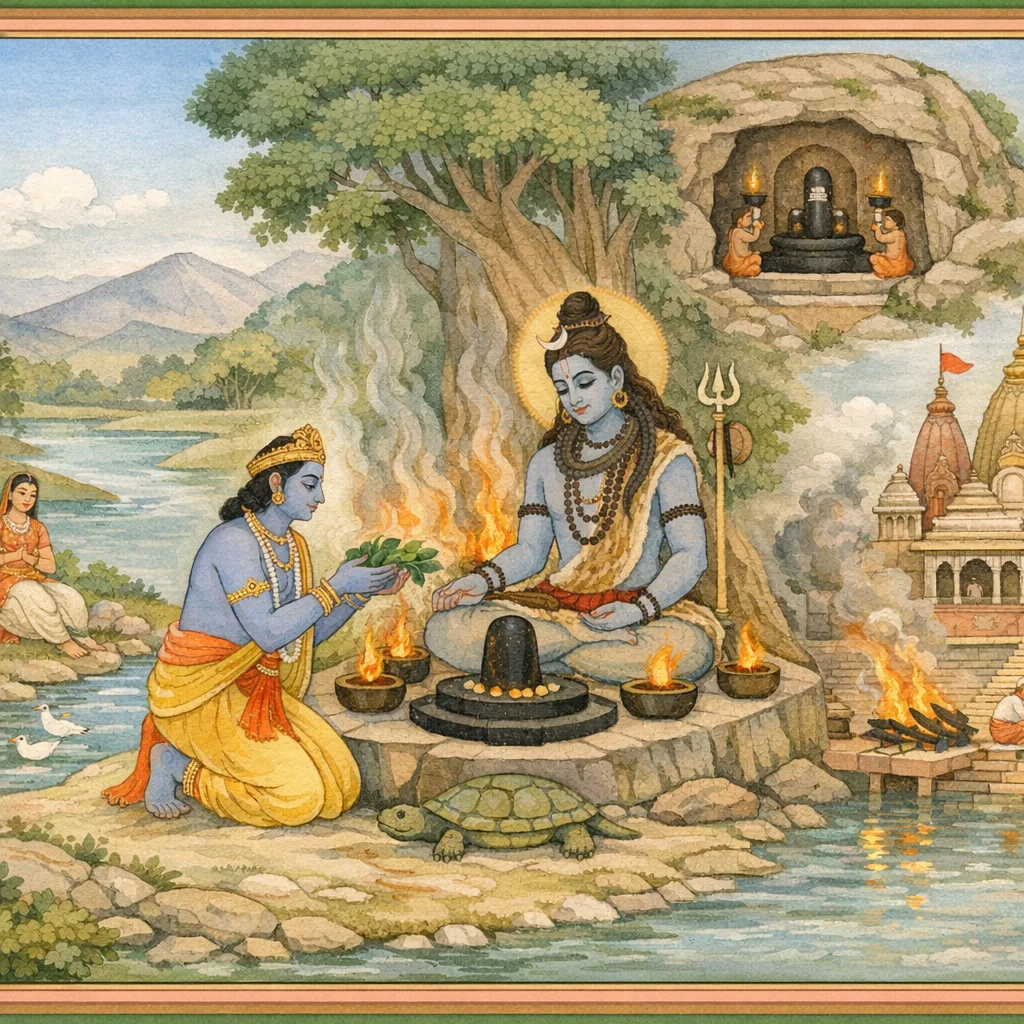
तीर्थं पञ्चतपं नाम शंभोरमिततेजसः / यत्र देवादिदेवेन चक्रार्थं पूजितो भवः
There is a sacred ford called Pañcatapa, belonging to Śambhu of immeasurable splendour—where Bhava (Śiva) was worshipped by the God of gods (Viṣṇu) for the sake of obtaining the cakra, the divine discus.
Verse 6
पिण्डदानादिकं तत्र प्रेत्यानन्तफलप्रदम् / मृतस्तत्रापि नियमाद् ब्रह्मलोके महीयते
There, acts such as offering piṇḍas (funerary rice-balls) bestow inexhaustible fruits after death. Even one who dies there, by the power of that sacred ordinance, is honored in the realm of Brahmā.
Verse 7
कायावरोहणं नाम महादेवालयं शुभम् / यत्र माहेश्वरा धर्मा मुनिभिः संप्रवर्तिताः
There is a blessed sanctuary of Mahādeva called Kāyāvarohaṇa, where the sages set in motion and established the Māheśvara disciplines of dharma.
Verse 8
श्राद्धं दानं तपो होम उपवासस्तथाक्षयः / परित्यजति यः प्राणान् रुद्रलोकं स गच्छति
One who gives up his life while established in śrāddha, charity, austerity, homa, fasting, and imperishable merit, goes to Rudra’s world (Rudraloka).
Verse 9
अन्यच्च तीर्थप्रवरं कन्यातीर्थमिति श्रुतम् / तत्र गत्वा त्यजेत् प्राणांल्लोकान् प्राप्नोति शाश्वतान्
And further, there is said to be an excellent sacred ford known as Kanyā-tīrtha. One who goes there and gives up the life-breath attains the eternal worlds.
Verse 10
जामदग्न्यस्य तु शुभं रामस्याक्लिष्टकर्मणः / तत्र स्नात्वा तीर्थ वरे गोसहस्रफलं लभेत्
At the auspicious sacred ford of Rāma Jāmadagnya—Rāma of unwearied deeds—one who bathes there, in that excellent tīrtha, attains the merit equal to the gift of a thousand cows.
Verse 11
महाकालमिति ख्यातं तीर्थं त्रैलोक्यविश्रुतम् / गत्वा प्राणान् परित्यज्य गाणपत्यमवाप्नुयात्
There is a sacred ford famed as “Mahākāla,” renowned throughout the three worlds. Having gone there, one who relinquishes the life-breath attains the state of Gaṇapati (lordship in Gaṇeśa’s sphere).
Verse 12
गुह्याद् गुह्यतमं तीर्थं नकुलीश्वरमुत्तमम् / तत्र सन्निहितः श्रीमान् भगवान् नकुलीश्वरः
More secret than the secret itself is the supremely excellent sacred ford called Nakulīśvara. There, the glorious Lord Nakulīśvara abides in a manifest presence.
Verse 13
हिमवच्छिखरे रम्ये गङ्गाद्वारे सुशोभने / देव्या सह महादेवो नित्यं शिष्यैश्च संवृतः
On a beautiful peak of the Himalaya, at the splendid gateway of the Gaṅgā (Gangādvāra), Mahādeva ever abides together with the Goddess, surrounded by his disciples.
Verse 14
तत्र स्नात्वा महादेवं पूजयित्वा वृषध्वजम् / सर्वपापैर्विमुच्येत मृतस्तज्ज्ञानमाप्नुयात्
Having bathed there and worshipped Mahādeva, the Bull-bannered Lord (Śiva), one is freed from all sins; and if one dies there, one attains the saving knowledge of Him.
Verse 15
अन्यच्च देवदेवस्य स्थानं पुण्यतमं शुभम् / भीमेश्वरमिति ख्यातं गत्वा मुञ्चति पातकम्
And further, there is another most holy and auspicious abode of the God of gods. It is renowned as Bhīmeśvara; by going there, one is released from sin.
Verse 16
तथान्यच्चण्डवेगायाः संभेदः पापनाशनः / तत्र स्नात्वा च पीत्वा च मुच्यते ब्रह्महत्यया
Likewise, another sacred confluence of the Caṇḍavegā River destroys sins. By bathing there and also drinking its water, one is released even from the sin of brahma-hatyā (the killing of a brāhmaṇa).
Verse 17
सर्वेषामपि चैतेषां तीर्थानां परमा पुरी / नाम्नावाराणसी दिव्या कोटिकोट्ययुताधिका
Among all these tīrthas, the supreme holy city is the radiant Vārāṇasī (Kāśī) by name—its merit surpassing crores upon crores, and more besides.
Verse 18
तस्याः पुरस्तान्माहात्म्यं भाषितं वो मया त्विह / नान्यत्र लभ्यते मुक्तिर्योगिनाप्येकजन्मना
Here I have already spoken to you of her sacred greatness. Liberation is not obtained elsewhere—not even by a yogin—within a single lifetime.
Verse 19
एते प्राधान्यतः प्रोक्ता देशाः पापहरा नृणाम् / गत्वा संक्षालयेत् पापं जन्मान्तरशतैः कृतम्
These regions have been declared, in brief and by priority, as the foremost lands that remove sin for human beings. By going there, one may wash away even the sins accumulated over hundreds of births.
Verse 20
यः स्वधर्मान् परित्यज्य तीर्थसेवां करोति हि / न तस्य फलते तीर्थमहि लोके परत्र च
He who, abandoning his own svadharma (ordained duties), engages in tīrtha-sevā (service of sacred places)—for him that tīrtha bears no fruit, neither in this world nor in the next.
Verse 21
प्रायश्चित्ती च विधुरस्तथा पापचरो गृही / प्रकुर्यात् तीर्थसंसेवां ये चान्ये तादृशा जनाः
A penitent performing prāyaścitta, a widower, and even a householder fallen into sinful conduct—these, and others of the same kind—should, with devotion, render service and resort to the sacred tīrthas for purification.
Verse 22
सहाग्निर्वा सपत्नीको गच्छेत् तीर्थानि यत्नतः / सर्वपापविनिर्मुक्तो यथोक्तां गतिमाप्नुयात्
Whether bearing the sacred fire or accompanied by his wife, one should diligently go to the tīrthas. Freed from all sins, he attains the very state of liberation that has been taught.
Verse 23
ऋणानि त्रीण्यपाकृत्य कुर्याद् वा तीर्थसेवनम् / विधाय वृत्तिं पुत्राणां भार्यां तेषु निधाय च
Having discharged the three debts—to the devas, the ṛṣis, and the ancestors—one may then undertake service and pilgrimage to the sacred tīrthas; and, after arranging the livelihood of one’s sons and entrusting one’s wife to their care, one should proceed accordingly.
Verse 24
प्रायश्चित्तप्रसङ्गेन तीर्थमाहात्म्यमीरितम् / यः पठेच्छृणुयाद् वापि मुच्यते सर्वपातकैः
Here, in the course of teaching prāyaścitta, the greatness of the sacred tīrthas has been proclaimed. Whoever recites it, or even hears it, is released from all sins.
Frequently Asked Questions
Pilgrimage is framed as part of prāyaścitta and must be grounded in svadharma: one should discharge the three debts, arrange family responsibilities, and then perform tīrtha-sevā; abandoning one’s ordained duties for pilgrimage is said to make the tīrtha fruitless.
It functions as samanvaya: the Purāṇa presents inter-devotional legitimacy by depicting Viṣṇu seeking Śiva’s grace for the cakra, reinforcing that Śaiva and Vaiṣṇava worship operate within a shared īśvara-centered sacral order.
The chapter declares Kāśī the highest holy city whose merit surpasses all measures and links it uniquely to liberation, implying that its soteriological efficacy exceeds ordinary tīrtha merit even for advanced practitioners.
Three-night fasting with Maheśvara worship (Pañcanada), piṇḍa/śrāddha rites yielding inexhaustible post-mortem results (Pañcatapa), bathing and worship leading to sin-destruction and liberating knowledge (Gangādvāra/Nakulīśvara region), and confluence bathing/drinking that removes even brahma-hatyā (Caṇḍavegā-saṅgama).