Adhyaya 44
Prākṛta-pralaya, Pratisarga Doctrine, and the Ishvara-Samanvaya of Yoga and Devotion
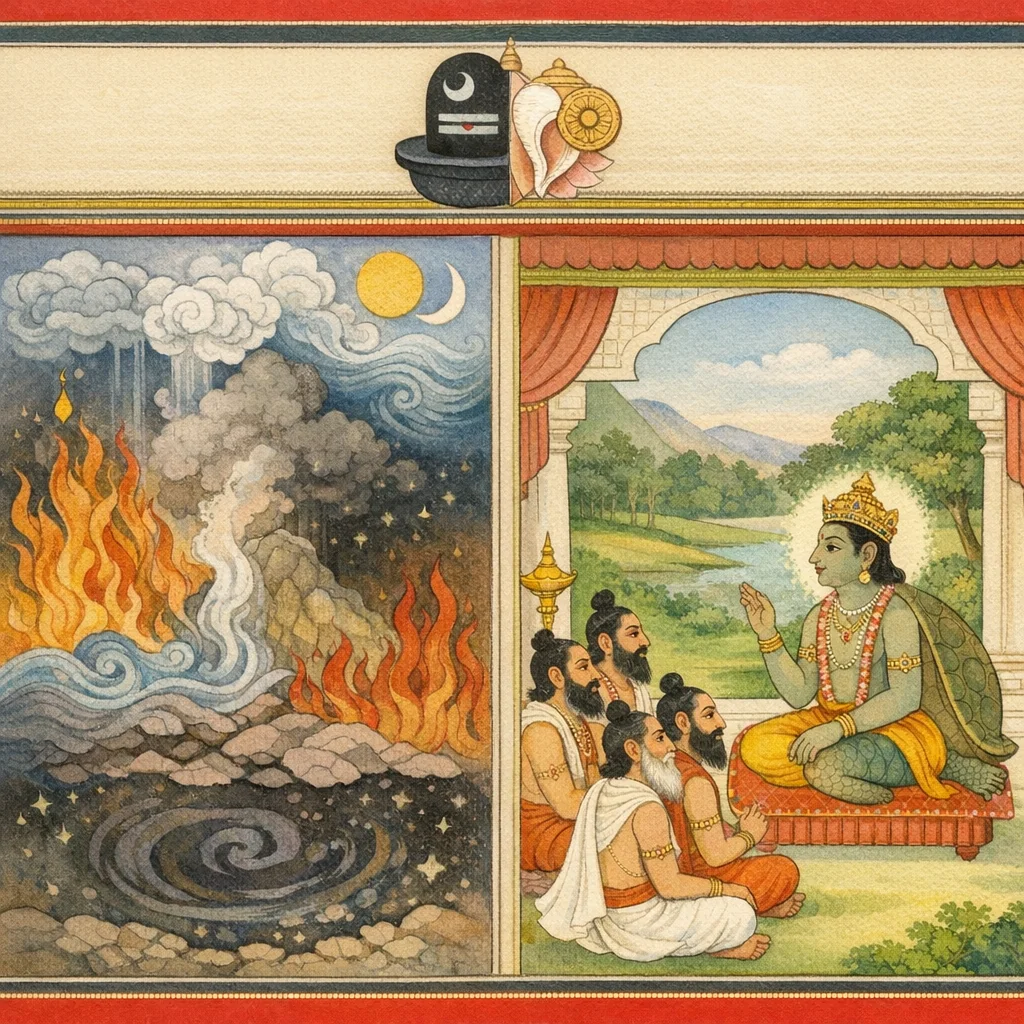
Continuing the prior cycle of instruction, Kūrma gives a concise account of pratisarga by first revealing the prākṛta dissolution: after vast aeons, Time becomes the world-burning Kāla-agni, and Maheśvara as Nīlalohita consumes the brahmāṇḍa. The teaching then turns to tattva-withdrawal—earth into waters, waters into fire, fire into wind, wind into space; senses and devas reabsorb into taijasa/vaikārika; the threefold ahaṅkāra returns to Mahat; the cosmos rests in the Unmanifest (Pradhāna/Prakṛti) while Puruṣa remains the witnessing 25th principle. Dissolution is affirmed as willed by Īśvara, and yogins are promised final absorption through Śaṅkara’s grace. The chapter harmonizes paths: nirguṇa yoga for the mature, saguṇa worship for aspirants, outlining sabīja and nirbīja disciplines and allowing graded deity-supports culminating in contemplation of Nārāyaṇa. It closes with a colophon-like survey of the whole Kūrma Purāṇa—its contents, the merit of recitation and gifting, and the authoritative lineage from Brahmā and the Kumāras to Vyāsa and Sūta—linking the doctrinal climax to the text’s conclusion and reception.
Shlokas
Verse 1
इति श्रीकूर्मपुराणे षट्साहस्त्र्यां संहितायामुपरिविभागे त्रिचत्वारिंशो ऽध्यायः कूर्म उवाच अतः परं प्रवक्ष्यामि प्रतिसर्गमनुत्तमम् / प्राकृतं हि समासेन शृणुध्वं गदतो मम
Thus, in the Śrī Kūrma Purāṇa, in the six-thousand-verse Saṃhitā, in the latter division, (begins) the forty-third chapter. Kūrma said: “Now, hereafter, I shall expound the unsurpassed teaching of pratisarga—secondary creation—namely the primordial (prākṛta) process, in brief. Listen as I speak.”
Verse 2
गते परार्धद्वितये कालो लोकप्रकालनः / कालाग्निर्भस्मसात् कर्तुं करोति निकिलं मतिम्
When two parārdhas have elapsed, Time—the regulator of the worlds—becomes Kālāgni, the Fire of Time, and it sets its resolve to reduce the entire cosmos to ashes.
Verse 3
स्वात्मन्यात्मानमावेश्य भूत्वा देवो महेश्वरः / दहेदशेषं ब्रह्माण्डं सदेवासुरमानुषम्
Having withdrawn the self into His own Self, the Lord Maheśvara becomes the consuming power and burns up the entire cosmos—this whole Brahmāṇḍa—together with gods, asuras, and human beings.
Verse 4
तमाविश्य महादेवो भगवान्नीललोहितः / करोति लोकसंहारं भीषणं रूपमाश्रितः
Entering into that principle and time of dissolution, Mahādeva—the Blessed Nīlalohita—assumes a fearsome form and brings about the destruction, the withdrawal, of the worlds.
Verse 5
प्रविश्य मण्डलं सौरं कृत्वासौ बहुधा पुनः / निर्दहत्यखिलं लोकं सप्तसप्तिस्वरूपधृक्
Entering the solar sphere, He again becomes manifold in many ways; assuming the form of the Sun with “seven sevens” of rays, He burns up the entire world.
Verse 6
स दग्ध्वा सकलं सत्त्वमस्त्रं ब्रह्मशिरो महत् / देवतानां शरीरेषु क्षिपत्यखिलदाहकम्
Having burned up every living being, that mighty missile called Brahmaśira—an all-consuming conflagration—was hurled into the bodies of the gods, scorching them entirely.
Verse 7
दग्धेष्वशेषदेवेषु देवी गिरिवरात्मजा / एकासा साक्षिणी शंभोस्तिष्ठते वैदिकी श्रुतिः
When all the gods had been consumed by the fiery power, the Goddess—the daughter of the Lord of mountains—alone remained as Śambhu’s witness; and the Vedic Śruti endured, standing as the single testimony.
Verse 8
शिरः कपालैर्देवानां कृतस्त्रग्वरभूषणः / आदित्यचन्द्रादिगणैः पूरयन् व्योममण्डलम्
Adorned with a splendid garland and noble ornaments fashioned from the skulls of the gods, he filled the vault of the sky with the hosts of the Sun, the Moon, and the other luminaries.
Verse 9
सहस्रनयनो देवः सहस्राकृतिरिश्वरः / सहस्रहस्तचरणः सहस्रार्चिर्महाभुजः
The Divine Lord, the Sovereign Īśvara, is thousand-eyed and of a thousand forms. With a thousand hands and feet, and with a thousand blazing rays, He is the Great-Armed One.
Verse 10
दंष्ट्राकरालवदनः प्रदीप्तानललोचनः / त्रिशूली कृत्तिवसनो योगमैश्वरमास्थितः
With fearsome jaws and protruding fangs, with eyes blazing like fire, bearing the trident and clad in a hide, he abides established in the sovereign Yoga of the Lord (Aiśvara-yoga).
Verse 11
पीत्वा तत्परमानन्दं प्रभूतममृतं स्वयम् / करोति ताण्डवं देवीमालोक्य परमेश्वरः
Having himself drunk that abundant nectar—supreme bliss—Parameśvara, on beholding the Goddess, performs the Tāṇḍava dance.
Verse 12
पीत्वा नृत्तामृतं देवी भर्तुः परममङ्गला / योगमास्थाय देवस्य देहमायाति शूलिनः
Having drunk the nectar of the Lord’s dance, the Goddess—supremely auspicious and devoted to her consort—enters yogic absorption and attains the very body of the trident-bearing God (Śiva).
Verse 13
संत्यक्त्वा ताण्डवरसं स्वेच्छयैव पिनाकधृक् / ज्योतिः स्वभावं भगवान् दग्ध्वा ब्रह्माण्डमण्डलम्
By his own free will, the Lord—bearer of the Pināka bow—cast aside the rapture of the Tāṇḍava, assumed his innate nature as pure Light, and with that radiance burned and consumed the entire cosmic sphere of the Brahmāṇḍa.
Verse 14
संस्थितेष्वथ देवेषु ब्रह्मविष्णुपिनाकिषु / गुणैरशेषैः पृथिवीविलयं याति वारिषु
Then, when the deities—Brahmā, Viṣṇu, and Śiva the Pināka-bearer—withdraw into their settled state, the earth, together with all its manifest qualities, passes into dissolution within the cosmic waters.
Verse 15
स वारितत्त्वं सगुणं ग्रसते हव्यवाहनः / तेजस्तु गुणसंयुक्तं वायौ संयाति संक्षयम्
Then fire—Havyavāhana—swallows up the water-principle together with its qualities; and fire itself, still conjoined with its qualities, passes into dissolution by merging into the wind.
Verse 16
आकाशे सगुणो वायुः प्रलयं याति विश्वभृत् / भूतादौ च तथाकाशं लीयते गुणसंयुतम्
At the time of dissolution, O Sustainer of the universe, the air—still bearing its qualities—merges into space. And likewise, at the primal source of the elements, space too is reabsorbed, together with its qualities.
Verse 17
इन्द्रियाणि च सर्वाणि तैजसे यान्ति संक्षयम् / वैकारिके देवगणाः प्रलंय यान्ति सत्तमाः
At dissolution, all the sense-faculties are absorbed into the taijasa principle; and the hosts of gods—O best of the virtuous—are likewise dissolved, merging back into the vaikārika principle.
Verse 18
वैकारिकस्तैजसश्च भूतादिश्चेति सत्तमाः / त्रिविधो ऽयमहङ्कारो महति प्रलंय व्रजेत्
O best of the virtuous, this ego-principle (ahaṅkāra) is threefold—sāttvika (vaikārika), rājasa (taijasa), and tāmasa (bhūtādi). At dissolution (pralaya) it is reabsorbed into Mahat, the cosmic intellect, and returns into it.
Verse 19
महान्तमेभिः सहितं ब्रह्माणमतितेजसम् / अव्यक्तं जगतो योनिः संहरेदेकमव्ययम्
Along with these Mahat-principles, He withdraws even Brahmā of surpassing radiance. The Unmanifest (Avyakta), womb of the universe, gathers the entire cosmos back into the One, the imperishable.
Verse 20
एवं संहृत्य भूतानि तत्त्वानि च महेश्वरः / वियोजयति चान्योन्यं प्रधानं पुरुषं परम्
Thus, having withdrawn the beings and the cosmic principles (tattvas), Mahādeva, the Great Lord, separates from one another Pradhāna (primordial Nature) and the supreme Puruṣa (Spirit).
Verse 21
प्रधानपुंसोरजयोरेष संहार ईरितः / महेश्वरेच्छाजनितो न स्वयं विद्यते लयः
Thus has been declared the dissolution of Pradhāna and Puruṣa along with the guṇas. Dissolution does not occur of itself; it arises only from the will of Maheśvara.
Verse 22
गुणसाम्यं तदव्यक्तं प्रकृतिः परिगीयते / प्रधानं जगतो योनिर्मायातत्त्वमचेतनम्
That state of equilibrium of the guṇas is called the Unmanifest (Avyakta). It is proclaimed as Prakṛti—the Pradhāna, the womb of the universe, the principle of Māyā, insentient in itself.
Verse 23
कूटस्थश्चिन्मयो ह्यात्मा केवलः पञ्चविंशकः / गीयते मुनिभिः साक्षी महानेकः पितामहः
The Ātman is kūṭastha, unchanging, pure consciousness—solitary and transcendent, the twenty-fifth principle. The sages sing of That as the Witness (sākṣin): the Great One, the One appearing as many, the primeval Grandsire (Pitāmaha).
Verse 24
एवं संहारकरणी शक्तिर्माहेश्वरी ध्रुवा / प्रधानाद्यं विशेषान्तं दहेद् रुद्र इति श्रुतिः
Thus the steadfast Maheshvarī Power—Śiva’s śakti whose office is dissolution (saṃhāra)—burns up the whole range of reality, from Pradhāna down to the last particularized evolutes. So declares the Śruti: “Rudra burns it all.”
Verse 25
योगिनामथ सर्वेषां ज्ञानविन्यस्तचेतसाम् / आत्यन्तिकं चैव लयं विदधातीह शङ्करः
And for all yogins whose minds are established in liberating knowledge, Śaṅkara (Śiva) here bestows the final and absolute laya—complete absorption into the Supreme.
Verse 26
इत्येष भगवान् रुद्रः संहारं कुरुते वशी / स्थापिका मोहनी शक्तिर्नारायण इति श्रुतिः
Thus the Blessed Lord Rudra—the sovereign—performs dissolution. Yet the establishing, deluding Power is known in the Śruti as Nārāyaṇa.
Verse 27
हिरण्यगर्भा भगवान् जगत् सदसदात्मकम् / सृजेदशेषं प्रकृतेस्तन्मयः पञ्चविंशकः
The Blessed Lord, as Hiraṇyagarbha, brings forth the entire universe—manifest and unmanifest in nature—out of Prakṛti. Pervading it as its very essence, He is spoken of as the twenty-fifth principle.
Verse 28
सर्वज्ञाः सर्वगाः शान्ताः स्वात्मन्येवव्यवस्थिताः / शक्तयो ब्रह्मविण्वीशा भुक्तिमुक्तिफलप्रदाः
These divine Powers (Śaktis) are all-knowing, all-pervading, and tranquil, established solely in their own Self. They are the Powers of Brahmā, Viṣṇu, and Īśa (Śiva), bestowing the fruits of bhukti (worldly enjoyment) and mukti (liberation).
Verse 29
सर्वेश्वराः सर्ववन्द्याः शाश्वतानन्तभोगिनः / एकमेवाक्षरं तत्त्वं पुंप्रधानेश्वरात्मकम्
All the lords (of the worlds) are worthy of all reverence, and they partake of eternal and unending enjoyments; yet the Reality is one alone—the imperishable Principle—whose nature is the triad of Puruṣa, Pradhāna, and Īśvara.
Verse 30
अन्याश्च शक्तयो दिव्याः सन्ति तत्र सहस्रशः / इज्यन्ते विविधैर्यज्ञैः शक्रादित्यादयो ऽमराः
And there, indeed, countless other divine powers are present in their thousands; and the immortals—Indra, the Ādityas, and the rest—are worshipped by means of many kinds of sacrificial rites (yajña).
Verse 31
एकैकस्य सहस्राणि देहानां वै शतानि च / कथ्यन्ते चैव माहात्म्याच्छक्तिरेकैव निर्गुणाः
For each (being), thousands—and even hundreds—of bodies are spoken of; yet, by virtue of the Supreme Greatness, the Power is only one, and it is nirguṇa (beyond all qualities).
Verse 32
तां तां शक्तिं समाधाय स्वयं देवो महेश्वरः / करोति देहान् विविधान् ग्रसते चैव लीलया
Assuming this or that power, the Lord—Mahēśvara Himself—manifests diverse bodies, and in the same way He also withdraws (devours) them, merely as His divine play (līlā).
Verse 33
इज्यते सर्वयज्ञेषु ब्राह्मणैर्वेदवादिभिः / सर्वकामप्रदो रुद्र इत्येषा वैदिकी श्रुतिः
In all sacrifices, Rudra is worshipped by Brahmins who proclaim the Veda. “Rudra is the giver of all desired aims”—this indeed is Vedic revelation (śruti).
Verse 34
सर्वासामेव शक्तीनां ब्रह्मविष्णुमहेश्वराः / प्राधान्येन स्मृता देवाः शक्तयः परमात्मनः
Among all divine powers, Brahmā, Viṣṇu, and Maheśvara are remembered as foremost; indeed, these gods are the pre-eminent śaktis—the operative potencies—of the Supreme Self (Paramātman).
Verse 35
आद्यः परस्ताद् भगवान् परमात्मा सनातनः / गीयते सर्वशक्त्यात्मा शूलपाणिर्महेश्वरः
He is the Primordial One, the Transcendent Lord—Supreme Self and Eternal. He is praised as the very embodiment of all powers: Maheśvara, the Trident-bearer.
Verse 36
एनमेके वदन्त्यग्निं नारायणमथापरे / इन्द्रमेके परे विश्वान् ब्रह्माणमपरे जगुः
Some call Him Agni; others call Him Nārāyaṇa. Some call Him Indra; others proclaim Him as the all-pervading Universe; and still others speak of Him as Brahmā.
Verse 37
ब्रह्मविष्णवग्निवरुणाः सर्वे देवास्तथर्षयः / एकस्यैवाथ रुद्रस्य भेदास्ते परिकीर्तिताः
Brahmā, Viṣṇu, Agni, Varuṇa—all the gods, and likewise the seers—are declared to be only differentiated manifestations of the one Rudra.
Verse 38
यं यं भेदं समाश्रित्य यजन्ति परमेश्वरम् / तत् तद् रूपं समास्थाय प्रददाति फलं शिवः
Whatever distinct conception people adopt and rely upon to worship the Supreme Lord, Śiva assumes that very form and grants the corresponding fruit of their devotion.
Verse 39
तस्मादेकतरं भेदं समाश्रित्यापि शाश्वतम् / आराधयन्महादेवं याति तत्परमं पदम्
Therefore, even if one adopts a single enduring standpoint, by worshipping Mahādeva one attains that supreme state, the highest abode.
Verse 40
किन्तु देवं महादेवं सर्वशक्तिं सनातनम् / आराधयेद् वै गिरिशं सगुणं वाथ निर्गुणम्
But one should indeed worship the God—Mahādeva, the eternal reservoir of all powers—Giriśa (Śiva), either as saguṇa, endowed with attributes, or as nirguṇa, beyond attributes.
Verse 41
मया प्रोक्तो हि भवतां योगः प्रागेव निर्गुणः / आरुरुक्षुस्तु सगुणं पूजयेत् परमेश्वरम्
Indeed, I have already taught you the nirguṇa yoga, beyond all attributes. But one who is still striving to ascend should worship the Supreme Lord in His saguṇa form, endowed with attributes.
Verse 42
पिनाकिनं त्रिनयनं जटिलं कृत्तिवाससम् / पद्मासनस्थं रुक्माभं चिन्तयेद् वैदिकी श्रुतिः
Vedic revelation enjoins one to meditate upon Śiva—bearer of the Pināka bow, three-eyed, matted-haired, clad in a skin—seated in lotus posture and radiant with golden splendor.
Verse 43
एष योगः समुद्दिष्टः सबीजो मुनिसत्तमाः / तस्मात् सर्वान् परित्यज्य देवान् ब्रह्मपुरोगमान् / आराधयेद् विरूपाक्षमादिमध्यान्तसंस्थितम्
O best of sages, this seed-bearing (bīja) Yoga has thus been taught. Therefore, abandoning all other gods—even those led by Brahmā—one should worship Virūpākṣa (Śiva), who abides as the Beginning, the Middle, and the End of all.
Verse 44
भक्तियोगसमायुक्तः स्वधर्मनिरतः शुचिः / तादृशं रूपमास्थाय समायात्यन्तिकं शिवम्
United with the Yoga of devotion, steadfast in one’s own dharma and purified, one assumes a form of that very kind; thus one draws near to Śiva, attaining Him in the ultimate sense.
Verse 45
एष योगः समुद्दिष्टः सबीजो ऽत्यन्तभावने / यथाविधि प्रकुर्वाणः प्राप्नुयादैश्वरं पदम्
This Yoga has been taught—seeded (bīja) as a support for profound contemplation. One who practices it according to the prescribed method attains the Lord’s sovereign state (aiśvarya-pada).
Verse 46
अत्राप्यशक्तो ऽथ हरं विष्णुं बह्माणमर्चयेत् / अथ चेदसमर्थः स्यात् तत्रापि मुनिपुङ्गवाः / ततो वाय्वग्निशक्रादीन् पूजयेद् भक्तिसंयुतः
Even here, if one is unable (to perform the prescribed worship), then let one worship Hara (Śiva), Viṣṇu, and Brahmā. And if one is incapable even of that, O best of sages, then, endowed with devotion, let one worship Vāyu, Agni, Śakra (Indra), and the other deities.
Verse 47
ये चान्ये भावने शुद्धे प्रागुक्ते भवतामिह / अथापि कथितो योगो निर्बोजश्च सबीजकः
And those other pure contemplative disciplines previously taught here for your benefit—along with them, Yoga too has been explained: both the seedless (nirbīja) and the with-seed (sabīja) forms.
Verse 48
ज्ञानं तदुक्तं निर्बोजं पूर्वं हि भवतां मया / विष्णुं रुद्रं विरञ्चिं च सबीजं भावयेद् बुधः / सथवाग्न्यादिकान् देवांस्तत्परः संयतेन्द्रियः
That knowledge which I earlier declared to you as “seedless” (nirbīja) has indeed been taught. Yet the wise aspirant—self-restrained, senses mastered, intent on That—should also contemplate “with seed” (sabīja) Viṣṇu, Rudra, and Virañci (Brahmā), and likewise the deities beginning with Agni, as supports for meditation.
Verse 49
पूजयेत् पुरुषं विष्णुं चतुर्मूर्तिधरं हरिम् / अनादिनिधनं देवं वासुदेवं सनातनम्
One should worship Viṣṇu, the Supreme Person—Hari who bears the fourfold manifestation—Vāsudeva, the eternal God, without beginning and without end.
Verse 50
नारायणं जगद्योनिमाकाशं परमं पदम् / तल्लिङ्गधारी नियतं तद्भक्तस्तदपाश्रयः / एष एव विधिर्ब्राह्मे भावने चान्तिके मतः
Fixing contemplation on Nārāyaṇa—womb of the universe, all-pervading like space, and the Supreme Abode—one should steadfastly bear His sacred marks, remain disciplined, be devoted to Him, and take refuge in Him alone. This alone is held to be the proper method in the Brahmic tradition, both for inner contemplation and for intimate approach to the Divine.
Verse 51
इत्येतत् कथितं ज्ञानं भावनासंश्रयं परम् / इन्द्रद्युम्नाय मुनये कथितं यन्मया पुरा
Thus has this supreme knowledge—grounded in contemplative realization (bhāvanā)—been taught. It is the very teaching that I formerly imparted to the sage Indradyumna.
Verse 52
अव्यक्तात्मकमेवेदं चेतनाचेतनं जगत् / तदीश्वरः परं ब्रह्म तस्माद् ब्रह्ममयं जगत्
This entire universe—both the conscious and the unconscious—has the unmanifest (avyakta) as its very essence. Its Lord is the Supreme Brahman; therefore the world is pervaded by Brahman and made of Brahman.
Verse 53
सूत उवाच एतावदुक्त्वा भगवान् विरराम जनार्दनः / तुष्टुवुर्मुनयो विष्णुं शक्रेण सह माधवम्
Sūta said: Having spoken thus much, the Blessed Lord Janārdana fell silent. Then the sages, together with Śakra (Indra), praised Viṣṇu—Mādhava.
Verse 54
मुनय ऊचुः नमस्ते कूर्मरूपाय विष्णवे परमात्मने / नारायणाय विश्वाय वासुदेवाय ते नमः
The sages said: Salutations to You who have assumed the form of the Tortoise—to Viṣṇu, the Supreme Self. Salutations to You as Nārāyaṇa, as the very Universe, and as Vāsudeva.
Verse 55
नमो नमस्ते कृष्णाय गोविन्दाय नमो नमः / माधवाय नमस्तुभ्यं नमो यज्ञेश्वराय च
Repeated salutations to You, Kṛṣṇa; salutations to Govinda again and again. Salutations to You, Mādhava, and salutations to You as Yajñeśvara, the Lord of sacrifice.
Verse 56
सहस्रशिरसे तुभ्यं सहस्राक्षाय ते नमः / नमः सहस्रहस्ताय सहस्रचरणाय च
Salutations to You of a thousand heads; salutations to You of a thousand eyes. Salutations to You of a thousand hands, and also to You of a thousand feet.
Verse 57
ॐ नमो ज्ञानरूपाय परमात्मस्वरूपिणे / आनन्दाय नमस्तुभ्यं मायातीताय ते नमः
Om—salutations to You whose very form is Consciousness, whose nature is the Supreme Self. Salutations to You who are Bliss; reverence to You who transcend Māyā.
Verse 58
नमो गूढशरीराय निर्गुणाय नमो ऽस्तु ते / पुरुषाय पुराणाय सत्तामात्रस्वरूपिणे
Salutations to You whose body is hidden beyond perception; salutations to You who are without attributes (nirguṇa). Salutations to the primeval Puruṣa, the Ancient One, whose very nature is pure Being alone.
Verse 59
नमः सांख्याय योगाय केवलाय नमो ऽस्तु ते / धर्मज्ञानाधिगम्याय निष्कलाय नमो नमः
Homage to You as Sāṃkhya and as Yoga; homage to You, the One alone (kevala). Homage again and again to You who are realized through dharma and true knowledge, and who are partless (niṣkala).
Verse 60
नमोस्तु व्योमतत्त्वाय महायोगेश्वराय च / परावराणां प्रभवे वेदवेद्याय ते नमः
Salutations to You who are the principle of space (vyoma-tattva), and to You, the Great Lord of Yoga (Mahāyogeśvara). Salutations to You, the source of both the higher and the lower (para–apara), and to You who are knowable through the Vedas.
Verse 61
नमो बुद्धाय शुद्धाय नमो युक्ताय हेतवे / नमो नमो नमस्तुभ्यं मायिने वेधसे नमः
Homage to the Pure Enlightened Intellect (buddhi); homage to You, the disciplined One who is the very Cause. Again and again I bow to You—O wielder of Māyā, O Vedhas, the divine Ordainer and Creator.
Verse 62
नमो ऽस्तु ते वराहाय नारसिंहाय ते नमः / वामनाय नमस्तुभ्यं हृषीकेशाय ते नमः
Salutations to You as Varāha; salutations to You as Narasiṃha. Salutations to You as Vāmana; salutations to You, Hṛṣīkeśa, Lord of the senses.
Verse 63
नमो ऽस्तु कालरुद्राय कालरूपाय ते नमः / स्वर्गापवर्गदात्रे च नमो ऽप्रतिहतात्मने
Salutations to Kālarudra; salutations to You whose very form is Time. Salutations to the Giver of heaven and of liberation; salutations to the One whose Self is unobstructed and invincible.
Verse 64
नमो योगाधिगम्याय योगिने योगदायिने / देवानां पतये तुभ्यं देवार्तिशमनाय ते
Salutations to You, attainable through Yoga—You who are the supreme Yogi and the giver of Yoga. Salutations to You, the Lord of the gods, the one who brings the gods’ distress to an end.
Verse 65
भगवंस्त्वत्प्रसादेन सर्वसंसारनाशनम् / अस्माभिर्विदितं ज्ञानं यज्ज्ञात्वामृतमश्नुते
O Blessed Lord, by your grace we have come to know that knowledge which destroys the whole round of worldly existence; knowing it, one attains immortality.
Verse 66
श्रुतास्तु विविधा धर्मा वंशा मन्वन्तराणि च / सर्गश्च प्रतिसर्गश्च ब्रह्माण्यस्यास्य विस्तरः
Here have been heard the many kinds of dharma, the dynastic lineages, and the cycles of Manus; likewise creation and re-creation—this is the extensive account of this Brahmāṇḍa (the cosmic egg/universe).
Verse 67
त्वं हि सर्वजगत्साक्षी विश्वो नारायणः परः / त्रातुमर्हस्यनन्तात्मंस्त्वमेव शरणं गतिः
You indeed are the Witness of the entire universe—the all-pervading Nārāyaṇa, the Supreme. O Infinite-Souled One, you are able to protect; you alone are my refuge and my final resort.
Verse 68
सूत उवाच एतद् वः कथितं विप्रा योगमोक्षप्रदायकम् / कौर्मं पुराणमखिलं यज्जगाद गदाधरः
Sūta said: O Brāhmaṇas, thus have I narrated to you the entire Kaurma Purāṇa, bestowing Yoga and liberation, just as Gadādhara (Lord Viṣṇu) proclaimed.
Verse 69
अस्मिन् पुराणे लक्ष्म्यास्तु संभवः कथितः पुरा / मोहायाशेषभूतानां वासुदेवेन योजनम्
In this Purāṇa, the manifestation of Śrī (Lakṣmī) was formerly recounted; and also the divine arrangement made by Vāsudeva, by which all beings are veiled in delusion.
Verse 70
प्रजापतीनां सर्गस्तु वर्णधर्माश्च वृत्तयः / धर्मार्थकाममोक्षाणां यथावल्लक्षणं शुभम्
Auspiciously are set forth the accounts of the creation of the Prajāpatis, the duties of the social orders and their proper livelihoods, and the true characteristics of Dharma, Artha, Kāma, and Mokṣa, exactly as they should be.
Verse 71
पितामहस्य विष्णोश्च महेशस्य च धीमतः / एकत्वं च पृथक्त्वं च विशेषश्चोपवर्णितः
The unity, the distinctness, and the specific differentiations of Pitāmaha (Brahmā), Viṣṇu, and the wise Maheśa (Śiva) have been described.
Verse 72
भक्तानां लक्षणं प्रोक्तं समाचारश्च शोभनः / वर्णाश्रमाणां कथितं यथावदिह लक्षणम्
The characteristics of devotees have been declared, along with their noble code of conduct; and here, in due order, the defining marks of the varṇas and āśramas have also been properly described.
Verse 73
आदिसर्गस्ततः पश्चादण्डावरणसप्तकम् / हिरण्यगर्भसर्गश्च कीर्तितो मुनिपुङ्गवाः
Then the primordial creation (ādi-sarga) was described; thereafter the sevenfold coverings of the cosmic egg (brahmāṇḍa) were explained; and the creation of Hiraṇyagarbha, the cosmic Brahmā, was also recounted, O foremost of sages.
Verse 74
कालसंख्याप्रकथनं माहात्म्यं चेश्वरस्य च / ब्रह्मणः शयनं चाप्सु नामनिर्वचनं तथा
Here are set forth the reckoning of cosmic time and the majesty of the Lord Īśvara; also Brahmā’s repose upon the waters, and likewise the derivation and explanation of names.
Verse 75
वराहवपुषा भूयो भूमेरुद्धरणं पुनः / मुख्यादिसर्गकथनं मुनिसर्गस्तथापरः
Again, in the form of Varāha, the uplifting of the Earth is described; then follows the account of the primary and other creations, and thereafter the creation of the sages as well.
Verse 76
व्याख्यतो रुद्रसर्गश्च ऋषिसर्गश्च तापसः / धर्मस्य च प्रजासर्गस्तामसात् पूर्वमेव तु
Thus the creation associated with Rudra, the creation of the sages, and the ascetic creation have been explained; and the creation of Dharma and the creation of progeny (beings) occur earlier than the tamasic creation.
Verse 77
ब्रह्मविष्णुविवादः स्यादन्तर्देहप्रवेशनम् / पद्मोद्भवत्वं देवस्य मोहस्तस्य च धीमतः
There arose a dispute between Brahmā and Viṣṇu; then occurred the entering into the inner body. There is also the account of the deity’s being lotus-born, and the delusion that came upon that wise one as well.
Verse 78
दर्शनं च महेशस्य माहात्म्यं विष्णुनेरितम् / दिव्यदृष्टिप्रदानं च ब्रह्मणः परमेष्ठिनः
Also recounted are the sacred vision of Maheśa, the greatness proclaimed by Viṣṇu, and the bestowal of divine sight upon Brahmā—Parameṣṭhin, the Supreme Lord of beings.
Verse 79
संस्तवो देवदेवस्य ब्रह्मणा परमेष्ठिना / प्रसादो गिरिशस्याथ वरदानं तथैव च
There was a hymn of praise to the God of gods, uttered by Brahmā, Parameṣṭhin; then came Girīśa’s (Śiva’s) gracious favor, and likewise the granting of a boon.
Verse 80
संवादो विष्णुना सार्धं शङ्करस्य महात्मनः / वरदानं तथापूर्वमन्तर्धानं पिनाकिनः
Here is told the dialogue of the great-souled Śaṅkara with Viṣṇu, along with Śiva’s granting of a boon, and then—most wondrously—Pinākin’s (Śiva’s) disappearance from sight.
Verse 81
वधश्च कथितो विप्रा मधुकैटभयोः पुरा / अवतारो ऽथ देवस्य ब्रह्मणो नाभिपङ्कजात्
O brāhmaṇas, the ancient slaying of Madhu and Kaiṭabha has been narrated; and then was described the manifestation of the god Brahmā, born from the lotus upon the Lord’s navel.
Verse 82
एकीभावश्च देवस्य विष्णुना कथितस्ततः / विमोहो ब्रह्मणश्चाथ संज्ञालाभो हरेस्ततः
Then Viṣṇu explained the oneness of the Lord; thereafter Brahmā’s delusion was dispelled, and then the true identity of Hari was recognized.
Verse 83
तपश्चरणमाख्यातं देवदेवस्य धीमतः / प्रादुर्भावो महेशस्य ललाटात् कथितस्ततः
Thus has been described the practice of austerity (tapas) by the wise Devadeva, the God of gods; and thereafter was narrated the manifestation of Maheśa from his forehead.
Verse 84
रुद्राणां कथिता सृष्टिर्ब्रह्मणः प्रतिषेधनम् / भूतिश्च देवदेवस्य वरदानोपदेशकौ
Here have been described the emanation of the Rudras and Brahmā’s restraint (his being checked). Also described are the majesty of Devadeva (Śiva) and the instruction concerning the granting of boons.
Verse 85
अन्तर्धानं च रुद्रस्य तपश्चर्याण्डजस्य च / दर्शनं देवदेवस्य नरनारीशरीरता
“Here is described the disappearance (antardhāna) of Rudra, and also of the one born from austerity; and the vision of Devadeva—revealing the embodiment that is both man and woman.”
Verse 86
देव्या विभागकथनं देवदेवात् पिनाकिनः / देव्यास्तु पश्चात् कथितं दक्षपुत्रीत्वमेव च
Thus has been narrated—by Pinākin (Śiva), the God of gods—the account of the Goddess’s divine portions; and thereafter has also been told the Goddess’s very becoming the daughter of Dakṣa.
Verse 87
हिमवद्दुहितृत्वं च देव्या माहात्म्यमेव च / दर्शनं दिव्यरूपस्य वैश्वरूपस्य दर्शनम्
And it speaks of the Goddess being the daughter of Himavat, and indeed of the Goddess’s greatness; it also tells of the vision of her divine form—yes, the vision of her universal (cosmic) form.
Verse 88
नाम्नां सहस्रं कथितं पित्रा हिमवता स्वयम् / उपदेशो महादेव्या वरदानं तथैव च
The thousand sacred Names were proclaimed by the Father—Himavat himself; likewise were told Mahādevī’s instruction and the granting of boons.
Verse 89
भृग्वादीनां प्रजासर्गो राज्ञां वंशस्य विस्तरः / प्राचेतसत्वं दक्षस्य दक्षयज्ञविमर्दनम्
These are described: the begetting of progeny beginning with Bhṛgu and the other sages; the detailed unfolding of royal dynasties; Dakṣa’s descent from Pracetā; and the disruption of Dakṣa’s sacrifice.
Verse 90
दधीचस्य च दक्षस्य विवादः कथितस्तदा / ततश्च शापः कथितो मुनीनां मुनिपुङ्गवाः
At that time the dispute between Dadhīci and Dakṣa was recounted; thereafter, O foremost of sages, the curse pronounced by the sages was also described.
Verse 91
रुद्रागतिः प्रसादश्च अन्तर्धानं पिनाकिनः / पितामहस्योपदेशः कीर्त्यते रक्षणाय तु
Rudra’s course, his gracious favor, and the disappearance of the wielder of the Pināka bow are described; and the Grandsire Brahmā’s instruction is proclaimed for protection.
Verse 92
दक्षस्य च प्रजासर्गः कश्यपस्य महात्मनः / हिरण्यकशिपोर्नाशो हिरण्याक्षवधस्तथा
Also described are Dakṣa’s emanation of progeny and that of the great-souled Kaśyapa; likewise, the destruction of Hiraṇyakaśipu and the slaying of Hiraṇyākṣa.
Verse 93
ततश्च शापः कथितो देवदारुवनौकसाम् / निग्रहश्चान्धकस्याथ गाणपत्यमनुत्तमम्
Then was recounted the curse uttered by the sages dwelling in the Devadāru forest; and thereafter the subjugation of Andhaka, along with the unsurpassed teaching concerning Lord Gaṇapati.
Verse 94
प्रह्रादनिग्रहश्चाथ बलेः संयमनं ततः / बाणस्य निग्रहश्चाथ प्रसादस्तस्य शूलिनः
Then came the curbing of Prahlāda; thereafter the restraint of Bali; then the subjugation of Bāṇa—and finally the gracious favor of the Trident-bearing Lord (Śiva).
Verse 95
ऋषीणां वंशविस्तारो राज्ञां वंशाः प्रकीर्तिताः / वसुदेवात् ततो विष्णोरुत्पत्तिः स्वेच्छया हरेः
Thus the extensive lineages of the seers and the dynasties of kings have been recounted. Thereafter, from Vasudeva occurred the manifestation of Viṣṇu—Hari’s birth taking place by his own free will.
Verse 96
दर्शनं चोपमन्योर्वै तपश्चरणमेव च / वरलाभो महादेवं दृष्ट्वा साम्बं त्रिलोचनम्
And there is the auspicious vision of Upamanyu, and indeed the very undertaking of austerity; and the gaining of a boon—after beholding Mahādeva, Sāmba, the three-eyed Lord.
Verse 97
कैलासगमनं चाथ निवासस्तत्र शार्ङ्गिणः / ततश्च कथ्यते भीतिर्द्वारिवत्या निवासिनाम्
Then comes the account of the journey to Kailāsa and of Śārṅgiṇ (Viṣṇu, the wielder of the Śārṅga bow) residing there; thereafter is narrated the fear that arose among the inhabitants of Dvārivatī.
Verse 98
रक्षणं गरुडेनाथ जित्वा शत्रून् महाबलान् / नारादागमनं चैव यात्रा चैव गरुत्मतः
(This section describes) the protection bestowed by Garuḍa, O Lord, after he had conquered mighty enemies; and also the coming of Nārada, as well as the onward journey of Garutmān (Garuḍa).
Verse 99
ततश्च कृष्णागमनं मुनीनामागतिस्ततः / नैत्यकं वासुदेवस्य शिवलिङ्गार्चनं तथा
Then follows the coming of Kṛṣṇa, and thereafter the arrival of the sages; and also the account of Vāsudeva’s daily religious observance—namely, the worship of the Śiva-liṅga.
Verse 100
मार्कण्डेयस्य च मुनेः प्रश्नः प्रोक्तस्ततः परम् / लिङ्गार्चननिमित्तं च लिङ्गस्यापि सलिङ्गिनः
Next, the question of the sage Mārkaṇḍeya was stated; and thereafter the reason for worshipping the Liṅga was explained—showing the significance of the Liṅga as well as of the Liṅgin, the One who bears the Liṅga (Śiva).
Verse 101
यथात्म्यकथनं चाथ लिङ्गाविर्भाव एव च / ब्रह्मविष्णोस्तथा मध्ये कीर्तितो मुनिपुङ्गवाः
And then, O foremost of sages, the exposition of the true nature (of the Self) is given, as well as the very manifestation of the Liṅga; and likewise the (account of the) Liṅga that was proclaimed as standing between Brahmā and Viṣṇu.
Verse 102
मोहस्तयोस्तु कथितो गमनं चोर्ध्वतो ऽप्यधः / संस्तवो देवदेवस्य प्रसादः परमेष्ठिनः
Thus the delusion of those two has been described, and also their movement—both upward and downward. (Now is declared) the hymn of praise to the God of gods, and the grace of the Supreme Lord (Parameṣṭhin).
Verse 103
अन्तर्धानं च लिङ्गस्य साम्बोत्पत्तिस्ततः परम् / कीर्तिता चानिरुद्धस्य समुत्पत्तिर्द्विजोत्तमाः
The disappearance of the Liṅga and, thereafter, the birth of Sāmba have been recounted; and likewise, O best among the twice-born, the origin of Aniruddha has been told.
Verse 104
कृष्णस्य गमने बुद्धिरृषीणामागतिस्तथा / अनुवशासितं च कृष्णेन वरदानं महात्मनः
There was resolve concerning Kṛṣṇa’s departure, and likewise the coming of the sages; and Kṛṣṇa instructed and bestowed a boon upon that great-souled one.
Verse 105
गमनं चैव कृष्णस्य पार्थस्यापि च दर्शनम् / कृष्णद्वैपायनस्योक्ता युगधर्माः सनातनाः
Thus were described Kṛṣṇa’s departure and Pārtha’s (Arjuna’s) final vision; and the eternal duties of the ages—the yuga-dharmas—taught by Kṛṣṇa Dvaipāyana (Vyāsa).
Verse 106
अनुग्रहो ऽथ पार्थस्य वाराणसीगतिस्ततः / पाराशर्यस्य च मुनेर्व्यासस्याद्भुतकर्मणः
Then is described the divine favor shown to Pārtha (Arjuna), and thereafter his journey to Vārāṇasī; and also the wondrous deeds of the sage Vyāsa, son of Parāśara.
Verse 107
वारणस्याश्च माहात्म्यं तीर्थानां चैव वर्णनम् / तीर्थयात्रा च व्यासस्य देव्याश्चैवाथ दर्शनम् / उद्वासनं च कथितं वरदानं तथैव च
The greatness of Vārāṇasī has been set forth, along with a description of the sacred tīrthas. Vyāsa’s pilgrimage and his vision of the Goddess are recounted; likewise her ritual dismissal (udvāsana) and the granting of boons are described.
Verse 108
प्रयागस्य च माहात्म्यं क्षेत्राणामथ कीर्तिनम् / फलं च विपुलं विप्रा मार्कण्डेयस्य निर्गमः
Here are set forth the greatness of Prayāga, the proclamation of the fame of the sacred tīrthas, and the abundant spiritual fruit of such merit—O brāhmaṇas—as well as the departure of Mārkaṇḍeya: these are the themes.
Verse 109
भुवनानां स्वरूपं च ज्योतिषां च निवेशनम् / कीर्त्यन्ते चैव वर्षाणि नदीनां चैव निर्णयः
The true forms of the worlds and the stations of the celestial luminaries are described; likewise the varṣas are enumerated, and the classification and determination of the rivers is set forth.
Verse 110
पर्वतानां च कथनं स्थानानि च दिवौकसाम् / द्वीपानां प्रविभागश्च श्वेतद्वीपोपवर्णनम्
Next comes the account of the mountains, the abodes of the celestial beings, the division of the dvīpas, and the description of Śvetadvīpa.
Verse 111
शयनं केशवस्याथ माहात्म्यं च महात्मनः / मन्वन्तराणां कथनं विष्णोर्माहात्म्यमेव च
Then will be described Keshava’s divine repose and the greatness of that Great-souled Lord; the account of the Manvantaras, and indeed the glory of Viṣṇu as well.
Verse 112
वेदशाखाप्रणयनं व्यासानां कथनं ततः / अवेदस्य च वेदानां कथनं मुनिपुङ्गवाः
O foremost of sages, thereafter comes the account of the composition and arrangement of the Vedic branches, the narration of the lineage of the Vyāsas, and also the exposition of both what lies outside the Veda (a-veda) and what belongs to the Vedas.
Verse 113
योगेश्वराणां च कथा शिष्याणां चाथ कीर्तनम् / गीताश्च विविधागुह्या ईश्वरस्याथ कीर्तिताः
Here are recounted the tales of the great Lords of Yoga, and also the accounts of their disciples; and likewise the many secret and varied songs and teachings of the Lord Īśvara are proclaimed.
Verse 114
वर्णाश्रमाणामाचाराः प्रायश्चित्तविधिस्ततः / कपालित्वं च रुद्रस्य भिक्षाचरणमेव च
The disciplines of conduct for the various varṇas and āśramas are taught, and then the ordinances of expiation (prāyaścitta); as well as Rudra’s state as a skull-bearing ascetic (kapālika) and his very practice of living by alms.
Verse 115
पतिव्रतायाश्चाख्यानं तीर्थानां च विनिर्णयः / तथा मङ्कणकस्याथ निग्रहः कीर्त्यते द्विजाः
O twice-born sages, here too is recounted the tale of the devoted chaste wife (pativratā), the authoritative determination of the sacred tīrthas, and likewise the subduing of Maṅkaṇaka.
Verse 116
वधश्च कथितो विप्राः कालस्य च समासतः / देवदारुवने शंभोः प्रवेशो माधवस्य च
And, O brāhmaṇas, the slaying of Kāla has been related in brief; likewise, the entry of Śaṃbhu into the Devadāru forest—and that of Mādhava as well.
Verse 117
दर्शनं षट्कुलीयानां देवदेवस्य धीमतः / वरदानं च देवस्य नन्दिने तु प्रकीर्तितम्
Here is proclaimed the sacred vision (darśana) granted to the six lineages by the wise God of gods; and also the boon bestowed by that Lord upon Nandin.
Verse 118
नैमित्तिकस्तु कथितः प्रतिसर्गस्ततः परम् / प्राकृतः प्रलयश्चोर्ध्वं सबीजो योग एव च
Thus has the occasional (naimittika) re-creation been declared; next comes the primordial (prākṛta) dissolution on the higher plane, and also Yoga “with seed” (sabīja)—the meditative discipline that retains a supporting object.
Verse 119
एवं ज्ञात्वा पुराणस्य संक्षेपं कीर्तयेत् तु यः / सर्वपापविनिर्मुक्तो ब्रह्मलोके महीयते
Thus, whoever, having understood the concise essence of this Purāṇa, proclaims it, is freed from all sins and is honored in the world of Brahmā.
Verse 120
एवमुक्त्वा श्रियं देवीमादाय पुरुषोत्तमः / संत्यज्य कूर्मसंस्थानं स्वस्थानं च जगाम ह
Having spoken thus, the Supreme Person (Puruṣottama) took the goddess Śrī (Lakṣmī) with him; abandoning his Kūrma (tortoise) form, he indeed departed to his own supreme abode.
Verse 121
देवाश्च सर्वे मुनयः स्वानि स्थानानि भेजिरे / प्रणम्य पुरुषं विष्णुं गृहीत्वा ह्यमृतं द्विजाः
All the gods and the sages returned to their own abodes; and the twice-born (dvija), having bowed to Viṣṇu—the Supreme Person—departed after receiving amṛta, the nectar of immortality.
Verse 122
एतत् पुराणं परमं भाषितं कूर्मरूपिणा / साक्षाद् देवादिदेनेन विष्णुना विश्वयोनिना
This Purāṇa—supreme among sacred teachings—was spoken by the One in the form of Kūrma, the Tortoise: by Viṣṇu Himself, God of gods, the direct source from whom the universe is born.
Verse 123
यः पठेत् सततं मर्त्यो नियमेन समाहितः / सर्वपापविनिर्मुक्तो ब्रह्मलोके महीयते
Any mortal who recites this continually, with disciplined observance and a collected mind, is freed from all sins and is honored in the world of Brahmā.
Verse 124
लिखित्वा चैव यो दद्याद् वैशाखे मासि सुव्रतः / विप्राय वेदविदुषे तस्य पुण्यं निबोधत
Know the merit of that disciplined votary who, in the month of Vaiśākha, has this sacred text written out and then donates it to a Brāhmaṇa learned in the Veda.
Verse 125
सर्वपापविनिर्मुक्तः सर्वैश्वर्यसमन्वितः / भुक्त्वा च विपुलान्स्वर्गे भोगान्दिव्यान्सुशोभनान्
Freed from all sins and endowed with every form of prosperity, he enjoys in heaven abundant, divine, and splendid pleasures.
Verse 126
ततः स्वर्गात् परिभ्रष्टो विप्राणां जायते कुले / पूर्वसंस्कारमाहात्म्याद् ब्रह्मविद्यामवाप्नुयात्
Then, having fallen back from heaven, he is born in the family of Brāhmaṇas; and by the power of impressions formed in the past (saṃskāras), he attains the knowledge of Brahman (brahma-vidyā).
Verse 127
पठित्वाध्यायमेवैकं सर्वपापैः प्रमुच्यते / योर्ऽथं विचारयेत् सम्यक् स प्राप्नोति परं पदम्
By reading even a single chapter, one is released from all sins; but the one who rightly contemplates its meaning attains the supreme state.
Verse 128
अध्येतव्यमिदं नित्यं विप्रैः पर्वणि पर्वणि / श्रोतव्यं च द्विजश्रेष्ठा महापातकनाशनम्
This sacred teaching should be studied continually by the brāhmaṇas on each day of holy observance; and it should also be heard, O best of the twice-born, for it destroys great sins.
Verse 129
एकतस्तु पुराणानि सेतिहासानि कृत्स्नशः / एकत्र चेदं परममेतदेवातिरिच्यते
If, on one side, all the Purāṇas together with the Itihāsas are placed in full, and this (the Kūrma Purāṇa) is placed on the other, then this alone is supreme—it surpasses even that collection.
Verse 130
धर्मनैपुण्यकामानां ज्ञाननैपुण्यकामिनाम् / इदं पुराणं मुक्त्वैकं नास्त्यन्यत् साधनं परम्
For those who seek excellence in dharma and merit, and for those who desire excellence in spiritual knowledge—apart from this single Purāṇa, there is no other supreme means of attainment.
Verse 131
यथावदत्र भगवान् देवो नारायणो हरिः / कथ्यते हि यथा विष्णुर्न तथान्येषु सुव्रताः
Here the Blessed Lord—Nārāyaṇa, Hari—is described fully in accordance with truth; for Viṣṇu is taught here as He truly is, not in the same way as in other texts, O you of excellent vows.
Verse 132
ब्राह्मी पौराणिकी चेयं संहिता पापनाशनी / अत्र तत् परमं ब्रह्म कीर्त्यते हि यथार्थतः
This is the Brahmā-born, Purāṇic compendium that destroys sin; here the Supreme Brahman is indeed proclaimed exactly as it truly is.
Verse 133
तीर्थानां परमं तीर्थं तपसां च परं तपः / ज्ञानानां परमं ज्ञानं व्रतानां परमं व्रतम्
Among all tīrthas, this is the supreme tīrtha; among austerities (tapas), this is the highest tapas; among knowledges, this is the supreme knowledge; and among vows (vratas), this is the highest vow.
Verse 134
नाध्येतव्यमिदं शास्त्रं वृषलस्य च सन्निधौ / यो ऽधीते स तु मोहात्मा स याति नरकान् बहून्
This sacred śāstra should not be studied in the presence of a vṛṣala (one outside the bounds of dharma). Whoever studies it in such a setting, with a deluded mind, goes to many hells.
Verse 135
श्राद्धे वा दैविके कार्ये श्रावणीयं द्विजातिभिः / यज्ञान्ते तु विशेषेण सर्वदोषविशोधनम्
At a śrāddha or in any rite performed for the devas, the dvijas (twice-born) should recite the prescribed sacred recitation that is to be heard. And especially at the close of a yajña, it is a purifier that cleanses away every defect.
Verse 136
मुमुक्षूणामिदं शास्त्रमध्येतव्यं विशेषतः / श्रोतव्यं चाथ मन्तव्यं वेदार्थपरिबृंहणम्
For those who seek liberation (mumukṣus), this śāstra should be studied with special care; it should also be heard and then reflected upon, for it expands and elucidates the meaning of the Vedas.
Verse 137
ज्ञात्वा यथावद् विप्रेन्द्रान् श्रावयेद् भक्तिसंयुतान् / सर्वपापविनिर्मुक्तो ब्रह्मसायुज्यमाप्नुयात्
Having duly understood the teaching, one should cause the foremost of Brahmins (viprendras), endowed with bhakti, to hear it. Freed from all sins, one attains sāyujya—union with Brahman.
Verse 138
यो ऽश्रद्दधाने पुरुषे दद्याच्चाधार्मिके तथा / स प्रेत्य गत्वा निरयान् शुनां योनिं व्रजत्यधः
Whoever gives a gift to a man devoid of faith—and likewise to one who is unrighteous—after death goes to the hell-realms and then falls into birth among dogs.
Verse 139
नमस्कृत्वा हरिं विष्णुं जगद्योनिं सनातनम् / अध्येतव्यमिदं शास्त्रं कृष्णद्वैपायनं तथा
Having bowed to Hari—Vishnu, the eternal womb-source of the universe—one should then study this sacred teaching, as composed and handed down by Kṛṣṇa Dvaipāyana (Vyāsa).
Verse 140
इत्याज्ञा देवदेवस्य विष्णोरमिततेजसः / पाराशर्यस्य विप्रर्षेर्व्यासस्य च महात्मनः
Thus was the command of Vishnu, the God of gods, of immeasurable splendor—and also of the great-souled sage Vyāsa, son of Parāśara, the seer among Brahmins.
Verse 141
श्रुत्वा नारायणाद् दिव्यां नारदो भगवानृषिः / गौतमाय ददौ पूर्वं तस्माच्चैव पराशरः
Having heard the divine teaching from Nārāyaṇa, the venerable sage Nārada first imparted it to Gautama; and from him, in turn, Parāśara also received and transmitted it.
Verse 142
पराशरो ऽपि भगवान गङ्गाद्वारे मुनीश्वराः / मुनिभ्यः कथयामास धर्मकामार्थमोक्षदम्
At Gaṅgādvāra, the venerable sage Parāśara too—revered as a Bhagavān—addressed the foremost sages and expounded to the ascetics that teaching which bestows dharma, kāma, artha, and mokṣa.
Verse 143
ब्रह्मणा कथितं पूर्वं सनकाय च धीमते / सनत्कुमाराय तथा सर्वपापप्रणाशनम्
Formerly, Brahmā taught this to the wise Sanaka, and likewise to Sanatkumāra—this teaching that destroys all sins.
Verse 144
सनकाद् भगवान् साक्षाद् देवलो योगवित्तमः / अवाप्तवान् पञ्चशिखो देवलादिदमुत्तमम्
From Sanaka himself, the venerable Devala—foremost among the knowers of Yoga—received this supreme teaching; and from Devala, Pañcaśikha obtained this excellent doctrine.
Verse 145
सनत्कुमाराद् भगवान् मुनिः सत्यवतीसुतः / लेभे पुराणं परमं व्यासः सर्वार्थसंचयम्
From Sanatkumāra, the venerable sage Vyāsa, the son of Satyavatī, received this supreme Purāṇa, a compendium that gathers together the essence of all aims and meanings.
Verse 146
तस्माद् व्यासादहं श्रुत्वा भवतां पापनाशनम् / ऊचिवान् वै भवद्भिश्च दातव्यं धार्मिके जने
Therefore, having heard from Vyāsa what destroys your sins, I have indeed declared that you too should give in charity, offering gifts to a righteous person.
Verse 147
तस्मै व्यासाय गुरवे सर्वज्ञाय महर्षये / पाराशर्याय शान्ताय नमो नारायणात्मने
Salutations to that Vyāsa—my teacher, the all-knowing great seer—Parāśara’s son, the tranquil one, whose very self is Nārāyaṇa.
Verse 148
यस्मात् संजायते कृत्सनं यत्र चैव प्रलीयते / नमस्तस्मै सुरेशाय विष्णवे कूर्मरूपिणे
From whom the whole universe arises, and in whom it is dissolved—salutations to that Lord of the gods, to Vishnu who bears the form of Kurma, the sacred Tortoise.
Frequently Asked Questions
It describes a total withdrawal initiated when Time becomes Kāla-agni and Maheśvara consumes the brahmāṇḍa, followed by systematic reabsorption of elements, senses, devas, ahaṅkāra, and Mahat into the Unmanifest (Pradhāna/Prakṛti), with Puruṣa remaining as the witness.
The chapter uses Sāṃkhya-Yogic language: Puruṣa is the 25th tattva, unchanging witness-consciousness; the manifest cosmos returns to Pradhāna in dissolution; and the Supreme is affirmed as one imperishable Reality approached through multiple divine forms—supporting both devotional theism and contemplative non-duality.
It explicitly advances samanvaya: Rudra is praised as the one appearing as many and as the recipient of Vedic worship, while Nārāyaṇa is identified as the deluding/establishing power and as the supreme refuge; worship of either, in saguṇa or nirguṇa modes, is presented as leading toward the Supreme.
Nirbīja is meditation without an object-support, aimed at attributeless realization; sabīja employs supports such as Viṣṇu, Rudra, Brahmā, and other deities for contemplation, recommended for aspirants still ascending toward nirguṇa steadiness.