Adhyaya 31
Kapālamocana: The Cutting of Brahmā’s Fifth Head, Śiva’s Kāpālika Vow, and Purification in Vārāṇasī
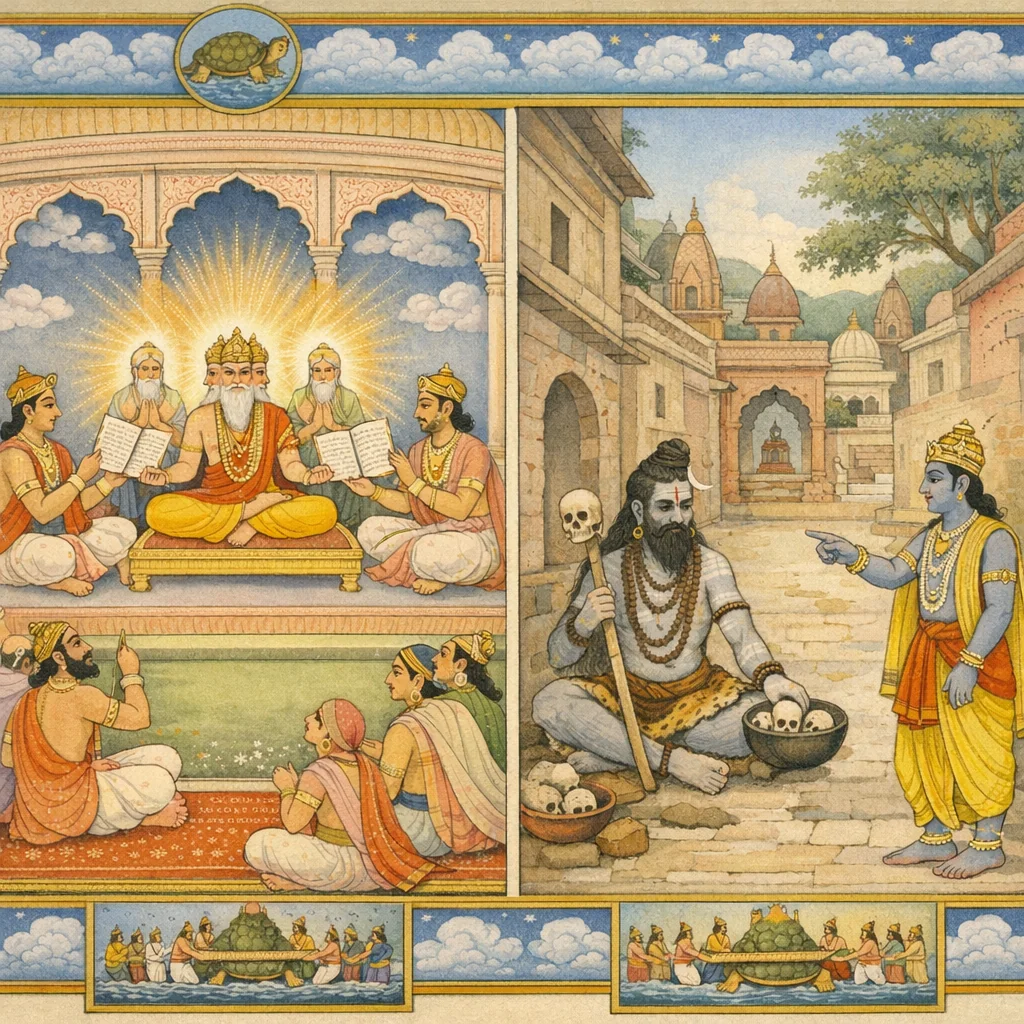
Continuing the Uttara-bhāga’s Śaiva-yogic emphasis, this chapter tells how Brahmā, deluded by Īśvara’s māyā, claims supremacy and disputes with a manifestation that is a portion of Nārāyaṇa. The four Vedas intervene and testify that the imperishable tattva is Maheśvara, yet Brahmā’s error persists until a vast radiance appears and Nīlalohita manifests; Kālabhairava severs Brahmā’s fifth head, raising the burden of brahmahatyā. Brahmā then beholds Mahādeva with Mahādevī in an inner yogic maṇḍala, praises them (Somāṣṭaka/Śatarudrīya), and receives restoration and instruction. Śiva is commanded to bear the skull and undertake a mendicant vow to teach the world, accompanied by the personified sin Brahmahatyā until he reaches Vārāṇasī. Approaching Viṣṇu’s abode, Śiva clashes with Viṣvaksena, who is slain; Viṣṇu offers blood-alms, yet the skull-bowl cannot be filled. Viṣṇu directs Śiva to Vārāṇasī; upon entering, Brahmahatyā falls to Pātāla, and Śiva sets down the skull at Kapālamocana, establishing a sin-destroying tīrtha. The chapter ends with a phalaśruti: remembrance, bathing, and recitation remove sins and grant supreme knowledge at death, leading into later tīrtha and yogic-liberation teachings.
Shlokas
Verse 1
इति श्रीकूर्मपुराणे षट्साहस्त्र्यां संहितायामुपरिविभागे त्रिशो ऽध्यायः ऋषय ऊचुः कथं देवेन रुद्रेण शङ्करेणामितौजसा / कपालं ब्रह्मणः पूर्वं स्थापितं देहजं भुवि
Thus, in the Śrī Kūrma Purāṇa, in the Ṣaṭsāhasrī Saṃhitā of the latter division, the thirty-first chapter begins. The sages said: “How was Brahmā’s skull—born of his own body—formerly set down upon the earth by the god Rudra, Śaṅkara of immeasurable might?”
Verse 2
सूत उवाच शृणुध्वमृषयः पुण्यां कथां पापप्रणाशनीम् / माहात्म्यं देवदेवस्य महादेवस्य धीमतः
Sūta said: “Listen, O sages, to this holy narrative that destroys sin—the sacred greatness of Mahādeva, the wise Lord of lords, Devadeva.”
Verse 3
पुरा पितामहं देवं मेरुशृङ्गे महर्षयः / प्रोचुः प्रणम्य लोकादिं किमेकं तत्त्वमव्ययम्
Formerly, on the peak of Mount Meru, the great seers, bowing down to the divine Pitāmaha (Brahmā)—the primal source of the worlds—asked: “What is the one imperishable Reality (tattva)?”
Verse 4
स मायया महेशस्य मोहितो लोकसंभवः / अविज्ञाय परं भावं स्वात्मानं प्राह धर्षिणम्
Thus the originator of the worlds, deluded by Maheśa’s māyā, failing to recognize the Supreme Reality, spoke arrogantly about his own self.
Verse 5
अहं धाता जगद्योनिः स्वयंभूरेक ईश्वरः / अनादिमत्परं ब्रह्म मामभ्यर्च्य विमुच्यते
I am the Sustainer, the womb-source of the universe, the Self-born One—the one Lord. I am the beginningless, supreme Brahman; by worshipping Me, one is set free.
Verse 6
अहं हि सर्वदेवानां प्रवर्तकनिवर्तकः / न विद्यते चाभ्यधिको मत्तो लोकेषु कश्चन
I alone am the impeller and the restrainer of all the gods; and in all the worlds there exists none who is superior to Me.
Verse 7
तस्यैवं मन्यमानस्य जज्ञे नारायणांशजः / प्रोवाच प्रहसन् वाक्यं रोषताम्रविलोचनः
While he was thinking in that way, one born as a portion of Nārāyaṇa manifested; with a faint smile he spoke words—his eyes copper-red with wrath.
Verse 8
किं कारणमिदं ब्रह्मन् वर्तते तव सांप्रतम् / अज्ञानयोगयुक्तस्य न त्वेतदुचितं तव
O Brahman, revered sage, what is the cause of this condition that has come upon you now? To be joined to the yoga of ignorance is indeed not fitting for you.
Verse 9
अहं धाता हि लोकानां यज्ञो नारायणः प्रभुः / न मामृते ऽस्य जगतो जीवनं सर्वदा क्वचित्
I am indeed the Sustainer of the worlds; I am the Yajña, the sacred sacrifice itself; I am Nārāyaṇa, the Supreme Lord. Without Me, this universe has no life—at any time, anywhere.
Verse 10
अहमेव परं ज्योतिरहमेव परा गतिः / मत्प्रेरितेन भवता सृष्टं भुवनमण्डलम्
I alone am the Supreme Light; I alone am the highest Goal. Impelled by Me, you have created this entire cosmic sphere—the circle of worlds.
Verse 11
एवं विवदतोर्मोहात् परस्परजयैषिणोः / आजग्मुर्यत्र तौ देवौ वेदाश्चत्वार एव हि
Thus, as those two deities—deluded and disputing, each intent on defeating the other—argued on and on, the four Vedas indeed came to the very place where they were.
Verse 12
अन्वीक्ष्य देवं ब्रह्माणं यज्ञात्मानं च संस्थितम् / प्रोचुः संविग्नहृदया याथात्म्यं परमेष्ठिनः
Having carefully observed the divine Brahmā—steadfast, and established as the very Self of sacrifice (Yajña)—they, with hearts stirred in anxious reverence, spoke out the true account of Parameṣṭhin (the Supreme Ordainer).
Verse 13
ऋग्वेद उवाच यस्यान्तः स्थानि भूतानि यस्मात्सर्वं प्रवर्तते / यदाहुस्तत्परं तत्त्वं स देवः स्यान्महेश्वरः
Ṛgveda said: “He within whom all beings abide, from whom the whole universe proceeds—what the wise declare to be that supreme Reality: that very Deity is Maheśvara.”
Verse 14
यजुर्वेद उवाच यो यज्ञैरखिलैरीशो योगेन च समर्च्यते / यमाहुरीश्वरं देवं स देवः स्यात् पिनाकधृक्
The Yajurveda said: “He who—the Lord—is worshipped through all sacrifices, and also duly revered through Yoga; he whom they call the God, Īśvara—may that very God indeed be Pinākadhṛk, the bearer of the bow Pināka (Śiva).”}]}}】}
Verse 15
सामवेद उवाच येनेदं भ्राम्यते चक्रं यदाकाशान्तरं शिवम् / योगिभिर्विद्यते तत्त्वं महादेवः स शङ्करः
The Sāmaveda said: He by whom this cosmic wheel is set in motion, and who is the auspicious Reality within the expanse of space—that Truth realized by yogins—He is Mahādeva; He is Śaṅkara.
Verse 16
अथर्ववेद उवाच यं प्रपश्यन्ति योगेशं यतन्तो यतयः परम् / महेशं पुरुषं रुद्रं स देवो भगवान् भवः
The Atharvaveda said: “He whom striving ascetics behold as the supreme Lord of Yoga—Mahēśa, the transcendent Person, Rudra—He indeed is the God, the Blessed Lord Bhava (Śiva).”
Verse 17
एवं स भगवान् ब्रह्मा वेदानामीरितं शुभम् / श्रुत्वाह प्रहसन् वाक्यं विश्वात्मापि विमोहितः
Thus, the blessed Lord Brahmā, having heard the auspicious utterance proclaimed by the Vedas, spoke with a gentle laugh—though he, the very Soul of the universe, was (momentarily) bewildered.
Verse 18
कथं तत्परमं ब्रह्म सर्वसङ्गविवर्जितम् / रमते भार्यया सार्धं प्रमथैश्चातिगर्वितैः
How can that Supreme Brahman—utterly free from all attachment—take delight together with a consort, and with the Pramathas who are exceedingly proud?
Verse 19
इतिरिते ऽथ भगवान् प्रणवात्मा सनातनः / अमूर्तो मूर्तिमान् भूत्वा वचः प्राह पितामहम्
When this had thus been said, the Blessed Lord—whose very essence is the sacred syllable Oṁ, the Eternal—though formless, assumed a form and spoke to Pitāmaha (Brahmā).
Verse 20
प्रणव उवाच न ह्येष भगवान् पत्न्या स्वात्मनो व्यतिरिक्तया / कदाचिद् रमते रुद्रस्तादृशो हि महेश्वरः
Praṇava said: “This Blessed Lord—Rudra—never delights in a ‘wife’ who is apart from His own Self; for such indeed is Maheśvara.”
Verse 21
अयं स भगवानीशः स्वयञ्ज्योतिः सनातनः / स्वानन्दभूता कथिता देवी नागन्तुका शिवा
He indeed is the Blessed Lord, Īśa—self-luminous and eternal. His Goddess (Devī) is declared to be of the very nature of His own bliss—ever auspicious (Śivā), not something adventitious or externally added.
Verse 22
इत्येवमुक्ते ऽपि तदा यज्ञमूर्तेरजस्य च / नाज्ञानमगमन्नाशमीश्वरस्यैव मायया
Even after this was spoken, the ignorance of the Unborn Lord—He whose very form is the sacrifice—did not come to an end, for it was veiled by the māyā of Īśvara Himself.
Verse 23
तदन्तरे महाज्योतिर्विरिञ्चो विश्वभावनः / प्रापश्यदद्भुतं दिव्यं पूरयन् गगनान्तरम्
In the meantime, Viriñca (Brahmā), the world-sustainer, beheld a vast, wondrous, divine radiance—filling the entire expanse of the sky.
Verse 24
तन्मध्यसंस्थं विमलं मण्डलं तेजसोज्ज्वलम् / व्योममध्यगतं दिव्यं प्रादुरासीद् द्विजोत्तमाः
In the very midst of it there appeared a spotless circular orb, blazing with radiance—divine, set in the middle of the sky, O best of the twice-born.
Verse 25
स दृष्ट्वा वदनं दिव्यं मूर्ध्नि लोकपितामहः / तेन तन्मण्जलं घोरमालोकयदनिन्दितम्
Beholding that divine countenance upon the crown of the Lord of beings, the Grandfather of the worlds (Brahmā) then gazed—through that very vision—upon that awe-inspiring, formidable radiance, immaculate and beyond reproach.
Verse 26
प्रजज्वालातिकोपेन ब्रह्मणः पञ्चमं शिरः / क्षणाददृश्यत महान् पुरुषो नीललोहितः
As Brahmā blazed with fierce wrath, his fifth head was burnt away; and in an instant there appeared the great Person, Nīlalohita (the blue-and-red Lord).
Verse 27
त्रिशूलपिङ्गलो देवो नागयज्ञोपवीतवान् / तं प्राह भगवान् ब्रह्मा शङ्करं नीललोहितम्
The radiant-hued Deva, bearing a trident and wearing the sacred yajñopavīta as a serpent, stood there. To that Śaṅkara—Nīlalohita—Lord Brahmā then spoke.
Verse 28
जानामि भवतः पूर्वं ललाटादेव शङ्कर / प्रादुर्भावं महेशान् मामेव शरणं व्रज
O Śaṅkara, I already know of your former manifestation—how you arose from the very forehead. O Maheśāna, take refuge in Me alone.
Verse 29
श्रुत्वा सगर्ववचनं पद्मयोनेरथेश्वरः / प्राहिणोत् पुरुषं कालं भैरवं लोकदाहकम्
Hearing the proud words of the Lotus-born (Brahmā), the Lord dispatched the Person called Time—Bhairava, the world-consuming fire that burns down all realms.
Verse 30
स कृत्वा सुमहद् युद्धं ब्रह्मणा कालभैरवः / चकर्त तस्य वदनं विरिञ्चस्याथ पञ्चमम्
Having waged a most mighty battle with Brahmā, Kālabhairava then severed the fifth face of Viriñci (Brahmā).
Verse 31
निकृत्तवदनो देवो ब्रह्मा देवेन शंभुना / ममार चेशयोगेन जीवितं प्राप विश्वसृक्
With his face cut off by the god Śambhu, Brahmā—the creator of the universe—fell as though dead; yet through Īśa-yoga he regained life.
Verse 32
अथानुपश्यद् गिरिशं मण्डलान्तरसंस्थितम् / समासीनं महादेव्या महादेवं सनातनम्
Then he beheld Girīśa (Lord Śiva), abiding within the inner sanctum of the sacred mandala—Mahādeva, the Eternal—seated together with Mahādevī, the Great Goddess.
Verse 33
भुजङ्गराजवलयं चन्द्रावयवभूषणम् / कोटिसूर्यप्रतीकाशं जटाजूटविराजितम्
Adorned with the serpent-king as a coiled ornament and the crescent moon as a radiant jewel, He blazes like ten million suns, resplendent with His matted locks (jaṭā).
Verse 34
शार्दूलचर्मवसनं दिव्यमालासमन्वितम् / त्रिशूलपाणिं दुष्प्रेक्ष्यं योगिनं भूतिभूषणम्
Clad in a tiger-skin garment and adorned with a celestial garland, trident in hand—hard to gaze upon—He was the Yogin whose ornaments were sacred ash (vibhūti).
Verse 35
यमन्तरा योगनिष्ठाः प्रपश्यन्ति हृदीश्वरम् / तमादिदेवं ब्रह्माणं महादेवं ददर्श ह
Within that inner interval of contemplation, those steadfast in Yoga behold the Lord abiding in the heart; thus he beheld the Primeval God—Brahman itself—Mahādeva.
Verse 36
यस्य सा परमा देवी शक्तिराकाशसंस्थिता / सो ऽनन्तैश्वर्ययोगात्मा महेशो दृश्यते किल
He whose Supreme Goddess—His transcendent Power—abides in the ether (ākāśa): that Maheshvara is indeed seen as the very embodiment of Yoga, endowed with limitless lordly powers.
Verse 37
यस्याशेषजगद् बीजं विलयं याति मोहनम् / सकृत्प्रणाममात्रेण स रुद्रः खलु दृश्यते
He—Rudra—unto whom the delusive seed of the entire universe dissolves: by a single act of reverent prostration alone, He is indeed beheld (revealed to the devotee).
Verse 38
यो ऽथ नाचारनिरतान् स्वभक्तानेव केवलम् / विमोचयति लोकानां नायको दृश्यते किल
Indeed, no other protector of the worlds is seen—save Him who liberates even those devotees of His who are not steadfast in prescribed conduct, solely because they are His own.
Verse 39
यस्य वेदविदः शान्ता निर्द्वन्द्वा ब्रह्मचारिणः / विदन्ति विमलं रूपं स शंभुर्दृश्यते किल
He whose stainless form is realized by Veda-knowing ascetics—peaceful, free from the pairs of opposites, and established in brahmacarya—He indeed is seen as Śaṃbhu (the auspicious Lord).
Verse 40
यस्य ब्रह्मादयो देवा ऋषयो ब्रह्मवादिनः / अर्चयन्ति सदा लिङ्गं विश्वेशः खलु दृश्यते
He whose liṅga is ever worshipped by Brahmā and the other gods, and by the seers who expound Brahman—He is indeed beheld as Viśveśa, the Lord of the Universe.
Verse 41
यस्याशेषजगद् बीजं विलयं याति मोहनम् / सकृत्प्रणाममात्रेण स रुद्रः खलु दृश्यते
He in whom the seed of the entire universe—this bewitching power of delusion—passes into dissolution: that Rudra is indeed beheld by a single act of reverent bowing alone.
Verse 42
विद्यासहायो भगवान् यस्यासौ मण्डलान्तरम् / हिरण्यगर्भपुत्रो ऽसावीश्वरो दृश्यते किल
Within whose solar orb that Blessed Lord is present, accompanied by sacred Knowledge; and there, indeed, that Īśvara—known as the son of Hiraṇyagarbha—is said to be seen.
Verse 43
यस्याशेषजगत्सूतिर्विज्ञानतनुरीश्वरी / न मुञ्चति सदा पार्श्वं शङ्करो ऽसावदृश्यत
He was beheld as Śaṅkara—he whose side is never abandoned, even for a moment, by the sovereign Goddess whose very body is pure consciousness and who is the source of the entire universe.
Verse 44
पुष्पं वा यदि वा पत्रं यत्पादयुगले जलम् / दत्त्वा तरति संसारं रुद्रो ऽसौ दृश्यते किल
Whether it is a flower or even a leaf—by offering water at His pair of feet, one crosses beyond saṃsāra; indeed, by Śiva’s grace, one is seen to attain Rudra-nature.
Verse 45
तत्सन्निधाने सकलं नियच्छति सनातनः / कालः किल स योगात्मा कालकालो हि दृश्यते
In His very presence, Eternal Time restrains and governs all things. Indeed, that Time—whose essence is Yoga—is beheld as the “Time of time,” the supreme regulator even of time itself.
Verse 46
जीवनं सर्वलोकानां त्रिलोकस्यैव भूषणम् / सोमः स दृश्यते देवः सोमो यस्य विभूषणम्
He is the very life of all worlds and the ornament of the threefold cosmos. That Deity is beheld as Soma, the Moon—Soma is the adornment of the One for whom Soma himself is an adornment.
Verse 47
देव्या सह सदा साक्षाद् यस्य योगः स्वभावतः / गीयते परमा मुक्तिः स योगी दृश्यते किल
He whose Yoga is, by his very nature, ever directly united with the Goddess—of him it is sung that Supreme Liberation is attained; such a one is indeed known as a true yogin.
Verse 48
योगिनो योगतत्त्वज्ञा वियोगाभिमुखानिशम् / योगं ध्यायन्ति देव्यासौ स योगी दृश्यते किल
Those yogins who truly know the principle of Yoga, ever turned away—day and night—from separation from the Divine, continually meditate upon Yoga itself. Such a one, O Goddess, is indeed seen to be a real yogin.
Verse 49
सो ऽनुवीक्ष्य महादेवं महादेव्या सनातनम् / वरासने समासीनमवाप परमां स्मृतिम्
Thus, having beheld Mahādeva—eternal—together with Mahādevī, seated upon the excellent throne, he attained the supreme smṛti: the highest spiritual recollection and awareness.
Verse 50
लब्ध्वा माहेश्वरीं दिव्यां संस्मृतिं भगवानजः / तोषयामास वरदं सोमं सोमविभूषणम्
Having regained the divine remembrance bestowed by Maheśvara, the unborn Lord then satisfied Soma—the boon-giver—adorned with the Moon.
Verse 51
ब्रह्मोवाच नमो देवाय महते महादेव्यै नमो नमः / नमः शिवाय शान्ताय शिवायै शान्तये नमः
Brahmā said: Salutations to the great God; again and again salutations to the great Goddess. Salutations to Śiva, the tranquil one; salutations to Śivā, who is peace itself.
Verse 52
ॐ नमो ब्रह्मणे तुभ्यं विद्यायै ते नमो नमः / नमो मूलप्रकृतये महेशाय नमो नमः
Om. Salutations to You as Brahman; salutations again and again to Your Vidyā, divine Knowledge. Salutations to You as the Root-Prakṛti; salutations again and again to Mahēśa, the Great Lord.
Verse 53
नमो विज्ञानदेहाय चिन्तायै ते नमो नमः / नमस्ते कालकालाय ईश्वरायै नमो नमः
Salutations again and again to You whose very body is pure consciousness—O Cintā, the Divine Power of reflective awareness. Salutations to You, Kālakālā, Time beyond time; to Īśvarī, the Sovereign Goddess—again and again, my reverence to You.
Verse 54
नमो नमो ऽस्तु रुद्राय रुद्राण्यै ते नमो नमः / नमो नमस्ते कामाय मायायै च नमो नमः
Repeated salutations to Rudra; repeated salutations to You, O Rudrāṇī. Salutations to You again and again as Kāma, the power of desire; and salutations again and again to Māyā, the power that projects and veils the world.
Verse 55
नियन्त्रे सर्वकार्याणां क्षोभिकायै नमो नमः / नमो ऽस्तु ते प्रकृतये नमो नारायणाय च
Homage, again and again, to the Controller of all actions, to the Power that sets creation into motion. Salutations to You as Prakṛti, the primordial Nature, and salutations also to Nārāyaṇa.
Verse 56
योगादायै नमस्तुभ्यं योगिनां गुरवे नमः / नमः संसारनाशाय संसारोत्पत्तये नमः
Salutations to You, the primal giver of Yoga; salutations to the Guru of yogins. Salutations to You as the destroyer of saṃsāra’s bondage, and salutations to You as the source from which the world arises.
Verse 57
नित्यानन्दाय विभवे नमो ऽस्त्वानन्दमूर्तये / नमः कार्यविहीनाय विश्वप्रकृतये नमः
Salutation to the all-powerful Lord who is eternal bliss—obeisance to Him whose very form is bliss. Salutation to the One beyond all effects and actions; salutation again to Him who is the very Prakṛti of the universe, its underlying cosmic ground.
Verse 58
ओङ्कारमूर्तये तुभ्यं तदन्तः संस्थिताय च / नमस्ते व्योमसंस्थाय व्योमशक्त्यै नमो नमः
Salutations to You whose very form is the sacred syllable Oṃ, and who abide within it. Salutations to You established in the ether (vyoma); again and again, salutations to the Power of Ether—Your all-pervading śakti.
Verse 59
इति सोमाष्टकेनेशं प्रणनाम पितामहः / पपात दण्डवद् भूमौ गृणन् वै शतरुद्रियम्
Thus, having praised the Lord with the Somāṣṭaka hymn, Pitāmaha (Brahmā) bowed to Īśvara. He fell upon the ground like a staff in full prostration (daṇḍavat), indeed chanting the Śatarudrīya in praise.
Verse 60
अथ देवो महादेवः प्रणतार्तिहरो हरः / प्रोवाचोत्थाप्य हस्ताभ्यां प्रतो ऽस्मि तव सांप्रतम्
Then the god Mahādeva—Hara, the remover of the distress of those who bow down—raised him up with both hands and spoke: “Now, I am pleased with you.”
Verse 61
दत्त्वासौ परमं योगमैश्वर्यमतुलं महत् / प्रोवाचाग्रे स्थितं देवं नीललोहितमीश्वरम्
Having bestowed that unsurpassed, supreme Yoga—together with incomparable, great divine sovereignty—he then addressed the Lord who stood before him: Nīlalohita, the Supreme Īśvara.
Verse 62
एष ब्रह्मास्य जगतः संपूज्यः प्रथमः सुतः / आत्मनो रक्षणीयस्ते गुरुर्ज्येष्ठः पिता तव
This one is Brahmā of this universe—the first-born son, worthy of complete worship. He is to be protected by you as your very self; he is your guru, your elder, and your father.
Verse 63
अयं पुराणपुरुषो न हन्तव्यस्त्वयानघ / स्वयोगैश्वर्यमाहात्म्यान्मामेव शरणं गतः
O sinless one, this Ancient Cosmic Person must not be slain by you. By the greatness of his own yogic sovereignty, he has come to Me alone for refuge.
Verse 64
अयं च यज्ञो भगवान् सगर्वो भवतानघ / शासितव्यो विरिञ्चस्य धारणीयं शिरस्त्वया
O sinless one, this Yajña is itself a divine Lord—yet it has become proud. Therefore, for the sake of Brahmā (Viriñca), it must be restrained by you; you must bear this burden upon your head.
Verse 65
ब्रह्महत्यापनोदार्थं व्रतं लोकाय दर्शयन् / चरस्व सततं भिक्षां संस्थापय सुरद्विजान्
To dispel the sin of brahma-slaying, undertake a sacred vow and display it for the world’s instruction. Live ever by alms, and uphold and restore the divine dvijas—the twice-born, worthy of honor like the gods.
Verse 66
इत्येतदुक्त्वा वचनं भगवान् परमेश्वरः / स्थानं स्वाभाविकं दिव्यं ययौ तत्परमं पदम्
Having spoken thus, the Blessed Supreme Lord, Parameśvara, departed to His own innate divine realm, attaining that highest state—the supreme abode.
Verse 67
ततः स भगवानीशः कपर्दे नीललोहितः / ग्राहयामास वदनं ब्रह्मणः कालभैरवम्
Then the Blessed Lord Īśa—matted-haired, the blue-and-reddish One—caused Kālabhairava to seize the face of Brahmā.
Verse 68
चर त्वं पापनाशार्थं व्रतं लोकहितावहम् / कपालहस्तो भगवान् भिक्षां गृह्णातु सर्वतः
Practice this vow for the destruction of sin—an observance that brings welfare to the world. May the Blessed Lord, bearing a skull-bowl in His hand, accept alms from all directions.
Verse 69
उक्त्वैवं प्राहिणोत् कन्यां ब्रह्महत्यामिति श्रुताम् / दंष्ट्राकरालवदनां ज्वालामालाविभूषणाम्
Having spoken thus, he dispatched a maiden known as “Brahmahatyā” (the sin of slaying a brāhmaṇa), her face made dreadful by protruding fangs, and adorned with a garland of flames.
Verse 70
यावद् वाराणसीं दिव्यां पुरीमेष गमिष्यति / तावत् त्वं भीषणे कालमनुगच्छ त्रिलोचनम्
Until he reaches the radiant city of Vārāṇasī, for that formidable span of time, follow after Trilocana—the Three-eyed Lord Śiva.
Verse 71
एवमाभाष्य कालाग्निं प्राह देवो महेश्वरः / अटस्व निखिलं लोकं भिक्षार्थो मन्नियोगतः
Having thus addressed Kālāgni, the Lord Maheśvara said: “By my command, wander through the entire world as a mendicant, seeking alms.”
Verse 72
यदा द्रक्ष्यसि देवेशं नारायणमनामयम् / तदासौ वक्ष्यति स्पष्टमुपायं पापशोधनम्
When you behold Nārāyaṇa—the Lord of the gods, free from all affliction—then He will clearly declare to you the means for the purification of sin.
Verse 73
स देवदेवतावाक्यमाकर्ण्य भगवान् हरः / कपालपाणिर्विश्वात्मा चचार भुवनत्रयम्
Having heard the words spoken by the gods, the Blessed Lord Hara—bearing the skull in his hand, the Universal Self—wandered through the three worlds.
Verse 74
आस्थाय विकृतं वेषं दीप्यमानं स्वतेजसा / श्रीमत् पवित्रमतुलं जटाजूटविराजितम्
Assuming an unusual guise, blazing with His own innate splendor—glorious, supremely pure, incomparable, and adorned with a resplendent matted crown of locks—He appeared.
Verse 75
कोटिसूर्यप्रतीकाशैः प्रमथैश्चातिगर्वितैः / भाति कालाग्निनयनो महादेवः समावृतः
Surrounded by the Pramathas—radiant as though lit by millions of suns and fiercely exultant—Mahādeva, whose eyes blaze like the fire of Time, shines forth in overwhelming splendor.
Verse 76
पीत्वा कदमृतं दिव्यमानन्दं परमेष्ठिनः / लीलाविलासूबहुलो लोकानागच्छतीश्वरः
Having drunk that nectar-like, divine bliss belonging to the Supreme Lord, the Īśvara—abounding in sportive play—comes forth to the worlds.
Verse 77
तं दृष्ट्वा कालवदनं शङ्करं कालभैरवम् / रूपलावण्यसंपन्नं नारीकुलमगादनु
Seeing him—Śaṅkara as Kālabhairava, whose face was like Time itself—endowed with striking beauty and radiance, the gathered company of women followed after him.
Verse 78
गायन्ति विविधं गीतं नृत्यन्ति पुरतः प्रभोः / सस्मितं प्रेक्ष्य वदनं चक्रुर्भ्रूभङ्गमेव च
They sang many kinds of songs and danced before the Lord; and, gazing at His smiling face, they also made expressive movements of the eyebrows.
Verse 79
स देवदानवादीनां देशानभ्येत्य शूलधृक् / जगाम विष्णोर्भवनं यत्रास्ते मधुसूदनः
He—the trident-bearer—having traversed the regions of the gods, Dānavas, and others, went to the abode of Viṣṇu, where Madhusūdana resides.
Verse 80
निरीक्ष्य दिव्यभवनं शङ्करो लोकशङ्करः / सहैव भूतप्रवरैः प्रवेष्टुमुपचक्रमे
Beholding that celestial mansion, Śaṅkara—the benefactor of the worlds—at once began to enter it together with the foremost among his bhūta-attendants.
Verse 81
अविज्ञाय परं भावं दिव्यं तत्पारमेश्वरम् / न्यवारयत् त्रिशूलाङ्कं द्वारपालो महाबलः
Not recognizing that supreme, divine state of the Lord of all—Parameśvara—the mighty gatekeeper, bearing the mark of the trident, barred the way.
Verse 82
शङ्खचक्रगदापाणिः पीतवासा महाभुजः / विष्वक्सेन इति ख्यातो विष्णोरंशसमुद्भवः
Bearing the conch, discus, and mace in his hands, clad in yellow garments, and possessing mighty arms—he is renowned as Viṣvaksena, born from a portion (aṁśa) of Lord Viṣṇu.
Verse 83
अथैनं शङ्करगणो युयुधे विष्णुसंभवम् / भीषणो भैरवादेशात् कालवेग इति श्रुतः
Then a gaṇa of Śaṅkara engaged him in combat—the one born of Viṣṇu. Terrifying, and acting under Bhairava’s command, he was renowned by the name Kālavega (“Time’s Speed”).
Verse 84
विजित्य तं कालवेगं क्रोधसंरक्तलोचनः / रुद्रायाभिमुखं रौद्रं चिक्षेप च सुदर्शनम्
Having overcome that one named Kālavega, his eyes reddened with anger, he hurled the fierce Sudarśana discus straight toward Rudra.
Verse 85
अथ देवो महादेवस्त्रिपुरारिस्त्रिशूलभृत् / तमापतन्तं सावज्ञमालोकयदमित्रजित्
Then the god Mahādeva—slayer of Tripura, bearer of the trident—looked upon him as he rushed forward, with a contemptuous gaze, the conqueror of foes.
Verse 86
तदन्तरे महद्भूतं युगान्तदहनोपमम् / शूलेनोरसि निर्भिद्य पातयामास तं भुवि
In the meantime, he pierced in the chest with a trident that mighty being—blazing like the fire at the end of an age—and cast him down upon the earth.
Verse 87
स शूलाभिहतो ऽत्यर्थं त्यक्त्वा स्वं परमं बलम् / तत्याज जीवितं दृष्ट्वा मृत्युं व्याधिहता इव
Struck severely by the trident, he—his supreme strength spent—abandoned his life, seeing death approaching, like a creature laid low by disease.
Verse 88
निहत्य विष्णुपुरुषं सार्धं प्रमथपुङ्गवैः / विवेश चान्तरगृहं समादाय कलेवरम्
Having slain the Viṣṇu-person together with the foremost of the Pramathas, he entered the inner chamber, carrying the body.
Verse 89
निरीक्ष्य जगतो हेतुमीश्वरं भगवान् हरिः / शिरो ललाटात् संभिद्य रक्तधारामपातयत्
Having beheld the Lord—Īśvara, the very cause of the universe—Bhagavān Hari split his own forehead and let a stream of blood pour forth.
Verse 90
गृहाण भगवन् भिक्षां मदीयाममितद्युते / न विद्यते ऽनाभ्युदिता तव त्रिपुरमर्दन
O Lord, accept this alms-offering of mine, O You of boundless splendor. O Tripuramardana, nothing exists that is not manifested, nothing that is not brought forth by You.
Verse 91
न संपूर्णं कपालं तद् ब्रह्मणः परमेष्ठिनः / दिव्यं वर्षसहस्रं तु सा च धारा प्रवाहिता
That skull-bowl of Brahmā, the Supreme Ordainer, was still not filled; for a full thousand divine years that very stream continued to flow.
Verse 92
अथाब्रवीत् कालरुद्रं हरिर्नारायणः प्रभुः / संस्तूय वैदिकैर्मन्त्रैर्बहुमानपुरः सरम्
Then the Lord Hari—Nārāyaṇa Himself—addressed Kālarudra; having praised him with Vedic mantras, He spoke with great honor and reverence.
Verse 93
किमर्थमेतद् वदनं ब्रह्मणो भवता धृतम् / प्रोवाच वृत्तमखिलं भगवान् परमेश्वरः
“For what purpose have you assumed this face (form) of Brahmā?”—thus he was asked; and then the Blessed Supreme Lord, Parameśvara, narrated the entire account in full.
Verse 94
समाहूय हृषीकेशो ब्रह्महत्यामथाच्युतः / प्रार्थयामास देवेशो विमुञ्चेति त्रिशूलिनम्
Then Hṛṣīkeśa, the infallible Lord Acyuta, summoned the personified Brahmahatyā and implored Triśūlin—the trident-bearing Lord—saying, “Release me from this sin.”
Verse 95
न तत्याजाथ सा पार्श्वं व्याहृतापि मुरारिणा / चिरं ध्यात्वा जगद्योनिः शङ्करं प्राह सर्ववित्
Though addressed by Murāri (Viṣṇu), she did not leave his side. Then the Womb of the world—omniscient—after long contemplation, spoke to Śaṅkara.
Verse 96
व्रजस्व भगवन् दिव्यां पुरीं वाराणसीं शुभाम् / यत्राखिलजगद्दोषं क्षिप्रं नाशयताश्वरः
O Blessed Lord, go to the divine and auspicious city of Vārāṇasī, where Īśvara swiftly destroys the faults and sins that cling to all the world.
Verse 97
ततः शर्वाणि गुह्यानि तीर्थान्यायतनानि च / जगाम लीलया देवो लोकानां हितकाम्यया
Then the Lord, wishing the welfare of all beings, went—playfully and at will—to all the hidden sacred fords (tīrthas) and to the holy sanctuaries and abodes (āyatanas).
Verse 98
संस्तूयमानः प्रमथैर्महायोगैरितस्ततः / नृत्यमानो महायोगी हस्तन्यस्तकलेवरः
Praised on all sides by the Pramathas—those great yogins—he, the Great Yogin, danced here and there, his bodily form held in perfect control, as though placed in his own hand.
Verse 99
तमभ्यधावद् भगवान् हरिर्नारायणः स्वयम् / अथास्थायापरं रूपं नृत्यदर्शनलालसः
The Blessed Lord Hari—Nārāyaṇa Himself—ran toward him. Then, assuming another form, He grew eager to behold the dance.
Verse 100
निरीक्षमाणो नोविन्दं वृषेन्द्राङ्कितशासनः / सस्मितो ऽनन्तयोगात्मा नृत्यति स्म पुनः पुनः
Though he looked about, he did not find Govinda. Then the Lord—whose command bears the emblem of the bull—smiled gently; of boundless yogic nature, he began to dance again and again.
Verse 101
अथ सानुचरो रुद्रः सहरिर्धर्मवाहनः / भेजे महादेवपुरीं वाराणसीमिति श्रुताम्
Then Rudra, accompanied by his attendants—and Hari as well, the bearer and upholder of dharma—set out for Mahādeva’s city, renowned in tradition as Vārāṇasī.
Verse 102
प्रविष्टमात्रे देवेशे ब्रह्महत्या कपर्दिनि / हा हेत्युक्त्वा सनादं सा पातालं प्राप दुः खिता
As soon as the Lord of the gods had entered, Brahmahatyā—the personified sin of brahmin-slaying—before Kapardin (Śiva) cried out “Alas! Alas!” with a loud wail and, grief-stricken, descended to Pātāla, the netherworld.
Verse 103
प्रविश्य परमं स्थानं कपालं ब्रह्मणो हरः / गणानामग्रतो देवः स्थापयामास शङ्करः
Entering that supreme sacred place, Hara (Śiva) set down Brahmā’s skull; and in the presence of the Gaṇas, the god Śaṅkara formally established it.
Verse 104
स्थापयित्वा महादेवो ददौ तच्च कलेवरम् / उक्त्वा सजीवमस्त्वीशो विष्णवे स घृणानिधिः
Having set it in place, Mahādeva bestowed that very body; and that Lord—an ocean of compassion—said, “Let it become living,” and handed it over to Viṣṇu.
Verse 105
ये स्मरन्ति ममाजस्त्रं कापालं वेषमुत्तमम् / तेषां विनश्यति क्षिप्रमिहामुत्र च पातकम्
Those who unceasingly remember my supreme Kāpālika guise—my skull-bearing ascetic form—their sin quickly perishes, both here in this world and in the world beyond.
Verse 106
आगम्य तीर्थप्रवरे स्नानं कृत्वा विधानतः / तर्पयित्वा पितॄन् देवान् मुच्यते ब्रह्महत्यया
Having gone to an excellent sacred ford, and bathing there according to prescribed rule, and having offered libations to the ancestors and to the gods, one is released even from the sin of brahma-hatyā (the killing of a brāhmaṇa).
Verse 107
अशाश्वतं जगज्ज्ञात्वा ये ऽस्मिन् स्थाने वसन्ति वै / देहान्ते तत् परं ज्ञानं ददामि परमं पदम्
Knowing this world to be impermanent, those who truly dwell in this sacred place—at the end of the body (at death), to them I bestow that supreme knowledge and the highest state (the supreme abode).
Verse 108
इतीदमुक्त्वा भगवान् समालिङ्ग्य जनार्दनम् / सहैव प्रमथेशानैः क्षणादन्तरधीयत
Having thus spoken, the Blessed Lord embraced Janārdana; and together with the chiefs of the Pramathas, he vanished from sight in an instant.
Verse 109
स लब्ध्वा भगवान् कृष्णो विष्वक्सेनं त्रिशूलिनः / स्वं देशमगत् तूर्णं गृहीत्वां परमं वपुः
Having obtained Viṣvaksena from the Trident-bearing Lord (Śiva), Bhagavān Kṛṣṇa swiftly returned to his own realm, assuming his supreme, divine form.
Verse 110
एतद् वः कथितं पुण्यं महापातकनाशनम् / कपालमोचनं तीर्थं स्थाणोः प्रियकरं शुभम्
Thus have I told you of the holy ford Kapālamocana—auspicious, dear to Sthāṇu (Śiva), and a destroyer of the great sins (mahāpātakas).
Verse 111
य इमं पठते ऽध्यायं ब्राह्मणानां समीपतः / वाचिकैर्मानसैः पापैः कायिकैश्च विमुच्यते
Whoever recites this chapter in the presence of brāhmaṇas is released from sins committed by speech, by mind, and by the body.
Frequently Asked Questions
Through the four Vedas’ direct testimony: the supreme tattva in which beings abide and from which the universe proceeds is identified as Maheśvara/Īśvara (Śiva), establishing Veda-pramāṇa as the decisive authority over divine dispute.
Praṇava is presented as the eternal, self-luminous principle that can assume form to instruct; it clarifies that Devī is not ‘separate’ from Īśvara but of the nature of his own bliss—supporting a non-dual Śiva-Śakti doctrine within a purāṇic narrative frame.
To demonstrate a world-instructing expiation-vow for brahmahatyā (brahmin-slaying) after the severing of Brahmā’s fifth head; the vow includes alms-seeking and culminates in purification at Vārāṇasī, establishing Kapālamocana as a paradigmatic tīrtha for removing mahāpātakas.
The narrative is explicitly harmonizing: Viṣṇu honors Śiva with Vedic mantras, offers alms to Śiva’s skull-bowl, and directs him to Vārāṇasī for final purification—depicting cooperative divine roles rather than rivalry, consistent with Kurma Purana’s samanvaya.