Adhyaya 30
Prāyaścitta for Mahāpātakas — Brahmahatyā, Association with the Fallen, and Tīrtha-Based Purification
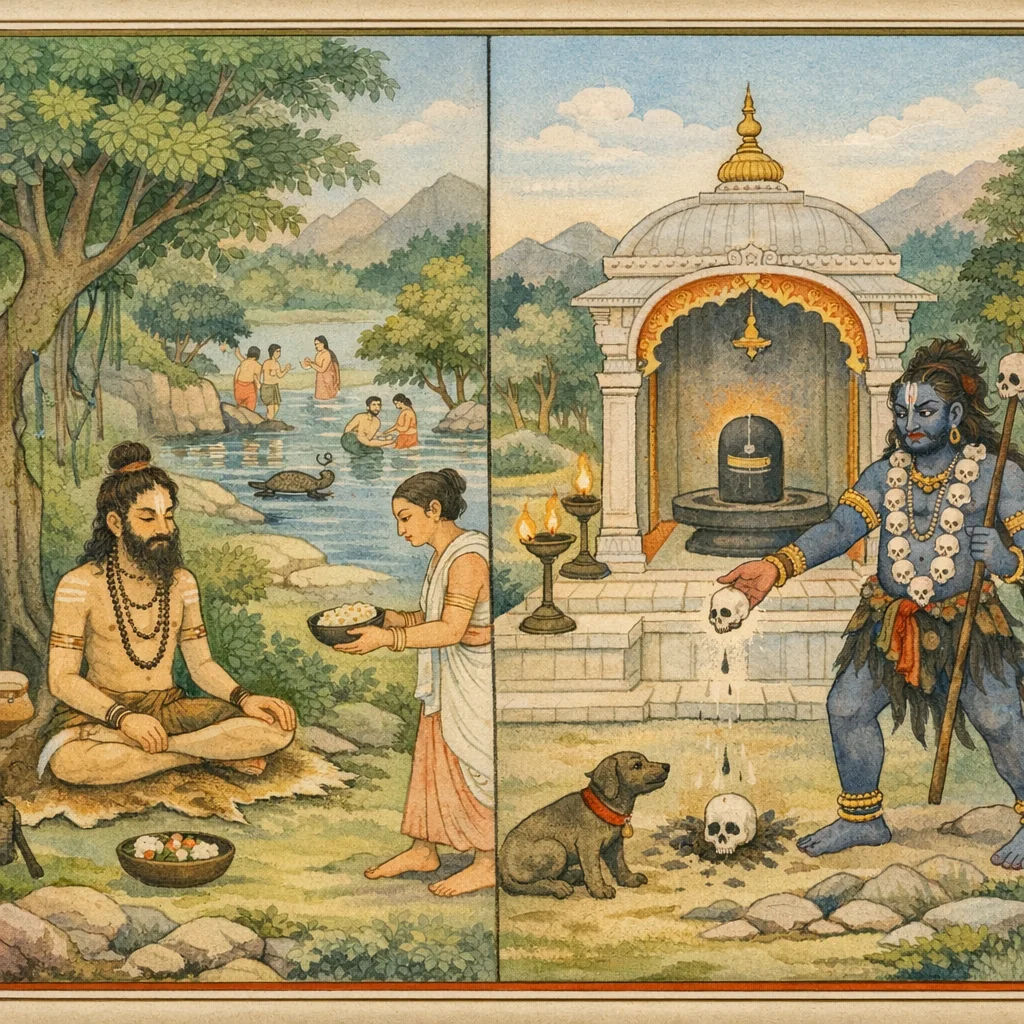
Continuing the Uttara-bhāga’s dharma-śāstric course, Vyāsa sets out prāyaścitta as a systematic remedial discipline for faults born of omitted duties and censured acts, grounding its authority in Veda-meaning specialists and dharma-reasoners. The chapter defines the mahāpātakas—brahmahatyā, surāpāna, theft, and guru-talpagamana—and extends blame to prolonged association with the fallen, including improper priestly service, illicit sex, and negligent teaching. It then describes the classic forest-penance for unintentional brahmahatyā: twelve years with ascetic insignia, controlled begging, self-reproach, and brahmacarya, while declaring that deliberate commission demands death-atonement. Finally, it offers alternative purifications through extraordinary merit and sacred places: the avabhṛtha of Aśvamedha, total donation to a Veda-knower, bathing at confluences, the Rāmeśvara ocean-bath with Rudra-darśana, and Kapālamocana—Bhairava’s skull-release tīrtha—integrating ancestral rites and Śaiva worship into the Purāṇa’s restorative dharma program and preparing further graded expiations ahead.
Shlokas
Verse 1
इति श्रीकूर्मपुराणे षट्साहस्त्र्यां संहितायामुपरिविभागे एकोनत्रिंशो ऽध्यायः व्यास उवाच अतः परं प्रवलक्ष्यामि प्रायश्चित्तविधिं शुभम् / हिताय सर्वविप्राणां दोषाणामपनुत्तये
Thus, in the Śrī Kūrma Purāṇa, in the six-thousand-verse Saṃhitā, in the latter division—begins the twenty-ninth chapter. Vyāsa said: “Hereafter I shall clearly set forth the auspicious procedure of prāyaścitta, the discipline of expiation and purification, for the welfare of all brāhmaṇas, that faults may be driven away.”
Verse 2
अकृत्वा विहितं कर्म कृत्वा निन्दितमेव च / दोषमाप्नोति पुरुषः प्रायश्चित्तं विशोधनम्
A person incurs fault by failing to perform an enjoined duty and by doing what is censured; the purifying remedy for that fault is prāyaścitta, the discipline of expiation.
Verse 3
प्रायश्चित्तमकृत्वा तु न तिष्ठेद् ब्राह्मणः क्वचित् / यद् ब्रूयुर्ब्राह्मणाः शान्ता विद्वांसस्तत्समाचरेत्
Without first performing prāyaścitta, a brāhmaṇa should not remain anywhere at all. Whatever calm and learned brāhmaṇas prescribe, that indeed he should carry out in practice.
Verse 4
वेदार्थवित्तमः शान्तो धर्मकामो ऽग्निमान् द्विजः / स एव स्यात् परो धर्मो यमेको ऽपि व्यवस्यति
That twice-born who is most versed in the meaning of the Veda—peaceful, devoted to dharma, and maintaining the sacred fires—he indeed embodies the highest Dharma; even if he upholds but this single resolve, it becomes the supreme religious path.
Verse 5
अनाहिताग्नयो विप्रास्त्रयो वेदार्थपारगाः / यद् ब्रूयुर्धर्मकामास्ते तज्ज्ञेयं धर्मसाधनम्
Three brāhmaṇa sages—though not maintainers of the sacred fires—are masters of the meaning of the three Vedas. Whatever they declare, devoted to dharma and desiring righteousness, should be understood as a true means for accomplishing dharma.
Verse 6
अनेकधर्मशास्त्रज्ञा ऊहापोहविशारदाः / वेदाध्ययनसंपन्नाः सप्तैते परिकीर्तिताः
These seven are declared to be: those who know many Dharma-śāstras, who are skilled in sound discernment—accepting what is valid and rejecting what is not—and who are accomplished through the study of the Vedas.
Verse 7
मीमांसाज्ञानतत्त्वज्ञा वेदान्तकुशला द्विजाः / एकविंशतिसंख्याताः प्रयाश्चित्तं वदन्ति वै
Brahmin sages—versed in Mīmāṃsā, knowers of the principles of sacred knowledge, and skilled in Vedānta—being twenty-one in number, indeed expounded the doctrine of prāyaścitta (expiatory atonement).
Verse 8
ब्रह्महा मद्यपः स्तेनो गुरुतल्पग एव च / महापातकिनस्त्वेते यश्चैतैः सह संवसेत्
A slayer of a Brāhmaṇa, a drinker of intoxicants, a thief, and one who violates the teacher’s bed—these are declared to be mahāpātakins, great sinners; and so too is anyone who lives in close association with them.
Verse 9
संवत्सरं तु पतितैः संसर्गं कुरुते तु यः / यानशय्यासनैर्नित्यं जानन् वै पतितो भवेत्
Whoever knowingly keeps company with the fallen for a full year—regularly sharing conveyances, beds, and seats with them—indeed becomes fallen as well.
Verse 10
याजनं योनिसंबन्धं तथैवाध्यापनं द्विजः / कृत्वा सद्यः पतेज्ज्ञानात् सह भोजनमेव च
If a twice-born man performs priestly service for improper persons, enters into illicit sexual relations, or teaches sacred learning wrongly, then he immediately falls from right knowledge—and likewise falls by eating in their company as well.
Verse 11
अविज्ञायाथ यो मोहात् कुर्यादध्यापनं द्विजः / संवत्सरेण पतति सहाध्ययनमेव च
If a twice-born man, without first understanding the matter and out of delusion, undertakes to teach sacred lore, he falls within a year—and with that, his own study too is brought to ruin.
Verse 12
ब्रह्माहा द्वादशाब्दानि कुटिं कृत्वा वने वसेत् / भैक्षमात्मविशुद्ध्यर्थं कृत्वा शवशिरोध्वजम्
One who has slain a Brāhmaṇa should build a hut and dwell in the forest for twelve years; and, for inner purification, he should live on alms, bearing a banner marked with a corpse’s head.
Verse 13
ब्राह्मणावसथान् सर्वान् देवागाराणि वर्जयेत् / विनिन्दन् स्वयमात्मानं ब्राह्मणं तं च संस्मरन्
He should avoid all the dwellings of Brāhmaṇas and even the temples of the gods, while censuring his own self and continually remembering that Brāhmaṇa (whom he has wronged).
Verse 14
असंकल्पितयोग्यानि सप्तागाराणि संविशेत् / विधूमे शनकैर्नित्यं व्यङ्गारे भुक्तवज्जने
He should enter the seven household spaces only for their proper purposes, without fanciful intentions. Daily he should eat slowly, when the fire is smokeless and the coals are settled, in the company of those who have already eaten (without greed or haste).
Verse 15
एककालं चरेद् भैक्षं दोषं विख्यापयन् नृणाम् / वन्यमूलफलैर्वापि वर्तयेद् धैर्यमाक्षितः
Let him beg for alms only once a day, openly declaring his fault to people; or else, living on forest roots and fruits, let him sustain himself—steadfast, with his fortitude unshaken.
Verse 16
कपालपाणिः खट्वाङ्गी ब्रह्मचर्यपरायणः / पूर्णे तु द्वादशे वर्षे ब्रह्महत्यां व्यपोहति
Bearing a skull-bowl in his hand and carrying a khaṭvāṅga staff, steadfast in brahmacarya—when twelve years are fully completed, he removes the sin of brahmahatyā.
Verse 17
अकामतः कृते पापे प्रायश्चित्तमिदं शुभम् / कामतो मरणाच्छुद्धिर्ज्ञेया नान्येन केनचित्
For a sin committed unintentionally, this auspicious expiation is prescribed. But for a sin committed deliberately, purification is to be known as attainable only through death.
Verse 18
कुर्यादनशनं वाथ भृगोः पतनमेव वा / ज्वलन्तं वा विशेदग्निं जलं वा प्रविशेत् स्वयम्
He may undertake fasting unto death; or he may cast himself down from a precipice; or he may enter a blazing fire; or he may himself plunge into water.
Verse 19
ब्राह्मणार्थे गवार्थे वा सम्यक् प्राणान् परित्यजेत् / ब्रह्महत्यापनोदार्थमन्तरा वा मृतस्य तु
For the sake of a brāhmaṇa, or for the sake of a cow, one should, if required, rightly relinquish one’s life. Or else, to remove the taint of brahmahatyā, undertake expiation up to death.
Verse 20
दीर्घामयान्वितं विप्रं कृत्वानामयमेव तु / दत्त्वा चान्नं स दुर्भिक्षे ब्रह्महत्यां व्यपोहति
If, during a time of famine, one restores to health a brāhmaṇa afflicted with a long illness and also gives him food, one thereby removes the sin of brahmahatyā.
Verse 21
अश्वमेधावभृथके स्नात्वा वा शुध्यते द्विजः / सर्वस्वं वा वेदविदे ब्राह्मणाय प्रदाय तु
A twice-born person is purified either by bathing in the concluding avabhṛtha bath of the Aśvamedha sacrifice, or by giving all his possessions to a Brāhmaṇa who knows the Veda.
Verse 22
सरस्वत्यास्त्वरुणया संगमे लोकविश्रुते / शुध्येत् त्रिषवणस्नानात् त्रिरात्रोपोषितो द्विजः
At the world-renowned confluence of the Sarasvatī and the Aruṇā, a twice-born person, having fasted for three nights, is purified by bathing at the three daily junctures (trīsavana).
Verse 23
गत्वा रामेश्वरं पुण्यं स्नात्वा चैव महोदधौ / ब्रह्मचर्यादिभिर्युक्तो दृष्ट्वा रुद्रं विमुच्यते
Having gone to the holy Rāmeśvara and bathed in the great ocean, one endowed with brahmacarya and allied disciplines—upon beholding Rudra—is released from bondage.
Verse 24
कपालमोचनं नाम तीर्थं देवस्य शूलिनः / स्नात्वाभ्यर्च्य पितॄन् भक्त्या ब्रह्महत्यां व्यपोहति
There is a sacred ford called Kapālamocana, belonging to the trident-bearing Lord (Śiva). Having bathed there and, with devotion, worshipped the ancestors, one drives away the sin of brahmahatyā (brahmin-slaying).
Verse 25
यत्र देवादिदेवेन भरवेणामितौजसा / कपालं स्थापितं पूर्वं ब्रह्मणः परमेष्ठिनः
It is there that, in former times, Bhārava—of immeasurable might, foremost among the gods—established the skull of Brahmā, the supreme Parameṣṭhin.
Verse 26
समभ्यर्च्य महादेवं तत्र भैरवरूपिणम् / तर्पपित्वा पितॄन् स्नात्वा मुच्यते ब्रह्महत्यया
Having duly worshipped Mahādeva there in His Bhairava-form, and having offered tarpana-libations to the Pitṛs and then bathed, one is released from the sin of brahma-hatyā (the killing of a brāhmaṇa).
Frequently Asked Questions
Prāyaścitta is the purifying remedy for faults caused by neglecting enjoined duties or performing censured acts; the chapter states that a brāhmaṇa should not remain anywhere without first undertaking appropriate expiation as prescribed by calm, learned authorities.
Brahmahatyā (slaying a brāhmaṇa), surāpāna (drinking intoxicants), theft, and violation of the teacher’s bed (guru-talpagamana), along with sustained close association with such offenders.
A twelve-year forest discipline: dwelling in a hut, living on alms (or roots and fruits), bearing penitential insignia (skull-bowl and khaṭvāṅga), maintaining brahmacarya, avoiding brāhmaṇa dwellings and temples, and cultivating continual self-censure and remembrance of the wronged brāhmaṇa.
It states purification is attainable only through death for deliberate commission, prescribing forms of death-atonement such as fasting unto death or self-surrender into fire, water, or from a height.
Avabhṛtha bathing of an Aśvamedha, giving away all possessions to a Veda-knowing brāhmaṇa, bathing at the Sarasvatī–Aruṇā confluence after a three-night fast, bathing at Rāmeśvara with brahmacarya and beholding Rudra, and bathing at Kapālamocana with devotion and Pitṛ worship—especially linked to removal of brahmahatyā.
Read Kurma Purana in the Vedapath app
Scan the QR code to open this directly in the app, with audio, word-by-word meanings, and more.