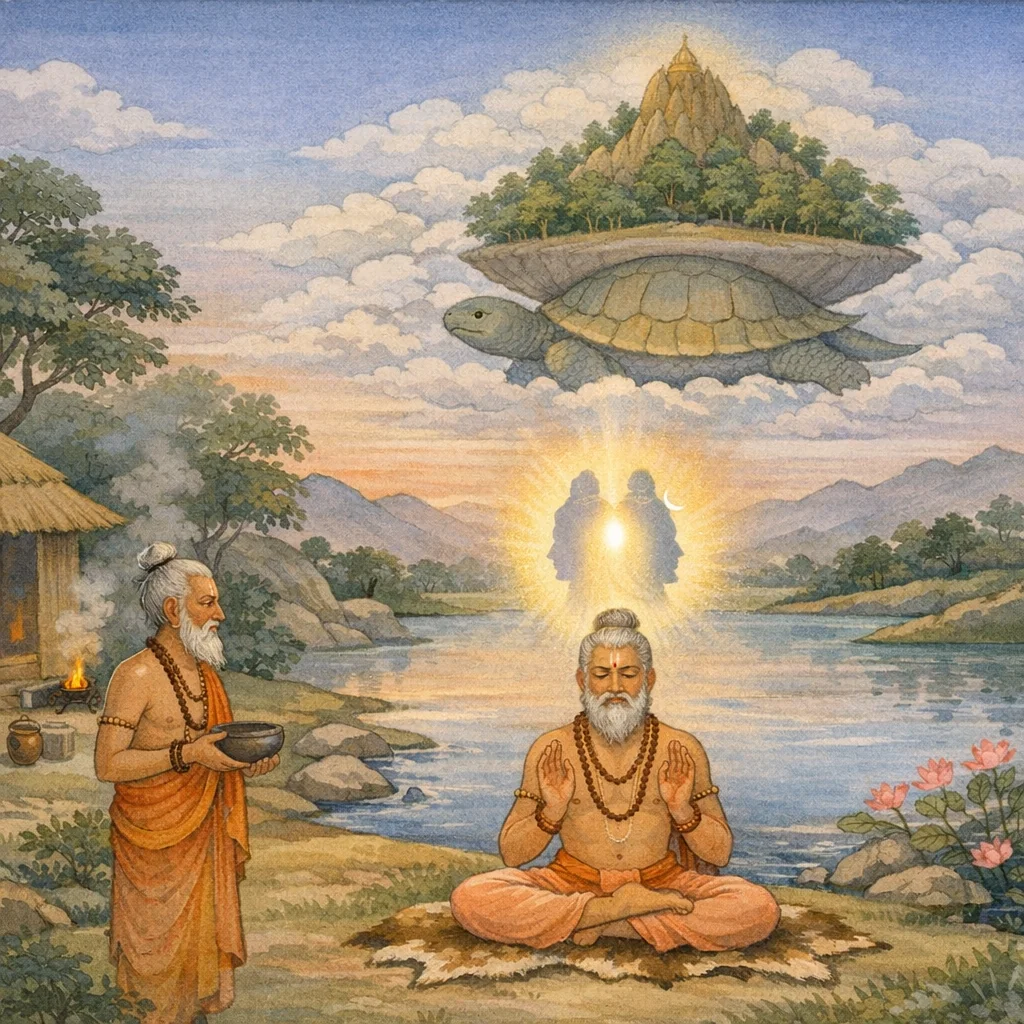
Adhyaya 29
Yati-Āśrama: Bhikṣā-vidhi, Īśvara-dhyāna, and Prāyaścitta (Mahādeva as Non-dual Brahman)
This adhyāya continues the Uttara-bhāga’s teaching on dharma and mokṣa, outlining the renunciant’s (yati/bhikṣu) disciplined livelihood: regulated alms as sustenance, minimal social ties, and a manner of seeking bhikṣā that does not burden householders (proper time, brevity, silence). It then turns from outer conduct to inner sādhana—offerings to Āditya, prāṇa-oblation, measured eating, and steady contemplation at night and at the sandhyā junctions—culminating in Vedāntic meditation on the Supreme as the heart-dwelling Light beyond tamas. Śiva is praised as Mahēśa/Mahādeva and identified with the imperishable, non-dual Brahman (vyoma/ākāśa-like, an inner sun-light), establishing Hari–Hara harmony in an Īśvara-centered Advaitic register. The final section codifies prāyaścitta for renunciant lapses (lust, untruth, theft, inadvertent violence, sensory weakness), repeatedly prescribing prāṇāyāma and severe vows (kṛcchra, sāṃtapana, cāndrāyaṇa) to restore yogic integrity. It closes by restricting transmission to qualified recipients, preparing for the Uttara-bhāga’s increasingly esoteric yogic-gnostic instruction.
Shlokas
Verse 1
इति श्रीकूर्मपुराणे षट्साहस्त्र्यां संहितायामुपरिविभागे ऽष्टाविंशो ऽध्यायः व्यास उवाच एवं स्वाश्रमनिष्ठानां यतीनां नियतात्मनाम् / भैक्षेण वर्तनं प्रोक्तं फलमूलैरथापि वा
Thus, in the Śrī Kūrma Purāṇa, in the six-thousand-verse Saṃhitā, in the latter division, (here begins) the twenty-eighth chapter. Vyāsa said: “In this manner, for yati ascetics steadfast in their own āśrama-dharma and self-controlled, livelihood is prescribed through bhikṣā (alms); or else, alternatively, through fruits and roots.”
Verse 2
एककालं चरेद् भैक्षं न प्रसज्येत विस्तरे / भैक्षे प्रसक्तो हि यतिर्विषयेष्वपि सज्जति
Let the renunciate seek bhikṣā (alms) only once a day, and let him not become entangled in prolonged dealings. For a yati who grows attached to alms-gathering readily becomes attached to sense-objects as well.
Verse 3
सप्तागारं चरेद् भैक्षमलाभात् तु पुनश्चरेत् / प्रक्षाल्य पात्रे भुञ्जीयादद्भिः प्रक्षालयेत् तु तत्
Let the mendicant go for alms to seven houses; if he gains no food, let him go again. Having washed his bowl, he should eat from that vessel, and then rinse it once more with water.
Verse 4
अथवान्यदुपादाय पात्रे भुञ्जीत नित्यशः / भुक्त्वा तत् संत्यजेत् पात्रं यात्रामात्रमलोलुपः
Or else, taking up another clean vessel, one should eat from a bowl each day; and after eating, one should discard that vessel—free from greed, taking only what suffices for the bare maintenance of life’s journey.
Verse 5
विधूमे सन्नमुसले व्यङ्गारे भुक्तवज्जने / वृत्ते शरावसंपाते भिक्षां नित्यं यतिश्चरेत्
A renunciant should go daily for alms only when the household fire is without smoke, the pestle and mortar have been set aside, the embers have cooled, the people have finished eating, and the vessels have been put away—so that his begging does not burden the householder.
Verse 6
गोदोहमात्रं तिष्ठेत कालं भिक्षुरधोमुखः / भिक्षेत्युक्त्वा सकृत् तूष्णीमश्नीयाद् वाग्यतः शुचिः
A mendicant should stand with his face lowered only as long as it takes to milk a cow. Having asked just once, “Alms,” he should then eat in silence—restrained in speech and inwardly pure.
Verse 7
प्रक्षाल्य पाणिपादौ च समाचम्य यथाविधि / आदित्ये दर्शयित्वान्नं भुञ्जीत प्राङ्मुखोत्तरः
Having washed the hands and feet and performed ācamana in the prescribed manner, one should offer the food to the Sun (Āditya) and then eat, seated facing east or north.
Verse 8
हुत्वा प्राणाहुतीः पञ्च ग्रासानष्टौ समाहितः / आचम्य देवं ब्रह्माणं ध्यायीत परमेश्वरम्
Having offered the five oblations to the vital breaths, and having eaten eight mouthfuls with a collected mind, one should perform ācamana and then meditate upon the Supreme Lord—Brahman, the divine Parameśvara.
Verse 9
अलाबुं दारुपात्रं च मृण्मयं वैणवं ततः / चत्वारि यतिपात्राणि मनुराह प्रजापतिः
A gourd-vessel, a wooden bowl, one made of clay, and then one made of bamboo—these are the four alms-bowls for an ascetic, as Manu, Prajāpati the Lord of creatures, has declared.
Verse 10
प्राग्रात्रे पररात्रे च मध्यरात्रे तथैव च / संध्यास्वह्नि विशेषेण चिन्तयेन्नित्यमीश्वरम्
In the early part of the night, in the later part of the night, and likewise at midnight—and especially at the twilight junctions (sandhyā) of the day—one should constantly contemplate Īśvara.
Verse 11
कृत्वा हृत्पद्मनिलये विश्वाख्यं विश्वसंभवम् / आत्मानं सर्वभूतानां परस्तात् तमसः स्थितम्
Having established within the lotus of the heart the Self—known as the ‘All’ and the source from which the universe arises—one should contemplate that Supreme Self of all beings as abiding beyond the darkness of tamas.
Verse 12
सर्वस्याधारभूतानामानन्दं ज्योतिरव्ययम् / प्रधानपुरुषातीतमाकाशं दहनं शिवम्
He is the blissful, imperishable Light—the very foundation of all that serves as a support. Transcending both Pradhāna (primordial Nature) and Puruṣa (spirit), He is the all-pervading Ether and the consuming Fire—Śiva, the auspicious Supreme.
Verse 13
तदन्तः सर्वभावानामीश्वरं ब्रह्मरूपिणम् / ध्यायेदनादिमद्वैतमानन्दादिगुणालयम्
One should meditate on the Lord who dwells within all states of being—Brahman in very form—beginningless, non-dual, the abode of bliss and all divine qualities.
Verse 14
महान्तं परमं ब्रह्म पुरुषं सत्यमव्ययम् / सितेतरारुणाकारं महेशं विश्वरूपिणम्
I worship the Great One—the Supreme Brahman, the transcendent Puruṣa—Truth itself and imperishable; Mahēśa, radiant as white and also as ruddy, who bears the form of the entire universe.
Verse 15
ओङ्कारान्ते ऽथ चात्मानं संस्थाप्य परमात्मनि / आकाशे देवमीशानं ध्यायीताकाशमध्यगम्
Then, at the close of the utterance of Oṃ, establishing one’s self in the Supreme Self, one should meditate on the Lord Īśāna (Śiva) as the Divine Presence in the ether, abiding in the very midst of space.
Verse 16
कारणं सर्वभावानामानन्दैकसमाश्रयम् / पुराणं पुरुषं शंभुं ध्यायन् मुच्येत बन्धनात्
Meditating on Śambhu—the primordial Puruṣa, the cause of all states of being, whose sole refuge is bliss—one is released from bondage.
Verse 17
यद्वा गुहायां प्रकृतौ जगत्संमोहनालये / विचिन्त्य परमं व्योम सर्वभूतैककारणम्
Or else, within the cave of Prakṛti—the dwelling of the world’s delusion—one should contemplate the Supreme ‘Vyoma’, the all-pervading expanse, the single cause of all beings.
Verse 18
जीवनं सर्वभूतानां यत्र लोकः प्रलीयते / आनन्दं ब्रह्मणः सूक्ष्मं यत् पश्यन्ति मुमुक्षवः
That Supreme Reality is the very life of all beings—into which the world dissolves. It is the subtle bliss of Brahman, beheld by those who yearn for liberation.
Verse 19
तन्मध्ये निहितं ब्रह्म केवलं ज्ञानलक्षणम् / अनन्तं सत्यमीशानं विचिन्त्यासीत संयतः
Within that inner locus, Brahman is enshrined—pure, marked only by consciousness. Meditating upon the Lord Īśāna as infinite and true, the disciplined seeker should remain self-restrained and absorbed.
Verse 20
गुह्याद् गुह्यतमं ज्ञानं यतीनामेतदीरितम् / यो ऽनुतिष्ठेन्महेशेन सो ऽश्नुते योगमैश्वरम्
This is the most secret knowledge—more hidden than all that is hidden—declared for renunciant yogins. Whoever practices it as taught by Maheśa (Śiva) attains the sovereign, divine Yoga.
Verse 21
तस्माद् ध्यानरतो नित्यमात्मविद्यापरायणः / ज्ञानं समभ्यसेद् ब्राह्मं येन मुच्येत बन्धनात्
Therefore, ever devoted to meditation and firmly intent on the knowledge of the Self, one should diligently cultivate Brahman-knowledge—by which one is released from bondage.
Verse 22
मत्वा पृथक् स्वमात्मानं सर्वस्मादेव केवलम् / आनन्दमजरं ज्ञानं ध्यायीत च पुनः परम्
Having understood one’s own Self to be distinct—utterly solitary and separate from all things—one should then meditate again upon the Supreme: the blissful, ageless Reality that is pure Consciousness itself.
Verse 23
यस्मात् भवन्ति भूतानि यद् गत्वा नेह जायते / स तस्मादीश्वरो देवः परस्माद् यो ऽधितिष्ठति
He from whom all beings arise, and having reached whom one is not born again here—He is that Lord (Īśvara), the Divine, who presides beyond even the highest (parasma).
Verse 24
यदन्तरे तद् गगनं शाश्वतं शिवमव्ययम् / यदंशस्तत्परो यस्तु स देवः स्यान्महेश्वरः
That which is within all is the Sky-like Reality—eternal, auspicious (Śiva), and imperishable. And the deity devoted to That Supreme, whose portion all this is, is indeed Mahēśvara.
Verse 25
व्रतानि यानि भिक्षूणां तथैवोपव्रतानि च / एकैकातिक्रमे तेषां प्रायश्चित्तं विधीयते
For the vows (vrata) prescribed for mendicants, and likewise for their subsidiary observances (upavrata), a specific expiation (prāyaścitta) is laid down for each individual transgression.
Verse 26
उपेत्य च स्त्रियं कामात् प्रायश्चित्तं समाहितः / प्राणायामसमायुक्तं कुर्यात् सांतपनं शुचिः
If a man approaches a woman out of lust, then, with a collected mind, he should undertake expiation: being purified, he should perform the sāṃtapana penance, accompanied by the discipline of prāṇāyāma.
Verse 27
ततश्चरेत नियमात् कृच्छ्रं संयतमानसः / पुनराश्रममागम्य चरेद् भिश्रुरतन्द्रितः
Then, with the mind restrained, one should undertake the kṛcchra austerity in accordance with rule; and afterwards, returning to one’s āśrama (proper stage and discipline of life), one should live on—reverent, self-controlled, and untiring.
Verse 28
न धर्मयुक्तमनृतं हिनस्तीति मनीषिणः / तथापि च न कर्तव्यं प्रसङ्गो ह्येष दारुणः
The wise declare that an untruth spoken in the service of dharma brings no harm; yet even so, it should not be resorted to, for it is a dreadful opening that easily leads to grave consequences.
Verse 29
एकरात्रोपवासश्च प्राणायामशतं तथा / उक्त्वानृतं प्रकर्तव्यं यतिना धर्मलिप्सुना
For a yati, a renunciant who longs for dharma, if he has spoken an untruth, he should perform expiation: a one-night fast and likewise one hundred rounds of prāṇāyāma.
Verse 30
परमापद्गतेनापि न कार्यं स्तेयमन्यतः / स्तेयादभ्यधिकः कश्चिन्नास्त्यधर्म इति स्मृतिः / हिंसा चैषापरा दिष्टा या चात्मज्ञाननाशिका
Even in extreme distress, one should never steal from another. Tradition declares that no unrighteous act is worse than theft. This is deemed a higher, subtler form of violence, for it destroys knowledge of the Self.
Verse 31
यदेतद् द्रविणं नाम प्राण ह्येते बहिश्वराः / स तस्य हरति प्राणान् यो यस्य हरते धनम्
What is called “wealth” is, in truth, life-breath itself; these outer powers are but external lords. Therefore, whoever takes another’s property takes away that person’s very life.
Verse 32
एवं कृत्वा स दुष्टात्मा भिन्नवृत्तो व्रताच्च्युतः / भूयो निर्वेदमापन्नश्चरेच्चान्द्रायणव्रतम्
Having acted in this way, that wicked-minded person—whose conduct has been broken and who has fallen away from his vow—should then, becoming again filled with remorse, undertake the Cāndrāyaṇa vow as an expiation.
Verse 33
विधिना शास्त्रदृष्टेन संवत्सरमिति श्रुतिः / भूयो निर्वेदमापन्नश्चरेद् भिक्षुरतन्द्रितः
Scripture declares that, in the manner laid down by the śāstras, it should be observed for a year. Thereafter, having attained deeper dispassion, the mendicant should continue to live diligently, without negligence.
Verse 34
अकस्मादेव हिंसां तु यदि भिक्षुः समाचरेत् / कुर्यात्कृछ्रातिकृच्छ्रं तु चान्द्रायणमथापि वा
If a mendicant (bhikṣu) commits violence unintentionally, he should perform the severe expiation called kṛcchrātikṛcchra; or else he may undertake the Cāndrāyaṇa vow for purification.
Verse 35
स्कन्देदिन्द्रियदौर्बल्यात् स्त्रियं दृष्ट्वा यतिर्यदि / तेन धारयितव्या वै प्राणायामास्तु षोडश / दिवास्कन्दे त्रिरात्रं स्यात् प्राणायामशतं तथा
If, through weakness of the senses, an ascetic (yati) looks upon a woman with a lapse of restraint, he should steady himself by performing sixteen prāṇāyāmas. If the lapse occurs by day, it is to be observed for three nights, and likewise one hundred prāṇāyāmas are prescribed.
Verse 36
एकान्ने मधुमांसे च नवश्राद्धे तथैव च / प्रत्यक्षलवणे चोक्तं प्राजापत्यं विशोधनम्
For the fault of taking a one-dish meal, and of consuming honey and meat, as well as in the case of a newly performed śrāddha, and also when salt is taken directly, the Prajāpatya observance is prescribed here as the purificatory expiation.
Verse 37
ध्याननिष्ठस्य सततं नश्यते सर्वपातकम् / तस्मान्महेश्वरं ज्ञात्वा तस्य ध्यानपरो भवेत्
For one who is steadfast in meditation, all sin is continually destroyed. Therefore, having truly known Mahēśvara, one should become devoted to meditating upon Him.
Verse 38
यद् ब्रह्म परमं ज्योतिः प्रतिष्ठाक्षरमद्वयम् / यो ऽन्तरात्र परं ब्रह्म स विज्ञेयो महेश्वरः
That Brahman is the supreme Light—the ultimate ground, imperishable and non-dual. He who, as the inner Ātman, is that Supreme Brahman is to be known as Mahēśvara.
Verse 39
एष देवो महादेवः केवलः परमः शिवः / तदेवाक्षरमद्वैतं तदादित्यान्तरं परम्
He alone is God—Mahādeva, the sole Supreme Śiva. He alone is the Imperishable, the non-dual Reality; He is the supreme Inner Light within the Sun (Āditya).
Verse 40
यस्मान्महीयते देवः स्वधाम्नि ज्ञानसंज्ञिते / आत्मयोगाह्वये तत्त्वे महादेवस्ततः स्मृतः
Because the Lord is glorified in His own abode—known as Knowledge—within the Reality called ‘Ātma-yoga’ (the yoga of the Self), therefore He is remembered as Mahādeva, the Great God.
Verse 41
नान्यद् देवान्महादेवाद् व्यतिरिक्तं प्रपश्यति / तमेवात्मानमन्वेति यः स याति परं पदम्
One who does not perceive any deity as separate from Mahādeva, and who follows Him alone as the very Ātman, attains the supreme state (parama-pada).
Verse 42
मन्यते ये स्वमात्मानं विभिन्नं परमेश्वरात् / न ते पश्यन्ति तं देवं वृथा तेषां परिश्रमः
Those who imagine their own Ātman to be separate from the Supreme Lord (Parameśvara) do not truly behold that God; all their striving becomes futile.
Verse 43
एकमेव परं ब्रह्म विज्ञेयं तत्त्वमव्ययम् / स देवस्तु महादेवो नैतद् विज्ञाय बध्यते
Only the one Supreme Brahman is to be realized—the imperishable Reality. That very Deva is Mahādeva; without knowing this, one remains bound.
Verse 44
तस्माद् यतेत नियतं यतिः संयतमानसः / ज्ञानयोगरतः शान्तो महादेवपरायणः
Therefore, the ascetic should strive constantly with disciplined resolve—his mind restrained—absorbed in the Yoga of knowledge, tranquil, and wholly devoted to Mahādeva (Śiva).
Verse 45
एष वः कथितो विप्रो यतीनामाश्रमः शुभः / पितामहेन विभुना मुनीनां पूर्वमीरितम्
Thus, O Brahmin, the auspicious discipline of the renunciates (the yati-āśrama) has been explained to you—just as it was formerly proclaimed to the sages by the mighty Grandfather (Brahmā).
Verse 46
नापुत्रशिष्ययोगिभ्यो दद्यादिदमनुत्तमम् / ज्ञानं स्वयंभुवा प्रोक्तं यतिधर्माश्रयं शिवम्
One should not bestow this unsurpassed teaching upon those who are not fit as a son, a disciple, or a dedicated yogin. This is the auspicious knowledge taught by Svayambhū (Brahmā), grounded in the dharma of renunciants and resting in Śiva.
Verse 47
इति यतिनियमानामेतदुक्तं विधानं पशुपतिपरितोषे यद् भवेदेकहेतुः / न भवति पुनरेषामुद्भवो वा विनाशः प्रणिहितमनसो ये नित्यमेवाचरन्ति
Thus has been stated this ordinance of the ascetic disciplines—the single effective cause for pleasing Paśupati. For those whose minds are steadily intent and who practice them constantly, there is no further arising of bondage nor any falling away from the attained state.
Frequently Asked Questions
He should beg only once daily, avoid prolonged interaction, approach a limited number of houses (seven), time the request so as not to burden householders, ask only once (“Alms”), stand briefly, eat in silence, and maintain strict cleanliness of the bowl and person.
It directs the seeker to establish the Self in the heart-lotus and meditate on the Supreme Self as pure consciousness and imperishable light beyond tamas; Mahēśvara/Mahādeva is identified with that non-dual Brahman, implying liberation through realizing non-separateness rather than merely external worship.
Prāṇāyāma-based purification is central, alongside classical vows and austerities such as sāṃtapana, kṛcchra/kṛcchrātikṛcchra, prājāpatya, and cāndrāyaṇa—applied specifically to faults like lustful approach, untruth, theft, inadvertent violence, and sensory lapses.