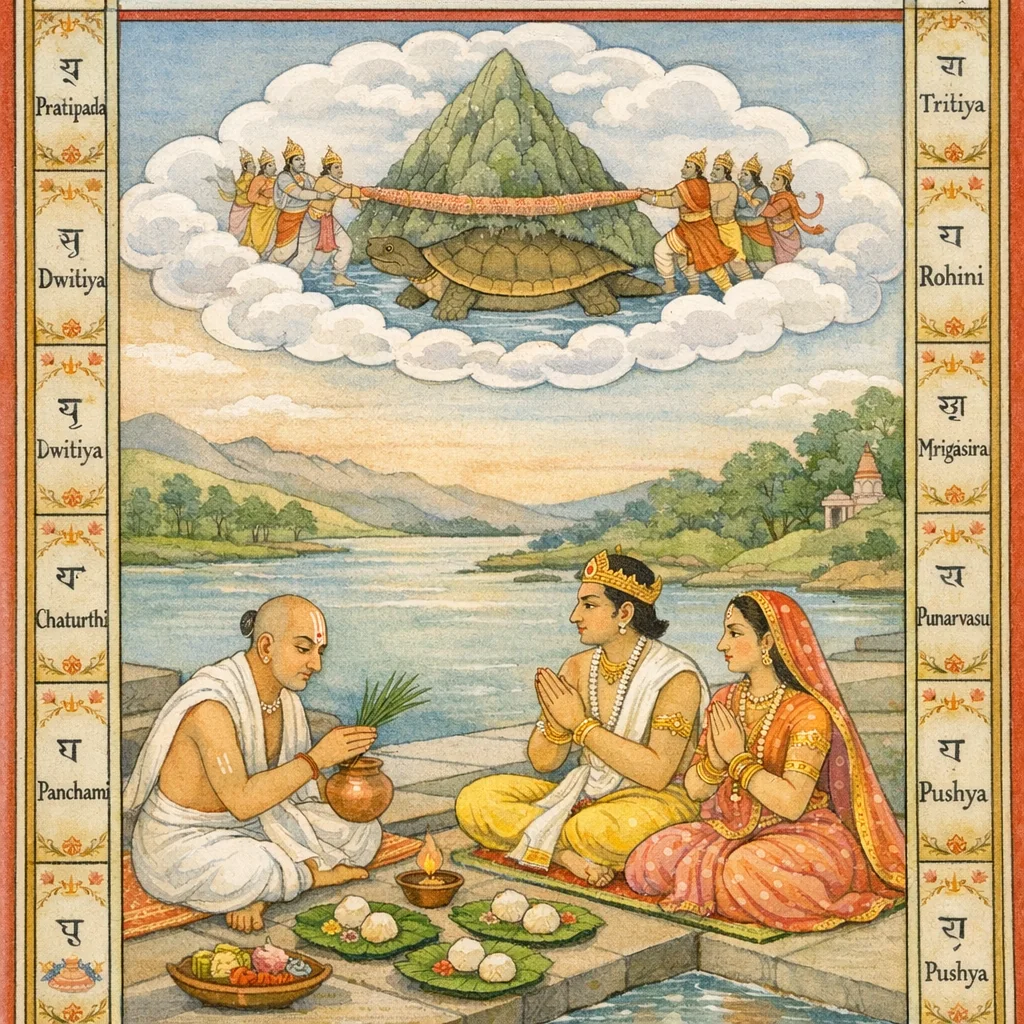
Adhyaya 20
Śrāddha-Kāla-Nirṇaya: Proper Times, Nakṣatra Fruits, Tīrtha Merit, and Offerings for Ancestral Rites
This chapter continues the Uttara-bhāga’s dharma teaching by systematizing śrāddha as a rite granting both bhoga (worldly welfare) and apavarga (liberation). It prioritizes the new-moon piṇḍānvāhāryaka śrāddha, lists allowable tithis in the dark fortnight (excluding caturdaśī except for weapon-slain deaths), and then explains naimittika occasions such as eclipses and deaths, as well as kāmya opportunities like solstices, equinoxes, vyatīpāta, saṃkrānti, and birthdays. A major section details results according to nakṣatra, weekday, planet, and tithi, presenting śrāddha as a time-sensitive sacrament. It classifies śrāddha forms (nitya, kāmya, naimittika, ekoddiṣṭa, vṛddhi/pārvaṇa, travel, purification, daivika) and notes twilight constraints. The teaching then turns to tīrtha-māhātmya, praising Gaṅgā, Prayāga, Gayā, Vārāṇasī, and many sacred sites for inexhaustible merit, and listing foods—grains, fruits, and dishes—that satisfy the Pitṛs for varying durations, along with items to avoid.
Shlokas
Verse 1
इति श्रीकूर्मपुराणे षट्साहस्त्र्यां संहितायामुपरिविभागे एकोनविंशो ऽध्यायः व्यास उवाच अथ श्राद्धममावास्यां प्राप्य कार्यं द्विजोत्तमैः / पिण्डान्वाहार्यकं भक्त्या भुक्तिमुक्तिफलप्रदम्
Thus, in the Śrī Kūrma Purāṇa—within the six-thousand-verse Saṃhitā, in the latter division—(begins) the nineteenth chapter. Vyāsa said: Now, when the day of amāvāsyā (new moon) arrives, the foremost among the twice-born should perform the śrāddha—namely the piṇḍānvāhāryaka rite—with devotion, for it bestows the fruits of both enjoyment and liberation.
Verse 2
पिण्डान्वाहार्यकं श्राद्धं क्षीणे राजनि शस्यते / अपराह्ने द्विजातीनां प्रशस्तेनामिषेण च
When the king’s protective power has waned, the piṇḍānvāhāryaka śrāddha is especially commended. For the twice-born, it is to be performed in the afternoon, and it may also be offered with duly approved meat.
Verse 3
प्रतिपत्प्रभृति ह्यन्यास्तिथयः कृष्णपक्षके / चतुर्दशीं वर्जयित्वा प्रशस्ता ह्युत्तरोत्तराः
From the first lunar day (Pratipat) onward, the other tithis of the dark fortnight (Kṛṣṇa-pakṣa) are praised—excluding the fourteenth (Caturdaśī); and, one after another, they grow progressively more auspicious.
Verse 4
अमावास्याष्टकास्तिस्त्रः पौषमासादिषु त्रिषु / तिस्त्रश्चान्वष्टकाः पुण्या माघी पञ्चदशी तथा
There are three Aṣṭakā observances connected with the Amāvāsyā (new-moon) day, occurring in the three months beginning with Pauṣa; and there are also three Anvaṣṭakā days, all meritorious—along with the fifteenth tithi (full-moon) of Māgha as well.
Verse 5
त्रयोदशी मघायुक्ता वर्षासु तु विशेषतः / शस्यापाकश्राद्धकाला नित्याः प्रोक्ता दिने दिने
The thirteenth lunar day (Trayodaśī), when joined with the Maghā constellation—especially in the rainy season—is declared to be a fitting time, recurring day after day, for Śrāddha rites connected with the ripening of crops and harvest offerings.
Verse 6
नैमित्तिकं तु कर्तव्यं ग्रहणे चन्द्रसूर्ययोः / बान्धवानां च मरणे नारकी स्यादतो ऽन्यथा
Occasional rites (naimittika-karmas) must indeed be performed at the time of lunar and solar eclipses, and also upon the death of one’s relatives; otherwise, one becomes fit for hell.
Verse 7
काम्यानि चैव श्राद्धानि शस्यान्ते ग्रहणादिषु / अयने विषुवे चैव व्यतीपाते ऽप्यनन्तकम्
Desire-motivated (kāmya) śrāddhas are also commended at the close of the harvest and on occasions such as eclipses and the like; likewise at the solstices (ayana), the equinoxes (viṣuva), and at the vyatīpāta conjunction—indeed, such times yield inexhaustible merit.
Verse 8
संक्रान्त्यमक्षयं श्राद्धं तथा जन्मदिनेष्वपि / नक्षत्रेषु च सर्वेषु कार्यं काम्यं विशेषतः
On the day of saṃkrānti, the solar transit, the śrāddha becomes of inexhaustible merit; so too on one’s birthday. Indeed, under all nakṣatras, desire-motivated kāmya rites should be performed with special care.
Verse 9
स्वर्गं च लभते कृत्वा कृत्तिकासु द्विजोत्तमः / अपत्यमथ रोहिण्यां सौम्ये तु ब्रह्मवर्चसम्
When the Moon is in Kṛttikā, the best of the twice-born, by performing the prescribed observance, attains heaven. In Rohiṇī he gains worthy offspring; and in Saumya he obtains brahma-varcas—radiant spiritual lustre and Vedic brilliance.
Verse 10
रौद्राणां कर्मणां सिद्धिमार्द्रायां शौर्यमेव च / पुनर्वसौ तथा भूमिं श्रियं पुष्ये तथैव च
In Ārdrā one attains success in raudra, fierce undertakings, and gains valor as well. In Punarvasu one obtains land; and in Puṣya likewise one attains śrī—prosperity and auspicious fortune.
Verse 11
सर्वान् कामांस्तथा सार्पे पित्र्ये सौभाग्यमेव च / अर्यम्णे तु धनं विन्द्यात् फाल्गुन्यां पापनाशनम्
In Sārpa, the Serpent-constellation, one gains the fulfillment of all desires; in Pitrya, the Ancestors’ constellation, one attains good fortune. Under Aryaman one finds wealth; and in Phālgunī, sins are destroyed.
Verse 12
ज्ञातिश्रैष्ठ्यं तथा हस्ते चित्रायां च बहून् सुतान् / वाणिज्यसिद्धिं स्वातौ तु विशाखासु सुवर्णकम्
Born under Hasta, one attains pre-eminence among one’s kinsmen; under Citrā, one gains many sons. Under Svātī, one achieves success in trade; and under Viśākhā, one obtains gold and wealth.
Verse 13
मैत्रे बहूनि मित्राणि राज्यं शाक्रे तथैव च / मूले कृषिं लभेद् यानसिद्धिमाप्ये समुद्रतः
In the Maitra asterism one gains many friends; in Śākra, sovereignty likewise. In Mūla one attains success in agriculture; in Āpya, accomplishment in voyages upon the sea.
Verse 14
सर्वान् कामान् वैश्वदेवे श्रैष्ठ्यं तु श्रवणे पुनः / श्रविष्ठायां तथा कामान् वारुणे च परं बलम्
In the Vaiśvadeva nakṣatra one gains the fulfillment of all desired aims; again, in Śravaṇa one attains excellence. Likewise, in Śraviṣṭhā (Dhaniṣṭhā) one obtains desired objectives, and in Vāruṇa (Śatabhiṣaj) one gains supreme strength.
Verse 15
अजैकपादे कुप्यं स्यादहिर्बुध्ने गृहं शुभम् / रेवत्यां बहवो गावो ह्यश्विन्यां तुरगांस्तथा / याम्ये ऽथ जीवनं तत् स्याद्यदि श्राद्धं प्रयच्छति
If one offers Śrāddha on the nakṣatra Ajaikapāda, one gains vessels and utensils; on Ahirbudhnya, an auspicious home. On Revatī, one obtains many cows; on Aśvinī, horses likewise. And on Yāmya, one attains vitality and continuance of life—when Śrāddha is duly given.
Verse 16
आदित्यवारे त्वारोग्यं चन्द्रे सौभाग्यमेव च / कौजे सर्वत्र विजयं सर्वान् कामान् बुधस्य तु
On Sunday one gains freedom from disease; on Monday, prosperity and good fortune. On Tuesday, victory everywhere; and on Wednesday, the fulfillment of all desired aims.
Verse 17
विद्यामभीष्टा जीवे तु धनं वै भार्गवे पुनः / शमैश्वरे लभेदायुः प्रतिपत्सु सुतान् शुभान्
When Jupiter (Jīva) is influential, one gains the desired learning; when Venus (Bhārgava) prevails, one gains wealth. Under Saturn’s (Śanaiśvara) pacifying influence one attains longevity; and on the lunar day of Pratipat one obtains auspicious sons.
Verse 18
कन्यकां वै द्वितीयायां तृतीयायां तु वन्दिनः / पशून्क्षुद्रांश्चतुर्थ्यां तु पञ्चम्यांशोभनान् सुतान्
On the second lunar day one gains a worthy maiden (a fitting bride); on the third, those who praise and proclaim one’s renown. On the fourth, one obtains small cattle; and on the fifth, one is blessed with handsome and auspicious sons.
Verse 19
षष्ट्यां द्यूतं कृषिं चापि सप्तम्यां लभते नरः / अष्टम्यामपि वाणिज्यं लभते श्राद्धदः सदा
One who gives Śrāddha on the sixth tithi gains success in gaming and in agriculture; on the seventh, a man attains the desired result; and on the eighth as well, the giver of Śrāddha ever gains prosperity in trade.
Verse 20
स्यान्नवम्यामेकखुरं दशम्यां द्विखुरं बहु / एकादश्यां तथा रूप्यं ब्रह्मवर्चस्विनः सुतान्
On the ninth lunar day one should give a one-hoofed animal; on the tenth, many two-hoofed animals; and on the eleventh, silver as well—thereby gaining sons endowed with brahmic radiance and spiritual lustre.
Verse 21
द्वादश्यां जातरूपं च रजतं कुप्यमेव च / ज्ञातिश्रैष्ठ्यं त्रयोदश्यां चतुर्दश्यां तु क्रुप्रजाः / पञ्चदश्यां सर्वकामानाप्नोति श्राद्धदः सदा
On the twelfth lunar day one gains gold, silver, and also wealth in base metals. On the thirteenth, one attains pre-eminence among one’s kinsmen; on the fourteenth, compassionate offspring. On the fifteenth, the giver of Śrāddha ever obtains all desired aims.
Verse 22
तस्माच्छ्राद्धं न कर्तव्यं चतुर्दश्यां द्विजातिभिः / शस्त्रेण तु हतानां वै तत्र श्राद्धं प्रकल्पयेत्
Therefore, the twice-born should not perform Śrāddha on the fourteenth lunar day (caturdaśī). However, in the case of those slain by weapons, one may duly arrange the Śrāddha on that very day.
Verse 23
द्रव्यब्राह्मणसंपत्तौ न कालनियमः कृतः / तस्माद् भोगापवर्गार्थं श्राद्धं कुर्युर्द्विजातयः
When proper offerings are at hand and qualified Brāhmaṇas are available, no restriction of time is prescribed. Therefore the twice-born should perform Śrāddha for worldly well-being (bhoga) and for final liberation (apavarga).
Verse 24
कर्मारम्भेषु सर्वेषु कुर्यादाभ्युदयं पुनः / पुत्रजन्मादिषु श्राद्धं पार्वणं पर्वणि स्मृतम्
At the commencement of every undertaking one should again perform the auspicious Ābhyudayika rite. At the birth of a son and similar joyful occasions, the prescribed Śrāddha is the Pārvaṇa; and on festival or sacred lunar days (parvan) the Pārvaṇa Śrāddha is likewise remembered as proper.
Verse 25
अहन्यहनि नित्यं स्यात् काम्यं नैमित्तिकं पुनः / एकोद्दिष्टादि विज्ञेयं वृद्धिश्राद्धं तु पार्वणम्
What is performed day after day is known as the ‘daily’ (nitya) rite. Again, there are the ‘desire-motivated’ (kāmya) and the ‘occasion-specific’ (naimittika) rites; Ekoddiṣṭa and related forms are to be understood accordingly. The Vṛddhi-śrāddha, indeed, is the Pārvaṇa, performed with the full set of ancestral offerings.
Verse 26
एतत् पञ्चविधं श्राद्धं मनुना परिकीर्तितम् / यात्रायां षष्ठमाख्यातं तत्प्रयत्नेन पालयेत्
Thus this fivefold Śrāddha has been proclaimed by Manu; and a sixth, to be performed while on a journey, is also taught. One should observe that rule with diligent effort.
Verse 27
शुद्धये सप्तमं श्राद्धं ब्रह्मणा परिभाषितम् / दैविकं चाष्टमं श्राद्धं यत्कृत्वा मुच्यते भयात्
For purification, the seventh form of Śrāddha is declared by Brahmā; and the eighth is the ‘daivika’ Śrāddha—by performing it, one is released from fear.
Verse 28
संध्यारात्र्योर्न कर्तव्यं राहोरन्यत्र दर्शनात् / देशानां च विशेषेण भवेत् पुण्यमनन्तकम्
The twilight rites should not be performed at night, except when Rāhu is seen. And by the distinctive sanctity of particular regions, the merit that arises becomes endless.
Verse 29
गङ्गायामक्षयं श्राद्धं प्रयागे ऽमरकण्टके / गायन्ति पितरो गाथां कीर्तयन्ति मनीषिणः
On the Gaṅgā, the śrāddha offered to the Fathers becomes inexhaustibly fruitful; at Prayāga and at Amarakantaka, the Pitṛs themselves sing the sacred refrain, and the wise proclaim its praise.
Verse 30
एष्टव्या बहवः पुत्राः शीलवन्तो गुणान्विताः / तेषां तु समवेतानां यद्येको ऽपि गायां व्रजेत्
Many sons should be sought—sons of good conduct and endowed with virtues. For when they are gathered together, if even one among them goes to tend, protect, or lead the cow to pasture, the family’s duty is fulfilled through that virtue.
Verse 31
गयां प्राप्यानुषङ्गेण यदि श्राद्धं समाचरेत् / तारिताः पितरस्तेन स याति परमां गतिम्
If, upon reaching Gayā—even incidentally—one duly performs the śrāddha rite, then by that act one’s ancestors are delivered, and the performer attains the highest state.
Verse 32
वराहपर्वते चैव गङ्गायां वै विशेषतः / वाराणस्यां विशेषेण यत्र देवः स्वयं हरः
And at Varāha Mountain, and especially on the Gaṅgā—most particularly at Vārāṇasī—where the God Hara (Śiva) himself abides in person.
Verse 33
गङ्गाद्वारे प्रभासे च बिल्वके नीलपर्वते / कुरुक्षेत्रे च कुब्जाम्रे भृगुतुङ्गे महालये
At Gaṅgādvāra (Haridvāra), at Prabhāsa, at Bilvaka, on Nīlaparvata, at Kurukṣetra, at Kubjāmra, at Bhṛgutunga, and at Mahālaya—these are renowned tīrthas, sacred places of pilgrimage.
Verse 34
केदारे फल्गुतीर्थे च नैमिषारण्य एव च / सरस्वत्यां विशेषेण पुष्करेषु विशेषतः
At Kedāra, at the Phalgu-tīrtha, and at Naimiṣāraṇya; especially on the Sarasvatī, and most of all at Puṣkara—there the sacred merit is proclaimed to be exceptional.
Verse 35
नर्मदायां कुशावर्ते श्रीशैले भद्रकर्णके / वेत्रवत्यां विपाशायां गोदावर्यां विशेषतः
On the Narmadā at Kuśāvarta, on Śrīśaila at Bhadrakarṇaka, on the Vetravatī, on the Vipāśā, and—most especially—on the Godāvarī: these sacred waters and sites are to be revered.
Verse 36
एवमादिषु चान्येषु तीर्थेषु पुलिनेषु च / नदीनां चैव तीरेषु तुष्यन्ति पितरः सदा
Likewise, at other tīrthas, upon river-sands and banks, and along the very shores of rivers, the Pitṛs—the ancestral spirits—are ever pleased by the rites performed there.
Verse 37
व्रीहिभिश्च यवैर्माषैरद्भिर्मूलफलेन वा / श्यामाकैश्च यवैः शाकैर्नोवारैश्च प्रियङ्गुभिः / गौधूमैश्च तिलैर्मुद्गैर्मासं प्रीणयते पितॄन्
By offerings of rice, barley, māṣa (black gram), water, or roots and fruits; by śyāmāka millet, barley, vegetables, nivāra (wild rice), and priyaṅgu grain; and also by wheat (godhūma), sesame, and mudga (green gram)—one gratifies the Pitṛs, the ancestral spirits, for a full month.
Verse 38
आम्रान् पाने रतानिक्षून् मृद्वीकांश्च सदाडिमान् / विदार्याश्च भरण्डाश्च श्राद्धकाले प्रादपयेत्
At the time of Śrāddha, one should duly offer mangoes, sugarcane fit for drinking its juice, grapes and pomegranates, and also the fruits called vidārī and bharaṇḍa.
Verse 39
लाजान् मधुयुतान् दद्यात् सक्तून् शर्करया सह / दद्याच्छ्राद्धे प्रयत्नेन शृङ्गाटककशेरुकान्
One should offer parched grains (lāja) mixed with honey, and saktu—barley flour—together with sugar. In the śrāddha, one should also, with due care, offer water-chestnuts (śṛṅgāṭaka) and edible roots or tubers (kaśeruka).
Verse 40
द्वौ मासौ मत्स्यमांसेन त्रीन् मासान् हारिणेनतु / औरभ्रेणाथ चतुरः शाकुनेनेह पञ्च तु
By consuming the flesh of fish, the period (of expiation/impurity) is two months; by deer-meat, three months; by sheep-meat, four months; and by the flesh of birds, here, five months.
Verse 41
षण्मासांश्छागमांसेन पार्षतेनाथ सप्त वै / अष्टावेणस्य मांसेन रौरवेण नवैव तु
For eating goat’s flesh, (the sinner suffers) for six months; for the flesh of the ‘pārṣata’ animal, for seven months. For the flesh of the ‘veṇa’ animal, the term is eight months; and for the flesh of the ‘raurava’ animal, indeed nine months.
Verse 42
दशमासांस्तु तृप्यन्ति वराहमहिषामिषैः / शशकूर्मर्योर्मांसेन मासानेकादशैव तु
With the flesh of boar and buffalo, the Pitṛs are satisfied for ten months; but with the meat of hare and tortoise, they are satisfied for eleven months indeed.
Verse 43
संवत्सरं तु गव्येन पयसा पायसेन तु / वार्ध्रोणसस्य मांसेन तृप्तिर्द्वादशवार्षिकी
By cow’s milk one attains satisfaction for a year; likewise by milk and by sweet rice cooked in milk (pāyasa). But by the meat of Varāha (the boar), satisfaction is said to endure for twelve years.
Verse 44
कालशाकं महाशल्कं खङ्गलोहामिषं मधु / आनन्त्यायैव कल्पन्ते मुन्यन्नानि च सर्वशः
Black leafy greens, large fish, flesh, honey, and the like—these are all classed as foods of the muni (ascetics), and are said to conduce to “ānantya,” the attainment of limitless spiritual fruition.
Verse 45
क्रीत्वा लब्ध्वा स्वयं वाथ मृतानाहृत्य वा द्विजः / दद्याच्छ्राद्धे प्रयत्नेन तदस्याक्षयमुच्यते
Whether by purchasing it, receiving it, gaining it by one’s own effort, or even collecting what has been left behind by the dead—if a twice-born man offers it with earnest care in the Śrāddha rite, that offering is said to become inexhaustible in merit.
Verse 46
पिप्पलीं क्रमुकं चैव तथा चैव मसूरकम् / कूष्माण्डालाबुवार्ताकान् भूस्तृणं सुरसं तथा
Pippalī (long pepper), kramuka (areca nut), and masūraka (lentil); likewise kūṣmāṇḍa (ash-gourd), ālābu (bottle-gourd), vārtāka (eggplant), bhūstṛṇa (a terrestrial herb/grass), and surasā (holy basil) as well.
Verse 47
कुसुम्भपिण्डमूलं वै तन्दुलीयकमेव च / राजमाषांस्तथा क्षीरं माहिषं च विवर्जयेत्
One should avoid the root of the kusumbha plant, the leafy green called tandulīyaka, the bean known as rāja-māṣa, and also buffalo’s milk.
Verse 48
कोद्रवान् कोविदारांश्चपालक्यान् मरिचांस्तथा / वर्जयेत् सर्वयत्नेन श्राद्धकाले द्विजोत्तमः
During the time of Śrāddha, the best among the twice-born should, with every effort, avoid kodo-millet, the blossoms/pods of the kovidāra tree, pālakya (leafy greens), and black pepper.
Frequently Asked Questions
The dark-fortnight tithis from pratipat onward are commended, progressively auspicious, with caturdaśī generally prohibited; however, for those slain by weapons, śrāddha may be performed on caturdaśī.
It presents a multi-type framework: nitya (daily), kāmya (desire-motivated), naimittika (occasion-specific), plus ekoddiṣṭa-related forms, vṛddhi/pārvaṇa, a travel form, a purification form, and daivika. This taxonomy governs intention, eligibility, timing, and expected phala (results), aligning ritual with both social dharma and liberation-oriented merit.
Saṃkrānti days are explicitly said to give inexhaustible merit, and the chapter also praises eclipses, solstices, equinoxes, and vyatīpāta conjunctions as exceptionally fruitful occasions for kāmya rites.
The Gaṅgā is singled out for inexhaustible fruit, and sites such as Prayāga, Amarakantaka, Gayā, Varāha Mountain, Gaṅgādvāra (Haridvāra), Prabhāsa, Kurukṣetra, Kedāra, Phalgu-tīrtha, Naimiṣāraṇya, Sarasvatī, Puṣkara, Narmadā locations, Śrīśaila, and especially Vārāṇasī are praised.
Recommended items include rice, barley, black gram, sesame, wheat, green gram, roots/fruits, and various fruits (mango, sugarcane juice, grapes, pomegranate), along with specific preparations (parched grain with honey, saktu with sugar, water-chestnut, tubers). Items to avoid include kusumbha root, tandulīyaka greens, rāja-māṣa, buffalo milk, kodo millet, kovidāra blossoms/pods, pālakya greens, and black pepper.