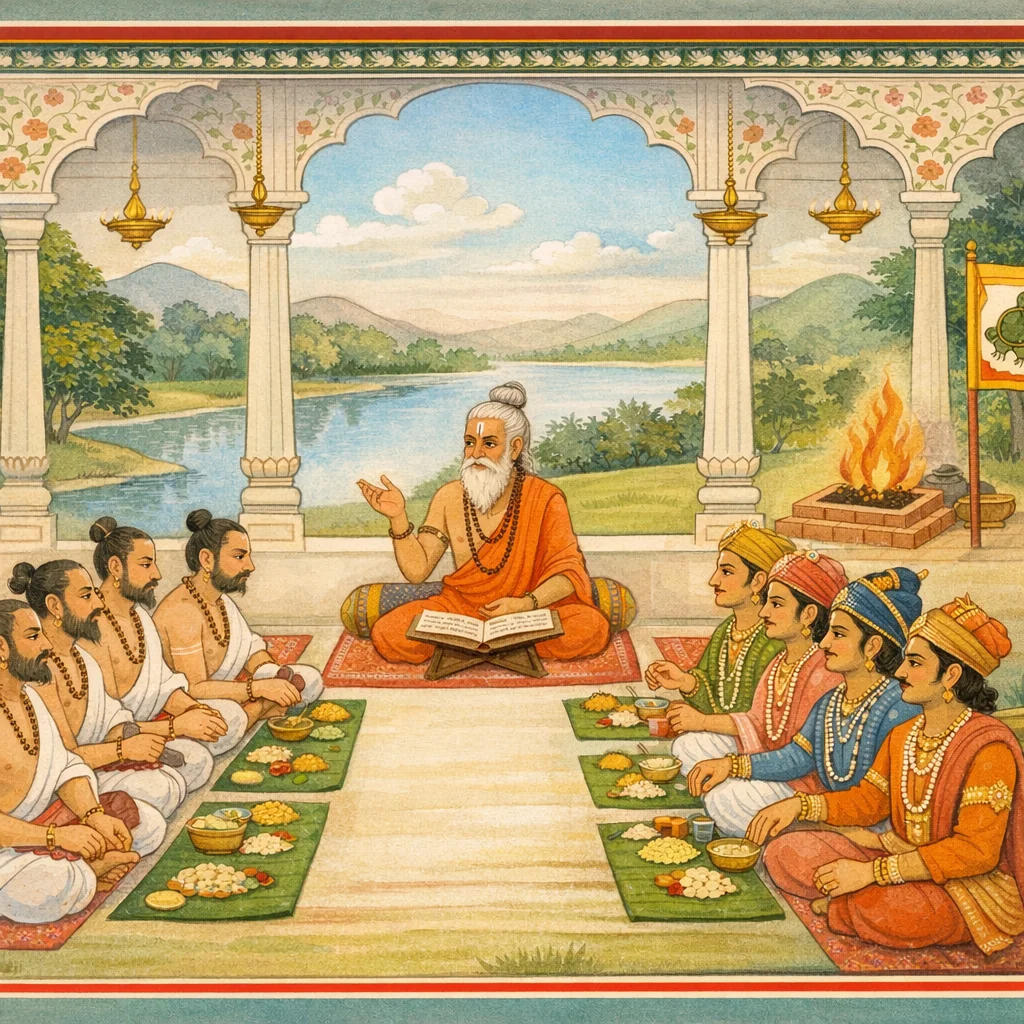
Adhyaya 16
Dharma of Non-Injury, Non-Stealing, Purity, and Avoidance of Hypocrisy (Ācāra and Saṅkarya-Nivṛtti)
This chapter closes Adhyāya 15 and continues Vyāsa’s dharma-instruction in the Uttara-bhāga as a compendium of ācāra (right conduct). It defines the core restraints—ahiṃsā, satya, and asteya—through sharp edge-cases: stealing even grass, water, or earth; the especially grave sin of misappropriating deity-property and brāhmaṇa-wealth; and limited allowances for travelers in distress. It then turns to inner dharma, condemning vows used to conceal wrongdoing, the “cat-like” hypocrisy of false renunciants, and the spiritual ruin that follows reviling Veda, Deva, and Guru. Social and ritual boundaries are set out via the doctrine of saṅkarya (confusion from improper mixing), prohibiting certain intimacies, commensality, and shared ritual roles, and even prescribing practical ways to separate dining rows. The latter half intensifies purity and conduct rules—what to see, say, touch, and eat; where to live; and how to behave near fire, water, temples, omens, and during impurity (sūtaka/ucchiṣṭa). The chapter moves from universal ethics to ritual-social safeguards, preparing for later teachings where disciplined conduct becomes the prerequisite for higher Yoga and Vedāntic realization.
Shlokas
Verse 1
इति श्रीकूर्मपुराणे षट्साहस्त्र्यां संहितायामुपरिविभागे पञ्चदशो ऽध्यायः व्यास उवाच न हिंस्यात् सर्वभूतानिनानृतं वावदेत् क्वचित् / नाहितं नाप्रियं वाक्यं न स्तेनः स्याद् कदाचन
Thus, in the Śrī Kūrma Purāṇa, in the six-thousand-verse Saṃhitā, in the latter division, the fifteenth chapter concludes. Vyāsa said: “One should not injure any being; one should never speak falsehood. One should not utter words that are harmful, nor words that are merely pleasing; and one should never be a thief.”
Verse 2
तृणं वा यदि वा शाकं मृदं वा जलमेव वा / परस्यापहरञ्जन्तुर्नरकं प्रतिपद्यते
Whether it be a blade of grass, a vegetable, a clod of earth, or even water—any being who steals what belongs to another falls into hell.
Verse 3
न राज्ञः प्रतिगृह्णीयान्न शूद्रपतितादपि / न चान्यस्मादशक्तश्च निन्दितान् वर्जयेद् बुधः
A wise person should not accept gifts from a king, nor from a Śūdra, nor from one who has fallen from right conduct; nor from any other donor who is incapable of giving rightly. The discerning should avoid gifts from those who are blameworthy.
Verse 4
नित्यं याचनको न स्यात् पुनस्तं नैव याचयेत् / प्राणानपहरत्येवं याचकस्तस्य दुर्मतिः
One should not become a habitual beggar, nor repeatedly beg from the same person. For thus the ill-intentioned petitioner, through relentless dependence and harassment, as it were steals away that person’s very life-breath.
Verse 5
न देवद्रव्यहारी स्याद् विशेषेण द्विजोत्तमः / ब्रह्मस्वं वा नापहरेदापद्यपि कदाचन
A foremost twice-born must never steal property dedicated to the gods; and he should never, even in times of distress, seize what belongs to Brahmins.
Verse 6
न विषं विषमित्याहुर्ब्रह्मस्वं विषमुच्यते / देवस्वं चापि यत्नेन सदा परिहरेत् ततः
They say ordinary poison is not truly the worst poison; the deadliest poison is what is called a Brahmin’s wealth (when misappropriated). Therefore, with utmost care one should always avoid taking what belongs to the gods as well.
Verse 7
पुष्पे शाक्रोदके काष्ठे तथा मूले फले तृणे / अदत्तादानमस्तेयं मनुः प्राह प्रजापतिः
Regarding flowers, vegetables, water, wood, as well as roots, fruits, and grass—Manu, the Prajāpati, declared that taking what is not given is theft; asteya (non-stealing) is the discipline of refraining from such ungiven taking.
Verse 8
ग्रहीतव्यानि पुष्पाणि देवार्चनविधौ द्विजाः / नैकस्मादेव नियतमननुज्ञाय केवलम्
O twice-born ones, in the procedure of worshipping the Deity, flowers should be gathered according to rule; one should not take them habitually from a single place alone, without first seeking permission.
Verse 9
तृणं काष्ठं फलं पुष्पं प्रकाशं वै हरेद् बुधः / धर्मार्थं केवलं विप्रा ह्यन्यथा पतितो भवेत्
A wise person may take grass, firewood, fruit, flowers, and a little fuel or light only for the sake of dharma; O brāhmaṇas, if it is done otherwise, he becomes fallen.
Verse 10
तिलमुद्गयवादीनां मुष्टिर्ग्राह्या पथि स्थितैः / क्षुधार्तैर्नान्यथा विप्रा धर्मविद्भिरिति स्थितिः
When travelers are afflicted by hunger on the road, they may take only a fistful of sesame, green gram, barley, and the like—nothing more. Thus is the established rule, O brāhmaṇas, as known by the wise in dharma.
Verse 11
न धर्मस्यापदेशेन पापं कृत्वा व्रतं चरेत् / व्रतेन पापं प्रच्छाद्य कुर्वन् स्त्रीशूद्रदम्भनम्
One should not commit sin under the pretext of “dharma” and then undertake a vow. Nor should one, while performing a vow, conceal one’s wrongdoing and practice hypocritical deception—especially by putting on a show of piety before women and Śūdras.
Verse 12
प्रेत्येह चेदृशो विप्रो गर्ह्यते ब्रह्मवादिभिः / छद्मनाचरितं यच्च व्रतं रक्षांसि गच्छति
A Brahmin of such a kind, after death and even here in this very life, is censured by the proclaimers of Brahman; and whatever vow he performs in hypocrisy goes to the rākṣasas, yielding demonic fruit rather than sacred merit.
Verse 13
अलिङ्गी लिङ्गिवेषेण यो वृत्तिमुपजीवति / स लिङ्गिनां हरेदेनस्तिर्यग्योनौ च जायते
One who is not truly a renunciant, yet makes a living by wearing the outward guise of a renunciant—he steals the merit of genuine ascetics; because of that sin, he is born among the animal wombs as well.
Verse 14
बैडालव्रतिनः पापा लोके धर्मविनाशकाः / सद्यः पतन्ति पापेषु कर्मणस्तस्य तत् फलम्
Those sinful people who practice the “cat-like vow”—hypocrites who destroy dharma in the world—fall at once into sin; such is the fruit of that kind of action.
Verse 15
पाषण्डिनो विकर्मस्थान् वामाचारांस्तथैव च / पञ्चरात्रान् पाशुपतान् वाङ्मात्रेणापि नार्चयेत्
One should not honor—even by mere words—sectarians and heretics, those established in forbidden acts, and those who follow the left-hand path; likewise, in this prescribed context of worship, one should not pay reverence to Pañcarātra adherents or to the Pāśupatas.
Verse 16
वेदनिन्दारतान् मर्त्यान् देवनिन्दारतांस्तथा / द्विजनिन्दारतांश्चैव मनसापि न चिन्तयेत्
One should not, even in one’s mind, entertain thoughts of those mortal people who delight in reviling the Vedas, who delight in reviling the gods, and who also delight in reviling the twice-born.
Verse 17
याजनं योनिसंबन्धं सहवासं च भाषणम् / कुर्वाणः पतते जन्तुस्तस्माद् यत्नेन वर्जयेत्
One who engages in improper officiating of sacrifices, sexual or lineage relations, close cohabitation, and intimate conversation with the unfit falls from righteousness; therefore one should avoid these with careful effort.
Verse 18
देवद्रोहाद् गुरुद्रोहः कोटिकोटिगुणाधिकः / ज्ञानापवादो नास्तिक्यं तस्मात् कोटिगुणाधिकम्
Compared to hostility toward the gods, betrayal of one’s guru is millions upon millions of times more grievous. And the disparagement of true knowledge—namely atheistic denial—is, in turn, millions of times more grievous than that.
Verse 19
गोभिश्च दैवतैर्विप्रैः कृष्या राजोपसेवया / कुलान्यकुलतां यान्ति यानि हीनानि धर्मतः
Through cattle-keeping, ritual service to the deities, association with Brahmins, agriculture, and service to kings, even families deficient in dharma lose their standing and fall into the state of “non-lineage” (social disrepute).
Verse 20
कुविवाहैः क्रियालोपैर्वेदानध्ययनेन च / कुलान्यकुलतां यान्ति ब्राह्मणातिक्रमेण च
Through improper marriages, neglect of prescribed rites, non-study of the Vedas, and transgression against Brahmins, families fall from noble lineage into a degraded state.
Verse 21
अनृतात् पारदार्याच्च तथाभक्ष्यस्य भक्षणात् / अश्रौतधर्माचरणात् क्षिप्रं नश्यति वै कुलम्
Through falsehood, adultery, eating what is forbidden, and practising rites and conduct not sanctioned by the Veda, a family indeed quickly perishes.
Verse 22
अश्रोत्रियेषु वै दानाद् वृषलेषु तथैव च / विहिताचारहीनेषु क्षिप्रं नश्यति वै कुलम्
By giving charity to those who are not Veda-trained (aśrotriyas), likewise to base or unworthy persons (vṛṣalas), and to those who lack the prescribed code of conduct, a family’s welfare and lineage quickly fall into ruin.
Verse 23
नाधार्मिकैर्वृते ग्रामे न व्याधिबहुले भृशम् / न शूद्रराज्ये निवसेन्न पाषण्डजनैर्वृते
One should not reside in a village surrounded by the unrighteous, nor in a place excessively afflicted by disease; nor in a realm ruled by a Śūdra, nor where it is dominated by pāṣaṇḍas (anti-Vedic sectarians).
Verse 24
हिमवद्विन्ध्ययोर्मध्ये पूर्वपश्चिमयोः शुभम् / मुक्त्वा समुद्रयोर्देशं नान्यत्र निवसेद् द्विजः
A twice-born should dwell in the auspicious land between the Himālaya and the Vindhya ranges, stretching from east to west; abandoning the coastal tracts by the two seas, he should not reside elsewhere.
Verse 25
कृष्णो वा यत्र चरति मृगो नित्यं स्वभावतः / पुण्याश्च विश्रुता नद्यस्तत्र वा निवसेद् द्विजः
A twice-born should dwell where the dark-hued deer naturally roams at all times, or where renowned and holy rivers flow.
Verse 26
अर्धक्रोशान्नदीकूलं वर्जयित्वा द्विजोत्तमः / नान्यत्र निवसेत् पुण्यं नान्त्यजग्रामसन्निधौ
A foremost twice-born should avoid dwelling within half a krośa of a riverbank; and he should not reside elsewhere either, even in a place deemed auspicious, if it lies near the settlement of the antyajas (outcaste communities).
Verse 27
न संवसेच्च पतितैर्न चण्डालैर्न पुक्कसैः / न मूर्खैर्नावलिप्तैश्च नान्त्यैर्नान्त्यावसायिभिः
One should not live in close association with the fallen, nor with caṇḍālas or pukkasas; nor with fools or the arrogant, nor with those deemed ‘outcast’ or those who subsist by outcaste occupations.
Verse 28
एकशय्यासनं पङ्क्तिर्भाण्डपक्वान्नमिश्रणम् / याजनाध्यापने योनिस्तथैव सहभोजनम्
Sharing the same bed or seat, sitting together in a dining-row, mixing cooked food and vessels, serving as priest or teacher across prohibited social boundaries, and likewise eating together—these are all regarded as the sources of improper intermixture.
Verse 29
सहाध्यायस्तु दशमः सहयाजनमेव च / एकादश समुद्दिष्टा दोषाः साङ्कर्यसंज्ञिताः
The tenth fault is “joint recitation,” the improper mixing of lessons, and likewise “joint officiation,” the improper mixing of sacrificial roles. These eleven faults are enumerated and collectively called “saṅkarya”—confusion born of mixing.
Verse 30
समीपे वा व्यवस्थानात् पापं संक्रमते नृणाम् / तस्मात् सर्वप्रयत्नेन साङ्कर्यं परिवर्जयेत्
By merely standing or dwelling in close proximity, sin can spread to people like contagion; therefore, with every effort one should avoid “saṅkara”—harmful mixing that leads to moral and dharmic confusion.
Verse 31
एकपङ्क्त्युपविष्टा ये न स्पृशन्ति परस्परम् / भस्मना कृतमर्यादा न तेषां संकरो भवेत्
Those who sit in a single row yet do not touch one another, and who set the boundary by marking it with sacred ash (bhasma)—among them there is no saṅkara, no intermixture.
Verse 32
अग्निना भस्मना चैव सलिलेनावसेकतः / द्वारेण स्तम्भमार्गेण षड्भिः पङ्क्तिर्विभिद्यते
By fire, by sacred ash, and by sprinkling with water; and also by the doorway and by the passage aligned with the pillar—by these six means the ritual row is marked out and separated.
Verse 33
न कुर्याच्छुष्कवैराणि विवादं च न पैशुनम् / परक्षेत्रे गां धयन्तीं न चाचक्षीत कस्यचित् / न संवदेत् सूतके च न कञ्चिन्मर्मणि स्पृशेत्
One should not create pointless enmities, nor engage in quarrels or slander. One should not point out to anyone a cow nursing her calf in another’s field. One should not converse during sūtaka, a period of ritual impurity, and one should not touch anyone on a vulnerable, secret, or painful spot.
Verse 34
न सूर्यपरिवेषं वा नेन्द्रचापं शवाग्निकम् / परस्मै कथयेद् विद्वान् शशिनं वा कदाचन
A learned person should never disclose to others—at any time—omens such as a halo around the sun, a rainbow, the fire of a corpse (cremation-fire), or even the moon as an ominous sign.
Verse 35
न कुर्याद् बहुभिः सार्धं विरोधं बन्धुभिस्तथा / आत्मनः प्रतिकूलानि परेषां न समाचरेत्
One should not quarrel with many people, nor even with one’s own relatives; and one should not do to others what is unfavourable to oneself.
Verse 36
तिथिं पक्षस्य न ब्रूयात् न नक्षत्राणि निर्दिशेत् / नोदक्यामभिभाषेत नाशुचिं वा द्विजोत्तमः
A foremost twice-born should not announce the lunar day (tithi) or the fortnight, nor point out the constellations; and he should not converse with a menstruating woman, nor with one who is impure.
Verse 37
न देवगुरुविप्राणां दीयमानं तु वारयेत् / न चात्मानं प्रशंसेद् वा परनिन्दां च वर्जयेत् / वेदनिन्दां देवनिन्दां प्रयत्नेन विवर्जयेत्
One should not obstruct what is being given to the gods, to one’s teacher (guru), or to Brahmins. Nor should one praise oneself; one should avoid disparaging others. With deliberate effort, one should refrain from reviling the Vedas and from reviling the deities.
Verse 38
यस्तु देवानृषीन् विप्रान्वेदान् वा निन्दति द्विजः / न तस्य निष्कृतिर्दृष्टा शास्त्रेष्विह मुनीश्वराः
But that twice-born person who reviles the gods, the seers (rishis), the Brahmin sages, or the Vedas—O best of sages—no expiation for him is found here in the scriptures.
Verse 39
निन्दयेद् वै गुरुं देवं वेदं वा सोपबृंहणम् / कल्पकोटिशतं साग्रं रौरवे पच्यते नरः
Truly, whoever reviles the Guru, the Deity, or the Veda together with its authoritative supplements and explanations is cooked in the Raurava hell for a full hundred crore kalpas and more.
Verse 40
तूष्णीमासीत निन्दायां न ब्रूयात् किञ्चिदुत्तरम् / कर्णौ पिधाय गन्तव्यं न चैतानवलोकयेत्
When faced with slander, one should remain silent and speak no reply at all. Covering one’s ears, one should depart, and one should not even look at such people.
Verse 41
वर्जयेद् वै रहस्यानि परेषां गूहयेद् बुधः / विवादं स्वजनैः सार्धं न कुर्याद् वै कदाचन
A wise person should avoid divulging secrets and should keep the confidences of others concealed. One should never, at any time, engage in quarrel with one’s own kinsmen.
Verse 42
न पापं पापिनां ब्रूयादपापं वा द्विजात्तमाः / सतेनतुल्यदोषः स्यान्मिथ्या द्विर्देषवान् भवेत्
O best of the twice-born: one should not proclaim the sin of sinners, nor should one declare the sinless to be sinful. Doing so incurs a fault equal to theft; but if it is done falsely, the blame becomes twofold.
Verse 43
यानि मिथ्याभिशस्तानां पतन्त्यश्रूणि रोदनात् / तानिपुत्रान् पशून्घ्निन्ति तेषां मिथ्याभिशंसिनाम्
The tears that fall from those who are falsely accused, as they weep, become the destroyers of the sons and cattle of the false accusers.
Verse 44
ब्रिह्महत्यासुरापाने स्तेयगुर्वङ्गनागमे / दृष्टं विशोधनं वृद्धैर्नास्ति मिथ्याभिशंसने
For brahmin-slaying, drinking intoxicants, theft, and approaching the wife of one’s teacher, the elders have recognized expiations that purify. But for false accusation (slander), they have not seen any such purification.
Verse 45
नेक्षेतोद्यन्तमादित्यं शशिनं चानिमित्ततः / नास्तं यान्तं न वारिस्थं नोपसृष्टं न मघ्यगम् / तिरोहितं वाससा वा नादर्शान्तरगामिनम्
One should not gaze at the rising sun, nor at the moon without proper reason; nor at the sun while it is setting, nor when reflected in water, nor when eclipsed, nor when it stands at midday; nor when hidden by cloth, nor when seen through a mirror or any reflecting surface.
Verse 46
न नग्नां स्त्रियमीक्षेत पुरुषं वा कदाचन / न च मूत्रं पुरीषं वा न च संस्पृष्टमैथुनम् / नाशुचिः सूर्यसोमादीन् ग्रहानालोकयेद् बुधः
One should never gaze upon a naked woman or a naked man. Nor should one look at urine or feces, nor at sexual union in progress. A wise person, when impure, should not look upon the Sun, the Moon, and the other grahas (heavenly luminaries).
Verse 47
पतितव्यङ्गचण्डालानुच्छिष्टान् नावलोकयेत् / नाभिभाषेत च परमुच्छिष्टो वावगुण्ठितः
One should not even look at the fallen, the disfigured, or a caṇḍāla when they are in a state of uchiṣṭa (impurity from food-remnants). Nor should one speak to them—especially when one is oneself in great impurity, or when veiled/covered as in a rite of impurity.
Verse 48
न पश्येत् प्रेतसंस्पर्शं न क्रुद्धस्य गुरोर्मुखम् / न तैलोदकयोश्छायां न पत्नीं भोजने सति / नामुक्तबन्धनाङ्गां वा नोन्मत्तं मत्तमेव वा
One should not look upon a person tainted by contact with a corpse, nor upon the face of one’s teacher when he is angry; nor should one look at one’s reflection in oil or in water, nor at one’s wife while one is eating; nor at one whose limbs are still bound, nor at a madman, nor at one who is intoxicated.
Verse 49
नाश्नीयात् भार्यया सार्धंनैनामीक्षेत चाश्नतीम् / क्षुवन्तीं जृम्भमाणां वा नासनस्थां यथासुखम्
One should not eat together with one’s wife; nor should one gaze upon her while she eats—nor when she sneezes or yawns, nor when she sits at ease, informally and unrestrained.
Verse 50
नोदके चात्मनो रूपं न कूलं श्वभ्रमेव वा / न लङ्घयेच्च मूत्रं वा नाधितिष्ठेत् कदाचन
One should not look upon one’s own reflection in water; nor step upon a riverbank or the edge of a pit. One should not leap over urine, and one should never stand upon it.
Verse 51
न शूद्राय मतिं दद्यात् कृशरं पायसं दधि / नोच्छिष्टं वा मधु घृतं न च कृष्णाजिनं हविः
One should not impart sacred counsel (confidential instruction) to a Śūdra; nor give him kṛśara (rice with pulses), pāyasa (milk-rice), or curd. Nor should one give him remnants of food, nor honey or ghee; and one should not give him a black antelope-skin or havis (sacrificial oblation).
Verse 52
न चैवास्मै व्रतं दद्यान्न च धर्मं वदेद् बुधः / न च क्रोधवशं गच्छेद् द्वेषं रागं च वर्जयेत्
A wise person should neither prescribe vows (vrata) to such a one nor instruct him in sacred duty (dharma). Nor should he act under the sway of anger; he should abandon both hatred and attachment.
Verse 53
लोभं दम्भं तथा यत्नादसूयां ज्ञानकुत्सनम् / ईर्ष्यां मदं तथा शोकं मोहं च परिवर्जयेत्
With deliberate effort, one should abandon greed and hypocrisy, malice and the disparagement of true knowledge; and likewise renounce envy, arrogance, sorrow, and delusion (moha).
Verse 54
न कुर्यात् कस्यचित् पीडां सुतं शिष्यं च ताडयेत् / न हीनानुपसेवेत न च तीक्ष्णमतीन् क्वचित्
Do not cause suffering to anyone. Even when disciplining a son or a student, do not strike in a way that becomes cruelty. Do not associate with the base-minded, nor ever keep company with those whose sharp intellect cuts and wounds.
Verse 55
नात्मानं चावमन्येत दैन्यं यत्नेन वर्जयेत् / न विशिष्टानसत्कुर्यात् नात्मानं वा शपेद् बुधः
Do not despise yourself; with care, avoid the spirit of wretchedness. A wise person should not disrespect those who are superior, nor should one curse oneself.
Verse 56
न नखैर्विलिखेद् भूमिं गां च संवेशयेन्न हि / न नदीषु नदीं ब्रूयात् पर्वतेषु च पर्वतान्
Do not scratch or score the earth with the nails, nor forcibly pen up a cow. Do not name a river while standing in rivers, nor speak of mountains while among mountains.
Verse 57
आवासे भोजने वापि न त्यजेत् हसयायिनम् / नावगाहेदपो नग्नो वह्निं नातिव्रजेत् पदा
Whether in lodging or at a meal, do not abandon the companion who shares your bed and is under your protection. Do not enter water while naked, and do not step across a fire.
Verse 58
शिरो ऽभ्यङ्गावशिष्टेन तैलेनाङ्गं न लेपयेत् / न सर्पशस्त्रैः क्रीडेत स्वानि खानि न संस्पृशेत् / रोमाणि च रहस्यानि नाशिष्टेन सह व्रजेत्
Do not smear the body with the oil left over after anointing the head. Do not play with weapons, nor touch your own bodily orifices. Do not go about carrying impure food-remnants, nor secretly engage in unclean acts such as plucking body-hair without purity.
Verse 59
न पाणिपादवाङ्नेत्रचापल्यं समुपाश्रयेत् / न शिश्नोदरचापल्यं न च श्रवणयोः क्वचित्
One should not give refuge to restlessness of hands, feet, speech, or eyes; nor ever yield to the fickleness of the sexual organ or the belly, nor to the wandering of the ears.
Verse 60
न चाङ्गनखवादं वै कुर्यान्नाञ्जलिना पिबेत् / नाभिहन्याज्जलं पद्भ्यां पाणिना वा कदाचन
One should not pick at the body or scrape the nails; nor drink water from cupped hands in añjali. One should never strike or splash water with the feet, nor with the hand at any time.
Verse 61
न शातयेदिष्टकाभिः फलानि न फलेन च / न म्लेच्छभाषां शिक्षेत नाकर्षेच्च पदासनम्
One should not knock down fruits with bricks, nor with other fruits. One should not learn the speech of the mlecchas (impure tongues), and one should not drag about a footstool or seat.
Verse 62
न भेदनमवस्फोटं छेदनं वा विलेखनम् / कुर्याद् विमर्दनं धीमान् नाकस्मादेव निष्फलम्
A wise person should not crack it, strike it, cut it, or scrape it; nor rub it harshly—never acting impulsively in a way that renders the rite fruitless.
Verse 63
नोत्सङ्गेभक्षयेद् भक्ष्यं वृथा चेष्टां च नाचरेत् / न नृत्येदथवा गायेन्न वादित्राणि वादयेत्
One should not eat food while holding it in one’s lap, nor engage in purposeless actions. One should not dance or sing, nor play musical instruments in a frivolous, undisciplined manner.
Verse 64
न संहताभ्यां पाणिभ्यां कण्डूयेदात्मनः शिरः / न लौकिकैः स्तवैर्देवांस्तोषयेद् बाह्यजैरपि
One should not scratch one’s head with both palms held together; nor should one seek to please the gods with worldly praises or with acts that are merely outward and external.
Verse 65
नाक्षैः क्रीडेन्न धावेत नाप्सु विण्मूत्रमाचरेत् / नोच्छिष्टः संविशेन्नित्यं न नग्नः स्नानमाचरेत्
One should not play at dice, nor run about heedlessly; one should not pass stool or urine in water. One should never lie down while still impure from food-remnants, and one should not bathe naked.
Verse 66
न गच्छेन्न पठेद् वापि न चैव स्वशिरः स्पृशेत् / न दन्तैर्नखरोमाणि छिन्द्यात् सुप्तं न बोधयेत्
One should not walk about or recite sacred texts while in an improper state; nor should one touch one’s own head in disrespect. One should not bite and cut nails or hair with the teeth, and one should not awaken a sleeping person.
Verse 67
न बालातपमासेवेत् प्रेतधूमं विवर्जयेत् / नैकः सुप्याच्छून्यगृहे स्वयं नोपानहौ हरेत्
One should not expose oneself to the harsh sun; one should avoid the smoke of a funeral pyre. One should not sleep alone in an empty house, and one should not remove one’s own footwear by oneself.
Verse 68
नाकारणाद् वा निष्ठीवेन्न बाहुभ्यां नदीं तरेत् / न पादक्षालनं कुर्यात् पादेनैव कदाचन
One should not spit without a valid reason. One should not cross a river by swimming with the arms. One should never wash one foot using the other foot.
Verse 69
नाग्नौ प्रतापयेत् पादौ न कांस्ये धावयेद् बुधः / नाभिप्रासरयेद् देवं ब्राह्मणान् गामथापि वा / वाय्वग्निगुरुविप्रान् वा सूर्यं वा शशिनं प्रति
A wise person should not warm the feet at the fire, nor wash them in a bronze vessel. One should not stretch out the feet toward a Deity, toward Brahmins, or even toward a cow—nor toward the wind, fire, one’s teacher, learned Brahmins, the sun, or the moon.
Verse 70
अशुद्धः शयनं यानं स्वाध्यायं स्नानवाहनम् / बहिर्निष्क्रमणं चैव न कुर्वोत कथञ्चन
When one is impure, one should not under any circumstance lie down (to sleep), ride or travel, engage in svādhyāya (Vedic recitation), bathe, mount a vehicle, or even go outside.
Verse 71
स्वप्नमध्ययनं स्नानमुद्वर्तं भोजनं गतिम् / उभयोः संध्ययोर्नित्यं मध्याह्ने चैव वर्जयेत्
One should always avoid sleeping, study, bathing, rubbing the body (with powders or oils), eating, and unnecessary going about—during both twilight junctions (dawn and dusk), and also at midday.
Verse 72
न स्पृशेत् पाणिनोच्छिष्टो विप्रोगोब्राह्मणानलान् / न चासनं पदा वापि न देवप्रतिमां स्पृशेत्
A brāhmaṇa whose hand is sullied by food-remnants should not touch a cow, another brāhmaṇa, or fire; nor should he touch a seat with his foot, and he should not touch an image of the Deity.
Verse 73
नाशुद्धो ऽग्निं परिचरेन्न देवान् कीर्तयेदृषीन् / नावगाहेदगाधाम्बु धारयेन्नानिमित्ततः
When one is impure, one should not tend the sacred fire, nor worship the gods, nor recite the names of the seers. Nor should one plunge into deep water, and one should not undertake a fast without a proper cause.
Verse 74
न वामहस्तेनोद्धत्य पिबेद् वक्त्रेण वा जलम् / नोत्तरेदनुपस्पृश्य नाप्सु रेतः समुत्सृजेत्
One should not drink water lifted with the left hand, nor drink by placing the mouth directly upon the water. One should not relieve oneself without first touching water for purification, and one should not discharge semen into water.
Verse 75
अमेध्यलिप्तमन्यद् वा लोहितं वा विषाणि वा / व्यतिक्रमेन्न स्त्रवन्तीं नाप्सु मैथुनमाचरेत् / चैत्यं वृक्षं न वै छिन्द्यान्नाप्सु ष्ठीवनमाचरेत्
One should not step over anything smeared with impurity, nor over blood, nor over horns. One should not step across a woman in her menstrual flow, nor engage in sexual intercourse in water. One should not cut a tree belonging to a sacred shrine (caitya), and one should not spit into water.
Verse 76
नास्थिभस्मकपालानि न केशान्न च कण्टकान् / तुषाङ्गारकरीषं वा नाधितिष्ठेत् कदाचन
One should never at any time step on bones, ashes, or skulls; nor on hair or thorns; nor on husks, live embers, or dung.
Verse 77
न चाग्निं लङ्घयेद् धीमान् नोपदध्यादधः क्वचित् / न चैनं पादतः कुर्यान्मुखेन न धमेद् बुधः
A wise person should not step over the sacred fire, nor place anything beneath it at any time. Nor should one treat it with the feet; the discerning should not blow on it with the mouth.
Verse 78
न कूपमवरोहेत नावेक्षेताशुचिः क्वचित् / अग्नौ न च क्षिपेदग्निं नाद्भिः प्रशमयेत् तथा
One should not climb down into a well, nor should an impure person look into it at any time. One should not throw anything into a fire, nor should one extinguish fire with water in that manner.
Verse 79
सुहृन्मरणमार्तिं वा न स्वयं श्रावयेत् परान् / अपण्यं कूटपण्यं वा विक्रये न प्रयोजयेत्
One should not oneself proclaim to others the death or distress of a dear friend. Nor should one sell what ought not be sold, or trade in counterfeit and deceitful goods.
Verse 80
न वह्निं मुखनिश्वासैर् ज्वालयेन्नाशुचिर्बुधः / पुण्यस्थानोदकस्थाने सीमान्तं वा कृषेन्न तु
A wise person, when impure, should not kindle fire by blowing with the mouth. Nor should one plough in a sacred place, at a holy site’s water-source, or along boundary-lines.
Verse 81
न भिन्द्यात् पूर्वसमयमभ्युपेतं कदाचन / परस्परं पशून् व्यालान् पक्षिणो नावबोधयेत्
One should never break a prior agreement once it has been accepted. Nor should one incite animals—cattle, wild beasts, or birds—against one another.
Verse 82
परबाधं न कुर्वोत जलवातातपादिभिः / कारयित्वा स्वकर्माणि कारून् पश्चान्न वञ्चयेत् / सायंप्रातर् गृहद्वारान् भिक्षार्थं नावघट्टयेत्
One should not harm others by misusing water, wind, heat, sunlight, and the like. Having had artisans perform one’s appointed works, one should not cheat them afterwards. And one should not, at evening and at dawn, go knocking at household doors for alms.
Verse 83
बहिर्माल्यं बहिर्गन्धं भार्यया सह भोजनम् / विगृह्य वादं कुद्वारप्रवेशं च विवर्जयेत्
One should avoid wearing garlands and perfumes for display outside the home; eating with one’s wife in a manner that invites impropriety; quarrelsome disputes; and entering by improper doors and secret ways.
Verse 84
न खादन्ब्राह्मणस्तिष्ठेन्न जल्पेद् वा हसन् बुधः / स्वमग्निं नैव हस्तेन स्पृशेन्नाप्सु चिरं वसेत्
A Brāhmaṇa should not remain standing while eating; the wise should not chatter or laugh during such acts. He should not touch his own sacred fire with his hand, and he should not remain in water for a long time.
Verse 85
न पक्षकेणोपधमेन्न शूर्पेण न पाणिना / मुखे नैव धमेदग्निं मुखादग्निरजायत
One should not fan a fire with a wing, nor with a winnowing basket, nor with the hand. Nor should one blow upon the fire with the mouth—for fire is said to have been born from the mouth.
Verse 86
परस्त्रियं न भाषेत नायाज्यं याजयेद् द्विजः / नैकश्चरेत् सभां विप्रः समवायं च वर्जयेत्
A twice-born man should not converse with another man’s wife; nor should a Brāhmaṇa officiate in sacrifice for one unfit for sacrifice. A learned Brāhmaṇa should not go alone into an assembly, and he should avoid factional gatherings and secret combinations.
Verse 87
न देवायतनं गच्छेत् कदाचिद् वाप्रदक्षिणम् / न वीजयेद् वा वस्त्रेण न देवायतने स्वपेत्
One should never circumambulate a temple in an improper manner; nor should one fan with a cloth; and one should not sleep within the temple precincts.
Verse 88
नैको ऽध्वानं प्रपद्येत नाधार्मिकजनैः सह / न व्याधिदूषितैर्वापि न शूद्रैः पतितेन वा
One should not set out on a journey alone, nor in the company of unrighteous people; nor with those corrupted by disease, nor with a fallen (outcaste) Śūdra.
Verse 89
नोपानद्वर्जितो वाथ जलादिरहितस्तथा / न रात्रौ नारिणा सार्धं न विना च कमण्डलुम् / नाग्निगोब्राह्मणादीनामन्तरेण व्रजेत् क्वचित्
One should not go about without sandals, nor without water and other necessities. One should not travel at night, nor in the company of a woman, nor without one’s kamaṇḍalu (water-pot). Never should one go anywhere while disregarding the sacred fire, cows, brāhmaṇas, and other venerable beings.
Verse 90
न वत्सतन्त्रीं विततामतिक्रामेत् क्वचिद् द्विजः / न निन्देद् योगिनः सिद्धान् व्रतिनो वायतींस्तथा
A dvija (twice-born) should never overstep the cord spread out to mark a boundary. Nor should he disparage yogins, accomplished siddhas, observers of sacred vows, or yatis—renunciant ascetics.
Verse 91
देवतायतनं प्राज्ञो देवानां चैव सत्रिणाम् / नाक्रामेत् कामतश्छायां ब्राह्मणानां च गोरपि
A wise person should not show disrespect to a temple, the abode of the deities, nor to the sacred precincts of the gods and of those engaged in sacrificial rites. Nor should one, out of mere whim, step upon the shadow of a brāhmaṇa—or even that of a cow.
Verse 92
स्वां तु नाक्रमयेच्छायां पतिताद्यैर्न रोगिभिः / नाङ्गारभस्मकेशादिष्वधितिष्ठेत् कदाचन
One should not allow one’s own shadow to be stepped upon by the fallen (patita) and the like, nor by the diseased. One should also never stand upon embers, ashes, hair, and similar impure remnants.
Verse 93
वर्जयेन्मार्जनीरेणुं स्नानवस्त्रघचोदकम् / न भक्षयेदभक्ष्याणि नापेयं च पिबेद् द्विजः
A dvija (twice-born) should avoid the dust raised by sweeping, and water that has been used for washing the body and garments. He should not eat what is forbidden to eat, nor drink what is forbidden to drink.
Frequently Asked Questions
It defines theft broadly as taking anything not given—even grass, water, roots, fruit, flowers, or earth—while framing asteya as disciplined restraint from all ungiven taking, with only narrowly delimited exceptions for dharma or dire traveler-need.
It condemns using vows to conceal sin, performing vratas as social display, and living by the outward marks of renunciation without inner renunciation—calling such conduct a theft of ascetics’ merit and a destroyer of dharma.
Saṅkarya is ‘confusion by mixing’—a set of enumerated faults arising from prohibited commensality, intimacy, shared ritual roles, and close association; it is treated as morally contagious and thus to be avoided or ritually demarcated.
Because it frames śāstra, guru, and deva as the pillars of dharma-knowledge and worship; undermining them destroys the very means of purification, hence it declares extreme consequences and, in places, the absence of expiation.