Adhyaya 15
Snātaka and Gṛhastha-Dharma: Conduct, Marriage Norms, Daily Rites, and Liberating Virtues
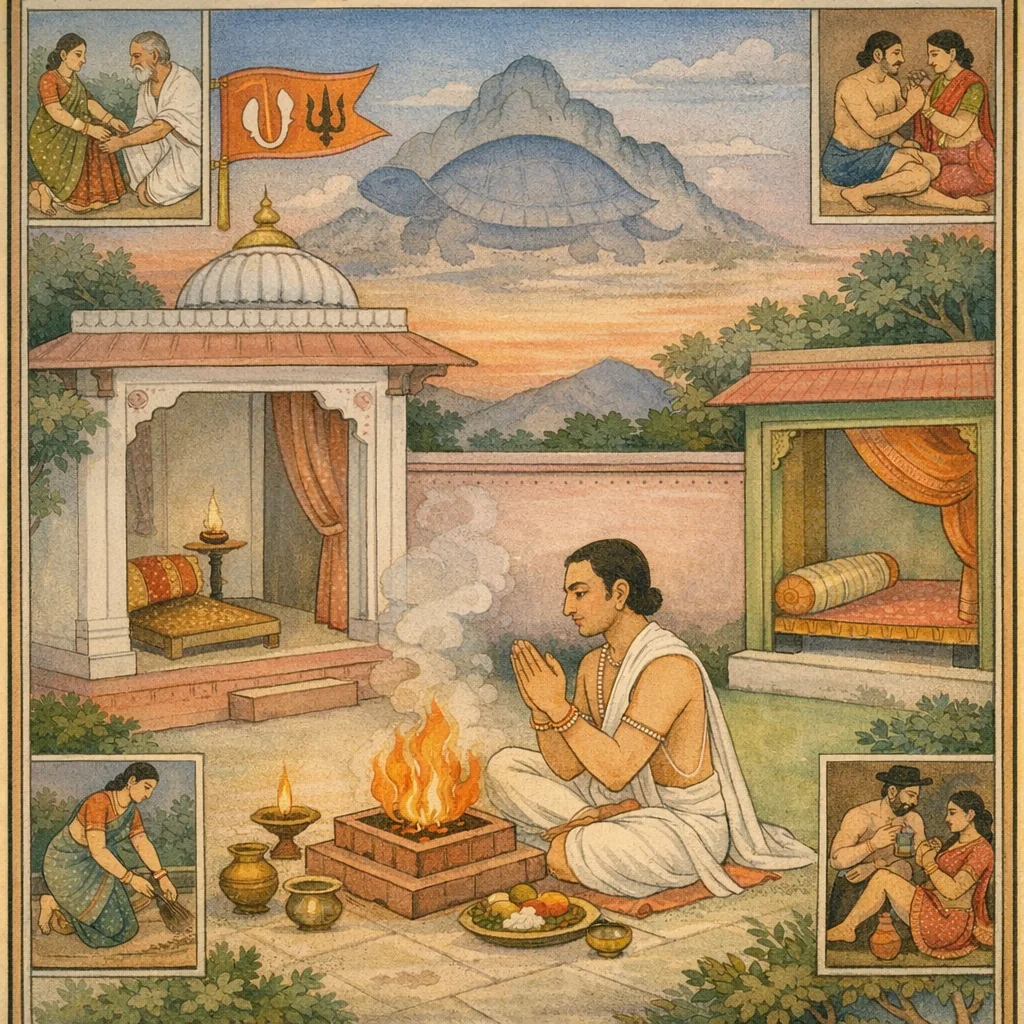
Concluding the prior unit (with chapter 14 ending in the opening verse), Vyāsa turns to a prescriptive Dharma teaching for the snātaka—one who has completed Vedic study and is fit for the concluding bath (samāvartana). The chapter lists the outward marks of disciplined life (staff, garments, sacred thread, kamaṇḍalu, cleanliness, restrained adornment) and prohibitions that safeguard ritual purity and modesty. It then sets forth gṛhastha duties: dharmic marriage rules (avoiding the same maternal line and gotra), regulated conjugal conduct mindful of prohibited tithis, and establishing the household fire with daily offerings to Agni (Jātavedas). The tone rises to ethical and liberating aims: neglect of Vedic duty leads to hellish states, while faithful sandhyā, brahma-yajña, japa of Sāvitrī, śrāddha, and compassionate conduct elevate one to Brahmaloka and even liberation. The closing verses define core virtues—kṣamā, dayā, satya, jñāna/vijñāna, self-restraint—and culminate by declaring Dharma itself as the Lord and refuge, with a phalaśruti promising honor in Brahmaloka for reciting or teaching this chapter. As the next chapter nears, the movement points from outer discipline toward deeper Yoga–Vedānta interiorization: knowledge of the Self and Īśvara as the consummation of varṇāśrama practice.
Shlokas
Verse 1
इति श्रीकूर्मपुराणे षट्साहस्त्र्यां संहितायामुपरिविभागे चतुर्दशो ऽध्यायः व्यास उवाच वेदं वेदौ तथा वेदान् वेदान् वा चतुरो द्विजाः / अधीत्य चाधिगम्यार्थं ततः स्नायाद् द्विजोत्तमः
Thus, in the Śrī Kūrma Purāṇa, in the six-thousand-verse Saṃhitā, in the latter division, the fourteenth chapter comes to an end. Vyāsa said: Having studied one Veda, or two, or the Vedas—indeed even all four—when the best of the twice-born has grasped their purport, he should thereafter perform the purificatory bath.
Verse 2
गुरवे तु वरं दत्त्वा स्नायीत तदनुज्ञया / चीर्णव्रतो ऽथ युक्तात्मा सशक्तः स्नातुमर्हति
First, having presented the guru with a fitting gift (dakṣiṇā), one should perform the concluding bath with the guru’s permission. Then, having duly completed the vow, disciplined in mind and self-controlled, and being physically able, one becomes fit to bathe as the rite of completion.
Verse 3
वैणवीं धारयेद् यष्टिमन्तर्वासस्तथोत्तरम् / यज्ञोपवीतद्वितयं सोदकं च कमण्डलुम्
He should carry a staff made of veṇu (bamboo/reed), wear the inner garment and the upper cloth, keep two sacred threads (yajñopavīta), and also a water-pot (kamaṇḍalu) filled with water.
Verse 4
छत्रं चोष्णीषममलं पादुके चाप्युपानहौ / रौक्मे च कुण्डले वेदं कृत्तकेशनखः शुचिः
With an umbrella and a spotless turban, wearing sandals and shoes, and adorned with golden earrings—having studied the Veda, with hair and nails trimmed, and being pure—one should conduct oneself in accordance with dharma.
Verse 5
स्वाध्याये नित्ययुक्तः स्याद् बहिर्माल्यं न धारयेत् / अन्यत्रकाञ्चनाद् विप्रोनरक्तां बिभृयात् स्त्रजम्
A brāhmaṇa should remain constantly devoted to svādhyāya (sacred self-study). He should not wear garlands outwardly for display; and, except for permitted gold, a brāhmaṇa should not wear a red garland.
Verse 6
शुक्लाम्बरधरो नित्यं सुगन्धः प्रियदर्शनः / न जीर्णमलवद्वासा भवेद् वै विभवे सति
He should always wear clean white garments, be gently fragrant, and appear pleasing to behold; and when he has the means, he should certainly not wear clothes that are old or soiled with dirt.
Verse 7
न रक्तमुल्बणं चान्यधृतं वासो न कुण्डिकाम् / नोपानहौ स्त्रजं चाथ पादुके च प्रयोजयेत्
One should not use a bright-red garment, nor clothing previously worn by another; nor should one employ a kuṇḍikā (water-pot). Likewise, in this observance one should not use footwear, garlands, or sandals (pādukā).
Verse 8
उपवीतमलङ्कारं दर्भान् कृष्णाजिनानि च / नापसव्यं परीदध्याद् वासो न विकृतं वसेत्
He should wear the upavīta (sacred thread) and the prescribed ritual accessories—darbha (kuśa) grass and a black antelope-skin. He should not put on the sacred thread in the reverse (inauspicious) manner, and he should not wear garments that are distorted, improper, or worn in a disordered way.
Verse 9
आहरेद् विधिवद् दारान् सदृशानात्मनः शुभान् / रूपलक्षणसंयुक्तान् योनिदोषविवर्जितान्
He should, according to due rite, take a wife who is auspicious and suited to himself—endowed with good form and favorable marks, and free from defects of lineage.
Verse 10
अमातृगोत्रप्रभवामसमानर्षिगोत्रजाम् / आहरेद् ब्राह्मणो भार्यां शीलशौचसमन्विताम्
A Brahmin should take a wife who is not born from his mother’s lineage and who does not belong to the same ṛṣi-lineage (gotra); she should be endowed with good conduct and purity.
Verse 11
ऋतुकालाभिगामी स्याद् यावत् पुत्रो ऽभिजायते / वर्जयेत् प्रतिषिद्धानि प्रयत्नेन दिनानि तु
A householder should approach his wife in her fertile season until a son is born; and he should diligently avoid the days that are expressly prohibited.
Verse 12
षष्ठ्यष्टमीं पञ्चदशीं द्वादशीं च चतुर्दशीम् / ब्रह्मचारी भवेन्नित्यं तद्वज्जन्मत्रयाहनि
On the sixth and eighth lunar days, on the fifteenth, the twelfth, and the fourteenth as well, one should always maintain brahmacarya (continence); and likewise on the three days connected with one’s birth.
Verse 13
आदधीतावसथ्याग्निं जुहुयाज्जातवेदसम् / व्रतानि स्नातको नित्यं पावनानि च पालयेत्
Having established the household sacred fire, he should offer oblations into Jātavedas (Agni). A snātaka, one who has completed Vedic study, should daily observe the purifying vows and disciplines.
Verse 14
वेदोदितं स्वकं कर्म नित्यं कुर्यादतन्द्रितः / अकुर्वाणः पतत्याशु नरकानतिभीषणान्
One should constantly and without negligence perform one’s own duty as enjoined by the Veda. He who does not perform it quickly falls into exceedingly dreadful hells.
Verse 15
अब्यसेत् प्रयतो वेदं महायज्ञान् न हापयेत् / कुर्याद् गृह्याणि कर्माणि संध्योपासनमेव च
With self-control and purity, one should study the Veda and never neglect the great sacrifices; one should also perform the domestic rites and, above all, the worship at the twilights (sandhyā).
Verse 16
सख्यं समाधैकैः कुर्यादुपेयादीश्वरं सदा / दैवतान्यपि गच्छेत कुर्याद् भार्याभिपोषणम्
With those chiefly devoted to samādhi, one should cultivate friendship; and one should ever approach and take refuge in the Lord (Īśvara). One may also visit the deities for due worship, and one should properly support and maintain one’s wife.
Verse 17
न धर्मं ख्यापयेद् विद्वान् न पापं गूहयेदपि / कुर्वोतात्महितं नित्यं सर्वभूतानिकम्पकः
A wise person should not publicize his own righteousness, nor should he conceal wrongdoing. He should constantly act for the true welfare of the self, being compassionate toward all beings.
Verse 18
वयसः कर्मणोर्ऽथस्य श्रुतस्याभिजनस्य च / वेषवाग्बुद्धिसारूप्यमाचरन् विचरेत् सदा
One should always move about practicing congruity—of dress, speech, and understanding—in keeping with one’s age, one’s occupation and duties, one’s means, one’s learning, and one’s family background.
Verse 19
श्रुतिस्मृत्युदितः सम्यक् साधुभिर्यश्च सेवितः / तमाचारं निषेवेत नेहेतान्यत्र कर्हिचित्
One should faithfully follow that proper code of conduct which is clearly taught by Śruti and Smṛti and is practiced by the virtuous; in this matter, one should not resort to any other path here, at any time.
Verse 20
येनास्य पितरो याता येन याताः पितामहाः / तेन यायात् सतां मार्गं तेन गच्छन् न रिष्यति
By the way his forefathers went, and by which his grandfathers too proceeded—by that very way he should walk the path of the virtuous; walking in it, he does not come to ruin.
Verse 21
नित्यं स्वाध्यायशीलः स्यान्नित्यं यज्ञोपवीतवान् / सत्यवादी जितक्रोधो ब्रह्मभूयाय कल्पते
One should ever be devoted to svādhyāya (sacred study), ever wearing the yajñopavīta (sacred thread); truthful in speech and having conquered anger—such a person becomes fit for brahmahood, the state of Brahman.
Verse 22
संध्यास्नानपरो नित्यं ब्रह्मयज्ञुपरायणः / अनसूयी मृदुर्दान्तो गृहस्थः प्रेत्य वर्धते
A householder who is always devoted to the Sandhyā rites and purificatory bathing, steadfast in the Brahma-yajña (study and recitation of sacred knowledge), free from envy, gentle, and self-controlled—after death, he prospers and attains higher well-being.
Verse 23
वीतरागभयक्रोधो लोभमोहविवर्जितः / सावित्रीजाप्यनिरतः श्राद्धकृन्मुच्यते गृही
A householder who is free from attachment, fear, and anger; who has abandoned greed and delusion; who is steadily devoted to the japa of Sāvitrī (Gāyatrī); and who performs the śrāddha rites—such a gṛhastha is liberated from bondage and sin.
Verse 24
मातापित्रोर्हिते युक्तो गोब्राह्मणहिते रतः / दान्तो यज्वा देवभक्तो ब्रह्मलोके महीयते
One who is devoted to the welfare of mother and father, who delights in the good of cows and Brahmins, who is self-restrained, a performer of sacrifices, and a devotee of the gods—such a person is honored in Brahmaloka, the world of Brahman.
Verse 25
त्रिवर्गसेवी सततं देवतानां च पूजनम् / कुर्यादहरहर्नित्यं नमस्येत् प्रयतः सुरान्
One devoted to the three aims of life (trivarga) should continually perform worship of the deities; day after day, without fail, he should reverently bow to the gods with disciplined self-control.
Verse 26
विभागशीलः सततं क्षमायुक्तो दयालुकः / गृहस्थस्तु समाख्यातो न गृहेण गृही भवेत्
A true householder is one ever inclined to fair distribution, endowed with forbearance (kṣamā) and compassion; though dwelling in a home, he should not become a man possessed by the home.
Verse 27
क्षमा दया च विज्ञानं सत्यं चैव दमः शमः / अध्यात्मनिरतं ज्ञानमेतद् ब्राह्मणलक्षणम्
Forbearance (kṣamā), compassion, discerning understanding (vijñāna), truthfulness, self-restraint (dama), and inner tranquility (śama)—together with knowledge devoted to the Supreme Self—these are the marks of a brāhmaṇa.
Verse 28
एतस्मान्न प्रमाद्येत विशेषेण द्विजोत्तमः / यथाशक्तिं चरन् कर्म निन्दितानि विवर्जयेत्
Therefore, the best of the twice-born (dvijottama) should never be negligent in this matter; performing his duties according to his capacity, he should avoid actions that are censured.
Verse 29
विधूय मोहकलिलं लब्ध्वा योगमनुत्तमम् / गृहस्थो मुच्यते बन्धात् नात्र कार्या विचारणा
Having shaken off the mire of delusion and attained the unsurpassed Yoga, even a householder is released from bondage—of this there is no need for doubt or further deliberation.
Verse 30
विगर्हातिक्रमाक्षेपहिंसाबन्धवधात्मनाम् / अन्यमन्युसमुत्थानां दोषाणां मर्षणं क्षमा
Forbearance (kṣamā) is the patient endurance—without retaliation—of faults that arise from mutual anger, such as censure, transgression, insult, violence, captivity, and even attempts upon one’s life.
Verse 31
स्वदुः खेष्विव कारुण्यं परदुः खेषु सौहृदात् / दयेति मुनयः प्राहुः साक्षाद् धर्मस्य साधनम्
Compassion that feels another’s suffering as one’s own, born of heartfelt goodwill toward the afflicted, is what the sages call “dayā” (mercy). Truly, it is a direct instrument of dharma.
Verse 32
चतुर्दशानां विद्यानां धारणं हि यतार्थतः / विज्ञानमिति तद् विद्याद् येन धर्मो विवर्धते
Know as vijñāna (realized knowledge) the truthful assimilation of the fourteen disciplines of learning, by which Dharma is nourished and made to flourish.
Verse 33
अधीत्य विधिवद् विद्यामर्थं चैवोपलभ्य तु / धर्मकार्यान्निवृत्तश्चेन्न तद् विज्ञानमिष्यते
Even after studying knowledge by the proper method and grasping its meaning, if one turns away from the duties of dharma, that is not accepted as true realization (vijñāna).
Verse 34
सत्येन लोकाञ्जयति सत्यं तत्परमं पदम् / यथाभूतप्रवाद् तु सत्यमाहुर्मनीषिणः
By truth one conquers the worlds; truth indeed is the supreme state. The wise declare truth to be speaking of things exactly as they are.
Verse 35
दमः शरीरोपरमः शमः प्रज्ञाप्रिसादजः / अध्यात्ममक्षरं विद्याद् यत्र गत्वा न शोचति
Self-restraint (dama) is the stilling of bodily impulses; inner calm (śama) arises from the clarity and serenity of wisdom. Know the imperishable reality as the Self (adhyātman); having reached it, one does not grieve.
Verse 36
यया स देवो भगवान् विद्यया वेद्यते परः / साक्षाद् देवो महादेवस्तज्ज्ञानमिति कीर्तितम्
That sacred knowledge by which the transcendent Lord—God beyond all—is truly known is proclaimed to be “jñāna” itself, for it is Mahādeva directly made manifest.
Verse 37
तन्निष्ठस्तत्परो विद्वान्नित्यमक्रोधनः शुचिः / महायज्ञपरो विप्रो लभते तदनुत्तमम्
A learned brāhmaṇa who is steadfast in That (the Supreme Reality), devoted to That alone, ever free from anger and pure—intent on the great sacrifice—attains that unsurpassed state.
Verse 38
धर्मस्यायतनं यत्नाच्छरीरं परिपालयेत् / न हि देहं विना रुद्रः पुरुषैर्विद्यते परः
Since the body is the abode and support of dharma, one should carefully preserve it with effort; for without a body, people do not realize Rudra—the Supreme—at all.
Verse 39
नित्यधर्मार्थकामेषु युज्येत नियतो द्विजः / न धर्मवर्जितं काममर्थं वा मनसा स्मरेत्
A disciplined twice-born person should constantly apply himself to dharma, artha, and kāma; and he should not even entertain in his mind any desire or pursuit of wealth that is devoid of dharma.
Verse 40
सीदन्नपि हि धर्मेण न त्वधर्मं समाचरेत् / धर्मो हि भगवान् देवो गतिः सर्वेषु जन्तुषु
Even when one is sinking into distress, one should act only by Dharma and never commit Adharma; for Dharma itself is the Blessed Lord, the divine refuge and final course for all living beings.
Verse 41
भूतानां प्रियकारी स्यात् न परद्रोहकर्मधीः / न वेददेवतानिन्दां कुर्यात् तैश्च न संवसेत्
One should act in ways that are pleasing and beneficial to all beings, and not set one’s mind on deeds that harm others. One should not revile the Veda or the deities, nor dwell in close company with those who do so.
Verse 42
यस्त्विमं नियतं विप्रो धर्माध्यायं पठेच्छुचिः / अध्यापयेत् श्रावयेद् वा ब्रह्मलोके महीयते
But that Brahmin who, disciplined and pure, regularly recites this chapter on Dharma—or teaches it, or has it heard by others—is honored and exalted in the world of Brahmā (Brahmaloka).
Frequently Asked Questions
Completion of Vedic study with grasp of meaning, offering dakṣiṇā to the guru, receiving permission, and maintaining mental discipline and physical capability—signaling readiness to enter regulated social life with dharmic restraint.
Vijñāna is not merely learned comprehension; it is truthful assimilation of disciplines that nourish Dharma, and it is invalidated if one turns away from dharmic duties even after understanding the teachings.
It explicitly affirms that even a gṛhastha can be released from bondage by shaking off delusion and attaining unsurpassed yoga—supported by daily sandhyā, purity, brahma-yajña, Sāvitrī-japa, śrāddha, and ethical virtues.
It identifies Dharma as the Lord and refuge, and describes jñāna as that by which the transcendent Īśvara is known—naming Mahādeva/Rudra as the Supreme—while still grounding the path in Vedic duties and household rites.