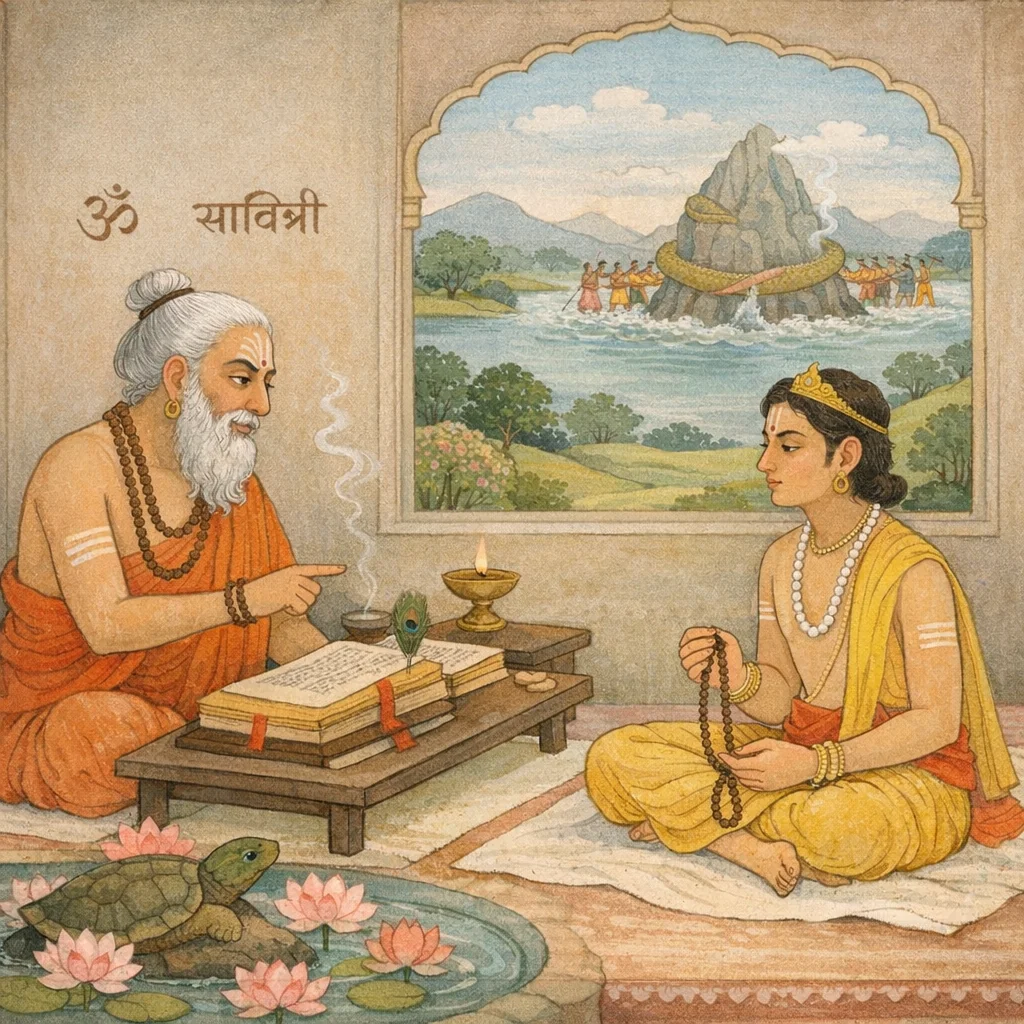
Adhyaya 14
Brahmacārin-Dharma: Guru-Sevā, Daily Vedic Study, Gāyatrī-Japa, and Anadhyāya Regulations
Continuing the prior teaching on disciplined preparation for sacred learning, this chapter systematizes brahmacarya as lived pedagogy: the student’s bodily etiquette, restraint of speech, and rules of nearness in the guru’s presence become the basis of Vedic transmission. It expands from daily guru-sevā (bringing water, kuśa, flowers, fuel; ritual cleanliness; alms-round) to the ethics of renunciation and social boundaries that protect purity and concentration. The instruction culminates in a technical regimen of study—facing north, formally requesting the teacher, prāṇāyāma, contemplation of the praṇava (Om), and the centrality of Gāyatrī as japa-yajña, symbolically equal in “weight” to the four Vedas. Finally it lays out an extensive calendar and omen-based code of anadhyāya (mandatory suspension of recitation), describing such times as “breaches” through which harm may arise, while exempting Vedāṅgas, Itihāsa–Purāṇa, and Dharmaśāstra for continued learning. The narrative thrust moves from outer discipline toward higher Yoga–Vedānta practice, where purity of life steadies contemplation and leads to the auspicious, deathless state.
Shlokas
Verse 1
इति श्रीकूर्मपुराणे षट्साहस्त्र्यां संहितायामुपरिविभागे त्रयोदशो ऽध्यायः व्यास उवाच एवं दण्डादिभिर्युक्तः शौचाचारसमन्वितः / आहूतो ऽध्ययनं कुर्याद् वीक्षमाणो गुरोर्मुखम्
Thus ends the thirteenth chapter in the latter division of the Śrī Kūrma Purāṇa, within the Ṣaṭsāhasrī Saṃhitā. Vyāsa said: “Thus equipped with the staff (daṇḍa) and other requisites, established in purity and right conduct, when summoned he should begin his study, keeping his gaze upon the teacher’s face.”
Verse 2
नित्यमुद्यतपाणिः स्यात् साध्वाचारः सुसंयतः / आस्यतामिति चोक्तः सन्नासीताभिमुखं गुरोः
He should always stand with hands respectfully raised, ready to serve—of good conduct and well-restrained. And only when told, “Be seated,” should he sit, facing the guru.
Verse 3
प्रतिश्रवणसंभाषे शयानो न समाचरेत् / नासीनो न च भुञ्जानो न तिष्ठन्न पराङ्मुखः
During attentive listening and respectful conversation, one should not do so while lying down; nor while sitting, nor while eating; nor while standing with one’s face turned away.
Verse 4
नीचं शय्यासनं चास्य सर्वदा गुरुसन्निधौ / गुरोस्तु चक्षुर्विषये न यथेष्टासनो भवेत्
In the guru’s presence, one should always keep one’s bed and seat at a lower level. And within the guru’s sight, one should not sit as one pleases—casually or presumptuously.
Verse 5
नोदाहरेदस्य नाम परोक्षमपि केवलम् / न चैवास्यानुकुर्वोत गतिभाषणचेष्टितम्
One should not utter His Name, even indirectly, merely for the sake of mention; nor should one imitate His gait, His manner of speech, or His deeds.
Verse 6
गुरोर्यत्र परीवादो निन्दा चापि प्रवर्तते / कर्णैं तत्र पिधातव्यौ गन्तव्यं वा ततो ऽन्यतः
Wherever slander and blame against one’s guru begin to spread, one should cover one’s ears there—or else leave that place and go elsewhere.
Verse 7
दूरस्थो नार्चयेदेनं न क्रुद्धो नान्तिके स्त्रियाः / न चैवास्योत्तरं ब्रूयात् स्थितो नासीत सन्निधौ
One should not worship Him from too great a distance, nor while angry, nor in the proximity of women. Nor should one speak back to Him; and in His immediate presence one should not stand or sit too close.
Verse 8
उदकुम्भं कुशान् पुष्पं समिधो ऽस्याहरेत् सदा / मार्जनं लेपनं नित्यमङ्गानां वै समाचरेत्
He should always bring for Him a water-pot, kuśa grass, flowers, and fuel-sticks; and he should regularly perform the daily cleansing and anointing of the deity’s limbs.
Verse 9
नास्य निर्माल्यशयनं पादुकोपानहावपि / आक्रमेदासनं चास्य छायादीन् वा कदाचन
One should never step upon the revered teacher’s bed, even if it bears discarded garlands; nor upon his sandals or footwear; nor upon his seat—nor should one ever transgress even his shadow and the like.
Verse 10
साधयेद् दन्तकाष्ठादीन् लब्धं चास्मै निवेदयेत् / अनापृच्छ्य न गन्तव्यं भवेत् प्रियहिते रतः
He should procure tooth-sticks and the like, and whatever he obtains he should offer to the teacher. Without asking permission he should not depart; he should remain devoted to what is pleasing and beneficial to the guru.
Verse 11
न पादौ सारयेदस्य संनिधाने कदाचन / जृम्भितं हसितं चैव कण्ठप्रावरणं तथा / वर्जयेत् सन्निधौ नित्यमवस्फोचनमेव च
One should never stretch out one’s feet in his presence. In his presence one should always avoid yawning, loud laughter, covering the throat/neck, and spitting or hawking phlegm.
Verse 12
यथाकालमधीयीत यावन्न विमना गुरुः / आसीताधो गुरोः कूर्चे फलके वा समाहितः
One should study at the proper times, so long as the teacher is not displeased. Seated below the guru—on a grass-seat or on a wooden plank—one should remain composed and attentive.
Verse 13
आसने शयने याने नैव तिष्ठेत् कदाचन / धावन्तमनुधावेत गच्छन्तमनुगच्छति
When a revered person is seated, reclining, or riding, one should never remain standing. If he runs, one should run after him; if he walks, one should walk along with him.
Verse 14
गो ऽश्वोष्ट्रयानप्रासादप्रस्तरेषु कटेषु च / आसीत गुरुणा सार्धं शिलाफलकनौषु च
Whether on vehicles drawn by cows, horses, or camels, on terraces and stone platforms, on a mat, or even upon a stone slab or a raft-like boat, one should sit together with the guru, keeping disciplined conduct.
Verse 15
जितेन्द्रियः स्यात् सततं वश्यात्माक्रोधनः शुचिः / प्रयुञ्जीत सदा वाचं मधुरां हितभाषिणीम्
One should ever conquer the senses—self-restrained, free from anger, and pure; and one should always employ speech that is sweet and beneficial, speaking only what is wholesome.
Verse 16
गन्धमाल्यं रसं कल्यां शुक्तं प्राणिविहिंसनम् / अभ्यङ्गं चाञ्चनोपानच्छत्रधारणमेव च
Fragrant scents and garlands, savory essences, auspicious fare, and sour preparations that do not involve injury to living beings; likewise oil-massage, the use of collyrium, wearing footwear, and the carrying of an umbrella as well.
Verse 17
कामं लोभं भयं निद्रां गीतवादित्रनर्तनम् / आतर्जनं परीवादं स्त्रीप्रेक्षालम्भनं तथा / परोपघातं पैशुन्यं प्रयत्नेन विवर्जयेत्
With deliberate effort, one should renounce lust, greed, fear, excessive sleep, indulgence in singing, instrumental music and dancing, intimidation, slander, gazing upon women with desire, flirtatious entanglement, harming others, and malicious tale-bearing.
Verse 18
उदकुम्भं सुमनसो गोशकृन्मृत्तिकां कुशान् / आहरेद् यावदर्थानि भैक्ष्यं चाहरहश्चरेत्
With a pure and well-disposed mind, he should procure a water-pot, flowers, cow-dung, clay, and kuśa grass—only as much as is necessary—and he should also go out each day to collect alms-food.
Verse 19
कृतं च लवणं सर्वं वर्ज्यं पर्युषितं च यत् / अनृत्यदर्शो सततं भवेद् गीतादिनिः स्पृहः
One should avoid all prepared salty foods, and whatever has become stale. One should always refrain from watching dancing, and be free from craving for songs and the like.
Verse 20
नादित्यं वै समीक्षेत न चरेद् दन्तधावनम् / एकान्तमशुचिस्त्रीभिः शूद्रान्त्यैरभिभाषणम्
One should not stare at the Sun, nor cleanse the teeth at an improper time or in an improper manner. One should also avoid solitary, private talk with impure women, as well as with Śūdras and those regarded as antyajas (outside the orthodox social order).
Verse 21
गुरूच्छिष्टं भेषजार्थं प्रयुञ्जीत न कामतः / कलापकर्षणस्नानं नाचरेद्धि कदाचन
What remains of the guru’s food may be used only for medicinal necessity, never out of desire. And at no time should one perform the bath that is accompanied by drawing out the bodily ‘kalā’, the vital essence.
Verse 22
न कुर्यान्मानसं विप्रो गुरोस्त्यागे कदाचन / मोहाद्वा यदि वा लोभात् त्यक्तेन पतितो भवेत्
A brāhmaṇa should never, even in thought, entertain abandoning his guru. If through delusion or greed he forsakes him, then by that very act of forsaking he becomes fallen.
Verse 23
लौकिकं वैदिकं चापि तथाध्यात्मिकमेव च / आददीत यतो ज्ञानं न तं द्रुह्येत् कदाचन
One should accept worldly knowledge, Vedic knowledge, and also adhyātmic (spiritual) knowledge from whoever imparts it; and one should never, at any time, betray or wrong that person.
Verse 24
गुरोरप्यवलिप्तस्य कार्याकार्यमजानतः / उत्पथप्रतिपन्नस्य मनुस्त्यागं समब्रवीत्
Even a guru—if arrogant, ignorant of what ought and ought not to be done, and fallen onto a wrong path—Manu has prescribed that such a teacher should be renounced.
Verse 25
गुरोर्गुरौ सन्निहिते गुरुवद् भक्तिमाचरेत् / न चातिसृष्टो गुरुणा स्वान् गुरूनबिवादयेत्
When the guru’s own guru is present, one should offer devotion to him exactly as to one’s own guru. And even if one’s guru has granted leave or freedom, one should not neglect to bow to one’s other venerable teachers.
Verse 26
विद्यागुरुष्वेतदेव नित्या वृत्तिः स्वयोनिषु / प्रतिषेधत्सु चाधर्माद्धितं चोपदिशत्स्वपि
This indeed is the constant rule of conduct among teachers of sacred knowledge within their own lineage: even while restraining students from adharma, they should also instruct them in what is beneficial.
Verse 27
श्रेयःसु गुरुवद् वृत्तिं नित्यमेव समाचरेत् / गुरुपुत्रेषु दारेषु गुरोश्चैव स्वबन्धुषु
In matters that lead to true welfare, one should always conduct oneself as if in the presence of one’s guru—maintaining the same reverent discipline—toward the guru’s sons, the guru’s wife, and the guru’s relatives as well.
Verse 28
बालः समानजन्मा वा शिष्यो वा यज्ञकर्मणि / अध्यापयन् गुरुसुतो गुरुवन्मानमर्हति
Whether he is a boy, of the same age, or even a fellow student—when engaged in sacrificial duties and instructing—the guru’s son deserves the same honor as the guru himself.
Verse 29
उत्सादनं वै गात्राणां स्नापनोच्छिष्टभोजने / न कुर्याद् गुरुपुत्रस्य पादयोः शौचमेव च
One should not massage his body, bathe him, eat his leftovers, or even wash his feet—when it is the guru’s son; such services are due to the guru himself, not to the son.
Verse 30
गुरुवत् परिपूज्यास्तु सवर्णा गुरुयोषितः / असवर्णास्तु संपूज्याः प्रत्युत्थानाभिवादनैः
The guru’s wives who are of the same varṇa are to be revered as the guru himself; but those of a different varṇa are to be duly respected by rising in greeting and offering salutations.
Verse 31
अभ्यञ्जनं स्नापनं च गात्रोत्सादनमेव च / गुरुपत्न्या न कार्याणि केशानां च प्रसाधनम्
One should not perform for the guru’s wife the acts of anointing with oil, bathing, massaging or rubbing the limbs, nor the dressing and arranging of her hair.
Verse 32
गुरुपत्नी तु युवती नाभिवाद्येह पादयोः / कुर्वोत वन्दनं भूम्यामसावहमिति ब्रुवन्
But if the guru’s wife is a young woman, one should not here offer salutation by touching her feet; rather, one should bow down on the ground, saying, “This is I,” identifying oneself respectfully.
Verse 33
विप्रोष्य पादग्रहणमन्वहं चाभिवादनम् / गुरुदारेषु कुर्वोत सतां धर्ममनुस्मरन्
Having returned after an absence, he should clasp the teacher’s feet and, every day, offer respectful salutations; and toward the guru’s wife he should keep proper, disciplined conduct, ever remembering the dharma upheld by the virtuous.
Verse 34
मातृष्वसा मातुलानी श्वश्रूश्चाथ पितृष्वसा / संपूज्या गुरुपत्नीव समास्ता गुरुभार्यया
One’s maternal aunt, maternal uncle’s wife, mother-in-law, and paternal aunt should all be duly honored—just as one honors the wife of one’s teacher—regarding them collectively with the same reverence as a guru’s spouse.
Verse 35
भ्रातुर्भार्योपसंग्राह्या सवर्णाहन्यहन्यपि / विप्रोष्य तूपसंग्राह्या ज्ञातिसंबन्धियोषितः
Even if she is of the same varṇa, one must never—day after day—take one’s brother’s wife. Only when the brother has gone away and is absent or lost may a woman related through the family bond be taken, according to the rule stated here.
Verse 36
पितुर्भगिन्यां मातुश्च ज्यायस्यां च स्वसर्यपि / मातृवद् वृत्तिमातिष्ठेन्मात् ताभ्यो गरीयसी
Toward one’s father’s sister, one’s mother’s sister, and one’s elder sister, one should act as toward one’s own mother; for the mother is regarded as even more venerable than they.
Verse 37
एवमाचारसंपन्नमात्मवन्तमदाम्भिकम् / वेदमध्यापयेद् धर्मं पुराणाङ्गानि नित्यशः
Thus a teacher should instruct daily in the Veda—together with Dharma and the ancillary limbs of the Purāṇa—one who is endowed with right conduct, self-possession, and freedom from hypocrisy.
Verse 38
संवत्सरोषिते शिष्ये गुरुर्ज्ञानमनिर्दिशन् / हरते दुष्कृतं तस्य शिष्यस्य वसतो गुरुः
When a disciple has lived in attendance for a year, even if the teacher has not yet formally imparted instruction, the guru—by the very fact of the disciple’s residence and service—removes that disciple’s demerit (duṣkṛta).
Verse 39
आचार्यपुत्रः शुश्रूषुर्ज्ञानदो धार्मिकः शुचिः / शक्तो ऽन्नदोर्ऽथो स्वःसाधुरध्याप्या दश धर्मतः
The teacher’s son—eager in service, a giver of knowledge, righteous and pure; capable, a provider of food, possessed of means, and of good conduct—these ten qualities, in accordance with dharma, make one fit to be taught.
Verse 40
कृतज्ञश्च तथाद्रोही मेधावी शुभकृन्नरः / आप्तः प्रियो ऽथ विधिवत् षडध्याप्या द्विजातयः / एतेषु ब्रह्मणो दानमन्यत्र तु यथोदितान्
To one who is grateful, not treacherous, wise, and devoted to auspicious deeds; likewise to one who is trustworthy and dear; and to the twice-born who, according to rule, teach the six Vedāṅgas—among such persons the gift of sacred knowledge (brahma-dāna) should be bestowed. Otherwise, one should give only in the manner previously prescribed.
Verse 41
आचम्य संयतो नित्यमधीयीत उदङ्मुखः / उपसंगृह्य तत्पादौ वीक्षमाणो गुरोर्मुखम् / अधीष्व भो इति ब्रूयाद् विरामो ऽस्त्विति चारमेत्
Having performed ācamanam for purification and remaining self-controlled, one should study daily facing north. Respectfully clasping the teacher’s feet and gazing upon the teacher’s face, one should say, “Venerable sir, please instruct me.” And when concluding, one should depart saying, “Let there be a pause (virāma).”
Verse 42
प्राक्कूलान् पर्युपासीनः पवित्रैश्चैव पावितः / प्राणायामैस्त्रिभिः पूतस्तत ओङ्कारमर्हति
Seated facing the eastern bank, purified by sacred rites of cleansing, and made pure by the threefold discipline of the breath (prāṇāyāma), one then becomes fit to contemplate and recite the Pranava, Oṁ.
Verse 43
ब्राह्मणः प्रणवं कुर्यादन्ते च विधिवद् द्विजः / कुर्यादध्ययनं नित्यं स ब्रह्माञ्जलिपूर्वतः
A Brāhmaṇa—indeed any twice-born—should duly utter the Pranava, Oṁ, at the end (of recitation). He should engage in daily Vedic study, beginning with reverent folded hands, in the spirit of worship of Brahman.
Verse 44
सर्वेषामेव भूतानां वेदश्चक्षुः सनातनम् / अधीयीताप्ययं नित्यं ब्राह्मण्याच्च्यवते ऽन्यथा
For all beings, the Veda is the eternal eye. Therefore one should study it daily; otherwise, one falls away from brahminhood—the state and discipline of a true Brāhmaṇa.
Verse 45
यो ऽधीयीत ऋचो नित्यं क्षीराहुत्या स देवताः / प्रीणाति तर्पयन्त्येनं कामैस्तृप्ताः सदैव हि
Whoever regularly recites the hymns of the Ṛgveda and offers oblations of milk gladdens the deities; and those gods, ever satisfied, in turn gratify him by granting his desired aims.
Verse 46
यजूंष्यधीते नियतं दध्ना प्रीणाति देवताः / सामान्यधीते प्रीणाति घृताहुतिभिरन्वहम्
One who regularly studies the Yajurveda pleases the deities through offerings of curd; and one who studies the Sāmaveda pleases them day after day with oblations of ghee.
Verse 47
अथर्वाङ्गिरसो नित्यं मध्वा प्रीणाति देवताः / धर्माङ्गानि पुराणानि मांसैस्तर्पयते सुरान्
The Atharvāṅgirasa tradition continually gratifies the deities with honey; and the Purāṇas—limbs of Dharma—satisfy the gods through offerings of meat.
Verse 48
अपां समीपे नियतो नैत्यकं विधिमाश्रितः / गायत्रीमप्यधीयीत गत्वारण्यं समाहितः
Disciplined and self-controlled, one should perform the daily obligatory rite according to rule near water; and, having gone to a forest-place with a collected mind, one should also recite and study the Gāyatrī.
Verse 49
सहस्रपरमां देवीं शतमध्यां दशावराम् / गायत्रीं वै जपेन्नित्यं जपयज्ञः प्रकीर्तितः
One should recite the Goddess Gāyatrī daily—her supreme measure is a thousand, her middle measure a hundred, and her lower measure ten. Such constant recitation is proclaimed to be the sacrifice called japa-yajña, the inner offering of mantra.
Verse 50
गायत्रीं चैव वेदांश्च तुलयातोलयत् प्रभुः / एकतश्चतुरो वेदान् गायत्रीं च तथैकतः
The Lord weighed the Gāyatrī and the Vedas upon a balance. Setting the four Vedas on one side and the Gāyatrī on the other, He found them equal in weight.
Verse 51
ओङ्कारमादितः कृत्वा व्याहृतीस्तदनन्तरम् / ततो ऽधीयीत सावित्रीमेकाग्रः श्रद्धयान्वितः
Having first uttered the sacred syllable Oṃ, and then the Vyāhṛtis (bhūḥ, bhuvaḥ, svaḥ) in their proper order, one should thereafter recite the Sāvitrī (Gāyatrī) with a one-pointed mind, endowed with faith.
Verse 52
पुराकल्पे समुत्पन्ना भूर्भुवःस्वः सनातनाः / महाव्याहृतयस्तिस्त्रः सर्वाशुभनिबर्हणाः
In the ancient cycle of creation arose Bhūr, Bhuvaḥ, and Svaḥ—eternal indeed. These three are the Mahāvyāhṛtis, the great sacred utterances that eradicate every inauspiciousness.
Verse 53
प्रधानं पुरुषः कालो विष्णुर्ब्रह्मा महेश्वरः / सत्त्वं रजस्तमस्तिस्त्रः क्रमाद् व्याहृतयः स्मृताः
Pradhāna (primordial Nature), Puruṣa (the conscious Person), Time, Viṣṇu, Brahmā, and Maheśvara—together with the three guṇas, Sattva, Rajas, and Tamas—are remembered in due order as the vyāhṛtis, sacred utterances that articulate the cosmic reality.
Verse 54
ओङ्कारस्तत् परं ब्रह्म सावित्री स्यात् तदक्षरम् / एष मन्त्रो महायोगः सारात् सार उदाहृतः
Oṃ is that Supreme Brahman; the Sāvitrī (Gāyatrī) is said to be that imperishable syllable. This mantra is the great Yoga itself—declared to be the very essence of all essences.
Verse 55
यो ऽधीते ऽहन्यहन्येतां गायत्रीं वेदमातरम् / विज्ञायार्थं ब्रह्मचारी स याति परमां गतिम्
The brahmacārin who studies, day after day, this Gāyatrī—the Mother of the Vedas—and who understands its meaning, attains the supreme state.
Verse 56
गायत्री वेदजननी गायत्री लोकपावनी / न गायत्र्याः परं जप्यमेतद् विज्ञाय मुच्यते
Gāyatrī is the mother of the Vedas; Gāyatrī is the purifier of the worlds. There is no mantra-japa superior to Gāyatrī—knowing this truth, one is liberated.
Verse 57
श्रावणस्य तु मासस्य पौर्णमास्यां द्विजोत्तमाः / आषाढ्यां प्रोष्ठपद्यां वा वेदोपाकरणं स्मृतम्
On the full-moon day of the month of Śrāvaṇa, O best of the twice-born, the rite of commencing (or renewing) Vedic study—Veda-upākaraṇa—is enjoined; alternatively, it is also prescribed on the full-moon day of Āṣāḍha or on Proṣṭhapadā.
Verse 58
उत्सृज्य ग्रामनगरं मासान् विप्रोर्ऽद्धपञ्चमान् / अधीयीत शुचौ देशे ब्रह्मचारी समाहितः
Having left behind village and town life for four-and-a-half months, a brahmin student, self-controlled and composed, should study the Veda in a clean and secluded place, established in brahmacarya.
Verse 59
पुष्ये तु छन्दसां कुर्याद् बहिरुत्सर्जनं द्विजः / माघशुक्लस्य वा प्राप्ते पूर्वाह्ने प्रथमे ऽहनि
On the (nakṣatra) Puṣya, a twice-born man should perform the ceremonial ‘sending forth’ (bahir-utsarjana) of his Vedic recitation; or else, when the bright fortnight of Māgha arrives, he should do so on its first day, in the forenoon.
Verse 60
छन्दांस्यूर्ध्वमथोभ्यस्येच्छुक्लपक्षेषु वै द्विजः / वेदाङ्गानि पुराणानि कृष्णपक्षे च मानवम्
A twice-born man should study the Vedic metres in the bright fortnight; and in the dark fortnight he should study the Vedāṅgas and the Purāṇas. Thus should a person devote himself to sacred learning.
Verse 61
इमान् नित्यमनध्यायानदीयानो विवर्जयेत् / अध्यापनं च कुर्वाणो ह्यभ्यस्यन्नपि यत्नतः
One engaged in Vedic study should always avoid these periods of obligatory non-recitation (nitya-anadhyāya). Even while teaching others or practicing with diligence, one should refrain from recitation at such times.
Verse 62
कर्णश्रवे ऽनिले रात्रौ दिवा पांशुसमूहने / विद्युत्स्तनितवर्षेषु महोल्कानां च संप्लवे / आकालिकमनध्यायमेतेष्वाह प्रजापतिः
When, at night, the wind roars loudly in the ears; when by day dust gathers in masses; when there are lightning, thunder, and rain; and when great meteors appear in tumult—on such occasions Prajāpati has prescribed an immediate, time-bound anadhyāya, a suspension of Vedic recitation and study.
Verse 63
एतानभ्युदितान् विद्याद् यदा प्रादुष्कृताग्निषु / तदा विद्यादनध्यायमनृतौ चाभ्रदर्शने
One should recognize these signs as having manifested when the sacred fires blaze forth; then one should understand it to be a time of anadhyāya, the suspension of study and recitation, and likewise when the season is abnormal or when clouds are seen out of season.
Verse 64
निर्घाते भूमिचलने ज्योतिषां चोपसर्जने / एतानाकालिकान् विद्यादनध्यायानृतावपि
During thunderous celestial crashes, earthquakes, and ominous disturbances of the luminaries, one should recognize these as untimely occasions of anadhyāya, requiring suspension of Vedic study—even if the proper season for study is otherwise in effect.
Verse 65
प्रादुष्कृतेष्वग्निषु तु विद्युत्स्तनितनिस्वने / सज्योतिः स्यादनध्यायः शेषरात्रौ यथा दिवा
When fires break out, or when lightning flashes and thunder rumbles, Vedic study should be suspended—and this rule holds for the rest of the night, just as in the daytime.
Verse 66
नित्यानध्याय एव स्याद् ग्रामेषु नगरेषु च / धर्मनैपुण्यकामानां पूतिगन्धे च नित्यशः
In villages and in cities there should indeed be a constant suspension of Vedic recitation; likewise, for those who seek proficiency in dharma, study should always be suspended in the presence of foul stench.
Verse 67
अन्तः शवगते ग्रामे वृषलस्य च सन्निधौ / अनध्यायो रुद्यमाने समवाये जनस्य च
Vedic recitation and study should be suspended when one is within a village where a corpse is present, in the proximity of a vṛṣala (an outcaste/impure person), when there is wailing due to death, and when crowds have gathered.
Verse 68
उदके मध्यरात्रे च विण्मूत्रे च विसर्जने / उच्छिष्टः श्राद्धबुक् चैव मनसापि न चिन्तयेत्
When one is in water, at midnight, while evacuating stool or urine, when in a state of impurity (having eaten and not yet cleansed), and also while partaking of a Śrāddha meal—one should not even in the mind dwell upon what is improper or impure.
Verse 69
प्रतिगृह्य द्विजो विद्वानेकोदिष्टस्य केतनम् / त्र्यहं न कीर्तयेद् ब्रह्म राज्ञो राहोश्च सूतके
After accepting the dwelling (a house-gift) given for an ekoddiṣṭa rite, a learned twice-born should not recite or teach the Veda for three days; likewise during the sūtaka impurity caused by a king’s death or during an eclipse attributed to Rāhu.
Verse 70
यावदेको ऽनुदिष्टस्य स्नेहो गन्धश्च तिष्ठति / विप्रस्य विदुषो देहे तावद् ब्रह्म न कीर्तयेत्
So long as even a trace of unpurified attachment and its lingering “odor” abides in the body of a learned brāhmaṇa, until then he should not proclaim (teach publicly) the knowledge of Brahman.
Verse 71
शयानः प्रौढपादश्च कृत्वा चैवावसक्थिकाम् / नाधीयीतामिषं जग्ध्वा सूतकान्नाद्यमेव च
One should not undertake Vedic recitation while lying down, with the feet stretched out, or with the legs improperly placed; nor should one study after eating meat, or immediately after consuming food associated with impurity such as that connected with birth-pollution (sūtaka).
Verse 72
नीहारे बाणशब्दे च संध्ययोरुभयोरपि / अमावास्यां चतुर्दश्यां पौर्णमास्यष्टमीषु च
In times of dense mist, when the ominous sound of an arrow is heard, at both twilights, and also on the new-moon day, the fourteenth lunar day, the full-moon day, and on the eighth lunar days—one should observe restraint and ritual caution.
Verse 73
उपाकर्मणि चोत्सर्गे त्रिरात्रं क्षपणं स्मृतम् / अष्टकासु त्वहोरात्रं ऋत्वन्त्यासु च रात्रिषु
For the rites of Upākarman and Utsarga, an expiatory observance (kṣapaṇa) for three nights is prescribed. During the Aṣṭakā days, it is to be kept for a full day and night; and at the closing nights of the seasons as well, it is to be observed on those nights.
Verse 74
मार्गशीर्षे तथा पौषे माघमासे तथैव च / तिस्त्रो ऽष्टकाः समाख्याता कृष्णपक्षेतु सूरिभिः
In the months of Mārgaśīrṣa, Pauṣa, and Māgha as well, the learned authorities declare that there are three Aṣṭakā observances—each to be performed in the dark fortnight (kṛṣṇa-pakṣa).
Verse 75
श्लेष्मातकस्य छायायां शाल्मलेर्मधुकस्य च / कदाचिदपि नाध्येयं कोविदारकपित्थयोः
One should not recite or study the Veda while seated in the shade of the śleṣmātaka, the śālmali, or the madhūka; nor should one ever undertake Vedic study beneath the kovidāra or the kapittha.
Verse 76
समानविद्ये च मृते तथा सब्रह्मचारिणि / आचार्ये संस्थिते वापि त्रिरात्रं क्षपणं स्मृतम्
If one who studied the same sacred discipline dies, or a fellow brahmacārin dies, or even if one’s ācārya (teacher) passes away, a three-night observance of purification (kṣapaṇa) is prescribed.
Verse 77
छिद्राण्येतानि विप्राणांये ऽनध्यायः प्रकीर्तिताः / हिंसन्ति राक्षसास्तेषु तस्मादेतान् विवर्जयेत्
These are the “breaches” of Brahmins—the times declared as anadhyāya, when Vedic study is forbidden. In those periods rākṣasas assail them; therefore one should strictly avoid such times.
Verse 78
नैत्यके नास्त्यनध्यायः संध्योपासन एव च / उपाकर्मणि कर्मान्ते होममन्त्रेषु चैव हि
For obligatory daily rites (nitya) there is no anadhyāya, and the same holds for Sandhyā worship. Likewise, at the Upākarman ceremony, at the conclusion of a rite, and in the mantras used for homa, recitation is to be maintained.
Verse 79
एकामृचमथैकं वा यजुः सामाथवा पुनः / अष्टकाद्यास्वधीयीत मारुते चातिवायति
When the wind blows excessively, one should study only a single Ṛg-verse—or just one Yajus formula, or one Sāman. Likewise, on the Aṣṭakā and other such special days, one should restrict oneself to a minimal portion of recitation.
Verse 80
अनध्यायस्तु नाङ्गेषु नेतिहासपुराणयोः / न धर्मशास्त्रेष्वन्येषु पर्वण्येतानि वर्जयेत्
The restriction called anadhyāya (suspension of study) does not apply to the Vedāṅgas, nor to the Itihāsas and Purāṇas, nor to other Dharma-śāstras; even on sacred festival days (parvan), one should not refrain from these.
Verse 81
एष धर्मः समासेन कीर्तितो ब्रह्मचारिणाम् / ब्रह्मणाभिहितः पूर्वमृषीणां भावितात्मनाम्
Thus, in brief, the dharma of brahmacārins (celibate students) has been declared—taught long ago by Brahmā to the sages whose selves were purified and disciplined.
Verse 82
यो ऽन्यत्र कुरुते यत्नमनधीत्य श्रुतिं द्विजः / स संमूढो न संभाष्यो वेदबाह्यो द्विजातिभिः
A twice-born man who, without first studying the Śruti (the Veda), exerts himself in other pursuits is utterly deluded; the twice-born should not converse with him, for he stands outside the Veda.
Verse 83
न वेदपाठमात्रेण संतुष्टो वै भवेद् द्विजः / पाठमात्रावसन्नस्तु पङ्के गौरिव सीदति
A twice-born should not be content with mere recitation of the Veda; for one who sinks into ‘only reciting’ (without living its discipline) sinks down like a cow in mud.
Verse 84
यो ऽधीत्य विधिवद् वेदं वेदार्थं न विचारयेत् / ससान्वयः शूद्रकल्पः पात्रतां न प्रपद्यते
He who studies the Veda according to the prescribed discipline, yet does not inquire into and reflect upon its meaning—he, even with lineage, becomes as one unfit for Vedic privilege, and does not attain eligibility (pātratā) for its true reception and fruits.
Verse 85
यदि त्वात्यन्तिकं वासं कर्तुमिच्छति वै गुरौ / युक्तः परिचरेदेनमाशरीरविमोक्षणात्
If one truly wishes to dwell permanently with the Guru, then, disciplined and steadfast, one should serve him unceasingly—until the casting off of the body.
Verse 86
गत्वा वनं वा विधिवज्जुहुयाज्जातवेदसम् / अधीयीत सदा नित्यं ब्रह्मनिष्ठः समाहितः
Having gone even to the forest, he should, according to rule, offer oblations into Jātavedas (Agni); and, ever steady and self-collected, established in Brahman, he should constantly engage in sacred study.
Verse 87
सावित्रीं शतरुद्रीयं वेदान्तांश्च विशेषतः / अभ्यसेत् सततं युक्ते भस्मस्नानपरायणः
One who is disciplined—devoted to bathing with sacred ash—should constantly practice the Sāvitrī (Gāyatrī), the Śatarudrīya, and especially the teachings of the Vedānta.
Verse 88
एतद् विधानं परमं पुराणं वेदागमे सम्यगिहेरितं वः / पुरा महर्षिप्रवराभिपृष्टः स्वायंभुवो यन्मनुराह देवः
This supreme Purāṇic ordinance—fully consonant with the Veda and Āgama—has been rightly declared to you here. Long ago, when questioned by the foremost of sages, the divine Svāyambhuva Manu taught this very doctrine.
Verse 89
एवमीश्वरसमर्पितान्तरो यो ऽनुतिष्ठति विधिं विधानवित् / मोहजालमपहाय सो ऽमृतो याति तत् पदमनामयं शिवम्
Thus, one whose inner being is offered to the Lord, and who—knowing the proper ordinance—performs the prescribed discipline: casting off the net of delusion, that person becomes deathless and attains that stainless, sorrowless, auspicious state—Śiva.
Frequently Asked Questions
Reverent bodily etiquette (lower seat/bed, controlled speech, no imitation), constant readiness to serve, offering whatever is obtained, not departing without permission, and protecting the guru’s honor by leaving places of slander—along with daily study only in ways that do not displease the teacher.
Gāyatrī is proclaimed the Mother of the Vedas and the supreme japa; its recitation is a sacrifice (japa-yajña), and it is said to be ‘weighed’ as equal to the four Vedas, leading the disciplined student toward the supreme state.
Anadhyāya is the mandatory suspension of Vedic recitation during impure conditions, social disruptions, death-pollution contexts, and ominous natural phenomena (thunder, meteors, earthquakes, abnormal seasons). These times are called ‘breaches’ for brāhmaṇas, when harmful forces may afflict them, hence strict avoidance is prescribed.
Yes. The chapter states anadhyāya does not apply to Vedāṅgas, Itihāsas, Purāṇas, and other Dharma-śāstras; these may be studied even on parvan (festival) days.
Conduct is presented as the prerequisite for effective transmission and realization: mere recitation without living discipline is condemned, and study without inquiry into meaning is said to fail in producing true eligibility and fruit.