Adhyaya 13
Ācamana-vidhi, Śauca, and Conduct Rules for Study, Eating, and Bodily Functions
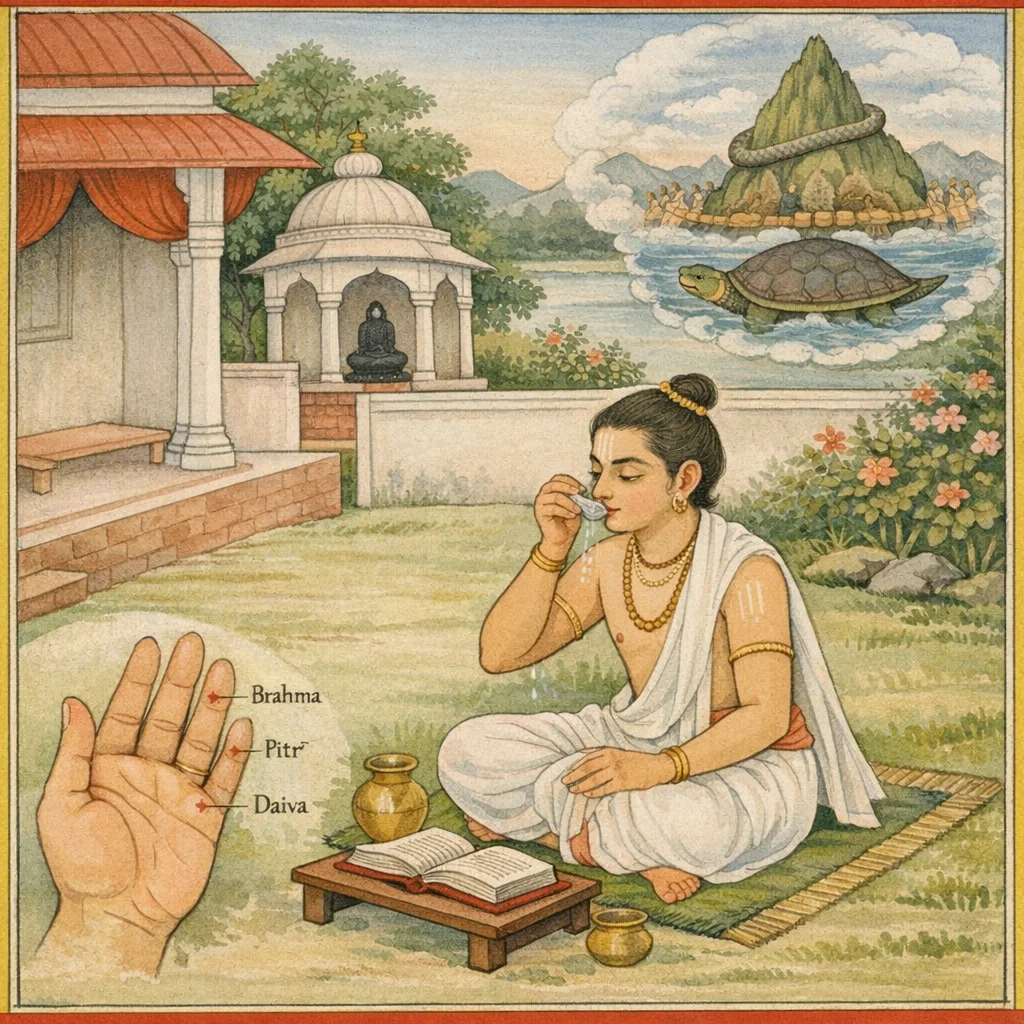
After the previous chapter’s close, Vyāsa continues the Uttara-bhāga’s dharma teaching by setting out a systematic discipline of ritual purity centered on ācamana (purificatory sipping of water) and related restraints. He lists times when Vedic recitation should not begin and occasions requiring renewed purification (after sleep, bathing, contact with impure substances, or socially contaminating interactions). He then prescribes proper posture, standards for water, and prohibitions that invalidate sacred speech or ācamana (head covered, footwear, improper seating, distraction). The chapter maps the hand-tīrthas (brahma, pitṛ, daiva, prājāpatya, ārṣa) and gives a step-by-step ācamana sequence, linking each touch-point with deities pleased by the rite. It concludes with practical rules on food-impurity (ucchiṣṭa), handling droplets, emergency allowances, and proper places/directions for evacuation and for obtaining cleansing earth and water, grounding spirituality in disciplined daily conduct in preparation for further dharma discussion.
Shlokas
Verse 1
इती श्रीकूर्मपुराणे षट्साहस्त्र्यां संहितायामुपरिविभागे द्वादशो ऽध्यायः व्यास उवाच भुक्त्वा पीत्वा च सुप्त्वा च स्नात्वा रथ्योपसर्पणे / ओष्ठावलमोकौ स्पृष्ट्वा वासो विपरिधाय च
Thus ends the twelfth chapter in the latter division of the Śrī Kūrma Purāṇa, in the Ṣaṭsāhasrī Saṃhitā. Vyāsa said: After eating and drinking, after sleeping, after bathing, when going out into the public street, after touching the lips and the lower opening (anus), and after putting on or changing garments—
Verse 2
रेतोमूत्रपुरीषाणामुत्सर्गे ऽयुक्तभाषणे / ष्ठीवित्वाध्ययनारम्भे कासश्वासागमे तथा
One should not begin Vedic recitation while discharging semen, urine, or feces; nor while speaking improperly; nor immediately after spitting; nor at the very commencement of study; and likewise when coughing or shortness of breath arises.
Verse 3
चत्वरं वा श्मशानं वा समाक्रम्य द्विजोत्तमः / संध्ययोरुभयोस्तद्वदाचान्तो ऽप्याचमेत् पुनः
If a foremost twice-born person steps into a crossroads or into a cremation ground, then at both twilight junctions (morning and evening) he should likewise perform ācamana; even if he has already sipped water for purification, he should sip again.
Verse 4
चण्डालम्लेच्छसंभाषे स्त्रीशूद्रोच्छिष्टभाषणे / उच्छिष्टं पुरुषं स्पृष्ट्वा भोज्यं चापि तथाविधम् / आचामेदश्रुपाते वा लोहितस्य तथैव च
After conversing with a Caṇḍāla or a mleccha (foreigner), after speaking with a woman or a Śūdra while one is in a state of uccheṣṭa (impurity from remnants), and after touching a person in such a state—or food similarly contaminated—one should perform ācamana. The same purification is prescribed after tears have fallen, and likewise after contact with blood.
Verse 5
भोजने संध्ययोः स्नात्वा पीत्वा मूत्रपुरीषयोः / आचान्तो ऽप्याचमेत् सुप्त्वा सकृत्सकृदथान्यतः
At the time of eating, at the two sandhyās (dawn and dusk), after bathing, after drinking, and after urination and defecation, one should perform ācamana, the purifying sipping of water. Even if it has already been done, ācamana should be done again after sleep, and likewise repeatedly on other such occasions.
Verse 6
अग्नेर्गवामथालम्भे स्पृष्ट्वा प्रयतमेव वा / स्त्रीणामथात्मनः स्पर्शे नीवीं वा परिधाय च
After touching fire, cows, or one engaged in sexual intercourse; likewise after touching women, after touching one’s own body, or after putting on the waist-cloth, one should purify oneself through the prescribed discipline of cleanliness and restraint, in accordance with dharma.
Verse 7
उपस्पृशेज्जलं वार्द्रं तृणं वा भूमिमेव वा / केशानां चात्मनः स्पर्शे वाससो ऽक्षालितस्य च
One should perform a brief purification by touching water, moist grass, or even the earth—especially after touching one’s hair or body, or when one’s garment is unwashed.
Verse 8
अनुष्णाभिरफेनाबिरदुष्टाभिश्च धर्मतः / शौचेप्सुः सर्वदाचामेदासीनः प्रागुदङ्मुखः
One who seeks purity should always perform ācamana properly, using water that is neither hot nor foamy, untainted and fit according to dharma—seated, facing east or north.
Verse 9
शिरः प्रावृत्य कण्ठं वा मुक्तकच्छसिखो ऽपि वा / अकृत्वा पादयोः शौचमाचान्तो ऽप्यशुचिर्भवेत्
If one covers the head or the throat, or leaves the waist-cloth loosened and the hair untied, and does not first cleanse the feet, then—even after performing ācamana—one becomes impure.
Verse 10
सोपानत्को जलस्थो वा नोष्णीषी वाचमेद् बुधः / न चैव वर्षधाराभिर्न तिष्ठन् नोद्धृतोदकैः
A wise person should not utter sacred speech while wearing footwear, while standing in water, or with the head covered. Nor should he speak as rain pours down, or while standing where water has just been drawn up and is being handled.
Verse 11
नैकहस्तार्पितजलैर्विना सूत्रेण वा पुनः / न पादुकासनस्थो वा बहिर्जानुरथापि वा
One should not perform ācamana with water offered through many hands, nor while not wearing the sacred thread. Nor should one do it while seated on sandals or on a seat, or with the knees thrust outward.
Verse 12
न जल्पन् न हसन् प्रेक्षन् शयानः प्रह्व एव च / नावीक्षिताभिः फेनाद्यैरुपेताभिरथापि वा
One should not chatter, nor laugh, nor stare about; even while lying down one should remain composed and humble. Nor should one direct the gaze toward women who are adorned—whether with foam-like cosmetics and the like, or with any other embellishments.
Verse 13
शूद्राशुचिकरोन्मुक्तैर्न क्षाराभिस्तथैव च / न चैवाङ्गुलिभिः शब्दं न कुर्वन् नान्यमानसः
He should not become defiled by contact with a Śūdra, with impure agents, or with alkaline substances; and he should not make noise by snapping his fingers. Remaining silent, he should keep his mind undistracted, fixed on the rite and on the Lord.
Verse 14
न वर्णरसदुष्टाभिर्न चैव प्रदरोदकैः / न पाणिक्षुभिताभिर्वा न बहिष्कक्ष एव वा
One should not bathe with water that is spoiled in colour or taste, nor with water seeping from a cleft or contaminated flow. Nor with water disturbed by the hand, nor in an exposed outer wash-place.
Verse 15
हृद्गाभिः पूयते विप्रः कण्ठ्याभिः क्षत्रियः शुचिः / प्राशिताभिस्तथावैश्यः स्त्रीशूद्रौ स्पर्शतो ऽन्ततः
A brāhmaṇa is purified by water that reaches the heart; a kṣatriya is made clean by water up to the throat; a vaiśya is purified by water that has been sipped; while a woman and a śūdra are, in the final sense, purified by mere touch of water.
Verse 16
अङ्गुष्ठमूलान्तरतो रेखायां ब्राह्ममुच्यते / अन्तराङ्गुष्ठदेशिन्यो पितॄणां तीर्थमुत्तमम्
On the line within the base of the thumb is what is called the Brahma-tīrtha. And the region between the thumb and the forefinger is the supreme sacred spot for offerings to the Pitṛs, the ancestral spirits.
Verse 17
कनिष्ठामूलतः पश्चात् प्राजापत्यं प्रचक्षते / अङ्गुल्यग्रे स्मृतं दैवं तदेवार्षं प्रकीर्तितम्
From the base of the little finger onward, the measure is called ‘Prajāpatya’. At the tip of the finger it is remembered as ‘Daiva’; that very same measure is also proclaimed as ‘Ārṣa’, the seers’ standard.
Verse 18
मूले वा दैवमार्षं स्यादाग्नेयं मध्यतः स्मृतं / तदेव सौमिकं तीर्थमेतज्ज्ञात्वा न मुह्यति
At the root it is regarded as a tīrtha of Daiva and Ārṣa nature; in the middle it is remembered as belonging to Agni. That very tīrtha is also Saumya in character (Soma—lunar and pacifying); one who knows this does not fall into confusion.
Verse 19
ब्राह्मेणैव तु तीर्थेन द्विजो नित्यमुपस्पृशेत् / कायेन वाथ दैवेन तु पित्र्येण वै द्विजाः
A twice-born man should perform his daily purification by touching water with the Brāhma-tīrtha; and the twice-born may also do so, as prescribed, with the Kāya, the Daiva, and the Pitṛya tīrthas.
Verse 20
त्रिः प्राश्नीयादपः पूर्वं ब्राह्मणः प्रयतस्ततः / संमृज्याङ्गुष्ठमूलेन मुखं वै समुपस्पृशेत्
First, the disciplined brāhmaṇa should sip water three times; then, after wiping the lips, he should touch and purify the mouth with the base of the thumb.
Verse 21
अङ्गुष्ठानामिकाभ्यां तु स्पृशेन्नेत्रद्वयं ततः / तर्जन्यङ्गुष्ठयोगेन स्पृशेन्नासापृटद्वयम्
Then, with the thumb and ring-finger one should touch both eyes; thereafter, joining the forefinger with the thumb, one should touch the two sides of the nose.
Verse 22
कनिष्ठाङ्गुष्ठयोगेन श्रवणे समुपस्पृशेत् / सर्वासामथ योगेन हृदयं तु तलेन वा / संस्पृशेद् वा शिरस्तद्वदङ्गुष्ठेनाथवा द्वयम्
Joining the little finger with the thumb, one should gently touch the ears. Then, uniting all the fingers in a single mudrā, one should touch the heart with the palm; or else touch the head in the same manner—using the thumb, or using both hands together.
Verse 23
त्रिः प्राश्नीयाद् यदम्भस्तु सुप्रीतास्तेन देवताः / ब्रह्मा विष्णुर्महेशश्च भवन्तीत्यनुशुश्रुमः
One should sip the water three times; by that act the deities are greatly pleased—so we have heard—namely Brahmā, Viṣṇu, and Maheśa (Śiva).
Verse 24
गङ्गा च यमुना चैव प्रीयेते परिमार्जनात् / संस्पृष्टयोर्लोचनयोः प्रीयेते शशिभास्करौ
By cleansing (the body), the Gaṅgā and the Yamunā are pleased; and when one touches and purifies the eyes, the Moon and the Sun are pleased.
Verse 25
नासत्यदस्त्रौ प्रीयेते स्पृष्टे नासापुटद्वये / कर्णयोः स्पृष्टयोस्तद्वत् प्रीयेते चानिलानलौ
When the twin Aśvin deities, the Nāsatyas, are invoked by touching the two nostrils, they are pleased; likewise, when the ears are touched, Vāyu (Wind) and Agni (Fire) also become pleased.
Verse 26
संस्पृष्टे हृदये चास्य प्रीयन्ते सर्वदेवताः / मूर्ध्नि संस्पर्शनादेकः प्रीतः स पुरुषो भवेत्
When his heart is touched in the rite, all the deities are pleased; but by touching the crown of the head, that one Supreme Person alone becomes pleased.
Verse 27
नोच्छिष्टं कुर्वते मुख्या विप्रुषो ऽङ्गं नयन्ति याः / दन्तवद् दन्तलग्नेषु जिह्वास्पर्शे ऽशुचिर्भवेत्
One becomes impure if, while eating, one makes the mouth ‘ucchiṣṭa’ (tainted by remnants), or if droplets of food or saliva fall upon the limbs. Likewise, food stuck between the teeth is to be regarded as though on the teeth themselves; and when the tongue touches it, one becomes impure.
Verse 28
स्पृशान्ति बिन्दवः पादौ य आचामयतः परान् / भूमिगैस्ते समा ज्ञेया न तैरप्रयतो भवेत्
If, while giving others the water for ācamana, droplets happen to touch one’s feet, those drops should be regarded as no different from water that has fallen to the ground; therefore one should not become careless on account of them.
Verse 29
मदुपर्के च सोमे च ताम्बूलस्य च भक्षणे / फलमूले चेक्षुदण्डे न दोषं प्राह वे मनुः
In the case of madhuparka (the ceremonial honey-mixture), in drinking soma, in chewing tāmbūla (betel), and in consuming fruits, roots, and sugarcane-stalk, Manu has declared that there is no fault.
Verse 30
प्रचरंश्चान्नपानेषु द्रव्यहस्तो भवेन्नरः / भूमौ निक्षिप्य तद् द्रव्यमाचम्याभ्युक्षयेत् तु तत्
If, while moving about in matters of food and drink, a man’s hand becomes soiled by contact with impure matter, he should set that substance upon the ground, perform ācamana (ritual sipping of water for purification), and then sprinkle purifying water upon that substance.
Verse 31
तैजसं वै समादाय यद्युच्छिष्टो भवेद् द्विजः / भूमौ निक्षिप्य तद् द्रव्यमाचम्याभ्युक्षयेत् तु तत्
If a twice-born man becomes defiled by contact with leftovers (ucchiṣṭa), he should take fire (or a fire-brand), place that substance on the ground, perform ācamana, and then sprinkle it with water to purify it.
Verse 32
यद्यमत्रं समादाय भवेदुच्छेषणान्वितः / अनिधायैव तद् द्रव्यमाचान्तः शुचितामियात् / वस्त्रादिषु विकल्पः स्यात् तत्संस्पृष्ट्वाचमेदिह
If, after taking up a vessel (for water), one becomes affected by impurity from leftovers (ucchiṣṭa), then without setting that object down one should perform ācamana and thereby regain purity. In the case of cloth and similar items, there is an alternative: having touched them, one should perform ācamana here to become pure.
Verse 33
अरण्ये ऽनुदके रात्रौ चौरव्याघ्राकुले पथि / कृत्वा मूत्रं पुरीषं वा द्रव्यहस्तो न दुष्यति
In a forest, in a place without water, at night, or on a road beset by thieves or tigers, if one must pass urine or stool, then even while holding valuables in the hand one is not deemed impure or blameworthy, for the act is compelled by circumstance.
Verse 34
निधाय दक्षिणे कर्णे ब्रह्मसूत्रमुदङ्मुखः / अह्नि कुर्याच्छकृन्मूत्रं रात्रौ चेद् दक्षिणामुखः
Placing the sacred thread (brahmasūtra) over the right ear and facing north, one should by day pass stool and urine in that posture; and if it is at night, then one should face south.
Verse 35
अन्तर्धाय महीं काष्ठैः पत्रैर्लोष्ठतृणेन वा / प्रावृत्य च शिरः कुर्याद् विण्मूत्रस्य विसर्जनम्
After digging the earth, one should cover it with wood, leaves, clods of soil, or grass; and, with the head properly covered, one should void feces and urine in a concealed and disciplined manner.
Verse 36
छायाकूपनदीगोष्ठचैत्याम्भः पथि भस्मसु / अग्नौ चैव श्मशाने च विण्मूत्रे न समाचरेत्
One should not relieve oneself in the shade, in wells, rivers, cowsheds, or near sacred shrines and their waters; nor on roads, in ashes, in fire, in cremation grounds, or in places befouled by feces and urine.
Verse 37
न गोमये न कृष्टे वा महावृक्षे न शाड्वले / न तिष्ठन् वा न निर्वासा न च पर्वतमस्तके
One should not answer the call of nature on cow-dung or on ploughed land; not at the base of a great tree, nor on grassy ground; not while standing, not in a dwelling-place, and not on the summit of a mountain.
Verse 38
न जीर्णदेवायतने न वल्मीके कदाचन / न ससत्त्वेषु गर्तेषु न गच्छन् वा समाचरेत्
One should never perform any religious act in a dilapidated temple, nor ever upon an anthill, nor in pits inhabited by living creatures. One should not go to such places, nor engage in conduct there.
Verse 39
तुषाङ्गारकपालेषु राजमार्गे तथैव च / न क्षेत्रे न विले वापि न तीर्थे न चतुष्पथे
One should not commit impure acts such as urination or defecation upon heaps of chaff, on ashes, on shards of pottery, nor on the king’s highway; likewise, not in cultivated fields, not in burrows or holes, not at a sacred ford (tīrtha), and not at a crossroads.
Verse 40
नोद्यानोदसमीपे वा नोषरे न पराशुचौ / न सोपानत्पादुको वा छत्री वा नान्तरिक्षके
One should not perform the sacred act near a garden or near water; not on saline or barren ground; and not in a place of excessive impurity. Nor should one do so while standing on steps, wearing footwear, holding an umbrella, or in an exposed open space.
Verse 41
न चैवाभिमुखे स्त्रीणां गुरुब्राह्मणयोर्गवाम् / न देवदेवालययोरपामपि कदाचन
One should never perform impure acts facing women, nor facing one’s guru, brāhmaṇas, or cows; nor should one do so facing the gods or their temples—nor even facing water, at any time.
Verse 42
न ज्योतींषि निरीक्षन्वानसंध्याभिमुखो ऽपिवा / प्रत्यादित्यं प्रत्यनलं प्रतिसोमं तथैव च
One should not stare at the celestial lights, nor remain with one’s back turned to the Sandhyā (twilight rites). Likewise, one should not act in opposition to the Sun, to Fire, or to the Moon.
Verse 43
आहृत्य मृत्तिकां कूलाल्लेपगन्धापकर्षणम् / कुर्यादतन्द्रितः शौचं विशुद्धैरुद्धृतोदकैः
Having brought clean earth from the riverbank, one should remove smeared impurities and foul odor; then, without negligence, one should perform purification (śauca) using pure water that has been properly drawn.
Verse 44
नाहरेन्मृत्तिकां विप्रः पांशुलान्न च कर्दमात् / न मार्गान्नोषराद् देशाच्छौचशिष्टां परस्य च
A brāhmaṇa should not take cleansing earth from a dusty place, nor from mud; nor from a roadway, nor from saline or barren ground; nor should he take earth left over from another person’s act of purification.
Verse 45
न देवायतनात् कूपाद् ग्रामान्न च जलात् तथा / उपस्पृशेत् ततो नित्यं पूर्वोक्तेन विधानतः
One should not perform upaspṛśa/ācamana—the purificatory touching of water—using water taken from a temple precinct, from a well, from a village source, or water connected with cooked village food. Therefore, one should perform this purification daily only in the manner previously prescribed.
Frequently Asked Questions
The chapter repeatedly prescribes ācamana around eating and drinking, dawn/dusk junctions, bathing, after sleep, after urination/defecation, after certain contacts (blood, tears, impure persons/objects), and after entering liminal places like crossroads or cremation grounds (with renewed sipping even if already performed).
It instructs sipping water three times, wiping the lips, then touching specific bodily points with prescribed finger combinations (mouth, eyes, sides of the nose, ears, heart/head), with attention to posture (seated, facing east or north) and water quality (untainted, not hot or foamy).
The chapter defines sacred zones on the hand—Brahma-tīrtha near the thumb base, Pitṛ-tīrtha between thumb and forefinger, and other measures (prājāpatya, daiva, ārṣa)—to regulate which part of the hand is used for purification and offerings, aligning bodily technique with ritual intention.
Yes. It states that in forests, waterless places, at night, or on dangerous roads, compelled evacuation while holding valuables does not incur blame, reflecting an āpaddharma principle even within strict purity norms.