Adhyaya 12
Karma-yoga Discipline for the Twice-born: Upanayana, Upavīta Conduct, Guru-veneration, and Alms-regimen
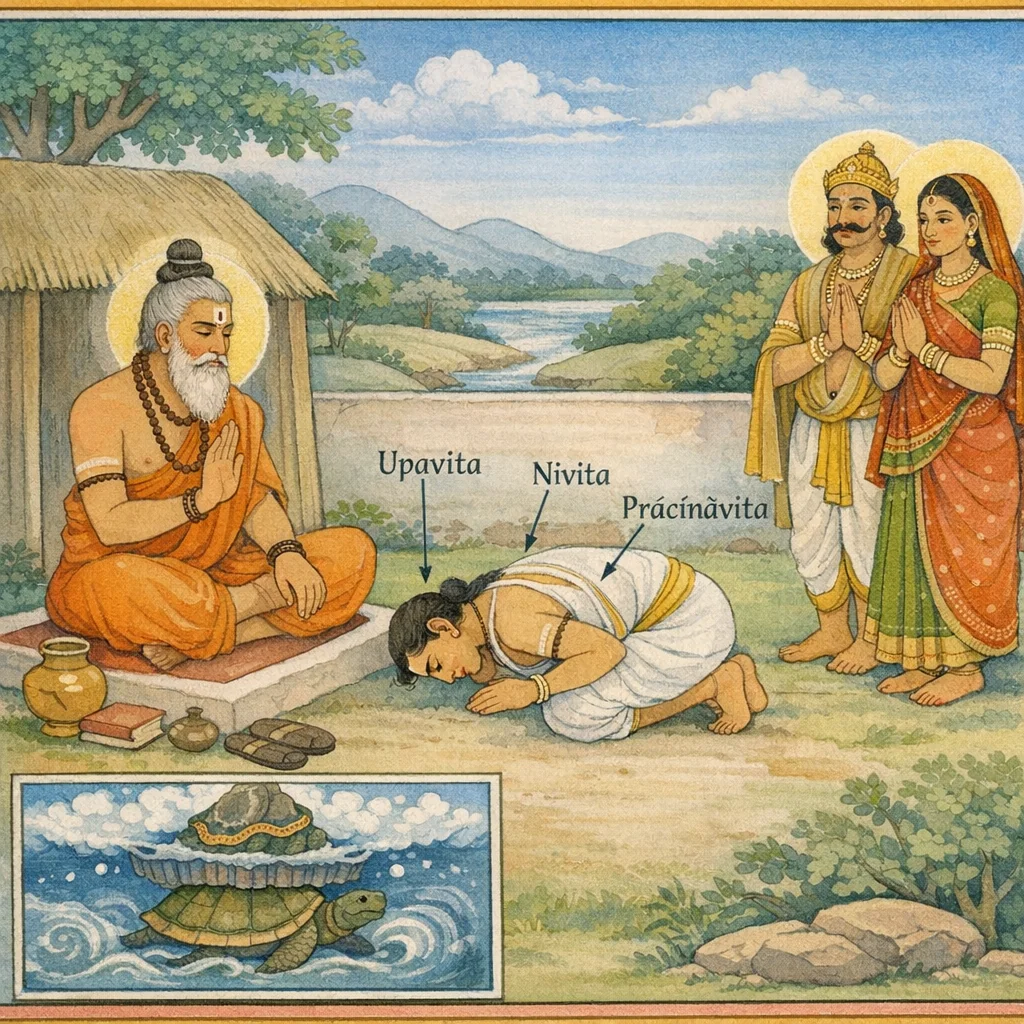
Continuing the Uttara-bhāga’s Īśvara-gītā instruction, Vyāsa sets forth an “eternal teaching” of karma-yoga for brāhmaṇas and the twice-born, handed down through Manu in the āmnāya lineage. The chapter then turns to brahmacarya discipline: the proper time and rite of upanayana, the materials and ways of wearing the sacred thread (upavīta/nivīta/prācīnāvīta), and the marks of student life (staff, girdle, skins/garments). It stresses daily duties—sandhyā at dawn and dusk, fire-rites, bathing, offerings to devas/ṛṣis/pitṛs—and the etiquette of reverent salutations (abhivādana) with correct forms of address. A hierarchy of “gurus” is outlined (parents, teacher, elders, king, relatives), culminating in the supremacy of mother and father and the dharmic claim that pleasing them fulfills dharma. The chapter closes with rules for bhaikṣya (alms), restraint in eating, directions while eating, and ācamana, preparing for broader varṇāśrama conduct and the inward steadiness of karma-yoga supported by outer purity and social reverence.
Shlokas
Verse 1
इति श्रीकूर्मपुराणे षट्साहस्त्र्यां संहितायामुपरिविभागे (ईश्वरगीतासु) एकादशो ऽध्यायः व्यास उवाच शृणुध्वमृषयः सर्वे वक्ष्यमाणं सनातनम् / कर्मयोगं ब्राह्मणानामात्यन्तिकफलप्रदम्
Thus, in the Śrī Kūrma Purāṇa, in the six-thousand-verse Saṃhitā, in the latter division—within the Īśvara-gītā—begins the eleventh chapter. Vyāsa said: “Hear, all you sages, the eternal teaching I shall now proclaim—the Karma-yoga for Brahmanas, bestowing the supreme fruit.”
Verse 2
आम्नायसिद्धमखिलं ब्रिह्मणानुप्रदर्शितम् / ऋषीणां शृण्वतां पूर्वं मनुराह प्रजापतिः
Previously, while the seers were listening, Prajāpati Manu spoke of the entire teaching—established in the sacred transmitted tradition (āmnāya) and duly expounded by Brahmā.
Verse 3
सर्वपापहरं पुण्यमृषिसङ्घैर्निषेवितम् / समाहितधियो यूयं शृणुध्वं गदतो मम
This holy teaching—meritorious and the remover of all sins—has been cherished and practiced by assemblies of sages. With minds gathered in concentration, listen now as I speak.
Verse 4
कृतोपनयनो वेदानधीयीत द्विजोत्तमाः / गर्भाष्टमे ऽष्टमे वाब्दे स्वसूत्रोक्तविधानतः
Having undergone the rite of upanayana, the best among the twice-born should study the Vedas, in the eighth year from conception—or else in the eighth year from birth—according to the procedure taught in his own Gṛhya-sūtra tradition.
Verse 5
दण्डी च मेखली सूत्री कृष्णाजिनधरो मुनिः / भिक्षाहारो गुरुहितो वीक्षमाणो गुरुर्मुखम्
Carrying a staff, wearing the girdle and the sacred thread, clad in a black antelope-skin, the sage-like student lives on alms, remains devoted to the teacher’s welfare, and keeps his gaze fixed upon the guru’s face, awaiting instruction.
Verse 6
कार्पासमुपवीतार्थं निर्मितं ब्रह्मणा पुरा / ब्राह्मणानां त्रिवित् सूत्रं कौशं वा वस्त्रमेव वा
In ancient times, Brahmā fashioned cotton for the purpose of the upavīta (sacred thread). For brāhmaṇas, the sacred cord is prescribed as a threefold thread; it may be made of kuśa-grass fiber, or even simply of cloth.
Verse 7
सदोपवीती चैव स्यात् सदा बद्धशिखो द्विजः / अन्यथा यत् कृतं कर्म तद् भवत्ययथाकृतम्
A twice-born man should always wear the sacred thread and keep his topknot duly tied. Otherwise, whatever rite or duty he performs becomes as though it were not properly done.
Verse 8
वसेदविकृतं वासः कार्पासं वा कषायकम् / तदेव परिधानीयं शुक्लमच्छिद्रमुत्तमम्
One should wear unaltered clothing—either cotton, or cloth dyed with mild astringent dye. That alone should be worn: clean white, free from tears, and of good quality.
Verse 9
उत्तरं तु समाख्यातं वासः कृष्णाजिनं शुभम् / अभावे गव्यमजिनं रौरवं वा विधीयते
The upper garment is declared to be the auspicious black antelope-skin (kṛṣṇājina). If it is unavailable, cowhide is prescribed; otherwise a deerskin (raurava) may be used.
Verse 10
उद्धृत्य दक्षिणं बाहुं सव्ये बाहौ समर्पितम् / उपवीतं भवेन्नित्यं निवीतं कण्ठसज्जने
Raising the right arm and placing the sacred thread (upavīta) upon the left arm is the proper upavīta position for regular practice; when it is worn resting at the neck, it is called nivīta.
Verse 11
सव्यं बाहुं समुद्धृत्य दक्षिणे तु धृतं द्विजाः / प्राचीनावीतमित्युक्तं पित्र्ये कर्मणि योजयेत्
Raising the left arm and placing the sacred thread upon the right shoulder, O twice-born ones (dvija), this arrangement is called prācīnāvīta; it should be adopted in rites performed for the ancestors (pitṛ-karmas).
Verse 12
अग्न्यगारे गवां गोष्ठे होमे जप्ये तथैव च / स्वाध्याये भोजने नित्यं ब्राह्मणानां च सन्निधौ
In the fire-house (agnyagāra), in the cows’ stall, at homa and in japa; likewise during Vedic study and at meals—one should always maintain disciplined purity and reverence in the presence of Brāhmaṇas.
Verse 13
उपासने गुरूणां च संध्ययोः साधुसंगमे / उपवीती भवेन्नित्यं विधिरेष सनातनः
During service and attendance upon one’s teachers, at the two twilight Sandhyā rites, and in the company of the virtuous, one should always remain invested with the sacred thread (upavīta). This is an eternal rule of conduct (sanātana).
Verse 14
मौञ्जी त्रिवृत् समा श्लक्षणा कार्या विप्रस्य मेखला / मुञ्जाभावे कुशेनाहुर्ग्रन्थिनैकेन वा त्रिभिः
For a brāhmaṇa, the waist-girdle (mekhalā) should be made of muñja-grass—threefold-twisted, even, and smooth. If muñja is unavailable, a girdle of kuśa-grass is prescribed, tied with one knot or with three knots.
Verse 15
धारयेद् बैल्वपालाशौ दण्डौ केशान्तकौ द्विजः / यज्ञार्हवृक्षजं वाथ सौम्यमव्रणमेव च
A twice-born student should carry a staff of bael or palāśa wood, reaching up to the end of the hair (the crown); or else a staff from any tree fit for sacrificial use—gentle in appearance and free from blemish.
Verse 16
सायं प्रातर्द्विजः संध्यामुपासीत समाहितः / कामाल्लोभाद् भयान्मोहात् त्यक्तेन पतितो भवेत्
A twice-born person should worship the Sandhyā at evening and at dawn with a collected mind. If he abandons it out of desire, greed, fear, or delusion, he becomes fallen.
Verse 17
अग्निकार्यं ततः कुर्यात् सायं प्रातः प्रसन्नधीः / स्नात्वा संतर्पयेद् देवानृषीन् पितृगणांस्तथा
Then, with a serene and cheerful mind, one should perform the fire-rite in the evening and again in the morning; after bathing, one should duly offer tarpaṇa to satisfy the gods, the seers, and likewise the hosts of ancestors.
Verse 18
देवताभ्यर्चनं कुर्यात् पुष्पैः पत्रेण वाम्बुभिः / अभिवादनशीलः स्यान्नित्यं वृद्धेषु धर्मतः
One should worship the deities with offerings of flowers, leaves, or even water; and, in accordance with dharma, one should always be devoted to respectful salutations—especially toward elders.
Verse 19
असावहं भो नामेति सम्यक् प्रणतिपूर्वकम् / आयुरारोग्यसिद्ध्यर्थं तन्द्रादिपरिवर्जितः
With due prostration, one should rightly utter the formula, “This is I—O revered one—(by) name …,” and, for the attainment of longevity and freedom from disease, remain free from lethargy and similar hindrances.
Verse 20
आयुष्णान् भव सौम्येति वाच्यो विप्रो ऽभिवादने / अकारश्चास्य नाम्नो ऽन्ते वाच्यः पूर्वाक्षरः प्लुतः
When offering a formal salutation (abhivādana), a brāhmaṇa should be addressed with the words, “Be long-lived, O gentle one.” Also, in pronouncing his name, an “a” should be added at the end, and the preceding syllable should be uttered in the prolonged (pluta) tone.
Verse 21
न कुर्याद् यो ऽभिवादस्य द्विजः प्रत्यभिवादनम् / नाभिवाद्यः स विदुषा यथा शूद्रस्तथैव सः
That twice-born man who does not return a salutation when he is respectfully greeted should not be greeted by the wise; in this matter he is to be regarded as no different from a śūdra.
Verse 22
व्यत्यस्तपाणिना कार्यमुपसंग्रहणं गुरोः / सव्येन सव्यः स्प्रष्टव्यो दक्षिणेन तु दक्षिणः
When approaching the Guru for respectful salutation, one should do so with the hands crossed: the left side should be touched with the left hand, and the right side with the right hand.
Verse 23
लौकिकं वैदिकं चापि तथाध्यात्मिकमेव वा / आददीत यतो ज्ञानं तं पूर्वमभिवादयेत्
Whether one receives worldly learning, Vedic learning, or even spiritual (adhyātmika) wisdom—one should first bow in reverence to the person from whom that knowledge is obtained.
Verse 24
नोदकं धारयेद् भैक्षं पुष्पाणि समिधस्तथा / एवंविधानि चान्यानि न दैवाद्येषु कर्मसु
One should not keep for ritual use water, alms-food, flowers, or fuel-sticks; nor should other such items be employed in rites that begin with deva-worship (daiva-karmas).
Verse 25
ब्राह्मणं कुशलं पृच्छेत् क्षत्रबन्धुमनामयम् / वैश्यं क्षेमं समागम्य शूद्रमारोग्यमेव तु
Ask a Brāhmaṇa of his well-being; a Kṣatriya of his freedom from affliction; on meeting a Vaiśya, inquire about his security and prosperity; and a Śūdra, indeed, about his health alone.
Verse 26
उपाध्यायः पिता ज्येष्ठो भ्राता चैव महीपतिः / मातुलः श्वशुरस्त्राता मातामहपितामहौ / वर्णज्येष्ठः पितृव्यश्च पुंसो ऽत्र गुरवः स्मृताः
In this matter, the teacher (upādhyāya), one’s father, one’s elder brother, and the king are regarded as gurus. Likewise the maternal uncle, the father-in-law, one’s protector, the maternal and paternal grandfathers, as well as one senior by varṇa and the paternal uncle—these are declared to be a man’s gurus.
Verse 27
माता मातामही गुर्वो पितुर्मातुश्च सोदराः / श्वश्रूः पितामहीज्येष्ठा धात्री च गुरवः स्त्रियः
One’s mother and maternal grandmother are to be revered as gurus; likewise the sisters of one’s father and mother. Also the mother-in-law, the eldest among the paternal grandmothers, and the nurse who reared one—these women, too, are to be regarded as gurus.
Verse 28
इत्युक्तो गुरुवर्गो ऽयं मातृतः पितृतो द्विजाः / अनुवर्तनमेतेषां मनोवाक्कायकर्मभिः
Thus has this entire class of venerable elders been declared—O twice-born—on the mother’s side and on the father’s side; one should follow and serve them with mind, speech, and bodily action.
Verse 29
गुरुं दृष्ट्वा समुत्तिष्ठेदभिवाद्य कृताञ्जलिः / नैतैरुपविशेत् सार्धं विवदेन्नात्मकारणात्
On seeing the Guru, one should rise and bow with joined palms in reverence; one should not sit as an equal with such venerable elders, nor dispute for the sake of one’s own ego.
Verse 30
जीवितार्थमपि द्वेषाद् गुरुभिर्नैव भाषणम् / उदितो ऽपि गुणैरन्यैर्गुरुद्वेषी पतत्यधः
Even for the sake of preserving one’s life, the Gurus do not speak to a person out of aversion; and even if such a person shines with other virtues, one who hates the Guru falls downward.
Verse 31
गुरूणामपि सर्वेषां पूज्याः पञ्च विशेषतः / तेषामाद्यास्त्रयः श्रेष्ठास्तेषां माता सुपूजिता
Even among all teachers, five are especially to be revered. Of these, the first three are the foremost; and among them, the mother is to be worshipped with the highest honor.
Verse 32
यो भावयति या सूते येन विद्योपदिश्यते / ज्येष्ठो भ्राता च भर्ता च पञ्चैते गुरवः स्मृताः
He who nurtures and raises one, she who gives birth, he by whom sacred knowledge is imparted, the elder brother, and the husband—these five are traditionally remembered as ‘gurus’, revered authorities.
Verse 33
आत्मनः सर्वयत्नेन प्राणत्यागेन वा पुनः / पूजनीया विशेषेण पञ्चैते भूतिमिच्छता
By every effort—indeed, even at the cost of one’s very life—these five are to be honored with special reverence by one who seeks welfare, prosperity, and spiritual flourishing.
Verse 34
यावत् पिता च माता च द्वावेतौ निर्विकारिणौ / तावत् सर्वं परित्यज्य पुत्रः स्यात् तत्परायणः
So long as one’s father and mother—these two—remain unimpaired, the son should set aside everything else and become wholly devoted to them.
Verse 35
पिता माता च सुप्रीतौ स्यातां पुत्रगुणैर्यदि / स पुत्रः सकलं धर्ममाप्नुयात् तेन कर्मणा
If, through the virtues of a son, the father and mother become deeply pleased, then by that very conduct the son attains the entirety of Dharma.
Verse 36
नास्ति मातृसमं दैवं नास्ति पितृसमो गुरुः / तयोः प्रत्युपकारो ऽपि न कथञ्चन विद्यते
There is no deity equal to one’s mother, and no teacher equal to one’s father. Even the possibility of repaying their beneficence does not exist in any way.
Verse 37
तयोर्नित्यं प्रियं कुर्यात् कर्मणा मनसा गिरा / न ताभ्यामननुज्ञातो धर्ममन्यं समाचरेत्
One should continually do what is pleasing to the two (mother and father) by deeds, by thought, and by speech; and, without their permission, one should not undertake any other religious duty or observance.
Verse 38
वर्जयित्वा मुक्तिफलं नित्यं नैमित्तिकं तथा / धर्मसारः समुद्दिष्टः प्रेत्यानन्तफलप्रदः
Setting aside the fruit of liberation, the essence of Dharma has been declared as the observance of the daily (nitya) and occasional (naimittika) duties; after death it bestows endless results.
Verse 39
सम्यगाराध्य वक्तारं विसृष्टस्तदनुज्ञया / शिष्यो विद्याफलं भुङ्क्ते प्रेत्य चापद्यते दिवि
Having duly revered the teacher, the expounder of the sacred teaching, and departing with his permission, the disciple enjoys the fruit of that knowledge; and after death he attains the heavenly world.
Verse 40
यो भ्रातरं पितृसमं ज्येष्ठं मूर्खो ऽवमन्यते / तेन दोषेण स प्रेत्य निरयं घोरमृच्छति
The fool who dishonors his elder brother—who is to be regarded as equal to a father—because of that very fault, after death, goes to a dreadful hell.
Verse 41
पुंसा वर्त्मनिविष्टेन पूज्यो भर्ता तु सर्वदा / याति दातरि लोके ऽस्मिन् उपकाराद्धि गौरवम्
For a man established on the proper path of conduct, the husband—as protector and supporter of the household—should always be honored. In this world, esteem is gained through benefaction; indeed, honor arises from the help one gives.
Verse 42
येनरा भर्तृपिण्डार्थं स्वान् प्राणान् संत्यजन्ति हि / तेषामथाक्षयांल्लोकान् प्रोवाच भगवान् मनुः
Those women who, for the sake of a piṇḍa-offering to their husband, truly give up their own lives—of them the Blessed Manu declared that they attain imperishable worlds.
Verse 43
मातुलांश्च पितृव्यांश्च श्वशुरानृत्विजो गुरून् / असावहमिति ब्रूयुः प्रत्युत्थाय यवीयसः
Younger people should rise in respect and address their maternal uncles, paternal uncles, fathers-in-law, officiating priests, and teachers, saying, “Here I am.”
Verse 44
अवाच्यो दीक्षितो नाम्ना यवीयानपि यो भवेत् / भोभवत्पूर्वकं त्वेनमभिभाषेत धर्मवित्
Even if he is younger, one who has received dīkṣā (initiation) should not be addressed by name. A knower of dharma should speak to him with respectful forms such as “bho” and “bhavat,” honoring him as is proper.
Verse 45
अभिवाद्याश्च पूज्यश्च शिरसा वन्द्य एव च / ब्राह्मणः क्षत्रियाद्यैश्च श्रीकामैः सादरं सदा
A brāhmaṇa should always be respectfully greeted, honored with worship, and bowed to with the head—by kṣatriyas and the other social orders, especially by those who desire prosperity and auspicious fortune.
Verse 46
नाभिवाद्यास्तु विप्रेण क्षत्रियाद्याः कथञ्चन / ज्ञानकर्मगुणोपेता यद्यप्येते बहुश्रुताः
A brāhmaṇa should never, under any circumstance, salute first the kṣatriyas and the other varṇas—even if they are endowed with knowledge, righteous conduct, and virtues, and are well-versed in many teachings.
Verse 47
ब्राह्मणः सर्ववर्णानां स्वस्ति कुर्यादिति स्थितिः / सवर्णेषु सवर्णानां कार्यमेवाभिवादनम्
The established rule is that a brāhmaṇa should pronounce “svasti,” words of blessing, for people of all the varṇas; and among those of the same varṇa, the proper duty is mutual salutation (abhivādana).
Verse 48
गुरुरग्निर्द्विजातीनां वर्णानां ब्राह्मणो गुरुः / पतिरेको गुरुः स्त्रीणां सर्वत्राभ्यागतो गुरुः
For the twice-born (dvija), Fire (Agni) is the guru; among the social orders, the brāhmaṇa is the guru. For women, the husband alone is the guru; and everywhere, the guest who arrives is to be regarded as a guru.
Verse 49
विद्या कर्म वयो बन्धुर्वित्तं भवति पञ्चमम् / मान्यस्थानानि पञ्चाहुः पूर्वं पूर्वं गुरूत्तरात्
Learning, righteous conduct (karma), age, kinship, and wealth are declared to be the five bases of honor. Among these five, each that is earlier is to be regarded as weightier and more worthy of precedence than the one that follows.
Verse 50
पञ्चानां त्रिषु वर्णेषु भूयांसि बलवन्ति च / यत्र स्युः सो ऽत्र मानार्हः शूद्रो ऽपि दशमीं गतः
Among the three higher varṇas, the one in whom the five qualifying virtues are more numerous and strong is worthy of honor there; even a Śūdra—if he has reached the tenth stage of merit or standing—is to be respected.
Verse 51
पन्था देयो ब्राह्मणाय स्त्रियै राज्ञे ह्यचक्षुषे / वृद्धाय भारबुग्नाय रोगिणे दुर्बलाय च
One should yield the way (grant right of passage) to a brāhmaṇa, to a woman, to a king, and to one who is blind; likewise to the elderly, to one bent down by a burden, to the sick, and to the weak.
Verse 52
भिक्षामाहृत्य शिष्टानां गृहेभ्यः प्रयतो ऽन्वहम् / निवेद्य गुरवे ऽश्नीयाद् वाग्यतस्तदनुज्ञया
Having respectfully brought alms (bhikṣā) each day from the homes of the well-conducted, he should present it to his teacher; then, with speech restrained, he should eat only with the teacher’s permission.
Verse 53
भवत्पूर्वं चरेद् भैक्ष्यमुपनीतो द्विजोत्तमः / भवन्मध्यं तु राजन्यो वैश्यस्तु भवदुत्तरम्
O King, a newly initiated brāhmaṇa—best among the twice-born—should go forth for alms in the forenoon; a kṣatriya at midday; and a vaiśya in the afternoon.
Verse 54
मातरं वा स्वसारं वा मातुर्वा भगिनीं निजाम् / भिक्षेत भिक्षां प्रथमं या चैनं न विमानयेत्
He should first seek alms from his mother, or from his own sister, or from his mother’s sister—provided she does not treat him with contempt.
Verse 55
सजातीयगृहेष्वेव सार्ववर्णिकमेव वा / भैक्ष्यस्य चरणं प्रोक्तं पतितादिषु वर्जितम्
The practice of seeking alms (bhaikṣya) is prescribed either in the houses of one’s own social group, or in a manner open to all varṇas; but it must be avoided in the houses of the fallen and other disapproved persons.
Verse 56
वेदयज्ञैरहीनानां प्रशस्तानां स्वकर्मसु / ब्रह्मचर्याहरेद् भैक्षं गृहेभ्यः प्रयतो ऽन्वहम्
A self-restrained brahmacārin should daily go for alms, with due care, to the houses of those who are not deficient in Vedic study and sacrificial duties, and who are reputable in performing their prescribed works.
Verse 57
गुरोः कुले न भिक्षेत न ज्ञातिकुलबन्धुषु / अलाभे त्वन्यगेहानां पूर्वं पूर्वं विवर्जयेत्
One should not beg for alms in the household of one’s guru, nor among one’s relatives and family connections. If alms are not obtained, one should approach other houses, avoiding in order the same houses previously approached.
Verse 58
सर्वं वा विचरेद् ग्रामं पूर्वोक्तानामसंभवे / नियम्य प्रयतो वाचं दिशस्त्वनवलोकयन्
Or, if the previously stated options are not available, he may walk through the entire village—self-possessed and attentive—restraining his speech and not looking about in the directions.
Verse 59
समाहृत्य तु तद् भैक्षं यावदर्थममायया / भुञ्जीत प्रयतो नित्यं वाग्यतो ऽनन्यमानसः
Having gathered that alms-food without deceit and only to the extent required, he should eat it daily in purity—restraining speech and keeping the mind fixed on none other than the Supreme Lord.
Verse 60
भैक्ष्येण वर्तयेन्नित्यं नैकान्नादी भवेद् व्रती / भैक्ष्येण व्रतिनो वृत्तिरुपवाससमा स्मृता
A vow-observant should sustain himself daily by alms and should not become one who eats many kinds of foods. For the keeper of vows, living on alms is traditionally regarded as equivalent to fasting.
Verse 61
पूजयेदशनं नित्यमद्याच्चैतदकुत्सयन् / दृष्ट्वा हृष्येत् प्रसीदेच्च प्रतिनन्देच्च सर्वशः
One should honor one’s food every day and eat it without disparaging it. On seeing it, one should feel glad, become serene, and express appreciation in every way.
Verse 62
अनारोग्यमनायुष्यमस्वर्ग्यं चातिभोजनम् / अपुण्यं लोकविद्विष्टं तस्मात् तत्परिवर्जयेत्
Overeating brings ill-health, shortens one’s lifespan, and obstructs heavenly welfare; it is also demeritorious and condemned by society—therefore one should avoid it.
Verse 63
प्राङ्मुखो ऽन्नानि भुञ्जीत सूर्याभिमुख एव वा / नाद्यादुदङ्मुखो नित्यं विधिरेष सनातनः
One should eat facing east—or else facing the sun. One should never habitually eat facing north. This is the eternal rule of prescribed conduct.
Verse 64
प्रक्षाल्य पाणिपादौ च भुञ्जानो द्विरुपस्पृशेत् / शुचौ देशे समासीनो भुक्त्वा च द्विरुपस्पृशेत्
Having washed hands and feet, while eating he should perform ācamana—the purificatory sipping—twice. Seated in a clean place, after eating he should again perform that sipping twice.
Frequently Asked Questions
It operationalizes karma-yoga as disciplined daily conduct: upanayana-based brahmacarya, constant upavīta observance, sandhyā rites, agni and offerings, humility through abhivādana, service to gurus/elders, regulated alms-living, and restraint in eating—actions performed as dharma with inner collectedness.
Upavīta (over the left shoulder) is prescribed for regular duties; nivīta (resting at the neck) is a named mode; prācīnāvīta (over the right shoulder) is specifically assigned for pitṛ-karmas, showing how bodily arrangement encodes ritual intention.
It expands ‘guru’ beyond the teacher to include father, mother (highest honor), elder brother, king, and a wide kinship network; it then crystallizes five especially revered gurus—nurturer, birth-giver (mother), giver of sacred knowledge, elder brother, and husband—linking social ethics to dharmic fruit.
It states that the ‘essence of dharma’ is nitya and naimittika karma and that these yield endless post-mortem results, presented as a pragmatic dharmic foundation even when the fruit of liberation is conceptually set aside—positioning disciplined action as the bedrock for higher realization.