Adhyaya 44
Meru-Topography: Cities of Brahmā and the Dikpālas; Descent of Gaṅgā; Varṣa-Lotus and Boundary Mountains
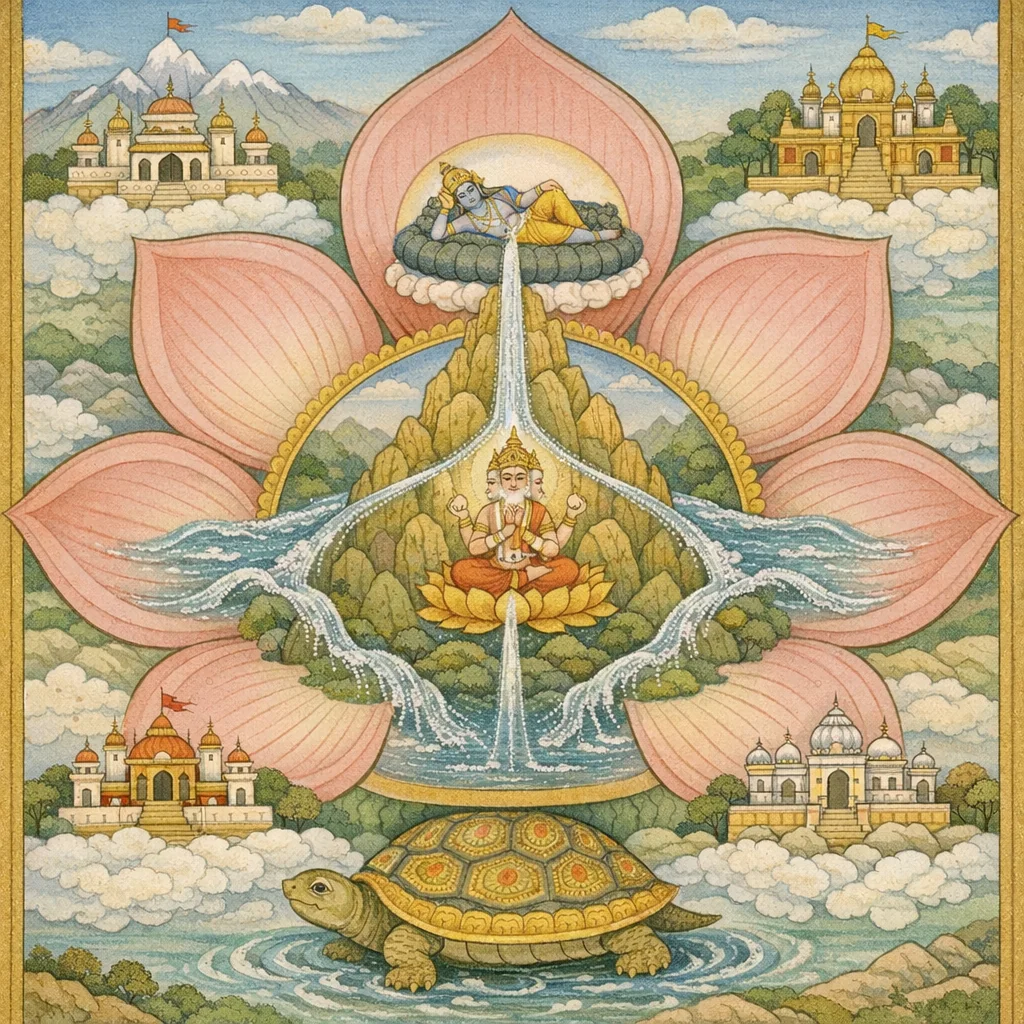
Continuing the Purāṇa’s Meru-centered cosmography, Sūta describes Brahmā’s exalted city above Mount Meru and the nearby sanctuaries and celestial capitals set by direction: Śambhu’s radiant abode near Brahmā; Indra’s Amarāvatī in the east; Agni’s Tejovatī in the south; Yama’s Saṃyamanī farther south; Nirṛti’s Rakṣovatī in the west; Varuṇa’s Suddhavatī in the western quarter; Vāyu’s Gandhavatī in the north; Soma’s Kāntimatī; and the hard-to-attain Śaṅkara-city (Yaśovatī) with Īśāna’s shrine. Each realm corresponds to conduct and liberation: Veda-knowers and yajña-performers, japa and oblation devotees, truth-abiders, tamasic adherents, envy-free tīrtha-servants, and prāṇāyāma practitioners attain their fitting stations. The chapter then turns to sacred waters: Gaṅgā issues from Viṣṇu’s foot, floods the lunar sphere, descends into Brahmā’s city, and divides into four rivers—Sītā, Ālakanandā, Sucakṣus, and Bhadrā—flowing through the varṣas to the oceans. It concludes by fixing the lotus-like world-structure around Meru and listing the boundary mountains that demarcate the varṣas, preparing for the next section’s fuller geographic and cosmological detail.
Shlokas
Verse 1
इति श्रीकूर्मपुराणे षट्साहस्त्र्यां सहितायां पूर्वविभागे त्रिचत्वारिशो ऽध्यायः सूत उवाच चतुर्दशसहस्त्रणि योजनानां महापुरी / मेरोरुपरि विख्याता देवदेवस्य वेधसः
Thus, in the Śrī Kūrma Purāṇa, in the Pūrvabhāga, the forty-fourth chapter. Sūta said: Above Mount Meru is renowned the great city of the God of gods, Vedhas (Brahmā) the Creator, extending fourteen thousand yojanas.
Verse 2
तत्रास्ते भगवान् ब्रह्मा विश्वात्मा विश्वभावनः / उपास्यमानो योगीन्द्रैर्मुनीन्द्रोपेन्द्रशङ्करैः
There sat the venerable Lord Brahmā—Soul of the universe and the one who brings forth the universe—being reverently worshipped by the foremost yogins: the best of sages, Indra, and Śaṅkara (Śiva).
Verse 3
तत्र देवेश्वरेशानं विश्वात्मानं प्रजापतिम् / सनत्कुमारो भगवानुपास्ते नित्यमेव हि
There, the revered Sanatkumāra constantly worships the Supreme Lord—the Lord of the gods, the great Īśāna, the Soul of the universe, and Prajāpati, the cosmic Progenitor.
Verse 4
स सिद्धैरृषिगन्धर्वैः पूज्यमानः सुरैरपि / समास्ते योगयुक्तत्मा पीत्वा तत्परमामृतम्
Worshipped by the Siddhas, the seers, and the Gandharvas—and even by the gods—he remains seated, his inner self absorbed in Yoga, having drunk that supreme nectar, the amṛta.
Verse 5
तत्र देवादिदेवस्य शंभोरमिततेजसः / दीप्तमायतनं शुभ्रं पुरस्ताद् ब्रह्मणः स्थितम्
There, in front of Brahmā, stood the radiant, immaculate sanctuary of Śambhu—the God of gods—whose splendor is immeasurable.
Verse 6
दिव्यकान्तिसमायुक्तं चतुर्धारं सुशोभनम् / महर्षिगणसंकीर्णं ब्रह्मविद्भिर्निषेवितम्
Endowed with a divine radiance, splendid to behold, and flowing forth in four streams, it is thronged with hosts of great seers and constantly resorted to by knowers of Brahman.
Verse 7
देव्या सह महादेवः शशाङ्कार्काग्निलोचनः / रमते तत्र विश्वेशः प्रमथैः प्रमथेश्वरः
There, Mahādeva—the Lord of the universe—whose eyes are the Moon, the Sun, and Fire, delights together with the Goddess, attended by the Pramathas, as Pramathêśvara, the sovereign of the Pramathas.
Verse 8
तत्र वेदविदः शान्ता मुनयो ब्रह्मचारिणः / पूजयन्ति महादेवं तापसाः सत्यवादिनः
There, the Veda-knowing sages—peaceful and devoted to brahmacarya—worship Mahādeva; the truth-speaking ascetics revere him through disciplined tapas and restraint.
Verse 9
तेषां साक्षान्महादेवो मुनीनां ब्रह्मवादिनाम् / गृह्णाति पूजां शिरसा पार्वत्या परमेश्वरः
For those sage-seers who proclaim Brahman, Mahādeva himself—Parameśvara, together with Pārvatī—accepts their worship, bowing his head in reverence.
Verse 10
तत्रैव पर्वतवरे शक्रस्य परमा पुरी / नाम्नामरावती पूर्वे सर्वशोभासमन्विता
There itself, on that excellent mountain, lies Śakra’s supreme city—named Amarāvatī—toward the east, endowed with every kind of splendor.
Verse 11
तमिन्द्रमप्सरः सङ्घा गन्धर्वा गीततत्पराः / उपासते सहस्त्राक्षं देवास्तत्र सहस्त्रशः
There, hosts of Apsarases and Gandharvas—intent on song—attend upon that Indra, the thousand-eyed lord; and thousands upon thousands of gods likewise worship him in that place.
Verse 12
ये धार्मिका वेदविदो यागहोमपरायणाः / तेषां तत् परमं स्थानं देवानामपि दुर्लभम्
Those who are righteous, who know the Vedas, and who are steadfastly devoted to sacrificial worship and sacred fire-offerings—for them there is that supreme abode, a state difficult to attain even for the gods.
Verse 13
तस्य दक्षिणदिग्भागे वह्नेरमिततेजसः / तेजोवती नाम पुरी दिव्याश्चर्यसमन्विता
In its southern quarter lies the city named Tejovatī, belonging to Agni of immeasurable radiance—endowed with wondrous, divine marvels.
Verse 14
तत्रास्ते भगवान् वह्निर्भ्राजमानः स्वतेजसा / जपिनां होमिनां स्थानं दानवानां दुरासदम्
There abides the Blessed Fire, Agni, radiant with his own tejas—an abode for those who practice japa and offer homa oblations, yet a fortress that the dāṇavas (hostile demonic powers) cannot assail.
Verse 15
दक्षिणे पर्वतवरे यमस्यापि महापुरी / नाम्ना संयमनी दिव्या सिद्धगन्धर्वसेविता
To the south, upon an excellent mountain, lies Yama’s great city—divine Saṃyamanī by name—attended and frequented by Siddhas and Gandharvas.
Verse 16
तत्र वैवस्वतं देवं देवाद्याः पर्युपासते / स्थानं तत् सत्यसंधानां लोके पुण्यकृतां नृणाम्
There, the gods and the foremost of the celestials continually revere Vaivasvata (Yama), the divine lord. That realm is the station of those steadfast in truth—of virtuous men in the world who have performed meritorious deeds.
Verse 17
तस्यास्तु पश्चिमे भागे निरृतेस्तु महात्मनः / रक्षोवती नाम पुरी राक्षसैः सर्वतो वृता
On its western side lies the realm of the great Nirṛti; there is a city named Rakṣovatī, surrounded on all sides by rākṣasas.
Verse 18
तत्र तं निरृतिं देवं राक्षसाः पर्युपासते / गच्छन्ति तां धर्मरता ये वै तामसवृत्तयः
There, the rākṣasas duly worship the deity Nirṛti; and those devoted to their own (dark) code of duty—people of tamasic disposition—go to her realm.
Verse 19
पश्चिमे पर्वतवरे वरुणस्य महापुरी / नाम्ना सुद्धवती पुण्या सर्वकामर्धिसंयुता
In the western quarter, upon an excellent mountain, stands Varuṇa’s great city. It is called Suddhavatī—holy and auspicious—endowed with the power to fulfill all desires and aims.
Verse 20
तत्राप्सरोगणैः सिद्धैः सेव्यमानो ऽमराधिपः / आस्ते स वरुणो राजा तत्र गच्छन्ति ये ऽम्बुदाः / तीर्थयात्रापरी नित्यं ये च लोके ऽधमर्षिणः
There, attended by hosts of Apsarās and perfected Siddhas, the lord among the gods—King Varuṇa—abides. To that very place go the rain-bearing clouds; and there also go those ever devoted to pilgrimage to the tīrthas, and those in the world who are free from envy and intolerance.
Verse 21
तस्या उत्तरदिग्भागे वायोरपि महापुरी / नाम्ना गन्धवती पुण्या तत्रास्ते ऽसौ प्रभञ्जनः
To the north of that region lies Vāyu’s great city, holy and famed as Gandhavatī; there indeed dwells Prabhañjana, the mighty Wind.
Verse 22
अप्सरोगणगन्धर्वैः सेव्यमानो ऽमरप्रभुः / प्राणायामपरामर्त्यास्थानन्तद्यान्ति शाश्वतम्
Served by hosts of Apsarās and Gandharvas, the Lord of the immortals dwells there; mortals devoted to prāṇāyāma attain that eternal station.
Verse 23
तस्याः पूर्वेण दिग्भागे सोमस्य परमा पुरी / नाम्ना कान्तिमती शुभ्रा तत्र सोमो विराजते
To the east of that region lies Soma’s supreme city, a radiant and auspicious abode named Kāntimatī; there Soma shines forth in glory.
Verse 24
तत्र ये भोगनिरता स्वधर्मं पुर्यपासते / तेषां तद् रचितं स्थानं नानाभोगसमन्वितम्
There, those devoted to enjoyments yet duly upholding their own svadharma— for them a realm is fashioned accordingly, endowed with many kinds of pleasures.
Verse 25
तस्याश्च पूर्वदिग्भागे शङ्करस्य महापुरी / नाम्ना यशोवती पुण्या सर्वेषां सुदुरासदा
In its eastern quarter lies a great city of Śaṅkara, a holy metropolis named Yaśovatī—sacred, and for all beings exceedingly difficult to attain.
Verse 26
तत्रेशानस्य भवनं रुद्रविष्णुतनोः शुभम् / घमेश्वरस्य विपुलं तत्रास्ते स गणैर्वृतः
There stands the auspicious abode of Īśāna—whose very form is Rudra and Viṣṇu in unity. There too is the vast shrine of Ghameśvara; and there he abides, surrounded by his gaṇas.
Verse 27
तत्र भोगाभिलिप्सूनां भक्तानां परमेष्ठिनः / निवासः कल्पितः पूर्वं देवदेवेन शूलिना
There, for the devotees of Parameṣṭhin (the Supreme Lord) who still long for enjoyments, a dwelling-place was formerly ordained by the God of gods—Śūlin (Śiva), the Trident-bearer.
Verse 28
विष्णुपादाद् विनिष्क्रान्ता प्लावयित्वेन्दुमण्डलम् / समन्ताद् ब्रह्मणः पुर्यां गङ्गा पतति वै दिवः
Issuing forth from the foot of Viṣṇu, the Gaṅgā—having flooded the orb of the Moon—then falls from heaven all around into the city of Brahmā.
Verse 29
सा तत्र पतिता दिक्षु चतुर्धा ह्यभवद् द्विजाः / सीता चालकनन्दा च सुचक्षुर्भद्रनामिका
Falling there and flowing forth toward the four directions, O twice-born ones, she became fourfold—named Sītā, Cālakanandā, Sucakṣus, and Bhadrā.
Verse 30
पूर्वेण सीता शैलात् तु शैलं यात्यन्तरिक्षतः / ततश्च पूर्ववर्षेण भद्राश्वेनैति चार्णवम्
To the east, from Mount Sītā, the (Sītā) range proceeds through the mid-sky; then, passing through the eastern realm—Bhadrāśva-varṣa—it reaches the ocean.
Verse 31
तथैवालकनन्दा च दक्षिणादेत्य भारतम् / प्रयाति सागरं भित्त्वा सप्तभेदा द्विजोत्तमाः
Likewise, the river Ālakanandā too, coming by the southern course into Bhārata, reaches the ocean—after splitting and breaking through, O best of twice-born, into seven branches.
Verse 32
सुचक्षुः पश्चिमगिरीनतीत्य सकलांस्तथा / पश्चिमं केतुमालाख्यं वर्षं गत्वैति चार्णवम्
The river Sucakṣus, having crossed all the western mountains, proceeds to the western region called Ketumāla-varṣa and then reaches the ocean.
Verse 33
भद्रा तथोत्तरगिरीनुत्तरांश्च तथा कुरून् / अतीत्य चोत्तराम्भोधिं समभ्येति महर्षयः
Passing beyond Bhadrā, the northern mountains, and the northern lands—including the country of the Kurus—and even crossing the Northern Ocean, O great sages, they proceed onward (to the far northern region).
Verse 34
आनीलनिषधायामौ माल्यवान् गन्धमादनः / तयोर्मध्यगतो मेरुः कर्णिकाकारसंस्थितः
Between the mountains Nīla and Niṣadha lie Mālyavān and Gandhamādana; and in the very midst of those two stands Mount Meru, set like the lotus’s pericarp, its central core.
Verse 35
भारताः केतुमालाश्च भद्राश्वाः कुरवस्तथा / पत्राणि लोकपद्मस्य मर्यादाशैलबाह्यतः
Bhārata, Ketumāla, Bhadrāśva, and likewise Kuru—these are the “petals” of the lotus of the world, lying beyond the boundary-mountains that mark its limits.
Verse 36
जठरो देवकूटश्च मर्यादापर्वतावुभौ / दक्षिणोत्तरमायामावानीलनिषधायतौ
Jathara and Devakūṭa—both boundary-mountains—stretch from south to north, reaching as far as the ranges called Ānīla and Niṣadha.
Verse 37
गन्धमादनकैलासौ पूर्वपश्चायतावुभौ / अशीतियोजनायामावर्णवान्तर्व्यवस्थितौ
Gandhamādana and Kailāsa—both running from east to west—are situated within the inner region of the Varṇavān range, each spanning eighty yojanas in breadth.
Verse 38
निषधः पारियात्रश्च मर्यादापर्वताविमौ / मेरोः पश्चिमदिग्भागे यथापूर्वौ तथा स्थितौ
These two boundary mountains—Niṣadha and Pāriyātra—are situated on the western side of Mount Meru, remaining in the same arrangement as previously described.
Verse 39
त्रिशृङ्गो जारुधैस्तद्वदुत्तरे वर्षपर्वतौ / पूर्वपश्चायतावेतौ अर्णवान्तर्व्यवस्थितौ
To the north are the Varṣa-mountains named Triśṛṅga and Jārudhā; these two stretch from east to west and stand within the vast oceanic expanse that lies between.
Verse 40
मर्यादापर्वताः प्रोक्ता अष्टाविह मया द्विजाः / जठराद्याः स्थिता मेरोश्चतुर्दिक्षु महर्षयः
O twice-born sages, I have here declared the eight boundary-mountains. Beginning with Jaṭhara and the rest, those great ṛṣis are stationed around Mount Meru in the four directions.
Frequently Asked Questions
It assigns specific realms to specific disciplines and virtues—yajña and Veda-study, japa and oblations, truthfulness, tīrtha devotion, and prāṇāyāma—so geography functions as a karmic-yogic map rather than mere description.
Gaṅgā originates from Viṣṇu’s foot yet flows through Brahmā’s city and across the cosmic regions, expressing Purāṇic samanvaya: a single sacred power traverses and sanctifies the spheres associated with multiple deities and their devotees.