Adhyaya 43
Bhūrloka-Vyavasthā — The Seven Dvīpas, Seven Oceans, and the Meru-Centered Order of Jambūdvīpa
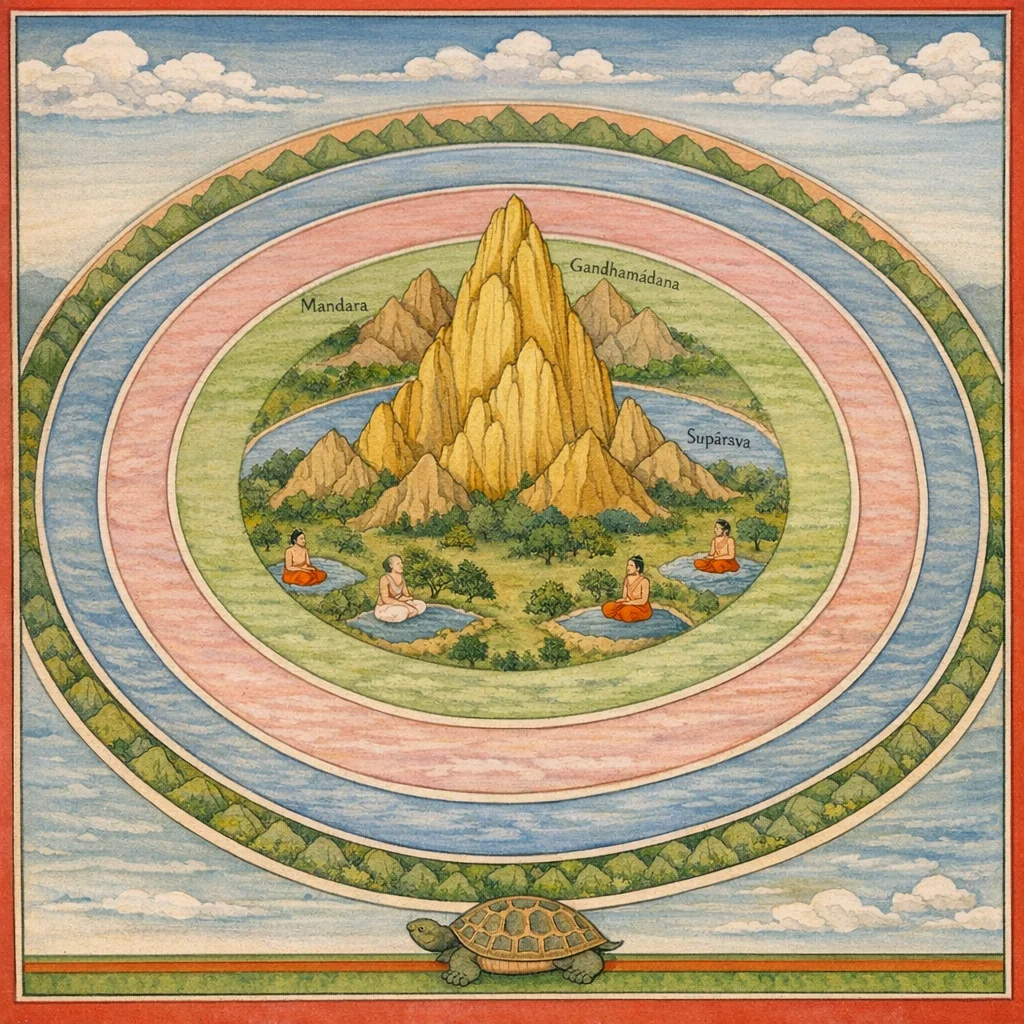
Concluding the earlier account of the brahmāṇḍa’s fourteenfold regional division, Sūta turns to a settled description of Bhūrloka, moving from macrocosmic structure to the mapped sacred earth. He enumerates the seven dvīpas—Jambū foremost, then Plakṣa, Śālmala, Kuśa, Krauñca, Śāka, and Puṣkara—and the seven encircling oceans of increasing extent: salt water, sugarcane juice, liquor, ghee, curds, milk, and sweet water. Jambūdvīpa is set at the center, with golden Mount Meru as the axial heart of the earth-lotus, its height, subterranean depth, and breadth given in precise measures. The surrounding varṣas are named and arranged—Bhārata, Kiṃpuruṣa, Harivarṣa to the south; Ramyaka, Hiraṇmaya, Uttara-Kuru to the north; Bhadrāśva east; Ketumāla west; Ilāvṛta central—along with the supporting mountains Mandara, Gandhamādana, Vipula, and Supārśva. Meru’s environs are sacralized through forests, lakes, and a wide catalogue of holy mountains, culminating in a vision of siddhas and sages dwelling in Brahman-poised yogic serenity, preparing for later chapters on sacred terrestrial geography and its dharmic-spiritual import.
Shlokas
Verse 1
इती श्रीकूर्मपुराणे षट्साहस्त्र्यां संहितायां पूर्वविभागे द्विचत्वारिंशो ऽध्यायः सूत उवाच एतद् ब्रह्माण्डमाख्यातं चतुर्दशविधं महत् / अतः परं प्रवक्ष्यामि भूर्लोकस्यास्य निर्णयम्
Thus, in the Śrī Kūrma Purāṇa, in the six-thousand-verse Saṃhitā, in the Pūrvabhāga, the forty-second chapter concludes. Sūta said: “This vast brahmāṇḍa, divided into fourteen regions, has been described; now I shall explain the settled account of this Bhūrloka, the earthly realm.”
Verse 2
जम्बुद्वीपः प्रधानो ऽयं प्लक्षः शाल्मल एव च / कुशः क्रौञ्चश्च शाकश्च पुष्करश्चैव सप्तमः
This Jambūdvīpa is the foremost; and there are also Plakṣa and Śālmala, as well as Kuśa, Krauñca, Śāka, and Puṣkara as the seventh.
Verse 3
एते सप्त महाद्वीपाः समुद्रैः सप्तभिर्वृताः / द्वीपाद् द्वीपो महानुक्तः सागरादपि सागरः
These are the seven great continents, each encircled by seven oceans. From continent to continent they are declared progressively greater, and from ocean to ocean as well, each surpassing the former.
Verse 4
क्षारोदेक्षुरसोदश्च सुरोदश्च घृतोदकः / दध्योदः क्षीरसलिलः स्वादूदश्चेति सागराः
The oceans are these: the salt-water ocean; the ocean of sugarcane-juice; the ocean of intoxicating liquor (sura); the ocean whose waters are ghee (ghṛta); the ocean of curds (dadhi); the ocean made of milk-waters; and the ocean of sweet, fresh water.
Verse 5
पञ्चाशत्कोटिविस्तीर्णा ससमुद्रा धरा स्मृता / द्वीपैश्च सप्तभिर्युक्ता योजनानां समासतः
The Earth, together with its encircling oceans, is remembered as extending fifty crores (of yojanas) in breadth; and, in summary, it is described as furnished with the seven continents (dvīpas) measured in yojanas.
Verse 6
जम्बूद्वीपः समस्तानां द्वीपानां मध्यतः शुभः / तस्य मध्ये महामेरुर्विश्रुतः कनकप्रभः
Auspicious Jambūdvīpa lies at the very center among all the continents; and in its midst stands the great Meru, renowned and radiant with a golden splendor.
Verse 7
चतुरशीतिसाहस्त्रो योजनैस्तस्य चोच्छ्रयः / प्रविष्टः षोडशाधस्ताद्द्वात्रिंशन्मूर्ध्नि विस्तृतः
Its height is eighty-four thousand yojanas. It extends sixteen thousand yojanas below (the earth’s surface), and at its summit it spreads out to a breadth of thirty-two thousand yojanas.
Verse 8
मूले षोडशसाहस्त्रो विस्तारस्तस्य सर्वतः / भूपद्मास्यास्य शैलो ऽसौ कर्णिकात्वेन संस्थितः
At its base, its expanse extends sixteen thousand yojanas in every direction. That mountain stands there as the “karnikā,” the central core of this Earth-lotus.
Verse 9
हिमवान् हेमकूटश्च निषधश्चास्य दक्षिणे / नीलः श्वेतश्च शृङ्गी च उत्तरे वर्षपर्वताः
To its south lie Himavān, Hemakūṭa, and Niṣadha; and to its north are the Varṣa-mountains—Nīla, Śveta, and Śṛṅgī.
Verse 10
लक्षप्रमाणौ द्वौ मध्ये दशहीनास्तथा परे / सहस्त्रद्वितयोच्छ्रायास्तावद्विस्तारिणश्च ते
In the middle there are two (ranges) measuring a lakṣa each; the others likewise are ten less in measure. Their height is two thousand, and their breadth is of the same extent.
Verse 11
भारतं दक्षिणं वर्षं ततः किंपुरुषं स्मृतम् / हरिवर्षं तथैवान्यन्मेरोर्दक्षिणतो द्विजाः
O twice-born sages, to the south of Mount Meru lies the southern region called Bhārata; beyond it is known the land of Kiṃpuruṣa; and likewise another region called Harivarṣa—these are situated to the south of Meru.
Verse 12
रम्यकं चोत्तरं वर्षं तस्यैवानुहिरण्मयम् / उत्तराः कुरवश्चैव यथैते भरतास्तथा
To its north lies the region called Ramyaka, and beyond that, Hiraṇmaya. There are also the Uttara-Kurūs; and just as the people of Bhārata are in their order and way of life, so too are they.
Verse 13
नवसाहस्त्रमेकैकमेतेषां द्विजसत्तमाः / इलावृतं च तन्मध्ये तन्मध्ये मेरुरुच्छ्रितः
O best of the twice-born, each of these regions extends for nine thousand yojanas. In their midst lies Ilāvṛta, and in the very heart of Ilāvṛta rises lofty Mount Meru.
Verse 14
मेरोश्चतुर्दिशं तत्र नवसाहस्त्रविस्तृतम् / इलावृतं महाभागाश्चात्वारस्तत्र पर्वताः / विष्कम्भा रचिता मेरोर्योजनायुतमुच्छ्रिताः
There, on all four sides around Mount Meru, lies Ilāvṛta, extending nine thousand yojanas. In that region, O noble ones, four mountains are set as supporting buttresses of Meru, each rising to a height of ten thousand yojanas.
Verse 15
पूर्वेण मन्दरो नाम दक्षिणे गन्धमादनः / विपुलः पश्चिमे पार्श्वे सुपार्श्वश्चोत्तरे स्मृतः
To the east is the mountain named Mandara; to the south, Gandhamādana. On the western side is Vipula, and to the north, Supārśva—so they are traditionally remembered.
Verse 16
कदम्बस्तेषु जम्बुश्च पिप्पलो वट एव च / जम्बूद्वीपस्य सा जम्बूर्नामहेतुर्महर्षयः
Among those trees are the kadamba, the jambū, the pippala, and the banyan. O great sages, that jambū tree is the very cause for the name of Jambūdvīpa.
Verse 17
महागजप्रमाणानि जम्ब्वास्तस्याः फलानि च / पतन्ति भूभृतः पृष्ठे शीर्यमाणानि सर्वतः
And the fruits of that jambū tree—each as large as a great elephant—fall down everywhere upon the mountain’s back, shattering as they strike its surface.
Verse 18
रसेन तस्याः प्रख्याता तत्र जम्बूनदीति वै / सरित् प्रवर्तते चापि पीयते तत्र वासिभिः
By the essence (sap) of that Jambū tree, there is famed there the river called Jambūnadī. From it a stream flows forth, and the inhabitants of that region drink its waters.
Verse 19
न स्वेदो न च दौर्गन्ध्यं न जरा नेन्द्रियक्षयः / तत्पानात् सुस्थमनसां नराणां तत्र जायते
By drinking that sanctified nectar there, people whose minds are well-set and steady have no excessive sweating, no foul odor, no old age, and no decline of the senses.
Verse 20
तीरमृत्तत्र संप्राप्य वायुना सुविशोषिता / जाम्बूनदाख्यं भवति सुवर्णं सिद्धभूषणम्
The mud upon that riverbank, once obtained and thoroughly dried by the wind, becomes gold known as Jāmbūnada—gold fit for the ornaments of the Siddhas.
Verse 21
भद्राश्वः पूर्वतो मेरोः केतुमालश्च पश्चिमे / वर्षे द्वे तु मुनिश्रेष्ठास्तयोर्मध्ये इलावृतम्
O best of sages, to the east of Mount Meru lies Bhadrāśva, and to the west is Ketumāla. These are two great varṣas; between them is Ilāvṛta.
Verse 22
वनं चैत्ररथं पूर्वे दक्षिणे गन्धमादनम् / वैभ्राजं पश्चिमे विद्यादुत्तरे सवितुर्वनम्
Know that the Caitraratha forest lies in the east; Gandhamādana in the south; Vaibhrāja in the west; and, in the north, the forest of Savitṛ (the Sun).
Verse 23
अरुणोदं महाभद्रमसितोदं च मानसम् / सरांस्येतानि चत्वारि देवयोग्यानि सर्वदा
Aruṇoda, Mahābhadra, Asitoda, and Mānasarovara—these four lakes are ever fit for the worship and refuge of the Devas.
Verse 24
सितान्तश्च कुमुद्वांश्च कुरुरी माल्यवांस्तथा / वैकङ्को मणिशैलश्च ऋक्षवांश्चाचलोत्तमाः
Also there are the mountains Sitānta and Kumudvān, Kururī and Mālyavān; likewise Vaikaṅka, Maṇiśaila, and Ṛkṣavān—excellent among mountains.
Verse 25
महानीलो ऽथ रुचकः सबिन्दुर्मन्दरस्तथा / वेणुमांश्चैव मेघश्च निषधो देवपर्वतः / इत्येते देवरचिताः सिद्धावासाः प्रकीर्तिताः
Mahānīla, Rucaka, Sabindu, and Mandara; Veṇumāṃśa, Megha, and Niṣadha—the divine mountain—are proclaimed as the Siddhas’ dwelling-places, fashioned by the Devas.
Verse 26
अरुणोदस्य सरसः पूर्वतः केसराचलः / त्रिकूटशिखरश्चैव पतङ्गो रुचकस्तथा
To the east of the lake called Aruṇoda lies Mount Kesarācala; there too are the peak named Trikūṭaśikhara, and the mountains Pataṅga and Rucaka.
Verse 27
निषधो वसुधारश्च कलिङ्गस्त्रिशिखः शुभः / समूलो वसुधारश्च कुरवश्चैव सानुमान्
Niṣadha, Vasudhāra, Kaliṅga, and the auspicious Triśikha; likewise Samūla, Vasudhāra again, and Kurava together with Sānumān—these are the mountains/regions spoken of here.
Verse 28
ताम्रातश्च विशालश्च कुमुदो वेणुर्वतः / एकशृङ्गो महाशैलो गजशैलः पिशाचकः
“Tāmrāta, Viśāla, Kumuda, and Veṇurvata; also Ekaśṛṅga, Mahāśaila, Gajaśaila, and Piśācaka”—these are among the celebrated mountains spoken of in the sacred geographical tradition.
Verse 29
पञ्चशैलो ऽथ कैलासो हिमवांशचाचलोत्तमः / इत्येते देवचरिता उत्कटाः पर्वतोत्तमाः
Then there are Pañcaśaila, Kailāsa, and Himavān—the supreme among mountains. Truly, these are the mighty and exalted best of peaks, famed as the dwelling and resort of the gods.
Verse 30
महाभद्रस्य सरसो दक्षिणे केसराचलः / शिखिवासश्च वैदूर्यः कपिलो गन्धमादनः
To the south of Lake Mahābhadra lie the mountains Keśarācala, Śikhivāsa, Vaidūrya, Kapila, and Gandhamādana.
Verse 31
जारुधिश्च सुगन्धिश्च श्रीशृङ्गश्चाचलोत्तमः / सुपार्श्वश्च सुपक्षश्च कङ्कः कपिल एव च
Also there are Jārudhi and Sugandhi; Śrīśṛṅga, the excellent mountain; likewise Supārśva and Supakṣa; as well as Kaṅka and Kapila.
Verse 32
पिञ्जरो भद्रशैलश्च सुरसश्च महाबलः / अञ्जनो मधुमांस्तद्वत् कुमुदो मुकुटस्तथा
Pinjara, Bhadraśaila, Surasa, and Mahābala; likewise Añjana and Madhumān; and also Kumuda and Mukuṭa—these too are named among the great mountains.
Verse 33
सहस्त्रशिखरश्चैव पाण्डुरः कृष्ण एव च / पारिजातो महाशैलस्तथैव कपिलोदकः
Likewise there are Sahasraśikhara, and also Pāṇḍura and Kṛṣṇa; there is Pārijāta, the great mountain, and also Kapilodaka.
Verse 34
सुषेणः पुण्डरीकश्च महामेघस्तथैव च / एते पर्वतराजानः सिद्धगन्धर्वसेविताः
Suṣeṇa, Puṇḍarīka, and likewise Mahāmegha—these are sovereign kings among mountains, attended and revered by Siddhas and Gandharvas.
Verse 35
असितोदस्य सरसः पश्चिमे केसराचलः / शङ्खकूटो ऽथ वृषभो हंसो नागस्तथा परः
To the west of the lake Asitoda lies the mountain Kesarācala; and there are also the peaks named Śaṅkhakūṭa, Vṛṣabha, Haṃsa, and likewise the lofty Nāga.
Verse 36
कालाञ्जनः शुक्रशैलो नीलः कमल एव च / पुष्पकश्च सुमेघश्च वाराहो विरजास्तथा / मयूरः कपिलश्चैव महाकपिल एव च
Kālāñjana, Śukraśaila, Nīla, and Kamala; Puṣpaka and Sumegha; Vārāha and Virajā; and also Mayūra, Kapila, and Mahākapila—these are counted among the renowned mountains.
Verse 37
इत्येते देवगन्धर्वसिद्धसङ्घनिषेविताः / सरसो मानसस्येह उत्तरे केसराचलाः
Thus, these Kesarācala mountains, frequented by hosts of devas, gandharvas, and siddhas, lie here to the north of the sacred lake Mānasa.
Verse 38
एतेषां शैलमुख्यानामन्तरेषु यथाक्रमम् / सन्ति चैवान्तरद्रोण्यः सरांसि च वनानि च
Between these principal mountain ranges, in due order, there are also inner valleys, lakes, and forests.
Verse 39
वसन्ति तत्र मुनयः सिद्धाश्च ब्रह्मभाविताः / प्रसन्नाः शान्तरजसः सर्वदुः खविवर्जिताः
There dwell sages and perfected beings, their minds steeped in Brahman. Serene and radiant with clarity, their rajas pacified, they are entirely free from every sorrow.
Frequently Asked Questions
Jambū, Plakṣa, Śālmala, Kuśa, Krauñca, Śāka, and Puṣkara (the seventh), each encircled by an ocean and described as progressively larger.
Salt-water; sugarcane-juice; intoxicating liquor; ghee; curds; milk; and sweet (fresh) water—each ocean encircling a dvīpa in expanding order.
Meru is said to be 84,000 yojanas high, extending 16,000 yojanas below the earth, with a summit breadth of 32,000 yojanas and a base extent of 16,000 yojanas in every direction.
It is linked to the great jambū tree; its immense fruits and essence are said to generate the Jambūnadī, and the region’s identity is etiologically derived from that sacred tree.
The river’s essence is described as conferring steadiness and freedom from bodily decline; its dried riverbank mud becomes Jāmbūnada gold, fit for siddhas’ ornaments—marking the landscape as both sacral and transformative.