Adhyaya 31
Kapardeśvara at Piśācamocana — Liberation of a Piśāca and the Brahmapāra Hymn
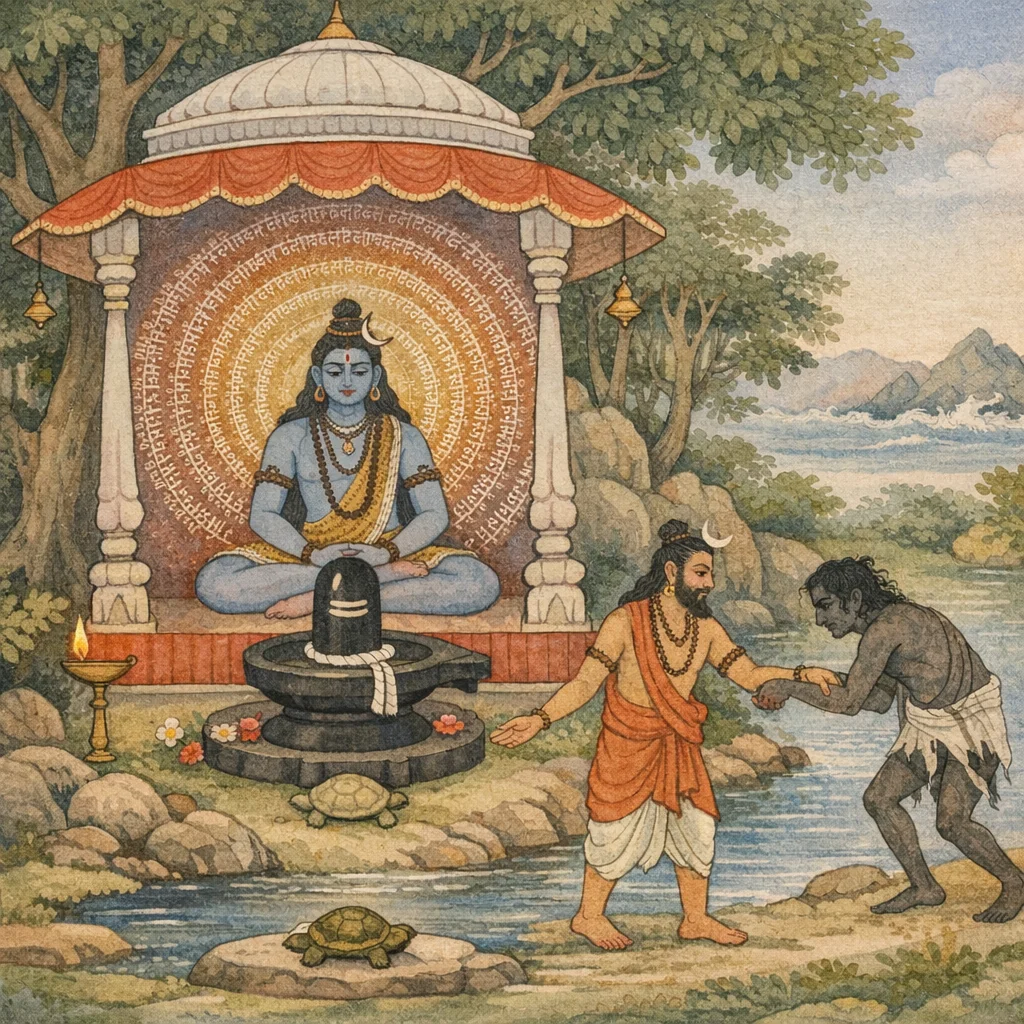
Continuing from the prior chapter’s close, Sūta carries on the pilgrimage narrative: after honoring their teacher, the sages go to behold the imperishable liṅga Kapardeśvara—Śiva “Śūlin”—at the ford called Piśācamocana. Having bathed and offered libations to the Pitṛs, they witness a fearful yet revelatory sign: a tiger kills a doe near the shrine, and then a blazing celestial manifestation appears with divine attendants and a rain of flowers, proclaiming the site’s extraordinary power. In wonder, Jaimini and the sages ask Acyuta/Vyāsa to expound Kapardeśvara’s māhātmya. The teaching first states the tīrtha’s fruits—destruction of sins, removal of obstacles, and yogic siddhi within six months—then gives an exemplum: the ascetic Śaṅkukarṇa meets a starving piśāca who confesses neglect of worship and charity despite once beholding Viśveśvara in Vārāṇasī. Directed to bathe and remember Kapardeśvara, the piśāca enters samādhi, is transformed into a radiant divine state, and attains a Veda-formed maṇḍala where Rudra shines. Śaṅkukarṇa then offers the lofty Vedāntic hymn Brahmapāra, culminating in the manifestation of the non-dual liṅga as pure knowledge-bliss; he dissolves into it. The chapter ends by promising merit from daily hearing/recitation and by recording the sages’ resolve to remain and worship, preparing further tīrtha-centered instruction.
Shlokas
Verse 1
इति श्रीकूर्मपुराणे षट्साहस्त्र्यां संहितायां पूर्वविभागेत्रिंशो ऽध्यायः सूत उवाच समाभाष्य मुनीन् धीमान् देवदेवस्य शूलिनः / जगाम लिङ्गं तद् द्रष्टुं कपर्देश्वरमव्ययम्
Thus, in the Śrī Kūrma Purāṇa, within the six-thousand-verse compendium, in the Former Division, the thirtieth chapter comes to an end. Sūta said: Having respectfully addressed the sages, the wise one set out to behold that Liṅga of Śūlin—the Lord of Lords—namely Kapardeśvara, the imperishable.
Verse 2
स्नात्वा तत्र विधानेन तर्पयित्वा पितॄन् द्विजाः / पिशाचमोचने तीर्थे पूजयामास शूलिनम्
Having bathed there according to the prescribed rite and having offered tarpaṇa libations to the Pitṛs, the twice-born worshipped Śūlin—Śiva, the Trident-bearer—at the tīrtha called Piśācamocana, “Liberation from Piśācas.”
Verse 3
तत्राश्चर्यमपश्यंस्ते मुनयो गुरुणा सह / मेनिरे क्षेत्रमाहात्म्यं प्रणेमुर्गिरिशं हरम्
There, those sages—together with their teacher—beheld a wondrous marvel. Recognizing the greatness of that sacred place, they bowed in reverence to Girīśa, Hara (Lord Śiva).
Verse 4
कश्चिदभ्याजगामेदं शार्दूलो घोररूपधृक् / मृगीमेकां भक्षयितुं कपर्देश्वरमुत्तमम्
Then a certain tiger, bearing a fearsome form, came to the supreme sacred place of Kapardeśvara, intending to devour a single doe.
Verse 5
तत्र सा भीतहृदया कृत्वा कृत्वा प्रदक्षिणम् / धावमाना सुसंभ्रान्ता व्याघ्रस्य वशमागता
There, her heart seized by fear, she performed pradakṣiṇa again and again; then, running in utter bewilderment, she fell under the tiger’s power.
Verse 6
तां विदार्य नखैस्तीक्ष्णैः शार्दूलः सुमहाबलः / जगाम चान्यं विजनं देशं दृष्ट्वा मुनीश्वरान्
Having torn her with his sharp claws, the exceedingly powerful tiger, on seeing the lordly sages, departed to another lonely region.
Verse 7
मृतमात्रा च सा बाला कपर्देशाग्रतो मृगी / अदृश्यत महाज्वाला व्योम्नि सूर्यसमप्रभा
And that young doe, as if struck dead, collapsed right before Kapardeśa. Then, in the sky, a vast flame appeared, radiant like the sun.
Verse 8
त्रिनेत्रा नीलकण्ठा च शशाङ्काङ्कितमूर्धजा / वृषाधिरूढा पुरुषैस्तादृशैरेव संवृता
She is three-eyed, blue-throated (Nīlakaṇṭha), and bears the moon as an emblem upon her head; mounted upon a bull, she is surrounded by attendants of the same divine appearance.
Verse 9
पुष्पवृष्टिं विमुञ्चिन्ति खेचरास्तस्य मूर्धनि / गणेश्वरः स्वयं भूत्वा न दृष्टस्तत्क्षणात् ततः
The celestial beings moving through the sky released a shower of flowers upon his head. Then Gaṇeśvara, having manifested in person, was no longer seen from that very moment thereafter.
Verse 10
दृष्ट्वैतदाश्चर्यवरं जैमिनिप्रमुखा द्विजाः / कपर्देश्वरमाहात्म्यं पप्रच्छुर्गुरुमच्युतम्
Having beheld this supreme marvel, the twice-born sages led by Jaimini asked their teacher Acyuta about the sacred greatness (māhātmya) of Kapardeśvara.
Verse 11
तेषां प्रोवाच भगवान् देवाग्रे चोपविश्य सः / कपर्देशस्य माहात्म्यं प्रणम्य वृषभध्वजम्
Then the Blessed Lord, seated in the presence of the gods, addressed them and proclaimed the greatness of Kapardeśa—after bowing in reverence to the Bull-bannered Lord, Śiva.
Verse 12
इदं देवस्य तल्लिङ्गं कपर्दोश्वरमुत्तमम् / स्मृत्वैवाशेषपापौघं क्षिप्रमस्य विमुञ्चति
This is that sacred liṅga of the Lord—Kapardośvara, the Supreme. By merely remembering it, one is swiftly freed from the entire multitude of sins.
Verse 13
कामक्रोधादयो दोषा वाराणसीनिवासिनाम् / विघ्नाः सर्वे विनश्यन्ति कपर्देश्वरपूजनात्
For the residents of Vārāṇasī, faults such as desire and anger—and all obstacles—are destroyed through the worship of Kapardeśvara (Śiva).
Verse 14
तस्मात् सदैव द्रष्टव्यं कपर्देश्वरमुत्तमम् / पूजितव्यं प्रयत्नेन स्तोतव्यं वैदिकैः स्तवैः
Therefore, the supreme Lord Kapardeśvara should always be sought for darśana; he should be worshipped with earnest effort, and he should be praised with Vedic hymns.
Verse 15
ध्यायतामत्र नियतं योगिनां शान्तचेतसाम् / जायते योगसंसिद्धिः सा षण्मासे न संशयः
For yogins whose minds are tranquil and self-restrained, if they meditate here with steady discipline, yogic accomplishment arises—within six months, without doubt.
Verse 16
ब्रह्महत्यादयः पापा विनश्यन्त्यस्य पूजनात् / पिशाचमोचने कुण्डे स्नातस्यात्र समीपतः
By worshipping him, sins beginning with brahma-slaughter are destroyed—especially for one who has bathed in the Piśācamocana tank and remains here nearby in this holy precinct.
Verse 17
अस्मिन् क्षेत्रे पुरा विप्रास्तपस्वी शंसितव्रतः / शङ्कुकर्ण इति ख्यातः पूजयामास शङ्करम् / जजाप रुद्रमनिशं प्रणवं ब्रह्मरूपिणम्
In this holy region long ago, a Brahmin ascetic, renowned for his well-observed vows and known by the name Śaṅkukarṇa, worshipped Śaṅkara. He ceaselessly repeated the mantra of Rudra—namely the Pranava (Oṃ), the very form of Brahman.
Verse 18
पुष्पधूपादिभिः स्तोत्रैर्नमस्कारैः प्रदक्षिणैः / उवास तत्र योगात्मा कृत्वा दीक्षां तु नैष्ठिकीम
With offerings of flowers, incense, and the like—along with hymns, prostrations, and circumambulations—the yogic-souled one remained there, having undertaken the steadfast (naiṣṭhikī) initiation (dīkṣā).
Verse 19
कदाचिदागतं प्रेतं पश्यति स्म क्षुधान्वितम् / अस्थिचर्मपिनद्धाङ्गं निः श्वसन्तं मुहुर्मुहुः
Once, he saw a departed spirit that had come there, tormented by hunger—its limbs bound only by bone and skin—repeatedly gasping for breath again and again.
Verse 20
तं दृष्ट्वा स मुनिश्रेष्ठः कृपया परया युतः / प्रोवाच को भवान् कस्माद् देशाद् देशमिमंश्रितः
Seeing him, that foremost of sages—filled with supreme compassion—said: “Who are you? From what region have you come, and why have you taken refuge in this land?”
Verse 21
तस्मै पिशाचः क्षुधया पीड्यमानो ऽब्रवीद् वचः / पूर्वजन्मन्यहं विप्रो धनधान्यसमन्वितः / पुत्रपौत्रादिभिर्युक्तः कुटुम्बभरणोत्सुकः
To him, the piśāca—tormented by hunger—spoke these words: “In a former birth I was a brāhmaṇa, endowed with wealth and grain, surrounded by sons, grandsons, and the rest, and intent on maintaining my household.”
Verse 22
न पूजिता मया देवा गावो ऽप्यतिथयस्तथा / न कदाचित् कृतं पुण्यमल्पं वा स्वल्पमेव वा
“I have not worshipped the gods; nor have I honored cows or guests. Never have I performed any meritorious act—neither great nor even the smallest.”
Verse 23
एकदा भगवान् देवो गोवृषेश्वरवाहनः / विश्वेश्वरो वाराणस्यां दृष्टः स्पृष्टे नमस्कृतः
Once, the Blessed Lord—God who rides upon the bull, the Lord of the bull—Viśveśvara, was seen in Vārāṇasī; having been beheld, touched, and reverently bowed to.
Verse 24
तदाचिरेण कालेन पञ्चत्वमहमागतः / न दृष्टं नन्मया घोरं यमस्य वदनं मुने
Then, after no long time, I met the state of ‘becoming the five elements’ (i.e., death). Yet I did not behold the terrifying face of Yama, O sage.
Verse 25
ईदृशीं योनिमापन्नः पैशाचीं क्षुधयान्वितः / पिपासयाधुनाक्रान्तो न जानामि हिताहितम्
Having fallen into such a womb—this piśāca state—afflicted by hunger and now overwhelmed by thirst, I no longer discern what is beneficial and what is harmful.
Verse 26
यदि कञ्चित् समुद्धर्तुमुपायं पश्यसि प्रभो / कुरुष्व तं नमस्तुभ्यं त्वामहं शरणं गतः
O Lord, if You see any means by which I may be lifted out of this distress, then bring that about. Salutations to You—I have taken refuge in You alone.
Verse 27
इत्युक्तः शङ्कुकर्णो ऽथ पिशाचमिदमब्रवीत् / त्वादृशो न हि लोके ऽस्मिन् विद्यते पुण्यकृत्तमः
Thus addressed, Śaṅkukarṇa then spoke to the Piśāca: “Indeed, in this world there is none like you—no one more excellent in the performance of meritorious deeds.”
Verse 28
यत् त्वया भगवान् पूर्वं दृष्टो विश्वेश्वरः शिवः / संस्पृष्टो वन्दितो भूयः को ऽन्यस्त्वत्सदृशो भुवि
Since you have previously beheld the Blessed Lord Śiva—Viśveśvara, the Lord of the universe—and have again touched Him and offered worship, who else on earth is equal to you?
Verse 29
तेन कर्मविपाकेन देशमेतं समागतः / स्नानं कुरुष्व शीघ्रं त्वमस्मिन् कुण्डे समाहितः / येनेमां कुत्सितां योनिं क्षिप्रमेव प्रहास्यसि
By the ripening of that karma you have arrived in this very place. Therefore, composed in mind, quickly perform a purifying bath in this sacred pond—by which you will swiftly abandon this vile womb, this degraded birth.
Verse 30
स एवमुक्तो मुनिना पिशाचो दयालुना देववरं त्रिनेत्रम् / स्मृत्वा कपर्देश्वरमीशितारं चक्रे समाधाय मनो ऽवगाहम्
Thus instructed by the compassionate sage, the piśāca—remembering Kapardeśvara, the supreme Īśvara, the Three‑eyed, best among the gods—composed his mind in samādhi and entered deep meditative absorption.
Verse 31
तदावगाढो मुनिसंनिधाने ममार दिव्याभरणोपपन्नः / अदृश्यतार्कप्रतिमे विमाने शशाङ्कचिह्नाङ्कितचारुमौलिः
Then, in the very presence of the sages, he entered that state—and a radiant One appeared, adorned with divine ornaments, seated in a celestial vimāna like unseen stars, his lovely crown marked with the emblem of the moon.
Verse 32
विभाति रुद्रैरभितो दिवस्थैः समावृतो योगिभैरप्रमेयैः / सबालखिल्यादिभिरेष देवो यथोदये भानुरशेषदेवः
This Deity shines, surrounded on every side by the Rudras who dwell in heaven, and encircled by immeasurable yogins—together with the Bālakhilya sages and others—just as, at sunrise, the Sun appears radiant amid all the gods.
Verse 33
स्तुवन्ति सिद्धा दिवि देवसङ्घा नृत्यन्ति दिव्याप्सरसो ऽभिरामाः / मुञ्चन्ति वृष्टिं कुसुमाम्बुमिश्रां गन्धर्वविद्याधरकिंनराद्याः
In heaven, the perfected Siddhas and the hosts of gods sing praises; the lovely celestial Apsarases dance. Gandharvas, Vidyādharas, Kinnaras, and the rest shower down a rain mingled with flowers and water.
Verse 34
संस्तूयमानो ऽथ मुनीन्द्रसङ्घै- रवाप्य बोधं भगवात्प्रसादात् / समाविशन्मण्डलमेतदग्र्यं त्रयीमयं यत्र विभाति रुद्रः
Then, praised by the host of great sages, and having attained awakening through the Lord’s grace, he entered this supreme maṇḍala—formed of the three Vedas—where Rudra shines forth in manifest glory.
Verse 35
दृष्ट्वा विमुक्तं स पिशाचभूतं मुनिः प्रहृष्टो मनसा महेशम् / विचिन्त्य रुद्रं कविमेकमग्निं प्रणम्य तुष्टाव कपर्दिनं तम्
Seeing that the being afflicted by the piśāca-state had been released, the sage rejoiced within. Meditating on Maheśa—Rudra, the seer-poet, the One, the fire-like Lord—he bowed down and praised that Kapardin, Śiva of the matted locks.
Verse 36
शङ्कुकर्ण उवाच कपर्दिनं त्वां परतः परस्ताद् गोप्तारमेकं पुरुषं पुराणम् / व्रजामि योगेश्वरमीशितार- मादित्यमग्निं कपिलाधिरूढम्
Śaṅkukarṇa said: I take refuge in You, O Kapardin—Supreme beyond the supreme—the one Protector, the Ancient Person. I approach You as the Lord of Yoga, the sovereign Ruler; as the Sun and as Fire; and as the One enthroned upon Kapila.
Verse 37
त्वां ब्रह्मपारं हृदि सन्निविष्टं हिरण्मयं योगिनमादिमन्तम् / व्रजामि रुद्रं शरणं दिवस्थं महामुनिं ब्रह्ममयं पवित्रम्
I take refuge in You—Rudra—Brahman transcendent, seated within the heart; the golden, primordial Yogin. I seek shelter in that heaven-abiding Great Sage, wholly pervaded by Brahman, the supremely purifying One.
Verse 38
सहस्त्रपादाक्षिशिरो ऽभियुक्तं सहस्त्रबाहुं नमसः परस्तात् / त्वां ब्रहामपारं प्रणमामि शंभुं हिरण्यगर्भाधिपतिं त्रिनेत्रम्
I bow to You, O Śambhu—endowed with a thousand feet, eyes, and heads, and with a thousand arms—who are beyond all salutations. I prostrate to You, the limitless Supreme Brahman, the Lord of Hiraṇyagarbha (the cosmic womb), the Three-eyed One.
Verse 39
यतः प्रसूतिर्जगतो विनाशो येनावृतं सर्वमिदं शिवेन / तं ब्रह्मपारं भगवन्तमीशं प्रणम्य नित्यं शरणं प्रपद्ये
From You arise the world’s manifestation and dissolution; by You—Śiva—this entire universe is pervaded. To that Lord, Bhagavān Īśa, beyond Brahman’s farthest shore, I bow always and take refuge forever.
Verse 40
अलिङ्गमालोकविहीनरूपं स्वयंप्रभं चित्पतिमेकरुद्रम् / तं ब्रह्मपारं परमेश्वरं त्वां नमस्करिष्ये न यतो ऽन्यदस्ति
I bow to You—the signless One, whose form is beyond all sensory light; self-luminous, Lord of Consciousness, the One Rudra. You are the Supreme Lord, the far shore of Brahman. I shall worship You, for apart from You there is nothing else.
Verse 41
यं योगिनस्त्यक्तसबीजयोगा लब्ध्वा समाधिं परमार्थभूताः / पश्यन्ति देवं प्रणतो ऽस्मि नित्यं तं ब्रह्मपारं भवतः स्वरूपम्
I bow ever to that Divine Lord—Your very form—who transcends even Brahman’s farthest shore; whom yogins, abandoning even seed-bearing (object-supported) yoga and attaining samādhi, behold as the supreme Reality itself.
Verse 42
न यत्र नामादिविशेषकॢप्ति- र् न संदृशे तिष्ठति यत्स्वरूपम् / तं ब्रह्मपारं प्रणतो ऽस्मि नित्यं स्वयंभुवं त्वां शरणं प्रपद्ये
I bow forever to that Supreme Brahman—beyond all limits—in which no construction of distinctions such as name and the rest can arise, and whose essential nature cannot be grasped by ordinary perception. O Self-born Lord, I take refuge in You alone.
Verse 43
यद् वेदवादाभिरता विदेहं सब्रह्मविज्ञानमभेदमेकम् / पश्यन्त्यनेकं भवतः स्वरूपं सब्रह्मपारं प्रणतो ऽस्मि नित्यम्
I ever bow to You—the One, indivisible Reality, bodiless and identical with Brahman-knowledge—whom those devoted to the Vedic teachings behold as manifold in form: You who transcend even Brahmā and all that is called “Brahman’s domain.”
Verse 44
यतः प्रधानं पुरुषः पुराणो विवर्तते यं प्रणमन्ति देवाः / नमामि तं ज्योतिषि संनिविष्टं कालं बृहन्तं भवतः स्वरूपम्
From You Pradhāna (primordial Nature) and the ancient Puruṣa (Cosmic Person) unfold—whom the gods bow to—I salute that vast Time (Kāla), established in the supreme Light, which is Your very form.
Verse 45
व्रजामि नित्यं शरणं गुहेशं स्थाणुं प्रपद्ये गिरिशं पुरारिम् / शिवं प्रपद्ये हरमिन्दुमौलिं पिनाकिनं त्वां शरणं व्रजामि
Ever do I go for refuge to Guheśa, Lord of the hidden mystery; I take shelter in Sthāṇu, the Immovable—Giriśa, Lord of the mountains, foe of the Three Cities. I seek refuge in Śiva, in Hara crowned with the moon; O Pinākin, bearer of the bow Pināka—to You I come for refuge.
Verse 46
स्तुत्वैवं शङ्कुकर्णो ऽसौ भगवन्तं कपर्दिनम् / पपात दण्डवद् भूमौ प्रोच्चरन् प्रणवं परम्
Thus having praised the Blessed Lord Kapardin (Śiva), Śaṅkukarṇa fell to the earth like a staff in full prostration, loudly uttering the supreme Praṇava, “Oṁ”.
Verse 47
तत्क्षणात् परमं लिङ्गं प्रादुर्भूतं शिवात्मकम् / ज्ञानमानन्दमद्वैतं कोटिकालाग्निसन्निभम्
At that very instant the Supreme Liṅga manifested—of the very essence of Śiva—non-dual, of the nature of pure knowledge and bliss, radiant like the fire of countless cosmic dissolutions.
Verse 48
शङ्कुकर्णो ऽथ मुक्तात्मा तदात्मा सर्वगो ऽमलः / निलिल्ये विमले लिङ्गे तद्भुतमिवाभवत्
Then Śaṅkukarṇa—his self set free—became of the very nature of That: all-pervading and stainless. He dissolved into the spotless Liṅga, and it appeared as though wondrous to behold.
Verse 49
एतद् रहस्यमाख्यातं माहात्म्यं वः कपर्दिनः / न कश्चिद् वेत्ति तमसा विद्वानप्यत्र मुह्यति
Thus have I disclosed to you this secret—the greatness of Kapardin (Śiva). Yet none truly comprehends it; veiled by darkness, even the learned become bewildered here.
Verse 50
य इमां शृणुयान्नित्यं कथां पापप्रणाशिनीम् / भक्तः पापविशुद्धात्मा रुद्रसामीप्यमाप्नुयात्
Whoever, in devotion, hears each day this sacred tale that destroys sin—being a bhakta whose inner self is purified of sin—attains closeness to Rudra (Śiva).
Verse 51
पठेच्च सततं शुद्धो ब्रह्मपारं महास्तवम् / प्रातर्मध्याह्नसमये स योगं प्राप्नुयात् परम्
If a purified person continually recites the great hymn called the Brahmapāra, especially at morning and midday, he attains the supreme Yoga.
Verse 52
इहैव नित्यं वत्स्यामो देवदेवं कपर्दिनम् / द्रक्ष्यामः सततं देवं पूजयामो ऽथ शूलिनम्
Here itself we shall dwell forever. We shall behold continually the God of gods—Kapardin (Śiva); and we shall ever worship that Lord, the Trident-bearer (Śūlin).
Verse 53
इत्युक्त्वा भगवान् व्यासः शिष्यैः सह महामुनिः / उवास तत्र युक्तात्मा पूजयन् वै कपर्दिनम्
Having spoken thus, the revered sage Vyāsa, that great seer, stayed there together with his disciples—steadfast in yoga—worshipping Kapardin (Śiva), the Lord who bears the matted locks.
Frequently Asked Questions
Because the narrative exemplifies ‘release from piśāca-hood’: a hungry piśāca, instructed to bathe and remember Kapardeśvara, enters samādhi and is liberated from the degraded womb, illustrating the site’s purificatory power.
Ritual bath at Piśācamocana, worship of Kapardeśvara with hymns/prostrations/circumambulation, steady meditation (samādhi), and recitation/hearing of the Brahmapāra stotra—together framed as destroying sins and granting yogic accomplishment.
The hymn presents Rudra/Śiva as the signless, self-luminous supreme Brahman beyond name-form distinctions; liberation is depicted as identity/absorption into that non-dual reality, dramatized when Śaṅkukarṇa dissolves into the spotless liṅga of pure knowledge-bliss.