Adhyaya 30
Oṅkāra-Liṅga and the Secret Pañcāyatana Liṅgas of Kāśī: Kṛttivāseśvara-Māhātmya
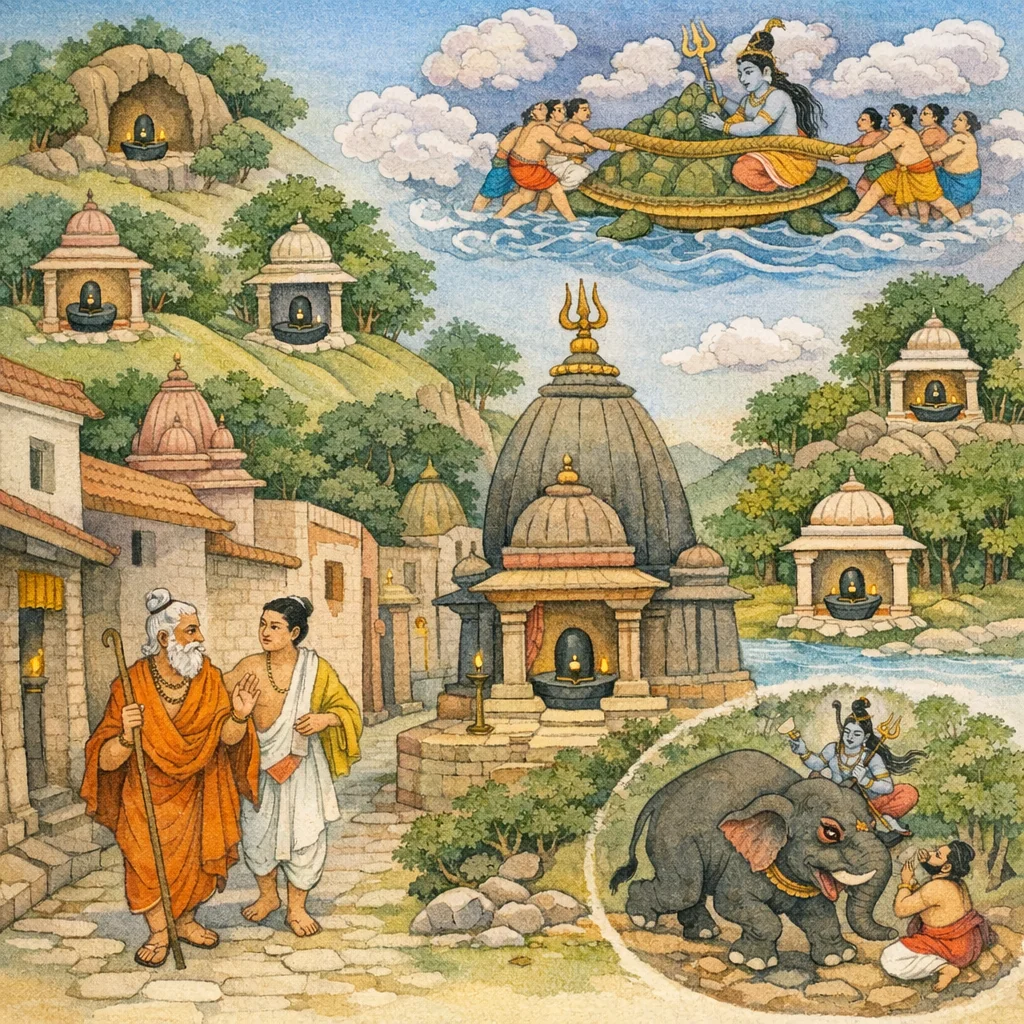
Sūta recounts Vyāsa's approach to the Oṅkāra-Liṅga, identified with the sacred 'Om' and Pāśupata philosophy. The chapter reveals five secret Liṅgas (Pañcāyatana) in Vārāṇasī knowable only by Śiva's grace. It details the origin of Kṛttivāseśvara, where Śiva slew an elephant demon and clad himself in its skin. Steadfast refuge here grants liberation (Moksha) within a single lifetime.
Shlokas
Verse 1
इति श्रीकूर्मपुराणे षट्साहस्त्र्यां संहितायां पूर्वंविभागे एकोनत्रिशो ऽध्यायः सूत उवाच स शिष्यैः संवृतो धीमान् गुरुर्द्वैपायनो मुनिः / जगाम विपुलं लिङ्गमोङ्कारं मुक्तिदायकम्
Thus, in the Śrī Kūrma Purāṇa—within the six-thousand-verse compendium, in the Pūrva-bhāga—begins the thirtieth chapter. Sūta said: The wise sage Dvaipāyana (Vyāsa), the preceptor, surrounded by his disciples, went to the vast Oṅkāra-Liṅga, the emblem of Om, which bestows liberation.
Verse 2
तत्राभ्यर्च्य महादेवं शिष्यैः सह महामुनिः / प्रोवाच तस्य माहात्म्यं मुनीनां भावितात्मनाम्
There, having worshipped Mahādeva together with his disciples, the great sage then proclaimed His greatness to the sages whose selves were purified and inwardly disciplined.
Verse 3
इदं तद् विमलं लिङ्गमोङ्कारं नाम शोभनम् / अस्य स्मरणमात्रेण मुच्यते सर्वपातकैः
This is that stainless Liṅga, the auspicious and radiant Oṅkāra in form. By the mere remembrance of it, one is released from all sins and downfalls.
Verse 4
एतत् परतरं ज्ञानं पञ्चयतनमुत्तमम् / सेवितं सूरिभिर्नित्यं वाराणस्यां विमोक्षदम्
This is the higher, transcendent knowledge—the supreme Pañcāyatana, the fivefold mode of worship. Ever practiced by the wise, it bestows liberation in Vārāṇasī.
Verse 5
अत्र साक्षान्महादेवः पञ्चायतनविग्रहः / रमते भगवान् रुद्रो जन्तूनामपवर्गदः
Here indeed is Mahādeva Himself, manifest in the form of the fivefold sacred shrine (Pañcāyatana); here the Blessed Rudra delights, the bestower of apavarga—final release—for living beings.
Verse 6
यत् तत् पाशुपतं ज्ञानं पञ्चार्थमिति शब्द्यते / तदेतद् विमलं लिङ्गमोङ्कारे समवस्थितम्
That Pāśupata knowledge spoken of as the “Fivefold Meaning”—that very reality is the stainless Liṅga, abiding in the syllable Oṃ (Oṅkāra).
Verse 7
शान्त्यतीता तथा शान्तिर्विद्या चैव परा कला / प्रतिष्ठा च निवृत्तिश्च पञ्चार्थं लिङ्गमैश्वरम्
Transcending even peace, and also peace itself; knowledge (vidyā) and the supreme power of manifestation (parā kalā); and establishment in the Self (pratiṣṭhā) and withdrawal from worldly entanglement (nivṛtti)—these five constitute the divine Liṅga of Īśvara.
Verse 8
पञ्चानामपि देवानां ब्रह्मादीनां सदाश्रयम् / ओङ्कारबोधकं लिङ्गं पञ्चायतनमुच्यते
That Liṅga which ever serves as the abiding refuge of the five deities—beginning with Brahmā—and which reveals the meaning of the sacred syllable Oṃ, is called the Pañcāyatana, the fivefold sanctuary.
Verse 9
संस्मरेदैश्वरं लिङ्गं पञ्चायतनमव्ययम् / देहान्ते तत्परं ज्योतिरानन्दं विशते बुधः
Let the wise one ever remember the liṅga of Lord Īśvara—the imperishable Pañcāyatana. When the body reaches its end, wholly devoted to That, he enters the radiant Light that is Bliss (Ānanda).
Verse 10
अत्र देवर्षयः पूर्वं सिद्धा ब्रह्मर्षयस्तथा / उपास्य देवमीशानं प्राप्तवन्तः परं पदम्
Here, in ancient times, the divine seers—together with the Siddhas and the great Brahma-seers—having worshipped Lord Īśāna, attained the supreme state.
Verse 11
मत्स्योदर्यास्तटे पुण्यं स्थानं गुह्यतमं शुभम् / गोचर्ममात्रं विप्रेन्द्रा ओङ्कारेश्वरमुत्तमम्
On the bank of the Matsyodarī there is a meritorious sacred spot, most secret and auspicious. O best of brāhmaṇas, though only the size of a cowhide, it is the supreme shrine of Oṅkāreśvara.
Verse 12
कृत्तिवासेश्वरं लिङ्गः मध्यमेश्वरमुत्तमम् / विश्वेश्वरं तथोङ्कारं कपर्देश्वरमेव च
The sacred Śiva-liṅgas are: Kṛttivāseśvara; the excellent Madhyameśvara; Viśveśvara; likewise Oṅkāra; and also Kapardeśvara.
Verse 13
एतानि गुह्यलिङ्गानि वाराणस्यां द्विजोत्तमाः / न कश्चिदिह जानाति विना शंभोरनुग्रहात्
O best of the twice-born, these are the secret liṅgas in Vārāṇasī; none here truly knows them without the grace of Śambhu (Śiva).
Verse 14
एवमुक्त्वा ययौ कृष्णः पाराशर्यो महामुनिः / कृत्तिवासेश्वरं लिङ्गं द्रष्टुं देवस्य शूलिनः
Having spoken thus, the great sage Kṛṣṇa Dvaipāyana, son of Parāśara, departed to behold the Liṅga of Kṛttivāseśvara—of the trident-bearing Lord (Śiva).
Verse 15
समभ्यर्च्य तथा शिष्यैर्माहात्म्यं कृत्तिवाससः / कथयामास शिष्येभ्यो भगवान् ब्रह्मवित्तमः
Having duly worshipped, together with his disciples, the sacred greatness of Kṛttivāsa (Śiva), the Blessed One—supreme among the knowers of Brahman—then narrated it to the disciples.
Verse 16
अस्मिन् स्थाने पुरा दैत्यो हस्ती भूत्वा भवान्तिकम् / ब्राह्मणान् हन्तुमायातो ये ऽत्र नित्यमुपासते
In this very place, long ago, a demon—having taken the form of an elephant—came close by, intending to kill the Brāhmaṇas who here constantly worship (the Lord).
Verse 17
तेषां लिङ्गान्महादेवः प्रादुरासीत् त्रिलोचनः / रक्षणार्थं द्विजश्रेष्ठा भक्तानां भक्तवत्सलः
From their liṅga, Mahādeva—the three-eyed Lord—manifested, O best of the twice-born, in order to protect (them), for he is tenderly devoted to his devotees and ever affectionate to those who worship him.
Verse 18
हत्वा गजाकृतिं दैत्यं शूलेनावज्ञया हरः / वसस्तस्याकरोत् कृत्तिं कृत्तिवासेश्वरस्ततः
Having slain with his trident the demon who had assumed the form of an elephant—out of contempt (for that foe)—Hara made of its hide a garment for himself; therefore the Lord came to be known as Kṛttivāsa (the One clothed in a skin).
Verse 19
अत्र सिद्धिं परां प्राप्ता मुनयो मुनिपुङ्गवाः / तेनैव च शरीरेण प्राप्तास्तत् परमं पदम्
Here the sages—foremost among seers—attained the supreme perfection; and with that very same body they reached the Supreme State, the ultimate abode.
Verse 20
विद्या विद्येश्वरा रुद्राः शिवाये च प्रकीर्तिताः / कृत्तिवासेश्वरं लिङ्गं नित्यमावृत्य संस्थिताः
The divine Vidyās, the Vidyeśvaras, the Rudras, and the hosts acclaimed as Śiva’s own ever abide there, continually surrounding the Liṅga of Kṛttivāseśvara.
Verse 21
ज्ञात्वा कलियुगं घोरमधर्मबहुलं जनाः / कृत्तिवासं न मुञ्चन्ति कृतार्थास्ते न संशयः
Knowing the Kali age to be dreadful and overflowing with adharma, people do not abandon Kṛttivāsa; those who do so are fulfilled in their aim—of this there is no doubt.
Verse 22
जन्मान्तरसहस्त्रेण मोक्षो ऽन्यत्राप्यते न वा / एकेन जन्मना मोक्षः कृत्तिवासे तु लभ्यते
Elsewhere, liberation may be attained only after a thousand lifetimes—or perhaps not at all; but at Kṛttivāsa, liberation is obtained within a single lifetime.
Verse 23
आलयः सर्वसिद्धानामेतत् स्थानं वदन्ति हि / गोपितं देवदेवेन महादेवेन शंभुना
Indeed, they declare this place to be the dwelling of all the Siddhas; it is kept concealed and protected by the God of gods—Mahādeva Śambhu.
Verse 24
युगे युगे ह्यत्र दान्ता ब्राह्मणा वेदपारागाः / उपासते महादेवं जपन्ति शतरुद्रियम्
In every age, in this sacred region, self-restrained Brahmins who have reached the far shore of the Vedas worship Mahādeva and recite the Śatarudrīya hymn.
Verse 25
स्तुवन्ति सततं देवं त्र्यम्बकं कृत्तिवाससम् / ध्यायन्ति हृदये देवं स्थाणुं सर्वान्तरं शिवम्
They ceaselessly praise the God—Tryambaka, the Three-Eyed One, the wearer of the hide—and within the heart they meditate on the Divine Sthāṇu: Śiva who abides as the inner presence in all.
Verse 26
गायन्ति सिद्धाः किल गीतकानि ये वाराणस्यां निवसन्ति विप्राः / तेषामथैकेन भवेन मुक्तिर् ये कृत्तिवासं शरणं प्रपन्नाः
Indeed, the perfected ones sing sacred songs of the Brahmins who dwell in Vārāṇasī. For them liberation comes within a single lifetime—those who have taken refuge in Kṛttivāsa (Śiva) as their shelter.
Verse 27
संप्राप्य लोके जगतामभीष्टं सुदुर्लभं विप्रकुलेषु जन्म / ध्याने समाधाय जपन्ति रुद्रं ध्यायन्ति चित्ते यतयो महेशम्
Having obtained in this world what beings most desire—birth in a brāhmaṇa family, exceedingly rare—the ascetics, established in meditation and samādhi, repeat the name of Rudra and contemplate Maheśa within the mind.
Verse 28
आराधयन्ति प्रभुमीशितारं वाराणसीमध्यगता मुनिन्द्राः / यजन्ति यज्ञैरभिसंधिहीनाः स्तुवन्ति रुद्रं प्रणमन्ति शंभुम्
Abiding in the very heart of Vārāṇasī, the foremost sages worship the Lord, the Supreme Ruler. Free from ulterior motive, they offer sacrifices; they praise Rudra and bow down to Śambhu.
Verse 29
नमो भवायामलयोगधाम्ने स्थाणुं प्रपद्ये गिरिशं पुराणम् / स्मरामि रुद्रं हृदये निविष्टं जाने महादेवमनेकरूपम्
Salutations to Bhava, the stainless abode of Yoga; I take refuge in Sthāṇu, Girīśa, the ancient Lord of the Mountain. I remember Rudra, enthroned within the heart; I recognize Mahādeva as the One who assumes countless forms.
Frequently Asked Questions
It presents the liṅga as the stainless, radiant form of Oṃ itself—both a sacred emblem and a metaphysical disclosure—where remembrance purifies sin and devotion culminates in entry into blissful light.
It is the fivefold sanctuary in which Mahādeva is manifest as the refuge of five deities (beginning with Brahmā) and as a liberating mode of worship tied to the meaning of Oṃ.
Kṛttivāseśvara, Madhyameśvara, Viśveśvara, Oṅkāra, and Kapardeśvara—stated to be truly known only through Śambhu’s grace.
The chapter emphasizes Īśvara as the inner presence (Sthāṇu within the heart) and the goal of final release; liberation is portrayed as entering radiant bliss through exclusive devotion and contemplative establishment in that inner Lord.