Adhyaya 32
Mādhayameśvara-māhātmya — Vyāsa at Mandākinī and the Pāśupata Vision
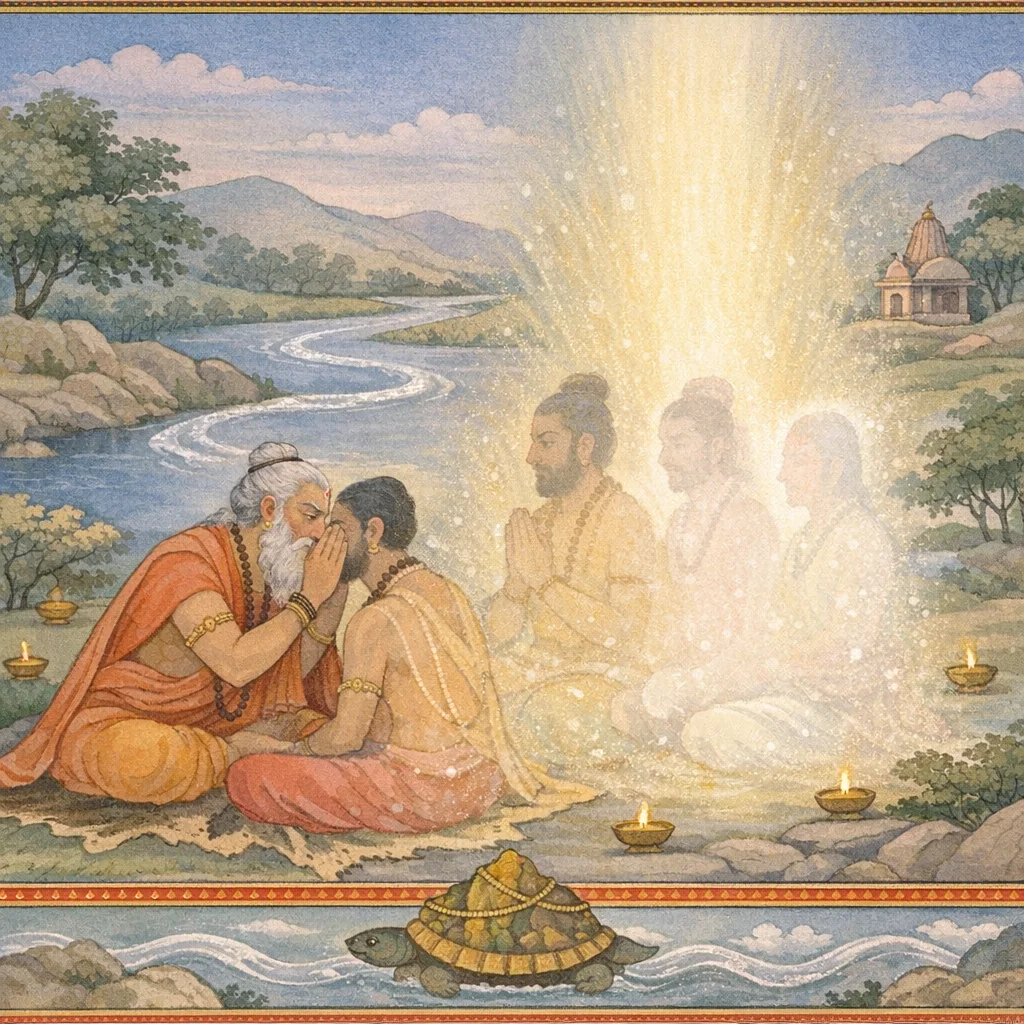
Continuing the sacred itinerary, Sūta tells how Vyāsa, after dwelling near Kapardeśa, travels to behold Madhyameśvara. At the Mandākinī—praised for purity and the company of sages—he performs snāna, completes offerings to devas, ṛṣis, and pitṛs, and worships Bhava/Īśāna (Śiva) with flowers. Pāśupata devotees, marked by bhasma, Vedic recitation, Oṁ-contemplation, and brahmacarya, recognize and honor him; a brief inquiry highlights his stature as arranger of the Vedas and as the channel through whom Śuka manifests by Śiva’s portion. Vyāsa imparts a hidden supreme teaching to select yogins; a stainless radiance then arises and the sages vanish, signaling immediate yogic fruition. He instructs his disciples on Madhyameśa’s greatness: Śiva and Devī rejoice here with the Rudras, and Kṛṣṇa once observed the Pāśupata vow here and received Nīlalohita’s boon. The chapter closes with the tīrtha’s fruits—sin-destruction even of brahmahatyā, post-mortem ascent, seven-generation purification through rites, and eclipse-merit multiplied—after which Vyāsa remains to worship Maheśvara, preparing further tīrtha-centered instruction.
Shlokas
Verse 1
इति श्रीकूर्मपुराणे षट्साहस्त्र्यां संहितायां पूर्वविभागे एकत्रिशोध्यायः सूत उवाच उषित्वा तत्र भगवान् कपर्देशान्तिके पुनः / द्रष्टुं ययौ मध्यमेशं बहुवर्षगणान् प्रभुः
Thus, in the Śrī Kūrma Purāṇa, in the Ṣaṭsāhasrī Saṃhitā, in the Pūrva-bhāga, in the thirty-first chapter—Sūta said: Having dwelt there again near Kapardeśa, the Lord, the sovereign Master, set out to behold Madhyameśvara, after the passing of many years.
Verse 2
तत्र मन्दाकिनीं पुण्यामृषिसङ्गनिषेविताम् / नदीं विमलपानीयां दृष्ट्वा हृष्टो ऽभवन्मुनिः
There he beheld the sacred Mandākinī, cherished and frequented by the company of ṛṣis. Seeing that river’s pure, spotless waters, fit to drink, the sage was filled with joy.
Verse 3
स तामन्वीक्ष्य मुनिभिः सह द्वैपायनः प्रभुः / चकार भावपूतात्मा स्नानं स्नानविधानवित्
Having observed her, the venerable Dvaipāyana (Vyāsa), together with the sages, performed the prescribed ritual bath. His inner being was purified by reverent intent, for he knew well the ordinances of sacred bathing.
Verse 4
संतर्प्य विधिवद् देवानृषीन् पितृगणांस्तथा / पूजयामास लोकादिं पुष्पैर्नानाविधैर्भवम्
Then, duly according to rite, he satisfied the gods, the seers, and likewise the hosts of ancestors. Thereafter he worshipped Bhava (Śiva), the primal source of the worlds, with flowers of many kinds.
Verse 5
प्रविश्य शिष्यप्रवरैः सार्धं सत्यवतीसुतः / मध्यमेश्वरमीशानमर्चयामास शूलिनम्
Entering the sacred place together with his foremost disciples, Satyavatī’s son (Vyāsa) worshipped the Lord—Madhyameśvara, Īśāna, Śūlin, the Trident-bearer.
Verse 6
ततः पाशुपताः शान्ता भस्मोद्धूलितविग्रहाः / द्रष्टुं समागता रुद्रं मध्यमेश्वरमीश्वरम्
Then the tranquil Pāśupata devotees, their bodies dusted with sacred ash, gathered to behold Rudra—the sovereign Īśvara, Madhyameśvara, the Supreme Lord abiding in the middle, as the inner ruler within all beings.
Verse 7
ओङ्कारासक्तमनसो वेदाध्ययनतत्पराः / जटिला मुण्डिताश्चापि शुक्लयज्ञोपवीतिनः
Their minds are absorbed in the sacred syllable Oṁ; they are devoted to the study and recitation of the Veda. Some wear matted locks, others are shaven-headed, and they bear the sacred thread (yajñopavīta) and ritual emblems in pure white.
Verse 8
कौपीनवसनाः केचिदपरे चाप्यवाससः / ब्रह्मचर्यरताः शान्ता वेदान्तज्ञानतत्पराः
Some wear only a loincloth (kaupīna), while others go unclad. Devoted to brahmacarya, they are tranquil and intent upon the knowledge of Vedānta.
Verse 9
दृष्ट्वा द्वैपायनं विप्राः शिष्यैः परिवृतं मुनिम् / पूजयित्वा यथान्यायमिदं वचनमब्रुवन्
Seeing Dvaipāyana (Vyāsa)—the sage surrounded by his disciples—the brāhmaṇa seers honored him according to proper rite and then spoke these words.
Verse 10
को भवान् कुत आयातः सह शिष्यैर्महामुने / प्रोचुः पैलादयः शिष्यास्तानृषीन् ब्रह्मभावितान्
“Who are you, and from where have you come, O great sage, together with your disciples?”—thus spoke Paila and the other disciples, addressing those seers established in the awareness of Brahman.
Verse 11
अयं सत्यवतीसूनुः कृष्णद्वैपायनो मुनिः / व्यासः स्वयं हृषीकेशो येन वेदाः पृथक् कृताः
“This is the sage Kṛṣṇa-Dvaipāyana, the son of Satyavatī—Vyāsa himself, none other than Hṛṣīkeśa, the Lord of the senses—by whom the Vedas were arranged and divided into distinct branches.”
Verse 12
यस्य देवो महादेवः साक्षादेव पिनाकधृक् / अंशांशेनाभवत् पुत्रो नाम्ना शुक इति प्रभुः
Of him, the very Lord Mahādeva—Śiva himself, bearer of the Pināka bow—manifested as a son through a small fraction of his own divine portion, the mighty one named Śuka.
Verse 13
यः स साक्षान्महादेवं सर्वभावेन शङ्करम् / प्रपन्नः परया भक्त्या यस्य तज्ज्ञानमैश्वरम्
Whoever surrenders directly to Mahādeva, to Śaṅkara, with his whole being and with supreme devotion—for him, that very surrender and bhakti becomes sovereign, God-realizing knowledge (aiśvarya-jñāna).
Verse 14
ततः पाशुपताः सर्वे हृष्टसर्वतनूरुहाः / नेमुरव्यग्रमनसः प्रोचुः सत्यवतीसुतम्
Then all the Pāśupata devotees—thrilled so deeply that the hairs on their bodies stood on end—bowed down with undistracted minds and addressed Satyavatī’s son (Vyāsa).
Verse 15
भगवन् भवता ज्ञातं विज्ञानं परमेष्ठिनः / प्रिसादाद् देवदेवस्य यत् तन्माहेश्वरं परम्
O Blessed Lord, you have come to know the supreme, discriminative wisdom of Parameṣṭhin (the Creator), gained through the grace of the God of gods— that highest knowledge belonging to Maheśvara (Śiva).
Verse 16
तद्वदास्माकमव्यक्तं रहस्यं गुह्यमुत्तमम् / क्षिप्रं पश्येम तं देवं श्रुत्वा भगवतो मुखात्
So too, for us there is an unmanifest secret—supremely hidden and most excellent. Having heard it from the mouth of the Blessed Lord, may we swiftly behold that very Deity.
Verse 17
विसर्जयित्वा ताञ्छिष्यान् सुमन्तुप्रमुखांस्ततः / प्रोवाच तत्परं ज्ञानं योगिभ्यो योगवित्तमः
Having dismissed those disciples—Sumantu and the others—he, the foremost knower of Yoga, then expounded that supreme, highest knowledge to the yogins.
Verse 18
तत्क्षणादेव विमलं संभूतं ज्योतिरुत्तमम् / लीनास्तत्रैव ते विप्राः क्षणादन्तरधीयत
At that very instant, a stainless, most excellent radiance arose. In that very light those brahmin-sages were absorbed, and in a moment they vanished from sight.
Verse 19
ततः शिष्यान् समाहूय भगवान् ब्रह्मवित्तमः / प्रोवाच मध्यमेशस्य माहात्म्यं पैलपूर्वकान्
Then the Blessed One, the foremost knower of Brahman, summoned his disciples—beginning with Paila—and expounded to them the sacred greatness of Madhyameśa.
Verse 20
अस्मिन् स्थाने स्वयं देवो देव्या सह महेश्वरः / रमते भगवान् नित्यं रुद्रैश्च परिवारितः
In this very place, the Blessed Lord Maheśvara himself—together with the Goddess—ever delights, surrounded by the Rudras.
Verse 21
अत्र पूर्वं हृषीकेशो विश्वात्मा देवकीसुतः / उवास वत्सरं कृष्णः सदा पाशुपतैर्वृतः
Here, in former times, Hṛṣīkeśa—Kṛṣṇa, the Cosmic Self, the son of Devakī—dwelt for a full year, ever surrounded by the Pāśupatas (devotees of Paśupati-Śiva).
Verse 22
भस्मोद्धूलितसर्वाङ्गो रुद्राध्ययनतत्परः / आराधयन् हरिः शंभुं कृत्वा पाशुपतं व्रतम्
With all his limbs dusted in sacred ash, intent on reciting and studying Rudra’s teaching, Hari worshipped Śambhu after undertaking the Pāśupata vow.
Verse 23
तस्य ते बहवः शिष्या ब्रह्मचर्यपरायणाः / लब्ध्वा तद्वचनाज्ज्ञानं दृष्टवन्तो महेश्वरम्
Many of his disciples, steadfast in the discipline of brahmacarya, received knowledge through his instruction; and, having thus attained understanding, they beheld Mahēśvara (Śiva) directly.
Verse 24
तस्य देवो महादेवः प्रत्यक्षं नीललोहितः / ददौ कृष्णास्य भगवान वरदो वरमुत्तमम्
For him, the God Mahādeva—Nīlalohita—appeared directly, and that Blessed Lord, the giver of boons, granted Kṛṣṇa the highest boon.
Verse 25
येर्ऽचयिष्यन्ति गोविन्दं मद्भक्ता विधिपूर्वकम् / तेषां तदैश्वरं ज्ञानमुत्पत्स्यति जगन्मय
Those devotees of Mine who will worship Govinda in accordance with the prescribed rites—within them, O All-pervading One, sovereign knowledge centered on Īśvara will then arise.
Verse 26
नमस्योर्ऽचयितव्यश्च ध्यातव्यो मत्परैर्जनैः / भविष्यसि न संदेहो मत्प्रसादाद् द्विजातिभिः
“You are to be bowed to, worshipped, and meditated upon by those devoted to Me. By My grace there is no doubt—you shall prosper and attain fulfillment among the twice-born.”
Verse 27
ये ऽत्र द्रक्ष्यन्ति देवेशं स्नात्वा रुद्रं पिनाकिनम् / ब्रह्महत्यादिकं पापं तेषामाशु विनश्यति
Those who, after bathing here, behold Rudra—the Lord of the gods, bearer of the Pināka bow—find that even sins beginning with brahma-hatyā (the slaying of a brāhmaṇa) swiftly perish for them.
Verse 28
प्राणांस्त्यजन्ति ये मर्त्याः पापकर्मरता अपि / ते यान्ति तत् परं स्थानं नात्र कार्या विचारणा
Even those mortals devoted to sinful deeds—if they depart from life in the manner taught—go to that supreme abode; of this there is no need for doubt or further deliberation.
Verse 29
धन्यास्तु खलु ते विप्रा मन्दाकिन्यां कृतोदकाः / अर्चयन्ति महादेवं मध्यमेश्वरमीश्वरम्
Blessed indeed are those Brahmin sages who have performed their ritual bathing in the Mandākinī; they worship Mahādeva—Īśvara Himself—at Madhyameśvara, the Lord of the central sacred station.
Verse 30
स्नानं दानं तपः श्राद्धं पिण्डनिर्वपणं त्विह / एकैकशः कृतं विप्राः पुनात्यासप्तमं कुलम्
Bathing in sacred observance, charitable giving, ascetic discipline (tapas), ancestral śrāddha, and the offering of piṇḍas here—each of these, even when performed individually, O brāhmaṇas, purifies one’s lineage up to the seventh generation.
Verse 31
संनिहत्यामुपस्पृश्य राहुग्रस्ते दिवाकरे / यत् फलं लभते मर्त्यस्तस्माद् दशगुणं त्विह
When the Sun is seized by Rāhu (during a solar eclipse), a mortal who performs ritual purification by touching water at the auspicious junction (saṃnihati) attains a reward; here, that very merit becomes tenfold.
Verse 32
एवमुक्त्वा महायोगी मध्यमेशान्ति के प्रभुः / उवास सुचिरं कालं पूजयन् वै महेश्वरम्
Thus having spoken, the great yogin—the lord abiding in the middle state of peace—dwelt there for a long time, continually worshipping Maheśvara (Śiva).
Frequently Asked Questions
Madhyameśvara is presented as an ever-abiding locus of Śiva-Śakti presence where disciplined worship and Pāśupata practice yield purification, sin-destruction, and ultimately direct darśana—validated by Vyāsa’s instruction and the episode of Kṛṣṇa receiving Nīlalohita’s boon.
It depicts Hari (Kṛṣṇa/Hṛṣīkeśa) taking the Pāśupata vow, studying Rudra’s teachings, worshipping Śambhu, and receiving Śiva’s direct boon—showing Vaiṣṇava divinity revering Śiva without contradiction, and linking devotion to the rise of Īśvara-centered knowledge.