Adhyaya 25
Adhyāya 25 — Liṅga-māhātmya (The Chapter on the Liṅga): Hari’s Śiva-Worship and the Fiery Pillar Theophany
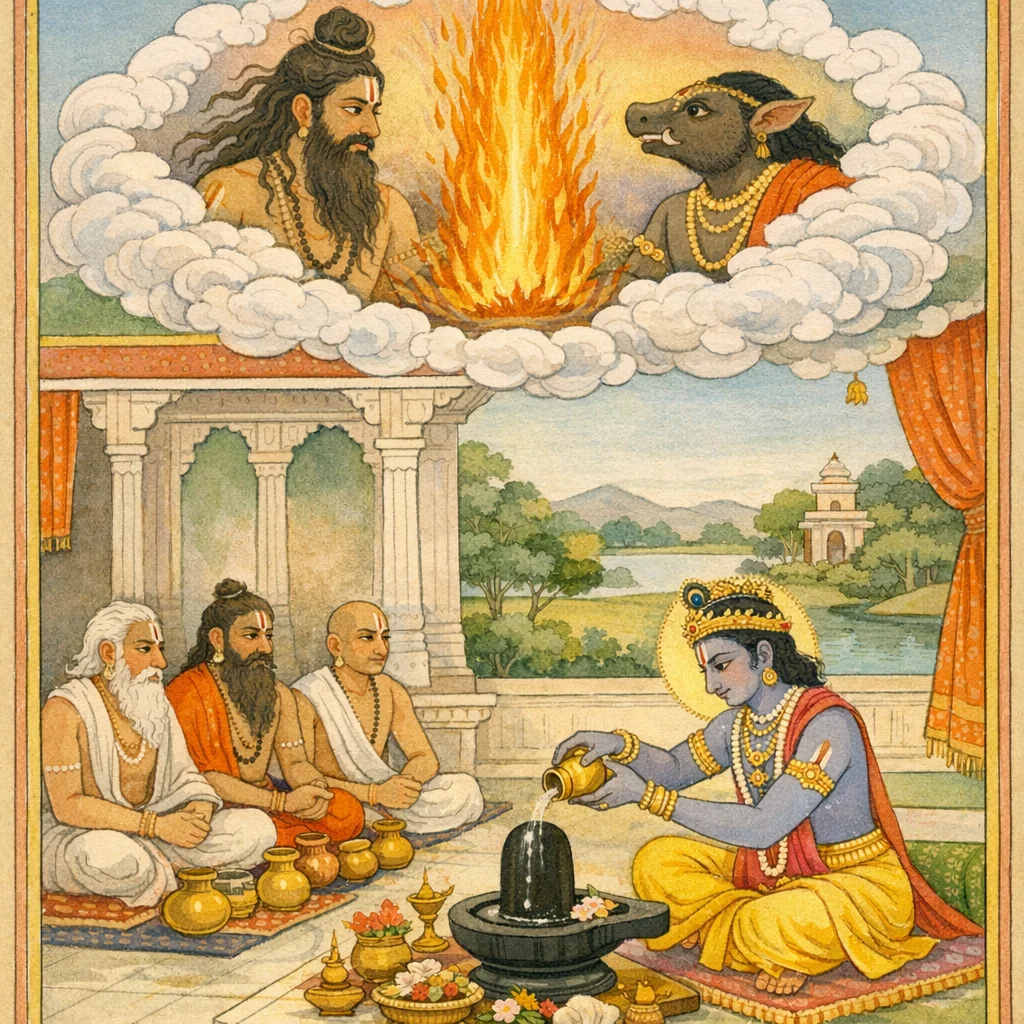
The chapter advances the explicit Hari–Hara synthesis. Kṛṣṇa sojourns on Kailāsa, where celestial beings and women are overwhelmed by his beauty and māyā. After a prolonged līlā, Dvārakā suffers the pain of separation; Garuḍa defends the city from Daityas and Rākṣasas, and Nārada’s report hastens Kṛṣṇa’s return. Back in Dvārakā, the narrative turns from royal splendor to dharmic routine: Kṛṣṇa performs midday solar worship, tarpaṇa, worship of Bhūteśa in the liṅga, and feeds sages, placing high theology within orthodox observance. Mārkaṇḍeya asks the decisive question—whom does the Supreme Kṛṣṇa worship? Kṛṣṇa replies that he worships Īśāna (Śiva) to reveal the source of his own Self and to teach the fear-destroying merit of liṅga worship. He explains the liṅga as unmanifest, imperishable light and recounts the primordial dispute of Brahmā and Viṣṇu resolved by the infinite fiery liṅga, culminating in Śiva’s revelation, boons, and the establishment of liṅga worship. The chapter ends with a phalaśruti: recitation/hearing removes sin and enjoins daily japa.
Shlokas
Verse 1
इति श्रीकूर्मपूराणे षट्साहस्त्र्यां संहितायां पूर्वविभागे चतुर्विशो ऽध्यायः सूत उवाच प्रविश्य मेरुशिखरं कैलासं कनकप्रभम् / रराम भगवान् सोमः केशवेन महेश्वरः
Thus, in the Śrī Kūrma Purāṇa—within the six-thousand-verse Saṃhitā, in the Pūrva-bhāga—begins the twenty-fifth chapter. Sūta said: Entering the peak of Meru, Kailāsa radiant like gold, the Blessed Lord Soma—Mahādeva, Mahēśvara—rejoiced together with Keśava (Viṣṇu).
Verse 2
अपश्यंस्तं महात्मानं कैलासगिरिवासिनः / पूजयाञ्चक्रिरे कृष्णं देवदेवमथाच्युतम्
When the dwellers of Mount Kailāsa beheld that great-souled One, they at once performed worship to Kṛṣṇa—the God of gods, the imperishable Acyuta.
Verse 3
चतुर्बाहुमुदाराङ्गं कालमेघसमप्रभम् / किरीटिनं शार्ङ्गपाणि श्रीवत्साङ्कितवक्षसम्
One should contemplate the four-armed Lord of noble limbs, radiant like a rain-laden dark cloud—crowned, bearing the Śārṅga bow in His hand, and with His chest marked by the Śrīvatsa emblem.
Verse 4
दीर्घबाहुं विशालाक्षं पीतवाससमच्युतम् / दधानमुरसा मालां वैजयन्तीमनुत्तमाम्
He beheld the Imperishable Lord—long-armed and large-eyed, clad in yellow garments—bearing upon His chest the unsurpassed Vaijayantī garland.
Verse 5
भ्राजमानं श्रिया दिव्यं युवानमतिकोमलम् / पद्माङ्घ्रिनयनं चारु सुस्मितं सुगतिप्रदम्
Radiant with divine splendor and beauty, youthful and exceedingly tender, with lotus-like feet and lotus-like eyes—charming, gently smiling, and bestowing the highest blessed course (sugati).
Verse 6
कदाचित् तत्र लीलार्थं देवकीनन्दवर्धनः / भ्राजमानः श्रीया कृष्णश्चचार गिरिकन्दरे
Once there, solely for divine sport, Kṛṣṇa—the increaser of Devakī’s joy—radiant with auspicious splendor, wandered within a mountain cavern.
Verse 7
गन्धर्वाप्सरसां मुख्या नागकन्याश्च कृत्स्नशः / सिद्धा यक्षाश्च गन्धर्वास्तत्र तत्र जगन्मयम्
The foremost among the Gandharvas and Apsarases, and all the Nāga-maidens without exception; the Siddhas, the Yakṣas, and the Gandharvas—everywhere, in every place—were pervaded by the very substance of the universe.
Verse 8
दृष्ट्वाश्चर्यं परं गत्वा हर्षादुत्फुल्लोचनाः / मुमुचुः पुष्पवर्षाणि तस्य मूर्ध्नि महात्मनः
Beholding that supreme marvel, overwhelmed with joy and with eyes wide in delight, they released showers of flowers upon the head of that great-souled one.
Verse 9
गन्धर्वकन्यका दिव्यास्तद्वदप्सरसां वराः / दृष्ट्वा चकमिरे कृष्णं स्त्रस्तवस्त्रविभूषणाः
The radiant daughters of the Gandharvas, and likewise the foremost of the Apsarases—on seeing Kṛṣṇa—were smitten with desire, their garments and ornaments slipping out of place.
Verse 10
काश्चिद् गायन्ति विविधां गीतिं गीतविशारदाः / संप्रेक्ष्य देवकीसूनुं सुन्दर्यः काममोहिताः
Some exquisitely beautiful maidens, skilled in song, sang many kinds of melodies; and, on beholding Devakī’s son, they became deluded by desire.
Verse 11
काश्चिद्विलासबहुला नृत्यन्ति स्म तदग्रतः / संप्रेक्ष्य संस्थिताः काश्चित् पपुस्तद्वदनामृतम्
Some, abounding in graceful play, danced before Him; and some, standing still and gazing intently, drank in the nectar of His face.
Verse 12
काश्चिद् भूषणवर्याणि स्वाङ्गादादाय सादरम् / भूषयाञ्चक्रिरे कृष्णं कामिन्यो लोकभूषणम्
Some of those enamored maidens, respectfully taking their finest ornaments from their own bodies, adorned Kṛṣṇa—He who is Himself the ornament of the worlds.
Verse 13
काश्चिद् भूषणवर्याणि समादाय तदङ्गतः / स्वात्मानं बूषयामासुः स्वात्मगैरपि माधवम्
Some devotees, taking up excellent ornaments from His own body, adorned themselves—and with those very ornaments belonging to themselves, they also adorned Mādhava.
Verse 14
काश्चिदागत्य कृष्णस्य समीपं काममोहिताः / चुचुम्बुर्वदनाम्भोजं हरेर्मुग्धमृगेक्षणाः
Some women, coming close to Kṛṣṇa, deluded by desire, kissed the lotus-like face of Hari—those doe-eyed ones, captivated and innocent in their infatuation.
Verse 15
प्रगृह्य काश्चिद् गोविन्दं करेण भवनं स्वकम् / प्रापयामासुर्लोकादिं मायया तस्य मोहिताः
Some, taking Govinda by the hand, led Him to their own dwelling; deluded by His māyā, they treated the Lord of the worlds as though He were one among them.
Verse 16
तासां स भगवान् कृष्णः कामान् कमललोचनः / बहूनि कृत्वा रूपाणि पूरयामास लीलया
That Blessed Lord Kṛṣṇa, lotus-eyed, fulfilled the desires of those women by playfully assuming many forms in his līlā.
Verse 17
एवं वै सुचिरं कालं देवदेवपुरे हरिः / रेमे नारायणः श्रीमान् मायया मोहयञ्जगत्
Thus, for a very long time, Hari—the glorious Nārāyaṇa—dwelt in Devadeva-pura, delighting in his divine sport, and through his māyā he cast the world into delusion.
Verse 18
गते बहुतिथे काले द्वारवत्यां निवासिनः / बभूवुर्विह्वला भीता गोविन्दविरहे जनाः
When a long time had passed, the residents of Dvāravatī became distraught and afraid; the people were overwhelmed with anguish due to separation from Govinda.
Verse 19
ततः सुपर्णो बलवान् पूर्वमेव विसजितः / कृष्णेन मार्गमाणस्तं हिमवन्तं ययौ गिरिम्
Then the mighty Suparṇa (Garuḍa), who had been sent forth earlier, went to the Himavat mountain, and Kṛṣṇa followed, searching for him.
Verse 20
अदृष्ट्वा तत्र गोविन्दं प्रणम्य शिरसा मुनिम् / आजगामोपमन्युं तं पुरीं द्वारवतीं पुनः
Not seeing Govinda there, he bowed his head in reverence to the sage; then Upamanyu returned once more to the city of Dvāravatī.
Verse 21
तदन्तरे महादैत्या राक्षसाश्चातिभीषणाः / आजग्मुर्द्वारकां शुभ्रां भीषयन्तः सहस्त्रशः
Meanwhile, mighty Daityas and exceedingly fearsome Rakshasas came in their thousands to the radiant city of Dvārakā, spreading terror.
Verse 22
स तान् सुपर्णो बलवान् कृष्णतुल्यपराक्रमः / हत्वा युद्धेन महता रक्षति स्म पुरीं शुभाम्
Then mighty Suparṇa—whose prowess equaled Kṛṣṇa’s—slew them in a great battle and thereafter safeguarded the auspicious city.
Verse 23
एतस्मिन्नेव काले तु नारदो भगवानृषिः / दृष्ट्वा कैलासशिखरे कृष्णं द्वारवतीं गतः
At that very time, the divine sage Nārada—having beheld Kṛṣṇa upon the peak of Kailāsa—set out for Dvāravatī (Dvārakā).
Verse 24
तं दृष्ट्वा नारदमृषिं सर्वे तत्र निवासिनः / प्रोचुर्नारायणो नाथः कुत्रास्ते भगवान् हरिः
Seeing the sage Nārada, all who dwelt there said: “O Nārāyaṇa, our Lord—where does Bhagavān Hari abide now?”
Verse 25
स तानुवाच भगवान् कैलसशिखरे हरिः / रमते ऽद्य महायोगीं तं दृष्ट्वाहमिहागतः
Then Nārada said to them: “Hari is upon the summit of Kailāsa; today the Great Yogin abides in delight. Having beheld Him, I have come here.”
Verse 26
तस्योपश्रुत्य वचनं सुपर्णः पततां वरः / जगामाकाशगो विप्राः कैलासं गिरिमुत्तमम्
Having overheard those words, Suparṇa (Garuḍa)—foremost among all who fly—rose into the sky and went, O brāhmaṇas, to the excellent mountain Kailāsa.
Verse 27
ददर्श देवकीसूनुं भवने रत्नमण्डिते / वरासनस्थं गोविन्दं देवदेवान्तिके हरिम्
He beheld Devakī’s son—Govinda, Hari—seated upon an excellent throne within a palace adorned with jewels, in the presence of the gods and the God of gods.
Verse 28
उपास्यमानममरैर्दिव्यस्त्रीभिः समन्ततः / महादेवगणैः सिद्धैर्योगिभिः परिवारितम्
He was being worshipped by the immortals, surrounded on every side by celestial women, and encircled by the hosts of Mahādeva—by perfected siddhas and accomplished yogins.
Verse 29
प्रणम्य दण्डवद् भूमौ सुपर्णः शङ्करं शिवम् / निवेदयामास हरेः प्रवृत्तिं द्वारके पुरे
Having bowed like a staff upon the earth, Suparṇa (Garuḍa) approached Śaṅkara, the auspicious Śiva, and reported to him the doings of Hari in the city of Dvārakā.
Verse 30
ततः प्रणम्य शिरसा शङ्करं नीललोहितम् / आजगाम पुरीं कृष्णः सो ऽनुज्ञातो हरेण तु
Then Kṛṣṇa, bowing his head to Śaṅkara, the blue-and-ruddy Lord (Nīlalohita), returned to the city, having indeed received permission from Hari.
Verse 31
आरुह्य कश्यपसुतं स्त्रीगणैरभिपूजितः / वचोभिरमृतास्वादैर्मानितो मधुसूदनः
Mounting the son of Kaśyapa, Madhusūdana was reverently worshipped by the hosts of celestial women and honored with words sweet as amṛta, the nectar of immortality.
Verse 32
वीक्ष्य यान्तममित्रघ्नं गन्धर्वाप्सरसां वराः / अन्वगच्छन् महोयोगं शङ्खचक्रगदाधरम्
Seeing the Enemy-slayer depart, the foremost among the Gandharvas and Apsaras followed after Him—Him who is the Great Yogin, bearing the conch, discus, and mace.
Verse 33
विसर्जयित्वा विश्वात्मा सर्वा एवाङ्गना हरिः / ययौ स तूर्णं गोविन्दो दिव्यां द्वारवतीं पुरीम्
Having respectfully dismissed all the women, Hari—Govinda, the Soul of the universe—departed swiftly for the radiant, divine city of Dvāravatī.
Verse 34
गते मुररिपौ नैव कामिन्यो मुनिपुङ्गवाः / निशेव चन्द्ररहिता विना तेन चकाशिरे
When Murā’s foe (Lord Viṣṇu) had departed, neither the foremost sages nor the longing ones shone forth—like a night bereft of the moon; without Him, none could appear radiant.
Verse 35
श्रुत्वा पौरजनास्तूर्णं कृष्णागमनमुत्तमम् / मण्डयाञ्चक्रिरे दिव्यां पुरीं द्वारवतीं शुभाम्
Hearing at once of Krishna’s most auspicious arrival, the townspeople quickly adorned Dvāravatī, the divine and blessed city.
Verse 36
पताकाभिर्विशालाभिर्ध्वजै रत्नपरिष्कृतैः / लाजादिभिः पुरीं रम्यां भूषयाञ्चक्रिरे तदा
Then they adorned the lovely city with broad banners and flags embellished with jewels, and with auspicious offerings such as lājā (parched grain) and other sacred items.
Verse 37
अवादयन्त विविधान् वादित्रान् मधुरस्वनान् / शङ्खान् सहस्त्रशो दध्मुर्वोणावादान् वितेनिरे
They played many kinds of musical instruments with sweet tones; thousands of conches were blown, and performances on the vīṇā were carried out in full measure.
Verse 38
प्रविष्टमात्रे गोविन्दे पुरीं द्वारवतीं शुभाम् / अगायन् मधुरं गानं स्त्रियो यौवनशालिनः
As soon as Govinda entered the auspicious city of Dvāravatī, the youthful women began to sing sweet songs.
Verse 39
दृष्ट्वा ननृतुरीशानं स्थिताः प्रासादमूर्धसु / मुमुचुः पुष्पवर्षाणि वसुदेवसुतोपरि
Seeing Īśāna, those stationed upon the rooftops danced, and they released showers of flowers upon Vasudeva’s son (Śrī Kṛṣṇa).
Verse 40
प्रविश्य भवनं कृष्ण आशीर्वादाभिवर्धितः / वरासने महायोगी भाति देवीभिरन्वितः
Entering the palace, Kṛṣṇa—strengthened by blessings—shone forth as the great Yogin, seated upon a splendid throne and attended by the goddesses (Devī).
Verse 41
सुरम्ये मण्डपे शुभ्रे शङ्खाद्यैः परिवारितः / आत्मजैरभितो मुख्यैः स्त्रीसहस्त्रैश्च संवृतः
In a lovely, radiant pavilion, he was surrounded by Śaṅkha and the other chief attendants; his foremost sons encircled him on every side, and thousands of women thronged about him.
Verse 42
तत्रासनवरे रम्ये जाम्बवत्या सहाच्युतः / भ्राजते मालया देवो यथा देव्या समन्वितः
There, upon an exquisite and delightful throne, Acyuta sat together with Jāmbavatī; adorned with a garland, the Lord shone forth—like a god attended by his goddess.
Verse 43
आजग्मुर्देवगन्धर्वा द्रष्टुं लोकादिमव्ययम् / महर्षयः पूर्वजाता मार्कण्डेयादयो द्विजाः
Devas and Gandharvas came to behold the imperishable One who is the primal source of the worlds; and the great sages of ancient birth—twice-born ones such as Mārkaṇḍeya and others—also arrived.
Verse 44
ततः स भगवान् कृष्णो मार्कण्डेयं समागतम् / ननामोत्थाय शिरसा स्वासनं च ददौ हरिः
Then the Blessed Lord Kṛṣṇa, seeing Mārkaṇḍeya arrive, rose up and bowed with his head in reverence, and Hari offered him his own seat.
Verse 45
संपूज्य तानृषिगणान् प्रणामेन महाभुजः / विसर्जयामास हरिर्दत्त्वा तदभिवाञ्छितान्
Having duly honored that assembly of sages with reverent salutations, the mighty-armed Hari then dismissed them, granting them the boons they had desired.
Verse 46
तदा मध्याह्नसमये देवदेवः स्वयं हरिः / स्नात्वा शुक्लाम्बरो भानुमुपतिष्ठत् कृताञ्जलिः
Then, at midday, Hari himself—the God of gods—having bathed and donned white garments, stood before the Sun with hands joined, in reverent devotion.
Verse 47
जजाप जाप्यं विधिवत् प्रेक्षमाणो दिवाकरम् / तर्पयामास देवेशो देवेशो देवान् मुनिगणान् पितॄन्
Gazing upon the Sun, he duly recited the prescribed japa; and that Lord of lords then performed tarpaṇa, satisfying the gods, the hosts of sages, and the ancestors.
Verse 48
प्रविश्य देवभवनं मार्कण्डेयेन चैव हि / पूजयामास लिङ्गस्थं भूतेशं भूतिभूषणम्
Entering the divine temple, he—together with Mārkaṇḍeya—worshipped Bhūteśa, Lord of beings, who abides in the liṅga, the One whose very adornment is sacred power and prosperity.
Verse 49
समाप्य नियमं सर्वं नियन्तासौ नृणां स्वयम् / भोजयित्वा मुनिवरं ब्राह्मणानभिपूज्य च
Having completed the entire discipline of observances, that self-restrained ruler of men, by his own hand, fed the best of sages and duly honoured the Brahmins as well.
Verse 50
कृत्वात्मयोगं विप्रेन्द्रा मार्कण्डेयेन चाच्युतः / कथाः पौराणिकीः पुण्याश्चक्रे पुत्रादिभिर्वृतः
O best of brāhmaṇas, after establishing the Yoga of the Self together with Mārkaṇḍeya, Acyuta, the Imperishable Lord, expounded holy Purāṇic narratives, surrounded by his sons and other attendants.
Verse 51
अथैतत् सर्वमखिलं दृष्ट्वा कर्म महामुनिः / मार्कण्डेयो हसन् कृष्णं बभाषे मधुरं वचः
Then, having beheld this entire deed in full, the great sage Mārkaṇḍeya—smiling—addressed Kṛṣṇa with gentle, sweet words.
Verse 52
मार्कण्डेय उवाच कः समाराध्यते देवो भवता कर्मभिः शुभैः / ब्रूहि त्वं कर्मभिः पूज्यो योगिनां ध्येय एव च
Mārkaṇḍeya said: “Which god is duly propitiated by you through auspicious deeds? Tell me—who is the deity to be worshipped through rites and actions, and who is indeed the very object of meditation for yogins?”
Verse 53
त्वं हि तत् परमं ब्रह्म निर्वाणममलं पदम् / भारावतरणार्थाय जातो वृष्णिकुले प्रभुः
You indeed are that Supreme Brahman—the stainless liberation-state, the pure highest abode. O Lord, for the purpose of lightening the Earth’s burden, you were born in the Vṛṣṇi lineage.
Verse 54
तमब्रवीन्महाबाहुः कृष्णो ब्रह्मविदां वरः / शृण्वतामेव पुत्राणां सर्वेषां प्रहसन्निव
Then mighty-armed Kṛṣṇa—foremost among the knowers of Brahman—addressed him, while all his sons listened, as though smiling.
Verse 55
श्रीभगवानुवाच भवता कथितं सर्वं तथ्यमेव न संशयः / तथापि देवमीशानं पूजयामि सनातनम्
The Blessed Lord said: “All that you have spoken is indeed true—there is no doubt about it. Even so, I worship the god Īśāna, the Eternal One.”
Verse 56
न मे विप्रास्ति कर्तव्यं नानवाप्तं कथञ्चन / पूजयामि तथापीशं जानन्नैतत् परं शिवम्
O brāhmaṇa, nothing remains for me to do, nor is there anything whatsoever that I have not already attained; yet I still worship the Lord, knowing Him to be the Supreme Śiva.
Verse 57
न वै पश्यन्ति तं देवं मायया मोहिता जनाः / ततो ऽहं स्वात्मनो मूलं ज्ञापयन् पूजयामि तम्
Deluded by Māyā, people do not truly perceive that Deva. Therefore, to make known the very source of my own Self, I worship Him.
Verse 58
न च लिङ्गार्चनात् पुण्यं लोकेस्मिन् भीतिनाशनम् / तथा लिङ्गे हितायैषां लोकानां पूजयेच्छिवम्
In this world, there is no merit arising from worship of the Śiva-liṅga that does not remove fear. Therefore, for the welfare of these worlds, one should worship Śiva in the liṅga.
Verse 59
यो ऽहं तल्लिङ्गमित्याहुर्वेदवादविदो जनाः / ततो ऽहमात्ममीशानं पूजयाम्यात्मनैव तु
The knowers of Vedic doctrine declare that this ‘I’ itself is the Liṅga, the supreme mark. Therefore I worship Īśāna (Śiva) as my own Self, by the Self alone.
Verse 60
तस्यैव परमा मूर्तिस्तन्मयो ऽहं न संशयः / नावयोर्द्यिते भेदो वेदेष्वेवं विनिश्चयः
I am verily the supreme form of Him alone, wholly constituted of His very essence—of this there is no doubt. Between the two of us there is no distinction at all; thus is the matter decisively established in the Vedas.
Verse 61
एष देवो महादेवः सदा संसारभीरुभिः / ध्येयः पूज्यश्च वन्द्यश्च ज्ञेयो लिङ्गे महेश्वरः
This very Deva is Mahādeva; those who fear the bondage of saṃsāra should ever meditate upon Him, worship Him, and bow in reverence—and Maheśvara is to be known and realized in the Liṅga.
Verse 62
मार्कण्डेय उवाच किं तल्लिङ्गं सुरश्रेष्ठ लिङ्गे संपूज्यते च कः / ब्रूहि कृष्ण विशालाक्ष गहनं ह्येतदुत्तमम्
Mārkaṇḍeya said: “O best among the gods, what indeed is that Liṅga? And who is worshipped with full reverence within the Liṅga? Tell me, O wide‑eyed Kṛṣṇa—this supreme matter is truly profound.”
Verse 63
अव्यक्तं लिङ्गमित्याहुरानन्दं ज्योतिरक्षरम् / वेदा महेस्वरं देवमाहुर्लिङ्गिनमव्ययम्
They declare the Liṅga to be unmanifest—imperishable light, of the nature of bliss. The Vedas proclaim God Maheśvara as the Liṅgin, the unchanging Lord who bears the Liṅga and yet transcends it.
Verse 64
पुरा चैकार्णवे घोरे नष्टे स्थावरजङ्गमे / प्रबोधार्थं ब्रह्मणो मे प्रादुर्भूतः स्वयं शिवः
Formerly, when the dreadful single ocean alone remained and all that was stationary and moving had perished, for the sake of awakening Brahmā, Śiva himself manifested before me.
Verse 65
तस्मात् कालात् समारभ्य ब्रह्मा चाहं सदैव हि / पूजयावो महादेवं लोकानां हितकाम्यया
From that time onward, Brahmā and I have indeed always worshipped Mahādeva, desiring the welfare of all the worlds.
Verse 66
मार्कण्डेय उवाच कथं लिङ्गमभूत् पूर्वमैश्वरं परमं पदम् / प्रबोधार्थं स्वयं कृष्ण वक्तुमर्हसि सांप्रतम्
Mārkaṇḍeya said: “How did the Liṅga arise in the beginning—that sovereign emblem, the supreme abode? For the awakening of our understanding, O Kṛṣṇa, deign now to explain it yourself.”
Verse 67
श्रीभगवानुवाच आसोदेकार्णवं घोरमविभागं तमोमयम् / मध्ये चैकार्णवे तस्मिन् शङ्खचक्रगदाधरः
The Blessed Lord said: “Then there was a single, dreadful ocean—undivided, made of darkness. And in the midst of that one ocean stood the Bearer of the conch, discus, and mace.”
Verse 68
सहस्त्रशीर्षा भूत्वाहं सहस्त्राक्षः सहस्त्रपात् सहस्त्रबाहुर्युक्तात्मा शयितो ऽहं सनातनः
Assuming the cosmic form of a thousand heads, a thousand eyes, a thousand feet, and a thousand arms—self-possessed, perfectly integrated in Yoga—I, the Eternal One, lie reposed as the timeless ground of all.
Verse 69
एतस्मिन्नन्तरे दूरता पश्यमि ह्यमितप्रभम् / कोटिसूर्यप्रतीकाशं भ्राजमानं श्रियावृतम्
Meanwhile, from a distance I behold that One of immeasurable radiance—shining like ten million suns—resplendent, and encompassed by the divine splendour of Śrī.
Verse 70
चतुर्वरक्त्रं महायोगं पुरुषं काञ्चनप्रभम् / कृष्णाजिरधरं देवमृग्यजुः सामभिः स्तुतम्
I meditate upon that divine Puruṣa—the great Yogin with four radiant faces, golden in splendour—clad in a black antelope-skin, and praised by the hymns of the Ṛg, Yajus, and Sāma Vedas.
Verse 71
निमेषमात्रेण स मां प्राप्तो योगविदां वरः / व्याजहार स्वयं ब्रह्मा स्मयमानो महाद्युतिः
In the space of a single blink, the foremost among the knowers of Yoga came to me. Then Brahmā himself—radiant with great splendor, and smiling—spoke.
Verse 72
कस्त्वं कुतो वा किं चेह तिष्ठसे वह मे प्रभो / अहं कर्ता हि लोकानां स्वयंभूः प्रपितामहः
“Who are you? From where have you come, and why are you standing here? Carry me, O lord. For I am indeed the maker of the worlds—the Self-born (Svayambhū), the Great Progenitor (Prapitāmaha).”
Verse 73
एवमुक्तस्तदा तेन ब्रह्मणाहमुवाच ह / अहं कर्तास्मि लोकानां संहर्ता च पुनः पुनः
Thus addressed at that time by Brahmā, I replied: “I am the maker of the worlds, and again and again I am their withdrawer (destroyer).”
Verse 74
एवं विवादे वितते मायया परमेष्ठिनः / प्रबोधार्थं परं लिङ्गं प्रादुर्भूतं शिवात्मकम्
Thus, when the dispute had spread on—through the deluding power of the Supreme Lord—the supreme Liṅga, whose very essence is Śiva, manifested in order to awaken them to the truth.
Verse 75
कालानलसमप्रख्यं ज्वालामालासमाकुलम् / क्षयवृद्धिविनिर्मुक्तमादिमध्यान्तवर्जितम्
Like the fire of Time itself, blazing and wreathed in garlands of flames, it is free from decay and increase, and devoid of beginning, middle, and end.
Verse 76
ततो मामाह भगवानधो गच्छ त्वमाशु वै / अन्तमस्य विजानीम ऊर्ध्वं गच्छे ऽहमित्यजः
Then the Blessed Lord said to me: “Go quickly downward; let us know its farthest limit. I—Aja (Brahmā)—shall go upward.”
Verse 77
तदाशु समयं कृत्वा गतावूर्ध्वमधश्च द्वौ / पितामहो ऽप्यहं नान्तं ज्ञातवन्तौ समाः शतम्
Then, quickly agreeing upon a fixed time, the two set out—one upward and the other downward. Yet neither I nor Pitāmaha (Brahmā) could ascertain its limit, even after a hundred years.
Verse 78
ततो विस्मयमापन्नौ भीतौ देवस्य शूलिनः / मायया मोहितौ तस्य ध्यायन्तौ विश्वमीश्वरम्
Then, overwhelmed with astonishment and fear, we two—attendants of the trident-bearing Lord—were deluded by his māyā, and we began to meditate upon Īśvara, Lord of the universe, who is himself the cosmos.
Verse 79
प्रोच्चारन्तौ महानादमोङ्कारं परमं पदम् / प्रह्वाञ्जलिपुटोपेतौ शंभुं तुष्टुवतुः परम्
Uttering aloud the syllable Oṃ—resounding with a great vibration, the supreme abode—, with bowed heads and hands joined in reverent añjali, we praised the Supreme Śambhu.
Verse 80
ब्रह्मविष्णू ऊचतुः / अनादिमलसंसाररोगवैद्याय शंभवे / नमः शिवाय शान्ताय ब्रह्मणे लिङ्गमूर्तये
Brahmā and Viṣṇu said: “Salutations to Śambhu—the physician who cures the disease of saṃsāra, tainted by beginningless impurity. Salutations to Śiva, the tranquil one; to Brahman itself, whose embodied form is the Liṅga.”
Verse 81
प्रलयार्णवसंस्थाय प्रलयोद्भूतिहेतवे / नमः शिवाय शान्ताय ब्रह्मणे लिङ्गमूर्तये
Salutations to Śiva, tranquil and auspicious, who abides in the ocean of dissolution, the very cause of manifestation after dissolution; salutations to Brahman itself, revealed in the form of the Liṅga.
Verse 82
ज्वालामालावृताङ्गाय ज्वलनस्तम्भरूपिणे / नमः शिवाय शान्ताय ब्रह्मणे लिङ्गमूर्तये
Salutations to Śiva, whose limbs are wreathed in garlands of flame, who appears as a blazing pillar of fire; salutations to the tranquil one—to Brahman itself—whose form is the Liṅga.
Verse 83
आदिमध्यान्तहीनाय स्वबावामलदीप्तये / नमः शिवाय शान्ताय ब्रह्मणे लिङ्गमूर्तये
Salutations to Śiva, without beginning, middle, or end, whose own nature shines with stainless radiance; salutations to the tranquil one—to Brahman itself—whose form is the Liṅga.
Verse 84
महादेवाय महते ज्योतिषे ऽनन्ततेजसे / नमः शिवाय शान्ताय ब्रह्मणे लिङ्गमूर्तये
Salutations to Mahādeva, the Great God—vast and supreme—who is Light itself, of endless radiance; salutations to Śiva, the tranquil one, to Brahman whose very form is the Liṅga.
Verse 85
प्रधानपुरुषेशाय व्योमरूपाय वेधसे / नमः शिवाय शान्ताय ब्रह्मणे लिङ्गमूर्तये
Salutations to the Lord of Pradhāna (primordial Nature) and Puruṣa (Spirit), the Creator whose form is vast as the sky; salutations to Śiva, the tranquil one, to Brahman manifested in the form of the Liṅga.
Verse 86
निर्विकाराय सत्याय नित्यायामलतेजसे / नमः शिवाय शान्ताय ब्रह्मणे लिङ्गमूर्तये
Salutations to the Changeless One, the Truth, the Eternal, whose radiance is stainless; salutations to Śiva—peace itself—to Brahman whose very form is the Liṅga.
Verse 87
वेदान्तसाररूपाय कालरूपाय धीमते / नमः शिवाय शान्ताय ब्रह्मणे लिङ्गमूर्तये
Salutations to Him whose form is the very essence of Vedānta, who appears as Time itself, the wise and radiant One; salutations to peaceful Śiva, to Brahman whose embodied form is the Liṅga.
Verse 88
एवं संस्तूयमानस्तु व्यक्तो भूत्वा महेश्वरः / भाति देवो महायोगी सूर्यकोटिसमप्रभः
Thus, as he was hymned in praise, Mahēśvara became manifest; the divine Great Yogi shone forth, radiant with the splendor of ten million suns.
Verse 89
वक्त्रकोटिसहस्त्रेण ग्रसमान इवाम्बरम् / सहस्त्रहस्तचरणः सूर्यसोमाग्निलोचनः
With millions of mouths he seemed to swallow the very sky; with thousands of hands and feet, his eyes were the Sun, the Moon, and Fire.
Verse 90
पिनाकपाणिर्भगवान् कृत्तिवासास्त्रिशूलभृत् / व्यालयज्ञोपवीतश्च मेघदुन्दुभिनिः स्वनः
The Blessed Lord bears the Pināka bow in his hand; clad in a skin-garment, he wields the trident. Wearing a serpent as his sacred thread, his voice resounds like the rolling drumbeat of thunderclouds.
Verse 91
अथोवाच महादेवः प्रीतो ऽहं सुरसत्तमौ / पश्येतं मां महादेवं भयं सर्वं प्रमुच्यताम्
Then Mahādeva spoke: “O best among the gods, I am well pleased. Behold Me—Mahādeva—and let every fear be wholly cast away.”
Verse 92
युवां प्रसूतौ गात्रेभ्यो मम पूर्वं सनातनौ / अयं मे दक्षिणे पार्श्वे ब्रह्मा लोकपितामहः / वामपार्श्वे च मे विष्णुः पालको हृदये हरः
“You two were born from My limbs before all else, eternal by nature. On My right is Brahmā, Pitāmaha, grandsire of the worlds; on My left is Viṣṇu, the Protector; and within My heart abides Hara (Śiva).”
Verse 93
प्रीतो ऽहं युवयोः सम्यक् वरं दद्मि यथेप्सितम् / एवमुक्त्वाथ मां देवो महादेवः स्वयं शिवः / आलिङ्ग्य देवं ब्रह्माणं प्रसादाभिमुखो ऽभवत्
“I am truly pleased with you both. I grant the boon you desire.” Having spoken thus, the Lord—Mahādeva, Śiva himself—embraced the god Brahmā and turned toward gracious favor.
Verse 94
ततः प्रहृष्टमनसौ प्रणिपत्य महेश्वरम् / ऊचतुः प्रेक्ष्य तद्वक्त्रं नारायणपितामहौ
Then Nārāyaṇa and Pitāmaha (Brahmā), their minds filled with joy, bowed down to Maheśvara (Śiva). Gazing upon His face, the two spoke.
Verse 95
यदि प्रीतिः समुत्पन्ना यदि देयो वरश्च नौ / भक्तिर्भवतु नौ नित्यं त्वयि देव महेश्वरे
“If Your gracious affection has truly arisen, and if a boon is to be granted to us, then let our devotion be eternal—steadfastly fixed in You, O divine Maheśvara.”
Verse 96
ततः स भगवानीशः प्रहसन् परमेश्वरः / उवाच मां महादेवः प्रीतः प्रीतेन चेतसा
Then the Blessed Lord—Īśa, the Supreme Ruler—smiling, spoke to me; Mahādeva, pleased, addressed me with a heart full of delight.
Verse 97
देव उवाच प्रलयस्थितिसर्गाणां कर्ता त्वं धरणीपते / वत्स वत्स हरे विश्वं पालयैतच्चराचरम्
The Deva said: “O Lord of the earth, you are the agent of dissolution, preservation, and creation. Dear one—dear one, O Hari—protect this entire universe, both the moving and the unmoving.”
Verse 98
त्रिधा भिन्नो ऽस्म्यहं विष्णो ब्रह्मविष्णुहराख्यया / सर्गरक्षालयगुणैर्निर्गुणो ऽपि निरञ्जनः
O Viṣṇu, I am spoken of as threefold—under the names Brahmā, Viṣṇu, and Hara—through the functions and qualities of creation, preservation, and dissolution; yet in truth I am stainless and untouched, even though I am beyond all qualities (nirguṇa).
Verse 99
संमोहं त्यज भो विष्णो पालयैनं पितामहम् / भविष्यत्येष भगवांस्तव पुत्रः सनातनः
O Viṣṇu, abandon this delusion; protect this Grandfather (Brahmā). This venerable one shall become your eternal son.
Verse 100
अहं च भवतो वक्त्रात् कल्पादौ घोररूपधृक् / शूलपाणिर्भविष्यामि क्रोधजस्तव पुत्रकः
And I too—arising from your mouth at the beginning of the aeon, assuming a terrible form—shall become the trident-bearing one, your son born of (your) wrath.
Verse 101
एवमुक्त्वा महादेवो ब्रह्माणं मुनिसत्तम / अनुगृह्य च मां देवस्तत्रैवान्तरधीयत
Thus having spoken, Mahādeva addressed Brahmā, O best of sages; and having shown grace to me as well, the Lord disappeared right there on the spot.
Verse 102
ततः प्रभृति लोकेषु लिङ्गार्चा सुप्रतिष्ठिता / लिङ्ग तल्लयनाद् ब्रह्मन् ब्रह्मणः परमं वपुः
From that time onward, throughout the worlds, the worship of the Liṅga became firmly established. For the Liṅga—by virtue of its being the sacred sign and the dissolver of all forms into the Absolute, O Brahman—is revered as the supreme embodiment of Brahman.
Verse 103
एतल्लिङ्गस्य माहात्म्यं भाषितं ते मयानघ / एतद् बुध्यन्ति योगज्ञा न देवा न च दानवाः
O sinless one, I have declared to you the greatness of this Liṅga. This truth is understood by those who are skilled in Yoga—not by the gods, nor by the demons.
Verse 104
एतद्धि परमं ज्ञानमव्यक्तं शिवसंज्ञितम् / येन सूक्ष्ममचिन्त्यं तत् पश्यन्ति ज्ञान वक्षुषः
This indeed is the supreme Knowledge—unmanifest, and known as Śiva—by which those whose eyes are wisdom behold That Reality: subtle and inconceivable.
Verse 105
तस्मै भगवते नित्यं नमस्कारं प्रकुर्महे / महादेवाय रुद्राय देवदेवाय लिङ्गिने
To that Blessed Lord we offer our constant salutations—unto Mahādeva, Rudra, the God of gods, the Bearer of the Liṅga.
Verse 106
नमो वेदरहस्याय नीलकण्ठाय वै नमः / विभीषणाय शान्ताय स्थाणवे हेतवे नमः
Salutations to the One who is the secret essence of the Vedas; salutations indeed to Nīlakaṇṭha. Salutations to the awe-inspiring One, to the Peaceful One; salutations to Sthāṇu, the Immutable, and to the Supreme Cause.
Verse 107
ब्रह्मणे वामदेवाय त्रिनेत्राय महीयसे / शङ्कराय महेशाय गिरीशाय शिवाय च
Salutations to Brahman (the Absolute), to Vāmadeva, to the Three-eyed One, to the Great and Glorious; salutations to Śaṅkara, to Maheśa, to Girīśa (Lord of the Mountains), and to Śiva as well.
Verse 108
नमः कुरुष्व सततं ध्यायस्व मनसा हरम् / संसारसागरादस्मादचिरादुत्तरिष्यसि
Offer homage continually; with your mind meditate upon Hara (Śiva). From this ocean of worldly becoming (saṃsāra) you will cross over—before long.
Verse 109
एवं स वासुदेवेन व्याहृतो मुनिपुङ्गवः / जगाम मनसा देवमीशानं विश्वतोमुखम्
Thus addressed by Vāsudeva, that foremost of sages turned inward and, by the power of mind alone, went to the Lord Īśāna—the deity whose face is turned to all directions.
Verse 110
प्रणम्य शिरसा कृष्णमनुज्ञातो महामुनिः / जगाम चेप्सितं देशं देवदेवस्य शूलिनः
Having bowed with his head to Kṛṣṇa, and receiving permission, the great sage departed for the desired region—(a sacred domain) belonging to the Trident-bearing Lord, the God of gods.
Verse 111
य इमं श्रावयेन्नित्यं लिङ्गाध्यायमनुत्तमम् / शृणुयाद् वा पठेद् वापि सर्वपापैः प्रमुच्यते
Whoever regularly has this unsurpassed “Chapter on the Liṅga” recited, or listens to it, or even reads it, is freed from all sins.
Verse 112
श्रुत्वा सकृदपि ह्येतत् तपश्चरणमुत्तमम् / वासुदेवस्य विप्रेन्द्राः पापं मुञ्चिति मानवः
O best of Brahmins, even by hearing just once this supreme discipline of austerity devoted to Vāsudeva, a human being is released from sin.
Verse 113
जपेद् वाहरहर्नित्यं ब्रह्मलोके महीयते / एवमाह महायोगी कृष्णद्वैपायनः प्रभुः
Let one perform japa every day, morning and evening; thereby one is honored in the world of Brahmā. Thus spoke the great yogin, the venerable Lord Kṛṣṇa-Dvaipāyana (Vyāsa).
Frequently Asked Questions
It defines the liṅga as unmanifest, imperishable light (prakāśa), bliss-nature, and the supreme mark of Brahman; Maheśvara is the Liṅgin—unchanging Lord who bears and transcends the liṅga.
The chapter asserts non-difference in essence: Kṛṣṇa declares himself constituted of Śiva’s essence, with no distinction between them, while also modeling Śiva-worship to reveal the supreme source to beings deluded by māyā.
Midday solar worship, prescribed japa, tarpaṇa to gods/sages/ancestors, temple worship of Bhūteśa in the liṅga, honoring and feeding sages and brāhmaṇas—integrating devotion with disciplined observance.
Regular recitation, hearing, or reading of the ‘Chapter on the Liṅga’ frees one from sins; even hearing once is said to release a person from sin, and daily morning-evening japa leads to honor in Brahmaloka.