Adhyaya 26
Kṛṣṇa’s Departure, Kali-yuga Dharma, and the Prohibition of Śiva-Nindā (Hari–Hara Samanvaya)
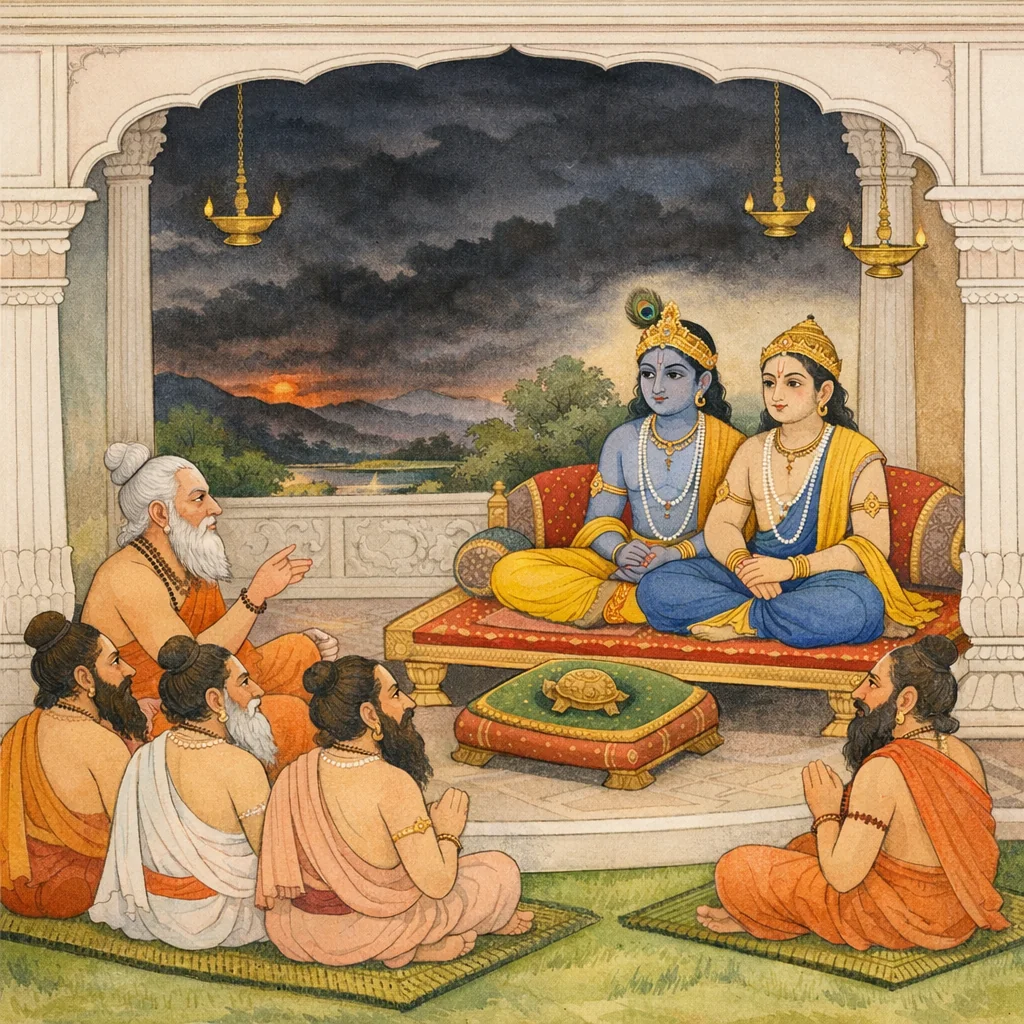
The chapter continues the dynastic and avatāric narrative, briefly naming Kṛṣṇa’s progeny (Sāmba and Aniruddha) and recalling his demon-slaying and cosmic re-ordering, until he—by highest wisdom—resolves to depart to his supreme abode. Bhṛgu and other sages arrive in Dvārakā; Kṛṣṇa honors them before Rāma, announces his impending departure, and declares that Kali-yuga has already arisen, foretelling moral decline. He instructs the sages to spread his salvific spiritual knowledge for the welfare of Brāhmaṇas, teaching that even a single remembrance of the Lord destroys Kali-born sin and that daily Vedic-style worship leads to the supreme state. The teaching then affirms Hari–Hara samanvaya: devotion to Nārāyaṇa is upheld, yet hatred or blasphemy of Maheśvara (Śiva) is condemned, warning that rites, austerities, and knowledge become fruitless for Śiva-revilers. The chapter ends with cautions to avoid cursed, Śiva-hostile lineages, the sages’ departure, Kṛṣṇa’s withdrawal of his clan, and a phalaśruti promising merit to reciters and hearers—closing this segment and turning to the next inquiry: “what more do you wish to hear?”
Shlokas
Verse 1
इति श्रीकूर्मपुराणे षट्साहस्त्र्यां संहितायां पूर्वविभागे पञ्चविंशो ऽध्यायः सूत उवाच ततो लब्धवरः कृष्णो जाम्बवत्यां महेश्वरात् / अजीजनन्महात्मानं साम्बमात्मजमुत्तमम्
Thus, in the Śrī Kūrma Purāṇa, in the six-thousand-verse Saṃhitā, in the Pūrva-bhāga, the twenty-fifth chapter. Sūta said: Then Kṛṣṇa, having obtained a boon from Maheśvara, begot upon Jāmbavatī the great-souled, excellent son—Sāmba.
Verse 2
प्रद्युम्नस्याप्यभूत् पुत्रो ह्यनिरुद्धो महाबलः / तावुभौ गुणसंपन्नौ कृष्णस्यैवापरे तनू
Pradyumna too had a son—Aniruddha, of great strength. Both of them were endowed with noble qualities, as though they were further embodiments of Kṛṣṇa himself.
Verse 3
हत्वा च कंसं नरकमन्यांश्च शतशो ऽसुरान् / विजित्य लीलया शक्रं जित्वा बाणं महासुरम्
Having slain Kaṃsa and Naraka, and hundreds of other asuras besides, and having playfully subdued Śakra (Indra) through His divine līlā, He also conquered Bāṇa, the great asura.
Verse 4
स्थापयित्वा जगत् कृत्स्नं लोके धर्मांश्च शाश्वतान् / चक्रे नारायणो गन्तुं स्वस्थानं बुद्धिमुत्तमाम्
Having set the entire world in order and established within it the eternal principles of dharma, Nārāyaṇa, through the highest wisdom, resolved to depart for His own abode.
Verse 5
एतस्मिन्नन्तरे विप्रा भृग्वाद्याः कृष्णमीश्वरम् / आजग्मुर्द्वारकां द्रष्टुं कृतकार्यं सनातनम्
Meanwhile, the brahmin sages—led by Bhṛgu—came to Dvārakā to behold Lord Kṛṣṇa, the Supreme Īśvara, the Eternal One who had already fulfilled His purpose.
Verse 6
स तानुवाच विश्वात्मा प्रणिपत्याभिपूज्य च / आसनेषूपविष्टान् वै सह रामेण धीमता
Then the Universal Self addressed them—having bowed down and duly honoured them—while they sat upon their seats, together with the wise Rāma.
Verse 7
गमिष्ये तत् परं स्थानं स्वकीयं विष्णुसंज्ञितम् / कृतानि सर्वकार्याणि प्रसीदध्वं मुनीश्वराः
“I shall depart to that supreme realm of Mine, known as Viṣṇu’s own abode. All that had to be accomplished has now been accomplished; be graciously at peace, O lords among sages.”
Verse 8
इदं कलियुगं घोरं संप्राप्तमधुनाशुभम् / भविष्यन्ति जनाः सर्वे ह्यस्मिन् पापानुवर्तिनः
Now has this dreadful, inauspicious Kali-yuga arrived; in it, all people indeed will follow sin, taking wrongdoing as their path.
Verse 9
प्रवर्तयध्वं मज्ज्ञानं ब्राह्मणानां हितावहम् / येनेमे कलिजैः पापैर्मुच्यन्ते हि द्विजोत्तमाः
“Set in motion and propagate My spiritual knowledge, beneficial to the welfare of the Brāhmaṇas; by it the best of the twice-born are indeed freed from the sins born of the Kali age.”
Verse 10
ये मां जनाः संस्मरन्ति कलौ सकृदपि प्रभुम् / तेषां नश्यतु तत् पापं भक्तानां पुरुषोत्तमे
In the Kali age, even those who remember Me—the Lord—even once: may that very sin of the devotees be destroyed, for I am Puruṣottama, the Supreme Person among beings.
Verse 11
येर्ऽचयिष्यन्तिमां भक्त्या नित्यं कलियुगे द्विजाः / विधाना वेददृष्टेन ते गमिष्यन्ति तत् पदम्
Those twice-born who, in the Kali age, worship Me daily with devotion, performing the rites in the manner seen in the Vedas, shall attain that supreme state—My abode.
Verse 12
ये ब्राह्मणा वंशजाता युष्माकं वै सहस्त्रशः / तेषां नारायणे भक्तिर्भविष्यति कलौ युगे
Among the Brāhmaṇas born in your lineage—indeed, by the thousands—devotion to Nārāyaṇa will arise in the age of Kali.
Verse 13
परात् परतरं यान्ति नारायणपरायणाः / न ते तत्र गमिष्यन्ति ये द्विषन्ति महेश्वरम्
Those whose sole refuge is Nārāyaṇa attain the state beyond the beyond—the supreme transcendence. But those who hate Maheśvara (Śiva) will not go there.
Verse 14
ध्यानं होमं तपस्तप्तं ज्ञानं यज्ञादिको विधिः / तेषां विनश्यति क्षिप्रं ये निन्दन्ति पिनाकिनम्
Meditation, fire-offerings (homa), well-performed austerities, spiritual knowledge, and prescribed rites such as sacrifices—all these swiftly perish for those who revile Pinākin (Śiva, bearer of the bow Pināka).
Verse 15
यो मां समाश्रयेन्नित्यमेकान्तं भावमाश्रितः / विनिन्द्य देवमीशानं स याति नरकायुतम्
Even if someone constantly takes refuge in me with single-pointed devotion, if he blasphemes the Lord—Īśāna (Śiva)—he goes to hell in countless multitudes.
Verse 16
तस्मात् सा परिहर्तव्या निन्दा पशुपतौ द्विजाः / कर्मणा मनसा वाचा तद्भक्तेष्वपि यत्नतः
Therefore, O twice-born ones, reviling Paśupati (Śiva) must be wholly avoided—carefully refraining, by deed, by mind, and by speech, from disparagement even of His devotees.
Verse 17
ये तु दक्षाध्वरे शप्ता दधीयेन द्विजोत्तमाः / भविष्यन्ति कलौ भक्तैः परिहार्याः प्रयत्नतः
But those best of twice-born who were cursed by Dadhīca at Dakṣa’s sacrifice—when the age of Kali arrives—are to be carefully avoided by devoted people, with deliberate effort.
Verse 18
द्विषन्तो देवमीशानं युष्माकं वंशसंभवाः / शप्ताश्च गौतमेनोर्व्यां न संभाष्या द्विजोत्तमैः
Those born in your lineage, having grown hostile to the Lord—Īśāna, the Supreme Ruler—were cursed by Gautama; therefore on this earth the best of the twice-born should not speak with them.
Verse 19
इत्येवमुक्ताः कृष्णेन सर्व एव महर्षयः / ओमित्युक्त्वा ययुस्तूर्णंस्वानि स्थानानि सत्तमाः
Thus addressed by Kṛṣṇa, all those great sages—foremost in virtue—uttered “Om” and swiftly departed to their own abodes.
Verse 20
ततो नारायणः कृष्णो लीलयैव जगन्मयः / संहृत्य स्वकुलं सर्वं ययौ तत् परमं पदम्
Thereafter Nārāyaṇa—Kṛṣṇa, who pervades the universe—by mere divine līlā withdrew His entire clan and departed to that Supreme State, the highest abode.
Verse 21
इत्येष वः समासेन राज्ञां वंशो ऽनुकीर्तितः / न शक्यो विस्तराद् वक्तुं किं भूयः श्रोतुमिच्छथ
Thus, in brief, the lineage of kings has been recounted to you. It cannot be told in full detail—what more do you wish to hear?
Verse 22
यः पठेच्छृणुयाद् वापि वंशानां कथनं शुभम् / सर्वपापविनिर्मुक्तः स्वर्गलोके महीयते
Whoever recites—or even hears—this auspicious narration of the dynastic lineages is freed from all sins and is honored in the heavenly world.
Frequently Asked Questions
It prioritizes smaraṇa (remembering the Lord) as immediately purifying, and also prescribes daily devotion performed in accordance with Vedic rites as a direct means to attain the supreme abode.
It presents a synthesis: refuge in Nārāyaṇa leads to the supreme transcendence, but hatred or blasphemy of Maheśvara is disqualifying and spiritually ruinous—making respect for Śiva integral to authentic Vaiṣṇava devotion.