Adhyaya 2
Cosmic Manifestation, Mahāmāyā’s Mandate, Varṇāśrama-Dharma, and the Unity of the Trimūrti
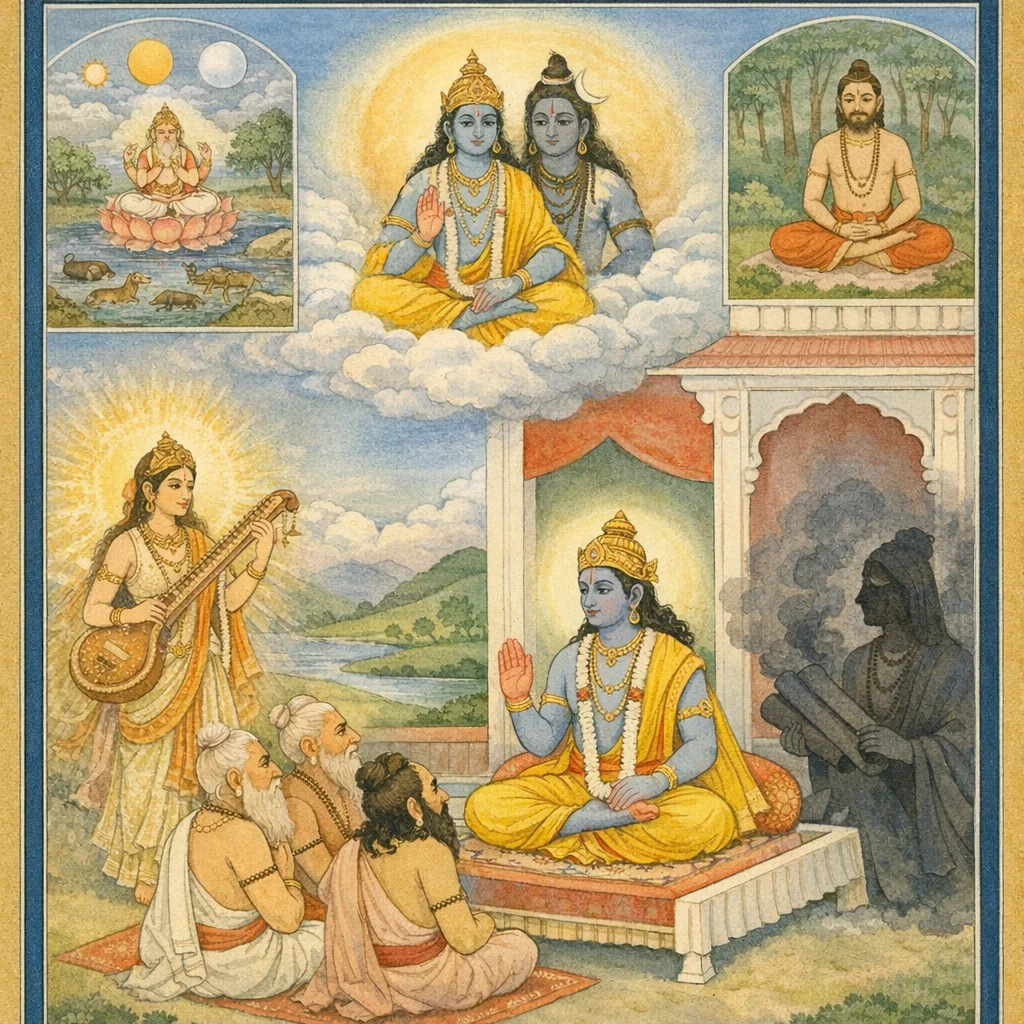
Continuing from the close of Adhyāya 1, Kūrma opens Adhyāya 2 by answering the sages’ welfare-seeking question and recalling that these teachings were earlier spoken to King Indradyumna. He defines a Purāṇa as a merit-bestowing revelation that discloses dharma leading to mokṣa. The account then turns to cosmogony: Nārāyaṇa alone exists, awakens from yogic sleep, and Brahmā arises; from Brahmā’s wrath Rudra manifests, while Śrī appears as Nārāyaṇī—Mahāmāyā and the imperishable root-Prakṛti. At Brahmā’s request she is appointed as Moha to expand creation, yet is commanded not to delude the truly disciplined—jñāna-yogins, meditative brāhmaṇas, sincere bhaktas, and those aligned with the Lord’s ordinance—thus establishing a moral taxonomy of spiritual immunity. Creation proceeds with the mind-born sages, the four varṇas, and Vāk as the beginningless Veda; heterodox treatises are censured as leading to darkness. As time advances and adharma rises, dharma-structures are formalized: duties of varṇa and āśrama, the primacy of the householder, and the hierarchy of puruṣārthas in which dharma culminates in mokṣa. The chapter deepens into yoga through pravṛtti–nivṛtti, extols nivṛtti as liberating, lists universal virtues, and describes post-mortem stations for each discipline. Asked about a ‘single āśrama’ for yogins, Kūrma clarifies there is no fifth āśrama beyond samādhi-rooted renunciation, and classifies types within each āśrama and yogin categories. The discourse culminates in explicit samanvaya: Brahmā creates, Viṣṇu sustains, Śiva dissolves (pralaya), yet in highest truth Viṣṇu and Mahādeva are non-different; three contemplations are taught, along with sectarian marks (liṅga/tripuṇḍra, trident sign, tilaka), under one overarching injunction—worship the Supreme through one’s ordained dharma with bhakti to attain imperishable liberation.
Shlokas
Verse 1
इति श्रीकूर्मपुराणे षट्साहस्त्र्यां संहितायां पूर्वविभागे प्रथमो ऽध्यायः श्रीकूर्म उवाच शृणुध्वमृषयः सर्वे यत्पृष्टो ऽहं जगद्धितम् / वक्ष्यमाणं मया सर्वमिन्द्रद्युम्नाय भाषितम्
Thus, in the Śrī Kūrma Purāṇa, in the six-thousand-verse compendium, in the First Division, the First Chapter concludes. Śrī Kūrma said: “Listen, all you sages, to what you have asked of me for the welfare of the world. I shall declare everything, just as I spoke it to King Indradyumna.”
Verse 2
भूतैर्भव्यैर्भविष्यद्भिश्चरितैरुपबृंहितम् / पुराणं पुण्यदं नृणां मोक्षधर्मानुकीर्तनम्
A Purāṇa is that sacred compendium enriched by narratives of the past, the present, and the future; it grants merit to human beings and proclaims the Dharma that leads to liberation (mokṣa).
Verse 3
अहं नारायणो देवः पूर्वमासं न मे परम् / उपास्य विपुलां निद्रां भोगिशय्यां समाश्रितः
I am Nārāyaṇa, the Divine Lord. In the beginning I alone existed—there was none higher than Me. Entering vast yogic slumber (yoga-nidrā), I rested upon the serpent-couch.
Verse 4
चिन्तयामि पुनः सृष्टिं निशान्ते प्रतिबुध्य तु / ततो मे सहसोत्पन्नः प्रसादो मुनिपुङ्गवा
When the cosmic night comes to its end and I awaken, I contemplate creation once again; then, O best of sages, prasāda—sudden clarity and gracious resolve—arises within Me.
Verse 5
चतुर्मुखस्ततो जातो ब्रह्मा लोकपितामहः / तदन्तरे ऽभवत् क्रोधः कस्माच्चित् कारणात् तदा
Then was born four-faced Brahmā, the grandsire of the worlds. In the midst of that unfolding of creation, anger arose at that time, due to some cause.
Verse 6
आत्मनो मुनिशार्दूलास्तत्र देवो महेश्वरः / रुद्रः क्रोधात्मजो जज्ञे शूलपाणिस्त्रिलोचनः / तेजसा सूर्यसंकाशस्त्रैलोक्यं संहरन्निव
O tiger-like sages, thereupon from the Self (Ātman) the god Maheśvara was manifested—Rudra, born of the essence of wrath—bearing the trident and possessing three eyes; blazing with a radiance like the sun, as though he were about to dissolve the three worlds.
Verse 7
ततः श्रीरभवद् देवि कमलायतलोचना / सुरूपा सौम्यवदना मोहिनी सर्वदेहिनाम्
Then, O Goddess, Śrī appeared—lotus-wide-eyed, exquisitely beautiful, gentle-faced, and enchanting to all embodied beings.
Verse 8
शुचिस्मिता सुप्रसन्ना मङ्गला महिमास्पदा / दिव्यकान्तिसमायुक्ता दिव्यमाल्योपशोभिता
She smiled with pure radiance, serene and gracious; auspicious, and a very seat of glory. Endowed with divine luster, she was adorned and beautified by heavenly garlands.
Verse 9
नारायणी महामाया मूलप्रकृतिरव्यया / स्वधाम्ना पूरयन्तीदं मत्पार्श्वं समुपाविशत्
Nārāyaṇī—the Great Māyā, the imperishable root-Prakṛti—filled this entire realm with her own radiance and then came and took her seat beside me.
Verse 10
तां दृष्टवा भगवान् ब्रह्मा मामुवाच जगत्पतिः / मोहायाशेषभूतानां नियोजय सुरूपिणीम् / येनेयं विपुला सृष्टिर्वर्धते मम माधव
Seeing her, the Blessed Lord Brahmā, the Lord of the world, said to me: “Appoint that fair-formed one as Moha (Delusion) for all beings; by her agency this vast creation of mine, O Mādhava, shall increase and expand.”
Verse 11
तथोक्तो ऽहं श्रियं देवीमब्रुवं प्रहसन्निव / देवीदमखिलं विश्वं सदेवासुरमानुषम् / मोहयित्वा ममादेशात् संसारे विनिपातय
Thus addressed, I—smiling as it were—spoke to the Goddess Śrī: “O Devī, delude this entire universe, together with gods, asuras, and humans; and by my command cast them down into the cycle of saṃsāra, worldly becoming.”
Verse 12
ज्ञानयोगरतान् दान्तान् ब्रह्मिष्ठान् ब्रह्मवादिनः / अक्रोधनान् सत्यपरान् दूरतः परिवर्जय
Keep far away from those devoted to the Yoga of knowledge—self-restrained, established in Brahman, and teachers of Brahman—those free from anger and steadfast in truth.
Verse 13
ध्यायिनो निर्ममान् शान्तान् धार्मिकान् वेदपारगान् / जापिनस्तापसान् विप्रान् दूरतः परिवर्जय
Keep far away from Brahmins absorbed in meditation—free from possessiveness, tranquil, established in dharma, and learned in the Veda—as well as those devoted to japa and austerities (tapas).
Verse 14
वेदवेदान्तविज्ञानसंछिन्नाशेषसंशयान् / महायज्ञपरान् विप्रान् दूरतः परिवर्जय
Keep far away from those Brahmins who, learned in the Veda and Vedānta and with doubts seemingly cut away by scholarship, are devoted chiefly to the great sacrificial rites (mahā-yajña).
Verse 15
ये यजन्ति जपैर्हेमैर्देवदेवं महेश्वरम् / स्वाध्यायेनेज्यया दूरात् तान् प्रयत्नेन वर्जय
Those who “worship” Mahādeva—the God of gods, Maheśvara—by mantra-recitation while being enticed by gold, and who make Vedic self-study (svādhyāya) and true sacrificial worship secondary—avoid them from afar with deliberate effort.
Verse 16
भक्तियोगसमायुक्तानीश्वरार्पितमानसान् / प्राणायामादिषु रतान् दूरात् परिहरामलान्
Keep far away from the pure—those joined to Bhakti-yoga, whose minds are offered to Īśvara, and who delight in disciplines such as prāṇāyāma and other yogic practices.
Verse 17
प्रणवासक्तमनसो रुद्रजप्यपरायणान् / अथर्वशिरसो ऽध्येतृन् धर्मज्ञान् परिवर्जय
Avoid those whose minds cling only to the syllable Oṁ, who are devoted exclusively to the muttering of Rudra-mantras, and those who merely study the Atharvaśiras—even if they speak of dharma—for such one-sidedness draws one away from the balanced path.
Verse 18
बहुनात्र किमुक्तेन स्वधर्मपरिपालकान् / ईश्वराराधनरतान् मन्नियोगान्न मोहय
What need is there to say more here? Do not delude those who uphold their own svadharma, who are devoted to the worship of Īśvara, and who act under My ordinance.
Verse 19
एवं मया महामाया प्रेरिता हरिवल्लभा / यथादेशं चकारासौ तस्माल्लक्ष्मीं समर्चयेत्
Thus, urged on by Me, that Great Māyā—Hari’s beloved—did exactly as she was instructed. Therefore, one should duly worship Lakṣmī (Śrī).
Verse 20
श्रियं ददाति विपुलां पुष्टिं मेधां यशो बलम् / अर्चिता भगवत्पत्नी तस्माल्लक्ष्मीं समर्चयेत्
When worshipped, the Lord’s consort bestows abundant prosperity (śrī), nourishment and well-being (puṣṭi), intelligence (medhā), fame (yaśas), and strength (bala). Therefore, one should duly worship Lakṣmī.
Verse 21
ततो ऽसृजत् स भगवान् ब्रह्मा लोकपितामहः / चराचराणि भूतानि यथापूर्वं ममाज्ञया
Thereafter that blessed Brahmā, the grandsire of the worlds, brought forth all beings—moving and unmoving—exactly as before, in accordance with My command.
Verse 22
परीचिभृग्वङ्गिरसः पुलस्त्यं पुलहं क्रतुम् / दक्षमत्रिं वसिष्ठं च सो ऽसृजद् योगविद्यया
By the power of yogic knowledge, he brought forth Parīci, Bhṛgu, Aṅgiras, Pulastya, Pulaha, Kratu, Dakṣa, Atri, and Vasiṣṭha.
Verse 23
नवैते ब्रह्मणः पुत्रा ब्रह्माणो ब्राह्मणोत्तमाः / ब्रह्मवादिन एवैते मरीच्याद्यास्तु साधकाः
These nine are the sons of Brahmā—exalted, Brahman-realized sages, the foremost among the brāhmaṇas. They are indeed proclaimers of Brahman; beginning with Marīci, they are accomplished spiritual practitioners (sādhakas).
Verse 24
ससर्ज ब्राह्मणान् वक्त्रात् क्षत्रियांश्च भुजाद् विभुः / वैश्यानूरुद्वयाद् देवः पादार्छूद्रान् पितामहः
The all-powerful Lord brought forth the Brāhmaṇas from His mouth; the Kṣatriyas from His arms; the Vaiśyas from His two thighs; and from His feet the Śūdras—thus did the Grandfather (the Creator) manifest the four orders.
Verse 25
यज्ञनिष्पत्तये ब्रह्मा शूद्रवर्जं ससर्ज ह / गुप्तये सर्ववेदानां तेभ्यो यज्ञो हि निर्बभौ
For the fulfillment of yajña, Brahmā created the three varṇas, excluding the Śūdra; and for the safeguarding of all the Vedas, from them indeed the sacrificial rite—Yajña—came forth.
Verse 26
ऋचो यजूंषि सामानि तथैवाथर्वणानि च / ब्रह्मणः सहजं रूपं नित्यैषा शक्तिरव्यया
The Ṛks, the Yajus-formulas, the Sāmans, and likewise the Atharvan hymns—these are the innate form of Brahman. This is His eternal, imperishable Śakti.
Verse 27
अनादिनिधना दिव्या वागुत्सृष्टा स्वयंभुवा / आदौ वेदमयी भूता यतः सर्वाः प्रवृत्तयः
That divine Speech (Vāk), without beginning or end, was emanated by the Self-born (Brahmā). In the beginning it was of the very nature of the Veda, and from it arise all pravṛttis—all lines of activity and practice, human and cosmic.
Verse 28
अतो ऽन्यानितु शास्त्राणिपृथिव्यांयानिकानिचित् / न तेषु रमते धीरः पाषण्डी तेन जायते
Therefore, as for the other treatises that exist upon the earth—whatever they may be—the steadfast and discerning do not delight in them; for by attachment to such heterodox doctrines one becomes a pāṣaṇḍin, a sectarian of false views.
Verse 29
वेदार्थवित्तमैः कार्यं यत्स्मृतं मुनिभिः पुरा / स ज्ञेयः परमो धर्मो नान्यशास्त्रेषु संस्थितः
That which the sages taught long ago—that one should act in accordance with those who truly know the meaning of the Veda—this alone is to be understood as the supreme Dharma; it is not established in other, merely secondary treatises.
Verse 30
या वेदबाह्याः स्मृतयो याश्च काश्च कुदृष्टयः / सर्वास्ता निष्फलाः प्रेत्यतमोनिष्ठाहिताः स्मृताः
Whatever Smṛtis lie outside the authority of the Veda, and whatever doctrines are warped in vision—all are declared fruitless; after death they lead to darkness, for they are grounded in tamas.
Verse 31
पूर्वकल्पे प्रजा जाताः सर्वबादाविवर्जिताः / शुद्धान्तः करणाः सर्वाः स्वधर्मनिरताः सदा
In the former aeon, creatures were born free from every affliction; all had purified inner faculties and were ever devoted to their own ordained duties (svadharma).
Verse 32
ततः कालवशात् तासां रागद्वेषादिको ऽभवत् / अधर्मो मुनिशार्दूलाः स्वधर्मप्रतिबन्धकः
Then, under the compulsion of Time, among them arose passion (rāga), aversion (dveṣa), and the like; and Adharma—O tiger-like sages—emerged as the force that obstructs one’s own prescribed dharma.
Verse 33
ततः सा सहजा सिद्धिस्तासां नातीव जायते / रजोमात्रात्मिकास्तासां सिद्धयो ऽन्यास्तदाभवन्
Thereupon, that innate perfection no longer arises strongly among them; instead, other attainments—chiefly constituted of rajas, restless passion—then come to be for them.
Verse 34
तासु क्षीणास्वशेषासु कालयोगेन ताः पुनः / वार्तोपायं पुनश्चक्रुर्हस्तसिद्धिं च कर्मजाम् / ततस्तासां विभुर्ब्रह्मा कर्माजीवमकल्पयत्
When those means had been wholly exhausted through the course of time, they again devised a livelihood: commerce and practical crafts accomplished by the hands, born of work. Thereupon the all-powerful Brahmā ordained for them a living sustained by prescribed actions—livelihood grounded in karma.
Verse 35
स्वायंभुवो मनुः पूर्वं धर्मान् प्रोवाच धर्मदृक् / साक्षात् प्रजापतेर्मूर्तिर्निसृष्टा ब्रह्मणा द्विजाः / भृग्वादयस्तद्वदनाच्छ्रुत्वा धर्मानथोचिरे
Formerly, Svayambhuva Manu—the seer of Dharma—declared the ordinances of righteousness. The twice-born sages, Bhṛgu and others, were brought forth by Brahmā as the very embodiment of Prajāpati; hearing those dharmas from Manu’s own lips, they in turn proclaimed them.
Verse 36
यजनं याजनं दानं ब्राह्मणस्य प्रतिग्रहम् / अध्यापनं चाध्ययनं षट् कर्माणि द्विजोत्तमाः
Sacrificing for oneself, officiating sacrifice for others, giving in charity, and—for a brāhmaṇa—accepting gifts; teaching and studying: these are the six duties, O best of the twice-born.
Verse 37
दानमध्ययनं यज्ञो धर्मः क्षत्रियवैश्ययोः / दण्डो युद्धं क्षत्रियस्य कृषिर्वैश्यस्य शस्यते
For Kṣatriyas and Vaiśyas, charity, Vedic study, and sacrifice are prescribed as their shared duties of dharma. For the Kṣatriya, the wielding of punishment and the conduct of war are enjoined; for the Vaiśya, agriculture is especially commended.
Verse 38
शुश्रूषैव द्विजातीनां शूद्राणां धर्मसाधनम् / कारुकर्म तथाजीवः पाकयज्ञो ऽपि धर्मतः
For Śūdras, devoted service to the twice-born is itself a means of accomplishing dharma. Likewise, livelihood through skilled crafts, and even the performance of the domestic pākayajña—the cooked-food sacrifice—are sanctioned as righteous.
Verse 39
ततः स्थितेषु वर्णेषु स्थापयामास चाश्रमान् / गृहस्थं च वनस्थं च भिक्षुकं ब्रह्मचारिणम्
Then, when the varṇas had been duly set in place, he also established the āśramas: the householder (gṛhastha), the forest-dweller (vānaprastha), the mendicant renunciant (bhikṣuka), and the celibate student (brahmacārin).
Verse 40
अग्नयो ऽतिथिशुश्रूषा यज्ञो दानं सुरार्चनम् / गृहस्थस्य समासेन धर्मो ऽयं मुनिपुङ्गवाः
Tending the sacred fires, reverent service to guests, sacrifice (yajña), charitable giving (dāna), and worship of the deities—this, in brief, O foremost of sages, is the dharma of the householder.
Verse 41
होमो मूलफलाशित्वं स्वाध्यायस्तप एव च / संविभागो यथान्यायं धर्मो ऽयं वनवासिनाम्
Offering oblations (homa) in the sacred fire, living on roots and fruits, Vedic self-study (svādhyāya) and austerity (tapas)—together with proper sharing according to rule—this is the dharma of those who dwell in the forest.
Verse 42
भैक्षाशनं च मौनित्वं तपो ध्यानं विशेषतः / सम्यग्ज्ञानं च वैराग्यं धर्मो ऽयं भिक्षुके मतः
Living on alms, observing sacred silence (mauna), practicing austerity and—above all—meditation (dhyāna); together with right knowledge and dispassion (vairāgya): this is declared to be the dharma of the mendicant (bhikṣu).
Verse 43
भिक्षाचर्या च शुश्रूषा गुरोः स्वाध्याय एव च / सन्ध्याकर्माग्निकार्यं च धर्मो ऽयं ब्रह्मचारिणाम्
Prescribed alms-rounds, devoted service to the guru, and self-study (svādhyāya)—together with the Sandhyā rites and the tending of the sacred fire—this is the dharma of brahmacārins, the celibate students.
Verse 44
ब्रह्मचारिवनस्थानां भिक्षुकाणां द्विजोत्तमाः / साधारणं ब्रह्मचर्यं प्रोवाच कमलोद्भवः
O best of the twice-born, Kamalodbhava (Brahmā) declared a common discipline of brahmacarya—continence and regulated conduct—for brahmacārins, forest-dwellers, and mendicants.
Verse 45
ऋतुकालाभिगामित्वं स्वदारेषु न चान्यतः / पर्ववर्जं गृहस्थस्य ब्रह्मचर्यमुदाहृतम्
For the householder, “brahmacarya” is declared to be this: approaching only one’s own wife in the proper season, never another’s wife, and abstaining on sacred observance-days (parva).
Verse 46
आगर्भसंभवादाद्यात् कार्यं तेनाप्रमादतः / अकुर्वाणस्तु विप्रेन्द्रा भ्रूणहा तु प्रजायते
From the very arising of pregnancy, one must carefully and without negligence perform the prescribed duties connected with it. But if one fails to do so—O best of brahmins—he is regarded as a slayer of the embryo (bhrūṇahā).
Verse 47
वेदाभ्यासो ऽन्वहं शक्त्या श्राद्धं चातिथिपूजनम् / गृहस्थस्य परो धर्मो देवताभ्यर्चनं तथा
For the householder, the highest dharma is this: daily study of the Veda according to one’s capacity, the offering of śrāddha, honoring guests, and likewise the worship of the deities.
Verse 48
वैवाह्ममग्निमिन्धीत सायं प्रातर्यथाविधि / देशान्तरगतो वाथ मृतपत्नीक एव वा
He should kindle the sacred household fire—the marriage-fire—in the evening and again in the morning, according to the prescribed rite, even if he has gone to another country, or even if he is bereft of his wife (through her death).
Verse 49
त्रयाणामाश्रमाणां तु गृहस्थो योनिरुच्यते / अन्ये तमुपजीवन्ति तस्माच्छ्रेयान् गृहाश्रमी
Among the three āśramas, the householder is said to be their very source; the others live supported by him. Therefore, the discipline of the householder is superior.
Verse 50
ऐकाश्रम्यं गृहस्थस्य त्रयाणां श्रुतिदर्शनात् / तस्माद् गार्हस्थ्यमेवैकं विज्ञेयं धर्मसाधनम्
Because the sacred scriptures declare that the householder upholds the other three āśramas, the gārhasthya stage alone should be known as the foremost means for accomplishing dharma.
Verse 51
परित्यजेदर्थकामौ यौ स्यातां धर्मवर्जितौ / सर्वलोकविरुद्धं च धर्ममप्याचरेन्न तु
One should renounce artha and kāma when they are devoid of dharma; and one should not practice even that which is called “dharma” if it stands opposed to the welfare and common accord of all people.
Verse 52
धर्मात् संजायते ह्यर्थो धर्मात् कामो ऽभिजायते / धर्म एवापवर्गाय तस्माद् धर्मं समाश्रयेत्
From dharma arises artha (worldly prosperity); from dharma is born kāma (rightful enjoyment). Dharma alone leads to apavarga (final liberation); therefore one should take refuge in dharma.
Verse 53
धर्मश्चार्थश्च कामश्च त्रिवर्गस्त्रिगुणो मतः / सत्त्वं रजस्तमश्चेति तस्माद्धर्मं समाश्रयेत्
Dharma, artha, and kāma—the triad of human aims—are held to be constituted by the three guṇas: sattva, rajas, and tamas. Therefore one should take refuge in dharma.
Verse 54
ऊर्ध्वं गच्छन्ति सत्त्वस्था मध्ये तिष्ठन्ति राजसाः / जघन्यगुणवृत्तिस्था अधो गच्छन्ति तामसाः
Those established in sattva ascend upward; those dominated by rajas remain in the middle. Those whose conduct is shaped by the lowest quality—tamas—go downward.
Verse 55
यस्मिन् धर्मसमायुक्तावर्थकामौ व्यवस्थितौ / इह लोके सुखी भूत्वा प्रेत्यानन्त्याय कल्पते
Where artha (wealth) and kāma (desire) are rightly established in harmony with Dharma, one lives happily in this world and, after death, becomes fit for endless blessedness.
Verse 56
धर्मात् संजायते मोक्षो ह्यर्थात् कामो ऽभिजायते / एवं साधनसाध्यत्वं चातुर्विध्ये प्रदर्शितम्
From Dharma arises mokṣa (liberation); and from artha (worldly gain) kāma (desire) is born. Thus, within the fourfold aims of life, the relation of means and ends is clearly shown.
Verse 57
य एवं वेद धर्मार्थकाममोक्षस्य मानवः / माहात्म्यं चानुतिष्ठेत स चानन्त्याय कल्पते
Whoever understands in this way dharma, artha, kāma, and mokṣa, and lives in accordance with this sacred greatness (māhātmya), becomes fit for endlessness—attaining the imperishable state.
Verse 58
तस्मादर्थं च कामं च त्यक्त्वा धर्मं समाश्रयेत् / धर्मात् संजायते सर्वमित्याहुर्ब्रह्मवादिनः
Therefore, setting aside the pursuits of artha (wealth) and kāma (pleasure), one should take refuge in Dharma; for from Dharma all things arise—so declare the knowers of Brahman.
Verse 59
धर्मेण धार्यते सर्वं जगत् स्थावरजङ्गमम् / अनादिनिधना शक्तिः सैषा ब्राह्मी द्विजोत्तमाः
By Dharma the entire world—both the immobile and the moving—is upheld. This power is without beginning and without end; it is indeed the Brahmī Śakti, the divine energy born of Brahman, O best of the twice-born.
Verse 60
कर्मणा प्राप्यते धर्मो ज्ञानेन च न संशयः / तस्माज्ज्ञानेन सहितं कर्मयोगं समाचरेत्
Through action, dharma is attained; through knowledge as well—of this there is no doubt. Therefore one should steadfastly practice the Yoga of action, joined with true knowledge.
Verse 61
प्रवृत्तं च निवृत्तं च द्विविधं कर्म वैदिकम् / ज्ञानपूर्वं निवृत्तं स्यात् प्रवृत्तं यदतो ऽन्यथा
Vedic action is of two kinds: engagement (pravṛtti) and withdrawal (nivṛtti). Withdrawal is that which is preceded by true knowledge; whatever is otherwise is called engagement.
Verse 62
निवृत्तं सेवमानस्तु याति तत् परमं पदम् / तस्मान्निवृत्तं संसेव्यमन्यथा संसरेत् पुनः
One who follows the path of withdrawal (nivṛtti) indeed attains that supreme state. Therefore nivṛtti should be diligently cultivated; otherwise one will return again to transmigratory existence.
Verse 63
क्षमा दमो दया दानमलोभस्त्याग एव च / आर्जवं चानसूया च तीर्थानुसरणं तथा
Forbearance, self-restraint, compassion, charity, freedom from greed, and renunciation; likewise straightforwardness, absence of envy, and the devoted practice of following sacred tīrthas—these are to be upheld.
Verse 64
सत्यं सन्तोष आस्तिक्यं श्रद्धा चेन्द्रियनिग्रहः / देवताभ्यर्चनं पूजा ब्राह्मणानां विशेषतः
Truthfulness, contentment, āstikya (faith in the Veda and in God), śraddhā, and restraint of the senses—along with worship of the deities through pūjā, and especially devoted service and veneration of Brāhmaṇas—are declared to be pillars of dharma.
Verse 65
आहिंसा प्रियवादित्वमपैशुन्यमकल्कता / सामासिकमिमं धर्मं चातुर्वर्ण्ये ऽब्रवीन्मनुः
Non-violence, gentle speech, freedom from slander, and purity without moral stain—this concise dharma for all four varṇas was taught by Manu.
Verse 66
प्राजापत्यं ब्राह्मणानां स्मृतं स्थानं क्रियावताम् / स्थानमैन्द्रं क्षत्रियाणां संग्रामेष्वपलायिनाम्
For Brahmins devoted to sacred rites, the Prajāpatya realm is declared their appointed abode; and for Kshatriyas who do not flee in battle, the Aindra realm, like Indra, is declared their appointed abode.
Verse 67
वैश्यानां मारुतं स्थानं स्वधर्ममनुवर्तताम् / गान्धर्वं शूद्रजातीनां परिचारेण वर्तताम्
For Vaiśyas who remain faithful to their own svadharma, the Marut realm is declared; and for those born as Śūdras who live by service and attendance, the Gandharva realm is declared.
Verse 68
अष्टाशीतिसहस्त्राणामृषीणामूर्ध्वरेतसाम् / स्मृतं तेषां तु यत्स्थानं तदेव गुरुवासिनाम्
The abode remembered for those eighty-eight thousand ṛṣis—continent sages whose vital energy rises upward—is indeed the very same abode for those who dwell with and serve their guru.
Verse 69
सप्तर्षोणां तु यत्स्थानं स्मृतं तद् वै वनौकसाम् / प्राजापत्यं गृहस्थानां स्थानमुक्तं स्वयंभुवा
The abode remembered as belonging to the Seven Sages is indeed the station appointed for forest-dwellers; and Svayambhū (Brahmā) declares the Prajāpatya realm to be the station for householders.
Verse 70
यतीनां यतचित्तानां न्यासिनामूर्ध्वरेतसाम् / हैरण्यगर्भं तत् स्थानं यस्मान्नावर्तते पुनः
That is the realm, the abode of Hiraṇyagarbha—attained by self-controlled ascetics, sages who restrain the mind, and renunciants who have sublimated vital energy; from that state one does not return again.
Verse 71
योगिनाममृतं स्थानं व्योमाख्यं परमाक्षरम् / आनन्दमैश्वरं धाम सा काष्ठा सा परागतिः
For yogins there is an immortal station called “Vyoma,” the Supreme Imperishable. It is the divine abode of bliss and sovereign lordship; that is the highest limit, that is the final, transcendent goal.
Verse 72
ऋषच ऊचुः भगवन् देवतारिघ्न हिरण्याक्षनिषूदन / चत्वारो ह्याश्रमाः प्रोक्ता योगिनामेक उच्यते
The sages said: “O Blessed Lord, slayer of the enemies of the gods, destroyer of Hiraṇyākṣa—though four āśramas are taught, for yogins a single (supreme) āśrama is spoken of.”
Verse 73
श्रीकूर्म ऊवाच सर्वकर्माणि संन्यस्य समाधिमचलं श्रितः / य आस्ते निश्चलो योगी स संन्यासी न पञ्चमः
Śrī Kūrma said: Having renounced all actions and taken refuge in unwavering samādhi, the yogin who abides motionless in inner steadiness—he alone is the true renunciant; there is no “fifth” order beyond this.
Verse 74
सर्वेषामाश्रमाणां तु द्वैविध्यं श्रुतदर्शितम् / ब्रह्मचार्युपकुर्वाणो नैष्ठिको ब्रह्मतत्परः
For all the āśramas, a twofold division is taught in the sacred tradition. Thus the brahmacārin is of two kinds: the upakurvāṇa (who completes studentship and then enters the next stage) and the naiṣṭhika (who remains steadfast in lifelong celibate discipline, wholly devoted to Brahman).
Verse 75
यो ऽधीत्यविधिवद्वेदान् गृहस्थाश्रममाव्रजेत् / उपकुर्वाणको ज्ञेयो नैष्ठिको मरणान्तिकः
He who studies the Vedas in the proper manner and then enters the householder āśrama is to be known as an upakurvāṇa—one who completes his studentship and returns to worldly dharma; whereas the naiṣṭhika is the lifelong brahmacārin, remaining a celibate student until death.
Verse 76
उदासीनः साधकश्च गृहस्थो द्विविधो भवेत् / कुटुम्बभरणे यत्तः साधको ऽसौ गृही भवेत्
A householder is said to be of two kinds: the detached (udāsīna) and the practicing seeker (sādhaka). He who strives diligently to sustain and support the family is called the sādhaka householder.
Verse 77
ऋणानित्रीण्यपाकृत्यत्यक्त्वा भार्याधनादिकम् / एकाकी यस्तु विचरेदुदासीनः स मौक्षिकः
Having discharged the three debts and renounced wife, wealth, and the like, he who wanders alone—detached, indifferent to worldly ties—is called a maukṣika, a seeker of liberation (mokṣa).
Verse 78
तपस्तप्यति यो ऽरण्ये यजेद् देवान् जुहोति च / स्वाध्याये चैव निरतो वनस्थस्तापसो मतः
He who performs tapas in the forest, worships the devas and offers oblations into the sacred fire, and who is devoted to svādhyāya—Vedic self-study and recitation—such a forest-dweller is regarded as a true tāpasin, an ascetic.
Verse 79
तपसा कर्षितो ऽत्यर्थं यस्तु ध्यानपरो भवेत् / सांन्यासिकः स विज्ञेयो वानप्रस्थाश्रमे स्थितः
One who is greatly emaciated by tapas and devoted to meditation (dhyāna) should be understood as a sannyāsika—a renunciant in spirit—even while remaining established in the vānaprastha āśrama of the forest-dweller.
Verse 80
योगाभ्यासरतो नित्यमारुरुक्षुर्जितेन्द्रियः / ज्ञानाय वर्तते भिक्षुः प्रोच्यते पारमेष्ठिकः
The mendicant who is ever devoted to the practice of Yoga, striving to ascend toward samādhi, having conquered the senses, and living solely for liberating knowledge, is declared “pārameṣṭhika”—one aligned with the Supreme Lord, Parameśvara.
Verse 81
यस्त्वात्मरतिरेव स्यान्नित्यतृप्तो महामुनिः / सम्यग् दर्शनसंपन्नः स योगी भिक्षुरुच्यते
But the great sage who delights only in the Self, is ever content, and is endowed with right vision—he is called a yogin, a true mendicant (bhikṣu).
Verse 82
ज्ञानसंन्यासिनः केचिद् वेदसंन्यासिनो ऽपरे / कर्मसन्यासिनः केचित् त्रिविधाः परामेष्ठिकाः
Some are renouncers grounded in liberating knowledge; others are renouncers who have set aside Vedic ritualism; and some are renouncers who have abandoned action itself—thus the highest renouncers (Parameṣṭhin) are of three kinds.
Verse 83
योगी च त्रिविधो ज्ञेयो भौतिकः सांख्य एव च / तृतीयोत्याश्रमी प्रोक्ती योगमुत्तममास्थितः
A yogin is to be understood as threefold: the worldly (bhautika), the Sāṃkhya-oriented, and third, the one beyond the stages of life (atyāśramī). This last is declared to be established in the highest Yoga.
Verse 84
प्रथमा भावना पूर्वे सांख्ये त्वक्षरभावना / तृतीये चान्तिमा प्रोक्ता भावना पारमेश्वरी
In the earlier Sāṃkhya teaching, the first contemplation is declared to be contemplation on the Imperishable (Akṣara). And in the third teaching, the final contemplation is proclaimed—the supreme Parameśvarī contemplation, centered on the Lord.
Verse 85
तस्मादेतद् विजानीध्वमाश्रमाणां चतुष्टयम् / सर्वेषु वेदशास्त्रेषु पञ्चमो नोपपद्यते
Therefore, know this well: the āśramas are four, and four alone. In all the Vedas and authoritative śāstras, a fifth āśrama is not admitted.
Verse 86
एवं वर्णाश्रमान् सृष्ट्वा देवदेवो निरञ्जनः / दक्षादीन् प्राह विश्वात्मा सृजध्वं विविधाः प्रजाः
Thus, having established the varṇas and the āśramas, the Deva of devas—the stainless Lord, the Soul of the universe—addressed Dakṣa and the other progenitors: “Bring forth diverse kinds of creatures.”
Verse 87
ब्रह्मणो वचनात् पुत्रा दक्षाद्या मुनिसत्तमाः / असृजन्त प्रजाः सर्वा देवमानुषपूर्विकाः
At Brahmā’s command, his sons—foremost sages such as Dakṣa—brought forth all beings, beginning with the gods and then humankind.
Verse 88
इत्येष भगवान् ब्रह्मा स्त्रष्ट्वत्वे स व्यवस्थितः / अहं वै पालयामीदं संहरिष्यति शूलभृत्
Thus, the blessed Brahmā stands established in the office of creation. I (Viṣṇu) indeed protect and sustain this universe, and the Trident-bearer (Śiva) will bring about its dissolution.
Verse 89
तिस्त्रस्तु मूर्तयः प्रोक्ता ब्रह्मविष्णुमहेश्वराः / रजः सत्त्वतमोयोगात् परस्य परमात्मनः
Three forms are declared—Brahmā, Viṣṇu, and Maheśvara—arising from the conjunction of rajas, sattva, and tamas within the Supreme Self, the Paramātman.
Verse 90
अनोयन्यमनुरक्तास्ते ह्यन्योन्यमुपजीविनः / अन्योन्यं प्रणताश्चैव लीलया परमेश्वराः
They are mutually devoted to one another and mutually sustain one another; and, as Supreme Lords, they also bow to one another—solely as a divine play (līlā).
Verse 91
ब्राह्मी माहेश्वरी चैव तथैवाक्षरभावना / तिस्त्रस्तु भावना रुद्रे वर्तन्ते सततं द्विजाः
The contemplations are threefold—Brahmī, Māheśvarī, and the contemplation upon the Imperishable (Akṣara). O twice-born ones, these three modes of meditation are to be maintained continually with Rudra as their focus.
Verse 92
प्रवर्तते मय्यजस्त्रमाद्या चाक्षरभावना / द्वितीया ब्रह्मणः प्रोक्ता देवस्याक्षरभावना
The first contemplation on the Imperishable proceeds in Me without interruption. The second, declared to belong to Brahman, is also taught as the contemplation on the Imperishable of the Lord.
Verse 93
अहं चैव महादेवो न भिन्नौ परमार्थतः / विभज्यस्वेच्छयात्मानं सो ऽन्यर्यामीश्वरः स्थितः
I and Mahādeva are not different in the highest truth. Dividing Himself by His own free will, that Lord abides as the inner ruler (antaryāmin) within all.
Verse 94
त्रैलोक्यमखिलं स्त्रष्टुं सदेवासुरमानुषम् / पुरुषः परतो ऽव्यक्ताद् ब्रह्मत्वं समुपागमत्
In order to create the entire threefold world—together with gods, asuras, and humans—the Puruṣa, transcending the Unmanifest, assumed the state of Brahmā, the creative function.
Verse 95
तस्माद् ब्रह्मा महादेवो विष्णुर्विश्वेश्वरः परः / एकस्यैव स्मृतास्तिस्त्रस्तनूः कार्यवशात् प्रभोः
Therefore, Brahmā, Mahādeva (Śiva), and Viṣṇu—the transcendent Lord of the universe—are remembered as the three bodies (forms) of the one Supreme Master, assumed according to the demands of cosmic function.
Verse 96
तस्मात् सर्वप्रयत्नेन वन्द्याः पूज्याः प्रयत्नतः / यदीच्छेदचिरात् स्थानं यत्तन्मोक्षाख्यमव्ययम्
Therefore, with every possible effort, they should be saluted and worshipped with care—if one desires, before long, to attain that imperishable state which is called liberation (mokṣa).
Verse 97
वर्णाश्रमप्रयुक्तेन धर्मेण प्रीतिसंयुतः / पूजयेद् भावयुक्तेन यावज्जीवं प्रतिज्ञया
Endowed with loving devotion, one should worship (the Lord) through the duties prescribed for one’s varṇa and āśrama, with a heart full of sincere feeling—maintaining the vow for as long as one lives.
Verse 98
चतुर्णामाश्रमाणां तु प्रोक्तो ऽयं विधिवद्द्विजाः / आश्रमो वैष्णवो ब्राह्मो हराश्रम इति त्रयः
O twice-born ones, this is the rule, duly declared, concerning the four āśramas: they are of three kinds—the Vaiṣṇava āśrama, the Brāhma (Brahmā-related) āśrama, and the Hara-āśrama (Śaiva āśrama).
Verse 99
तल्लिङ्गधारी सततं तद्भक्तजनवत्सलः / ध्यायेदथार्चयेदेतान् ब्रह्मविद्यापरायणः
Ever bearing that sacred liṅga-mark, affectionate toward the Lord’s devotees, and devoted to the knowledge of Brahman, one should meditate upon these (divine forms) and then worship them.
Verse 100
सर्वेषामेव भक्तानां शंभोर्लिङ्गमनुत्तमम् / सितेन भस्मना कार्यं ललाटे तु त्रिपुण्ड्रकम्
For all devotees, the supreme emblem is the liṅga of Śambhu (Śiva). One should place upon the forehead the triple sacred mark (tripuṇḍra) with white holy ash.
Verse 101
यस्तु नारायणं देवं प्रपन्नः परमं पदम् / धारयेत् सर्वदा शूलं ललाटे गन्धवारिभिः
But one who has taken refuge in Lord Nārāyaṇa—the God who is the Supreme Goal—should always bear upon the forehead the sign of the trident (triśūla), made with fragrant water.
Verse 102
प्रपन्ना ये जगद्बीजं ब्रह्माणं परमेष्ठिनम् / तेषां ललाटे तिलकं धारणीयं तु सर्वदा
Those who have taken refuge in Brahmā—the World-Seed, the Supreme Lord (Parameṣṭhin)—should always bear a tilaka mark upon their forehead.
Verse 103
यो ऽसावनादिर्भूतादिः कालात्मासौ धृतो भवेत् / उपर्यधो भावयोगात् त्रिपुण्ड्रस्य तु धारणात्
By wearing the Tripuṇḍra, and by bhāva-yoga—contemplation directed upward and downward—one holds fast to that very Lord: beginningless, the source of beings, whose very nature is Kāla, Time.
Verse 104
यत्तत् प्रधानं त्रिगुणं ब्रह्मविष्णुशिवात्मकम् / धृतं त्रिशूलधरणाद् भवत्येव न संशयः
That primordial Pradhāna, constituted of the three guṇas and having the nature of Brahmā, Viṣṇu, and Śiva—when upheld by the bearer of the trident—indeed comes to manifestation; of this there is no doubt.
Verse 105
ब्रह्मतेजोमयं शुक्लं यदेतन् मण्डलं रवेः / भवत्येव धृतं स्थानमैश्वरं तिलके कृते
That white orb of the Sun, formed of Brahman’s radiance—when borne as a tilaka—indeed becomes, upon the wearer, an Īśvara-like seat, a locus of divine sovereignty.
Verse 106
तस्मात् कार्यं त्रिशूलाङ्कं तथा च तिलकं शुभम् / त्रियायुषं च भक्तानां त्रयाणां विधिपूर्वकम्
Therefore one should, in due rite, make the auspicious mark of the trident, and likewise the sacred tilaka; and, according to proper rule, observe the triad that bestows threefold longevity upon devotees.
Verse 107
यजेत जुहुयादग्नौ जपेद् दद्याज्जितेन्द्रियः / शान्तो दान्तो जितक्रोधो वर्णाश्रमविधानवित्
Let the one who has mastered the senses perform worship and yajña, offer oblations into the sacred fire, recite mantras in japa, and bestow gifts in charity—tranquil, disciplined, victorious over anger, and well-versed in the ordinances of varṇa and āśrama.
Verse 108
एवं परिचरेद् देवान् यावज्जीवं समाहितः / तेषां संस्थानमचलं सो ऽचिरादधिगच्छति
Thus, with a mind well-collected, one should serve the gods for as long as one lives; he soon attains their stable, unshakable abode.
Frequently Asked Questions
It defines Purāṇa as a sacred compendium enriched with accounts of past, present, and future that grants merit and proclaims the dharma whose culmination is liberation (mokṣa), positioning Purāṇic narrative as both ethical instruction and soteriology.
The chapter emphasizes Brahman/Paramātman as the beginningless inner ruler (antaryāmin) within all, with liberation attained through nivṛtti grounded in true knowledge and steadfast samādhi; devotion and ordained duty purify the jīva, while the highest truth affirms non-difference of the Supreme across Viṣṇu and Mahādeva forms.
No. It states there are four āśramas only; the ‘single āśrama’ for yogins refers to renunciation established in unwavering samādhi, not an additional institutional stage beyond the four.
Because Śrī, though functioning as Mahāmāyā in cosmic delusion for worldly expansion, is also Hari’s beloved whose worship grants śrī (prosperity), puṣṭi (well-being), medhā (intelligence), yaśas (fame), and bala (strength), aligning worldly flourishing with dharmic order.