Adhyaya 1
Invocation, Purāṇa Lakṣaṇas, Kurma at the Samudra-manthana, and Indradyumna’s Liberation Teaching (Iśvara-Gītā Prelude)
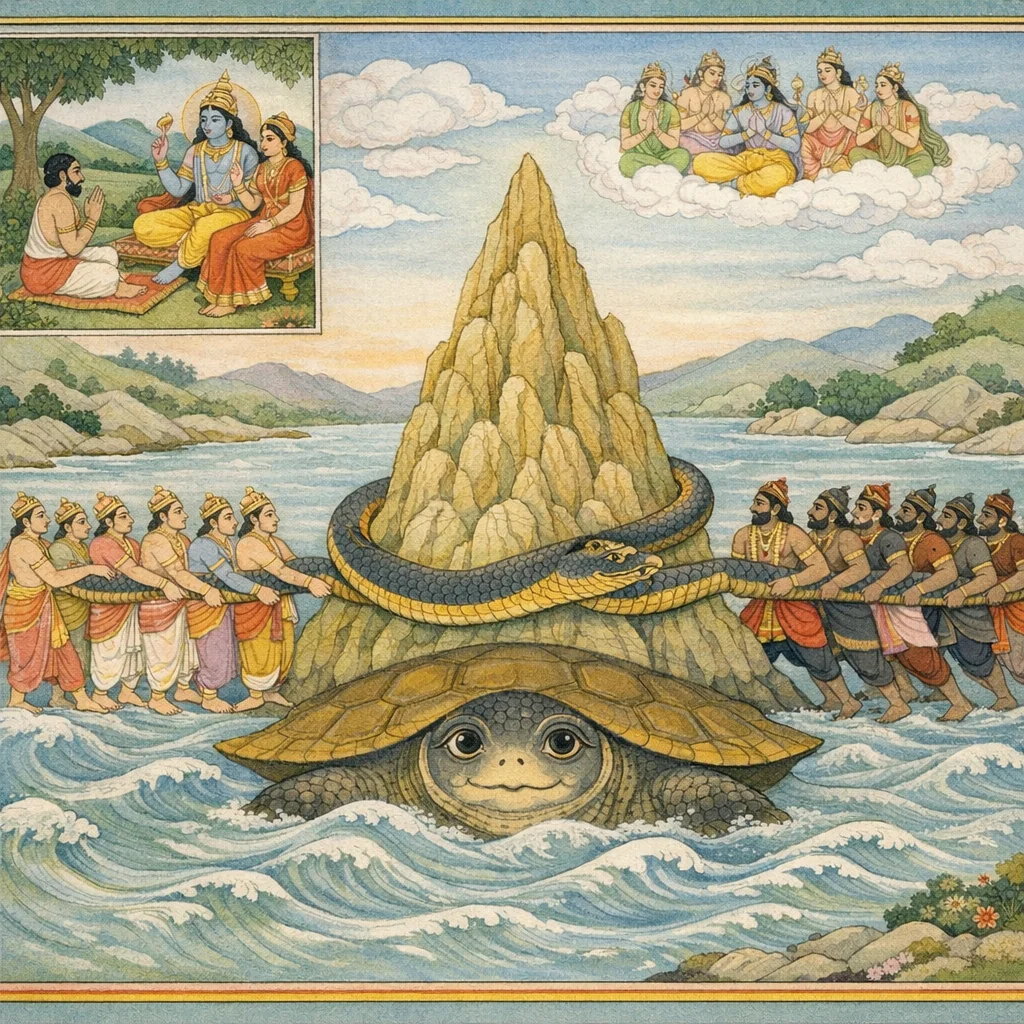
The chapter opens with homage to Nārāyaṇa, Nara, and Sarasvatī, then frames the narration at Naimiṣa where the sages ask Sūta Romaharṣaṇa to teach the excellent Kūrma Purāṇa as received through Vyāsa. Sūta defines the five Purāṇa-lakṣaṇas and lists the eighteen mahāpurāṇas, identifying the Kūrma as a principal Purāṇa with internal saṃhitā divisions. The scene shifts to the churning of the Ocean of Milk: Viṣṇu becomes Kūrma to support Mandara, and the sages inquire into Śrī’s true nature. Viṣṇu explains Śrī/Lakṣmī as His own Māyā-Śakti (Prakṛti, three-guṇa), which deludes and withdraws the cosmos, yet can be transcended by devotees who discern the Self. He presents Indradyumna as one who crossed Māyā by taking refuge in Him; taught through Śrī and by Nārāyaṇa’s direct appearance, Indradyumna attains grace-bestowed knowledge. The Lord prescribes varṇāśrama discipline, karma-yoga, and threefold bhāvanā, and notably enjoins worship of Maheśvara through jñāna and bhakti—establishing the Kurma Purāṇa’s Vaiṣṇava–Śaiva harmony. Returning to the frame, the sages request the full teaching; Sūta promises to relate what Kūrma taught in Rasātala, preparing for later chapters on sarga/pratisarga, manvantaras, geography, tīrthas, and vratas.
Shlokas
Verse 1
कूर्मपुराण (ग्रेतिल्) कूर्मपुराण हेअदेर् थिस् फ़िले इस् अन् ह्त्म्ल् त्रन्स्फ़ोर्मतिओन् ओफ़् स_कुर्मपुरन।xम्ल् wइथ् अ रुदिमेन्तर्य् हेअदेर्। फ़ोर् अ मोरे एxतेन्सिवे हेअदेर् प्लेअसे रेफ़ेर् तो थे सोउर्चे फ़िले। दत एन्त्र्य्: मेम्बेर्स् ओफ़् थे सन्स्क्नेत् प्रोजेच्त् चोन्त्रिबुतिओन्: मेम्बेर्स् ओफ़् थे सन्स्क्नेत् प्रोजेच्त् दते ओफ़् थिस् वेर्सिओन्: २०२०-०७-३१ सोउर्चे: । पुब्लिस्हेर्: गऺत्तिन्गेन् रेगिस्तेर् ओफ़् एलेच्त्रोनिच् तेxत्स् इन् इन्दिअन् लन्गुअगेस् (ग्रेतिल्), सुब् गऺत्तिन्गेन् लिचेन्चे: थिस् ए-तेxत् wअस् प्रोविदेद् तो ग्रेतिल् इन् गोओद् फ़ैथ् थत् नो चोप्य्रिघ्त् रिघ्त्स् हवे बेएन् इन्फ़्रिन्गेद्। इफ़् अन्योने wइस्हेस् तो अस्सेर्त् चोप्य्रिघ्त् ओवेर् थिस् फ़िले, प्लेअसे चोन्तच्त् थे ग्रेतिल् मनगेमेन्त् अत् ग्रेतिल्(अत्)सुब्(दोत्)उनि-गोएत्तिन्गेन्(दोत्)दे। थे फ़िले wइल्ल् बे इम्मेदिअतेल्य् रेमोवेद् पेन्दिन्ग् रेसोलुतिओन् ओफ़् थे च्लैम्। दिस्त्रिबुतेद् उन्देर् अ च्रेअतिवे चोम्मोन्स् अत्त्रिबुतिओन्-नोन्चोम्मेर्चिअल्-स्हरेअलिके ४।० इन्तेर्नतिओनल् लिचेन्से। इन्तेर्प्रेतिवे मर्कुप्: नोने नोतेस्: थिस् फ़िले हस् बेएन् च्रेअतेद् ब्य् मस्स् चोन्वेर्सिओन् ओफ़् ग्रेतिल्ऽस् सन्स्क्रित् चोर्पुस् फ़्रोम् कुर्म्प्१उ।ह्त्म्। दुए तो थे हेतेरोगेनेइत्य् ओफ़् थे सोउर्चेस् थे हेअदेर् मर्कुप् मिघ्त् बे सुबोप्तिमल्। फ़ोर् थे सके ओफ़् त्रन्स्परेन्च्य् थे हेअदेर् ओफ़् थे लेगच्य् फ़िले इस् दोचुमेन्तेद् इन् थे <नोते> एलेमेन्त् बेलोw: कुर्म-पुरन, पर्त् १ इन्पुत् ब्य् मेम्बेर्स् ओफ़् थे सन्स्क्नेत् प्रोजेच्त् (www।सन्स्क्नेत्।ओर्ग्) थिस् ग्रेतिल् वेर्सिओन् हस् बेएन् चोन्वेर्तेद् फ़्रोम् अ चुस्तोम् देवनगरि एन्चोदिन्ग्। थेरेफ़ोरे, wओर्द् बोउन्दरिएस् अरे उसुअल्ल्य् नोत् मर्केद् ब्य् ब्लन्क्स्। थेसे अन्द् ओथेर् इर्रेगुलरितिएस् चन्नोत् बे स्तन्दर्दिज़ेद् अत् प्रेसेन्त्। थे तेxत् इस् नोत् प्रोओफ़्-रेअद्! रेविसिओन्स्: २०२०-०७-३१: तेइ एन्चोदिन्ग् ब्य् मस्स् चोन्वेर्सिओन् ओफ़् ग्रेतिल्ऽस् सन्स्क्रित् चोर्पुस् तेxत् कूर्मपुराणम्-१ अथ श्रीकूर्मपुराणम् पूर्वविभागः नारायणं नमस्कृत्य नरं चैव नरोत्तमम् / देवीं सरस्वतीं चैव ततो जयमुदीरयेत् // कूर्म्प्१,मन्ग्।१ // नमस्कृत्वाप्रमेयाय विष्णवे कूर्मरूपिणे / पुराणं संप्रवक्ष्यामि यदुक्तं विश्वयोनिना
Having bowed to Nārāyaṇa, and also to Nara—the best among men—and likewise to the Goddess Sarasvatī, one should then proclaim “Victory!” as an auspicious beginning.
Verse 2
सत्रान्ते सूतमनघं नैमिषीया महर्षयः / पुराणसंहितां पुण्यां पप्रच्छू रोमहर्षणम्
At the conclusion of the sacrificial session, the Naimiṣa seers questioned the blameless Sūta, Romaharṣaṇa, about the sacred and meritorious compendium of Purāṇic lore.
Verse 3
त्वया सूत महाबुद्धे भगवान् ब्रह्मवित्तमः / इतिहासपुराणार्थं व्यासः सम्यगुपासितः
O Sūta, O great-minded one, the blessed Vyāsa—foremost among the knowers of Brahman—has been duly served and studied by you, for the sake of understanding the true purport of the Itihāsas and the Purāṇas.
Verse 4
तस्य ते सर्वरोमाणि वचसा हृषितानि यत् / द्वैपायनस्य भगवांस्ततो वै रोमहर्षणः
Because all the hairs on his body bristled with joy at those words, the blessed Dvaipāyana (Vyāsa) therefore gave him the name Romaharṣaṇa (“he whose hair stands on end”).
Verse 5
भवन्तमेव भगवान् व्याजहार स्वयं प्रभुः / मुनीनां संहितां वक्तुं व्यासः पौराणिकीं पुरा
The Blessed Lord—self-sovereign and independent—addressed you alone; and in ancient times Vyāsa, the master of Purāṇic lore, spoke the Purāṇic compendium for the sages.
Verse 6
त्वं हि स्वायंभुवे यज्ञे सुत्याहे वितते हरिः / संभूतः संहितां वक्तुं स्वांशेन पुरुषोत्तमः
For you indeed are Hari—the Supreme Person (Puruṣottama)—who, at Svāyambhuva Manu’s sacrifice, when the Soma-pressing rite was being performed, manifested by a portion of your own being in order to proclaim this sacred saṃhitā.
Verse 7
तस्माद् भवन्तं पृच्छामः पुराणं कौर्ममुत्तमम् / वक्तुमर्हसि चास्माकं पुराणार्थविशारद
Therefore we question you about the excellent Kūrma Purāṇa. O you who are skilled in the meaning of the Purāṇas, you ought to expound it to us.
Verse 8
मुनीनां वचनं श्रुत्वा सूतः पौराणिकोत्तमः / प्रणम्य मनसा प्राह गुरुं सत्यवतीसुतम्
Hearing the words of the sages, Sūta—the foremost among the expounders of the Purāṇas—bowed inwardly in his mind and then addressed his teacher, the son of Satyavatī (Vyāsa).
Verse 9
रोमहर्षण उवाच नमस्कृत्वा जगद्योनिं कूर्मरूपधरं हरिम् / वक्ष्ये पौराणिकीं दिव्यां कथां पापप्रणाशिनीम्
Romaharṣaṇa said: Having bowed to Hari—the womb and source of the universe—who bears the form of the Tortoise (Kūrma), I shall proclaim a divine Purāṇic narrative that destroys sin.
Verse 10
यां श्रुत्वा पापकर्मापि गच्छेत परमां गतिम् / न नास्तिके कथां पुण्यामिमां ब्रूयात् कदाचन
By hearing this sacred account, even one engaged in sinful deeds may attain the highest state. Therefore, one should never, at any time, recite this meritorious narrative to a disbeliever (nāstika).
Verse 11
श्रद्दधानाय शान्ताय धार्मिकाय द्विजातये / इमां कथामनुब्रूयात् साक्षान्नारायणेरिताम्
One should recount this sacred narrative to a twice-born person who is full of faith, tranquil in mind, and established in dharma—for it was proclaimed directly by Nārāyaṇa Himself.
Verse 12
सर्गश्च प्रतिसर्गश्च वंशो मन्वन्तराणि च / वंशानुचरितं चैव पुराणं पञ्चलक्षणम्
Creation and re-creation, the genealogies, the cycles of Manus, and the accounts that follow those dynasties—these five characteristics together define what is called a Purāṇa.
Verse 13
ब्राह्मं पुराणं प्रथमं पाद्मं वैष्णवमेव च / शैवं भागवतं चैव भविष्यं नारदीयकम्
First is the Brāhma Purāṇa; then the Pādma and the Vaiṣṇava; likewise the Śaiva and the Bhāgavata; also the Bhaviṣya and the Nāradīya.
Verse 14
मार्कण्डेयमथाग्नेयं ब्रह्मवैवर्तमेव च / लैङ्गं तथा च वाराहं स्कान्दं वामनमेव च
Also (there are) the Mārkaṇḍeya, the Āgneya, and the Brahmavaivarta; likewise the Liṅga, the Vārāha, the Skānda, and the Vāmana (Purāṇas).
Verse 15
कौर्मं मात्स्यं गारुडं च वायवीयमनन्तरम् / अष्टादशं समुद्दिष्टं ब्रह्मण्डमिति संज्ञितम्
Then come the Kūrma, the Mātsya, the Gāruḍa, and thereafter the Vāyavīya; the eighteenth Purāṇa is declared to be the Brahmāṇḍa, so named.
Verse 16
अन्यान्युपराणानि मुनिभिः कथितानि तु / अष्टादशपुराणानि श्रुत्वा संक्षेपतो द्विजाः
Other subsidiary Purāṇas too have indeed been recounted by the sages. O twice-born ones, having heard in brief the eighteen principal Purāṇas, (they seek the essential purport that is to be taught here).
Verse 17
आद्यं सनत्कुमारोक्तं नारसिहमतः परम् / तृतीयं स्कान्दमुद्दिष्टं कुमारेण तु भाषितम्
The first teaching was spoken by Sanatkumāra; the next is the doctrine of Nārasiṁha. The third is declared to be the Skanda-teaching, and it too was expounded by the Kumāra.
Verse 18
चतुर्थं शिवधर्माख्यं साक्षान्नन्दीशभाषितम् / दुर्वाससोक्तमाश्चर्यं नारदोक्तमतः परम्
The fourth section is called the Śiva-dharma, spoken directly by Nandīśa. Next comes the wondrous teaching proclaimed by Durvāsas, and thereafter the instruction spoken by Nārada.
Verse 19
कापिलं मानवं चैव तथैवोशनसेरितम् / ब्रह्माण्डं वारुणं चाथ कालिकाह्वयमेव च
“(The Purāṇas are also known as) the Kāpila, the Mānavā, likewise that taught by Uśanas; the Brahmāṇḍa, the Vāruṇa, and also the one called Kālikā.”
Verse 20
माहेश्वरं तथा साम्बं सौरं सर्वार्थसंचयम् / पराशरोक्तमपरं मारीचं भार्गवाह्वयम्
Also (there are) the Māheśvara tradition, the Sāmba tradition, the Saura tradition, and the Sarvārtha-saṃcaya (“Compendium of All Meanings”); likewise another work spoken by Parāśara, the Mārīca tradition, and that known as Bhārgava.
Verse 21
इदं तु पञ्चदशमं पुराणं कौर्ममुत्तमम् / चतुर्धा संस्थितं पुण्यं संहितानां प्रभेदतः
This indeed is the fifteenth Purāṇa—the excellent Kūrma Purāṇa. By the distinctions among its saṃhitās, this sacred text is arranged in four divisions.
Verse 22
ब्राह्मी भगवती सौरी वैष्णवी च प्रकीर्तिताः / चतस्त्रः संहिताः पुण्या धर्मकामार्थमोक्षदाः
They are proclaimed as the Brāhmī, the Bhagavatī, the Saurī, and the Vaiṣṇavī—four sacred saṃhitās, holy in themselves, bestowing dharma, kāma, artha, and mokṣa.
Verse 23
इयं तु संहिता ब्राह्मी चतुर्वेदैस्तु सम्मिता / भवन्ति षट्सहस्त्राणि श्लोकानामत्र संख्यया
This indeed is the Brahmī Saṃhitā, harmonized with the four Vedas; and in this work the total number of verses amounts to six thousand.
Verse 24
यत्र धर्मार्थकामानां मोक्षस्य च मुनीश्वराः / माहात्म्यमखिलं ब्रह्म ज्ञायते परमेश्वरः
Therein, O lordly sages, the complete greatness of Brahman is made known—Brahman who is the Supreme Lord—together with the teachings on dharma, artha, kāma, and mokṣa.
Verse 25
सर्गश्च प्रतिसर्गश्च वंशो मन्वन्तराणि च / वंशानुचरितं दिव्याः पुण्याः प्रासङ्गिकीः कथाः
Creation and re-creation, the genealogies, the Manvantara cycles, the histories of dynasties—along with divine, meritorious, and contextually connected narratives: these are the recognized themes to be taught in a Purāṇa.
Verse 26
ब्राह्मणाद्यैरियं धार्या धार्मिकैः शान्तमानसैः / तामहं वर्तयिष्यामि व्यासेन कथितां पुरा
This sacred Purāṇa is to be upheld by brāhmaṇas and the other orders, by the righteous whose minds are tranquil. That very teaching, once narrated by Vyāsa, I shall now set forth in due order.
Verse 27
पुरामृतार्थं दैतेयदानवैः सह देवताः / मन्थानं मन्दरं कृत्वा ममन्थुः क्षीरसागरम्
Long ago, desiring amṛta, the nectar of immortality, the gods—together with the Daityas and Dānavas—made Mount Mandara their churning-rod and churned the Ocean of Milk.
Verse 28
मथ्यमाने तदा तस्मिन् कूर्मरूपी जनार्दनः / बभार मन्दरं देवो देवानां हितकाम्यया
When that churning was underway, Janārdana, assuming the form of a tortoise (Kūrma), bore up Mount Mandara—the Lord doing so out of a desire for the welfare of the gods.
Verse 29
देवाश्च तुष्टुवुर्देवं नारदाद्या महर्षयः / कूर्मरूपधरं दृष्ट्वा साक्षिणं विष्णुमव्ययम्
Seeing the Deva who had assumed the form of a Tortoise—Viṣṇu, the imperishable Witness—both the gods and the great sages led by Nārada praised Him.
Verse 30
तदन्तरे ऽभवद् देवी श्रीर्नारायणवल्लभा / जग्राह भगवान् विष्णुस्तामेव पुरुषोत्तमः
In the meantime, the Goddess Śrī—beloved of Nārāyaṇa—came into being; and the Blessed Lord Viṣṇu, the Supreme Person (Puruṣottama), accepted her alone as His own.
Verse 31
तेजसा विष्णुमव्यक्तं नारदाद्या महर्षयः / मोहिताः सह शक्रेण श्रियो वचनमब्रुवन्
Overwhelmed by the effulgence of the unmanifest Viṣṇu, the great seers led by Nārada—together with Śakra (Indra)—were bewildered and addressed their words to Śrī (Lakṣmī).
Verse 32
भगवन् देवदेवेश नारायण जगन्मय / कैषा देवी विशालाक्षी यथावद् ब्रूहि पृच्छताम्
O Blessed Lord, O God of gods, Nārāyaṇa who pervades the whole universe—who is this wide-eyed Goddess? Please explain her rightly, for we ask to know.
Verse 33
श्रुत्वा तेषां तदा वाक्यं विष्णुर्दानवमर्दनः / प्रोवाच देवीं संप्रेक्ष्य नारदादीनकल्मषान्
Having heard their words, Viṣṇu—the crusher of the Dānavas—looked toward the Goddess; then, casting his glance upon Nārada and the other stainless sages, he spoke.
Verse 34
इयं सा परमा शक्तिर्मन्मयी ब्रह्मरूपिणी / माया मम प्रियानन्ता ययेदं मोहितं जगत्
She indeed is the Supreme Power (Śakti), of my very essence, assuming the form of Brahman; she is my beloved, endless Māyā, by whom this entire world is deluded.
Verse 35
अनयैव जगत्सर्वं सदेवासुरमानुषम् / मोहयामि द्विजश्रेष्ठा ग्रसामि विसृजामि च
By this very power, O best of the twice-born, I delude the entire universe—together with gods, asuras, and humans; and by it I also withdraw all beings and send them forth again.
Verse 36
उत्पत्तिं प्रलयं चैव भूतनामागतिं गतिम् / विज्ञायान्वीक्ष्य चात्मानं तरन्ति विपुलामिमाम्
Knowing the arising and dissolution of beings, and understanding their coming and going, those who discern and contemplate the Self (Ātman) cross beyond this vast ocean of saṃsāra.
Verse 37
अस्यास्त्वंशानधिष्ठाय शक्तिमन्तो ऽभवन् द्विजाः / ब्रह्मेशानादयो देवाः सर्वशक्तिरियं मम
Presiding over portions of Her power, the radiant ones became empowered; thus Brahmā, Īśāna (Śiva), and the other gods arose. This Goddess is My all-encompassing Power, My Śakti.
Verse 38
सैषा सर्वजगत्सूतिः प्रकृतिस्त्रिगुणात्मिका / प्रागेव मत्तः संजाता श्रीकल्पे पद्मवासिनी
She is the mother-source of the entire universe—Prakṛti, whose very nature is the three guṇas. Even earlier, in the Śrī-kalpa, she arose from Me as Padmavāsinī, the Lotus-dwelling one.
Verse 39
चतुर्भुजा शङ्खचक्रपद्महस्ता शुभान्विता / कोटिसूर्यप्रतीकाशा मोहिनी सर्वदेहिनाम्
Four-armed, bearing the conch, discus, and lotus in her hands, endowed with auspiciousness—radiant like ten million suns—she was Mohinī, the enchantress of all embodied beings.
Verse 40
नालं देवा न पितरो मानवा वसवो ऽपि च / मायामेतां समुत्तर्तुं ये चान्ये भुवि देहिनः
Neither the gods, nor the Pitṛs (ancestral spirits), nor human beings, nor even the Vasus are capable of crossing beyond this Māyā—nor any other embodied beings who dwell upon the earth.
Verse 41
इत्युक्तो वासुदेवेन मुनयो विष्णुमब्रुवन् / ब्रूहि त्वं पुण्डरीकाक्ष यदि कालत्रये ऽपि च / को वा तरति तां मायां दुर्जयां देवनिर्मिताम्
Thus addressed by Vāsudeva, the sages said to Viṣṇu: “O Lotus-eyed One, declare to us—whether in past, present, or future—who can cross that Māyā, hard to conquer, fashioned by the Divine Lord?”
Verse 42
अथोवाच हृषीकेशो मुनीन् मुनिगणार्चितः / अस्ति द्विजातिप्रवर इन्द्रद्युम्न इति श्रुतः
Then Hṛṣīkeśa, revered by multitudes of sages, spoke to the seers: “There is a foremost among the twice-born, renowned by the name Indradyumna, as tradition has long proclaimed.”
Verse 43
पूर्वजन्मनि राजासावधृष्यः शङ्करादिभिः / दृष्ट्वा मां कूर्मसंस्थानं श्रुत्वा पौराणिकीं स्वयम् / संहितां मन्मुखाद् दिव्यां पुरस्कृत्य मुनीश्वरान्
In a former birth, that king—invincible even to Śaṅkara and the other gods—beheld Me in the form of Kūrma, the Tortoise; and having himself heard from My own mouth the divine Purāṇic Saṃhitā, he honored the lordly sages and set them in the foremost place.
Verse 44
ब्रह्माणं च महादेवं देवांश्चान्यान् स्वशक्तिभिः / मच्छक्तौ संस्थितान् बुद्ध्वा मामेव शरणं गतः
Knowing that Brahmā, Mahādeva, and the other gods—together with their own powers—abide within My very Power, he took refuge in Me alone.
Verse 45
संभाषितो मया चाथ विप्रयोनिं गमिष्यसि / इन्द्रद्युम्न इति ख्यातो जातिं स्मरसि पौर्विकीम्
And I spoke to him: “You shall go to birth in a brahmin lineage. There you will be renowned as ‘Indradyumna,’ and you will remember your former birth.”
Verse 46
सर्वेषामेव भूतानां देवानामप्यगोचरम् / वक्तव्यं यद् गुह्यतमं दास्ये ज्ञानं तवानघ / लब्ध्वा तन्मामकं ज्ञानं मामेवान्ते प्रवेक्ष्यसि
That which lies beyond the reach of all beings—even of the gods—I shall declare to you, O sinless one: the most secret teaching. Having obtained that knowledge which is Mine, you will, in the end, enter into Me alone.
Verse 47
अंशान्तरेण भूम्यां त्वं तत्र तिष्ठ सुनिर्दृतः / वैवस्वते ऽन्तरे ऽतिते कार्यार्थं मां प्रवेक्ष्यसि
On the earth, remain there for a further interval, firmly resolved. When the Vaivasvata Manvantara has passed, for the sake of accomplishing the required task you shall enter into Me.
Verse 48
मां प्रणम्य पुरीं गत्वा पालयामास मेदिनीम् / कालधर्मं गतः कालाच्छ्वेतद्वीपे मया सह
Having bowed to Me, he went to the royal city and ruled the earth. In due course, when the law of time came upon him, he departed at his appointed time—and now abides with Me in Śvetadvīpa.
Verse 49
भुक्त्वा तान् वैष्णवान् भोगान् योगिनामप्यगोचरान् / मदाज्ञया मुनिश्रेष्ठा जज्ञे विप्रकुले पुनः
Having enjoyed those Vaiṣṇava felicities—delights beyond even the range of yogins—she, the best among sages, by My command, was born again in a brāhmaṇa lineage.
Verse 50
ज्ञात्वा मां वासुदेवाख्यं यत्र द्वे निहिते ऽक्षरे / विद्याविद्ये गूढरूपे यत्तद् ब्रह्म परं विदुः
Knowing Me, called Vāsudeva—within whom the two imperishables are set, namely Knowledge and Ignorance in their hidden forms—one realizes That which the wise know as the Supreme Brahman.
Verse 51
सोर्ऽचयामास भूतानामाश्रयं परमेश्वरम् / व्रतोपवासनियमैर्हेमैर्ब्राह्मणतर्पणैः
He worshipped the Supreme Lord, the refuge of all beings, through sacred vows, fasts, and disciplines—by offerings of gold and by deeds that satisfied and honored the brāhmaṇas.
Verse 52
तदाशीस्तन्नमस्कारस्तन्निष्ठस्तत्परायणः / आराधयन् महादेवं योगिनां हृदि संस्थितम्
With his blessings and salutations directed to That alone, steadfast in That and taking That as his supreme refuge, he worshipped Mahādeva—who abides established in the heart of the yogins.
Verse 53
तस्यैवं वर्तमानस्य कदाचित् परमा कला / स्वरूपं दर्शयामास दिव्यं विष्णुसमुद्भवम्
While he continued in that state, at a certain time the Supreme Power revealed to him Its own form—radiant and divine, arising from Viṣṇu.
Verse 54
दृष्ट्वा प्रणम्य शिरसा विष्णोर्भगवतः प्रियाम् / संस्तूय विविधैः स्तोत्रैः कृताञ्जलिरभाषत
Having beheld the beloved consort of Lord Viṣṇu, he bowed his head in reverence; then, praising her with various hymns and joining his palms, he spoke.
Verse 55
इर्न्द्दयुम्न उवाच का त्वं देविविशालाक्षि विष्णुचिह्नङ्किते शुभे / याथातथ्येन वै भावं तवेदानीं ब्रवीहि मे
Indradyumna said: “Who are you, O wide-eyed goddess—auspicious one marked with the emblems of Viṣṇu? Tell me now, truthfully and exactly as it is, the real state of your being.”
Verse 56
तस्य तद् वाक्यमाकर्ण्य सुप्रसन्ना सुमङ्गला / हसन्ती संस्मरन् विष्णुं प्रियं ब्राह्मणमब्रवीत्
Hearing his words, the blessed and most auspicious Lady—utterly delighted—smiled; and, remembering Viṣṇu, she spoke to the dear brāhmaṇa.
Verse 57
न मां पश्यन्ति मुनयो देवाः शक्रपुरोगमाः / नारायणात्मिका चैका मायाहं तन्मया परा
Neither the sages nor the gods—Indra and the rest—truly perceive Me. I alone am Māyā, whose essence is Nārāyaṇa; and, being wholly of Him, I am the supreme power.
Verse 58
न मे नारायणाद् भेदो विद्यते हि विचारतः / तन्मयाहं परं ब्रह्म स विष्णुः परमेश्वरः
Upon true discernment, no difference at all is found between me and Nārāyaṇa. I am of His very essence; I am the Supreme Brahman—He is Viṣṇu, the highest Lord (Parameśvara).
Verse 59
येर्ऽचयन्तीह भूतानामाश्रयं परमेश्वरम् / ज्ञानेन कर्मयोगेन न तेषां प्रभवाम्यहम्
Those who, here in this world, worship the Supreme Lord—the ultimate refuge of all beings—through spiritual knowledge and through Karma-yoga: over such people I have no power; I do not prevail against them.
Verse 60
तस्मादनादिनिधनं कर्मयोगपरायणः / ज्ञानेनाराधयानन्तं ततो मोक्षमवाप्स्यसि
Therefore, devoted to Karma-yoga, worship through true knowledge the Infinite Lord, beginningless and endless; then you will attain liberation (mokṣa).
Verse 61
इत्युक्तः स मुनिश्रेष्ठ इन्द्रद्युम्नो महामतिः / प्रणम्य शिरसा देवीं प्राञ्जलिः पुनरब्रवीत्
Thus addressed, the great-minded King Indradyumna—foremost among sages—bowed his head to the Goddess; then, with hands joined in reverence, he spoke again.
Verse 62
कथं स भगवानीशः शाश्वतो निष्कलो ऽच्युतः / ज्ञातुं हि शक्यते देवि ब्रूहि मे परमेश्वरि
How can that Blessed Lord—Īśa, eternal, partless, and unfailing—truly be known? O Goddess, tell me, O Supreme Lady.
Verse 63
एकमुक्ताथ विप्रेण देवी कमलवासिनी / साक्षान्नारायणो ज्ञानं दास्यतीत्याह तं मुनिम्
Then, after hearing the brāhmaṇa’s words, the Goddess who dwells in the lotus (Lakṣmī) spoke to that sage: “Nārāyaṇa himself will directly bestow upon you the knowledge (jñāna).”
Verse 64
उभाभ्यामथ हस्ताभ्यां संस्पृश्य प्रणतं मुनिम् / स्मृत्वा परात्परं विष्णुं तत्रैवान्तरधीयत
Then, touching with both hands the sage who had bowed down in reverence, and recollecting Viṣṇu—the Supreme beyond the supreme—he vanished then and there.
Verse 65
सो ऽपि नारायणं द्रष्टुं परमेण समाधिना / आराधयद्धृषीकेशं प्रणतार्तिप्रभञ्जनम्
He too, desiring to behold Nārāyaṇa, worshipped Hṛṣīkeśa with the highest samādhi—Him who shatters the suffering of those who bow down in surrender.
Verse 66
ततो बहुतिथे काले गते नारायणः स्वयम् / प्रादुरासीन्महायोगी पीतवासा जगन्मयः
Then, after a long span of time had passed, Nārāyaṇa Himself appeared—the great Yogin, clad in yellow garments, pervading and embodying the entire universe.
Verse 67
दृष्ट्वा देवं समायान्तं विष्णुमात्मानमव्ययम् / जानुभ्यामवनिं गत्वा तुष्टाव गरुडध्वजम्
Seeing the Lord approaching—Vishnu, the imperishable Supreme Self—he went down to the ground upon his knees and praised the bearer of Garuḍa as His banner.
Verse 68
इन्द्रद्युम्न उवाच यज्ञेशाच्युत गोविन्द माधवानन्त केशव / कुष्ण विष्णो हृषीकेश तुभ्यं विश्वात्मने नमः
Indradyumna said: O Lord of sacrifice, O Acyuta—Govinda, Mādhava, Ananta, Keśava; O Kṛṣṇa, O Viṣṇu, O Hṛṣīkeśa—salutations to You, the Universal Self who indwells all.
Verse 69
नमो ऽस्तु ते पुराणाय हरये विश्वमूर्तये / सर्गस्थितिविनाशानां हेतवे ऽनन्तशक्ये
Salutations to You—the Ancient One (Purāṇa), Hari, whose form is the entire universe; the immeasurably powerful cause of creation, preservation, and dissolution.
Verse 70
निर्गुणाय नमस्तुभ्यं निष्कलायामलात्मने / पुरुषाय नमस्तुभ्यं विश्वरूपाय ते नमः
Salutations to You, the attributeless (nirguṇa), the partless and stainless Self. Salutations to You, the Supreme Person (Puruṣa); salutations to You whose form is the entire universe (Viśvarūpa).
Verse 71
नमस्ते वासुदेवाय विष्णवे विश्वयोनये / आदिमध्यान्तहीनाय ज्ञानगम्याय ते नमः
Salutations to You, Vāsudeva—Viṣṇu, the womb and source of the universe. Salutations to You who are without beginning, middle, or end, and who are attainable through true knowledge alone.
Verse 72
नमस्ते निर्विकाराय निष्प्रपञ्चाय ते नमः / भेदाभेदविहीनाय नमो ऽस्त्वानन्दरूपिणे
Salutations to You, the changeless One; salutations to You who are beyond all phenomenal projection. Salutations to You who are free from both difference and non-difference—salutations indeed to You whose very nature is bliss.
Verse 73
नमस्ताराय शान्ताय नमो ऽप्रतिहतात्मने / अनन्तमूर्तये तुभ्यममूर्ताय नमो नमः
Salutations to You, the saving Guide and the Peaceful One; salutations to Him whose Self is unobstructed. Salutations to You of infinite forms—and again salutations to You who are formless.
Verse 74
नमस्ते परमार्थाय मायातीताय ते नमः / नमस्ते परमेशाय ब्रह्मणे परमात्मने
Salutations to You who are the highest Truth, beyond Māyā—salutations to You. Salutations to the Supreme Lord, to Brahman, to the Supreme Self (Paramātman).
Verse 75
नमो ऽस्तु ते सुसूक्ष्माय महादेवाय ते नमः / नमः शिवाय शुद्धाय नमस्ते परमेष्ठिने
Salutations to You, the supremely subtle One; salutations to You, Mahādeva. Salutations to Śiva, the Pure; salutations to You, the Highest Lord (Parameṣṭhin).
Verse 76
त्वयैव सृष्टमखिलं त्वमेव परमा गतिः / त्वं पिता सर्वभूतानां त्वं माता पुरुषोत्तम
By You alone has this entire universe been created; You alone are the highest refuge and the final goal. You are the father of all beings, and You are the mother, O Puruṣottama (Supreme Person).
Verse 77
त्वमक्षरं परं धाम चिन्मात्रं व्योम निष्कलम् / सर्वस्याधारमव्यक्तमनन्तं तमसः परम्
You are the Imperishable (Akṣara), the supreme Abode; pure Consciousness alone, the partless expanse. You are the unmanifest (Avyakta), infinite support of all, utterly transcending tamas, the darkness.
Verse 78
प्रपश्यन्ति परात्मानं ज्ञानदीपेन केवलम् / प्रपद्ये भवतो रूपं तद्विष्णोः परमं पदम्
With the lamp of knowledge alone, they directly behold the Paramātman, the Supreme Self. I take refuge in Your form—this is Viṣṇu’s highest abode, the supreme state.
Verse 79
एवं स्तुवन्तं भगवान् भूतात्मा भूतभावनः / उभाभ्यामथ हस्ताभ्यां पस्पर्श प्रहसन्निव
Thus, as he praised Him, the Blessed Lord—Inner Self of all beings and the source that brings beings forth—touched him with both His hands, as though smiling gently.
Verse 80
स्पृष्टमात्रो भगवता विष्णुना मुनिपुङ्गवः / यथावत् परमं तत्त्वं ज्ञातवांस्तत्प्रसादतः
Merely by being touched by the Blessed Lord Viṣṇu, that foremost of sages came to know—exactly as it is—the Supreme Reality, through His grace.
Verse 81
ततः प्रहृष्टमनसा प्रणिपत्य जनार्दनम् / प्रोवाचोन्निद्रपद्माक्षं पीतवाससमच्युतम्
Then, his heart brimming with joy, he bowed in reverence to Janārdana and spoke to the Unfailing Lord Acyuta—whose lotus-like eyes were fully awakened and who was clad in yellow garments.
Verse 82
त्वत्प्रसादादसंदिग्धमुत्पन्नं पुरुषोत्तम / ज्ञानं ब्रह्मैकविषयं परमानन्दसिद्धिदम्
By your grace, O Puruṣottama, there has arisen in me a knowledge free from doubt—knowledge whose single object is Brahman, and which bestows the attainment of supreme bliss.
Verse 83
नमो भगवते तुभ्यं वासुदेवाय वेधसे / किं करिष्यामि योगेश तन्मे वद जगन्मय
Salutations to You, O Bhagavān—Vāsudeva, the all-knowing Ordainer. O Lord of Yoga, pervader of the universe, tell me: what should I do?
Verse 84
श्रुत्वा नारायणो वाक्यमिन्द्रद्युम्नस्य माधवः / उवाच सस्मितं वाक्यमशेषजगतो हितम्
Having heard King Indradyumna’s words, Nārāyaṇa—Mādhava—spoke with a gentle smile, uttering a reply meant for the welfare of the entire world.
Verse 85
श्रीभगवानुवाच वर्णाश्रमाचारवतां पुंसां देवो महेश्वरः / ज्ञानेन भक्तियोगेन पूजनीयो न चान्यथा
The Blessed Lord said: For men who live in accordance with the disciplines of varṇa and āśrama, the divine Lord Maheśvara is to be worshipped through spiritual knowledge and the yoga of devotion—never in any other way.
Verse 86
विज्ञाय तत्परं तत्त्वं विभूतिं कार्यकारणम् / प्रवृतिं चापि मे ज्ञात्वा मोक्षार्थोश्वरमर्चयेत्
Having realized that Supreme Principle, and understanding My sovereign manifestation (vibhūti) as the cause behind both cause and effect, and also knowing My cosmic activity (pravṛtti), one who seeks liberation should worship Īśvara.
Verse 87
सर्वसङ्गान् परित्यज्य ज्ञात्वा मायामयं जगत् / अद्वैतं भावयात्मानं द्रक्ष्यसे परमेश्वरम्
Abandoning all attachments, and knowing this world to be constituted of māyā, contemplate the Self as non-dual; then you will behold Parameśvara, the Supreme Lord.
Verse 88
त्रिविधा भावना ब्रह्मन् प्रोच्यमाना निबोध मे / एका मद्विषया तत्र द्वितीया व्यक्तसंश्रया / अन्या च भावना ब्राह्मी विज्ञेया सा गुणातिगा
O Brahman-sage, understand from Me the threefold bhāvanā being taught: one is directed toward Me; the second is grounded in the manifest (vyakta); and the other—known as the Brahmic contemplation—is to be understood as transcending the guṇas.
Verse 89
आसामन्यतमां चाथ भावनां भावयेद् बुधः / अशक्तः संश्रयेदाद्यामित्येषा वैदिकी श्रुतिः
Then the wise should cultivate the most universal of these contemplations; but if one is unable, one should take refuge in the primordial, first support—so declares the Vedic śruti.
Verse 90
तस्मात् सर्वप्रयत्नेन तन्निष्ठस्तत्परायणः / समाराधय विश्वेशं ततो मोक्षमवाप्स्यसि
Therefore, with every effort, being firmly established in Him and taking Him alone as your supreme refuge, worship Viśveśa, the Lord of the Universe; then you shall attain liberation.
Verse 91
इन्द्रद्युम्न उवाच किं तत् परतरं तत्त्वं का विभूतिर्जनार्दन / किं कार्यं कारणं कस्त्वं प्रवृत्तिश्चापि का तव
Indradyumna said: “O Janārdana, what is that Reality higher than all? What is Your vibhūti, Your sovereign manifestation? What is effect and what is cause? Who are You in truth, and what is also Your impulse to act (pravṛtti)?”
Verse 92
परात्परतरं तत्त्वं परं ब्रह्मैकमव्ययम् / नित्यानन्दं स्वयञ्ज्योतिरक्षरं तमसः परम्
That Reality which is beyond even the beyond—the one, supreme, imperishable Brahman—is eternal bliss, self-luminous, undecaying, and transcendent to darkness (ignorance).
Verse 93
ऐश्वर्यं तस्य यन्नित्यं विभूतिरिति गीयते / कार्यं जगदथाव्यक्तं कारणं शुद्धमक्षरम्
That Lord’s eternal sovereignty is praised as His vibhūti. The universe is His effect; the unmanifest (avyakta) is His cause—pure, imperishable, and undecaying.
Verse 94
अहं हि सर्वभूतानामन्तर्यामीश्वरः परः / सर्गस्थित्यन्तकर्तृत्वं प्रवृत्तिर्मम गीयते
For I am the Supreme Lord, the inner ruler (Antaryāmin) dwelling within all beings. It is proclaimed that the power to bring about creation, maintenance, and dissolution is My own divine activity (pravṛtti).
Verse 95
एतद् विज्ञाय भावेन यथावदखिलं द्विज / ततस्त्वं कर्मयोगेन शाश्वतं सम्यगर्चय
O twice-born one, having understood all this rightly and with true devotion, then worship the Eternal One properly through Karma-yoga—the discipline of consecrated action.
Verse 96
इन्द्रद्युम्न उवाच के ते वर्णाश्रमाचारा यैः समाराध्यते परः / ज्ञानं च कीदृशं दिव्यं भावनात्रयसंस्थितम्
Indradyumna said: “What are those disciplines of varṇa and āśrama by which the Supreme is duly worshipped? And what is that divine knowledge—of what kind is it—which is established in the threefold contemplative cultivation (bhāvanā)?”
Verse 97
कथं सृष्टमिदं पूर्वं कथं संह्रियते पुनः / कियत्यः सृष्टयो लोके वंशा मन्वन्तराणि च / कानि तेषां प्रमाणानि पावनानि व्रतानि च
How was this universe created in the beginning, and how is it dissolved again? How many kinds of creations are there in the world, and what are the dynastic lineages and the Manvantaras? What are the measures and authorities for these, and which purifying observances (vratas) pertain to them?
Verse 98
तीर्थान्यर्कादिसंस्थानं पृथिव्यायामविस्तरे / कति द्वीपाः समुद्राश्च पर्वताश्च नदीनदाः / ब्रूहि मे पुण्डरीकाक्ष यथावदधुनाखिलम्
Tell me in full, O Lotus-eyed Lord, about the sacred pilgrimage places and the arrangement of the Sun and the other luminaries. Also, on the broad expanse of the earth—how many continents, oceans, mountains, rivers, and streams are there? Please explain all of this to me correctly, here and now.
Verse 99
श्रीकूर्म उवाच एवमुक्तो ऽथ तेनाहं भक्तानुग्रहकाम्यया / यथावदखिलं सर्वमवोचं मुनिपुङ्गवाः
Śrī Kūrma said: Thus addressed by him, desiring to bestow grace upon my devotee, I then explained—properly and in full—everything, O foremost of sages.
Verse 100
व्याख्यायाशेषमेवेदं यत्पृष्टो ऽहं द्विजेन तु / अनुगृह्य च तं विप्रं तत्रैवान्तर्हितो ऽभवम्
Having explained, without remainder, exactly what I was asked by that twice-born (brāhmaṇa), and having shown him grace, I vanished from that very place.
Verse 101
सो ऽपि तेन विधानेन मदुक्तेन द्विजोत्तमः / आराधयामास परं भावपूतः समाहितः
Thus the best of the twice-born, following the rite I had prescribed, worshipped the Supreme Lord with a mind purified by devotion—steadfast and gathered in meditation.
Verse 102
त्यक्त्वा पुत्रादिषु स्नेहं निर्द्वन्द्वो निष्परिग्रहः / संन्यस्य सर्वकर्माणि परं वैराग्यमाश्रितः
Abandoning attachment to sons and the like, free from the pairs of opposites and without possessiveness, and renouncing all actions, one takes refuge in the supreme dispassion—parama-vairāgya.
Verse 103
आत्मन्यात्मानमन्वीक्ष्य स्वात्मन्येवाखिलं जगत् / संप्राप्य भावनामन्त्यां ब्राह्मीमक्षरपूर्विकाम्
Contemplating the Self within the Self, and beholding the entire universe as existing in one’s own Self alone, one attains the final meditative realization—the Brahmī state—grounded in the Imperishable (Akṣara).
Verse 104
अवाप परमं योगं येनैकं परिपश्यति / यं विनिद्रा जितश्वासाः काङ्क्षन्ते मोक्षकाङ्क्षिणः
He attained the supreme Yoga, by which one beholds the One alone. That state—sought by aspirants for liberation—is longed for by those who have overcome sleep and mastered the breath.
Verse 105
ततः कदाचिद् योगीन्द्रो ब्रह्माणं द्रष्टुमव्ययम् / जगामादित्यनिर्देशान्मानसोत्तरपर्वतम् / आकाशेनैव विप्रेन्द्रो योगैश्वर्यप्रभावतः
Then, at a certain time, that lord among yogins set out to behold the imperishable Brahmā. Following the course indicated by the Sun, the best of Brahmins went to Mount Mānasottara—moving through the very sky by the power and majesty born of yogic mastery (yogaiśvarya).
Verse 106
विमानं सूर्यसंकाशं प्राधुर्भूतमनुत्तमम् / अन्वगच्छन् देवगणा गन्धर्वाप्सरसां गणाः / दृष्ट्वान्ये पथि योगीन्द्रं सिद्धा ब्रह्मर्षयो ययुः
A supremely excellent vimāna, radiant like the sun, suddenly manifested. Following it came hosts of gods, with multitudes of Gandharvas and Apsarases. And seeing upon the path the Lord of yogins, other siddhas and Brahmarṣis also went forth (to that place).
Verse 107
ततः स गत्वा तु गिरिं विवेश सुरवन्दितम् / स्थानं तद्योगिभिर्जुष्टं यत्रास्ते परमः पुमान्
Then he went and entered that mountain, revered even by the gods—into that holy place frequented by yogins, where the Supreme Person abides.
Verse 108
संप्राप्य परमं स्थानं सूर्यायुतसमप्रभम् / विवेश चान्तर्भवनं देवानां च दुरासदम्
Having reached the supreme realm, radiant like ten thousand suns, he entered the inner mansion—an abode of the gods, difficult for others to approach.
Verse 109
विचिन्तयामास परं शरण्यं सर्वदेहिनाम् / अनादिनिधनं देवं देवदेवं पितामहम्
He contemplated the Supreme Refuge of all embodied beings—the God without beginning or end, the God of gods, the Primordial Father (Pitāmaha).
Verse 110
ततः प्रादुरभूत् तस्मिन् प्रकाशः परमात्मनः / तन्मध्ये पुरुषं पूर्वमपश्यत् परमं पदम्
Then, within that state, the radiance of the Supreme Self manifested; and in the midst of that Light, the seer beheld the primordial Puruṣa—the Supreme Abode itself.
Verse 111
महान्तं तेजसो राशिमगम्यं ब्रह्मविद्विषाम् / चतुर्मुखमुदाराङ्गमर्चिभिरुपशोभितम्
They beheld a vast mass of radiance—unapproachable to those hostile to Brahman—within which stood the Four-faced One, broad-limbed and noble in form, resplendent with flames of light.
Verse 112
सो ऽपि योगिनमन्वीक्ष्य प्रणमन्तमुपस्थितम् / प्रत्युद्गम्य स्वयं देवो विश्वात्मा परिषस्वजे
Seeing the yogin standing before Him in reverent prostration, the God Himself—the Universal Self—stepped forward to greet him and embraced him.
Verse 113
परिष्वक्तस्य देवेन द्विजेन्द्रस्याथ देहतः / निर्गत्य महती ज्योत्स्ना विवेशादित्यमण्डलम् / ऋग्यजुः सामसंज्ञं तत् पवित्रममलं पदम्
Then, as that foremost of the twice-born was embraced by the Deva, a vast radiance issued forth from his body and entered the orb of the Sun—attaining that pure, stainless state known as the Ṛg-, Yajus-, and Sāma-(Veda) itself.
Verse 114
हिरण्यगर्भो भगवान् यत्रास्ते हव्यकव्यभुक् / द्वारं तद् योगिनामाद्यं वेदान्तेषु प्रतिष्ठितम् / ब्रह्मतेजोमयं श्रीमन्निष्ठा चैव मनीषिणाम्
Where the Blessed Lord Hiraṇyagarbha abides—the receiver of both havya (offerings to the gods) and kavya (rites for the ancestors)—there is the primordial gateway for yogins, firmly grounded in Vedānta. It shines with the radiance of Brahman, auspicious, and indeed the steadfast refuge of the wise.
Verse 115
दृष्टमात्रो भगवतात ब्रह्मणार्चिर्मयो मुनिः / अपश्यदैश्वरं तेजः शान्तं सर्वत्रगं शिवम्
The sage—whose form was like a flame of Brahman—having merely beheld the Blessed Lord, perceived the sovereign, divine radiance: tranquil, all-pervading, and auspicious (Śiva) everywhere.
Verse 116
स्वात्मानमक्षरं व्योमतद् विष्णोः परमं पदम् / आनन्दमचलं ब्रह्म स्थानं तत्पारमेश्वरम्
That imperishable, all-pervading inner Self is the vast ether-like Reality—Vishnu’s supreme abode: the unmoving Brahman, pure bliss, the transcendent station of the Supreme Lord (Parameśvara).
Verse 117
सर्वभूतात्मभूतः स परमैश्वर्यमास्थितः / प्राप्तवानात्मनो धाम यत्तन्मोक्षाख्यमव्ययम्
Having become the very Self within all beings, he abides in supreme lordship; he has attained his own true abode—imperishable, and known as liberation (mokṣa).
Verse 118
तस्मात् सर्वप्रयत्नेन वर्णाश्रमविधौ स्थितः / समाश्रित्यान्तिमं भावं मायां लक्ष्मीं तरेद् बुधः
Therefore, with every effort, remaining established in the discipline of varṇa and āśrama, the wise person—taking refuge in the final (highest) state of realization—crosses beyond Māyā and even Lakṣmī (prosperity and worldly attainment).
Verse 119
सूत उवाच व्याहृता हरिणा त्वेवं नारादाद्या महर्षयः / शक्रेण सहिताः सर्वे पप्रच्छुर्गरुडध्वजम्
Sūta said: When Hari had thus spoken, the great sages beginning with Nārada—together with Śakra (Indra)—all questioned Garuḍadhvaja (the Lord whose banner bears Garuḍa).
Verse 120
ऋषय ऊचुः देवदेव हृषीकेश नाथ नारायणामल / तद् वदाशेषमस्माकं यदुक्तं भवता पुरा
The sages said: O God of gods, Hṛṣīkeśa—our Lord, stainless Nārāyaṇa—tell us in full that teaching which was spoken by you in former times.
Verse 121
इन्द्रद्युम्नाय विप्रया ज्ञानं धर्मादिगोचरम् / शुश्रूषुश्चाप्ययं शक्रः सखा तव जगन्मय
O Jagannmaya, all-pervading Lord, the brahmin lady imparted to Indradyumna the knowledge whose scope reaches dharma and its allied principles; and this Śakra (Indra) too, eager to serve, has become your companion.
Verse 122
ततः स भगवान् विष्णुः कूर्मरूपी जनार्दनः / रसातलगतो देवो नारदाद्यैर्महर्षिभिः
Then the Blessed Lord Vishnu—Janardana, assuming the form of the Tortoise (Kurma)—went down to Rasātala; and the God was accompanied by the great sages beginning with Nārada.
Verse 123
पृष्टः प्रोवाच सकलं पुराणं कौर्ममुत्तमम् / सन्निधौ देवराजस्य तद् वक्ष्ये भवतामहम्
Being questioned, he expounded in full the excellent Kurma Purana in the presence of the king of the gods; that very account I shall now relate to you.
Verse 124
धन्यं यशस्यामायुष्यं पुण्यं मोक्षप्रदं नृणाम् / पुराणश्रवणं विप्राः कथनं च विशेषतः
O Brāhmaṇas, for human beings the hearing of the Purāṇas—and, even more so, the expounding of them—is blessed, fame-bestowing, life-enhancing, merit-producing, and a giver of liberation.
Verse 125
श्रुत्वा चाध्यायमेवैकं सर्वपापैः प्रमुच्यते / उपाख्यानमथैकं वा ब्रह्मलोके महीयते
By listening even to a single chapter, one is released from all sins; or even by hearing a single sacred episode, one is honored in the world of Brahmā.
Verse 126
इदं पुराणं परमं कौर्मं कूर्मस्वरूपिणा / उक्तं देवाधिदेवेन श्रद्धातव्यं द्विजातिभिः
This is the supreme Purāṇa, known as the Kūrma Purāṇa, proclaimed by the God above the gods, the Lord who bears the form of the Tortoise; therefore the twice-born should receive it with reverent faith.
Frequently Asked Questions
It gives the canonical fivefold definition: sarga (creation), pratisarga (re-creation), vaṃśa (genealogies), manvantara (Manu cycles), and vaṃśānucarita (dynastic histories), and reiterates that context-linked meritorious narratives support these themes.
Liberation is presented as grace-aided direct knowledge of the Supreme Reality: by discerning the Self and contemplating non-duality, the aspirant crosses Māyā; the realized one abides in the imperishable, all-pervading Brahman—described as Viṣṇu’s supreme abode—implying a Vedāntic non-dual culmination within a devotional framework.
Yes. Nārāyaṇa explicitly states that for those established in Varnāśrama, Maheśvara should be worshipped through jñāna and bhakti-yoga. This functions as samanvaya: the Supreme is affirmed as inner ruler and Brahman, while Śiva-worship is prescribed as a valid mode aligned with liberation-oriented knowledge and devotion.