Adhyaya 9
Dīkṣā Procedure: Homa Measures, Elemental Reconstitution, and Naming by Omen
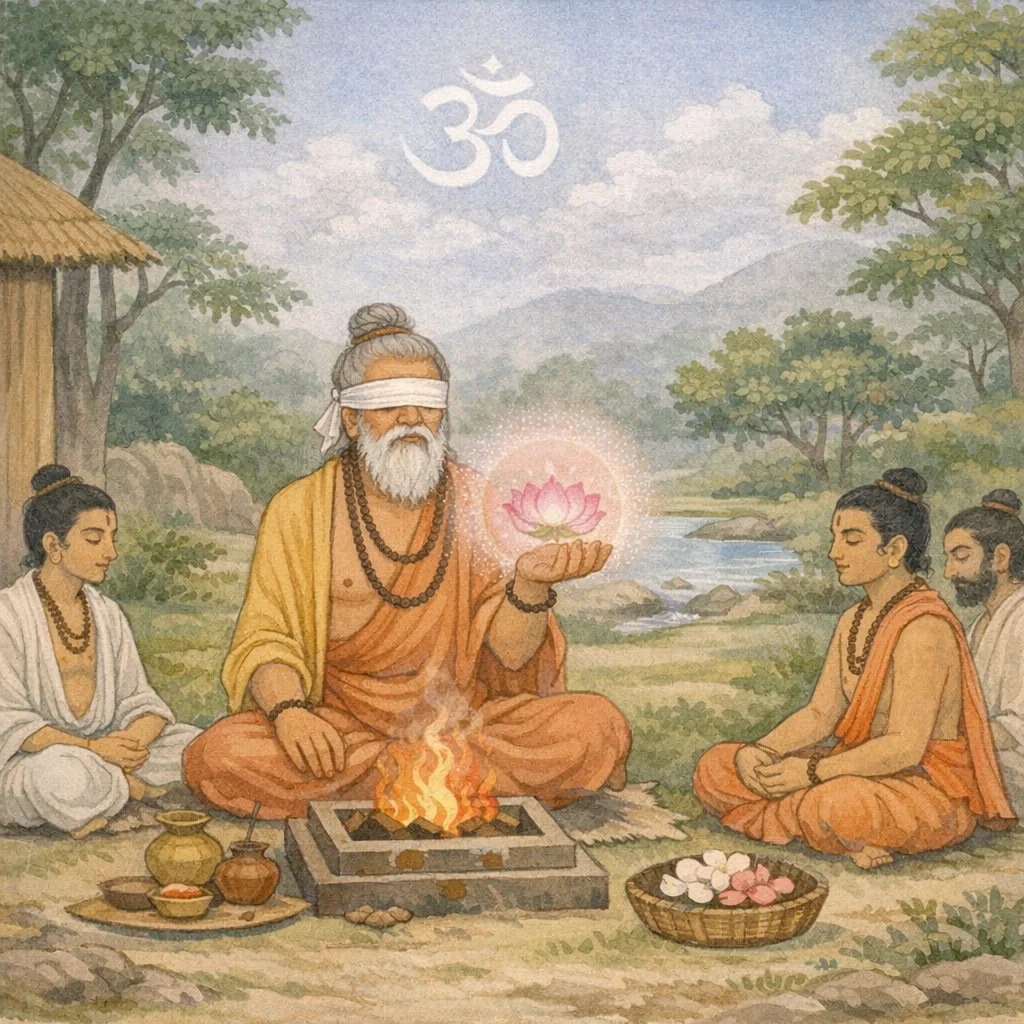
Continuing the Ācāra-khāṇḍa’s practical ritual teaching, Hari instructs Rudra/Śiva on the dīkṣā for an already-initiated disciple: at the proper time the disciple is blindfolded and offers 108 homa oblations with the root-mantra, with higher counts for specific aims (a son, becoming a sādhaka, or a liberating teacher). The guru then seats the disciples outside for concentrated focus and performs an inner visualization—drying by Rudra’s vāyavī power, burning in Agni, and immersion in water—gathering the jīva’s radiance and merging “light into light.” The instruction turns to contemplation of Oṁ in the sky and a causal principle within the body, leading to realization of the Kṣetrajña distinct from bodily causes. Ritual structure follows: preparing maṇḍalas (or delegating their making), worship of Hari, and a hand-lotus visualization that culminates in placing the “hand of Viṣṇu” on the disciple’s head for purification. The chapter ends with a blindfolded flower-offering taken as an omen for naming, setting the stage for further refinements of initiation and worship practice.
Shlokas
Verse 1
नामाष्टमो ऽध्यायः हरिरुवाच / समये (या) दीक्षितः शिष्यो बद्धनेत्रस्तु वाससा / अष्टाहुतिशतं तस्य मूलमन्त्रेण होमयेत्
Hari (Lord Viṣṇu) said: At the proper time, the initiated disciple—his eyes covered with a cloth—should offer one hundred and eight oblations into the fire, using the root (principal) mantra.
Verse 2
द्विगुणं पुत्रके होमं त्रिगुणं साधके मतम् / निर्वाणदेशिके रुद्र ! चतुर्गुणमुदाहृतम्
For a son, the fire-offering is prescribed as double; for a sādhaka (spiritual aspirant), it is held to be triple. And for the teacher who instructs in liberation, O Rudra, it is declared to be fourfold.
Verse 3
गुरुविष्णुद्विजस्त्रीणां हन्ता बध्यस्त्व(श्च)दीक्षितैः / अथ दीक्षां प्रवक्ष्यामि धर्माधर्मक्षयङ्करीम्
The slayer of one’s teacher, the violator of Viṣṇu (that is, one who harms His devotee or profanes what is sacred to Him), the killer of a twice-born brāhmaṇa, or of a woman—such a one is to be bound and restrained by the initiated. Now I shall expound dīkṣā, the initiation that destroys both dharma and adharma.
Verse 4
उपवेश्य बहिः शिष्यान्धारणं तेषु कारयेत् / वायव्या कलया रुद्र शोष्यमाणान्विचिन्तयेत्
Having seated the disciples outside, he should have them practice concentration upon that. He should contemplate them as being dried up by Rudra through the airy portion (vāyavī) of his power.
Verse 5
आग्रेय्या दह्यमानांश्च प्लावितानम्भसा पुनः / तेजस्तेजासि तं जीवमेकीकृत्य समाक्षिपेत्
Then, by the fiery rite, those who have been burned—and again those who have been immersed in water—should have that individual soul gathered into its own radiance and cast back into the element of fire: light into light.
Verse 6
प्राणवं चिन्तयेव्द्योम्नि शरीरे ऽन्यत्तु कारणम् / एकैकं यो जयेत्तत्र क्षेत्रज्ञं देहकारणात्
Let one contemplate the sacred syllable Oṁ in the expanse of the sky; and within the body, the other causal principle (kāraṇa). Whoever conquers these, one by one, thereby realizes the Kṣetrajña, the Knower of the Field—the Self—distinct from the body and its causes.
Verse 7
उत्पाद्य योजयेत्पश्चादेकैकं वृषभध्वज / मण्डलादिष्वशक्तस्तु कल्पयित्वार्ऽचयेद्धरिम्
O bearer of the bull-banner (Śiva), after preparing them one by one, one should then arrange them in due order. But if one is unable to make the maṇḍalas and the like, one should have them prepared and worship Hari (Viṣṇu).
Verse 8
चतुर्द्वारं भवेत्तच्च ब्रह्मतीर्थादनुक्रमात् / हस्तं पद्मं समाख्यातं पत्राण्यङ्गुलयः स्मृताः
That (formation) is said to have four gateways, in due sequence beginning from the “Brahma-tīrtha.” The hand is described as a lotus, and the fingers are remembered as its petals.
Verse 9
कर्णिका तलहस्तन्तु नखान्यस्य तु केसराः / तत्रार्चयेद्धरिं ध्यात्वा सूर्यन्द्वग्नयन्तरेव च
Let the palm be regarded as the lotus’s pericarp (karnikā), and the nails as its filaments (kesara). In that lotus-like hand, meditating on Hari, one should worship Him—placing the offering between the two fires and also facing the Sun.
Verse 10
तं हस्तं पातयेन्मूर्ध्नि शिष्यस्य तु समाहितः / हस्ते विष्णुः स्थितो यस्माद्विष्णुहस्तस्ततस्त्वयम् / नश्यन्ति स्पर्शनात्तस्य पातकान्यखिलानि च
With focused mind, he should place that hand upon the disciple’s head. Because Viṣṇu abides in the hand, it is therefore called the “hand of Viṣṇu”; and by its very touch, all sins without exception are destroyed.
Verse 11
गुरुः शिष्यं समभ्यर्च्य नेत्रे बद्धे तु वाससा / देवस्य प्रमुखं कृत्वा पुष्पमेवार्पयेत्ततः / पुष्पं निपतितं यत्र मूर्ध्नो देवस्य शार्ङ्गिणः
After honoring the disciple, the guru should blindfold the disciple’s eyes with a cloth. Facing the deity, he should have the disciple offer a flower. The place where that flower falls—upon the head of Śārṅgin (Viṣṇu, bearer of the Śārṅga bow)—is to be noted as the significant indication.
Verse 12
तन्नाम कारयेत्तस्य स्त्रीणां नामाङ्कितं स्वयम् / शूद्राणां दाससंयुक्तं कारयेत्तु विचक्षणः
A discerning person should have the name made accordingly: for women, a name marked by feminine form; and for Śūdras, a name formed with an element indicating service.
Frequently Asked Questions
The text sets 108 as the base count, then prescribes doubling for obtaining a son, tripling for a sādhaka, and fourfold for a teacher who instructs in liberation—mapping ritual intensity to the intended outcome and role within the initiation economy.
Kṣetrajña is the Knower of the Field—the Self distinct from the body and its causal layers; realization is framed as a sequential conquest of contemplations (Oṁ in the sky and a causal principle within the body), culminating in discernment of the witnessing consciousness beyond material causation.