Adhyaya 3
Paramparā (Transmission) and Viṣaya-Saṅgraha (Scope) of the Garuḍa Purāṇa
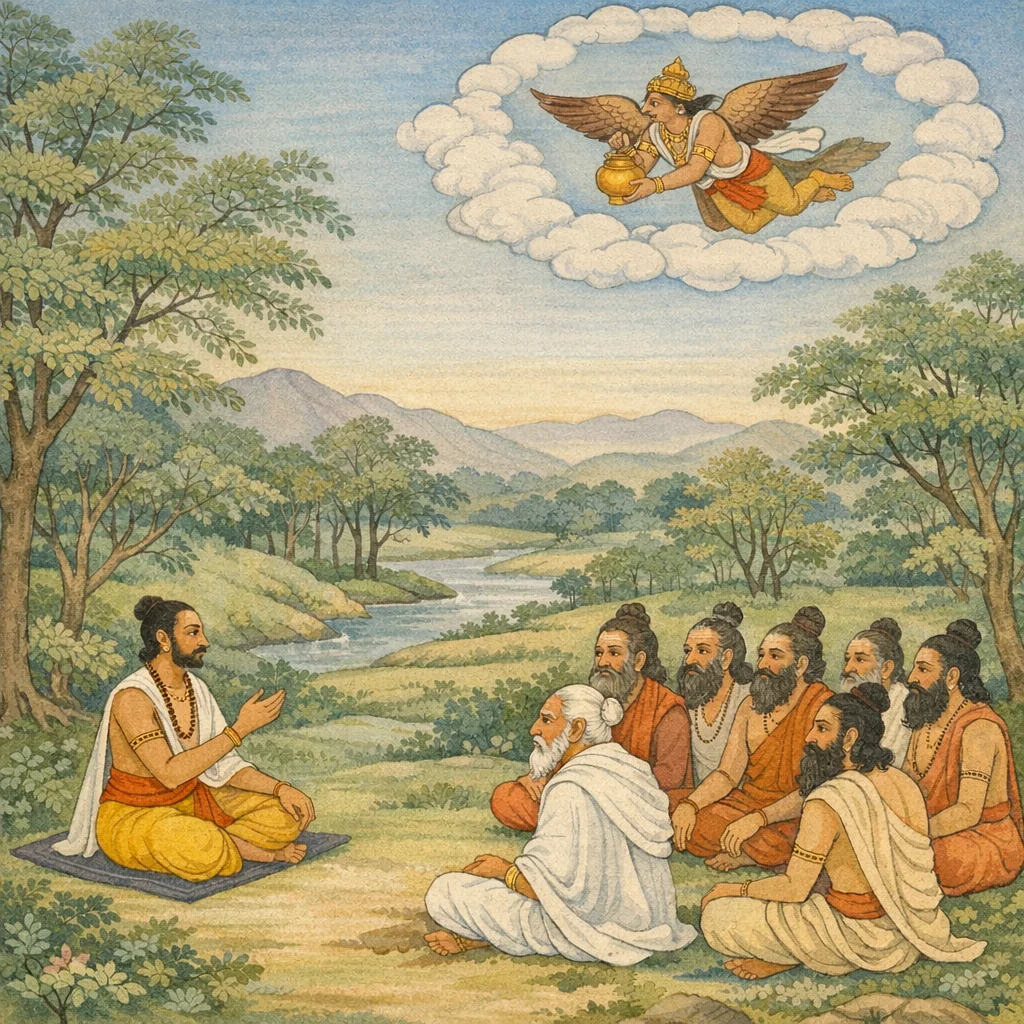
In the Naimiṣāraṇya setting, as Śaunaka and the sages seek instruction, Sūta first establishes the Garuḍa Purāṇa’s authority through a sacred transmission: Viṣṇu teaches Brahmā, Brahmā teaches Rudra, Rudra teaches Vyāsa, and Vyāsa teaches Sūta, who now teaches the assembled ṛṣis. He then gives an ordered preview of the Purāṇa’s scope—cosmogony, worship, tīrthas, the structure of the lokas, manvantaras, varṇa–āśrama duties, charity and kingship, jurisprudence, vows (vrata), genealogies, and āyurvedic causation. The chapter ends by glorifying Garuḍa’s identity and deeds under Vāsudeva’s grace (amṛta-haraṇa, association with the cakra, destruction of nāgas), presenting recitation as bestowing blessings. This synopsis prepares the reader for a systematic movement from cosmology and dharma to applied disciplines and devotional efficacy in the chapters ahead.
Shlokas
Verse 1
नाम द्वितीयो ऽध्यायः सूत उवाच / इति रुद्राब्जजो विष्णोः शुश्राव ब्रह्मणो मुनिः / व्यासो व्यासादहं वक्ष्येहं ते शौनक नैमिषे
Sūta said: Thus the sage born from the lotus (Brahmā) heard this teaching from Viṣṇu, and Rudra heard it from Brahmā. Vyāsa heard it from Rudra, and I have heard it from Vyāsa; now I shall declare it to you, O Śaunaka, here in Naimiṣa.
Verse 2
मुनीनां शृण्वतां मध्ये सर्गाद्यं देवपूजनम् / तीर्थं भुवनकोशं च मन्वन्तरमिहोच्यते
Amid the sages who listen, it is here explained: creation and its first beginnings, the worship of the gods, the tīrthas—holy places of pilgrimage—the structure of the worlds, and the Manvantaras, the cosmic ages of the Manus.
Verse 3
वर्णाश्रमादिधर्माश्च दानराजादिधर्मकाः / व्यवहारो व्रतं वंशा वैद्यकं सनिदानकम्
This Purāṇa also sets forth the duties beginning with those of varṇa and āśrama, the dharmas of charity (dāna) and of kings, the principles of legal procedure, vows and observances (vrata), lineages, and medical knowledge together with its causes (diagnosis).
Verse 4
अङ्गानि प्रलयो धर्मकामार्थज्ञानमुत्तमम् / सप्रपञ्चं निष्प्रपञ्चं कृतं विष्णोर्निगद्यते
The limbs (constituent parts), dissolution (pralaya), dharma, kāma, artha, and the highest knowledge—together with what is with manifestation (sa-prapañca) and what is beyond manifestation (niṣ-prapañca)—are declared to be the work of Viṣṇu.
Verse 5
पुराणे गारुडे सर्वं गरुडो भगवानथ / वासुदेवप्रसादेन सामर्थ्यातिशयैर्युतः
In the Garuḍa Purāṇa, everything is taught by the Blessed Lord Garuḍa, endowed with extraordinary powers through the grace of Vāsudeva.
Verse 6
भुत्वा हरेर्वाहनं च सर्गादीनां च कारणम् / देवान्विजित्य गरुडो ह्यमृताहरणं तथा
Becoming Hari’s vāhana (mount) and a causal power behind creation and the rest, Garuḍa—having conquered the gods—also became the bringer of amṛta, the nectar of immortality.
Verse 7
चक्रे क्षुधा हृतं यस्य ब्रह्माण्डमुदरे हरेः / यं दृष्ट्वा स्मृतमात्रेण नागान्दीनां च संक्षयः
When He became the discus (Cakra), through hunger, it was as though the entire cosmic egg (Brahmāṇḍa) were swallowed into Hari’s belly. By merely seeing Him—or even by remembering Him—destruction befalls the Nāga-serpents and the like.
Verse 8
कश्यपो गारुडाद्वृक्षं दग्धं चाजीवयद्यतः / गरुडः स हरिस्तेन प्रोक्तं श्रीकश्यपाय च
Because Kaśyapa restored to life a tree that had been burned by Garuḍa, that very Garuḍa was therefore called “Hari”; and this too was declared by him to the venerable Śrī Kaśyapa.
Verse 9
तच्छ्रीमद्रारुडं पुण्यं सर्वदं पठतस्तव / वक्ष्ये व्यासं नमस्कृत्य शृणु शौनक तद्यथा
That glorious and sacred Garuḍa Purāṇa, which grants every blessing to one who recites it—I shall now expound, after bowing to Vyāsa. Listen, O Śaunaka, just as it is.
Frequently Asked Questions
To establish prāmāṇya (textual authority) and continuity: the knowledge is presented as originating with Viṣṇu and preserved through Brahmā, Rudra, and Vyāsa before reaching Sūta. This signals that the coming teachings on dharma, cosmology, and practice are not merely speculative but received and transmitted within an orthodox framework.
By recalling Garuḍa as the bringer of amṛta and as empowered by Vāsudeva, the chapter turns myth into theology: Garuḍa embodies divine assistance that overcomes mortality and obstacles. This supports the Purāṇa’s claim that listening/reciting it is blessing-bearing and that devotion (smaraṇa) has protective and transformative effects.