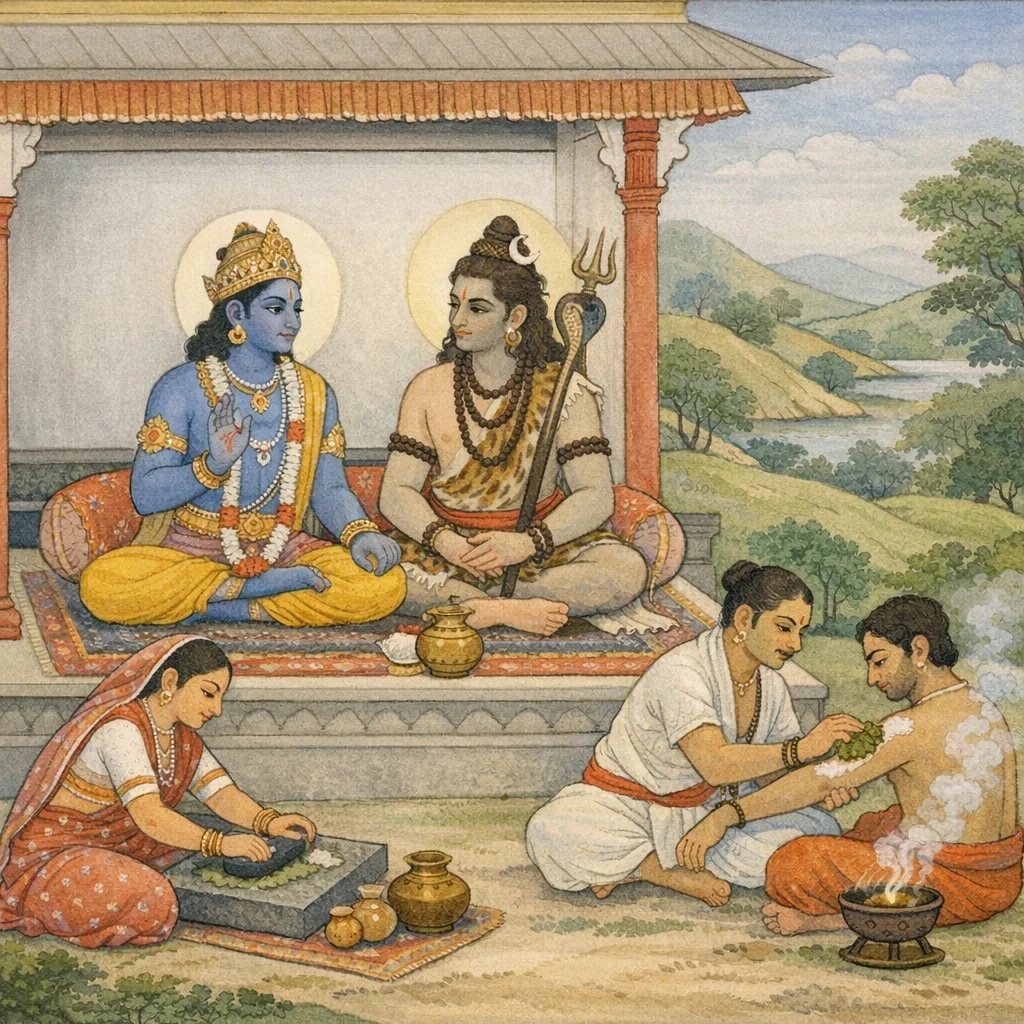
Adhyaya 188
Remedial Formulas for Wounds (Vraṇa), Sinus/Fistula (Nāḍī-vraṇa), Swellings (Granthikā), and Bhūta/Graha Afflictions
Continuing the Purāṇic transmission of applied dharma-knowledge, Hari instructs Śaṅkara in a sequence of specific remedies. First, for acute wounds, apāmārga root-juice is applied to stop bleeding and prevent ulceration and suppuration. Next come difficult, quasi-surgical conditions: foreign bodies lodged in wounds are drawn out by anointing with a compound of rudra-lāṅgalikā, cekṣu, and darbha; chronic sinus-tract wounds (nāḍī-vraṇa) are soothed with bāla or meṣaśṛṅgī root paste, while a stronger regimen (buffalo-hoof substance with kodrava meal and hiṅgu-root powder) is said to remove nāḍī-vraṇa. Blood disorders are treated with brahmayaṣṭi fruit paste, and a powdered mixture (barley-ash, viḍaṅga, gandha-pāṣāṇa, dry ginger) is prepared with blood, indicating specialized pharmaceutics. The chapter then addresses swellings and boils (lizard-fat; saubhāñjana seeds; mustard with non-sour buttermilk for granthikā). Finally it turns to rakṣā: white aparājitā nasya and a multi-ingredient plaster drive away bhūtas; collyrium counters seizing spirits; guggulu fumigation with owl-tail dispels graha afflictions, concluding with a protective rule of conduct after quartan fever, and setting continuity with later chapters where bodily regimen and ritual protection remain intertwined.
Shlokas
Verse 1
ऽध्यायः हरिरुवाच / निर्व्रणः स्यात्पूयंहीनो प्रहारो घृपूरितः / अपामार्गस्य वै मूलं हस्ताभ्याञ्च विमर्दितम् / तद्रसेन प्रहारस्य रक्तस्त्रावो न पूरणात्
Hari said: “A wound becomes free from ulceration, without pus, and filled with ghee. The root of apāmārga, well rubbed between the hands—when its juice is applied to the injured spot, the bleeding does not continue and the wound does not fester.”
Verse 2
रुद्र लाङ्गलिकामूलं चेक्षुदर्भस्तथैव च / तेन व्रणमुखं लिप्तं शल्यं निः स रति व्रणात् / चिरकालप्रविष्टो ऽपि तेन मार्गेण शङ्कर
O Śaṅkara, take the root of the herb called rudra-lāṅgalikā, and also cekṣu and darbha. When the mouth of the wound is anointed with it, the embedded foreign body comes out of the wound—even if it has been lodged there a long time—by that very channel.
Verse 3
बालमूलं मेषशृङ्गीमूलं वा वारिघर्षितम् / तेन लिप्तं चिरं जातं व्रणं नाड्याः प्रशाम्यति
If the root of bāla or the root of meṣaśṛṅgī is ground with water and applied, then even a long-standing nāḍī-wound—a sinus or tract—becomes pacified and heals.
Verse 4
जग्धं माहिषपध्ना च युक्तं कोद्रवभक्तकम् / हिङ्गुमूलस्य वै चूर्णं दत्तं नाडीव्रणापहम्
When a buffalo’s hoof (or a hoof-derived substance) is consumed with a meal of kodrava grain, and the powder of the root of hiṅgu (asafoetida) is administered, it removes nāḍī-vraṇa—sinus/fistula-type wounds of the channels.
Verse 5
ब्रह्मयष्टिफलं पिष्टं वारिणा तेनलेपितम् / तेन घृष्टं रक्तदोषः प्रणश्यति न संशयः
The fruit of brahmayaṣṭi, ground into a paste with water and applied as a smear—by rubbing with it, disorders of the blood (raktadoṣa) are destroyed; of this there is no doubt.
Verse 6
यवभस्म विडङ्गञ्च गन्धपाषाणमेव च / शुण्ठिरेषाञ्चैव चूर्णं भ्वितं रुधिरेणवै
Barley-ash, viḍaṅga, and the fragrant mineral-stone (gandha-pāṣāṇa), together with dry ginger—these are to be ground into a powder and truly impregnated (prepared) with blood.
Verse 7
कृकलासस्य तल्लिप्तं विद्रधिं नाशयेच्छिव / सौभाञ्जनस्य बीजानि त्वतसीमसिना सह
O Śiva, an abscess (vidradhi) is destroyed by applying a preparation anointed with the fat of a lizard; likewise, the seeds of saubhāñjana, together with tvatasī and masinā, are used as a remedy.
Verse 8
सौरसर्षपयुक्तानि सर्वाण्येतानि शङ्कर / पिष्टान्यनम्लतक्रेण ग्रन्थिकं नाशयेद्धि वै
O Śaṅkara, all these remedies, combined with mustard and then ground with non-sour buttermilk, indeed destroy the condition called granthikā (a glandular knot or swelling).
Verse 9
श्वेतापराजितामूलं पिष्टं तण्डुलवारिणा / तेन नस्यप्रदानात्स्याद्भूतवृन्दस्य विद्रवः
The root of the white aparājitā, ground and mixed with rice-water—when administered as nasya (a nasal remedy), it drives away a host of bhūtas (malevolent spirits).
Verse 10
अगस्त्यपुष्पनस्यं वै समरीचं तु शूलहृत् / भुजङ्गचर्म वै हिङ्गु निम्बपत्रं तथा यवाः / गौरसर्षम एभिः स्याल्लेपो भूतहरः शिव
A paste made from agastya-flower nasya, black pepper, a pain-removing herb, snake-skin, hiṅgu (asafoetida), neem leaves, barley, and white mustard—when applied as a plaster—becomes, O Śiva, a Śiva-blessed remedy that drives away afflictive bhūtas (spirits).
Verse 11
गोरोचना मरीचानि पिप्पली सैन्धवं मधु / अञ्जनं कृतमेभिः स्याद्ग्रहभूतहरं शिव
O auspicious one, an eye-collyrium (añjana) prepared from gorocanā, black pepper, pippalī (long pepper), rock-salt, and honey becomes a remover of afflictions caused by seizing spirits—grahas and bhūtas.
Verse 12
गुग्गुलूलूकपुच्छाभ्यां धूपो ग्रहहरो भवेत् / चातुर्थिकज्वरैर्मुक्तो कृष्णवस्त्रावगुण्ठितः
Fumigation (dhūpa) made with guggulu and an owl’s tail is said to dispel afflictions of the grahas. When one is freed from quartan fever, one should remain veiled or covered with a black cloth.
Frequently Asked Questions
Adhyāya 188 states that apāmārga root, well-rubbed and applied as juice to the injured spot, stops continued bleeding and helps the wound remain free from ulceration and pus, described metaphorically as becoming “filled with ghee,” i.e., conducive to healing/ropana.
The text prescribes an anointment using the root of rudra-lāṅgalikā along with cekṣu and darbha; when applied to the wound’s mouth, the foreign body is said to emerge through the same channel even if lodged for a long time—indicating a traditional śalya-extraction approach.