Adhyaya 175
Jvara-Chikitsa: Doṣa-wise Fever Management, Medicated Waters, and Escalation Therapies
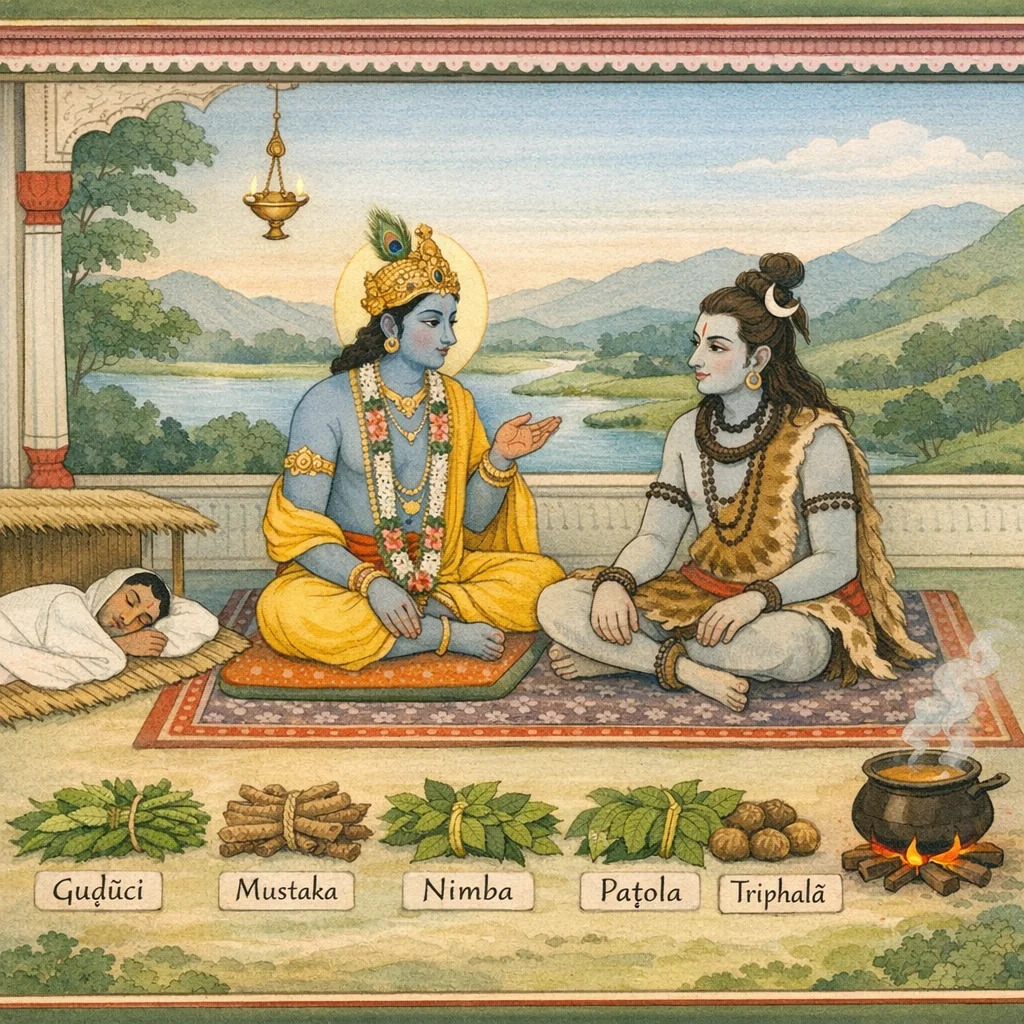
Continuing the remembrance of Viṣṇu as Dhanvantari and the Ayurvedic lineage to Suśruta, Hari instructs Śaṅkara in a structured management of fever (jvara). The chapter opens with a universal regimen—fasting/lightening therapy, boiled water, and shelter from wind—then gives doṣa-wise remedies: guḍūcī–mustaka for vāta-jvara; ghṛta with cooling aromatics (uśīra, candana, etc.) for pitta-jvara; and ginger–durālabhā with ghṛta for kapha-jvara. It further teaches multi-ingredient decoctions (nimba, dhānyā/coriander, paṭola, triphalā) to kindle appetite and normalize vāta. For sannipāta (tri-doṣic) fever, turmeric–nimba–triphalā–mustaka–devadāru is emphasized, along with a kaṭurohiṇī–paṭola decoction as tridoṣa-pacifying. Supportive measures include managing thirst with warm or very cool water according to doṣa and symptoms, and bilvādi pañcamūla for vāta-fever. In severe cases with insensibility, stronger measures are permitted: cauterization of soles/forehead and purgation using bitter groups with milk. Thus the chapter bridges gentle regimen and intensive śodhana, establishing fever as a central axis of diagnosis and therapy.
Shlokas
Verse 1
नाम चतुः सप्तत्युत्तरशततमो ऽध्यायः रुद्र उवाच / एवं धन्वन्तरिर्विष्णुः सुश्रुतादीनुवाच ह / हरिः पुनर्हरायाह नानायोगान्रुगर्दनान्
This is the one-hundred-and-seventy-fifth chapter. Rudra said: Thus did Viṣṇu, as Dhanvantari, instruct Suśruta and others; and Hari again explained to Hara various therapeutic procedures that destroy diseases.
Verse 2
हरिरुवाच / सर्वज्वरेषु प्रथमं कार्यं शङ्कर लङ्घनम् / क्वथितोदकपानं च तथा निर्वातसेवनम्
Hari said: In all fevers, O Śaṅkara, the first measure is langhana—fasting or lightening therapy; also drink boiled water, and stay in a place sheltered from drafts.
Verse 3
अग्निस्वेदाज्ज्वरास्त्वेवं नाशमायान्तिहीश्वर / वातज्वरहरः क्वाथो गुडूच्या मुस्तकेन च
O Lord, thus fevers come to an end through fomentation by heat and the bringing forth of sweat. A decoction of guḍūcī together with mustaka removes fever born of vāta.
Verse 4
दुरालभैश्चैव घृतं पित्तज्वरहरः शृणु / शुण्ठीपर्पटमुस्तैश्च बालकोशीरचन्दनैः
Listen: ghee prepared with durālabhā, and also with dry ginger, parpaṭa, musta, bālaka, uśīra, and sandalwood, is a remedy that alleviates pitta-type fever.
Verse 5
साज्यः क्वाथः श्लेष्मजं तु सशुण्ठिः सदुरालभः / सवालकः सर्वज्ज्वरं सशुण्ठिः सहपर्पटः
A decoction taken with ghee—containing dry ginger and durālabhā—alleviates fever arising from śleṣman (kapha). With vālaka added it is effective for all fevers; and with dry ginger and parpaṭa together it acts broadly against fever.
Verse 6
किराततिक्तैर्नारीगुडूचीशुण्ठिमुस्तकैः / पित्तज्वरहरः स्याच्च शृण्वन्यं योगमुत्तमम्
With kirāta-tikta (the bitter herb), nārī, guḍūcī, dry ginger, and musta, this formulation becomes a remover of pitta-type fever. Now listen to another excellent remedy.
Verse 7
वालकोशीरपाठाभिः कण्टकारिकमुस्तकैः / ज्वरनुच्च कृतः क्वाथस्तथा वै सुरदारुणा
A decoction prepared with vālaka, uśīra (vetiver), pāṭhā, kaṇṭakārikā, and musta also alleviates fever; likewise, a preparation with sura-dāru is indeed fever-relieving.
Verse 8
धन्याकनिम्बमुस्तानां समधुः स तु शङ्कर / पटोलपत्रयुक्तस्तु गुडूचीत्रिफलायुतः
O Śaṅkara, a preparation of coriander (dhānyā), neem, and musta, taken together with honey, is beneficial; and when combined with paṭola leaves, along with guḍūcī and triphalā, it becomes another effective remedy.
Verse 9
पीतो ऽखिलज्वरहरः क्षुधाकृद्वातनुत्त्विदम् / हरीतकीपिप्लीनामामलीचित्रकोद्भवम्
When taken as a drink, this formulation removes all kinds of fever, kindles appetite, and pacifies vāta. It is prepared from harītakī, pippalī, nāma (a pungent drug), āmalakī, and citraka.
Verse 10
चूर्णं ज्वरं च क्वथितं धान्य (धन्या) कोशीरपपर्पटैः / आमलक्या गुडूच्या च मधुयुक्तं सचन्दनम्
A powdered medicine and a decoction for fever are prepared with dhānyā, kośīra, and paparpaṭa; along with āmalakī and guḍūcī—mixed with honey and combined with sandalwood.
Verse 11
समस्तज्वरनुच्च स्यात्सन्निपातहरं शृणु / हरिद्रानिम्बत्रिफलामुस्तकैर्देवदारुणा
It becomes a remover of all fevers; listen to the remedy that destroys sannipāta (the combined-doṣa fever): made with turmeric, neem, triphalā, mustaka, and devadāru.
Verse 12
कषायं कटुरोहिण्या सपटोलं सपत्रकम् / त्रिदोषज्वरनुच्चस्यात्पीतं तु क्वथितं जलम्
A decoction prepared with kaṭurohiṇī, together with paṭola and its leaves, and taken as boiled water to drink, alleviates fever arising from all three doṣas.
Verse 13
कण्टकार्या नागरस्य गुडूच्या पुष्करेण च / जग्ध्वा नागबलाचूर्णं श्वसकासादिनुद्भवेत्
With kaṇṭakārī, dry ginger, guḍūcī, and puṣkara; when nāgabala powder is consumed, it relieves breathlessness, cough, and related ailments.
Verse 14
कफवातज्वरे देयं जलमुष्णं पिपासिने / विश्वपर्पटकोशीरमुस्तचन्दनसाधितम्
In fever due to kapha and vāta, warm water should be given to one who is thirsty—water prepared with viśva-parpaṭa, kośīra, musta, and sandalwood.
Verse 15
दद्यात्सुशीतलं वारि तृट्छर्दिज्वरदाहनुत् / बिल्वादिप पञ्चमूलस्य क्वाथः स्याद्वातिके ज्वरे
One should give very cool water, which alleviates thirst, vomiting, fever, and burning. In vāta-fever, a decoction of the Bilvādi pañcamūla (five roots beginning with bilva) should be administered.
Verse 16
पाचनं पिप्पलीमूलं गुडृचीविश्वभेषजम् / वातज्वरे त्वयं क्वाथो दत्तः शान्तिकरः परः
Pippalī-root kindles digestion, and guḍūcī is a universal medicine. For vāta-fever, this decoction, when given, is exceedingly pacifying and brings relief.
Verse 17
पित्तज्वरघ्नः समधुः क्वाथः पर्पटनिम्बयोः / विधाने क्रियमाणे ऽपि य्सय संज्ञा न जायते
A decoction of parpaṭa and nimba, taken together with honey, destroys pitta-fever. Even while treatment is being carried out, for one whose consciousness does not arise (who remains insensible), this is the prescribed measure.
Verse 18
पादयोस्तु ललाटे वा दहेल्लौहशलाकया / तिक्ता पाठा पर्पटाश्च विशाला त्रिफला त्रिवृत् / सक्षीरो भेदनः क्वाथः सर्वज्वरविशोधनः
One may cauterize, for therapy, either the soles of the feet or the forehead with a heated iron rod. A decoction of bitter herbs—tiktā, pāṭhā, parpaṭa, viśālā, triphalā, and trivṛt—taken with milk acts as a purgative and purifies the body from all kinds of fevers.
Frequently Asked Questions
It aligns therapies with doṣa qualities: vāta-jvara receives warming/digestive and stabilizing herbs (e.g., guḍūcī with mustaka; bilvādi pañcamūla), pitta-jvara emphasizes cooling and bitter measures (candana, uśīra, nimba/parpaṭa with honey), and kapha-jvara uses pungent/digestive combinations (dry ginger, durālabhā) often paired with ghṛta to support agni while reducing heaviness.
It gives a dedicated formulation—haridrā (turmeric), nimba, triphalā, mustaka, and devadāru—explicitly aimed at sannipāta-jvara, and also recommends kaṭurohiṇī with paṭola (and leaves) as a decoction-drink that alleviates fever arising from all three doṣas, indicating a bitter-purifying and balancing strategy.
Alongside ongoing medicinal management, the text prescribes stronger interventions: therapeutic cauterization with a heated iron rod on the soles or forehead, and purgation using a bitter-herb decoction (tiktā group with pāṭhā, parpaṭa, viśālā, triphalā, trivṛt) taken with milk—intended to cleanse and resolve persistent fever states.