Adhyaya 17
Sūrya-upāsanā: Lotus Mandala, Mudrā, Dik-nyāsa, and the Twelve Ādityas
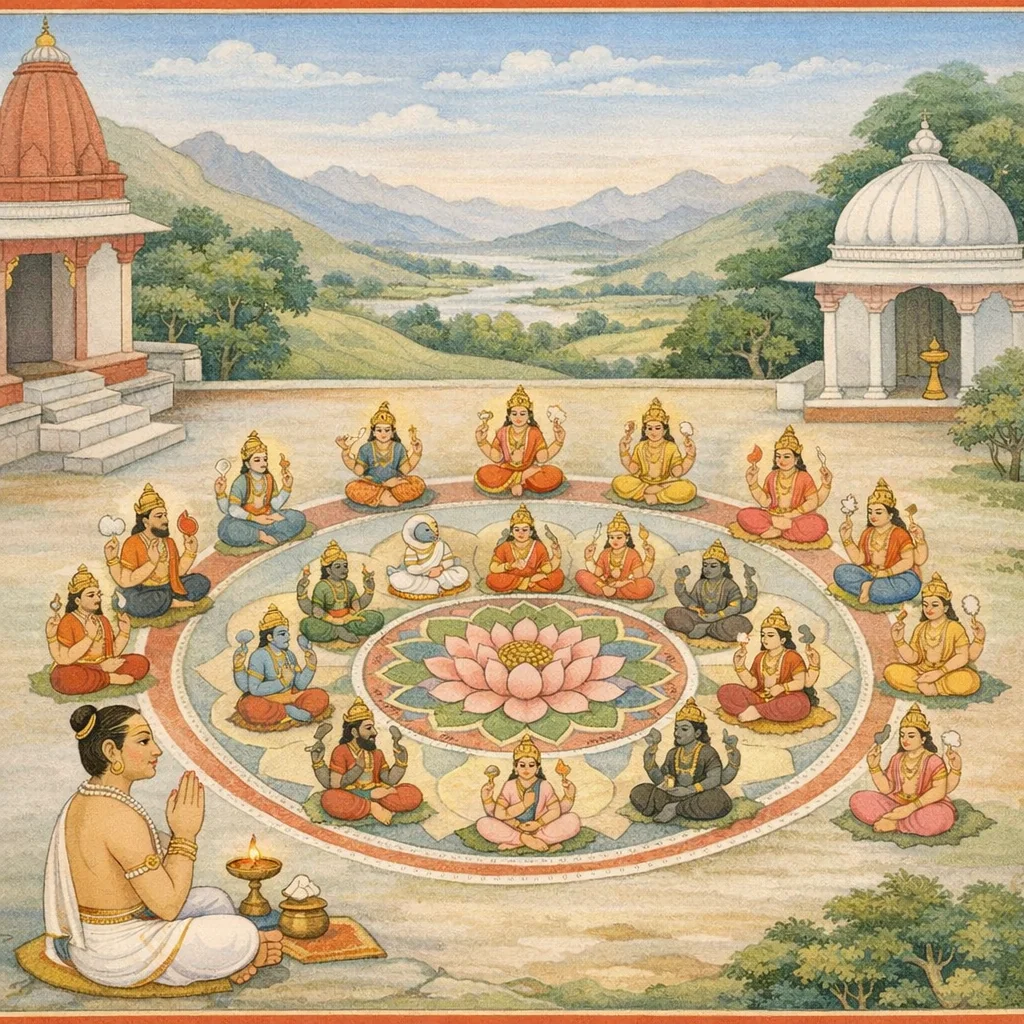
Continuing the ācāra-based teaching on effective worship, Hari (Viṣṇu) instructs Śiva in a wealth-bestowing Sūrya rite that begins by forming an eight-petalled lotus mandala in a purified place. The worshipper invokes the Sun with the āvāhanī-mudrā, establishes the ritual vessel (kalaśa), and fixes the mantra-embodying mudrā to anchor divine presence. The chapter then explains dik-nyāsa: installing the Lord’s heart, head, and śikhā in prescribed quarters, followed by placing Dharma, the Eye (cakṣus), and protective weapons through the directions to create a guarded sacred field. An outer perimeter assigns Soma, Lohita, Soma’s son, Bṛhaspati, Śukra, Śani, Ketu, and Rāhu to their respective quarters, integrating astral order into the mandala. In the second enclosure, worship turns to the twelve Ādityas, named as twelve forms of Viṣṇu, and concludes with reverent honor to the Devas and victory-powers (Jayā, Vijayā, Jayantī, Aparājitā) together with nāgas such as Śeṣa and Vāsuki, preparing for further elaborations of protective and expansive worship.
Shlokas
Verse 1
नाम षोडशो ऽध्यायः हरिरुवाच / पुनः सूर्यार्चनं वक्ष्ये यदुक्तं धनदाय हि / अष्टपत्रं लिखेत्पद्मं शुचौ देशे सकर्णिकम्
Hari (Lord Viṣṇu) said: “Again I shall explain the worship of the Sun, which is said to bestow wealth. In a pure place one should draw an eight‑petalled lotus, complete with its central pericarp (karnikā).”
Verse 2
आवाहनीं ततो बद्धा मुद्रामावाहयेद्रविम् / खखोल्कं स्थाप्य मुद्रां तु स्थापयेन्मन्त्ररूपिणीम्
Then, having formed the invocation (āvāhanī) mudrā, one should invoke Ravi, the Sun. Placing the khakholka vessel in its proper position, one should then establish the mudrā—the mudrā that embodies the mantra itself.
Verse 3
आग्नेय्यां दिशि देवस्य हृदयं स्थापयेच्छिव ! / ऐशान्यां तु शिरः स्थाप्यं नैरृत्यां विन्यसेच्छिखाम्
O Śiva! One should place the Lord’s “heart” in the south‑eastern direction; then the “head” should be placed in the north‑eastern direction, and the “śikhā” (topknot) should be arranged in the south‑western direction.
Verse 4
पौरन्दर्यां न्यसेद्धर्ंममेकाग्रस्थितमानसः / वायव्यां चैव नेत्रं तु वारुण्यामस्त्रमेव च
With a one-pointed, steady mind, one should place Dharma in Indra’s quarter; in Vāyu’s quarter one should place the Eye; and in Varuṇa’s quarter, indeed, the protective weapon.
Verse 5
ऐशान्यां स्थापयेत्सोमं पौरन्दर्यां तु लोहितम् / आग्नेय्यां सोमतनयं याम्यां चैव बृहस्पतिम्
In the north-east (Īśāna) direction one should install Soma; in Indra’s eastern quarter (Paurandarī) one should install Lohita; in the south-east (Āgneyī) one should install Soma’s son; and in the southern (Yāmya) direction, Bṛhaspati.
Verse 6
नैरृत्यां दानवगुरुं वारुण्यां तु शनैश्चरम् / वायव्यां च तथा केतुं कौबेर्यां राहुमेव च
In the south‑west (Nairṛti) one places the preceptor of the Dānavas, Śukra; in the west (Varuṇa’s quarter) one places Śani; in the north‑west (Vāyu’s quarter) one places Ketu; and in the north (Kubera’s quarter) one places Rāhu as well.
Verse 7
द्वितीयायां तु कक्षायां सूर्यान्द्वादश पूजयेत् / भगः सूर्योर्ऽय्यमा चैव मित्रो वै वरुणस्तथा
In the second enclosure (kakṣā), one should worship the twelve forms of the Sun—Bhaga, Sūrya, Aryamā, Mitra, and also Varuṇa.
Verse 8
सविता चैव धाता च विवस्वांश्च महाबलः / त्वष्टा पूषा तथा चेन्द्रो द्वादशो विष्णुरुच्यते
Savitṛ and Dhātṛ, mighty Vivasvān, Tvaṣṭṛ, Pūṣan, and Indra—these (together with the others) are spoken of as the twelve forms of Viṣṇu.
Verse 9
पूर्वादावर्चयेद्देवानिन्द्रादीञ्छ्रद्धया नरः / जया च विजया चैव जयन्ति चापराजिता / शेषश्च वासुकिश्चैव नागानित्यादि पूजयेत्
Beginning in the east, a man should worship the Devas with faith, starting with Indra. He should also worship the divine powers Jayā, Vijayā, Jayantī, and Aparājitā; and likewise Śeṣa and Vāsuki, and the Nāgas and others.
Frequently Asked Questions
The eight-petalled lotus functions as the ritual mandala-body (adhiṣṭhāna) for installing Sūrya’s presence. It provides a structured locus for invocation, enclosure-based worship, and directional placements, turning an ordinary space into an ordered sacred field.
This is a form of nyāsa (ritual installation) that distributes divine embodiment across space. By assigning key ‘limb’ loci to quarters, the practitioner establishes a stabilized presence and a protective geometry consistent with Purāṇic-Āgamic ritual logic.
The text explicitly states that Bhaga, Sūrya, Aryamā, Mitra, Varuṇa, Savitṛ, Dhātṛ, Vivasvān, Tvaṣṭṛ, Pūṣan, and Indra are the twelve forms of Viṣṇu. Thus, worship of the twelve solar forms is framed as Vaiṣṇava in essence.