Adhyaya 18
Daṇḍanātha-Śyāmalā Senāyātrā (The Marshal Śyāmalā’s Military Procession) / दण्डनाथश्यामला सेनायात्रा
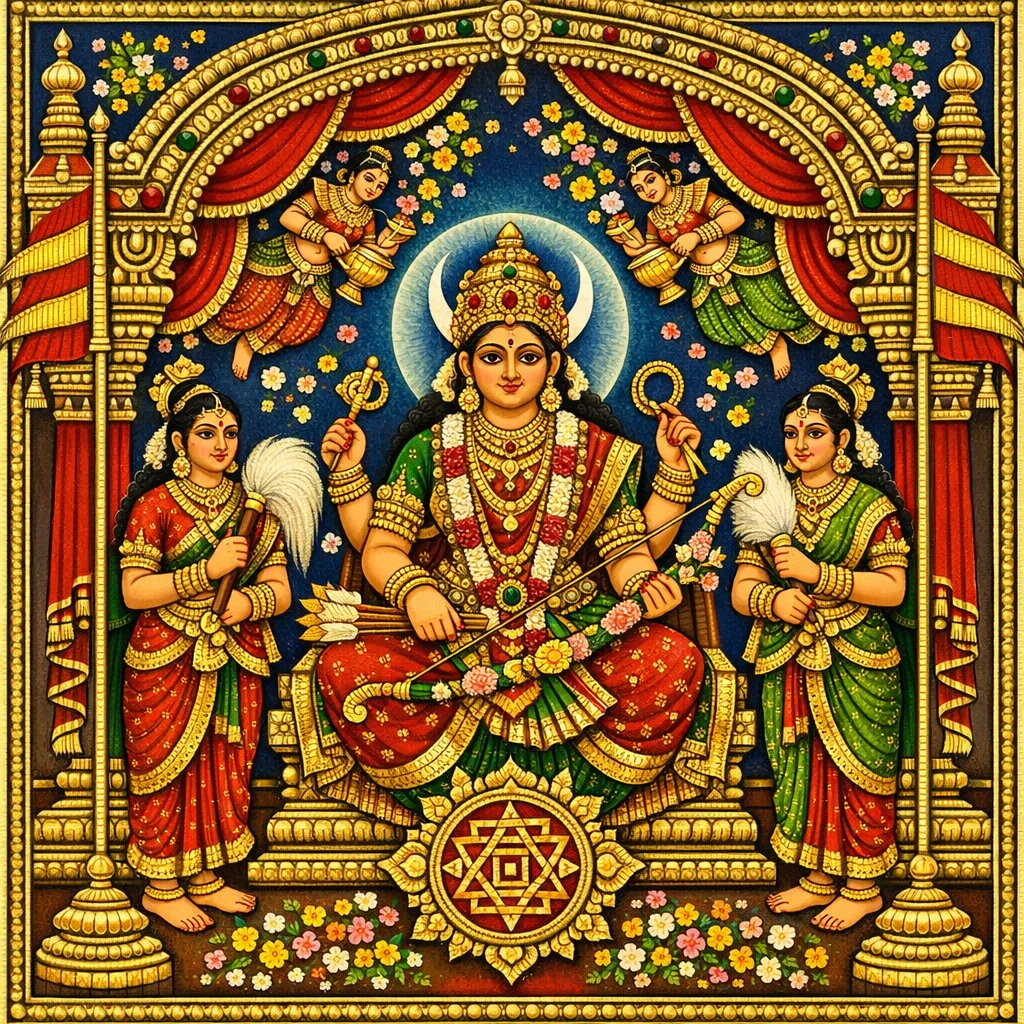
This adhyāya is set within the Hayagrīva–Agastya dialogue of the Lalitopākhyāna. It opens with a dense poetic vision of Śyāmalā’s royal-martial epiphany as daṇḍanātha (commander/marshal), marked by ankush-like authority, pāśa imagery, bow-and-flower-arrow iconography, and moonlike radiance. The narrative then turns to the ceremonial order of divine sovereignty: attendants such as Vijayā fan her with cāmara whisks; apsarases scatter auspicious victory offerings; Nityā deities stand near her feet; and her insignia is described on a cosmological scale, including a Śrīcakra-like tilaka and towering banners. The rhetoric stresses the inexpressible—beyond speech and mind—presenting Śakti’s rule as a cosmic fact. The chapter ends with Agastya requesting the “twenty-five names” as aural nectar (karṇarasāyana), and Hayagrīva beginning to enumerate Lalitā’s epithets, turning the procession into a transmissible litany for devotees and reciters.
Shlokas
Verse 1
इति श्रीब्रह्माण्डमहापुराणे उत्तरभागे हयग्रीवागस्त्यसंवादे ललितोपाख्याने दण्डनाथाश्यामलासेनायात्रा नाम सप्तदशो ऽध्यायः अथ राजनायिका श्रिताज्वलिताङ्कुशा फणिसमानपाशभृत् / कलनिक्वणद्वलयमैक्ष्वं धनुर्दधती प्रदीप्तकुसुमेषुपञ्चका
Thus, in the Śrī Brahmāṇḍa Mahāpurāṇa, in the latter section, in the dialogue of Hayagrīva and Agastya, within the Lalitā narrative, is the seventeenth chapter called “The March of Śyāmalā’s Army under Daṇḍanātha.” Then the royal commander (rājanāyikā), leaning on a blazing goad (aṅkuśa) and bearing a serpent-like noose, her bangles chiming, held the sugarcane bow and five radiant flower-arrows.
Verse 2
उदयत्सहत्स्रमहसा सहस्रतो ऽप्यतिपाटलं निजवपुः प्रभाझरम् / किरती दिशासु वदनस्य कान्तिभिः सृजतीव चन्द्रमयमभ्रमण्डलम्
With radiance like the rising of a thousand suns, her own form—lotus-red beyond all measure—poured forth the splendors of her face to every quarter, as though creating a cloud-circle made wholly of moonlight.
Verse 3
दशयोजनायतिमाता जगत्त्रयीमभिवृण्वता विशदमौक्तिकात्मना / धवलातपत्रवलयेन भासुरा शशिमण्डलस्य सखितामुपेयुषा
A radiant ring of white parasol, clear as pure pearl, spanning ten yojanas and seeming to canopy the three worlds, shone splendidly—as though it had become the companion of the moon’s orb.
Verse 4
अभिवीजिता च मणिकान्तशोभिना विजयादिमुख्यपरिचारिकागणैः / नवचन्द्रिकालहरिकान्तिकन्दलीचतुरेण चामरचतुष्टयेन च
She was fanned by the foremost handmaidens—Vijayā and the rest—shining with jewel-like splendor, and also by four cāmaras, deft and cool in radiance like the light of a new moon.
Verse 5
शक्त्यैकराज्यपदवीमभिसूचयन्ती साम्राज्यचिह्नशतमण्डितसैन्यदेशा / संगीतवाद्यरचनाभिरथामरीणां संस्तूयमानविभवा विशदप्रकाशा
By her power she proclaimed the station of sole sovereignty; her martial realm was adorned with hundreds of imperial emblems; and her glory, praised by the apsarases through music and instruments, shone forth in lucid radiance.
Verse 6
वाचामगोचरमगोचरमेव बुद्धेरीदृक्तया न कलनीयमनन्यतुल्यम्
It lies beyond the reach of speech, beyond even the reach of thought; in such a state it cannot be measured—without any equal.
Verse 7
त्रैलोक्यगर्भपरिपूरितशक्तिचक्रसाम्राज्यसंपदभिमानमभिस्पृशन्ती / आबद्धभक्तिविपुलाञ्जलिशेखराणामारादहंप्रथमिका कृतसेवनानाम्
She touched the pride of the power-wheel that fills the womb of the three worlds, and of imperial prosperity; and near those who served with bound devotion, bearing great añjali upon their heads, she shone with primacy, as though declaring, “I am the first.”
Verse 8
ब्रह्मेशविष्णुवृषमुख्यसुरोत्तमानां वक्त्राणिवर्षितनुतीनि कटाक्षयन्ती / उद्दीप्तपुष्पशरपञ्चकतः समुत्थैज्योतिर्मयं त्रिभुवनं सहसा दधाना
She cast a sidelong glance upon the hymns that rained from the mouths of Brahmā, Īśa, Viṣṇu, and the foremost gods such as Vṛṣamukhya; and with the radiance arising from the five blazing flower-arrows, she suddenly filled the three worlds with light.
Verse 9
विद्युत्समद्युतिभिरप्सरसां समूहैर्विक्षिप्यमाणजयमङ्गललाजवर्षा / कामेश्वरीप्रभृतिभिः कमनीयभाभिः संग्रामवेषरचनासुमनोहराभिः
Hosts of apsarases, radiant like lightning, scattered showers of auspicious akṣata proclaiming victory; Kāmeśvarī and the rest, lovely in their splendor, were enchanting in their finely wrought attire of war.
Verse 10
दीप्तायुधद्युतितिरस्कृत भास्कराभिर्नित्याभिरङ्घ्रिसविधे समुपाक्यमाना / श्रीचक्रनामतिलकं दशयोजनातितुङ्गध्वजोल्लिखितमेघकदंबमुच्चैः
The Nityā goddesses, whose blazing weapon-splendor outshone the sun, drew near at the feet in attendance; the tilaka called “Śrīcakra” rose aloft like a mass of clouds grazed by a banner ten yojanas high.
Verse 11
तीव्राभिरावणसुशक्तिपरंपरभिर्युक्तं रथं समरकर्मणि चालयन्ती / प्रोद्यत्पिशङ्गरुचिभागमलांशुकेन वीतामनोहररुचिस्समरे व्यभासीत्
Driving in the work of war a chariot armed with a fierce succession of mighty weapons, clad in a spotless garment tinged with rising golden light, she shone upon the battlefield with captivating radiance.
Verse 12
पञ्चाधिकैर्विशतिनामरत्नैः प्रपञ्चपापप्रशमातिदक्षैः / संस्तूयमाना ललिता मरुद्भिः संग्राममुद्दिश्य समुच्चचाल
Praised by the Maruts with twenty-five jewel-like names, supremely skilled at quelling the sins of the world, Lalitā rose and set forth, intent upon the battle.
Verse 13
अगस्त्य उवाच वीजिवक्त्र महाबुद्धे पञ्चविंशतिनामभिः / ललितापरमेशान्या देहि कर्णरसायनम्
Agastya said: “O Vījivaktra, O great-minded sage, grant me the karṇa-rasāyana—the nectar for the ear—through the twenty-five names of Lalitā Parameśvarī.”
Verse 14
हयग्रीव उवाच सिंहासना श्रीललिता महाराज्ञी पराङ्कुशा / चापिनी त्रिपुरा चैव महात्रिपुरसुन्दरी
Hayagriva said: She is enthroned—Śrī Lalitā, the Great Queen, Parāṅkuśā; the bearer of the bow, Tripurā, and Mahātripurasundarī.
Verse 15
सुन्दरी चक्रनाथा च साम्राजी चक्रिणी तथा / चक्रेश्वरी महादेवी कामेशी परमेश्वरी
She is Sundarī, Lord of the Cakra, the Empress, the Cakriṇī; Cakreśvarī, Mahādevī, Kāmeśī, and Parameśvarī.
Verse 16
कामराजप्रिया कामकोटिगा चक्रवर्तिनी / महाविद्या शिवानङ्गवल्लभा सर्वपाटला
She is Kāmarājapriyā, Kāmakōṭigā, the Cakravartinī; Mahāvidyā, Śivā, Anaṅgavallabhā, and Sarvapāṭalā.
Verse 17
कुलनाथाम्नायनाथा सर्वाम्नायनिवासिनी / शृङ्गारनायिका चेति पञ्चविंशतिनामभिः
She is Kulanāthā, Āmnāyanāthā, the Dweller in all Āmnāyas, and Śṛṅgāranāyikā—thus praised by twenty-five names.
Verse 18
स्तुवन्ति ये महाभागां ललितां परमेश्वरीम् / ते प्राप्नुवन्ति सौभाग्यमष्टौ सिद्धीर्महद्यशः
Those who hymn the most blessed Lalitā, the Supreme Goddess, attain sacred good fortune, the eight siddhis, and great renown.
Verse 19
इत्थं प्रचण्डसंरंभं चालयन्ती महद्बलम् / भण्डासुरं प्रति क्रुद्धा चचाल ललितांबिका
Thus, stirring the mighty host with fierce ardor, Lalitāmbikā, wrathful toward Bhaṇḍāsura, advanced.
Frequently Asked Questions
No explicit solar/lunar royal genealogy is enumerated in the sampled verses; instead, the chapter encodes “divine sovereignty lineage” through titles and attendants, and it pivots into nāma-transmission (epithet lists) that function as a ritual taxonomy of Lalitā’s authority.
The imagery uses yojana-scale measures (e.g., umbrella/canopy spanning ‘ten yojanas’) and lunar/celestial metaphors to signal that the procession is not merely terrestrial; it is staged as a tri-loka (three-world) event, mapping Shākta power onto cosmic space.
It converts spectacle into sādhanā-ready knowledge: Agastya requests a compact liturgical unit (25 names) as “ear-nectar,” and Hayagrīva begins the epithet sequence (e.g., Siṃhāsanā, Śrīlalitā, Mahārājñī, Tripurā), establishing a recitable interface to the Goddess’s cosmological kingship.