Adhyaya 62
गान्धर्वमूर्छनालक्षणवर्णनम् (Description of Gandharva Mūrchanā Characteristics)
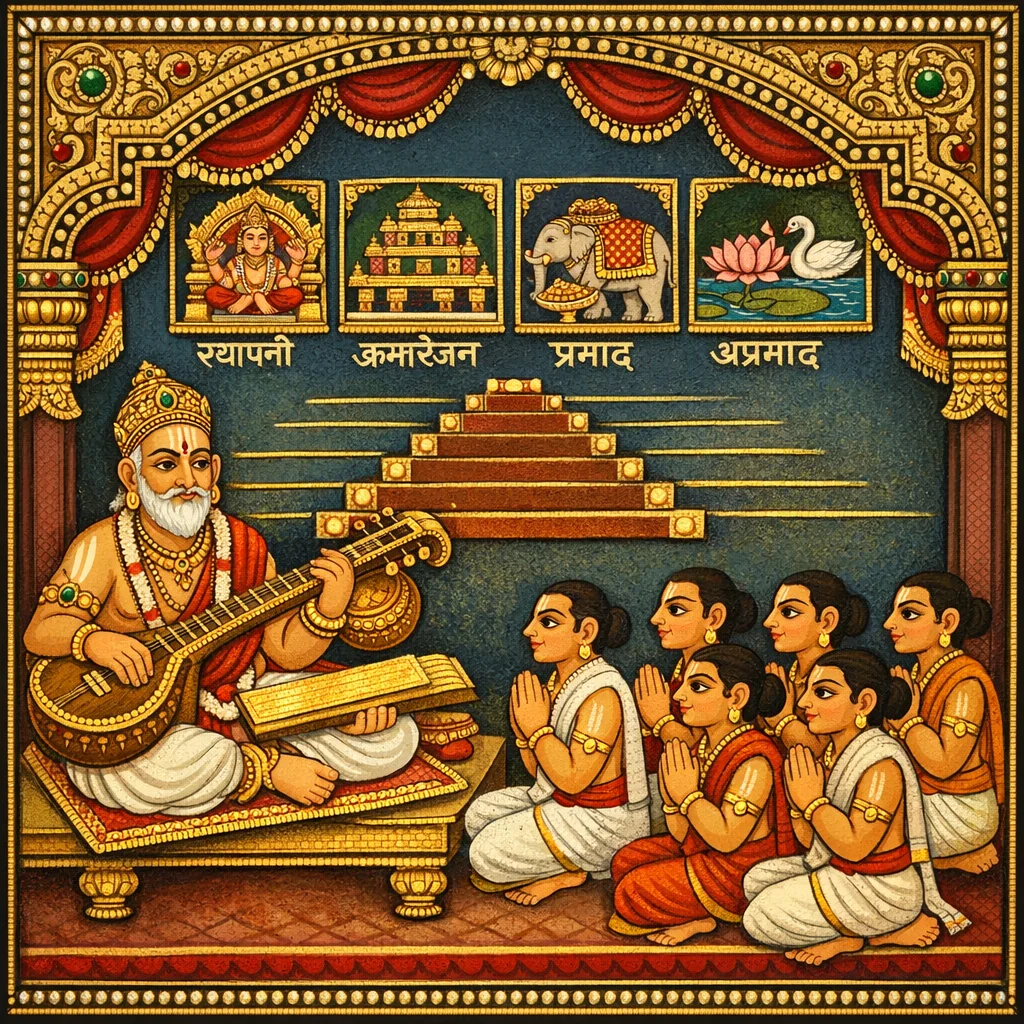
This chapter gives a technical account of Gandharva (classical) music, presented faithfully as the doctrine of earlier ācāryas (pūrvācārya-mata). It explains how sonic ornaments/figures (alaṅkāra) are to be performed according to varṇa-types and their proper placements, and how a gītaka (song-form) is completed through vākyārtha/pada-yoga together with ornamentation. It distinguishes operational loci of sound-production (notably throat- and head-related placements) and sets out classifications: four foundational varṇas, further divided by human practice and expanded in divine systems into eightfold and sixteenfold schemes. The chapter then defines movement-types—sañcāra (circulation), avarohaṇa (descent), and ārohaṇa (ascent)—and enumerates four principal alaṅkāras (sthāpanī, kramarejana, pramāda, apramāda), describing their lakṣaṇas. Overall, it reads as a compact handbook that orders sound through disciplined taxonomy to preserve tradition.
Shlokas
Verse 1
इति श्रीब्रह्माण्डे महापुराणे वायुप्रोक्ते मध्यमाभागे तृतीय उपोद्धातपादे गान्धर्वमूर्छनालक्षणवर्णनं नामैकषष्टितमो ऽध्यायः // ६१// पूर्वाचार्यमतं बुद्ध्वा प्रवक्ष्याम्यनुपूर्वशः / विख्यातान्वै अलङ्कारांस्तन्मे निगदतः श्रुणु
Thus, in the Śrī Brahmāṇḍa Mahāpurāṇa, in the middle section spoken by Vāyu, within the third introductory pāda, ends the sixty-first chapter entitled “The Description of the Marks of Gāndharva Mūrchanā.” Now, having understood the view of the former ācāryas, I shall set forth in due order the renowned alaṅkāras; hear my words.
Verse 2
अलङ्कारास्तु वक्तव्याः स्वैः स्वैर्वर्णैः प्रहेतवः / संस्था नयोगैश्च तथा सदा नाढ्याद्यवेक्षया
The alaṅkāras are to be stated with their respective varṇas and with their causes; and, in accordance with the ordinances of saṃhitā-niyoga, always with due regard to nāḍī and the like.
Verse 3
वाक्यार्थपदयोगार्थैरलङ्कारैश्च पूरणम् / पदानि गीतकस्याहुः पुरस्तात्पृष्ठतो ऽथ वा
That completion by the meaning of the sentence, the meaning of the word, the meaning arising from the joining of words, and by alaṅkāras—these are called the padas of a gītaka, whether placed in front or behind.
Verse 4
स्थातोनित्रीनरो नीड्डीमनःकण्ठशिरस्थया / एतेषु त्रिषु स्थानेषु प्रवृत्तो विधिरुत्तमः
Sthāto, nitrī, naro, and nīḍḍī are said to abide in the mind, the throat, and the head; the finest rule is that which is set in motion within these three seats.
Verse 5
चत्त्वारः प्रकृतौ वर्णाः प्रविचारस्य नुर्विधा / विकल्पमष्टधा चैव देवाः षोडशधा विदुः
In Prakriti there are four varṇas, and the modes of discernment are manifold; vikalpa is taught as eightfold, and the Devas know it as sixteenfold.
Verse 6
सृष्टो वर्मः प्रसंचारी तृतीयमवरोहणम् / आरोहणं चतुर्थं तु वर्णं वर्मविदो विदुः
‘Sṛṣṭa’ and ‘prasaṃcārī’ are forms of varma; the third is called ‘avarohana’ (descent), and the fourth ‘ārohana’ (ascent), so the knowers of varma declare.
Verse 7
तत्रैकः संचरस्थायी संचरस्तु चरो ऽभवत् / अवरोहणवर्णानामवरोहं विनिर्दिशेत्
There, one is ‘saṃcara-sthāyī’ (abiding in movement), while ‘saṃcara’ becomes the roaming one; for the varṇas of avarohana, the ‘avaroha’ (descent) is to be specified.
Verse 8
आरोहणेन वारोहान्वर्णान्वर्णविदो विदुः / एतेषामेव वर्णानामलङ्कारन्निबोधत
By ārohana the knowers of varṇa discern the varṇas of ‘āroha’; now understand the alaṅkāra—the sacred adornment—of these very varṇas.
Verse 9
अलङ्कारास्तु चत्वारस्थापनी क्रमरेजनः / प्रमादस्याप्रमादश्च तेषां वक्ष्यामि लक्षणम्
The alaṅkāras are four—sthāpanī, kramarejana, pramāda, and apramāda; now I shall declare their defining marks.
Verse 10
विस्वरो ऽष्टकलाश्चैव स्थानं द्व्येकतरागतः / आवर्त्तस्याक्रमो त्वाक्षी वेकार्यां परिमाणतः
Visvaro is endowed with eight kalās, and his station is said to rest in one of the two. The course of the āvarta is like the eyes, and in its function its measure is fixed by due proportion.
Verse 11
कुमारं संपरं विद्धि द्विस्तरं वामनं गतः / एष वै एष चैवस्यकुतरेकः कुलाधिकः
Know Kumāra as the saṃpara: becoming two-tiered, he attains the state of Vāmana. Truly, this is he—herein lies a singular mark of the preeminence of the lineage.
Verse 12
स्वेत स्वे कातरे जातकलामग्नितरैषितः / तस्मिंश्चैव स्वरे वृद्धिर्निष्टप्ते तद्विचक्षणः
Śveta, in his own trembling state, urges the newly arisen kalā onward by fire all the more. In that very tone, when it is heated, there is increase—so the discerning understand.
Verse 13
स्येनस्तु अपरो हस्त उत्तरः कमलाकलः / प्रमाणघसबिन्दुर्ना जायते विदुरे पुनः
Śyena is another measure of the hasta, and the northern quarter is joined with the lotus-kalā. The dense point of measure does not arise again in the far distance.
Verse 14
कला कार्या तु वर्णानां तदा नुः स्थापितो भवेत् / विपर्ययस्य रोपिस्या द्यस्य प्रादुर्घटी मम
The kalā of the varṇas should indeed be duly fashioned; then it becomes firmly established. Yet by the planting of inversion (viparyaya), within my order there arises a harsh and difficult manifestation.
Verse 15
एकोत्तरः स्वरस्तु स्यात्षड्जतः परमः स्वरः / अक्षेपस्कन्दनाकार्यं काकस्योयचपुष्कलम्
Let there be one additional note; Ṣaḍja is the supreme note. One should perform the acts called “ākṣepa” and “skandana”, like the crow’s full, resonant throat-cry.
Verse 16
संतारौ तौनुसर्वाय्यौ कार्यं वा कारणं तथा / आक्षिप्तमवरोह्यासीत्प्रोक्षमद्यस्तथैव च
These two—“saṃtāra” and “sarvāyya”—are to be taken as effect or as cause. “ākṣipta” should be joined with the descending movement (avarohana); “prokṣa” and “madhya” are likewise.
Verse 17
द्वादशे च कलास्थानामेकान्तरगतस् तथा / प्रेशोल्लिखितमलङ्कारमेवस्वरसमन्विता
In the twelfth station of the kalās as well, it abides in alternating intervals. The ornament called “preśollikhita”, endowed with the notes, is precisely that.
Verse 18
स्वरस्वरबहुग्रामकाप्रयोष्टनुपत्कला / प्रक्षिप्तमेव कलयाचोपादानारयो भवेत्
Among the many clusters of notes there is a kalā called “kāprayoṣṭanupat”. By that kalā the “prakṣipta” is produced; and it becomes the supporting basis (upādāna) and also the cause of opposition (ari-bhāva).
Verse 19
द्विकथंवावथाभूतयत्रभाषितमुच्यते / उच्चराद्विश्वरारूढातथायाष्टस्वरातथा
What is spoken as it truly is, in the manner called “dvikatha”, arises from “uccara”, mounts upon “viśvara”, and likewise accords with the pattern of “aṣṭasvara” (the eight notes).
Verse 20
वापः स्यादवरोहेण नारतो भवति ध्रुवम् / एकान्तरं च ह्येतेवैतमेवस्वरसत्तमः
By the descending movement (avaroha) arises the vāpa; the nārata becomes surely steadfast. Their alternating order—this alone is held the most excellent among the svaras.
Verse 21
सक्षिप्रच्छेदनामाचचतुष्कलगणः स्मृतः / अलङ्कारा भवन्त्येते त्रिंशद्देवैः प्रकीर्त्तिताः
The catuṣkala group known as ‘sākṣi’ and ‘pracchedana’ is remembered in the smṛti. These are the alaṅkāras, proclaimed by the thirty deities.
Verse 22
वर्णास्थानप्रयोगेण कलामात्राप्रमाणतः / संस्थानं च प्रमाणं च विकारो लक्षणस्तथा
By applying the places of articulation of the sounds, and by the measure of the kalā-unit, are determined form (saṃsthāna), measure (pramāṇa), modification (vikāra), and characteristic mark (lakṣaṇa) as well.
Verse 23
चतुर्विधमिदं ज्ञेय मलङ्कारप्रयोजनम् / यथात्मनो ह्यलङ्कारो विपयस्तो विगर्हितः
Know that the purpose of faulty ornamentation (mal-alaṅkāra) is fourfold. For an ornament contrary to one’s own nature becomes perverted and blameworthy.
Verse 24
वर्ममेवाप्यलङ्कर्त्तुं विषमाह्यात्मसंभवाः / नानाभरणसंयोगा यथा नार्या विभूषणम्
Even to adorn a coat of mail there are varied contrasts born of one’s own nature; just as a woman’s finery is formed by the joining of many ornaments.
Verse 25
वर्मस्य चैवालङ्कारो विभूषा ह्यात्मसंभवः / न पादे कुण्डलं दृष्टं न कण्ठे रसना तथा
Even armor has its own ornament; its splendor arises from itself. No earring is seen upon the foot, nor such a cord upon the neck.
Verse 26
एवमेवाद्यलङ्कारे विपर्यस्तो विगर्हितः / क्रियमाणो ऽप्यलङ्कारो नागं यश्चैव दर्शयत्
So too the primal ornament became inverted and blameworthy; though fashioned as adornment, it seemed only to reveal the Nāga itself.
Verse 27
यथादृष्टस्य मार्गस्यकर्त्तव्यस्यविधीयते / लक्षणंपर्यवस्यापिवर्त्तिका मपिवर्त्तते
As the path is seen, so is the rule of what must be done ordained; even when the marks are settled, the course of practice moves accordingly.
Verse 28
याथातथ्येन वक्ष्यामि मासोद्भवमुखोद्भव / त्रयोविंशतिशीतिस्तु विज्ञातपवदैवतम्
O Māsodbhava, O Mukhodbhava, I shall speak in full accordance with truth; the deity of the twenty-third state of ‘śīti’ is also known.
Verse 29
नगोनातुपुरस्तानुमध्यमांशस्तु पर्ययः / तयोर्विभागो देवानां लावण्ये मार्गसंस्थितः
The forepart and the middle portion of Naga-Ona are the turning of the sequence; the division of the two abides upon the path of the gods’ beauty.
Verse 30
अनुषङ्गमयो दृष्टं स्वसारं वस्वरातर / विपर्ययः संवर्त्तो च सप्तस्वरपदक्रमम्
Beheld is the order born of continuous linkage, together with the intervals among the groups of notes; inversion and cyclic return also occur within the stepwise sequence of the seven swaras.
Verse 31
गान्धारसेतुगीयन्ते वरोमद्भगवानिच / पञ्चमंमध्यमञ्चैवधैवतं तु निषादतः
The ‘bridging’ tones of Gandhāra are sung by the noble devotees of Bhagavān; and pañcama, madhyama, and dhaivata are held to be connected from niṣāda.
Verse 32
षड्जर्षभश्चजानीमोमद्रकेष्वेवनान्तरे / द्वेव्द्यपरतुकिंविद्याद्द्वयमुष्णन्तिकस्यतु
We know ṣaḍja and ṛṣabha, in the madra-ka usage, as having no difference; but what is the distinction called dvyapara, and what is the twofold nature of uṣṇantika?
Verse 33
प्राकृते वैकृते चैव गान्धारः स प्रयुज्यते / पदस्यात्ययरूपन्तुसप्तरूपन्तुकौशिकीम्
In both the prākṛta and the vaikṛta modes, gandhāra is employed; for the pada there is said to be the ‘atyaya’ form, and for the kauśikī the ‘sevenfold’ (sapta) form.
Verse 34
गान्धारस्येनकार्त्स्येन चायं यस्यविधिः स्मृतः / एषचैवक्रमोद्दिष्टोमध्यमांशस्य मध्यमः
Concerning gandhāra, this ordinance is remembered in full; and this very sequence is taught as the ‘madhyama’ within the madhyama portion.
Verse 35
यानि प्रोक्तानि गीतानिवतुरूपं विशेषतः / ततः सप्तस्वरङ्कार्यंसप्तरूपञ्चकौशिकी
The hymns that were proclaimed are, in particular, of fourfold form; thereafter Kaushikī is remembered as fashioned from seven notes and bearing seven aspects.
Verse 36
अगदर्शनमित्याहुर्मानुद्वैममकेतथा / द्वितीयामासमात्राणाभिः सर्वाः प्रतिष्ठिताः
Some call it “Agadarśana,” and others also “Mānudvaimamaka”; by the measures of the second month, all of these are established and set firm.
Verse 37
उत्तरेवप्रकृत्येवंमाताब्राह्मतलायत / तथाहतानोपिडकेयत्रमायांनिवर्त्तते
So too in the north, Mother Brahmī went as far as Brahmatala; and where māyā turns back, even the stricken find repose.
Verse 38
पादेनैकेनमायात्रा पादोनामतिवारिमः / संख्यापनोपहूतांवैतत्रपानमिति स्मृतम्
With one pāda it is called “Māyātrā,” and there is also the “Pāda” of overflowing abundance; what is invoked by numerical reckoning is there remembered as “pāna,” the sacred draught.
Verse 39
द्वितीयपादभङ्गञ्चग्रहेनामप्रतिष्ठितम् / पूर्वमष्ठतीटती नद्वितीयं चापरान्तिकैः
The breaking of the second pāda is established under the name “Graha”; the former is called “Aṣṭhatīṭatī,” yet the latter is not accepted by the Aparāntikas.
Verse 40
पादभागसपादं तु प्रकृत्यमपि संस्थितम् / चतुर्थमुत्तरं चैवमद्रवत्पावमद्रकौ
With the portion of the foot together with its part, it stands established in its own natural order. The fourth reply is likewise; Madravat and Pāvamadraka are thus declared.
Verse 41
मद्रकोदक्षिणस्यापि यथोक्ता वर्त्तते कला / सर्वमेवानुयोगं तु द्वितीयं बुद्धिमिष्यते
The kalā of the southern Madraka proceeds exactly as has been stated. The whole anuyoga, taken together, is regarded as the second understanding.
Verse 42
पादौवाहरणं चास्यात्पारं नात्र विधीयते / एकत्वं मुनुयोगस्य द्वयोर्यद्यद्द्विजोत्तम
Here there is the taking up of the pāda (pādoddharaṇa); no further shore or limit (pāra) is laid down. O best of the twice-born, in both cases, wherever the oneness of muni-yoga is acknowledged.
Verse 43
अनेकसमवायस्तु पातका हरिणा स्मृताः / तिसृणां चैव वृत्तीनां वृत्तौ वृत्ते च दक्षिणः
Many samavāyas are remembered by Hari as pātakas (faults). And regarding the three vṛttis—within the vṛtti and within its inner course—‘dakṣiṇa’ (the southern/dakṣiṇā aspect) is indicated.
Verse 44
अष्टौ तु समवायस्तु वीरा संमूर्छना तथा / कस्यनासुतराचैव स्वरशाखा प्रकीर्त्तिता
The samavāyas are eight; likewise are ‘Vīrā’ and ‘Saṃmūrchanā’. And ‘Kasyanāsutarā’ as well as the ‘Svara-śākhā’ are also proclaimed as renowned.
Frequently Asked Questions
It is a technical chapter on Gandharva music, focusing on mūrchanā-lakṣaṇa (characteristics of modal/scale progressions) and the definition and application of musical alaṅkāras (ornamental figures), alongside classifications of varṇa and movement-types such as ārohaṇa and avarohaṇa.
The sample indicates: (1) four foundational varṇas with further human/divine differentiations, (2) movement categories including sañcāra (circulation), avarohaṇa (descent), and ārohaṇa (ascent), and (3) four named alaṅkāras—sthāpanī, kramarejana, pramāda, and apramāda—whose defining features are then discussed.
By treating ordered sound as a disciplined system grounded in authoritative tradition, it models the same taxonomic impulse used in cosmology (ordered worlds/time-cycles) and genealogy (ordered lineages). In Puranic knowledge design, such auxiliary sciences function as cultural infrastructure that preserves transmission fidelity for cosmological and vamsha materials.