Adhyaya 46
Bhārgava’s Resolve after His Father’s Slaying (Parashurama’s Vow against the Kshatriyas)
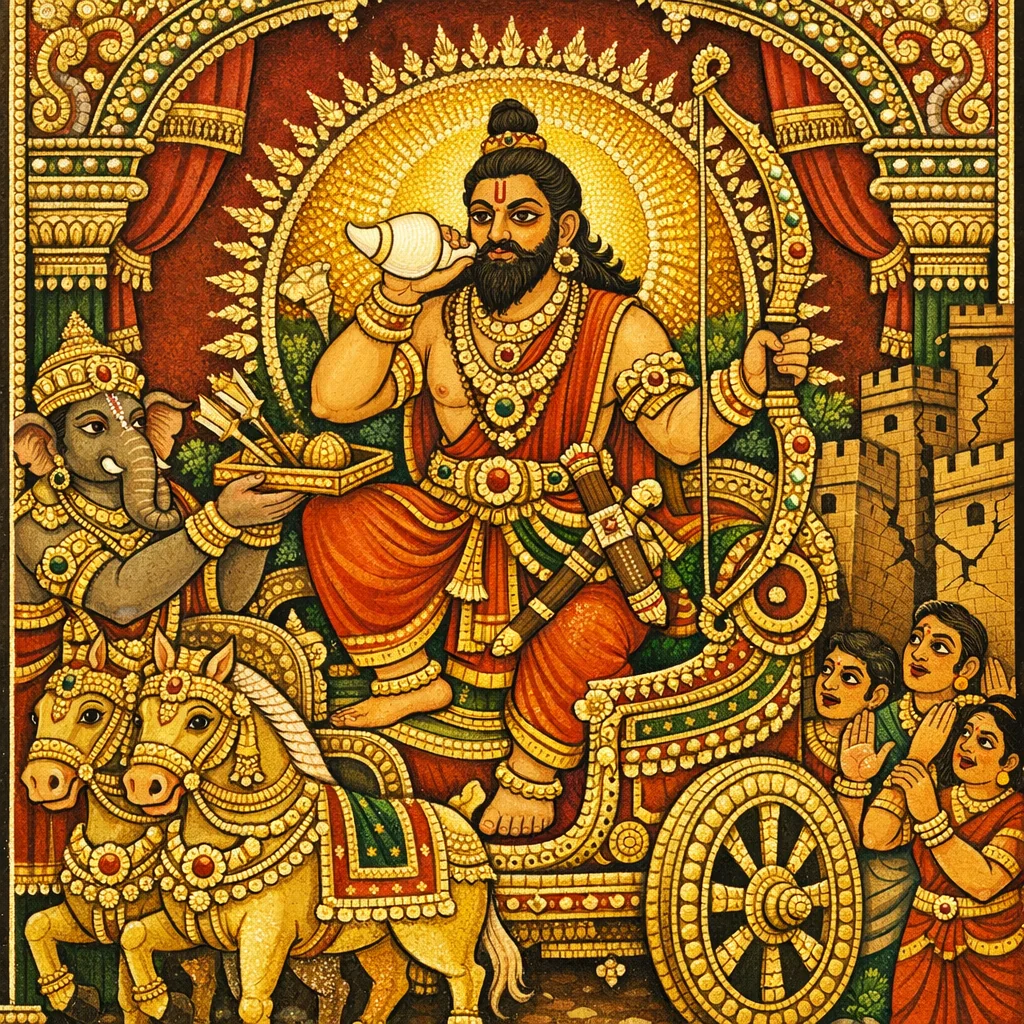
This chapter continues the Bhārgava-carita within the Sagaropākhyāna. Vasiṣṭha tells how Bhārgava (Rāma/Paraśurāma), while traveling, learns from sages the full story of his father’s murder and beheading, and of his mother’s death from grief. He laments in anguish, but his companion Akṛtavraṇa consoles him with śāstra-based reasoning and worldly examples until he regains composure. Bhārgava then meets his brothers and mourns with them; yet the memory of his father’s death makes his wrath swell to world-destroying force. He hardens an earlier promise made for his mother into a firm vow: to annihilate the kṣatriya lineages and to offer tarpaṇa to his parents with the blood of those he slays. With his brothers’ assent and after completing his father’s funerary rites, he goes to Māhiṣmatī, takes position in an outer grove, invokes Mahodara, receives war-gear (chariot, bow, horses, and weapons), mounts the chariot, blows Rudra’s conch, and thunders his bowstring so that the city and its beings tremble—heralding the imminent punitive campaign.
Shlokas
Verse 1
इति श्रीब्रह्माण्डे महापुराणे वायुप्रोक्ते मध्यमभागे सगरोपाख्याने भार्गवचरिते पञ्चचत्वारिंशत्तमोध्यायः // ४५// वसिष्ठ उवाच सगच्छन्पथि शुश्राव मुनिभ्यस्त त्त्वमादितः / राजपुत्रव्यवसितं पित्रौः स्वर्गतिमेव च
Thus, in the Śrī Brahmāṇḍa Mahāpurāṇa, in the middle section proclaimed by Vāyu, within the Sagara narrative in the Bhārgava account, the forty-fifth chapter concludes. Vasiṣṭha said: As he went along the road, he heard from the sages the whole truth from the beginning—the resolve of the prince and also the ascent of his parents to heaven.
Verse 2
पितुस्तु जीवहरणं शिरोहरणमेव च / तन्मृतेरेव मरणं श्रुत्वा मातुश्च केवलम्
Hearing that his father’s life had been taken and his head severed, and that thus he had met his death, the mother was overwhelmed by sorrow at the mere report.
Verse 3
विललाप महाबाहुर्दुःखशोकसमन्वितः / तमथाश्वासयामास तुल्यदुःखो ऽकृतव्रणः
The mighty-armed one wailed, consumed by grief and sorrow; then another, sharing the same anguish yet unhurt, sought to comfort him.
Verse 4
हेतुभिः शास्त्रनिर्दिष्टैर् वीर्यसामर्थ्यसूचकैः / युक्तिलौकिकदृष्टान्तैस्तच्छोकं संव्यशामयत्
With reasons taught in the śāstras, with arguments revealing valor and strength, and with worldly examples, he soothed that grief and brought it to rest.
Verse 5
सांत्वितस्तेन मैधावी धृतिमालंब्य भार्गवः / प्रययौ सहितः सख्या भ्रातॄणां तु दिदृक्षया
Thus consoled, the wise Bhārgava took hold of steadfastness and set out with his friend, longing to see his brothers.
Verse 6
स तान्दृष्ट्वाभिवाद्यैतान्दुःखितान्दुःखकर्शितः / शोकामषयुतस्तैश्च सह त्स्थौ दिनत्रयम्
Seeing them, he bowed in reverence; himself worn down by sorrow, he stayed with them for three days, filled with grief and burning indignation.
Verse 7
ततो ऽस्य सुमाहान्क्रोधः स्मरतो निधनं पितुः / बभूव सहसा सर्वलोकसंहरणक्षमः
Then, remembering the death of his father, a great anger suddenly arose in him, capable of destroying all the worlds.
Verse 8
मातुरर्थे कृतां पूर्वं प्रतिज्ञां सत्यसंगरः / दृढीचकार हृदये सर्वक्षत्रवधोद्यतः
True to his promise, he strengthened the vow made earlier for his mother's sake in his heart, ready to kill all Kshatriyas.
Verse 9
क्षत्रवंश्यानशेषेण हत्वा तद्देहलोहितैः / करिष्ये तर्पणं पित्रोरिति निश्चित्य भार्गवः
Bhargava resolved: 'Having killed the Kshatriya lineage without remainder, I will perform the Tarpan offering to my parents with the blood of their bodies.'
Verse 10
भ्रातॄणां चैव सर्वेषामाख्यायात्मसमीहितम् / प्रययौ तदनुज्ञातः कृत्वा संस्थांपितुः क्रियाम्
Having told his brothers his intention and receiving their permission, he departed after performing the funeral rites for his father.
Verse 11
अकृतव्रणसंयुक्तः प्राप्य माहिष्मतीं ततः / तद्बाह्योपवने स्थित्वा सस्मार स महोदरम्
Accompanied by Akritavrana, he reached Mahishmati; staying in the outer garden, he thought of Mahodara.
Verse 12
स तस्मै रथचापाद्यं सहसाश्वसमन्वितम् / प्रेषयामास रामाय सर्वसंहननानि च
He at once sent to Rama the chariot, the bow and other arms, together with a thousand horses and all the implements of war.
Verse 13
रामो ऽपि रथमारुह्य सन्नद्धः सशरं धनुः / गृहीत्वापूरयच्छङ्खं रुद्रदत्तममित्रजित्
Rama too, the conqueror of foes, mounted the chariot fully armed, took up his bow with arrows, and blew the conch bestowed by Rudra.
Verse 14
ज्याघोषं च चकारोच्चै रोदसी कंपयन्निव / सहसाहोथ सारथ्यं चक्रे सारथिनां वरः
He made the bowstring resound loudly, as though shaking heaven and earth; and at once the finest of charioteers took up the task of driving.
Verse 15
रथज्याशङ्खनादैस्तु वधात्पित्रोरमर्षिणः / तस्याभून्नगरी सर्वा संक्षुब्धाश्च नरद्विपाः
By the roar of the chariot, the twang of the bowstring, and the conch’s blast—born of his wrath over his father’s slaying—the whole city was thrown into turmoil, and the warriors were shaken.
Verse 16
रामं त्वागतमाज्ञाय सर्वक्षत्रकुलान्तकम् / संक्षुब्धाश्चक्रुरुद्योगं संग्रामाय नृपात्मजाः
Knowing that Rama had arrived—the ender of all Kshatriya lineages—the princes were shaken and set about preparing for battle.
Verse 17
अथ पञ्चरथाः शुराः शूरसेनादयो नृप / रामेण योद्धुं सहिता राजभिश्च क्रुरुद्यमम्
Then the valiant kings—Śūrasena and others—arrayed with five chariots, joined with the other rulers, and with fierce resolve set out to fight Rāma.
Verse 18
चतुरङ्गवलोपेतास्ततस्ते क्षत्रियर्षभाः / राममासादयामासुः पतङ्गा इव पावकम्
Then those foremost of kṣatriyas, supported by the fourfold host, rushed upon Rāma like moths drawn into fire.
Verse 19
निवार्य तानापततो रथेनैकेन भार्गवः / युयुधे पार्थिवैः सर्वैः समरे ऽमितविक्रमः
Checking their onrush with but a single chariot, Bhārgava Rāma—of immeasurable might—fought in battle against all those kings.
Verse 20
ततः पुनरभूद्युद्धं रामस्य सह राजभिः / जघान यत्र संक्रुद्धो राज्ञां शतमुदारधीः
Thereupon the battle between Rāma and the kings flared up again; and there, in wrath, Rāma—noble in mind—slew a hundred kings.
Verse 21
ततः स शूरसेनादीन्हत्वा सबलवाहनान् / त्रणेन पातयामास क्षितौ क्षत्रियमण्डलम्
Then, having slain Śūrasena and the rest together with their forces and mounts, he cast the whole host of kṣatriyas down upon the earth like mere blades of grass.
Verse 22
ततस्ते भग्नसंकल्पा हतस्वबलवाहनाः / हतशिष्टा नृपतयो दुद्रुवुः सर्वतोदिशम्
Then those kings, their resolve shattered and their forces and mounts destroyed, the few survivors fled in haste in every direction.
Verse 23
एवं विद्राव्य सैन्यानि हत्वा जित्वाथ संयुगे / जघान शतशो राज्ञः शूराञ्छरवराग्निना
Thus, having routed the armies, slain them and won the battle, he struck down hundreds of valiant kings with the fire of a storm of arrows.
Verse 24
ततः क्रोधपरीतात्मा दग्धुकामो ऽखिलां पुरीम् / उदैरयद्भार्गवो ऽस्त्रं कालाग्निसदृशप्रभम्
Then, his soul engulfed in wrath and longing to burn the entire city, Bhārgava unleashed a weapon whose radiance was like the fire of the end of time.
Verse 25
ज्वालाकवलिताशेषपुरप्राकारमालिनीम् / पुरीं सहस्त्यश्वनरां स ददाहास्त्रपावकः
That city—its walls and ramparts wholly swallowed by flames, adorned with lines of fortifications, with elephants, horses, and people within—was burned to ashes by the fire of that weapon.
Verse 26
दह्यमानां पुरीं दृष्ट्वा प्राणत्राणपरायणः / जीवनाय जगामाशु वीतिहोत्रो भयातुरः
Seeing the city ablaze, Vītihotra—intent only on saving his life, shaken with fear—quickly departed in search of survival.
Verse 27
अस्त्राग्निना पुरीं सर्वां दग्ध्वा हत्वा च शात्रवान् / प्राशयानो ऽखिलान् लोकान् साक्षात्काल इवान्तकः
With the fire of his weapons he burned the entire city and slew the foes; like Antaka, Time itself made manifest, he seemed to devour all the worlds.
Verse 28
अकृतव्रणसंयुक्तः सहसाहेन चान्वितः / जगामरथघोषेण कंपयन्निव मेदिनीम्
Unwounded and filled with fierce valor, he went forth with the roar of his chariot, as though making the earth itself tremble.
Verse 29
विनिघ्नन् क्षत्रियान्सर्वान् संशाम्य पृथिवीतले / महेन्द्राद्रिं ययौ रामस्तपसे धतमानसः
Having slain all the kshatriyas upon the earth and brought the land to quiet, Rama, his mind resolved on austerity, went to Mount Mahendra.
Verse 30
तस्मिन्नष्टचतुष्कं च यावत्क्षत्रसमुद्गमम् / प्रत्येत्य भूयस्तद्धत्यै बद्धदीक्षो धृतव्रतः
Until the warrior line arose again—after eight catuṣkas, thirty-two years—he returned once more, consecrated by dīkṣā and steadfast in his vow, to slay them anew.
Verse 31
क्षत्रक्षेत्रेषु भूयश्च क्षत्रमुत्पादितं द्विजैः / निजघान पुनर्भूमौ राज्ञ शतसहस्रशः
In the kshatriya lands the twice-born brought forth warriors again; and once more upon the earth he slew kings by the hundreds of thousands.
Verse 32
वर्षद्वयेन भूयो ऽपि कृत्वा निःक्षत्रियां महीम् / षट्चतुष्टयवर्षान्तं तपस्तेपे पुनश्च सः
Within two years he again made the earth bereft of kṣatriyas; and once more he performed tapas until the term of six catuṣṭayas of years was completed.
Verse 33
भूयो ऽपि राजन् संबुद्धं क्षत्रमुत्पादितं द्विजैः / जघान भूमौ निःशेषं साक्षात्काल इवान्तकः
O king, the kṣatriya host that the dvijas had again roused and brought forth—him he slew upon the earth without remainder, like Antaka himself, Time made manifest.
Verse 34
कालेन तावता भूयः समुत्पन्नं नृपात्त्वयम् / निघ्नंश्चचार पृथिवीं वर्षद्वयमनारतम्
In that span of time, O king, he roamed the earth unceasingly for two years, slaying those (kṣatriyas) who had arisen anew because of you.
Verse 35
अलं रामेण राजेन्द्र स्मरता निधनं पितुः / त्रिः सप्तकृत्वः पृथिवी तेन निःक्षत्रिया कृता
O lord of kings, Rama, ever mindful of his father’s death, did enough: twenty-one times he made the earth bereft of kṣatriyas.
Verse 36
त्रिःसप्तकृत्वस्तन्माता यदुरः स्वमताडयत् / तावद्रामेण तस्मात्तु क्षत्रमुत्सादितं भुवि
As many times as his mother, in grief, struck her own breast—twenty-one times—so many times did Rama, for that very cause, uproot the kṣatriyas upon the earth.
Frequently Asked Questions
The chapter foregrounds the kṣatriya lineages as a collective dynastic target and frames Paraśurāma’s vow as a lineage-shaping event—an episode that explains later disruptions and reconfigurations in royal genealogies.
Māhiṣmatī is the key geographic node; Bhārgava waits in its outer grove, invokes Mahodara for equipment, then mounts a chariot with bow, arrows, and horses, sounding Rudra’s conch—an explicit ‘campaign launch’ marker in the itinerary.
No. The sampled verses place it in the Sagaropākhyāna/Bhārgava-carita context, not the Lalitopākhyāna; its focus is on vow, rites, and dynastic conflict rather than Śākta vidyā/yantra exposition.