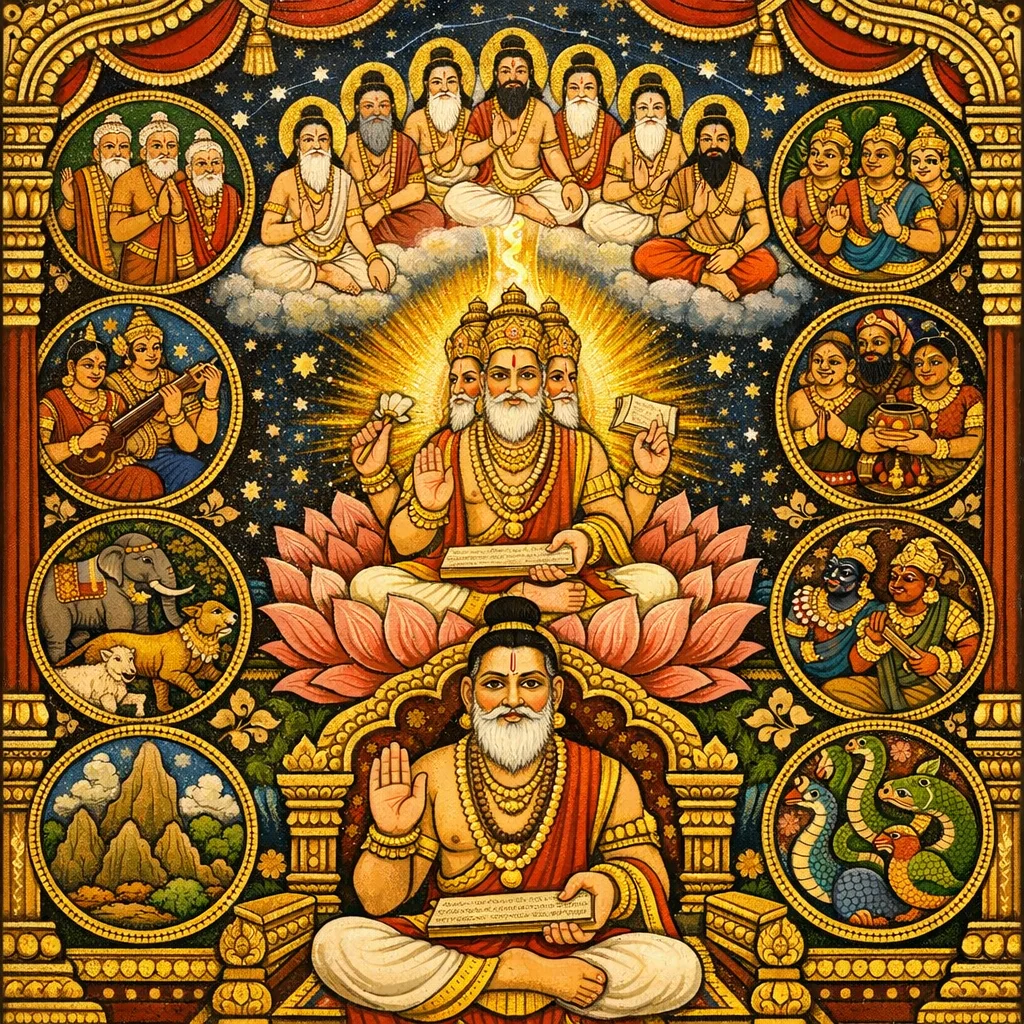
Adhyaya 1
Vaivasvata-Manu Sarga and the Re-Manifestation of the Saptarṣis (वैवस्वतसर्गः—सप्तर्षिप्रादुर्भावः)
The chapter begins with a formal, colophon-like transition: the prior manvantara account is completed and the middle portion begins. Prompted by Śāṃśapāyana to expand the forthcoming third Pada (Upodghāta), Sūta vows to explain, in detailed sequence (vistareṇa anupūrvyā), the nisarga/sarga and related narratives in the present Vaivasvata-Manu setting. Cosmic time is framed through yuga and manvantara reckoning, and the world is populated with all classes of beings—pitṛs, gandharvas, yakṣas, rākṣasas, bhūtas, nāgas, humans, animals, birds, and immovables—affirming Purāṇic totality. A central doctrinal issue is the re-emergence of the Saptarṣis: the sages ask how the seven ṛṣis can be “mind-born” (mānasāḥ) yet appointed as sons by Svayambhū (Brahmā). Sūta explains their recurrence through manvantara transitions (from Svāyambhuva to Vaivasvata) and a Bhava/Maheśvara-linked curse motif, clarifying why they appear again in the human sphere and how creation resumes in proper order. The chapter thus blends cyclic cosmology with the genealogical authorization of the primeval sages.
Shlokas
Verse 1
इति श्रीब्रह्माण्डे महापुराणे वायुप्रोक्ते पूर्वभागे द्वितीये ऽनुषङ्गपादे मन्वन्तरवर्णनं नामाष्टात्रिंशत्तमो ऽध्यायः समाप्तो ऽयं ब्रह्माण्डमहापुराणपूर्वभागः श्रीगणेशाय नमः अथ ब्रह्माण्डमहापुराणमध्यभागप्रारम्भः / शांशपायन उवाच पादः शेक्तो द्वितीयस्तु अनुषङ्गेन नस्त्वया / तृतीयं विस्तरात्पादं सोपोद्धातं प्रवर्त्तय
Thus, in the Śrī Brahmāṇḍa Mahāpurāṇa, proclaimed by Vāyu, in the former section, in the second anuṣaṅga-pāda, the thirty-eighth chapter entitled “Description of the Manvantaras” is concluded. This is the former section of the Brahmāṇḍa Mahāpurāṇa. Salutations to Śrī Gaṇeśa. Now begins the middle section of the Brahmāṇḍa Mahāpurāṇa. Śāṃśapāyana said: “O Sūta, you have set forth the second pāda with its anuṣaṅga; now unfold at length the third pāda, together with its prologue.”
Verse 2
सूत उवाच कीर्त्तयिष्ये तृतीयं वः सोपोद्धातं सविस्तरम् / पादं समुच्चयाद्विप्रा गदतो मे निबोधत
Sūta said: “O vipras, I shall proclaim to you the third pāda, with its prologue and in full detail; attend closely to my words, spoken as a compendium.”
Verse 3
मनोर्वैवस्वतस्येमं सांप्रतं तु महात्मनः / विस्तरेणानुपूर्व्या च निसर्गं शृणुत द्विजाः
O twice-born ones, now hear in detail and in due sequence this account of creation belonging to the great Vaivasvata Manu.
Verse 4
चतुर्युगैकस प्तत्या संख्यातं पूर्वमेव तु / मह देवगणैश्चैव ऋषिभिर्दानवैस्सह
This has already been reckoned of old as seventy-one caturyugas, together with the hosts of the gods, the rishis, and the dānavas.
Verse 5
पितृगन्धर्वयक्षैश्च रक्षोभूतमहोरगैः / मानुषैः पशुभिश्चैव पक्षिभिः स्थावरैः सह
Together with the Pitris, gandharvas and yakshas, rakshasas, bhūtas and great serpents; with humans, beasts, birds, and the immobile beings as well.
Verse 6
मन्वादिकं भविष्यान्तमाख्यानैर्बहुभिर्युतम् / वक्ष्ये वैवस्वतं सर्गं नमस्कृत्य विवस्वते
From the first Manus up to the end of what is yet to come, filled with many narratives, I shall proclaim the Vaivasvata creation, having bowed to Vivasvān.
Verse 7
आद्ये मन्वन्तरे ऽतीताः सर्गप्रावर्त्तकास्तु ये / स्वायंभुवेंऽतरे पूर्वं सप्तासन्ये महर्षयः
In the first manvantara, those who have passed on and served as the inaugurators of creation—before the Svāyambhuva manvantara—were seven other great rishis.
Verse 8
चाक्षुषस्यान्तरे ऽतीते प्राप्ते वैवस्वते पुनः / दक्षस्य च ऋषीणां च भृग्वादीनां महौजसाम्
When the Manvantara of Cākṣuṣa had passed and the Manvantara of Vaivasvata arrived again, Dakṣa and the mighty Ṛṣis—Bhṛgu and others—manifested.
Verse 9
शापान्महेश्वरस्यासीत्प्रादुर्भावो महात्मनाम् / भूयः सप्तर्षयस्त्वेवमुत्पन्नाः सप्त मानसाः
From Maheśvara’s curse came the manifestation of those great souls; thus, once more, the seven Saptarṣis—the seven mind-born—were brought forth.
Verse 10
पुत्रत्वे कल्पिताश्चैव स्वयमेव स्वयंभुवा / प्रजासंतानकृद्भिस्तैरुत्पदद्भिर्महात्मभिः
Svayaṃbhū himself appointed them as sons; those great souls were born as begetters, to extend the lineage of living beings.
Verse 11
पुनः प्रवर्त्तितः सर्गो यथापूर्वं यथाक्रमम् / तेषां प्रसूतिं वक्ष्यामि विशुद्धज्ञानकर्मणाम्
Creation was set in motion again, as before and in due sequence; now I shall speak of the births of those whose knowledge and deeds are pure.
Verse 12
समासव्यासयोगाभ्यां यथावदनुपूर्वशः / येषामन्वयसंभूतैलर् एको ऽयं सचराचरः / पुनरापूरितः सर्वो ग्रहनक्षत्रमण्डितः
With both concise and expanded telling, I shall relate it properly and in order: from their line were born those who filled again this single world of moving and unmoving beings, and the whole cosmos became full once more, adorned with planets and stars.
Verse 13
ऋषय ऊचुः कथं सप्तर्षयः पूर्वमुत्पन्नाः सप्त मनसाः / पुत्रत्वे कल्पिताश्चैव तन्नो निगद सत्तम
The sages said: “O best of men, how did the Seven Ṛṣis arise in the beginning? And how were those seven ‘manas’ conceived as sons? Tell us this.”
Verse 14
सूत उवाच पूर्वं सप्तर्षयः प्रोक्ता ये वै स्वायंभुवेंऽतरे / मनोरन्तरमासाद्य पुनर्वैवस्वतं किल
Sūta said: “The Seven Ṛṣis spoken of earlier in the Svāyambhuva Manvantara, upon the passing of the Manvantara, appeared again indeed in the Vaivasvata Manvantara.”
Verse 15
भवाभिशाप संविद्धा अप्राप्तास्ते तदा तपः / उपपन्ना जने लोके सकृदागमनास्तु त
Bound by the curse of Bhava (Śiva), they did not attain austerity at that time; they manifested in Janaloka, and their coming was but once.
Verse 16
ऊचुः सर्वे सदान्योन्यं जनलोके महार्षयः / एत एव महाभागा वरुणे वितते ऽध्वरे
In Janaloka those great Ṛṣis would ever say to one another: “These indeed are the greatly blessed, present at Varuṇa’s widely spread sacrifice (adhvara).”
Verse 17
सर्वे वयं प्रसूयामश्चाक्षुषस्यान्तरे मनोः / पितामहात्मजाः सर्वे तन्नः श्रेयो भविष्यति
Let us all be born in the Manvantara of Cākṣuṣa Manu; we are all sons of Pitāmaha (Brahmā)—that will be for our highest good.
Verse 18
एवमुक्त्वा तु ते सर्वे चाक्षुषस्यान्तरे मनोः / स्वायंभुवेन्तरे प्राप्ताः सृष्ट्यर्थं ते भवेन तु
Thus having spoken, they all, in the Manvantara of Cākṣuṣa—within the interval of Svāyambhuva—arrived there for the purpose of creation.
Verse 19
जज्ञिरे ह पुनस्ते वै जनलोकादिहागताः / देवस्य महतो यज्ञे वारुणीं बिभ्रतस्तनुम्
They, having come here from Janaloka, were born again; and in the Deva’s great sacrifice they bore a body in the form of Vāruṇī.
Verse 20
ब्रह्मणो जुह्वतः शुक्रमग्रौ पूर्वं प्रजेप्सया / ऋषयो जज्ञिरे दीर्घे द्वितीयमिति नः श्रुतम्
With the desire to bring forth beings, as Brahmā poured the oblations, first his radiant seed appeared in the fire; from it were born the long-lived ṛṣis—this we have heard as the second arising.
Verse 21
भृग्वङ्गिरा मरीचिश्च पुलस्त्यः पुलहः क्रतुः / अत्रिश्चैव वसिष्ठश्च ह्यष्टौ ते ब्रह्मणः सुताः
Bhṛgu, Aṅgirā, Marīci, Pulastya, Pulaha, Kratu, Atri, and Vasiṣṭha—these eight are the sons of Brahmā.
Verse 22
तथास्य वितते यज्ञे देवाः सर्वे समागताः / यज्ञाङ्गानि च सर्वाणि वषठ्कारश्च मूर्त्तिमान्
In that sacrifice, spread out in full, all the Devas assembled; all the limbs of the yajña were present, and Vaṣaṭkāra too appeared in embodied form.
Verse 23
मूर्त्तिमन्ति च सामानि यजूंषि च सहस्रशः / ऋग्वेदश्चाभवत्तत्र यश्च क्रमविभूषितः
There arose there, by the thousand, the embodied chants of the Sāma and the Yajus formulas; and there too the Ṛgveda came into being, adorned with the ordered sequence of recitation.
Verse 24
यजुर्वेदश्च वृत्ताढ्य ओङ्कारवदनोज्ज्वलः / स्थितो यज्ञार्थसंपृक्तः सूक्तब्राह्मणमन्त्रवान्
The Yajurveda, rich in meter, shone with a face of Oṃkāra; it stood joined to the purpose of sacrifice, endowed with sūktas, brāhmaṇas, and mantras.
Verse 25
सामवेदश्च वृत्ताढ्यः सर्वगेयपुरः सरः / विश्वावस्वादिभिः सार्द्धं गन्धर्वैः संभृतो ऽभवत्
The Sāmaveda, rich in meter, was like a lake of all melodies; it became complete together with the Gandharvas, with Viśvāvasu and the rest.
Verse 26
ब्रह्मवेदस्तथा घोरैः कृत्वा विधिभिरन्वितः / प्रत्यङ्गिरसयोगैश्च द्विशरीरशिरो ऽभवत्
So too the Brahmaveda, joined with awe-inspiring rites and with the Pratyaṅgirasa yogas, assumed a form as though with two bodies and a single head.
Verse 27
लक्षणा विस्तराः स्तोभा निरुक्तस्वर भक्तयः / आश्रयस्तु वषट्कारो निग्रहप्रग्रहावपि
Marks, expansions, stobhas, nirukta, tones (svara), and modes of devotion; and as the support, the vaṣaṭkāra exclamation, along with nigraha and pragraha as well.
Verse 28
दीप्तिमूर्त्तिरिलादेवी दिशश्चसदिगीश्वराः / देवकन्याश्च पत्न्यश्च तथा मातर एव च
There were present the radiant-formed goddess Ilā, the directions with their lords, the daughters of the gods, the wives, and the venerable mothers as well.
Verse 29
आययुः सर्व एवैते देवस्य यजतो मखे / मूर्तिमन्तः सुरूपाख्या वरुणस्य वपुर्भृतः
All of them came to the god’s sacrificial rite—embodied, fair of form, bearing the very bodily aspect of Varuṇa.
Verse 30
स्वयंभु वस्तु ता दृष्ट्वा रेतः समपतद्भुवि / ब्रह्मर्षिभाविनोर्ऽथस्य विधानाच्च न संशयः
Seeing them, the Self-born let his seed fall upon the earth; and what was to culminate in the state of a brahmarṣi came to pass by ordained law—without doubt.
Verse 31
धृत्वा जुहाव हस्ताभ्यां स्रुवेण परिगृह्य च / आस्रवज्जुहुयां चक्रे मन्त्रवच्च पितामहः
Then the Pitāmaha held it in both hands, took it up with the sacrificial ladle (sruva), and offered it as an oblation with mantras; even what had spilled he made into an offering in the homa.
Verse 32
ततः स जनयामास भूतग्रामं प्रजापतिः / तस्यार्वाक्तेजसश्चैव जज्ञे लोकेषु तैजसम्
Thereafter Prajāpati brought forth the entire host of beings; and from his prior radiance, within the worlds, the taijasa principle—luminous in nature—was born.
Verse 33
तमसा भावि याप्यत्वं यथा सत्त्वं तथा रजः / आज्यस्थाल्यामुपादाय स्वशुक्रं हुतवांश्च ह
The waning born of tamas is found in sattva, and likewise in rajas. Then Hutavaha, the sacred Fire, taking the vessel of ghee, offered his own seed as an oblation.
Verse 34
शुक्रे हु ते ऽथ तस्मिंस्तु प्रादुर्भूता महर्षयः / ज्वलन्तो वपुषा युक्ताः सप्रभावैः स्वकैर्गुणैः
When that seed had been offered, the great seers appeared from it—ablaze in form, radiant with the power of their own innate qualities.
Verse 35
हुते चाग्नौ सकृच्छुक्रे ज्वालाया निसृतः कविः / हिरण्यगर्भस्तं दृष्ट्वा ज्वालां भित्त्वा विनिर्गतम्
When the seed was offered once into the fire, from the flame emerged the seer called Kavi. Hiranyagarbha beheld him breaking through the blaze and coming forth.
Verse 36
भृगुस्त्वमिति चोवाच यस्मात्तस्मात्स वै भृगुः / महादेवस्तथोद्भूतो दृष्ट्वा ब्रह्माणमब्रवीत्
He said, “You are Bhṛgu”; therefore he indeed came to be known as Bhṛgu. In the same way Mahādeva arose, and seeing Brahmā, spoke to him.
Verse 37
ममैष पुत्रकामस्य दीक्षितस्य त्वया प्रभो / विजज्ञे प्रथमं देव मम पुत्रो भवत्वयम्
O Lord, for me who undertook consecration longing for a son, through you this one has been born first. O Deva, let him become my son.
Verse 38
तथेति समनुज्ञातो महादेवः स्वयंभुवा / पुत्रत्वे कल्पयामास महादेव स्तदा भृगुम्
Thus permitted by Svayambhū (Brahmā), Mahādeva then appointed Bhṛgu to the status of his son.
Verse 39
वारुणा भृगवस्तस्मात्तदपत्यं च स प्रभुः / द्वितीयं च ततः शुक्रमङ्गारेष्वजुहोत्प्रभुः
From that arose the Bhṛgus connected with Varuṇa, and that Lord became the source of their lineage. Then the Lord offered Śukra a second time into the glowing embers.
Verse 40
अङ्गारेष्वङ्गिरो ऽङ्गानि संहतानि ततोङ्गिराः / संभूतिं तस्य तां दृष्ट्वा वह्निर्ब्रह्माणमब्रवीत्
Within the embers, the limbs of Aṅgiras came together, and from them Aṅgiras arose. Seeing that manifestation, Agni spoke to Brahmā.
Verse 41
रेतोधास्तुभ्यमेवाहं द्वितीयो ऽयं ममास्त्विति / एवमस्त्विति सो ऽप्युक्तो ब्रह्मणा सदसस्पतिः
Agni said, “O Brahmā, I myself am Retodhā; let this second one be mine.” And Brahmā replied to the lord of the assembly, “So be it.”
Verse 42
जग्रा हाग्निस्त्वङ्गिरस आग्नेया इति नः श्रुतम् / षट् कृत्वा तु पुनः शुक्रे ब्रह्मणा लोककारिणा
We have heard that Agni accepted Aṅgiras; therefore they are known as the Āgneyas, “those of Fire.” Then Brahmā, the maker of worlds, repeated this again six times with regard to Śukra.
Verse 43
हुते समभवंस्तस्मिन्यद् ब्रह्माण इति श्रुतिः / मरीचिः प्रथमं तत्र मरीचिभ्यः समुत्थितः
In that fire-offering, says the Śruti, there arose what is called “Brahmā.” There Marīci appeared first, said to have sprung from the Marīcis.
Verse 44
क्रतौ तस्मिन्क्रतुर्जज्ञे यतस्तस्मात्स वै क्रतुः / अहं तृतीय इत्यत्रिस्तस्मादत्रिः स कीर्त्यते
In that sacrifice Kratu was born; therefore he is indeed called Kratu. And Atri, who declared “I am the third,” is thus renowned as Atri.
Verse 45
केशैस्तु निचितैर्भूतः पुलस्त्यस्तेन स स्मृतः / केशैर्लंबैः समुद्भूतस्तस्मात्स पुलहः स्मृतः
Formed of thick, gathered hair, he is remembered as Pulastya. Born of long-flowing hair, he is remembered as Pulaha.
Verse 46
वसुमध्यात्समुत्पन्नो वशी च वसुमान् स्वयम् / वसिष्ठ इति तत्त्वज्ञैः प्रोच्यते ब्रह्मवादिभिः
Born from the midst of the Vasus, self-mastered and radiant with wealth, he is called “Vasiṣṭha” by the truth-knowing brahmavādins.
Verse 47
इत्येते ब्रह्मणः पुत्रा मानसाः षण्महर्षयः / लोकस्य सन्तानकरा यैरिमा वर्द्धिताः प्रजाः
Thus these are Brahmā’s mind-born sons, the six great sages. They bring forth the world’s lineages, and by them these beings were increased.
Verse 48
प्रजापतय इत्येवं पठ्यन्ते ब्रह्मणःसुताः / अपरे पितरो नाम एतैरेव महर्षिभिः
Thus are the sons of Brahmā recited as the Prajāpatis; and these very great ṛṣis are also called by others the Pitṛs, the ancestral Fathers.
Verse 49
उत्पादिता देवगणाः सप्त लोकेषु विश्रुताः / अजेयाश्च गणाः सप्त सप्तलोकेषु विश्रुताः
The hosts of devas that were brought forth are seven, renowned throughout the seven worlds; and the unconquerable hosts too are seven, famed in the saptaloka.
Verse 50
मारीया भार्गवाश्चैव तथैवाङ्गिरसो ऽपरे / पौलस्त्याः पौलहाश्चैव वासिष्ठाश्चैव विश्रुताः
The Mārīyas and the Bhārgavas, and likewise other Āṅgirasas; the Paulastyas, the Paulahas, and the Vāsiṣṭhas too—these are all renowned.
Verse 51
आत्रेयाश्च गणाः प्रोक्ता पितॄणां लोकवर्द्धनाः / एते समासतः ख्याताः पुनरन्ये गणास्त्रयः
The Ātreya hosts are also spoken of, as those who increase the realm of the Pitṛs; these are known in brief, and then there are three other hosts besides.
Verse 52
अमर्त्ताश्चाप्रकाशाश्च ज्योतिष्मन्तश्च विश्रुताः / तेषां राजायमो देवो यमैर्विहतकल्मषः
Amartta, Aprakāśa, and Jyotiṣmant are renowned; their king is the god Yama, whose stains are dispelled through yama and niyama (sacred restraints and observances).
Verse 53
अपरं प्रजानां यतयस्ताञ्छृमुध्वमतन्द्रिताः / कश्यपः कर्दमः शेषो विक्रान्तः सुश्रवास्तथा
Now hear, O tireless ones, of other yatis among the progeny: Kaśyapa, Kardama, Śeṣa, Vikrānta, and Suśravā as well.
Verse 54
बहुपुत्रः कुमारश्च विवस्वान्स शुचिव्रतः / प्रचेतसोरिष्टनेमिर्बहुलश्च प्रजापतिः
Bahuputra, Kumāra, and Vivasvān—he was of pure vows; and Pracetas, Ariṣṭanemi, and Bahula were Prajāpatis as well.
Verse 55
इत्येवमादयो ऽन्ये ऽपि बहवो वै प्रजेश्वराः / कुशोच्चया वालखिल्याः सभूताः परमर्षयः
Thus, and in like manner, there were many other lords of progeny. Kusoccaya and the Vālakhilyas were supreme seers, gathered together in assembly.
Verse 56
मनोजवाः सर्वगताः सर्वभोगाश्च ते ऽभवन् / जाताश्च भस्मनो ह्यन्ये ब्रह्मर्षिगणसंमताः
They became swift as thought, all-pervading, and endowed with every enjoyment. Others, too, were born from ashes, acknowledged by the host of Brahmarṣis.
Verse 57
वैखानसा मुनिगणास्तपः श्रुतपरायणाः / नस्तो द्वावस्य चोत्पन्नावश्विनौ रूपसंमतौ
The Vaikhānasa hosts of sages were devoted to austerity and to the Śruti. And from Nasto were born two sons—the Aśvinīkumāras, renowned for their beauty.
Verse 58
विदुर्जन्मर्क्षरजसो तथा तन्नेत्रसंचरात् / अन्ये प्रजानां पतयः श्रोतोभ्यस्तस्य जज्ञिरे
They know that birth arose from the dust of the constellations and from the movement of His eyes; and other lords of creatures were born from His ears.
Verse 59
ऋषयो रोमकूपेभ्यस्तथा स्वेदमलोद्भवाः / अयने ऋतवो मासर्द्धमासाः पक्षसंधयः
The rishis arose from His pores, and others from the residue of sweat; and the ayanas, seasons, months, half-months, fortnights, and their junctions came forth.
Verse 60
वत्सरा ये त्वहोरात्राः पित्तं ज्योतिश्च दारुणम् / रौद्रं लोहितमित्याहुर्लोहितं कनकं स्मृतम्
That which becomes the years and the days and nights is also bile and a dreadful radiance; it is called ‘Raudra’ and ‘Lohita’, and Lohita is remembered too as ‘Kanaka’.
Verse 61
तत्तैजसमिति प्रोक्तं धूमाश्च पशवः स्मृताः / ये ऽर्चिषस्तस्य ते रुद्रास्तथादित्याः समृद्गताः
This is declared to be ‘Taijasa’, and the smoke is remembered as the beasts; His flames are the Rudras, and the Adityas too attained abundance.
Verse 62
अङ्गारेभ्यः समुत्पन्ना अर्चिषो दिव्यमानुषाः / आदिभूतो ऽस्य लोकस्य ब्रह्मा त्वं ब्रह्मसंभवः
The flames born of the embers became divine humans; O Brahma, primal source of this world, you are born of Brahman.
Verse 63
सर्वकामदमित्याहुस्तथा वाक्यमुदाहरन् / ब्रह्मा सुरगुरुस्तत्र त्रिदशैः संप्रसादितः
They call it “the giver of all desires” and utter such a saying. There Brahmā, preceptor of the gods, was graciously pleased by the Devas.
Verse 64
इमेवै जनयिष्यन्ति प्रजाः सर्वाः प्रचेश्वराः / सर्वे प्रजानां पतयः सर्वे चापि तपस्विनः
These very Praceśvaras shall beget all beings. All will be lords of creatures, and all will be ascetics as well.
Verse 65
त्वत्प्रसादादिमांल्लोकान्धारयेयुरिमाः क्रियाः / त्वद्वंशवर्द्धनाः शश्वत्तव तेजोविवर्द्धनाः
By your grace may these rites uphold these worlds. May they ever increase your lineage and ever augment your radiance.
Verse 66
भवेयुर्वेदविद्वांसः सर्वे वाक्पतयस्तथा / वेदमन्त्रधराः सर्वे प्रजापतिसमुद्भवाः
May they all become knowers of the Veda and lords of sacred speech. May they all bear the Vedic mantras, born of Prajāpati.
Verse 67
श्रयन्तु ब्रह्मसत्यं तु तपश्च परमं भुवि / सर्वे हि वयमेते च तवैव प्रसवः प्रभो
May they take refuge in Brahman’s truth and practise the supreme tapas upon the earth. O Lord, all of us—and all of them—are born of you alone.
Verse 68
ब्रह्म च ब्रह्माणाश्चैव लोकश्चैव चराचराः / मरीचिमादितः कृत्वा देवाश्च ऋषिभिः सह
Brahma and the Brahmās, and the whole world of the moving and the unmoving—together the Devas, with the Ṛṣis, assembled, placing Marīci and the rest at the fore.
Verse 69
अपत्यानीति संचिन्त्य ते ऽपत्ये कामयामहे / तस्मिन् यज्ञे महाभागा देवाश्च ऋषयश्च ये
Thinking, “Let there be offspring,” they said, “We desire progeny.” In that sacrifice were present the blessed Devas and the Ṛṣis.
Verse 70
एते त्वद्वंशसंभूताः स्थानकालाभिमानिनः / तव तेनैव रूपेण स्थापयेयुरिमाः प्रजाः
These are born of your lineage, mindful of place and time; in that very form of yours, let them establish these beings.
Verse 71
युगादिनिधनाश्चापि स्थापयन्तु इति द्विजाः / ततो ऽब्रवील्लोकगुरुः परमित्यभिधार यन्
The twice-born said, “Let them also set in place the beginnings and the endings of the yugas.” Then the Teacher of the worlds declared, “Hold this as the supreme decree.”
Verse 72
एतदेव विनिश्चित्य मया सृष्टा न संशयः / भवतां वंशसंभूताः पुनरेते महर्षयः
Having determined this alone, I created—without doubt. And these great Ṛṣis, once again, are born from your very lineage.
Verse 73
तेषां भृगोः कीर्त्तयिष्ये वंशं पूर्वं महात्मनः / विस्तरेणानुपूर्व्या च प्रथमस्य प्रजापतेः
Now I shall first recount the lineage of the great-souled Bhṛgu, and also describe, in due order and at length, the first Prajāpati.
Verse 74
भार्ये भृगोरप्रतिमे उत्तमाभिजने शुभे / हिरण्यकशिपो कन्या दिव्या नाम परिश्रुता
Bhṛgu’s wife was incomparable, auspicious, and born of a noble line; she was the daughter of Hiraṇyakaśipu, renowned by the name Divyā.
Verse 75
पुलोम्नश्चव पौलोमी दुहिता वरवर्णिनी / भृगोस्त्वजनयद्दिव्या पुत्रं ब्रह्मविदां वरम्
Paulomī, the fair-complexioned daughter of Puloman, was of excellent beauty; that Divyā bore to Bhṛgu a son, the foremost among knowers of Brahman.
Verse 76
देवासुराणामाचार्यं शुक्रं कविवरं ग्रहम् / शुक्र एवोशना नित्यमतः काव्यो ऽपि नामतः
Śukra, the preceptor of devas and asuras, is the foremost planet among the poet-sages; Śukra himself is ever Uśanā, and thus by name too he is called Kāvyā.
Verse 77
पितॄणां मानसी कन्या सोमपानां यशस्विनी / शुक्रस्य भार्या गौर्नाम विजज्ञे चतुरः सुतान्
Gau, the mind-born daughter of the Pitṛs, renowned among the Somapānas, became Śukra’s wife and gave birth to four sons.
Verse 78
त्वष्टा चैव वरत्री च शण्डामकारै च तावुभौ / तेजसादित्यसंकाशा ब्रह्मकल्पाः प्रभावतः
Tvaṣṭā and Varatrī, and also Śaṇḍāmākāra—those two shone with a radiance like the sun, and by their might were as a Brahmā-kalpa.
Verse 79
रजतः पृथुरश्मिश्च विद्वान्यश्च बृहङ्गिराः / वरत्रिणः सुता ह्येते ब्रह्मिष्ठा दैत्ययाजकाः
Rajata, Pṛthurāśmi, Vidvānya, and Bṛhaṅgirā—these were the sons of Varatrī, steadfast in Brahman, priests who performed sacrifices for the Daityas.
Verse 80
इज्याधर्मविनाशार्थं मनुमेत्याभ्ययाजयन् / निरस्यमानं वै धर्मं दृष्ट्वेन्द्रो मनुमाब्रवीत्
To bring ruin upon the dharma of sacrifice, they came to Manu and had him conduct rites. Seeing dharma being cast aside, Indra spoke to Manu.
Verse 81
एतैरेव तु कामं त्वां प्रापयिष्यामि याजनम् / श्रुत्वेन्द्रस्य तु तद्वाक्यं तस्माद्देशादपाक्रमन्
“By these very ones I shall surely bring you to the desired fruit of sacrifice.” Hearing Indra’s words, they withdrew from that land.
Verse 82
तिरोभूतेषु तेष्विन्द्रो मनुपत्नीमचेतनाम् / ग्रहेण मोचयित्वा च ततश्चानुससार ताम्
When they had vanished from sight, Indra freed Manu’s unconscious wife from the grasp of the Graha (Rāhu), and then followed after her.
Verse 83
तत इन्द्रविनाशाय यतमानान्मुनींस्तु तान् / तानागतान्पुनर्दृष्ट्वा दुष्टानिन्द्रो विहस्य तु
Then, seeing those sages striving for Indra’s destruction return again, the wicked Indra laughed in derision.
Verse 84
ततस्ता नदहत्क्रुद्धो वेद्यर्द्धे दक्षिणे ततः / तेषां तु धृष्यमाणानां तत्र शालावृकैः सह
Then, in wrath, he burned them on the southern side of the altar; there they were tormented together with the śālāvṛkas.
Verse 85
शीर्षाणि न्यपतंस्तानि खर्जूरा ह्यभवंस्ततः / एवं वरत्रिणः पुत्रा इन्द्रेण निहताः पुरा
Their heads fell down, and then became date-palms. Thus, in ancient times, the sons of Varatri were slain by Indra.
Verse 86
जयन्त्यां देवयानी तु शुक्रस्य दुहिताभवत् / त्रिशिरा विश्वरूपस्तु त्वष्टुः पुत्रो ऽभवन्महान्
From Jayantī was born Devayānī, the daughter of Śukra; and Triśirā Viśvarūpa, the great son of Tvaṣṭṛ, was born as well.
Verse 87
यशोधरायामुत्पन्नो वैरोचन्यां महायशाः / विश्वरूपानुजश्चैव विश्वकर्मा च यः स्मृतः
From Yaśodharā, in Vairocanī, was born one of great renown—the younger brother of Viśvarūpa, remembered as Viśvakarmā.
Verse 88
भृगोस्तु भृगवो देवा जज्ञिरे द्वादशात्मजाः / दिव्यानुसुषुवे कन्या काव्यस्यैवानुजा प्रभोः
From Bhṛgu were born twelve divine sons known as the Bhṛgavas. And a celestial maiden was also born, the younger sister of the lord Kāvya.
Verse 89
भुवनोभावनश्चैव अन्त्यश्चान्त्यायनस्तथा / क्रतुः शुचिः स्वमूर्द्धा च व्याजश्च वसुदश्च यः
Bhuvanobhāvana, Antya, and Antyāyana; and also Kratu, Śuci, Svamūrddhā, Vyāja, and Vasuda—these were their names.
Verse 90
प्रभवश्चाव्ययश्चैव द्वादशो ऽधिपतिः स्मृतः / इत्येते भृगवो देवाः स्मृता द्वादश यज्ञियाः
Prabhava and Avyaya were also among them; the twelfth is remembered as Adhipati, the Lord. Thus are recalled the twelve Bhṛgava deities, worthy of the sacred sacrifice.
Verse 91
पौलोम्यजनयत्पुत्रं ब्रह्मिष्ठं वशिनं द्विजम् / व्यादितः सो ऽष्टमे मासिगर्भः क्रूरेण रक्षसा
Paulomī bore a son, a dvija most devoted to Brahman and master of himself. Yet in the eighth month that womb was torn open by a cruel rākṣasa.
Verse 92
च्यवनाच्च्यवनः सो ऽथ चेतनात्तु प्रचेतनः / प्रचेताः श्च्यवनः क्रोधाद्दग्धवान्पुरुषादकान्
From the ‘falling away’ he was called Cyavana, and from awakened awareness, Pracetana. In wrath, Pracetā Cyavana burned the man-eaters to ashes.
Verse 93
जनयामास पुत्रौ द्वौ सुकन्यायां सभार्गवः / आप्रवानं दधीचं च तावुभौ साधुसंमतौ
That Bhārgava begot two sons in Sukanyā—Āpravāna and Dadhīca; both were esteemed by the righteous sages.
Verse 94
सारस्वतः सरस्वत्यां दधीचस्योदपद्यत / ऋची पत्नी महाभागा अप्रवानस्य नाहुषी
From Dadhīca, on the Sarasvatī, was born a son named Sārasvata; and Āpravāna’s most fortunate wife was Ṛcī Nāhuṣī.
Verse 95
तस्यामौर्व ऋषिर्जज्ञे ऊरुं भित्तवा महायशाः / और्वस्यासीदृचीकस्तु दीप्तो ऽग्निसमतेजसा
In her was born the illustrious sage Aurva, bursting forth by cleaving the thigh; and Aurva’s son Ṛcīka shone with splendor equal to fire.
Verse 96
जमदग्निरृचीकस्य सत्यवत्यामजायत / भृगोश्चरुविपर्यासे रौद्रवैष्णवयौः पुरा
To Ṛcīka and Satyavatī was born Jamadagni; this came to pass long ago through Bhṛgu’s reversal of the sacrificial caru between the Raudra and the Vaiṣṇava portions.
Verse 97
जमनाद्वैष्मवस्याग्नेर्जमदग्निरजायत / रेणुकाजमदग्नेश्च शक्रतुल्यपराक्रमम्
From the ‘jamana’ of the Vaiṣṇava fire was born Jamadagni; and from Reṇukā, Jamadagni begot a son whose valor was equal to Śakra (Indra).
Verse 98
ब्रह्मक्षत्रमयं रामं सुषुवे ऽमिततेजसम् / ओर्वस्यासीत्पुत्रशतं जमदग्निपुरोगमम्
Urvā gave birth to Rāma, embodying both brahmin and kshatriya nature, of immeasurable splendor. Urvā had a hundred sons, with Jamadagni foremost among them.
Verse 99
तेषां पुत्र सहस्राणि भार्गवाणां परस्परात् / ऋष्यतरेषु वै बाह्या बहवो भार्गवाः स्मृताः
Among those Bhārgavas, from one another arose thousands of sons. And in the branches called Ṛṣyatara, many Bhārgavas are remembered as ‘bāhya’, belonging to an outer line.
Verse 100
वत्सा विदा आर्ष्टिषेणा यस्का वैन्याश्च शौनकाः / मित्रेयुः सप्तमा ह्येते पक्षा ज्ञेयास्तु भार्गवाः
Vatsā, Vidā, Ārṣṭiṣeṇa, Yaskā, Vainya, and Śaunaka—and Mitreyu as the seventh: these are to be known as the ‘pakṣas’, the branch-groups of the Bhārgavas.
Verse 101
शृणुताङ्गिरसो वंशमग्नेः पुत्रस्य धीमतः / यस्यान्ववाये संभूता भारद्वाजाः सगौतमाः
Hear the lineage of Aṅgiras, the wise son of Agni; in his line were born the Ṛṣis, including the Bhāradvājas and the Gautamas.
Verse 102
देवाश्चाङ्गिरसो मुख्यास्त्त्विषिमन्तो महौजसः / सुरूपा चैव मारीची कार्दमी च तथा स्वराट्
The foremost, godlike offspring of Aṅgiras were radiant and mighty in ojas; and there also arose Surūpā, Mārīcī, Kārdamī, and Svarāṭ.
Verse 103
पथ्या च मानवी कन्या तिस्रो भार्या ह्यथर्वणः / अथर्वणस्तु दायादास्तासु जाताः कुलोद्वहाः
Pathyā and the maiden Mānavī were Atharva’s three wives. From them were born Atharva’s heirs, sons who uphold and continue the lineage.
Verse 104
उत्पन्ना महता चैव तपसा भावितात्मनः / बृहस्पतिं सुरूपायां गौतमं सुषुवे स्वराट्
They arose from Svarāṭ, whose soul was refined by mighty austerity. In Surūpā’s womb were born Bṛhaspati and Gautama.
Verse 105
अयास्यं वामदेवं च उतथ्यमुशितिं तथा / धृष्णिः पुत्रस्तु पथ्यायाः संवर्त्तश्चैव मानसः
Ayāsya, Vāmadeva, Utathya, and Uśiti were also born. Dhṛṣṇi was Pathyā’s son, and Saṃvartta was born of Mānavī.
Verse 106
कितवश्चाप्ययास्यस्य शरद्वांश्चप्युतथ्यजः / अथोशिजो दीर्घतमा बृहदुक्थो वामदेवजः
Kitava was Ayāsya’s son, and Śaradvān was born of Utathya. From Athośija came Dīrghatamā, and from Vāmadeva came Bṛhaduktha.
Verse 107
धृष्णेः पुत्रः सुधन्वा तु ऋषभश्च सुधन्वनः / रथकाराः स्मृता देवा ऋभवो ये परिश्रुताः
Dhṛṣṇi’s son was Sudhanvā, and Sudhanvā’s son was Ṛṣabha. The famed Ṛbhus are remembered as divine rathakāras—heavenly artisans who fashion chariots.
Verse 108
बृहस्पतेर्भरद्वाजो विश्रुतः सुमहायशाः / बृहस्पतिं सुरूपायां गौतमं सुषुवे स्वराट्
In the line of Bṛhaspati, Bharadvāja was renowned, possessed of great glory. Svarāṭ, through Surūpā, begot Gautama and Bṛhaspati.
Verse 109
औरसांगिरसः पुत्राः सुरूपायां विजज्ञिरे / आधार्यायुर्द्दनुर्दक्षो दमः प्राणस्त थैव च
In Surūpā were born the true sons of Aṅgirasa: Ādhāryāyu, Danu, Dakṣa, Dama, and likewise Prāṇa.
Verse 110
हविष्यांश्च हविष्णुश्च ऋतः सत्यश्च ते दश / अयास्याश्चप्युतथ्याश्च वामदेवास्तथौशिजाः
Among those ten were Haviṣyāṃśa, Haviṣṇu, Ṛta, and Satya; and also Ayāsya, Utathya, Vāmadeva, and Auśija.
Verse 111
भारद्वाजाः सांकृतयो गर्गाः कण्वरथीतराः / मुद्गला विष्णुवृद्धाश्च हरिताः कपयस्तथा
The line further branched as Bhāradvājas, Sāṃkṛtyas, Gargās, Kaṇvas, and Rathītaras; as well as Mudgalas, Viṣṇuvṛddhas, Haritas, and Kapis.
Verse 112
तथा रूक्षभरद्वाजा आर्षभाः कितवस्तथा / एते चाङ्गिरसां पक्षा विज्ञेया दश पञ्च च
So too are the Rūkṣa-Bhāradvājas, the Ārṣabhas, and the Kitavas. These are to be known as the branches of the Aṅgirasas—ten and five, fifteen in all.
Verse 113
ऋष्यन्तरेषु वै बाह्या बहवोङ्गिरसः स्मृताः / मरीचेरपि वक्ष्यामि भेद मुत्तमपूरुषम्
In other lineages of seers as well, many of the Angirasa sages are remembered. Now I shall also speak of the distinction concerning Marīci, in relation to the Supreme Purusha.
Verse 114
यस्यान्ववाये संभूतं जगत्स्थावरजङ्गमम् / मरीचिरापश्चकमे नाभिध्यायन्प्रजेप्सया
From his line of succession arose the whole world, both the unmoving and the moving. Marīci, desiring progeny, fixed his mind in contemplation and sought refuge in the waters.
Verse 115
पुत्रः सर्वगुणोपेतः प्रजावान्प्रभवेदिति / संयुज्यात्मानमेवन्तु तपसा भावितः प्रभुः
“May a son arise, endowed with every virtue and rich in progeny”—with this resolve, the Lord, refined by tapas, gathered his own being into perfect union.
Verse 116
आहताश्च ततः सर्वा आपः समभवंस्तदा / तासु प्रणिहितात्मानमेकं सो ऽजनयत्प्रभुः
Then all the waters arose and spread forth. Fixing his spirit within them, the Lord brought forth a single being.
Verse 117
पुत्रमप्रतिमं नाम्नारिष्टनेमिं प्रजापतिम् / पुत्रं मरीचिस्तपसि निरतः सो ऽप्स्वतीतपत्
Marīci, steadfast in austerity, performed intense tapas within the waters and brought forth an incomparable Prajāpati-son named Ariṣṭanemi.
Verse 118
प्रध्याय हि सतीं वाचं पुत्रार्थी सरिरे स्थितः / सप्तवर्षसहस्राणि ततः सो ऽप्रतिमो ऽभवत्
Desiring a son, abiding within his body, he meditated upon the holy and truthful Word; after seven thousand years, he became without equal.
Verse 119
कश्यपः सवितुर्विद्वांस्तेजसा ब्रह्मणा समः / मन्वन्तरेषु सर्वेषु ब्रह्मणोंऽशेन जायते
Kashyapa, wise as Savitṛ and in splendor equal to Brahmā, is born in every Manvantara as a portion of Brahmā.
Verse 120
कन्यानिमित्तमत्युक्तो दक्षेण कुपितः प्रभुः / अपिबत्स तदा कश्यं कश्यं मद्यमिहोच्यते
Because of the maiden, Daksha spoke with excessive insult and the Lord grew wrathful; then he drank “kasya”—here “kasya” is said to be an intoxicant.
Verse 121
हास्ये कशिर्हि विज्ञेयो वाङ्मनः कश्यमुच्यते / कश्यं मद्यं स्मृतं विप्रैः कश्यपानां तु कश्यपः
In laughter it is known as “kasi,” and speech and mind are called “kasyam”; “kasya” is remembered by the brahmins as an intoxicant, and among the Kashyapas, Kashyapa is the foremost.
Verse 122
कशेति नाम यद्वाचो वाचा क्रूरमुदात्दृतम् / दक्षाभिशप्तः कुपितः कश्यपस्तेन सो ऽभवत्
The name “kasa” in speech is uttered harshly and with fierce force; Kashyapa, angered by Daksha’s curse, thus became as he was.
Verse 123
तस्माच्च कश्यपायोक्तो ब्रह्मणा परमेष्ठिना / तस्मै प्राचेतसो दक्षः कन्यास्ताः प्रत्यपादयत्
Therefore Parameṣṭhin Brahmā spoke to Kaśyapa; and Dakṣa, son of Prācetas, duly bestowed those daughters upon him.
Verse 124
सर्वाश्च ब्रह्मवादिन्यः सर्वा वै लोकमातरः / इत्येतमृषिसर्गं तु पुण्यं यो वेद वारुणम्
All of them are proclaimers of Brahman, and all indeed are Mothers of the worlds; blessed is one who knows this holy account of the sages’ creation, called Vāruṇa.
Verse 125
आयुष्मान्पुण्यवाञ्छुद्धः सुखमाप्नोति शाश्वतम् / धारणाच्छ्रवणाद्वापि सर्वपापैः प्रमुच्यते
He becomes long-lived, meritorious, and pure, attaining everlasting happiness; by holding it in mind or even by hearing it, he is freed from all sins.
Frequently Asked Questions
The Vaivasvata manvantara is foregrounded; it functions as the ‘present’ cosmic administration in many Purāṇic accounts, allowing the text to anchor re-creation, sage reappearance, and lineage continuity in a familiar temporal frame.
It treats ‘mind-born’ (mānasāḥ) as the mode of origination while ‘sonship’ is an appointed genealogical status (putratve kalpitāḥ) granted by Svayambhū to authorize them as progenitors and transmitters of creation-order across manvantaras.
It supplies (1) temporal indexing (yuga/manvantara context), (2) entity registers (classes of beings and named progenitors like Dakṣa, Bhṛgu), and (3) causal motifs (curse → reappearance) that link cyclic cosmology to genealogical recurrence.