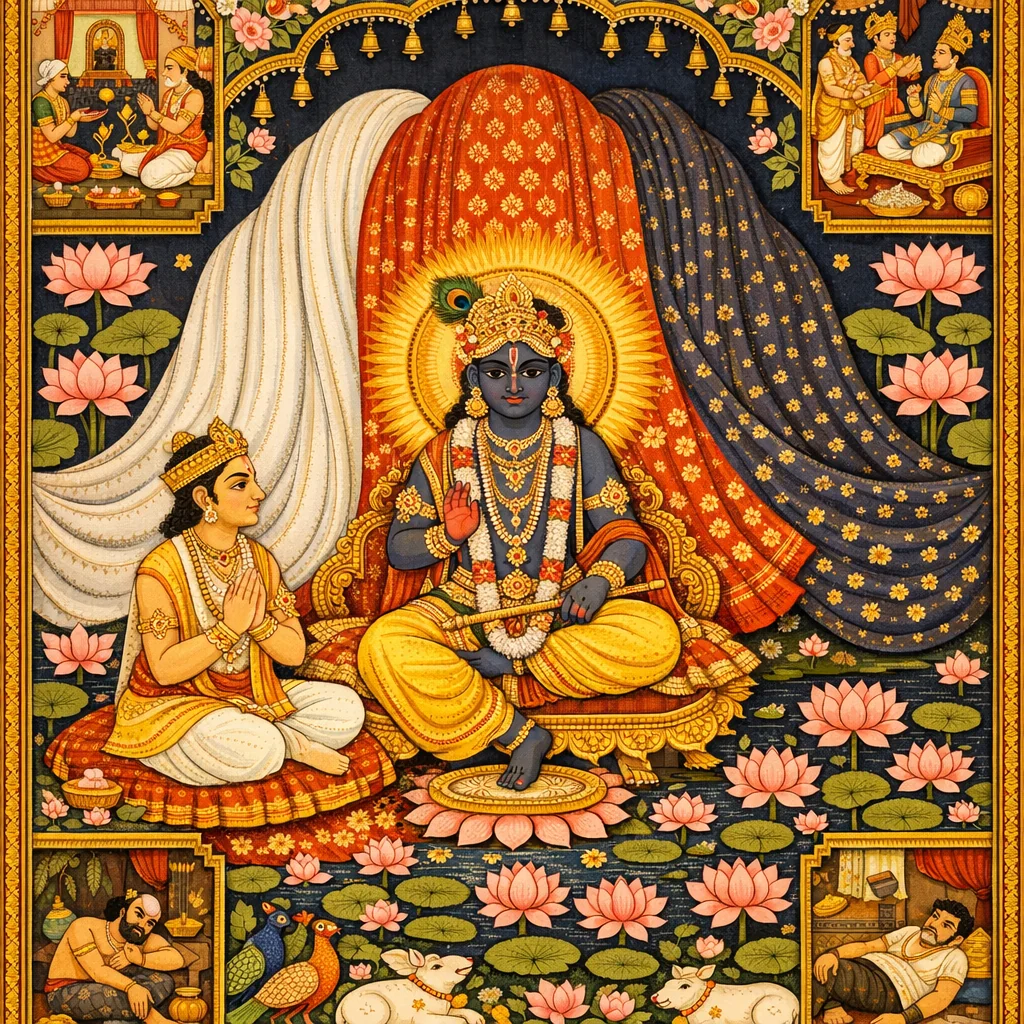
Adhyaya 25
Guṇa-vibhāga: The Three Modes and the Path Beyond Them
This chapter continues Kṛṣṇa’s Uddhava-gītā teachings on freeing the self from material conditioning. It outlines the lived signs of the three guṇas—sattva, rajas, and tamas—and shows how association (saṅga) shapes one’s nature. Kṛṣṇa lists the behavioral and psychological traits of each mode, then explains how the blended sense of “I” and “mine” and ordinary worldly dealings arise from their combination. He links the guṇas to motives in worship, states of consciousness (waking, dreaming, deep sleep), and social and cosmic results (demigods/demons, higher/lower births), as well as to work, knowledge, residence, faith, food, and happiness. The chapter culminates in a liberating progression: rise through sattva, conquer rajas and tamas through sattvic engagement, and finally transcend even sattva by indifference to the modes—taking exclusive shelter of Kṛṣṇa in devotional service (bhakti). It prepares the reader for later teachings on steadiness in bhakti and the full freedom of the jīva who no longer seeks enjoyment in external energy.
Shlokas
Verse 1
श्रीभगवानुवाच गुणानामसम्मिश्राणां पुमान् येन यथा भवेत् । तन्मे पुरुषवर्येदमुपधारय शंसत: ॥ १ ॥
The Supreme Lord said: O best among men, listen carefully as I explain how the living being attains a particular nature by association with each material mode.
Verse 2
शमो दमस्तितिक्षेक्षा तप: सत्यं दया स्मृति: । तुष्टिस्त्यागोऽस्पृहा श्रद्धा ह्रीर्दयादि: स्वनिर्वृति: ॥ २ ॥ काम ईहा मदस्तृष्णा स्तम्भ आशीर्भिदा सुखम् । मदोत्साहो यश:प्रीतिर्हास्यं वीर्यं बलोद्यम: ॥ ३ ॥ क्रोधो लोभोऽनृतं हिंसा याच्ञा दम्भ: क्लम: कलि: । शोकमोहौ विषादार्ती निद्राशा भीरनुद्यम: ॥ ४ ॥ सत्त्वस्य रजसश्चैतास्तमसश्चानुपूर्वश: । वृत्तयो वर्णितप्राया: सन्निपातमथो शृणु ॥ ५ ॥
Mind and sense control, tolerance, discrimination, austerity, truthfulness, mercy, remembrance, satisfaction, generosity, renunciation, freedom from craving, faith in the spiritual master, shame at improper acts, charity, simplicity, humility, and inner contentment are qualities of goodness (sattva). Material desire, great endeavor, audacity, dissatisfaction even in gain, false pride, prayers for worldly advancement, considering oneself superior, sense enjoyment, rash eagerness to fight, fondness for hearing praise, ridiculing others, advertising one’s prowess, and justifying actions by strength are qualities of passion (rajas). Intolerant anger, greed, speech without śāstric authority, violence, parasitic living, hypocrisy, chronic fatigue, quarrel, lamentation, delusion, misery, depression, excessive sleep, false hopes, fear, and laziness are major qualities of ignorance (tamas). Now hear of the mixture of these three modes.
Verse 3
शमो दमस्तितिक्षेक्षा तप: सत्यं दया स्मृति: । तुष्टिस्त्यागोऽस्पृहा श्रद्धा ह्रीर्दयादि: स्वनिर्वृति: ॥ २ ॥ काम ईहा मदस्तृष्णा स्तम्भ आशीर्भिदा सुखम् । मदोत्साहो यश:प्रीतिर्हास्यं वीर्यं बलोद्यम: ॥ ३ ॥ क्रोधो लोभोऽनृतं हिंसा याच्ञा दम्भ: क्लम: कलि: । शोकमोहौ विषादार्ती निद्राशा भीरनुद्यम: ॥ ४ ॥ सत्त्वस्य रजसश्चैतास्तमसश्चानुपूर्वश: । वृत्तयो वर्णितप्राया: सन्निपातमथो शृणु ॥ ५ ॥
Mind and sense control, tolerance, discrimination, austerity, truthfulness, mercy, remembrance, satisfaction, generosity, renunciation, freedom from craving, faith in the spiritual master, shame at improper acts, charity, simplicity, humility, and inner contentment are qualities of goodness (sattva). Material desire, great endeavor, audacity, dissatisfaction even in gain, false pride, prayers for worldly advancement, considering oneself superior, sense enjoyment, rash eagerness to fight, fondness for hearing praise, ridiculing others, advertising one’s prowess, and justifying actions by strength are qualities of passion (rajas). Intolerant anger, greed, speech without śāstric authority, violence, parasitic living, hypocrisy, chronic fatigue, quarrel, lamentation, delusion, misery, depression, excessive sleep, false hopes, fear, and laziness are major qualities of ignorance (tamas). Now hear of the mixture of these three modes.
Verse 4
शमो दमस्तितिक्षेक्षा तप: सत्यं दया स्मृति: । तुष्टिस्त्यागोऽस्पृहा श्रद्धा ह्रीर्दयादि: स्वनिर्वृति: ॥ २ ॥ काम ईहा मदस्तृष्णा स्तम्भ आशीर्भिदा सुखम् । मदोत्साहो यश:प्रीतिर्हास्यं वीर्यं बलोद्यम: ॥ ३ ॥ क्रोधो लोभोऽनृतं हिंसा याच्ञा दम्भ: क्लम: कलि: । शोकमोहौ विषादार्ती निद्राशा भीरनुद्यम: ॥ ४ ॥ सत्त्वस्य रजसश्चैतास्तमसश्चानुपूर्वश: । वृत्तयो वर्णितप्राया: सन्निपातमथो शृणु ॥ ५ ॥
Control of mind and senses, forbearance, discernment, steadfastness in one’s prescribed dharma, truthfulness, compassion, sacred remembrance, contentment, generosity, renunciation of sense pleasure, faith in the spiritual master, shame at improper acts, charity, simplicity, humility, and inner satisfaction—these are the qualities of sattva, the mode of goodness. Material desire, intense endeavor, audacity, dissatisfaction even in gain, false pride, prayers for worldly advancement, seeing oneself as superior, indulgence in sense enjoyment, rash eagerness to fight, delight in hearing one’s own praise, ridiculing others, flaunting one’s prowess, and justifying actions by strength—these are the qualities of rajas, the mode of passion. Intolerant anger, greed and stinginess, speech without śāstric authority, violent hatred, living as a parasite, hypocrisy, chronic fatigue, quarrel, lamentation, delusion, misery, depression, excessive sleep, false hopes, fear, and laziness—these are the qualities of tamas, the mode of ignorance. Now hear of the intermixture of these three modes.
Verse 5
शमो दमस्तितिक्षेक्षा तप: सत्यं दया स्मृति: । तुष्टिस्त्यागोऽस्पृहा श्रद्धा ह्रीर्दयादि: स्वनिर्वृति: ॥ २ ॥ काम ईहा मदस्तृष्णा स्तम्भ आशीर्भिदा सुखम् । मदोत्साहो यश:प्रीतिर्हास्यं वीर्यं बलोद्यम: ॥ ३ ॥ क्रोधो लोभोऽनृतं हिंसा याच्ञा दम्भ: क्लम: कलि: । शोकमोहौ विषादार्ती निद्राशा भीरनुद्यम: ॥ ४ ॥ सत्त्वस्य रजसश्चैतास्तमसश्चानुपूर्वश: । वृत्तयो वर्णितप्राया: सन्निपातमथो शृणु ॥ ५ ॥
Control of mind and senses, forbearance, discernment, steadfastness in one’s prescribed dharma, truthfulness, compassion, sacred remembrance, contentment, generosity, renunciation of sense pleasure, faith in the spiritual master, shame at improper acts, charity, simplicity, humility, and inner satisfaction—these are the qualities of sattva, the mode of goodness. Material desire, intense endeavor, audacity, dissatisfaction even in gain, false pride, prayers for worldly advancement, seeing oneself as superior, indulgence in sense enjoyment, rash eagerness to fight, delight in hearing one’s own praise, ridiculing others, flaunting one’s prowess, and justifying actions by strength—these are the qualities of rajas, the mode of passion. Intolerant anger, greed and stinginess, speech without śāstric authority, violent hatred, living as a parasite, hypocrisy, chronic fatigue, quarrel, lamentation, delusion, misery, depression, excessive sleep, false hopes, fear, and laziness—these are the qualities of tamas, the mode of ignorance. Now hear of the intermixture of these three modes.
Verse 6
सन्निपातस्त्वहमिति ममेत्युद्धव या मति: । व्यवहार: सन्निपातो मनोमात्रेन्द्रियासुभि: ॥ ६ ॥
My dear Uddhava, the intermixture of all three modes is present in the mentality of “I” and “mine.” The world’s ordinary dealings—carried out through the mind, the objects of perception, the senses, and the body’s vital airs (prāṇa)—are likewise founded upon this combination of the modes.
Verse 7
धर्मे चार्थे च कामे च यदासौ परिनिष्ठित: । गुणानां सन्निकर्षोऽयं श्रद्धारतिधनावह: ॥ ७ ॥
When a person becomes firmly devoted to dharma, artha, and kāma, the faith, wealth, and sensual enjoyment gained by his endeavors reveal the mutual interaction of nature’s three modes.
Verse 8
प्रवृत्तिलक्षणे निष्ठा पुमान् यर्हि गृहाश्रमे । स्वधर्मे चानुतिष्ठेत गुणानां समितिर्हि सा ॥ ८ ॥
When a man, desiring sense gratification, becomes attached to household life—marked by pravṛtti—and thus becomes established in the practice of his own svadharma, the combination of nature’s modes is clearly manifest.
Verse 9
पुरुषं सत्त्वसंयुक्तमनुमीयाच्छमादिभि: । कामादिभी रजोयुक्तं क्रोधाद्यैस्तमसा युतम् ॥ ९ ॥
One who displays qualities such as self-control is understood to be predominated by sattva (goodness). One marked by lust and the like is in rajas (passion), and one marked by anger and the like is in tamas (ignorance).
Verse 10
यदा भजति मां भक्त्या निरपेक्ष: स्वकर्मभि: । तं सत्त्वप्रकृतिं विद्यात् पुरुषं स्त्रियमेव वा ॥ १० ॥
Whether man or woman, one who worships Me with loving bhakti, offering one’s prescribed duties unto Me without material attachment, should be understood to be situated in sattva (goodness).
Verse 11
यदा आशिष आशास्य मां भजेत स्वकर्मभि: । तं रज:प्रकृतिं विद्यात् हिंसामाशास्य तामसम् ॥ ११ ॥
When one worships Me through one’s prescribed duties, hoping for material benediction, one’s nature should be understood to be in rajas (passion). And one who worships Me with the desire to harm others is in tamas (ignorance).
Verse 12
सत्त्वं रजस्तम इति गुणा जीवस्य नैव मे । चित्तजा यैस्तु भूतानां सज्जमानो निबध्यते ॥ १२ ॥
Sattva, rajas and tamas are modes affecting the living being, not Me. Arising within the mind, they impel the jīva to cling to the body and other created objects, and thus he becomes bound.
Verse 13
यदेतरौ जयेत् सत्त्वं भास्वरं विशदं शिवम् । तदा सुखेन युज्येत धर्मज्ञानादिभि: पुमान् ॥ १३ ॥
When sattva—luminous, pure and auspicious—prevails over rajas and tamas, a person is naturally endowed with happiness, dharma, knowledge and other noble qualities.
Verse 14
यदा जयेत्तम: सत्त्वं रज: सङ्गं भिदा चलम् । तदा दु:खेन युज्येत कर्मणा यशसा श्रिया ॥ १४ ॥
When the mode of passion (rajas), which breeds attachment, separatism, and restless activity, conquers ignorance and goodness, a person toils to gain prestige and prosperity. Thus, in rajas, one undergoes anxiety and struggle.
Verse 15
यदा जयेद् रज: सत्त्वं तमो मूढं लयं जडम् । युज्येत शोकमोहाभ्यां निद्रयाहिंसयाशया ॥ १५ ॥
When the mode of ignorance (tamas), dull and inert, conquers passion and goodness, it covers one’s consciousness and makes one foolish and lethargic. Overcome by lamentation and illusion, one sleeps excessively, clings to false hopes, and shows violence toward others.
Verse 16
यदा चित्तं प्रसीदेत इन्द्रियाणां च निर्वृति: । देहेऽभयं मनोऽसङ्गं तत् सत्त्वं विद्धि मत्पदम् ॥ १६ ॥
When consciousness becomes serene and clear and the senses withdraw from matter, one feels fearlessness within the body and detachment from the material mind. Know this as the predominance of goodness (sattva), wherein the chance to realize Me arises.
Verse 17
विकुर्वन् क्रियया चाधीरनिवृत्तिश्च चेतसाम् । गात्रास्वास्थ्यं मनो भ्रान्तं रज एतैर्निशामय ॥ १७ ॥
Discern the mode of passion (rajas) by these symptoms: intelligence distorted by excessive activity, the senses unable to disengage from mundane objects, an unhealthy condition of the working organs, and the mind’s unsteady confusion.
Verse 18
सीदच्चित्तं विलीयेत चेतसो ग्रहणेऽक्षमम् । मनो नष्टं तमो ग्लानिस्तमस्तदुपधारय ॥ १८ ॥
When higher awareness collapses and finally fades so that one cannot concentrate, the mind becomes ruined, revealing ignorance and depression. Understand this as the predominance of the mode of ignorance (tamas).
Verse 19
एधमाने गुणे सत्त्वे देवानां बलमेधते । असुराणां च रजसि तमस्युद्धव रक्षसाम् ॥ १९ ॥
With the increase of the mode of goodness, the strength of the demigods similarly increases. When passion increases, the demoniac become strong. And with the rise of ignorance, O Uddhava, the strength of the most wicked increases.
Verse 20
सत्त्वाज्जागरणं विद्याद् रजसा स्वप्नमादिशेत् । प्रस्वापं तमसा जन्तोस्तुरीयं त्रिषु सन्ततम् ॥ २० ॥
It should be understood that alert wakefulness comes from the mode of goodness, sleep with dreaming from the mode of passion, and deep, dreamless sleep from the mode of ignorance. The fourth state of consciousness pervades these three and is transcendental.
Verse 21
उपर्युपरि गच्छन्ति सत्त्वेन ब्राह्मणा जना: । तमसाधोऽध आमुख्याद् रजसान्तरचारिण: ॥ २१ ॥
Learned persons dedicated to Vedic culture are elevated by the mode of goodness to higher and higher positions. The mode of ignorance, on the other hand, forces one to fall headfirst into lower and lower births. And by the mode of passion one continues transmigrating through human bodies.
Verse 22
सत्त्वे प्रलीना: स्वर्यान्ति नरलोकं रजोलया: । तमोलयास्तु निरयं यान्ति मामेव निर्गुणा: ॥ २२ ॥
Those who leave this world in the mode of goodness go to the heavenly planets, those who pass away in the mode of passion remain in the world of human beings, and those dying in the mode of ignorance must go to hell. But those who are free from the influence of all modes of nature come to Me.
Verse 23
मदर्पणं निष्फलं वा सात्त्विकं निजकर्म तत् । राजसं फलसङ्कल्पं हिंसाप्रायादि तामसम् ॥ २३ ॥
Work performed as an offering to Me, without consideration of the fruit, is considered to be in the mode of goodness. Work performed with a desire to enjoy the results is in the mode of passion. And work impelled by violence and envy is in the mode of ignorance.
Verse 24
कैवल्यं सात्त्विकं ज्ञानं रजो वैकल्पिकं च यत् । प्राकृतं तामसं ज्ञानं मन्निष्ठं निर्गुणं स्मृतम् ॥ २४ ॥
Knowledge leading to kaivalya is in goodness; knowledge founded on dualistic alternatives is in passion; and crude, materialistic knowledge is in ignorance. But knowledge fixed in Me is understood as nirguna—transcendental to the modes.
Verse 25
वनं तु सात्त्विको वासो ग्रामो राजस उच्यते । तामसं द्यूतसदनं मन्निकेतं तु निर्गुणम् ॥ २५ ॥
Living in the forest is in goodness; living in a town is in passion; living in a gambling house is in ignorance. But living where I reside is nirguna—beyond the modes.
Verse 26
सात्त्विक: कारकोऽसङ्गी रागान्धो राजस: स्मृत: । तामस: स्मृतिविभ्रष्टो निर्गुणो मदपाश्रय: ॥ २६ ॥
A worker free from attachment is in goodness; a worker blinded by personal desire is in passion; and a worker who has lost moral memory and cannot discern right from wrong is in ignorance. But one who takes shelter of Me is nirguna—beyond the modes.
Verse 27
सात्त्विक्याध्यात्मिकी श्रद्धा कर्मश्रद्धा तु राजसी । तामस्यधर्मे या श्रद्धा मत्सेवायां तु निर्गुणा ॥ २७ ॥
Faith directed toward spiritual life is in goodness; faith rooted in fruit-seeking work is in passion; faith dwelling in irreligion is in ignorance. But faith in My devotional service is nirguna—purely transcendental.
Verse 28
पथ्यं पूतमनायस्तमाहार्यं सात्त्विकं स्मृतम् । राजसं चेन्द्रियप्रेष्ठं तामसं चार्तिदाशुचि ॥ २८ ॥
Food that is wholesome, pure, and obtained without hardship is considered in goodness; food that gives immediate delight to the senses is in passion; and food that is unclean and brings distress is in ignorance.
Verse 29
सात्त्विकं सुखमात्मोत्थं विषयोत्थं तु राजसम् । तामसं मोहदैन्योत्थं निर्गुणं मदपाश्रयम् ॥ २९ ॥
Happiness arising from the self is sāttvika; happiness born of sense enjoyment is rājasika; and happiness born of delusion and degradation is tāmasika. But the happiness that takes shelter in Me is nirguṇa—transcendental.
Verse 30
द्रव्यं देश: फलं कालो ज्ञानं कर्म च कारक: । श्रद्धावस्थाकृतिर्निष्ठा त्रैगुण्य: सर्व एव हि ॥ ३० ॥
Material substance, place, the fruit of action, time, knowledge, work, the doer, faith (śraddhā), the state of consciousness, the species of life, and one’s destination after death—all are indeed founded upon the three modes of material nature.
Verse 31
सर्वे गुणमया भावा: पुरुषाव्यक्तधिष्ठिता: । दृष्टं श्रुतमनुध्यातं बुद्ध्या वा पुरुषर्षभ ॥ ३१ ॥
O best of men, all conditions of material existence are connected with the interaction of the enjoying soul (puruṣa) and unmanifest nature (avyakta). Whether seen, heard of, or merely conceived by the intelligence, everything without exception is constituted of the guṇas.
Verse 32
एता: संसृतय: पुंसो गुणकर्मनिबन्धना: । येनेमे निर्जिता: सौम्य गुणा जीवेन चित्तजा: । भक्तियोगेन मन्निष्ठो मद्भावाय प्रपद्यते ॥ ३२ ॥
O gentle Uddhava, all these phases of conditioned life arise from work bound to the guṇas. The living being who conquers these mind-born guṇas can, through bhakti-yoga, become fixed in Me and thus attain pure love for Me.
Verse 33
तस्माद् देहमिमं लब्ध्वा ज्ञानविज्ञानसम्भवम् । गुणसङ्गं विनिर्धूय मां भजन्तु विचक्षणा: ॥ ३३ ॥
Therefore, having attained this human body, which can give rise to knowledge and realized wisdom, the intelligent should cast off all association with the guṇas and engage exclusively in loving service to Me.
Verse 34
नि:सङ्गो मां भजेद् विद्वानप्रमत्तो जितेन्द्रिय: । रजस्तमश्चाभिजयेत् सत्त्वसंसेवया मुनि: ॥ ३४ ॥
A wise sage, free from attachment, alert and self-controlled, should worship Me. By cultivating the mode of goodness, he conquers passion and ignorance.
Verse 35
सत्त्वं चाभिजयेद् युक्तो नैरपेक्ष्येण शान्तधी: । सम्पद्यते गुणैर्मुक्तो जीवो जीवं विहाय माम् ॥ ३५ ॥
Then, fixed in devotion and serene in mind, the sage should transcend even goodness by remaining indifferent to the modes. Thus freed from the gunas, the soul abandons the cause of bondage and attains Me.
Verse 36
जीवो जीवविनिर्मुक्तो गुणैश्चाशयसम्भवै: । मयैव ब्रह्मणा पूर्णो न बहिर्नान्तरश्चरेत् ॥ ३६ ॥
Freed from the mind’s subtle conditioning and from the modes born of material consciousness, the living being becomes fully satisfied by experiencing My transcendental form. He no longer seeks enjoyment outside, nor does he dwell on it within.
Frequently Asked Questions
The chapter defines sattva through inner governance and clarity (sense control, tolerance, truthfulness, mercy, satisfaction, humility, faith in guru), rajas through acquisitive drive and egoic competition (material desire, intense endeavor, pride, craving for praise, agitation), and tamas through obscuration and degradation (anger, stinginess, hypocrisy, fatigue, delusion, depression, laziness, fear). These are not merely moral labels but diagnostic markers of consciousness shaped by association.
Because ahaṅkāra (false ego) and possessiveness arise when consciousness identifies with the mind-body complex, which itself operates through guṇic interaction (mind, senses, prāṇa, objects). The “I/mine” structure is therefore a product of prakṛti’s modes acting within conditioned awareness, not the intrinsic nature of the ātmā.
Kṛṣṇa correlates wakefulness with sattva, dreaming with rajas, and deep dreamless sleep with tamas, then states that a fourth state pervades these three and is transcendental. This indicates the witness-consciousness of the self (and ultimately realization of Bhagavān) that is not reducible to guṇic fluctuations.
The chapter outlines a sequence: subdue the senses and worship Kṛṣṇa; overcome rajas and tamas by engaging with sattvic supports (clarity, restraint, purity); then transcend sattva by indifference to the modes—remaining fixed in devotional service without identification with any guṇic state. Taking shelter of Kṛṣṇa is identified as the transcendental position beyond the modes.
Those who depart in sattva attain higher planetary destinations (svarga and upward trajectories), those in rajas remain within human-centered transmigration, and those in tamas fall to hellish conditions. Yet the chapter’s conclusion is that one free from all modes attains Kṛṣṇa (the āśraya), which supersedes guṇa-based destinations.