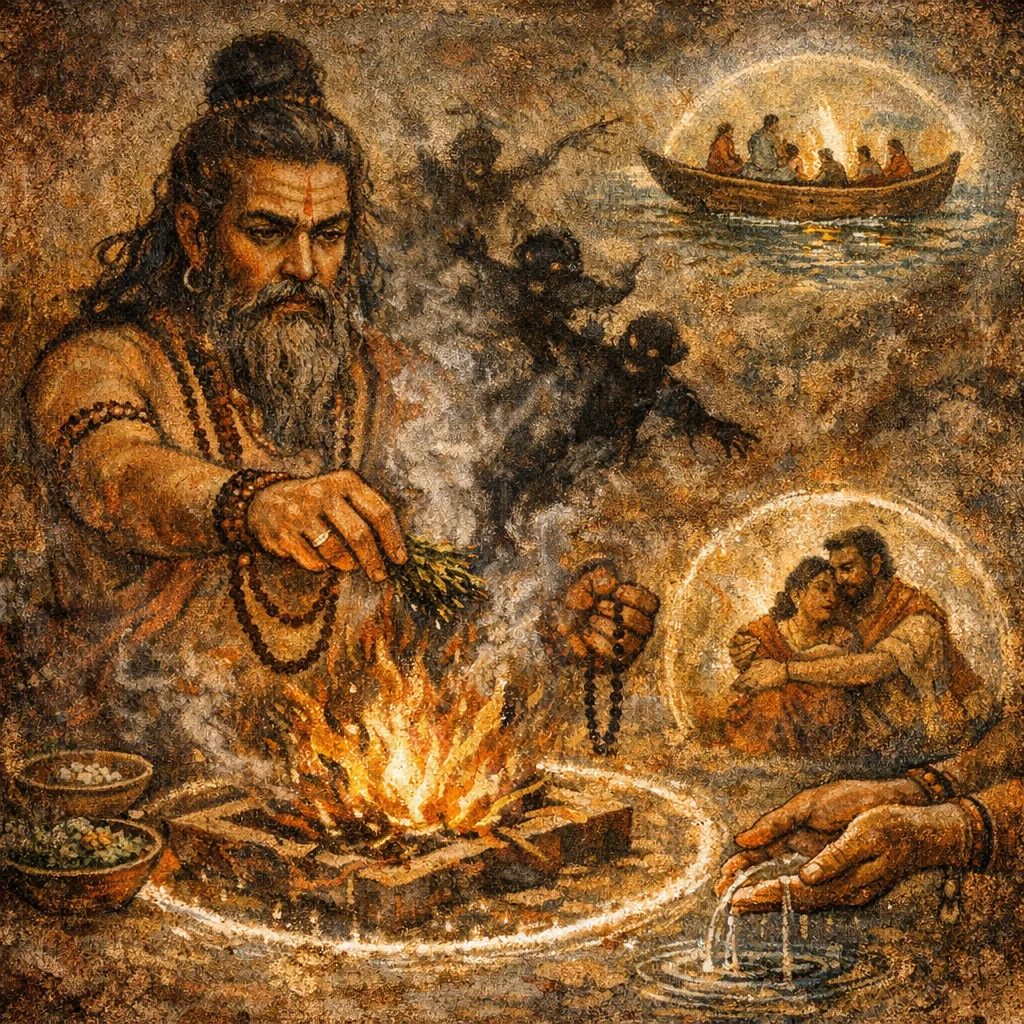
Sukta 33
Rishi: Atharvanic tradition (seer not specified in the provided input; commonly treated as Atharvan/Angiras-type for such Agni-expulsion hymns)
Devata: Agni (as pāpa-nāśana, purifier)
Chandas: Anuṣṭubh (probable; refrain structure suggests anuṣṭubh cadence, but meter should be verified against a critical text)
Mantras
Mantra 1
पाप-नाशनम् अप नः शोशुचदघमग्ने शुशुग्ध्या रयिम्। अप नः शोशुचदघम्
O Agni, the evil-destroyer—away from us let the evil be burnt away; kindle forth and bring hither wealth. Away from us let the evil be burnt away.
Mantra 2
सुक्षेत्रिया सुगातुया वसूया च यजामहे । अप नः शोशुचदघम्
With good fields, with good ways of going, and with wealth we do sacrifice: away from us let the evil be burnt away.
Mantra 3
प्र यद् भन्दिष्ठ एषां प्रास्माकासश्च सूरयः । अप नः शोशुचदघम्
When their most bounteous (power) goes forth, and our own patrons too go forth—away from us let the evil be burnt away.
Mantra 4
प्र यत् ते अग्ने सूरयो जायेमहि प्र ते वयम्। अप नः शोशुचदघम्
So that, O Agni, we may come to be thy patrons, and we ourselves may advance under thee—away from us let the evil be burnt away.
Mantra 5
प्र यदग्नेः सहस्वतो विश्वतो यन्ति भानवः । अप नः शोशुचदघम्
When the beams of Agni the mighty go forth on every side, away from us let the evil be burnt away.
Mantra 6
त्वं हि विश्वतोमुख विश्वतः परिभूरसि । अप नः शोशुचदघम्
For thou, O All-faced, art the overmasterer on every side: scorch thou away from us the evil.
Mantra 7
द्विषो नो विश्वतोमुखाति नावेव पारय । अप नः शोशुचदघम्
From them that hate us, by the All-faced One, bear us across, as in a boat: scorch thou away from us the evil.
Mantra 8
स नः सिन्धुमिव नावाति पर्ष स्वस्तये । अप नः शोशुचदघम्
So bear us over, for our welfare, as in a boat across the Sindhu: scorch thou away from us the evil.
Frequently Asked Questions
In Atharvavedic usage, agha can mean evil, misfortune, harmful influence, or a kind of ritual/moral pollution. The hymn asks Agni to ‘scorch it away’ so it no longer clings to the patron or the place.
Both. The repeated refrain targets inner fault and outer danger alike, and verses about Agni’s beams going in all directions frame it as a space-clearing, protective charm.
It is naturally paired with kindling a fire: recite while establishing a steady flame, directing the refrain as an expulsion formula. It fits moments of purification—after bad omens, before travel, or before important rites—seeking svasti and rayi.