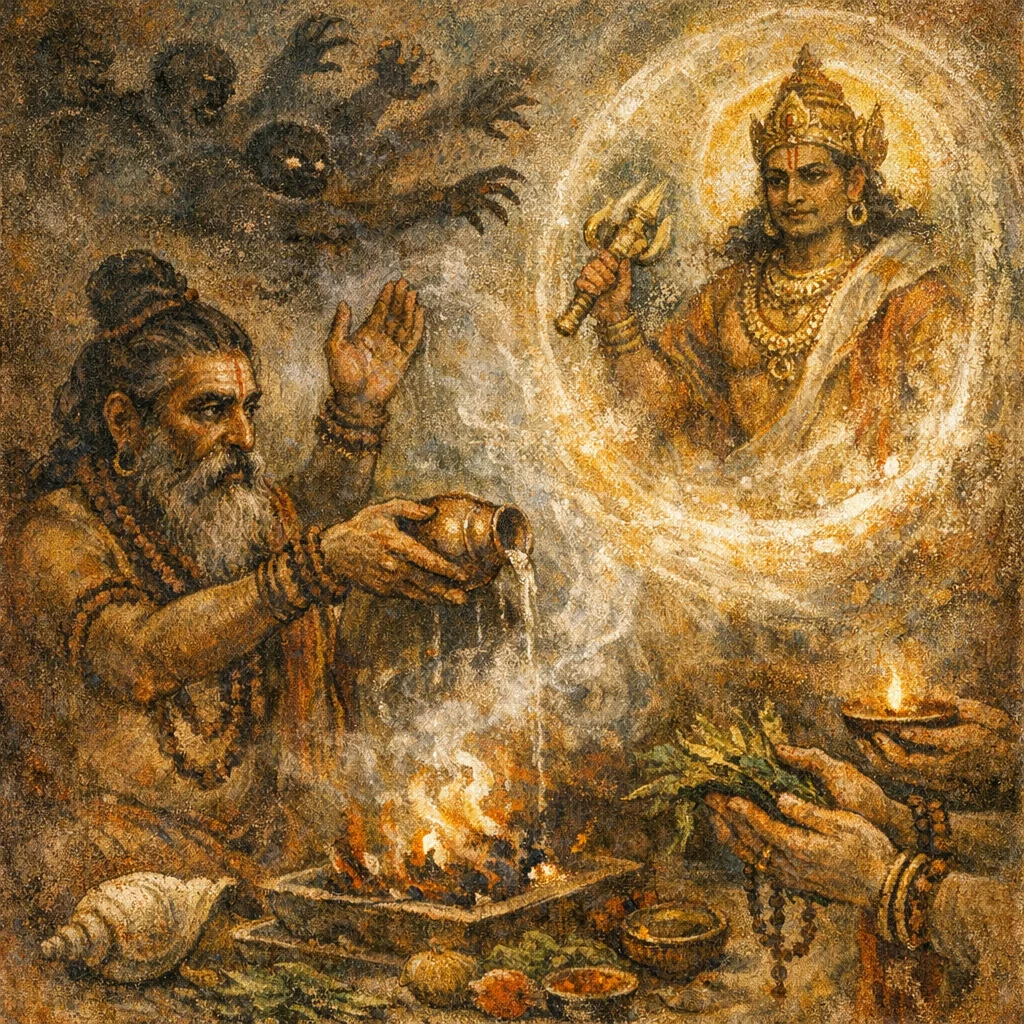
Sukta 112
Rishi: Ṛgvedic provenance; r̥ṣi not determinable from excerpt alone.
Devata: Indra (Vṛtrahan); Sūrya appears as addressed marker.
Chandas: Not securely determinable from excerpt alone.
Mantras
Mantra 1
यदद्य कच्च वृत्रहन्नुदगा अभि सूर्य । सर्वं तदिन्द्र ते वशे
Whatsoever, today, in any wise, O Vṛtra-slayer, thou hast gone forth toward the Sun— all that, O Indra, is in thy dominion.
Mantra 2
यद् वा प्रवृद्ध सत्पते न मरा इति मन्यसे । उतो तत् सत्यमित् तव
If, O might-increased Lord of the True, thou deemest thus, ‘I shall not die,’—then that, moreover, is verily thine own truth.
Mantra 3
ये सोमासः परावति ये अर्वावति सुन्विरे। सर्वांस्तां इन्द्र गच्छसि
What Soma-draughts are pressed in the far region, what are pressed in the near,—to all of them, O Indra, thou resortest.
Frequently Asked Questions
It declares that everything within the day’s cosmic field (marked by the Sun) lies under Indra’s dominion, and it calls Indra to attend the Soma offering so the rite succeeds without obstacles.
The verse treats Indra’s invincibility as grounded in satya—truth itself guarantees his unassailable power, which stabilizes the sacrificer’s undertaking under Indra’s protection.
In a Soma-rite it fits naturally with Soma pressing, but outside that setting a simple clean libation (like water or milk) can serve as a symbolic offering while reciting the mantras with the intent of inviting Indra’s presence.