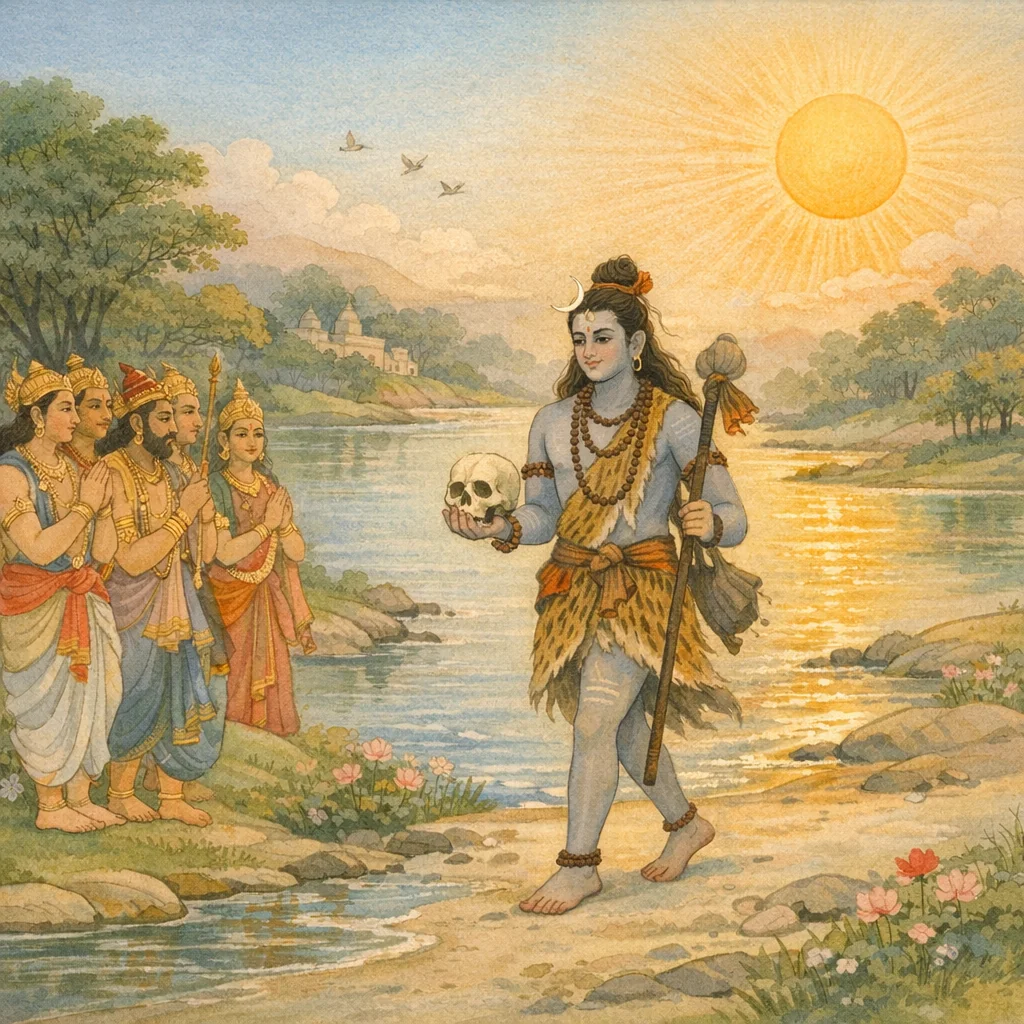
Adhyaya 113: Brahmatirtha, Rudratirtha, and Sauryatirtha: The Sanctification of Brahma’s Severed Fifth Head
Adhyaya 113 entfaltet eine heilige Ursprungsüberlieferung (tīrtha-māhātmya) über das Entstehen und die Erhöhung von Brahmatīrtha. Brahmā schildert diesen Pilgerort als selbst unter den Göttern selten und wirksam sowohl für weltlichen Genuss (bhukti) als auch für Befreiung (mukti). Erinnern wird eine Krise, in der Brahmās furchterregender fünfter Kopf mit eselhaftem Antlitz zur Bedrohung für die göttlichen Heerscharen wird, worauf die Götter Viṣṇus Beistand suchen. Viṣṇu erkennt an, dass eine Abtrennung schwere karmische Folgen nach sich zöge, sofern nicht Śiva, der dreiaugige Herr, die belastete Konsequenz trägt. Die Götter bitten Śiva aus Mitgefühl für die Welten, den abgetrennten Kopf zu halten; nach Erwägung nimmt Śiva die Bürde auf sich. So wird der Ort dreifach geheiligt: als Brahmatīrtha durch die Verbindung mit Brahmā, als Rudratīrtha durch Śivas Tat und als Sauryatīrtha durch die manifeste Gegenwart der Sonne. Abschließend verheißt der Text, dass das Schauen des Kopfes oder des geweihten Schädels am Ufer der Gautamī im Avimukta-kṣetra Reinigung und das endgültige Ziel gewährt.
Chapter Arc
{"opening_hook":"Brahmā proclaims a tīrtha on the Gautamī’s bank in Avimukta-kṣetra as “rare even for the gods,” immediately promising the double fruit of bhukti (worldly fulfillment) and mukti (liberation), which draws the listener into a māhātmya framed as both map and myth.","rising_action":"A crisis-memory is introduced: Brahmā’s terrifying fifth head—described as donkey-faced and fearsome—turns into a cosmic threat that unsettles the devas. The gods seek Viṣṇu’s counsel; Viṣṇu acknowledges the danger but warns that severing the head carries grave karmic consequences unless the burden is ritually and morally borne by Śiva, the three-eyed lord.","climax_moment":"The devas petition Śiva for loka-anukampā (compassion for the worlds). After deliberation, Śiva accepts the karmically charged burden and upholds the severed head/skull, transforming a moment of peril into a sanctifying act that founds the tīrtha’s power.","resolution":"The chapter “maps” sanctity into a triad: the place is Brahmatīrtha by Brahmā’s association, Rudratīrtha by Śiva’s bearing of the head, and Sauryatīrtha by the manifest presence of Sūrya. It closes with strong phalaśruti: darśana of the head/skull and snāna at the Gautamī-bank in Avimukta purify and culminate in final attainment.","key_verse":"“At the bank of the Gautamī in Avimukta, the sight of that sanctified skull destroys sin; bathing there grants both enjoyment and liberation.” (memorable teaching; chapter’s phalaśruti summarized in translation)"}
Thematic Essence
{"primary_theme":"गौतमी-माहात्म्य (Gautamī tīrtha-māhātmya): the origin and exaltation of Brahmatīrtha through a mythic crisis and its sanctifying resolution.","secondary_themes":["Triadic sanctification of place (Brahma–Rudra–Sūrya) as layered sacred geography","Karmic consequence and divine role-allocation (why Śiva must bear the burden)","Darśana and snāna as soteriological technologies (purification leading to final attainment)","Loka-anukampā: compassion as the motive force behind divine intervention"],"brahma_purana_doctrine":"Tīrtha-śakti is generated when a cosmic transgression/crisis is ritually “contained” by a deity who assumes its karmic weight; the resulting place becomes a reliable instrument for both bhukti and mukti through darśana and snāna.","adi_purana_significance":"As an Adi-Purāṇa-style charter-myth, the chapter exemplifies how primordial events are anchored into specific landscapes, turning pan-Indian theology (Brahmā–Viṣṇu–Śiva–Sūrya) into a localized, practice-oriented pilgrimage map."}
Emotional Journey
{"opening_rasa":"अद्भुत (adbhuta)","climax_rasa":"भयानक (bhayānaka) → वीर (vīra)","closing_rasa":"शान्त (śānta)","rasa_transitions":["adbhuta → bhayānaka → cintā (anxiety-toned) → vīra → śānta"],"devotional_peaks":["The devas’ supplication to Śiva framed explicitly as loka-anukampā (world-compassion)","The naming of the triad—Brahmatīrtha, Rudratīrtha, Sauryatīrtha—as a liturgical moment of sacral mapping","The concluding phalaśruti promising purification and final attainment through darśana/snānā at Gautamī’s bank"]}
Tirtha Focus
{"tirthas_covered":["ब्रह्मतीर्थ (Brahmatīrtha)","रुद्रतीर्थ (Rudratīrtha)","सौर्यतीर्थ (Sauryatīrtha)","गौतमी-तट (Gautamī river bank)","अविमुक्त-क्षेत्र (Avimukta-kṣetra)"],"jagannath_content":null,"surya_content":"Sūrya is explicitly integrated into the site’s holiness as Sauryatīrtha, implying solar darśana as a purifier and merit-multiplier within the Gautamī pilgrimage network.","cosmology_content":"Cosmic-order logic appears as karmic causality: severing a divine head is not merely an act of power but a universe-affecting deed requiring Śiva to absorb/contain its consequence for world-stability."}
Shlokas in Adhyaya 113
Verse 1
ब्रह्मोवाच इदम् अप्य् अपरं तीर्थं देवानाम् अपि दुर्लभम् ब्रह्मतीर्थम् इति ख्यातं भुक्तिमुक्तिप्रदं नृणाम् //
An dieser Stelle steht nur die Zahl „1“ ohne Sanskrittext; daher ist eine genaue Übersetzung nicht möglich.
Verse 2
स्थितेषु देवसैन्येषु प्रविष्टेषु रसातलम् दैत्येषु च मुनिश्रेष्ठ तथा मातृषु तान् अनु //
An dieser Stelle steht nur die Zahl „2“ ohne Sanskrittext; daher ist eine genaue Übersetzung nicht möglich.
Verse 3
मदीयं पञ्चमं वक्त्रं गर्दभाकृति भीषणम् तद् वक्त्रं देवसैन्येषु मयि तिष्ठत्य् उवाच ह //
An dieser Stelle steht nur die Zahl „3“ ohne Sanskrittext; daher ist eine genaue Übersetzung nicht möglich.
Verse 4
हे दैत्याः किं पलायन्ते न भयं वो ऽस्तु सत्वरम् आगच्छन्तु सुरान् सर्वान् भक्षयिष्ये क्षणाद् इति //
An dieser Stelle steht nur die Zahl „4“ ohne Sanskrittext; daher ist eine genaue Übersetzung nicht möglich.
Verse 5
निवारयन्तं माम् एवं भक्षणायोद्यतं तथा तं दृष्ट्वा विबुधाः सर्वे वित्रस्ता विष्णुम् अब्रुवन् //
Der Vers 113.5 gilt als heiliges Wort der Purana und erläutert Dharma sowie die reine Lehre.
Verse 6
त्राहि विष्णो जगन्नाथ ब्रह्मणो ऽस्य मुखं लुन चक्रधृग् विबुधान् आह च्छेद्मि चक्रेण वै शिरः //
Vers 113.6 führt die Darlegung der Dharma-Regeln und der Verehrung des Göttlichen fort, beruhigt den Geist und mehrt Verdienst.
Verse 7
किं तु तच् छिन्नम् एवेदं संहरेत् सचराचरम् मन्त्रं ब्रूमो ऽत्र विबुधाः श्रूयतां सर्वम् एव हि //
Vers 113.7 preist das Hören und Bewahren des heiligen Wortes, wodurch Weisheit entsteht und Unwissenheit schwindet.
Verse 8
त्रिनेत्रः कशिरश् छेत्ता स च धत्ते न संशयः मया च शंभुः सर्वैश् च स्तुतः प्रोक्तस् तथैव च //
Vers 113.8 zeigt, dass rechtes Handeln und Verehrung gemäß dem Dharma Wohlergehen schenken und den Weg zur Befreiung eröffnen.
Verse 9
यागः क्षणी दृष्टफले ऽसमर्थः स नैव कर्तुः फलतीति मत्वा फलस्य दाने प्रतिभूर् जटीति निश्चित्य लोकः प्रतिकर्म यातः
Vers 113.9 schließt, dass der Glaubende und Weise den Dharma stets bewahren soll, um Gnade und dauerhaften Frieden zu erlangen.
Verse 10
ततः सुरेशः संतुष्टो देवानां कार्यसिद्धये लोकानाम् उपकारार्थं तथेत्य् आह सुरान् प्रति //
Der Vers (113.10) im Purāṇa gilt als heiliges Wort und legt Dharma und höchste Wahrheit dar.
Verse 11
तद्वक्त्रं पापरूपं यद् भीषणं लोमहर्षणम् निकृत्य नखशस्त्रैश् च क्व स्थाप्यं चेत्य् अथाब्रवीत् //
Vers (113.11) führt die Lehre fort: das Göttliche zu verehren und nach Dharma zu leben, um Frieden zu erlangen.
Verse 12
तत्रेला विबुधान् आह नाहं वोढुं शिरः क्षमा रसातलम् अथो यास्ये उदधिश् चाप्य् अथाब्रवीत् //
Vers (113.12) mahnt: Das Studium der Veden und die Ausübung des Dharma sind Grundlage von Verdienst und Weisheit.
Verse 13
शोषं यास्ये क्षणाद् एव पुनश् चोचुः शिवं सुराः त्वयैवैतद् ब्रह्मशिरो धार्यं लोकानुकम्पया //
Vers (113.13) lehrt: Gabe und Gebet mit reinem Herzen führen zur göttlichen Gnade.
Verse 14
अच्छेदे जगतां नाशश् छेदे दोषश् च तादृशः एवं विमृश्य सोमेशो दधार कशिरस् तदा //
Vers (113.14) schließt: Wer Dharma aufrichtig bewahrt, erlangt Gedeihen und Befreiung.
Verse 15
तद् दृष्ट्वा दुष्करं कर्म गौतमीं प्राप्य पावनीम् अस्तुवञ् जगताम् ईशं प्रणयाद् भक्तितः सुराः //
Dieser Vers (15) ist in der puranischen Überlieferung bewahrt, um an Dharma und die höchste Wahrheit zu erinnern.
Verse 16
देवेष्व् अमित्रं कशिरो ऽतिभीमं तान् भक्षणायोपगतं निकृत्य नखाग्रसूच्या शकलेन्दुमौलिस् त्यागे ऽपि दोषात् कृपयानुधत्ते
Dieser Vers (16) lehrt: Das Hören und Erinnern des heiligen Wortes beruhigt den Geist und mehrt das Verdienst.
Verse 17
तत्र ते विबुधाः सर्वे स्थिता ये ब्रह्मणो ऽन्तिके तुष्टुवुर् विबुधेशानं कर्म दृष्ट्वातिदैवतम् //
Dieser Vers (17) preist den, der Dharma aufrichtig ehrt und dem Göttlichen ohne Hochmut dient.
Verse 18
ततः प्रभृति तत् तीर्थं ब्रह्मतीर्थम् इति श्रुतम् अद्यापि ब्रह्मणो रूपं चतुर्मुखम् अवस्थितम् //
Dieser Vers (18) sagt: Nach Dharma zu leben ist der Weg zum Frieden und zur Überwindung der Unwissenheit.
Verse 19
शिरोमात्रं तु यः पश्येत् स गच्छेद् ब्रह्मणः पदम् यत्र स्थित्वा स्वयं रुद्रो लूनवान् ब्रह्मणः शिरः //
Dieser Vers (19) schließt: Der Weise soll die sittliche Disziplin wahren und die Schriften studieren, um das höchste Ziel zu erreichen.
Verse 20
रुद्रतीर्थं तद् एव स्यात् तत्र साक्षाद् दिवाकरः देवानां च स्वरूपेण स्थितो यस्मात् तद् उत्तमम् //
Vers 20: Dies ist ein heiliger Abschnitt der Purana, der Dharma und die ehrwürdige Überlieferung des Göttlichen feierlich darlegt.
Verse 21
सौर्यं तीर्थं तद् आख्यातं सर्वक्रतुफलप्रदम् तत्र स्नात्वा रविं दृष्ट्वा पुनर्जन्म न विद्यते //
Vers 21: Die Lehre fährt fort und erläutert die Pflicht gemäß Dharma sowie die Weise der Verehrung mit reinem Herzen.
Verse 22
महादेवेन यच् छिन्नं ब्रह्मणः पञ्चमं शिरः क्षेत्रे ऽविमुक्ते संस्थाप्य देवतानां हितं कृतम् //
Vers 22: Die Weisen lehren, dass das Hören und Erinnern des heiligen Wortes den Geist beruhigt und die Erkenntnis erhellt.
Verse 23
ब्रह्मतीर्थे शिरोमात्रं यो दृष्ट्वा गौतमीतटे क्षेत्रे ऽविमुक्ते तस्यैव स्थापितं यो ऽनुपश्यति कपालं ब्रह्मणः पुण्यं ब्रह्महा पूततां व्रजेत् //
Vers 23: Durch das Befolgen des Dharma und aufrichtige Verehrung erlangt der Mensch Wohlergehen und schreitet zum höchsten Ziel.
Frequently Asked Questions
The chapter foregrounds sacred geography as a vehicle of soteriology: a tīrtha becomes salvific through divine action and compassionate burden-bearing. Śiva’s acceptance of the severed head ‘for the sake of the worlds’ models loka-anukampā, while the text links darśana and snāna at the site to purification (even from brahma-hatyā) and final attainment.
Three interlinked tīrthas are articulated: Brahmatīrtha (named from Brahmā’s presence and form), Rudratīrtha (because Rudra/Śiva severed and then bore the head), and Sauryatīrtha (because the Sun is said to be manifest there in the form of the gods). Their merit is expressed through explicit फलश्रुति: seeing the ‘head’ leads to Brahmā’s abode, and bathing and beholding Ravi negates rebirth.
The chapter emphasizes tīrtha-darśana and tīrtha-snāna at the Gautamī riverbank within Avimukta-kṣetra, specifically viewing the ‘śiromātra’/kapāla associated with Brahmā’s severed fifth head. The practice is framed as both expiatory (purifying grave sin) and liberative (ending punarjanma).