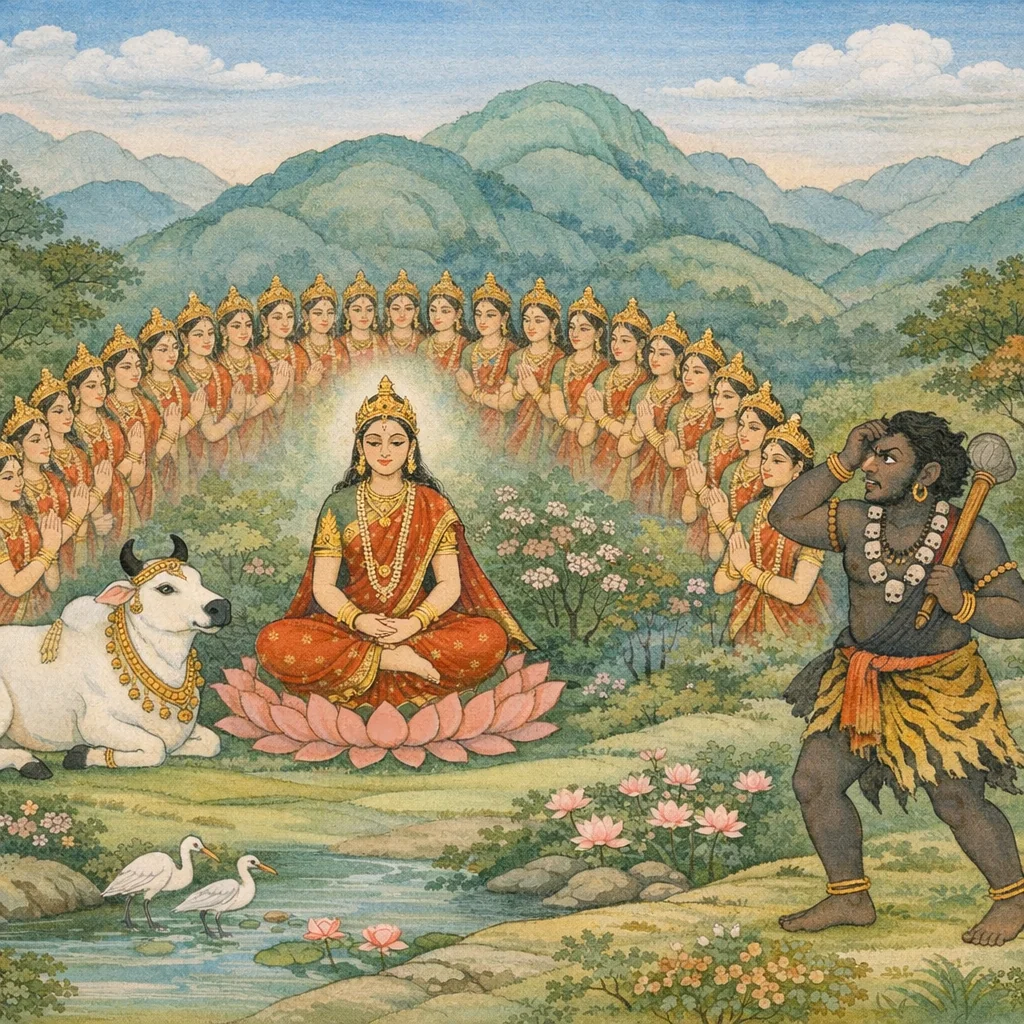
Adhyaya 33: Ritadhvaja’s Aid to Galava and Andhaka’s Infatuation with Gauri
ऋतध्वज-गालवोपकारः तथा अन्धक-गौरीमोहः (Ṛtadhvaja–Gālavopakāraḥ tathā Andhaka–Gaurīmohāḥ)
Andhaka's Infatuation with Gauri
Adhyāya 33 unfolds within the Pulastya–Nārada dialogue-frame, moving from a heroic-royal episode to a Śaiva mythic crisis. Pulastya narrates how the Raghu-line king Ṛtadhvaja, exemplary in kṣatriya-dharma and compassion toward the vulnerable, becomes instrumental in protecting the ascetic practice of the sage Gālava. When the asura Pātālaketu disrupts Gālava’s tapas, a providential horse and an aśarīriṇī vāk (disembodied voice) appear, enabling Ṛtadhvaja to slay the offender—an episode that blends royal agency with ascetic power. The narrative then pivots to Andhaka, son of Hiraṇyākṣa, whose kāma-driven delusion leads him to pursue Gaurī on Mandara. Prahlāda articulates asura-dharma through ethical counsel (including a didactic verse on restraint), yet Andhaka persists, is checked by Nandī and the Devī’s stratagem of multiplying forms, and retreats to Pātāla in obsessive longing. The chapter’s syncretic theology is implicit: Śiva’s household (Gaurī, Nandī, Gaṇeśvara) is defended through moral discourse and divine power, while the earlier episode affirms tapas as a cosmic regulator supported by righteous kingship.
Divine Beings
Sacred Geography
Mortal & Asura Figures
Key Content Points
- Pulastya answers Nārada’s query about the asura pierced by an arrow by recounting Ṛtadhvaja’s slaying of Pātālaketu while aiding the sage Gālava’s tapas.
- Etiological detail of the miraculous horse and the aśarīriṇī vāk: the Gandharva-king Viśvavasu provides the swift horse in connection with his abducted beloved Madālasā.
- Andhaka, enraged after earlier asura defeats, emerges from Pātāla, sees Gaurī on Mandara, and becomes kāmāndha; Prahlāda warns him with dharmic counsel, but Andhaka attacks and is repelled by Nandī and the Devī’s śatarūpa (hundred-forms) stratagem, leading to his retreat and continued obsession.
Shlokas in Adhyaya 33
Verse 1
इति श्रीवामनपुराणे द्वात्रिंशो ऽध्यायः नारद उवाच यो ऽसौ मन्त्रयतां प्राप्तो दैत्यानां शरताडितः स केन वद निर्भिन्नः शरेण दितिजेश्वरः
Here ends the thirty-second chapter of the Śrī Vāmana Purāṇa. Nārada said: ‘That lord of the Dānavas, who, while the Daityas were in counsel, was struck by an arrow—tell me, by whose arrow was that chief of Diti’s sons pierced?’
Verse 3
पुलस्त्य उवाच आसीन्नृपो रघुकुले रिपुजिन्महर्षे तस्यात्मजो गुमगणैकनिर्धिर्महात्मा सूरो ऽसैन्यदमनो बलवान् सुहृत्सु विप्रान्धदीनकृपणेषु समानभावः // वम्प्_33.2 ऋतध्वजो नाम महान् महीयान् स गालवार्थे तुरगाधिपूढः पातालकेतुं निजघान पृष्ठे बाणेन चन्द्रार्धनिभेन वेगात्
Pulastya said: “O great sage, there was a king in the Raghu lineage, a conqueror of enemies. His son was a great-souled man, an ocean of countless virtues—heroic, capable of subduing foes even without an army, strong, and of equal regard toward friends, brahmins, and toward the blind, the poor, and the destitute. That eminent and illustrious one was named Ṛtadhvaja. For the sake of (a task connected with) Gālava, having mounted the lord of horses, he struck down Pātālaketu from behind with a swift arrow resembling a half-moon.”
Verse 4
नारद उवाच/ किमर्थं गालवस्यासौ साधयामास सत्तमः येनासौ पत्रिणा दैत्यं निजघान नृपात्मजः
Nārada said: “For what purpose of Gālava did that excellent man undertake the task—on account of which the king’s son slew the daitya with an arrow?”
Verse 5
पुलस्त्य उवाच पुरा तपस्तप्यति गालवर्षिर्महाश्रमे स्वे सततं निविष्टः पपातालकेतुस्तपसो ऽस्य विघ्नं करोति मौढ्यात् स समाधिभङ्गम्
Pulastya said: “Formerly, when the sage Gālava was practicing austerities—constantly abiding in his own great hermitage—Pātālaketu, out of folly, created an obstruction to his tapas, causing a disruption of his meditative absorption.”
Verse 6
न चेष्यतऽसौ तपसो व्ययं हि शक्तो ऽपि कर्त्तु त्वथ भस्मसात् तम् आकाशमीक्ष्याथ स दीर्घमुष्णं मुमोच निःश्वासमनुत्तमं हि
Though he was capable of reducing him to ashes, he did not act so, for it would have meant a waste of his austerity. Then, looking up into the sky, he released a long, hot, unsurpassed exhalation.
Verse 7
ततो ऽम्बराद् वाजिवरः पपात बभूव वाणी त्वशरीरिणी च असौ तुरङ्गो बलवान् क्रमेत अह्ना सहस्राणि तु योजनानाम्
Then, from the sky a splendid horse fell down, and a bodiless voice also arose. That powerful steed could traverse, in a single day, thousands of yojanas.
Verse 9
स तं प्रगृह्यश्ववरं नरेन्द्रं ऋतध्वजं योज्य तदात्तशस्त्रम् स्थितस्तपस्येव ततो महर्षिर्दैत्यं समेत्य विशिखैर्नृपजो बिभेद // वम्प्_33.8 केनाम्बरतलाद् वाजी निसृष्टो वद सुव्रत वाक् कस्यादेहिनी जाता परं कौतूहलं मम
Taking hold of that excellent horse, the great sage then yoked it to King Ṛtadhvaja, who had taken up his weapons. Standing firm as if absorbed in austerity, the sage confronted the Daitya; and the king’s son pierced him with arrows. Then (someone asked): ‘By whom was this horse released from the surface of the sky? Tell me, O you of good vow. Whose was the bodiless voice? Great indeed is my curiosity.’
Verse 10
पुलस्त्य उवाच विश्ववसुर्नाम महेन्द्रगायनो गन्धर्वराजो बलवान् यशस्वी निसृष्टवान् भूवलये तुरङ्गं ऋतध्वजस्यैव सुतार्थमाशु
Pulastya said: There was a Gandharva king named Viśvavasu, a singer in the court of Mahendra (Indra), mighty and renowned. He quickly released (sent forth) a horse upon the surface of the earth for the sake of Ṛtadhvaja’s son.
Verse 11
नारद उवाच कोर्ऽथो गन्धर्वराजस्य येनाप्रैषीन्महाजवम् राज्ञः कुवलयाश्वस्य कोर्ऽथो नृपसुतस्य च
Nārada said: What was the purpose of the Gandharva king, for which you sent (that horse), swift of great speed? And what was the purpose (or interest) of King Kuvalayāśva, and what of the prince as well?
Verse 12
पुलस्त्य उवाच विश्ववसोः शीलगुणोपपन्ना आसीत्पुरन्ध्रीषु वरा त्रिलोके लावण्यराशिः शशिकान्तितुल्या मदालसा नाम मदालसैव
Pulastya said: Viśvavasu had a wife endowed with good conduct and virtues, the foremost among women in the three worlds—a heap of beauty, equal to the moon’s radiance. Her name was Madālasā, indeed Madālasā herself.
Verse 13
तां नन्दने देवरिपुस्तरस्वी संक्रीडतीं रूपवतीं ददर्श पातालकेतुस्तु जहार तन्वीं तस्यार्थतः सो ऽश्ववरः प्रदत्तः
In Nandana (Indra’s pleasure-grove) the swift enemy of the gods beheld that beautiful, slender maiden sporting. But Pātālaketu carried off the delicate one; and for that very purpose the excellent horse had been bestowed upon him.
Verse 14
हत्वा च दैत्यं नृपतेस्तनूजो लब्ध्वा वरोरूमपि संस्थितो ऽभूत् दृष्टो यथा देवपतिर्महेन्द्रः शच्या तथा राजसुतो मृगाक्ष्या
And having slain the daitya, the king’s son, having regained Varorū, became established (in his proper state). He was seen—just as Mahendra, lord of the gods, is seen with Śacī—so too was the prince with the doe-eyed maiden.
Verse 15
नारद उवाच एवं निरस्ते महिषे तारके च महासुरे हिरण्याक्षसुतो धीमान् किमचेष्टत वै पुनः
Nārada said: ‘Thus, when the great asuras Mahiṣa and Tāraka had been destroyed, what did the intelligent son of Hiraṇyākṣa do thereafter?’
Verse 16
पुलस्त्य उवाच तारकं निहतं दृष्ट्वा महिषं च रणे ऽन्धकः क्रोधं चक्रे सुदुर्बुद्धिर्देवानां देवसैन्यहा
Pulastya said: Seeing Tāraka slain, and the Buffalo-demon (Mahiṣa) also killed in battle, Andhaka—of perverse understanding, a slayer of the gods’ armies—was seized with wrath.
Verse 17
ततः स्वल्पपरीवारः प्रगृह्य परिघं करे निर्जगामाथ पातालाद् विचचार च मेदिनीम
Then, with only a small retinue, grasping an iron club in his hand, he came forth from Pātāla and began to roam over the earth.
Verse 18
ततो विचरता तेन मन्दरे चारुकन्दरे दृष्टा गौरी च गिरिजा सखीमध्ये स्थिताशुभा
Then, as he wandered, on Mandara—within a lovely cave—he saw Gaurī, the mountain-born goddess (Girijā), standing amid her companions, inauspicious (for him).
Verse 19
ततो ऽभूत् कामबाणार्त्तः सहसैवान्धको ऽसुरः तां दृष्ट्वा चारुसर्वाङ्गीं गिरिराजसुतां वने
Then Andhaka, the Asura, was suddenly afflicted by the arrows of Kāma; for, upon seeing in the forest the daughter of the King of Mountains—she whose limbs were all lovely—he became tormented by desire.
Verse 20
अथोवाचासुरो मूढो वचनं मन्मथान्धकः कस्येयं चारुसर्वाङ्गी वने चरति सुन्दरी
Then the deluded Asura, Andhaka—blinded by Manmatha (Kāma)—spoke these words: ‘Whose is this beautiful woman, lovely in every limb, who wanders in the forest?’
Verse 21
इयं यदि भवेन्नैव ममान्तःपुरवासिनि तन्मदीयेन जीवेन क्रियते निष्फलेन किम्
‘If this woman does not become an inmate of my inner palace (harem), then what is the use of my life—mine, yet rendered fruitless?’
Verse 22
यदस्यास्तनुमध्याया न पिरष्वङ्गवानहम् अतो धिङ् मम रूपेण किं स्थिरेण प्रयोजनम्
“Since I am not the one who bears (or embraces) the slender-waisted one upon my side, then—fie upon my form! What use is this steadfast (strong) body to me?”
Verse 23
स मे बन्धुः स सचिवः स भ्राता साम्परायिकः यो मामसितकेशां तां योजयेन् मृगलोचनाम्
“He is my kinsman; he is my minister; he is my brother for the hereafter—whoever would unite me with that doe-eyed woman of dark hair.”
Verse 24
इत्थं वदति दैत्येन्द्रे प्रह्लादो बुद्धिसागरः पिधाय कर्णो हस्ताभ्यां शिरःकम्पं वचो ऽब्रवीत्
“While the lord of the Daityas was speaking thus, Prahlāda—an ocean of understanding—covered his ears with both hands; with his head trembling, he spoke these words.”
Verse 25
मा मैवं वद दैत्येन्द्र जगतो जननी त्वियम् लोकनाथस्य भार्योयं शङ्करस्य त्रिशूलिनः
“Do not speak thus, O lord of the Daityas. You are (as it were) the mother of the world. This (lady) is the wife of the Lord of the worlds—Śaṅkara, the trident-bearer.”
Verse 26
मा कुरुष्व सुदुर्बुद्धिं सद्यः कुलविनाशिनीम् भवतः परदारोयं मा निमज्ज रसातले
“Do not commit this act of grievous folly—one that instantly destroys a lineage. This woman is another’s wife; do not sink into Rasātala.”
Verse 27
सत्सु कुत्सितमेवं हि असत्स्वपि हि कुत्सितम् शत्रवस्ते प्रकुर्वन्तु परदारावगाहनम्
“Indeed, such conduct is blameworthy among the good—and blameworthy even among the wicked. Let your enemies commit the trespass of approaching another’s wife.”
Verse 29
किञ्चित् त्वया न श्रुतं दैत्यनाथ गीतं श्लोकं गाधिना पार्थिवेन दृष्ट्वा सैन्यं विप्रधेनुप्रसक्तं तथ्यं पथ्यं सर्वलोके हितं च // वम्प्_33.28 वरं प्राणास्त्याज्या न च पिशुनवादेष्वभिरतिः वरं मौनं कार्यं न च वचनमुक्तं यदनृतम् वरं क्लीबैर्भाव्यं न च परकगलत्राभिगमनं वरं भिक्षार्थित्वं न च परधनास्वादमसकृत्
“O lord of the Daityas, have you not heard even a little of that verse sung by King Gādhi—true, wholesome, and beneficial to all the world—when he saw an army intent on (seizing) a brāhmaṇa’s cow? ‘Better to give up one’s life than to delight in slanderous speech. Better to practice silence than to utter words that are false. Better to be deemed impotent than to approach another man’s wife. Better to live by begging than repeatedly to taste (enjoy) another’s wealth.’”
Verse 30
स प्रह्लादवचः श्रुत्वा क्रोदान्धो मदनार्दितः इयं सा शत्रुजननीत्येवमुक्त्वा प्रदुद्रुवे
Hearing Prahlāda’s words, he—blinded by anger and driven by passion—cried, “She is the mother who gives birth to enemies!” and rushed forward.
Verse 31
ततो ऽन्वधावन् दैतेया यन्त्रमुक्ता इवोपलाः तान् रुरोध बलान्नन्दी वज्रोद्यतकरो ऽव्ययः
Then the Daityas charged after (him), like stones released from a machine. But Nandī, imperishable, with his hand raised like a thunderbolt, forcibly checked them.
Verse 32
मयतारपुरोगास्ते वारिता द्रावितास्तथा कुलिशोनाहतास्तूर्णं जग्मुर्भीता दिशो दश
Led by Mayatārā, they were checked and then put to flight; struck by the thunderbolt, they quickly fled in fear to the ten directions.
Verse 33
तानर्दितान् रणे दृष्ट्वा नन्दिनान्धकदानवः परिघेण समाहत्य पातयामास नन्दिनम्
Seeing them distressed in battle by Nandin, the Dānava Andhaka struck Nandin with an iron club (parigha) and caused him to fall.
Verse 34
शैलादिं पतितं दृष्ट्वा धावमानं तथान्धकम् शतरूपाभवद् गौरी भयात् तस्य दुरात्मनः
Seeing Śailādi fallen, and Andhaka rushing forward, Gaurī, out of fear of that wicked-souled one, became of a hundred forms.
Verse 35
ततः स देवीगणमध्यसंस्थितः परिभ्रमन्न भाति महासुरेन्द्रः यथा वने मत्तकरी परिभ्रमन् करेणुमध्ये मदलोलदृष्टिः
Then that great lord of the Asuras, standing amid the retinue of the Goddess, wandered about, yet did not truly perceive (what was before him)—like an intoxicated bull-elephant roaming in a forest among the female elephants, his gaze unsteady with rut.
Verse 36
न पिरज्ञातवांस्तत्र का तु सा गिरिकन्यका नात्राश्चर्यं न पश्यन्ति चत्वारो ऽमी सदैव हि
He did not recognize her there—who indeed was that mountain-born maiden? There is no wonder in this: these four do not see at all, always.
Verse 37
न पश्यतीह जात्यन्धो रागान्धो ऽपि न पश्यति न पश्यति मदोन्मत्तो लोभाक्तान्तो न पश्यति सो ऽपश्यमानो गिरिजां पश्यन्नपि तदान्धकः
Here, one blind from birth does not see; one blinded by passion also does not see. One maddened by intoxication does not see; one whose inner being is smeared over with greed does not see. Thus Andhaka, though looking at Girijā, at that time did not truly see her.
Verse 38
प्रहारं नाददत् तासां युवत्य इति चिन्तयन् ततो देव्या स दुष्टात्मा शतवर्या निराकृतः
Thinking, “These are young women,” he did not deliver a blow against them. Thereupon that wicked-souled one was repulsed by the Goddess Śatavārī.
Verse 39
कुट्टितः प्रवरैः शस्त्रैर्निपपात महीतले वीक्ष्यान्धकं निपतितं शतरूपा विभावरी
Smashed by excellent weapons, he fell upon the ground. Seeing Andhaka fallen, Śatarūpā Vibhāvarī (the Goddess in that form) looked on.
Verse 40
तस्मात् स्थानादपाक्रम्य गतान्तर्धानमम्बिका पतितं चान्धकं दृष्ट्वा दैत्यदानवयूथपाः
Withdrawing from that place, Ambikā vanished from sight. And seeing Andhaka fallen, the leaders of the Daityas and Dānavas (beheld him).
Verse 41
कुर्वान्तः सुमहाशब्दं प्राद्रवन्त रणार्थिनः तेषामापततां शब्दं श्रुत्वा तस्थौ गणेश्वरः
Making a very great uproar, those eager for battle rushed forward. Hearing the sound of their oncoming advance, Gaṇeśvara stood his ground.
Verse 42
आदाय वज्रं बलवान् मघवानिव गणेश्वरः
Taking up the thunderbolt, the powerful Gaṇeśvara (appeared) like Maghavān (Indra).
Verse 43
सम्भ्येत्याम्बिकां दृष्ट्वा ववन्दे चरणौ शुभौ देवी च ता निजा मूर्तिः प्राह गच्छध्वमिच्छया
Approaching and seeing Ambikā, he bowed to her auspicious feet. And the Goddess—his own (divinely appointed) form—said: ‘Go forth as you wish.’
Verse 44
विहरध्वं महीपृष्ठे पूज्यमाना नरैरिह वसतिर्भवतीनां च उद्यानेषु वनेषु च
“Roam upon the surface of the earth, being worshipped here by men. Let there be dwelling-places for you in pleasure-groves and in forests as well.”
Verse 45
वनस्पतिषु वृक्षेषु गच्छध्वं प्रणिपत्याम्बिकां क्रमात्
“Go among the lordly trees and the trees; bowing down, approach Ambikā step by step (in due order).”
Verse 46
दक्षु सवासु जग्मुस्ताः स्तूयमानाश्च किन्नरैः अन्धको ऽपि स्मृतिं लब्ध्वा अपश्यन्नद्रिनन्दिनीम् स्वबलं निर्जितं दृष्ट्वा ततः पातालमाद्रवात्
“They went to their respective abodes, and were praised by the Kinnaras. And Andhaka too, regaining his awareness, saw the Daughter of the Mountain. Seeing his own forces defeated, he then fled swiftly to Pātāla.”
Verse 47
ततो दुरात्मा स तदान्धको मुने पातालमभ्येत्य दिवा न भुङ्क्ते रात्रौ न शेते मदनेषुताडितो गौरीं स्मरन्कामबलाभिपन्नः
Then that wicked-souled Andhaka, O sage, went down to Pātāla. Struck by the arrows of Kāma, he neither ate by day nor slept by night, remembering Gaurī, overcome by the force of desire.
Frequently Asked Questions
The chapter juxtaposes tapas as a cosmic force (Gālava’s austerity requiring protection) with Śiva’s household as the guarantor of moral and cosmic stability (Gaurī, Nandī, Gaṇeśvara). Royal kṣatriya agency (Ṛtadhvaja) supports ascetic power, while Andhaka’s violation of dharma is checked by Śaiva guardianship—together presenting a unified moral cosmos rather than competing sectarian claims.
This Adhyāya is primarily mythic-topographical rather than a Kurukṣetra-style tīrtha catalogue. The named locales function as sacral settings: Mandara (the mountain-forest where Gaurī is encountered), Nandana (the divine garden linked to Madālasā’s abduction), and Pātāla (Andhaka’s realm and retreat). No specific Sarasvatī-basin rivers, kuṇḍas, or tīrtha-vidhis are detailed in the provided passage.
Prahlāda frames restraint as asura-dharma in its highest form: better to sacrifice life than indulge in slander, false speech, illicit approach to another’s spouse, or repeated tasting of others’ wealth. His counsel identifies Gaurī as the world-mother and Śaṅkara’s consort, warning that transgression triggers immediate kula-vināśa (dynastic ruin)—a moral hinge that explains Andhaka’s downfall despite his power.