Adhyaya 64: Portents at Bali’s Sacrifice and the Kośakāra’s Son: The Power of Past Karma
बलियज्ञे उत्पाताः तथा कोशकारसुतोपाख्यानम् (Bali-yajñe Utpātāḥ tathā Kośakāra-sutopākhyānam)
Power of Past Karma
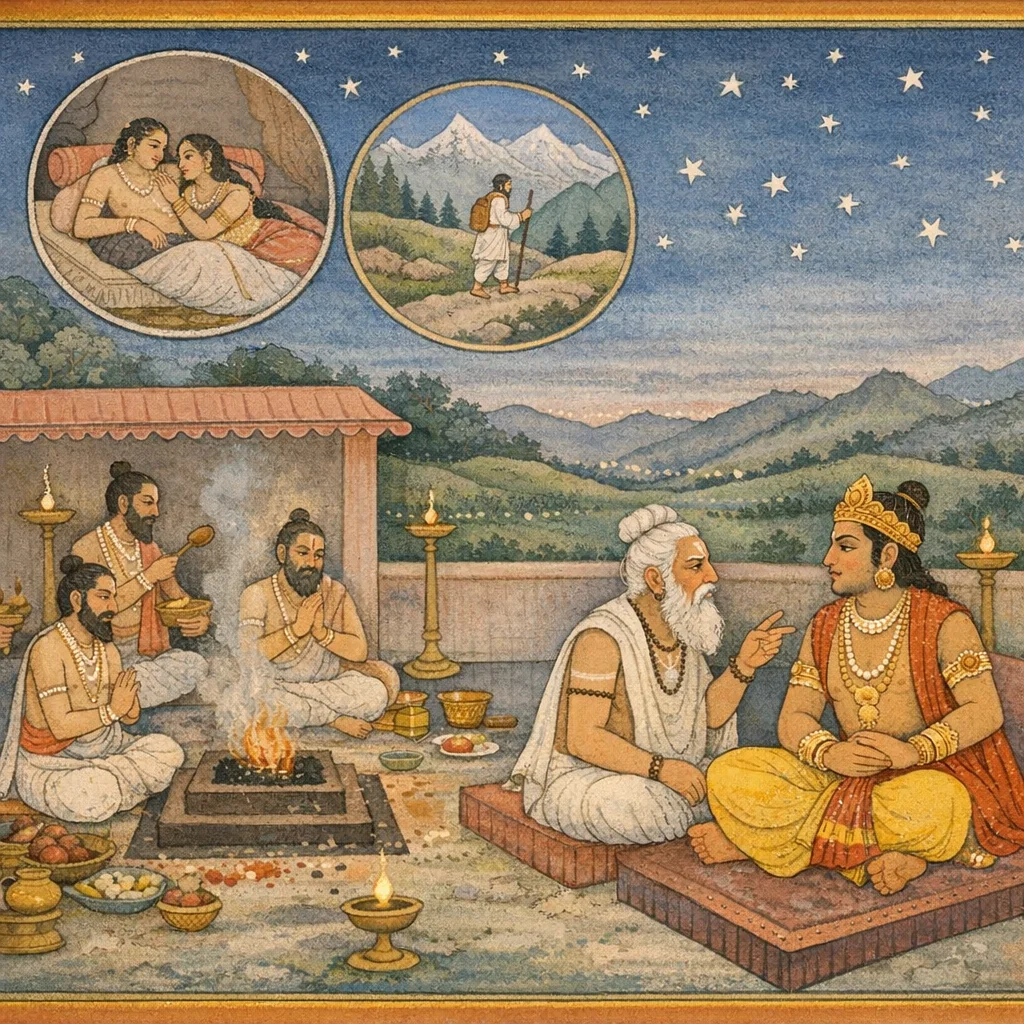
Within the Pulastya–Nārada narrative frame, this adhyāya opens with cosmic portents announcing Vāsudeva’s approach: the earth trembles, mountains shake, oceans churn, and the stellar order appears disturbed. At Bali’s asura-yajña, even the fire refuses the oblations, signalling a theological crisis in ritual legitimacy. Bali, embodying asura-dharma marked by generosity and resolve, consults Śukra, who identifies the cause as Viṣṇu’s imminent arrival. The chapter then pivots into an extended exemplum (upākhyāna) narrated by Bali—the story of Kośakāra’s son Niśākara—demonstrating how pūrvābhyāsa (habitual past action) and karmic residue shape births, capacities, and moral downfall across multiple embodiments. The didactic arc reinforces dharma as disciplined restraint, critiques sensual transgression (paradāra), and frames renunciation and pilgrimage (Badaryāśrama) as purificatory remedies. While explicit Harihara iconography is not foregrounded here, the syncretic Purāṇic method persists: ritual authority, cosmic order, and ethical purification converge under Viṣṇu’s sovereign presence.
Divine Beings
Sacred Geography
Mortal & Asura Figures
Key Content Points
- Cosmic and ritual omens (utpāta) arise as Vāsudeva approaches Bali’s sacrifice; the sacrificial fire refuses asura-offerings, indicating disruption of adhvara efficacy.
- Bali’s consultation with Śukra clarifies the theological cause: Viṣṇu’s advent; Bali seeks guidance on what should be done or given, foregrounding dāna and asura-dharma under divine scrutiny.
- Kośakāra-sutopākhyāna: Niśākara recounts a chain of rebirths driven by lust, theft, and moral error, illustrating pūrvābhyāsa, karmic retribution (naraka), and eventual turn toward renunciation and Badaryāśrama.
Shlokas in Adhyaya 64
Verse 1
इति श्रीवामनपुराणे त्रिषष्टितमो ऽध्यायः इन् रेए निछ्त् zउल्äस्सिगे zएइछेन्: - #2 र्̥̄ #1 ष् #1 श्रीवामनपुराणं-64 पुलस्त्य उवाच ततः समागच्चति वासुदेवे मही चकम्पे गिरयच चेलुः क्षुब्धाः समुद्रा श्रीवामनपुराणं-64 पुलस्त्य उवाच ततः समागच्चति वासुदेवे मही चकम्पे गिरयश्च चेलुः क्षुब्धाः समुद्रा दिवि ऋक्षमण्डलो बभौ विपर्यस्तगतिर्महर्षे
Pulastya said: Then, as Vāsudeva drew near, the earth trembled and the mountains shook; the oceans were agitated, and in the sky the circle of stars appeared with its course reversed, O great seer.
Verse 3
यज्ञः समागात् परमाकुलत्वं न वेद्मि किं मे मधुहा करिष्यति यथा प्रदग्धो ऽस्मि महेश्वरेण किं मां न संधक्ष्ययति वासुदेवः // वम्प्_64.2 ऋक्साममन्त्राहुतिभिर्हुताभिर्वितानकीयान् ज्वलनास्तु भागान् भक्त्या द्विजेन्द्ररपि संप्रपादितान् नैव प्रतीच्चन्ति विभोर्भयेन
The Yajña (the sacrificial rite/personified sacrifice) fell into extreme agitation: ‘I do not know what Madhuhā (the slayer of Madhu) will do to me. Since I have been burned by Maheśvara, will not Vāsudeva also utterly burn me?’ And the fires, though offered their portions through oblations accompanied by Ṛg and Sāma mantras—portions duly presented with devotion even by the best of twice-born—did not accept them, out of fear of the Lord.
Verse 4
तान् दृष्ट्वा घोररुपांस्तु उत्पातान् दानवेश्वरः पप्रच्छोशनसं शुक्रं प्रणिपत्य कृताञ्जलिः
Seeing those dreadful portents, the lord of the Dānavas (Bali) questioned Uśanas—Śukra—having bowed down and with hands joined in reverence.
Verse 5
किमर्थमाचार्य मही सशैला रम्भेव वाताभिहता चचाल किमासुरीयान् सुहुतानपीह भागान् न गृह्णन्ति हुताशनाश्च
‘For what reason, O Teacher, has the earth—together with its mountains—shaken, like a plantain tree struck by the wind? And why do the fires here not accept the offered portions, even though the oblations have been properly made for the Asuras?’
Verse 6
क्षुब्धाः किमर्थं मकरालयाश्च भो ऋक्षा न खे किं प्रचरन्ति पूर्ववत् दिशः किमर्थं तमसा परिप्लुता दोषेण कस्याद्य वदस्व मे गुरो
‘Why are the oceans—abodes of makaras—agitated? Why do the constellations not move across the sky as before? Why are the directions flooded with darkness? Tell me today, O Guru: through whose fault is this?’
Verse 7
पुल्स्त्य उवाच शुक्रस्तद् वाक्यमाकर्ण्य विरोचनसुतेरितम् अथ ज्ञात्वा कारणं च बलिं वचनमब्रवीत्
Pulastya said: Hearing that statement spoken by Bali, the son of Virocana, Śukra—having understood the underlying reason—addressed Bali with these words.
Verse 8
शुक्र उवाच शृणुष्व दैत्येश्वर येन भागान् नामी प्रतीच्छन्ति हि आसुरीयान् हुताशना मन्त्रहुतानपीह नूनं समागच्छति वासुदेवः
Śukra said: Listen, O lord of the Daityas. By reason of which the Fire-gods do not accept the Asuric shares here—even when offered with mantras—surely Vāsudeva is now approaching.
Verse 9
तदङ्घ्रिविक्षेपमपारयन्ती मही सशैला चलिता दितीश तस्यां चलत्यां मकरालयामी उद्वृत्तवेला दितिजाद्य जाताः
Then, unable to bear the placing/impact of that foot, the Earth—together with her mountains—trembled, O lord of Diti’s race; and as she shook, the waters that are the abode of makaras surged up, their shore-waves thrown into upheaval, and the Daityas and others were thrown into agitation.
Verse 16
बलिरुवाच मया न चोक्तं वचनं हि भार्गव न चास्ति मह्यं न च दातुमुत्सहे समागते ऽप्ययर्थिनि हीनवृत्ते जनार्दने लोकपतौ कथं तु
Bali said: “O Bhārgava (Śukra), I have not spoken any false word. Nor is there (any deceit) in me; nor do I shrink from giving. Even when a petitioner of low conduct comes before me, how could I refuse—especially when Janārdana, the Lord of the worlds, has arrived (as a supplicant)?”
Verse 17
एवं च श्रुयते श्लोकः सतां कथयतां विभो सद्भावो ब्राह्मणेष्वेव कर्त्तव्यो भूतिमिच्छता दृश्यते हि तथा तच्च सत्यं ब्राह्मणसत्तम
And thus a verse is heard, O mighty one, as recited by the virtuous: ‘One who desires prosperity should cultivate true regard only toward brāhmaṇas.’ For it is indeed seen to be so; and this is true, O best of brāhmaṇas.
Verse 19
किं वा त्वया द्विजश्रेष्ठ पौराणी न श्रुता कथा या वृत्ता मलये पूर्वं कोशकारसुतस्य तु
“Or else, O best of twice-borns, have you not heard the Purāṇic tale that formerly occurred in the Malaya (region)—the tale concerning the son of the silk-weaver?”
Verse 22
मुद्गलस्य मुनेः पुत्रो ज्ञानविज्ञानपारगः कोशकार इति ख्यात आसीद् ब्रह्मंस्तपोरतः
O Brahmin, the sage Mudgala had a son who had crossed to the far shore of knowledge and realized discernment; he was renowned by the name Kośakāra and was devoted to austerity.
Verse 27
तत्रोत्सृज्य स्वपुत्रं सा जग्राह द्विजनन्दनम् तमादाय जगामाथ भोक्तुं शालोदरे गिरौ
Leaving her own child there, she seized the brāhmaṇa’s son; taking him, she went to eat him on the mountain called Śālodara.
Verse 28
ततस्तामागतां वीक्ष्य तस्या भर्ता घटोदरः नेत्रहीनः प्रत्युवाच किमानीतस्त्वया प्रिये
Then, seeing her return, her husband Ghaṭodara—bereft of sight—replied: “Beloved, what have you brought (with you)?”
Verse 29
साब्रवीत् राक्षसपते मया स्थाप्य निजं शिशुम् कोशकारद्विजगृहे तस्यानीतः प्रभो सुतः
She said: “O lord of rākṣasas, after placing my own infant in the house of the brāhmaṇa Kośakāra, I have brought here his son, O master.”
Verse 30
स प्राह न त्वया भद्रे भद्रमाचरितं त्विति महाज्ञानी द्विजेन्द्रो ऽसौ ततः शप्स्यति कोपितः
He said: “O good woman, you have not done a good deed by this.” For that brāhmaṇa-lord is a great knower; therefore, once angered, he will curse (us).
Verse 31
तस्माच्छीघ्रमिमं त्यक्त्वा मनुजं घोररुपिणम् अन्यस्य कस्यचित् पुत्रं शीघ्रमानय सुन्दरि
“Therefore, quickly abandon this human of dreadful form, and swiftly bring (me) the son of some other person, O beautiful one.”
Verse 32
इत्येवमुक्ता सा रौद्रा राक्षसी कामचारिणी समाजगाम त्वरिता समुत्पत्य विहायसम्
Thus addressed, that fierce rākṣasī—moving at will—went quickly, leaping up into the sky.
Verse 33
स चापि राक्षससुतो निसृष्टो गृहबाह्यतः रुरोद सुस्वरं ब्रह्मन् प्रक्षिप्याङ्गुष्ठमानने
And the rākṣasa’s son as well, having been let out from outside the house, cried loudly, O brāhmaṇa, putting his thumb into his mouth.
Verse 34
सा क्रन्दितं चिराच्छ्रुत्वा धर्मिष्ठा पतिमब्रवीत् पश्य स्वयं मुनिश्रेष्ठ सशब्दस्तनयस्तव
Having heard the crying after a long time, that most righteous woman said to her husband: “See for yourself, O best of sages—your son is crying aloud.”
Verse 35
त्रस्ता सा निर्जगामाथ गृहमध्यात् तपस्विनी स चापि ब्राह्मणश्रेष्ठः समपश्यत तं शिशुम्
Frightened, that ascetic woman then came out from the middle of the house; and that foremost brāhmaṇa, too, saw the infant there.
Verse 36
वर्णरूपादिसंयुक्तं यथा स्वतनयं तथा ततो विहस्य प्रोवाच कोशकारो निजां प्रियाम्
Endowed with complexion, form, and other marks—just like his own son—then, smiling, the kośakāra spoke to his beloved wife.
Verse 37
एतेनाविश्य धर्मिष्ठे भाव्यं भूतेन साम्प्रतम् को ऽप्यटस्माकं छलयितुं सुरूपी भुवि संस्थितः
“Having entered (this one), O most righteous (king), something is to be brought about now by a being (of occult power). Some handsome person is stationed on the earth in order to deceive us.”
Verse ["Vishnu (Trivikrama)", "Bali (implied)"]
इत्युक्त्वा वचनं मन्त्री मन्त्रैस्तं राक्षसात्मजम् बबन्धोल्लिख्य वसुध�Vamana Purana
Avataric Deed (Trivikrama’s Cosmic Stride)
Verse 39
एतस्मिन्नन्तरे प्राप्ता सूर्पाक्षी विप्रबालकम् अन्तर्धानगता भूमौ चिक्षेप गृहदूरतः
“Meanwhile, Sūrpākṣī arrived; having made herself invisible, she cast the young brāhmaṇa boy onto the ground, far from the house.”
Verse 40
तं क्षिप्तमात्रं जग्राह कोशकारः स्वकं सुतम् सा चाभ्येत्य ग्रहीतुं स्वं नाशकद् राक्षसी सुतम्
As soon as he was hurled away, the weaver seized his own son. The Rākṣasī rushed forward to snatch back her child, but she was unable to take him.
Verse 44
द्वावेव वर्धितौ बालौ संजातौ सप्तवार्षिकौ पित्रा च कृतनामानौ निशाकरदिवाकरौ
Thus the two boys were brought up and, having reached seven years of age, were given names by their father: Niśākara and Divākara.
Verse 45
नैशाचरिर्दिवाकीर्तिर्निशाकीर्तिः स्वपुत्रकः तयोश्चकार विप्रो ऽसौ व्रतबन्धक्रियां क्रमात्
That brāhmaṇa—(named) Naiśācari—performed, in due order, the rite of ‘vrata-bandha’ (initiation/upbringing into disciplined observance) for his own sons, Divākīrti and Niśākīrti.
Verse 46
व्रतबन्धे कृते वेदं पपाठासौ दिवाकरः निशाकरो जडतया न पपाठेति नः श्रुतम्
We have heard that, after his rite of initiation (vratabandha) was performed, Divākara studied (recited) the Veda; but Niśākara, through dullness, did not study it.
Verse 47
तं बान्धवाश्च पितरौ माता भ्राता गुरुस्तथा पर्यनिन्दंस्तथा ये च जना मलयवासिनः
His relatives—his parents, mother, brother, and teacher—as well as the people who dwelt in Malaya, all reproached him.
Verse 48
ततः स पित्रा क्रुद्धेन क्षिप्तः कूपे निरूदके महाशिलां चोपरि वै पिधानमवरोपयत्
Then, his father—angered—threw him into a waterless well, and placed a great stone above it as a covering.
Verse 49
एवं क्षिप्तस्तदा कूपे समतीतेषु भार्गव तस्य मातागमत् कूपं तमन्धं शिलयाचितम्
Thus, when he had been thrown into the well, O Bhārgava, after some time had passed, his mother came to the well—(finding) that blind one shut in/covered over with a stone.
Verse 50
ततो दशसु वर्षेषु समतीतेषु भार्गव तस्य मातागमत् कूपं तमन्धं शिलयाचितम्
Then, when ten years had passed, O Bhārgava, his mother came to the well—(finding) that blind one shut in/covered over with a stone.
Verse 51
सा दृष्टावा निचितं कूपं शिलया गिरिकल्पया उच्चैः प्रोवाच केनेयं कूपोपरि शिला कृता
Seeing the well filled up/blocked with a stone like a mountain, she cried aloud: ‘By whom has this stone been placed upon the well?’
Verse 52
कूपान्तस्थः स तां वाणीं श्रुत्वा मातुर्निशाकरः प्राह प्रदत्ता पित्रा मे कूपोपरि शिला त्वियम्
Dwelling at the bottom of the well, Niśākara, having heard his mother’s voice, said: “This stone upon the well was given to me by my father.”
Verse 53
सातिभीताब्रवीत् को ऽसि कूपान्तस्थो ऽद्भुतस्वरः सो ऽप्याह तव पुत्रो ऽस्मि निशाकरेति विश्रुतः
Terrified, she said: “Who are you, staying at the bottom of the well, with such a wondrous voice?” He too replied: “I am your son, renowned by the name Niśākara.”
Verse 44
साब्रवीत् तनयो मह्यं नाम्ना ख्यातो दिवाकरः निशाकरेति नाम्नाहो न कश्चित् तनयो ऽस्ति मे
She said: “My son is known by the name Divākara. But by the name Niśākara—alVamana Purana
Verse the mighty Lord
ततो/न्वपृच्छद् विप्रो ऽसौ किमिदं तात कारणम् नोक्तवान् यद्भवान् पूर्वं महत्कौतूहलं मम
Then that brāhmaṇa questioned him: “Dear son, what is the cause of this? You did not tell me earlier—though I had great curiosity.”
Verse No named tirtha, river, lake, forest, or pilgrimage site is mentioned
65
Adhyaya 65 (Vamana–Bali episode; fruit of Bali’s gift)
Verse 76
साप्ययब्रवीद् दिवा व्याघ्र लोको ऽयं परिपश्यति रात्रावुद्घाटयिष्याम ततो रंस्याव स्वेच्छया
She, too, said: “By day, O tiger (of men), this world is watching. At night we shall open (the door); then we two shall enjoy ourselves as we please.”
Verse 78
ततः सा पीवरश्रेणी द्वारमुद्घाटयन्मुने उद्घाटिते ततो द्वारे निर्गतो ऽहं बहिः श्रणात्
Then she—she of full hips—opened the door, O sage. When the door had been opened, I went out, outside, from the enclosure/shelter.
Verse 79
पाशानि निगडादीनि छिन्नानि हि बलान्मया सा गृहीता च नृपतेर्भार्या रमितुमिच्छता
“By my strength I broke the nooses, fetters, and the like. Then the king’s wife—desiring to sport (with me)—seized hold (of me).”
Verse 80
ततो दृष्टो ऽस्मि नृपतेर्भृत्यैरतुलविक्रमैः शस्त्रहस्तैः सर्वतश्च तैरहं परिवेष्टितः
“Then I was seen by the king’s servants of incomparable prowess; with weapons in their hands, from every side, I was surrounded by them.”
Verse 81
महापाशैः शृङ्खलाभिः समाहत्य च मुद्गरैः वध्यमानो ऽब्रुवमहं मा मा हिंसध्वमाकुलाः
“Struck with great nooses and chains, and also with clubs, as I was being beaten (or put to death), I said: ‘Do not—do not harm me, O agitated ones!’”
Verse 82
ते मद्वचनमाकर्ण्य मत्वैव रजनीचरम् दृढं वृक्षे समुद्ब्ध्य घातयन्त तपोधन
“Hearing my words, those ascetics—taking him to be a night-roaming fiend—firmly bound him to a tree and struck him down.”
Verse 83
भयो गतश्च नरकं परदारनिषेवणात् मुक्तो वर्षसहस्रान्ते जातो ऽहं श्वेतगर्दभः
“Because of consorting with another man’s wife, I went to a dreadful hell; after a thousand years I was released, and I was born as a white donkey.”
Verse 84
ब्राह्मणस्याग्निवेश्यस्य गेहे बहुकलत्रिणः तत्रापि सर्वविज्ञानं प्रत्यभासत् ततो मम
“In the house of the Brahmin Āgniveśya, who had many wives, there too all knowledge became manifest again to me.”
Verse 86
विमतिर्नामतः ख्याता गन्तुमैच्छद् गृहं पितुः तामुवाच पतिर्गच्छ आरुह्यं श्वेतगर्दभम्
“She was renowned by the name Vimati. She wished to go to her father’s house. Her husband said to her: ‘Go, mounting the white donkey.’”
Verse 87
मासेनागमनं कार्यं न स्थेयं परतस्ततः इत्येवमुक्ता सा भर्त्रा तन्वी मामधिरुह्य च
“‘Your return must be within a month; you should not remain there beyond that.’ Thus instructed by her husband, the slender woman mounted me (the conveyance) and (set out).”
Verse 88
बन्धनादवमुच्याथ जगाम त्वरिता मुने ततोर्ऽधपथि सा तन्वी मत्पृष्ठादवरुह्य वै
“Released from her bondage, she hurried away, O sage. Then, when she had gone halfway, that slender maiden dismounted from my back.”
Verse 89
अवतीर्णा नदीं स्नातुं स्वरूपा चार्द्रवाससा साङ्गोपाङ्गां रूपवतीं दृष्ट्वा तामहमाद्रवम्
“She descended to the river to bathe, in her own (natural) form, her garments wet. Seeing her—beautiful, with all her limbs and features complete—I ran toward her.”
Verse 90
मया चाभिद्रुता तूर्णं पतिता पृथिवीतले तस्यामुपरि भो तात पतितो ऽहं भृशातुरः
“And as I rushed quickly toward her, she fell upon the ground; and upon her, O dear one, I fell—greatly pained.”
Verse 91
हृष्टो भर्त्रानुसृष्टेन नृणा तदनुसारिणा प्रोत्क्षिप्य यष्टिं मां ब्रह्मन् समाधावत् त्वरान्वितः
“Delighted, a man—sent by his master and acting in accordance with him—lifted up a staff and, O Brahmin, rushed at me with haste.”
Verse 92
तद् भयात् तां परित्यज्य प्रद्रुतो दक्षिणामुखः ततो ऽभिद्रवतस्तूर्ण खलीनरसना मुने
“Out of fear of him, abandoning that (staff/that course), I ran off facing south. Then, as I fled, O sage, a dog with a collar and leash quickly ran after (me).”
Verse 93
ममासक्ता वंशगुल्मे दुर्मोक्षे प्राणनाशने तत्रासक्तस्य षड्रात्रान्ममाभूज्जीवितक्षयः
“Clinging to me, it became stuck in a clump of bamboo—hard to escape from and life-destroying. Because of my attachment there, after six nights my life came to an end.”
Verse 94
गतो ऽस्मि नरकं भूयस्तस्मान्मुक्तो ऽभवं शुकः महारण्ये तथा बद्धः शबरेण दुरात्मना
“I went again to hell; from that I was released, O Śuka. Yet in the great forest I was again bound by a wicked Śabara (forest-dweller/hunter).”
Verse 97
भक्ष्यैश्च दाडिमफलैः पुष्णन्त्यहरहः पितः कदाचित् पद्मपत्राक्षी श्यामा पीनपयोधरा
“With various foods and with pomegranate fruits she nourished (me) day after day. At one time there was (a woman) lotus‑leaf‑eyed, dark‑complexioned, and full‑breasted.”
Verse 98
सुश्रोणी तनुमध्या च वणिक्पुत्रप्रिया शुभा नाम्ना चन्द्रावली नाम समुद्घाट्याथ पञ्जरम्
“She was fair-hipped and slender-waisted, auspicious, and dear to a merchant’s son. By name she was called Candrāvalī. Then she opened the cage.”
Verse 99
मां जग्राह सुचार्वङ्गी कराभ्यां चारुहासिनी चकारोपरि पीनाभ्यां कराभ्यां चारुहासिनी चकारोपरि पीनाभ्यां स्तनाभ्यां सा हि मां ततः
“That lovely-limbed woman, smiling charmingly, took hold of me with her hands. Then she placed me upon (her) full breasts—she indeed did so to me.”
Verse 100
ततो ऽहं कृतवान् भावं तस्यां विलसितुं प्लवन् ततो ऽनुप्लपतस्तत्र हारे मर्कटबन्धनम्
“Then I conceived the desire to sport with her, leaping about. As I sprang there, I was seized and bound—like a monkey—by a rope/halter.”
Verse 102
तस्माच्चाहं वृषत्वं वै गतश्चाण्डालपक्वणे स चैकदा मां शकटे नियोज्य स्वां विलासिनीम्
“Therefore I came to the state of a bull, in the ‘cooking-place/quarter’ of a caṇḍāla. And once that man yoked me to a cart, (to convey) his own pleasure-seeking woman.”
Verse "
समारोप्य महातेजा गन्तुं कृतमतिर्वनम् ततो ऽग्रतः स चण्डालो गतस्त्वेवास्य पृष्ठतः
Having mounted (him/it), that mighty one, resolved to go to the forest. Then that Caṇḍāla went in front, while he (the narrator/subject) followed behind him.
Verse 104
गायन्ती याति तच्छ्रुत्वा जातो ऽहं व्यथितेन्द्रियः पृष्ठस्तु समालोक्य विपर्यस्तस्तथोत्प्लुतः
She went along singing; hearing that, I became shaken in my senses. Looking behind, I was thrown into confusion and sprang up in agitation.
Frequently Asked Questions
This chapter primarily foregrounds Viṣṇu’s sovereign presence through cosmic portents and ritual disruption rather than explicit Harihara iconography. Its syncretic theology operates structurally: Purāṇic authority validates dharma through cosmic order (ṛta), ritual legitimacy (Agni’s acceptance/refusal), and ethical purification—domains often shared across Śaiva and Vaiṣṇava practice—while keeping the Pulastya–Nārada frame that typifies integrative Purāṇic narration.
The explicit sacred-geographical marker here is Badaryāśrama, described as the ‘puṇyaṃ sadanaṃ’ of Murāri (Viṣṇu). It functions as a purificatory destination within the moral economy of the narrative: Niśākara’s departure to Badaryāśrama models pilgrimage/renunciation as a remedial path for pāpa-kṣaya (sin-diminution) and śubha-vardhana (augmentation of merit).
The adhyāya advances the Vāmana–Bali cycle by staging the immediate prelude: Viṣṇu’s approach is announced through utpātas and Agni’s refusal of offerings, and Śukra explicitly identifies Vāsudeva as the cause. Bali’s questions about what should be done or given sharpen the ethical tension around dāna and sovereignty, preparing the ground for the forthcoming encounter with Vāmana.