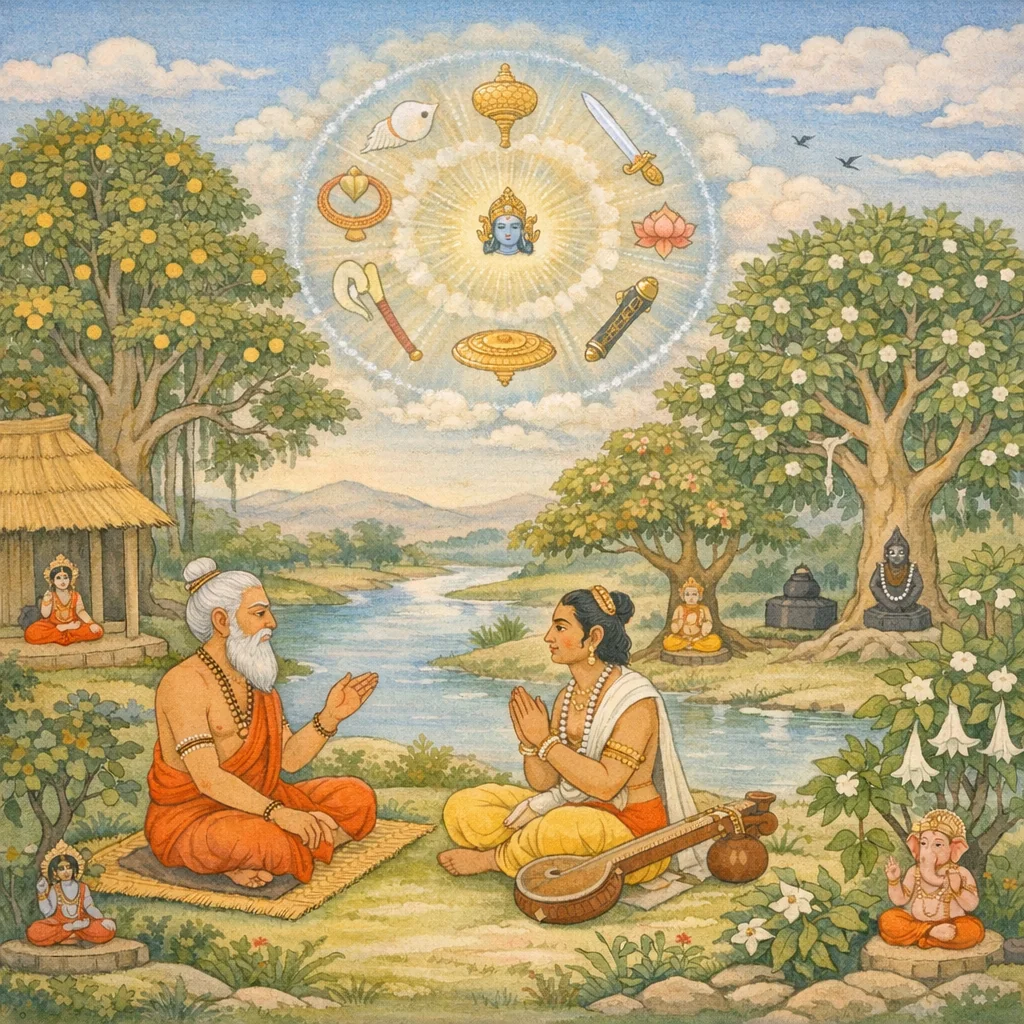
Adhyaya 18: Akhaṇḍa-Ekādaśī Vrata and the Vaiṣṇava Protective Hymn; Prelude to the Kātyāyanī–Mahiṣāsura Narrative
अखण्डैकादशी-व्रत-विधिः । वैष्णव-पञ्जर-स्तोत्रम् । कात्यायनी-माहात्म्य-प्रस्तावः (Akhaṇḍaikādaśī-vrata-vidhiḥ | Vaiṣṇava-pañjara-stotram | Kātyāyanī-māhātmya-prastāvaḥ)
Prelude to Katyayani-Mahishasura
In this Adhyāya, the Pulastya–Nārada dialogue frames a ritual-theological sequence that moves from cosmological correspondences to practical vrata-performance and finally to mythic historiography. The chapter opens with a calendrical marker in Āśvayuja and a striking syncretic catalogue: specific trees and plants are said to arise in association with major deities (e.g., Kāma, Maṇibhadra, Maheśvara, Yama, Skanda, Sūrya, Lakṣmī, the Nāgas, and the Sādhyas), mapping divine presence onto vegetal iconography. This sacral ecology then grounds the Akhaṇḍa-Ekādaśī observance—year-long “unbroken” prosperity (akhaṇḍatā) sought through Viṣṇu/Padmanābha worship, offerings, bathing, homa, and a petitionary mantra emphasizing dharma–artha–kāma–mokṣa. The Adhyāya further articulates a directional protective litany, the Vaiṣṇava Pañjara, invoking Viṣṇu’s weapons and forms as apotropaic theology. The narrative pivots when Nārada queries Kātyāyanī and the slaying of Mahiṣāsura and Raktabīja, prompting Pulastya to begin a purāṇic account of Durgā/Kātyāyanī—an explicit instance of sectarian synthesis where Vaiṣṇava ritual and Śākta mythic power are integrated within a single salvific discourse.
Divine Beings
Sacred Geography
Mortal & Asura Figures
Key Content Points
- Cosmo-botanical sacralization: a list of deities linked to specific trees/plants (e.g., Kadamba for Kāma, Vaṭa for Maṇibhadra, Dhattūra for Maheśvara, Aśvattha for Sūrya, Bilva for Lakṣmī, Śara-stamba and Dūrvā for Nāgas, Haricandana for Sādhyas), establishing a vegetal iconography of divine presence.
- Akhaṇḍa-Ekādaśī vrata-vidhi: worship of Viṣṇu/Keśava/Padmanābha on Śukla Ekādaśī with offerings (grains, ghee, sesame, gold, gems, garments, varied tastes/rasas), austerity, bathing, udvartana, and homa—aimed at “unbroken” auspiciousness and the four puruṣārthas.
- Vaiṣṇava Pañjara (protective hymn): directional guardianship through Viṣṇu’s weapons and epithets (Sudarśana, Kaumodakī, Śārṅga, Pāñcajanya, etc.), presented as a powerful rakṣā-mantra with a Śākta application (Kātyāyanī’s demon-slaying).
- Mythic transition: Nārada’s inquiry about Kātyāyanī, Mahiṣāsura, Namara, and Raktabīja leads Pulastya to commence a pāpa-praṇāśinī kathā, linking ritual observance to narrative soteriology.
Shlokas in Adhyaya 18
Verse 1
इति श्रीवामनपुराणे सप्तदशो ऽध्यायः पुलस्त्य उवाच मासि चाश्वयुजे ब्रह्मन् यदा पद्मं जगत्पतेः नाभ्या निर्याति हि तदा देवेष्वेतान्यथो ऽभवन्
Pulastya said: “O Brahmin, in the month of Āśvayuja, when the lotus of the Lord of the universe emerges from (His) navel, then these (particular conditions/observances) come to be among the gods.”
Verse 2
कन्दर्पस्य कराग्रे तु कदम्बश्चारुदर्शनः तेन तस्य परा प्रीतिः कदम्बेन विवर्द्धते
At the very hand (or fingertip) of Kandarpa (the god of love) is the kadamba tree, lovely to behold; by it, his supreme delight increases through the kadamba.
Verse 3
यक्षाणामधिपस्यापि मणिभद्रस्य नारद वटवृक्षः समभवत् तस्मिस्तस्य यतिः सदा
O Nārada, for Maṇibhadra also—the lord of the Yakṣas—there came to be the banyan (vaṭa) tree; upon it (or in it), his ascetic/attendant is always present.
Verse 4
महेश्वरस्य हृदये धत्तूरविटपः शुभः संजातः स च शर्वस्य पतिकृत् तस्य नित्यशः
In Maheśvara’s heart an auspicious branch of dhattūra arose; and it became the beloved (dear, favored) of Śarva always.
Verse 5
ब्रह्मणो मध्यतो देहाञ्जातो मरकतप्रभः ख दरः कण्टकी श्रेयानभवद्विश्वकर्मणः
From the middle of Brahmā’s body there arose the khadira tree, shining like an emerald; (it is) thorny, and it became especially excellent for Viśvakarman.
Verse 6
गिरिजायाः करतले कुन्दसुल्मस्त्वजायत गणाधिपस्य कुम्भस्थो राजते सिन्धुवारकः
On Girijā’s palm the jasmine-bud/cluster arose; and on Gaṇādhipa, the sindhuvāra plant shines, being situated on (his) pot (kumbha).
Verse 7
यमस्य क्षिणे पार्श्वे पालाशो दक्षिणोत्तरे कृष्णोदुम्बरको रुद्राज्जातः क्षोमकरो वृषः
On Yama’s left side arose the palāśa tree; on the right (southern-northern side) the kṛṣṇa-udumbara. From Rudra was born the kṣomakara (flax/linen-yielding plant), and (from him/there arose) the bull (vṛṣa).
Verse 8
स्कन्दस्य बन्धुजीवस्तु रवेरश्वत्थ एव च कात्यायनयाः शमीजाताबिल्वो लक्ष्मायाः करे ऽभवत्
For Skanda, the bandhujīva plant (arose); for Ravi (the Sun), the aśvattha (sacred fig) indeed. From Kātyāyanī was born the śamī tree; and the bilva became (placed in) the hand of Lakṣmī.
Verse 9
नागानां पतये ब्रह्मञ्छरस्तम्बो व्यजायत वासुकेर्विस्तृते पुच्छे पृष्ठे दूर्वा सितासिता
O Brahmin, for the lord of the nāgas there arose the śara-stambha (a clump of reeds). Upon Vāsuki’s spread-out tail and back, the dūrvā grass—white and dark—(appeared/grew).
Verse 10
साध्यानां हृदये जातो वृक्षो हरितचन्दनः एवं जातेषु सर्वेषु तेन तत् रतिर्भवेत्
In the heart of the Sādhyas there arose a tree of green sandalwood. When all (such auspicious things) have thus arisen, through that, delight/attachment toward that (holy observance or sacred place) comes to be.
Verse 11
तत्र रम्ये शुभे काले या शुक्लैकादशी भवेत् तस्यां संपूजयेद् विष्णुं तेन खण्डो ऽस्य पूर्यते
There, at a delightful and auspicious time, when the bright-fortnight Ekādaśī occurs, one should worship Viṣṇu fully on that day; by that, his ‘khaṇḍa’ is filled/completed (i.e., a deficiency is made whole, or a segment of the vow is fulfilled).
Verse 12
पुष्षैः पुत्रैः फलैर्वापि गन्धवर्णरस्न्वितैः ओषधीभिश्च मुख्याभिर्यावत्स्याच्छरदागमः
With flowers, with sons (or: with offerings connected to progeny), or with fruits endowed with fragrance, color, and taste—and also with choice medicinal herbs—(one should continue the rite) until the coming of autumn.
Verse 13
घृतं तिला ब्रीहियवा हिरण्यकन्कादि यत् मणिमुक्ताप्रवालानि वस्त्राणि विविधानि च
For that worship, one should offer ghee, sesame, rice and barley, gold and ornaments and the like, jewels—pearls and corals—and various kinds of garments as well.
Verse 14
रसानि स्वादुकट्वम्लकषायलवणानि च तिक्तानि च निवेद्यानि तान्यखण्डानि यानि हि
One should offer (as naivedya) the tastes—sweet, pungent, sour, astringent, salty, and bitter—indeed, those offerings should be unbroken/whole.
Verse 15
तत्पूजार्थं प्रदातव्यं केशवाय महात्मने यदा संवत्सरं पूर्णमखण्डं भवते गृहे
For the sake of that worship, one should give (these offerings) to the great-souled Keśava, when a full year has been completed and the observance in the household has remained unbroken.
Verse 16
कृतोपवासो देवर्षे द्वितीये ऽहनि संयतः स्नानेन तेन स्नायीत येनाखण्डं हि वत्सरम्
O divine seer, having undertaken a fast, disciplined on the second day, one should bathe with that bath by which (the merit of) an unbroken full year is obtained.
Verse 17
सिद्धार्तकैस्तिलैर्वापि तेनैवोद्वर्तनं स्मृतम् हविषा पद्मनाभस्य स्नानमेव समाचरेत् होमे तदेव गदितं दाने शक्तिर्निजा द्विज
With siddhārtaka (mustard) and/or sesame, that very (substance) is prescribed for the body-scrub (udvartana). One should perform the bath for Padmanābha with haviṣ (a pure offering substance). The same is said regarding homa; and in giving (dāna), one should act according to one’s own capacity, O twice-born.
Verse 18
पूजयेताथ कुसुमैः पादादारभ्य केशवम् धूपयेद् विविधं धूपं येन स्याद् वत्सरं परम्
Then one should worship Keśava with flowers, beginning from (His) feet; and one should offer various kinds of incense, by which a supreme (merit of a) year is attained.
Verse 19
हिरण्यरत्नवासोभिः पूजयेत जगद् गुरुम् रागखाण्डवचोष्याणि हविष्याणि निवेदयेत्
One should worship the Guru of the world with gold, jewels, and garments, and should present as offerings the havis—(foods such as) rāga, khāṇḍava, and coṣyāṇa.
Verse 20
ततः संपूज्य देवेशं पद्मनाभं जगद् गुरुम् विज्ञापयेन्मुनिश्रेष्ठ मन्त्रेणानेन सुव्रत
Then, having duly worshiped the Lord of gods—Padmanābha, the Guru of the world—one should address (make a formal supplication to) him with the following mantra, O best of sages, O you of good vows.
Verse 21
नमो ऽस्तु ते पद्मनाभ पद्माधव महाद्युते धर्मार्थकाममोक्षणि त्वखण्डानि भवन्तु मे
Obeisance to you, O Padmanābha, O Padmādhava, O greatly radiant one. May dharma, artha, kāma, and mokṣa be unbroken (unhindered/undiminished) for me.
Verse 22
विकासिपद्मपत्राक्ष यथाखण्डोसि सर्वतः तेन सत्येन धर्माद्य अखण्डाः सन्तु केशव
O Keśava, lotus-petal-eyed (with eyes like a blossoming lotus-leaf), as You are wholly unbroken in every way—by that truth, may dharma and the rest (the aims of life) be unbroken (complete) for me.
Verse 23
एवं संवत्सरं पूर्णं सोपवासो जितेन्द्रियः अघण्डं पारयेद् ब्रह्मन् व्रतं वै सर्ववस्तुषु
Thus, having completed a full year—fasting and with the senses conquered—one should conclude (perform the pāraṇa of) the unbroken vow, O Brahman, in respect of all requisites/observances.
Verse 24
अस्मिंश्चीर्णे व्रतं व्यक्तं परितुष्यन्ति देवताः धर्मार्थकाममोक्षाद्यास्त्वक्षयाः संभवन्ति हि
When this vow is clearly and properly observed, the deities become pleased; and dharma, artha, kāma, mokṣa and the like indeed arise as imperishable (enduring results).
Verse 25
एतानि ते मयोक्तानि व्रतान्युक्तानि कामिभिः प्रक्ष्याम्यधुना त्वेतद्वैष्णवं पञ्जरं शुभम्
“These vows (vratas) have been told to you by me, as prescribed for those who desire (their aims). Now I shall teach you this auspicious Vaiṣṇava ‘pañjara’ (protective enclosure/prayer).”
Verse 26
नमो नमस्ते गोविन्द चक्रं गृह्य सुदर्शनम् प्राच्यां रक्षस्व मां विष्णो त्वामाहं शरणं गतः
“Homage, homage to you, Govinda. Taking up the Sudarśana discus, protect me in the eastern direction. O Viṣṇu, I have taken refuge in you.”
Verse 27
गदां कौमोदकीं गृह्य पद्मनाभामितद्युते याम्यां रक्षस्व मां विष्णो त्वमाहं शरणं गतः
“Taking up the mace Kaumodakī, O Padmanābha of immeasurable splendor, protect me in the southern direction. O Viṣṇu, I have taken refuge in you.”
Verse 28
हलमादाय सौनन्दं नमस्ते पुरषोत्तम प्रतीच्यां रक्ष मे विष्णो भवन्तं शरणं गतः
Taking up the plough named Saunanda, salutations to you, O Puruṣottama. In the western direction protect me, O Viṣṇu; I have come to you for refuge.
Verse 29
मुसलं शातनं गृह्य पुण्डरीकाक्ष रक्ष माम उत्तरस्यां जगन्नाथ भवन्तं शरणं गतः
Taking up the mace named Śātana, O Lotus-eyed one, protect me. In the northern direction, O Jagannātha, I have come to you for refuge.
Verse 30
शार्ङ्गमादाय च धनुरस्त्रं नारायणं हरे नमस्ते रक्ष रक्षघ्न ऐशान्यां शरणं गतः
Taking up Śārṅga—the bow-weapon—salutations to you, O Nārāyaṇa, O Hari. O slayer of (those who threaten) protection, protect [me] in the north-east (aiśānya) direction; I have taken refuge.
Verse 31
पाञ्चजन्यं महाशङ्खमन्तर्बोध्यं च पङ्कजम् प्रगृहय् रक्ष मां विष्णो आग्नेय्यां यज्ञसूकर
Taking up the great conch Pāñcajanya and the lotus, protect me, O Viṣṇu, in the southeast (āgneya direction), O sacrificial Boar (Yajña-sūkara).
Verse 32
चर्म सूर्यशतं गृह्य खङ्गं चन्द्रमसं तथा नैरृत्यां मां च रक्षस्व दिव्यमूर्ते नृकेसरिन्
Taking up the shield like a hundred suns and the sword like the moon as well, protect me in the southwest (nairṛtya direction), O divine-formed Nṛkeśarin (Man-Lion).
Verse 33
वैजयन्तीं प्रगृह्य त्वं श्रीवत्सं कण्ठभूषणम् वायव्यां रक्ष मां देव अश्वशीर्ष नमो ऽस्तु ते
Holding the Vaijayantī garland and the Śrīvatsa mark that adorns the throat, protect me in the northwest (vāyavya direction), O God—O Horse-headed one (Aśvaśīrṣa), homage to you.
Verse 34
वैनतेयं समारुह्य अन्तरिक्षे जनार्दन मां त्वं रक्षाजित सदा नमस्ते त्वपराजति
O Janārdana, mounting Vainateya (Garuḍa) in the sky, protect me always, O Unconquered One. Salutations to You, O Invincible One.
Verse 35
विशालाक्षं समारुह्य रक्ष मां त्वं रसातले अकूपार नमस्तुभ्यं महामोह नमो ऽस्तु ते
Mounting the wide-eyed (Garuḍa), protect me in Rasātala (the nether region). O Boundless One, salutations to You; O Great Deluder (who bewilders the wicked), may salutations be to You.
Verse 36
करशीर्षाङ्घ्रर्वेषु तथाष्टबाहुपञ्जरम् कृत्वा रक्षस्व मां देव नमस्ते पुरुषोत्तम
Having formed (around me) a protective enclosure of hands, head, and feet, and likewise a cage of eight arms—protect me, O God. Salutations to You, O Puruṣottama.
Verse 37
एतदुक्तं भगवता वैष्णवं पञ्जरं महत् पुरा रक्षार्थमीशेन कात्यायन्या द्विजोत्तम
“This great Vaiṣṇava ‘protective cage’ (armor-mantra) was formerly taught by the Lord for the sake of protection, O best of twice-born, to Kātyāyanī.”
Verse 38
नाशयामास सा यत्र दानवं महिषासुरम् नमरं रक्तबीजं च तथान्यान् सुरकण्टकान्
“There (by that means/thereupon) she destroyed the dānava Mahiṣāsura, Namara, and Raktabīja, and also other ‘thorns to the gods’.”
Verse 39
नारद उवाच कासौ कात्यायानी नाम यचा जघ्ने महिषासुरम् नमरं रक्तबीजं च तथान्यान् कुरकण्टकान्
“Nārada said: Who is she called Kātyāyanī—she who slew Mahiṣāsura, Namara, and Raktabīja, and also other (enemy) ‘thorns’?”
Verse 40
कश्चसौ महिषो नाम कुले जातश्च कस्य सः कश्चासौ रक्तबीजाख्यो नमरः कस्य चात्मजः एतद्विस्तरतस्तात यथावद् वक्तुमर्हसिः
“Who is this one named Mahiṣa—of what lineage was he born, and whose (son) is he? And who is that demon called Raktabīja—whose son is he? Explain this to me in detail, dear sir, as it truly happened.”
Verse 41
पुलस्त्य उवाच/ श्रूयतां संप्रवक्ष्यामि कथां पापप्रणाशिनीम् सर्वदा वरदा दुर्गा येयं कात्यायनी मुने
Pulastya said: “Listen; I shall now narrate a sin-destroying account. This Durgā—ever a giver of boons—is (indeed) Kātyāyanī, O sage.”
Verse 42
पुरासुरवरौ रौद्रौ जगत्क्षोभकरावुभौ रम्भश्चैव करम्भश् च द्वावास्तां सुमाबलौ
“In former times there were two foremost asuras, fierce in nature—both agitators of the world: Rambha and Karambha, two of exceedingly great strength.”
Verse 43
तावपुत्रौ च देवर्षे पुत्रार्थं तेपतुस्तपः बहून् वर्षगणान् दैत्यौ स्थितौ पञ्चनदे जले
O divine seer, those two sons performed austerity for the sake of obtaining sons. For many multitudes of years, the two Daityas remained stationed in the waters at Pañcanada.
Verse 44
तत्रैको जलमध्यस्थो द्वितीयो ऽप्यग्निपञ्चमी करम्भश्चैव रम्भश्च यक्षं मालपटं प्रति
There, one remained standing in the midst of the water, while the second observed the ‘fire-(austerity)’ (agnipañcamī). And (they were) Karambha and Rambha, (directed) against the Yakṣa named Mālapaṭa.
Verse 45
एकं मिमग्नं सलिले ग्राहरूपेण वासवः चरणाभ्यां समादाय निजघान यथेच्छया
Indra (Vāsava), assuming the form of a crocodile, seized one who was submerged in the water; taking him by the feet, he struck him down as he pleased.
Verse 46
ततो भ्रातरि नष्टे च रम्भः कोपपरिप्लुतः वह्नौ स्वशीर्षं संक्षिद्य होतुमैच्चन् महाबलः
Then, when his brother was lost (killed), Rambha—overwhelmed by anger—cut off his own head into the fire, wishing to offer it (as an oblation), he of great strength.
Verse 47
ततः प्रगृह्य केशेषु खङ्गं च रविसप्रभम् छेत्तुकामो निजं शीर्षं वह्निना प्रतिषेधितः
Then, grasping (him) by the hair, and taking a sword radiant like the sun, he wished to cut off his own head—but was restrained/forbidden by the Fire (Vahni).
Verse 48
उक्तश्च मा दैत्यवर नाशयात्मानमात्मना दुस्तरा परवध्यापि स्ववध्याप्यतिदुस्तरा
And he was told: ‘O best of Daityas, do not destroy yourself by yourself. (Death) is hard to cross/overcome; even if one may be slain by another, to slay oneself is exceedingly difficult (and grievous).’
Verse 49
यच्च प्रार्थयसे वीर तद्ददामि यथेप्सितम् मा म्रियस्व मृतस्येह नष्टा भवति वै कथा
“Whatever you request, O hero, that I shall grant as you desire. Do not die; for if one dies here, the matter (the account/pledge) is indeed lost.”
Verse 50
ततो ऽब्रवीद् वचो रम्भो वरं चेन्मे ददासि हि त्रैलोक्यविजयी पुत्रः स्यान्मे त्वत्तेजसाधिकः
“Then Rambhā spoke these words: ‘If indeed you grant me a boon, let there be for me a son who conquers the three worlds, exceeding even your splendor/power.’”
Verse 51
अजेयो दैवतैः सर्वैः पुभिर्दैत्यैश्च पावक महाबलो वायुरिव कामरूपी कृतास्त्रवित्
“(Let him be) unconquerable by all the gods and by the male Daityas as well, O Pāvaka (Fire); of great strength like the wind, able to assume forms at will, and skilled in the use of weapons.”
Verse 52
तं प्रोवाच कविर्ब्रह्मन् बाञमेवं भविष्यति यस्यां चित्तं समालम्बि करिष्यसि ततः सुतः
Kavi said to him: “O brāhmaṇa, the matter will indeed be thus. From the woman on whom you will fix your mind, you shall thereafter obtain a son.”
Verse 53
इत्येवमुक्तो देवेन वह्निना दानवो ययौ द्रष्टुं मालवटं यक्षं यक्षैश्च परिवारितम्
Thus addressed by the god Vahni (Fire), the Dānava went to see the Yakṣa Mālavaṭa, who was surrounded by Yakṣas.
Verse 54
तेषां पद्मनिधिस्तत्र वसते नान्यचेतनः गजश्च महिषाश्चाश्वा गावो ऽजाविपरिप्लुताः
Among them, the Padma-nidhi dwelt there, intent on nothing else. And there were elephants, buffaloes, horses, cows, goats and sheep in great abundance.
Verse 55
तान् दृष्ट्वैव तदा चक्रे भावं दानवपार्थिवः महिष्यां रूपयुक्तायां त्रिहायण्यां तपोधन
Seeing her, the Daitya king at once became enamored of the queen, who was endowed with beauty and was three years of age, O treasure of austerities.
Verse 56
सा समागाच्च दैत्यैन्द्रं कामयन्ती तरस्विनी स चापि गमनं चक्रे भवितव्यप्रचोदितः
She, eager with desire, swiftly approached the lord of Daityas; and he too went (to her), impelled by what was destined to happen.
Verse 57
तस्यां समभवद् गर्भस्तां प्रगृह्याथ दानवः पातालं प्रविवेशाथ ततः स्वभवनं गतः
In her, a pregnancy arose. Then the Danava, taking her along, entered Pātāla; thereafter he went to his own residence.
Verse 58
दृष्टश्च दानवैः सर्वैः परित्यक्तश्च बन्धुभिः अकार्यकारकेत्येवं भृयो मालवटं गतः
He was seen by all the Dānavas, and he was abandoned by his kinsmen; thus, being repeatedly branded as ‘a doer of what ought not be done,’ he went to Mālavaṭa.
Verse 59
सापि तेनैव पतिना महिषी चारुदर्शना समं जगाम तत् पुण्यं यक्षमण्डलमुत्तमम्
She too—the beautiful queen—went together with that very husband to that supremely excellent and meritorious Yakṣa domain.
Verse 60
ततस्तु वसतस्तस्य श्यामा सा सुषुवे मुने अजीजनत् सुतं शुभ्रं महिषं कामरूपिणम्
Then, while he was dwelling there, Śyāmā gave birth, O sage; she bore a splendid son—an extraordinary buffalo (being) able to assume forms at will.
Verse 61
एतामृतुमतीं जातां महिषो ऽन्यो ददर्श ह सा चाभ्यगाद् दितिवरं रक्षन्ती शीलमात्मनः
Another buffalo saw her when she had become ṛtumatī (in season). While safeguarding her own chastity, she approached the best of the sons of Diti (a Daitya).
Verse 62
तमुन्नामितनासं च महिषं वीक्ष्य दानवः खङ्ग निष्कृष्य तरसा महिषं समुपाद्रवत्
Seeing that buffalo with its snout raised, the Dānava swiftly drew his sword and rushed at the buffalo.
Verse 64
तेनापि दैत्यस्तीक्ष्णाभ्यां शृङ्गाभ्यां हृदि ताडितः निर्भिन्नहृदयो भूमौ निपपात ममार च / 18.63 मृते भर्तरि सा श्यामा यक्षाणां शरणं गता रक्षिता गुह्यकैः साध्वी निवार्य महिषं ततः
He (the buffalo) struck the Daitya in the chest with his two sharp horns. With his heart pierced, the Daitya fell to the ground and died. When her husband had died, that dark-complexioned woman sought refuge among the Yakṣas; the sādhvī was protected by the Guhyakas, who then restrained the buffalo.
Verse 65
ततो निवारितो यक्षैर्हयारिर्मदनातुरः निपपात सरो दिव्यं ततो दैत्यैऽभवन्मृतः
Then Hayāri, checked by the Yakṣas and afflicted by frenzy, fell into the divine lake; thereupon that Daitya met his death.
Verse 66
नमरो नाम विख्यातो महाबलपराक्रमः यक्षानाश्रित्य तस्थौ स कालयन् श्वापदान् मुन्
A (Daitya) named Namara, renowned for great strength and valor, took his stand relying on the Yakṣas, devouring the wild beasts, O sage.
Verse 67
स च दैत्येश्वरो यक्षैर्मालवटपुरस्सरैः चितामारोपितः सा च श्यामा तं चारुहत् पतिम्
And that lord of the Daityas was placed upon the funeral pyre by the Yakṣas and the leaders of Mālavaṭa; and Śyāmā too mounted the pyre with her husband.
Verse 68
ततो ऽग्निमध्यादुत्तस्थौ पुरुषो रौद्रदर्शनः व्यद्रावयत् स तान् यक्षान् खङ्गपाणिर्भयङ्करः
Then, from the midst of the fire, a man of terrifying, Rudra-like appearance arose. Sword in hand and dreadful, he put those Yakṣas to flight.
Verse 69
ततो हतास्तु महिषाः सर्व एव महात्मना ऋते संरक्षितारं हि महिषं रम्भनन्दनम्
Then all the buffalo(-demons) were slain by that great-souled one—except the buffalo named Rambha’s son, who was kept protected.
Verse 70
स नामतः स्मृतो दैत्यो रक्तबीजो महामुन् यो ऽजयत् सर्वतो देवान् सेन्द्ररुद्रार्कमारुतान्
That Daitya is remembered by name as Raktabīja, O great sage—he who conquered the gods on all sides, including Indra, Rudra, the Sun, and the Wind.
Verse 71
एवं प्रभावा दनुपुङ्गवास्ते तेजो ऽधिकस्तत्र बभौ हयारिः राज्ये ऽभिषिक्तश्च महासुरेन्द्रैर्विनिर्जितैः शम्बरतारकाद्यैः
Thus, by their power those foremost among the Danu-born (Daityas) prevailed; there the might of Hayāri (Indra, the foe of the demon Hayagrīva) shone as superior. And he was consecrated to kingship by the great lords of the Asuras—Śambara, Tāraka, and others—who had been conquered.
Verse 72
अशक्नुवद्भिः सहितैश्च देवैः सलोकपालैः सहुताशभास्करैः स्थानानि त्यक्तानि शशीन्द्रभास्करैर्धर्मश्च दूरे प्रतियोजितश्च
The Devas, unable (to resist), together with the Lokapālas, and even with Agni and the Sun, abandoned their stations. The Moon, Indra, and the Sun (too) forsook their places, and Dharma was driven far away.
Frequently Asked Questions
The chapter is structurally Vaiṣṇava (Akhaṇḍa-Ekādaśī worship of Viṣṇu/Padmanābha and the Vaiṣṇava Pañjara invoking his weapons), yet it embeds Śaiva and broader deva-associations through the plant–deity correspondences (including Maheśvara/Rudra and Yama). It then explicitly validates Śākta power by presenting Kātyāyanī/Durgā as the agent who deploys the Vaiṣṇava Pañjara for rakṣā and demon-destruction, producing a syncretic theology where ritual authority (Viṣṇu) and martial salvific agency (Devī) are mutually reinforcing.
Topographical detail is minimal here; the primary geographic marker is Pañcanada, where the Asuras Rambha and Karambha perform prolonged tapas in water. The chapter’s stronger “sacred geography” is symbolic rather than cartographic: it sanctifies the world through a deva–vṛkṣa mapping (trees/plants as loci of divine presence), functioning as a portable tīrtha-logic applied to ritual space rather than a Kurukṣetra-style site catalogue.
It prescribes worship of Viṣṇu/Keśava/Padmanābha on Śukla Ekādaśī with year-long continuity (akhaṇḍatā), including fasting/discipline, bathing and udvartana, homa, flowers, incense, and offerings such as grains, ghee, sesame, gold, gems, garments, and foods of varied rasas. The stated fruit is “unbroken” well-being and fulfillment of dharma–artha–kāma–mokṣa, with the gods being pleased and benefits described as enduring/akṣaya.