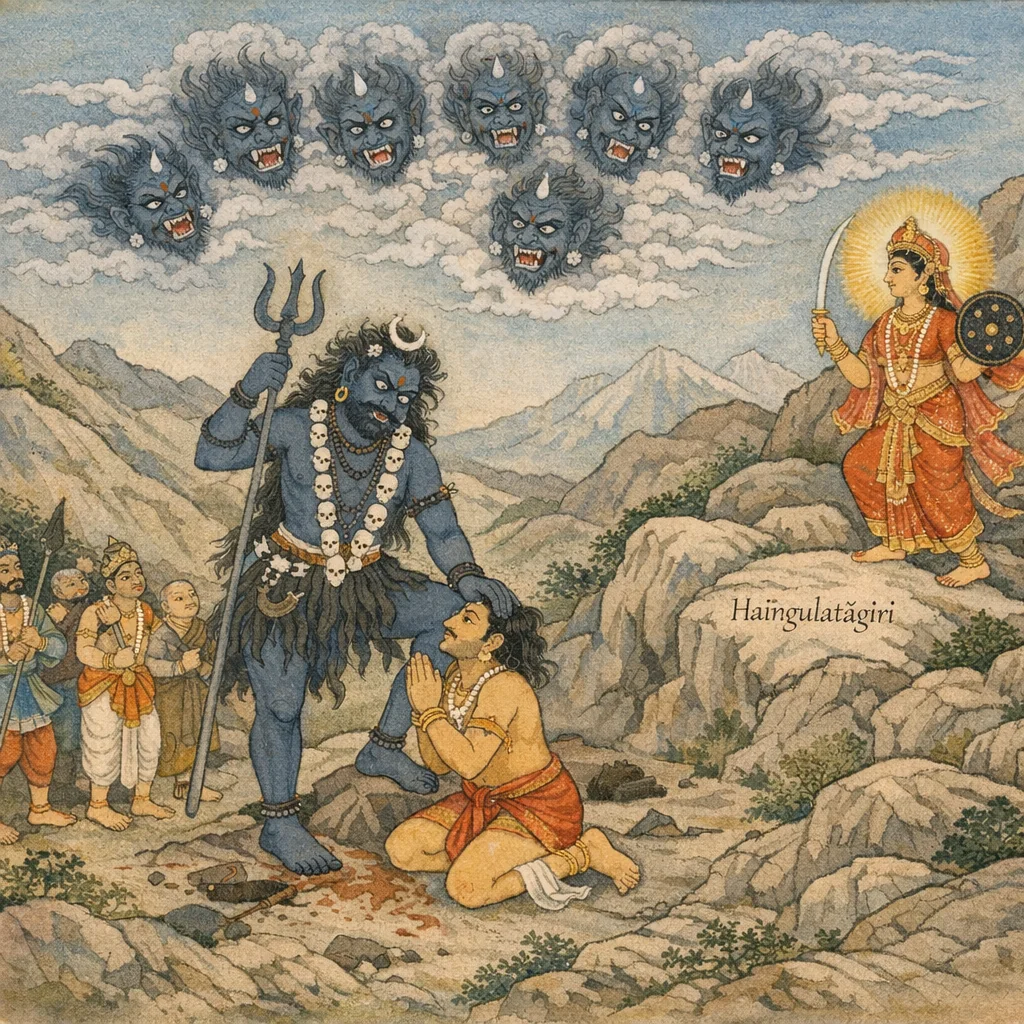
Adhyaya 44: Andhaka’s Defeat, the Bhairava Manifestation, and His Redemption as Bhṛṅgī Gaṇapati
अन्धक-भैरव-प्रादुर्भावः (Andhaka-Bhairava-Prādurbhāvaḥ)
Bhairava Manifestation
Within the Pulastya–Nārada narrative frame, this Adhyāya stages a decisive Shaiva episode that nonetheless preserves the Purāṇa’s syncretic theology: the devas act under Vāsudeva’s (Viṣṇu’s) strategic command, while Śaṅkara (Śiva) becomes the direct agent of cosmic rebalancing. After the daitya host falters, Śukra urges retreat, but Andhaka—Hiraṇyākṣa’s son—refuses, boasting of victory over Indra and Maheśvara. The battle turns when Viṣṇu orders the destruction of Andhaka’s chariot and horses, enabling Skanda and the gaṇas to render him viratha. Śiva then internalizes the gods within his own body, confronting Andhaka alone and manifesting a terrifying Bhairava form with explicit iconographic detail. From Śiva’s blood arise multiple Bhairava aspects (a Bhairavāṣṭaka taxonomy), and from sweat/blood emerges the goddess Carccikā, later established at Haiṅgulatāgiri. Andhaka is purified by Śiva’s ocular fire, offers a long stotra of surrender, and receives a transformative boon: release from daitya-bhāva and installation as Bhṛṅgī, a gaṇapati devoted to Śiva and Ambikā—an ethical resolution emphasizing asura-dharma corrected through bhakti and grace.
Divine Beings
Sacred Geography
Mortal & Asura Figures
Key Content Points
- Pulastya narrates Andhaka’s renewed assault and Viṣṇu’s tactical leadership: Janārdana instructs the devas/gaṇas to cripple Andhaka’s mobility (horses, chariot), illustrating coordinated Hari–Hara alignment in warfare and dharma-protection.
- Śiva’s iconographic escalation into Bhairava: a fearsome, multi-armed, tri-loka-terrifying form; the ensuing emergence of multiple Bhairava manifestations (Vidyārāja, Kālarāja, Kāmarāja, Somarāja, Svacchandarāja, Lalitarāja, etc.) culminating in the Bhairavāṣṭaka schema.
- Redemption theology: Andhaka’s purification by Śiva’s netra-agni, his extensive stotra of śaraṇāgati, and the boon that dissolves his daitya-nature—recasting him as Bhṛṅgī/gaṇapati; parallel elevation of Carccikā and her localization at Haiṅgulatāgiri.
Shlokas in Adhyaya 44
Verse 7
ते यत्नतो ऽपि तुरघाः प्रेर्यमाणा हरं प्रति जघनेष्ववसीदन्तः कृच्छ्रे णोहुश्च तं रथम्
Though urged on with effort toward Hara, those horses, sinking down upon their haunches, with difficulty dragged that chariot.
Verse 8
वहन्तस्तुरगा दैत्यं प्राप्ताः प्रमथवाहिनीम् संवत्सरेण साग्रेण वायुवेगसमा अपि
Bearing the Daitya, the horses reached the army of the Pramathas only after a full year had passed—though they were, indeed, equal to the wind in speed.
Verse 9
ततः कार्मुकमानम्य बाणजालैर्गणेश्वरान् सुरान् संछादयामास सेन्द्रोपेन्द्रमहेश्वरान्
Then, bending his bow, he covered the hosts of the Gaṇa-lords and the gods with a net of arrows—along with Indra, Upendra (Viṣṇu), and Maheśvara (Śiva).
Verse 14
इतेयवमुक्ताः प्रमथा वासुदेवेन सामराः चक्रुर्वेगं सहेन्द्रेण समं चक्रधरेण च
“Thus addressed, the Pramathas—together with the gods—made a swift advance, along with Indra and with Vāsudeva, the bearer of the discus.”
Verse 18
सहसा स महातेजा विरथस्त्यज्य कार्मुकम् गदामादाय बलवानभिदुद्राव दैवतान्
Suddenly that mighty, radiant one—having become without a chariot—cast aside his bow; then, taking up a mace, the powerful (Daitya) rushed straight at the gods.
Verse 19
पदान्यष्टौ ततो गत्वा मेघगम्भीरया गिरा स्थित्वा प्रोवाच दैत्येन्द्रो महादेवं स हेतुमत्
Then, having gone eight paces, and standing (there), the lord of the Daityas spoke to Mahādeva in a voice deep as thunderclouds—addressing him with a pointed, reasoned challenge.
Verse 20
भिक्षो भवान् सहानीकस्त्वसहायो ऽस्मि साम्प्रतम् तथापि त्वां विजेष्यामि पश्य मे ऽद्य पराक्रमम्
“You are (like) a mendicant, though attended by an army; but I am now without allies. Even so, I shall conquer you—behold my valor today!”
Verse 21
तद्वाक्यं शङ्करः श्रुत्वा सेन्द्रान्सुरगणांस्तदा ब्रह्मणा सहितान् सर्वान् स्वशरीरे न्यवेशयत्
Hearing those words, Śaṅkara then caused all the hosts of gods—together with Indra and with Brahmā—to enter into his own body.
Verse 22
शरीरस्थांस्तान् प्रमथान् कृत्वा देवांश्च शङ्करः प्राह एह्येहि तुष्टात्मन् अहमेको ऽपि संश्थितः
Having placed those Pramathas and the gods within his body, Śaṅkara said: “Come, come! O content-minded one—though alone, I stand firm.”
Verse 23
तं दृष्ट्वा महदाश्चर्यं सर्वामरगणक्षयम् दैत्यः शङ्करमभ्यागाद् गदामादाय वेगवान्
Seeing that great marvel—the disappearance/withdrawal of all the hosts of gods—the Daitya rushed toward Śaṅkara, swiftly taking up his mace.
Verse 24
तमापतन्तं भगवान् दृष्ट्वा त्यक्त्वा वृषोत्तमम् शूलपाणिर्गिरिप्रस्थे पदातिः प्रत्यतिष्ठत
Seeing him rushing down in attack, the Blessed Lord—bearing the trident—abandoned his excellent bull (mount) and, on foot, took his stand upon a mountain-ledge.
Verse 25
वेगेनैवापतन्तं च बिभेदोरसि भैरवः दारुणं सुमहद् रूपं कृत्वा त्रैलोक्यभीषणम्
And as the foe rushed in with speed, Bhairava struck and split him upon the chest; assuming a fierce and exceedingly vast form, he became terrifying to the three worlds.
Verse 26
दंष्ट्राकरालं रविकोटिसंनिभं मृगारिचर्माभिवृतं जटाधरम् भुजङ्गहारामलकण्ठकन्दरं विंशार्धबाहुं सषडर्धलोचनम्
(He appeared) with fearsome fangs, radiant like ten million suns; clad in the hide of the lord of beasts, bearing matted locks; with a garland of serpents and a spotless, cavernous throat; possessing twenty arms, and eyes numbering six and a half.
Verse 36
क्षतस्य रुधिरात् जातो भैरवः शूलभूषितः स्वच्छन्दराजो विख्यातः इन्द्रायुधसमप्रभः
From the blood of the wound there arose Bhairava, adorned with a trident. He became renowned as Svacchandarāja, possessing a radiance comparable to Indra’s weapon (the thunderbolt).
Verse 37
भूमिस्थाद् रुधिराज्जातो भैरवः शूलभूषितः ख्यातो ललितराजेति सौभाञ्जनसमप्रभः
From the blood that had fallen upon the earth there arose Bhairava, adorned with a trident. He became known as Lalitarāja, possessing a luster comparable to saubhāñjana (collyrium/antimony).
Verse 40
तस्यासृगुल्बणं ब्रह्मञ्छूलभेदादवापतत् येनाकष्ठं महादेवो निमग्नः सप्तमूर्तिमान्
From the wound made by the trident, his blood poured down in torrents, O Brāhmaṇa; by that (flood of blood) Mahādeva—he of seven forms—became immersed up to the very wood (of the weapon/shaft).
Verse 41
ततः स्वेदो ऽभवद् भूरि श्रमजः शङ्करस्य तु ललाटफलके तस्माज्जाता कन्यासृगाप्लुता
Then abundant sweat arose—born of exertion—upon Śaṅkara; and upon the surface of his forehead, from that (sweat) a maiden was born, drenched in blood.
Verse 42
यद्भूभ्यां न्यपतद् विप्र स्वेदबिन्दुः शिवाननात् तस्मादङ्गरपुञ्जाभो बालकः समजायत
O brāhmaṇa, when a drop of sweat fell to the ground from Śiva’s face, from that there arose a child, resembling a heap of glowing embers.
Verse 43
स बालस्तषितो ऽत्यर्थं पपौ रुधिरमान्धकम् कन्या चोत्कृत्य संजातमसृग्विलिलिहे ऽद्भुता
That child, exceedingly thirsty, drank Andhaka’s blood. And a wondrous maiden, having sprung forth, licked up the blood that had come into being after being drawn out.
Verse 44
ततस्तामाह बालार्कप्रभां भैरवमूर्तिमान् शङ्करो वरदो लोके श्रेयोर्ऽथाय वचो महत्
Then Śaṅkara—assuming the form of Bhairava, the boon-giver in the world—addressed her, who shone with the radiance of the rising sun, speaking lofty words for (the attainment of) welfare.
Verse 45
त्वां पूजयिष्यन्ति सुरा ऋषः पितरोरगाः यक्षविद्याधराश्चैव मानवाश्च शुभङ्करि
O auspicious one, the gods, sages, Pitṛs, Nāgas, Yakṣas, Vidyādharas, and also human beings will worship you.
Verse 46
त्वां स्तोष्यन्ति सदा देवि बलिपुष्पोत्करैः करैः चर्च्चिकेति सुभं नाम यस्मादा रुधिरचर्चिता
They will always praise you, O Goddess, with hands bearing abundant offerings and heaps of flowers. Because you are ‘smeared/marked with blood’ (rudhira-carcitā), your auspicious name is Carccikā.
Verse 47
इत्येवमुक्ता वरदेन चर्चिका भूतानुजाता हरिचर्मवासिनी महीं समन्ताद् विचचार सुन्दरी स्थानं गता हैङ्गुलताद्रिमुत्तमम्
Thus addressed by the boon-giver, Carccikā—born among the Bhūtas and dwelling in the hide/skin of Hari—wandered all around the earth. That beautiful goddess then reached her abode: the excellent mountain Haiṅgulatā.
Verse 50
तस्यां गतायां वरदः कुजस्य प्रादाद् वरं सर्ववरोत्तमं यत् ग्रहाधिपत्यं जगातां शुभाशुभं भविष्यति त्वद्वरागं महात्मन // वम्प्_44.48 हरो ऽन्धकं वर्षसहस्रमात्रं दिव्यं स्वनेत्रार्कहुताशनेन चकार संशुष्कतनुं त्वशोणितं त्वगस्थिशेषं भगवान् स भैरवः // वम्प्_44.49 तत्राग्निना नेत्रभवेन शुद्धः स मुक्तपापो ऽसुरराड् बभुव ततः प्रजानां बहुरूपमीशं नाथं हि सर्वस्य चराचरस्य
When she had gone there, the boon-giver (Kujā/Mars) granted a boon—indeed the best of boons—that he would attain lordship among the planets, becoming the regulator of auspicious and inauspicious outcomes for beings, by the power of your boon, O great-souled one. Then Hara—Bhairava, the Blessed Lord—by the fire that is the sun of his own eye, scorched Andhaka for a full thousand divine years, making his body dried up, without skin and blood, leaving only skin-and-bone remnants. Purified there by that fire born of the (Lord’s) eye, the king of Asuras became freed from sin; thereafter he recognized the many-formed Lord, the master of all, of moving and unmoving beings.
Verse 51
ज्ञात्वा स सर्वेश्वरमीशमव्ययं त्रैलोक्यनाथं वरदं वरेण्यम् सर्वैः सुराद्यैर्नतमीड्यमाद्यं ततो ऽन्धकः स्तोत्रमिदं चकार
Having understood him to be the Lord of all, the imperishable God, the master of the three worlds—boon-giver, most worthy of choice—bowed to by all the gods and other beings, praised and primordial, Andhaka then composed this hymn of praise.
Verse 52
अन्धक उवाच नमो ऽस्तु ते भैरव भीममूर्ते त्रिलोकगोप्त्रे शितशूलधारिणे विंशार्द्धबाहो भुजगेशहार त्रिनेत्र मां पाहि विपन्नबुद्धिम्
Andhaka said: Salutation to you, O Bhairava of terrifying form—protector of the three worlds, bearer of the sharp spear/trident; O one with (mighty) arms, wearing the lord of serpents as an ornament; O three-eyed one—protect me, whose understanding has fallen into ruin.
Verse 53
जयस्व सर्वेश्वर विश्वमूर्त्ते सुरासुरैर्वन्दितपादपीठ त्रैलोक्यमातुर्गुरवे वृषाङ्क भीतः शरण्यं शरणागतो ऽस्मि
Be victorious, O Lord of all, O One whose form is the universe, whose footstool is worshipped by gods and demons alike. O teacher of the Mother of the three worlds, O Bull-marked One (Śiva): in fear I have come for refuge to you, the Refuge of all.
Verse 54
त्वां नाथ देवाः शिवमीरयन्ति सिद्धा हरं स्थाणुं महर्षयश्च भीमं च यक्षा मनुजा महेश्वरं भूताश्च भूताधिपमामनन्ति
O Lord, the gods proclaim you as Śiva; the Siddhas (proclaim you as) Hara and Sthāṇu; the great seers (do so as well). The Yakṣas and humans call you Bhīma and Maheśvara; and the Bhūtas name you Bhūtādhipa, the Lord of spirits.
Verse 55
निशाचरा उग्रमुपार्चयन्ति भवेति पुण्याः पितरो नमन्ति दासो ऽस्मि तुभ्यं हर पाहि मह्यं पापक्षयं मे कुरु लोकनाथ
The night-roaming beings worship you as the Fierce One; the virtuous Fathers bow to you as ‘Bhava.’ I am your servant—O Hara, protect me. O Lord of the world, bring about the destruction of my sins.
Verse 56
भावंस्त्रिदेवस्त्रियुगस्त्रिधर्मा त्रिपुष्करश्चासि विभो त्रिनेत्र त्रय्यारुणिस्त्रितिव्ययात्मन् पुनीहि मां त्वां शरणं गतो ऽस्मि
O Bhava, you are the Lord of the three gods; you preside over the three yugas and the threefold dharma. You are the threefold Puṣkara; O all-pervading one, O three-eyed Lord; you are the Aruṇi of the three Vedas, the Self whose nature is threefold. Purify me—I have come to you for refuge.
Verse 57
त्रिणाचिकेतस्त्रिपदप्रतिष्ठः षडङ्गवित् त्वं विषयेष्वलुब्धः त्रैलोक्यनाथो ऽसि पुनीहि शंभो दासो ऽस्मि भीतः शरणागतस्ते
You are the one whose awareness is threefold; you are established in the threefold footing. You are the knower of the six limbs, and you are not deluded by sense-objects. You are the Lord of the three worlds. Purify me, O Śaṃbhu; I am your servant—frightened, I have come to you for refuge.
Verse 60
मा मे क्रुध्यस्व देवेश त्वया चैतादृशो ऽस्मयहम् सृष्टः पापसमाचारो मे प्रसन्नो भवेश्वर
“Do not be angry with me, O Lord of the gods. For I am such as I am—created by you—one whose conduct has become sinful. Be gracious to me, O Bhaveśvara.”
Verse 61
त्वं कर्त्ता चैव धाता च त्वं जयस्त्वं महाजयः त्वं मङ्गल्यस्त्वमोङ्कारस्त्वमीशानो ध्रुवो ऽव्ययः
“You alone are the doer and the sustainer; you are Victory, and the Great Victory. You are auspiciousness; you are the syllable Oṃ; you are Īśāna—steadfast and imperishable.”
Verse 62
त्वं ब्रह्म सृष्टिकृन्नाथस्त्वं विष्णुस्त्वं महेश्वरः त्वमिन्द्रस्त्वं वषट्कारो धर्मस्त्वं च सुरोत्तमः
You are Brahmā, the Lord who performs creation; you are Viṣṇu; you are Maheśvara (Śiva). You are Indra; you are the vaṣaṭ-call (the sacrificial exclamation); you are Dharma; and you are the foremost among the gods.
Verse 63
सूक्ष्मस्त्वं व्यक्तरूपस्त्वं त्वमव्यक्तस्त्वमीश्वरः त्वया सर्वमिदं व्याप्तं जगत् स्थावरजङ्गमम्
You are subtle; you are manifest in form; you are also unmanifest—O Lord. By you all this universe is pervaded, the world of the immobile and the mobile.
Verse 64
त्वमादिरन्तो मध्यश्च त्वमनादिः सहस्रपात् विजयस्त्वं सहस्राक्षो विरूपाक्षो महाभुजः
You are the beginning, the end, and the middle; and yet you are without beginning. You are the thousand-footed one; you are Victory; you are thousand-eyed; you are the many-formed-eyed one; you are the great-armed.
Verse 65
अन्तः सर्वागो व्यापी हंसः प्राणाधिपो ऽच्युतः गीर्वाणपतिरव्यग्रो रुद्रः पशुपतिः शिवः
“(You are) the indwelling one, all-limbed and all-pervading; the Haṃsa; the lord of the vital breaths; the unfailing (Acyuta); the lord of the gods; the unagitated; Rudra; Paśupati; Śiva.”
Verse 66
त्रैविद्यस्त्वं जितक्रोधो जितारिर्विजितेन्द्रियः जयश्च शूलपाणिस्त्वं त्राहि मां शरणागतम्
“You are the knower of the three Vedas; you have conquered anger; you have conquered enemies; you are one who has mastered the senses. You are Victory itself, and you are the bearer of the trident. Protect me—I have come seeking refuge.”
Verse 67
पुलस्त्य उवाच इत्थं महेश्वरो ब्रह्मन् स्तुतो दैत्याधिपेन तु प्रीतियुक्तः विङ्गलाक्षो हैरण्याक्षिमुवाच ह
Pulastya said: “Thus, O Brahman, Maheśvara—praised by the lord of the Daityas—became filled with pleasure. The tawny-eyed one then spoke to Hiraṇyākṣi.”
Verse 68
सिद्धो ऽसि दानवपते परितुष्टो ऽस्मि ते ऽन्धक वरं वरय भद्रं ते यमिच्छसि विनाम्बिकाम्
“You have attained success, O lord of the Dānavas. I am pleased with you, Andhaka. Choose a boon—may auspiciousness be yours—whatever you desire, except (the goddess) Ambikā.”
Verse 69
अन्धक उवाच अम्बिका जननी मह्यं भगवांस्त्र्यम्बकः पिता वन्दामि चरणौ मातुर्वन्दनीया ममाम्बिका
Andhaka said: “Ambikā is my mother; the Blessed Tryambaka is my father. I bow to the feet of my mother—my Ambikā is worthy of reverence.”
Verse 70
वरदो ऽसि यदीशान तद्यातु विलयं मम शारीरं मानसं वाग्जं दुष्कृतं दुर्विचिन्तितम्
“If you are indeed the giver of boons, O Īśāna, then let my evil deed—whether bodily, mental, or born of speech—together with my wicked, ill-conceived intent, go to destruction.”
Verse 71
तथा मे दानवो भावो व्यपयातु महेश्वर स्थिरास्तु त्वयि भक्तिस्तु वरमेतत् प्रयच्छ मे
“So too, O Maheśvara, may my demonic disposition depart. Let my devotion toward you be steadfast—grant me this boon.”
Verse 72
महादेव उवाच एवं भवतु दैत्येन्द्र पापं ते यातु संक्षयम् मुक्तो ऽसि दैत्यभावाच्च भृङ्गी गणपतिर्भव
Mahādeva said: “So be it, O lord of the Daityas. Let your sin come to an end. You are freed from the daitya-nature; become Bhṛṅgī, a Gaṇapati (chief among my attendants).”
Verse 73
इत्येवमुक्त्वा वरदः शूलग्रादवतार्य तम् निर्मार्ज्य निजहस्तेन चक्रे निर्व्रणमन्धकम्
Having spoken thus, the boon-giver (Śiva), lowering him down from the tip of the trident, wiped him with his own hand and made Andhaka free from wounds.
Verse 74
ततः स्वदेहतो देवान् ब्रह्मादीनाजुहाव सः ते निश्चेरुर्महात्मानो नमस्यन्तस्त्रिलोचनम्
Then, from his own body, he summoned the gods beginning with Brahmā. Those great-souled deities came forth, bowing in reverence to the Three-eyed Lord (Śiva).
Verse 75
गणान् सनन्दीनाहूय सन्निवेश्य तदाग्रतः भृङ्गिनं दर्शयामास ध्रुवं नैषो ऽन्धकति हि
Having summoned the gaṇas together with Nandī and having stationed them before him, he then showed them Bhṛṅgin, saying, ‘Surely, this one is Andhaka.’
Verse 76
तं दृष्ट्वा दानवपतिं संशुष्कपिशितं रिपुम् गणाधिपत्यमापन्नं प्रशशंसुर्वृषध्वजम्
Seeing that lord of the Dānavas—an enemy whose flesh was withered—(and seeing) that he had come under the authority of the gaṇa-leaders, they praised Vṛṣadhvaja (Śiva, whose banner bears the bull).
Verse 77
ततस्तान् प्राह भगवान् संपरिष्वज्य देवताः गच्छध्वं स्वानि धिष्ण्यानि भुञ्जध्वं त्रिदिवं सुखम्
Then the Blessed Lord, having embraced the deities, spoke to them: “Go to your own abodes; enjoy the happiness of heaven (Tridiva).”
Verse 78
सहस्राक्षो ऽपि संयातु पर्वतं मलयं शुभम् तत्र स्वकार्यं कृत्वैव पश्चाद् यातु त्रिविष्टपम्
“Let Sahasrākṣa (Indra) also proceed to the auspicious Malaya mountain; having accomplished his own task there, let him afterwards go to Triviṣṭapa (heaven).”
Verse 79
इत्येवमुक्त्वा त्रिदशान् समाभाष्य व्यसर्जयत् पिमामहं नमस्कृत्य परिष्वज्य जनार्दनम् ते विसृष्टा महेशेन सुरा जग्मुस्त्रक्षिविष्टपम्
Having thus spoken and addressed the Thirty-three gods, he dismissed them. Then Pitāmaha (Brahmā), having bowed and embraced Janārdana (Viṣṇu),—those gods, dismissed by Maheśa, went to Triviṣṭapa (heaven).
Verse 80
महेन्द्रो मलयं गत्वा कृत्वा कार्यं दिवं गतः गतेषु शक्रपाग्र्येषु देवेषु भगवाञ्चिशवः
Mahendra (Indra), having gone to Malaya and accomplished his task, returned to heaven. When the gods—foremost among them Śakra (Indra)—had departed, the Blessed Lord (Śiva) … (the verse transitions to Śiva’s subsequent action, continued in the next śloka).
Verse 81
विसर्जयामास गणाननुमान्य यथार्हतः गणाश्च शङ्करं दृष्ट्वा स्वं स्वं वाहनमास्थिताः
He (Śiva), having duly honored them as was fitting, dismissed the gaṇas. And the gaṇas, seeing Śaṅkara, each mounted his own vehicle.
Verse 82
जग्मुस्ते शुभलोकानि महाभोगानि नारद यत्र कामदुधा गावः सर्वकामफलद्रुमाः
They went to auspicious worlds of great enjoyments, O Nārada—where there are wish-yielding cows and trees that bear the fruits of every desire.
Verse 83
नद्यस्त्वमृतवाहिन्यो ह्रदाः पायसकर्दमाः स्वां स्वां गतिं प्रयातेषु प्रमथेषु महेश्वरः
The rivers became streams bearing nectar, and the lakes became filled with a mire of sweet milk-rice. When the Pramathas had departed each to his own course, Maheśvara (Śiva) [remained/was present there].
Verse 84
समादायान्धकं हस्ते सनन्दिः शैलमभ्यगात् द्वाभ्यां वर्षसहस्राभ्यां पुनरागाद्वरो गृह्म्
Taking Andhaka in his hand, Sanandī went to the mountain. After two thousand years, the excellent one returned home.
Verse 85
ददृशे च गिरेः पुत्रीं श्वेतार्ककुसुमस्थिताम् समायातं निरीक्ष्यैव सर्वलक्षणसंयुतम्
And he saw the daughter of the mountain, standing amid the blossoms of the white arka plant. Seeing the one who had arrived, endowed with every auspicious mark, [she observed him].
Verse 89
पश्यस्व प्रणतिं यातं स्वसुतं चारुहासिनि इत्युच्चार्यान्धकं चैव पुत्र पह्येहि सत्वरम्
“Behold your own son who has come to bow down (in submission), O fair-smiling one.” Having spoken thus, he also addressed Andhaka: “Son, look (upon her) at once.”
Verse 90
व्रजस्व शरणं मातुरेष श्रेयस्करी तव इत्युक्तो विभुना नन्दी अन्धकश्च गणेश्वरः
“Go and take refuge in the Mother; this will bring you welfare.” Thus instructed by the mighty one (Nandī), Andhaka—the lord of the gaṇas—(proceeded accordingly).
Verse 91
समागम्याम्बिकापादौ ववन्दतुरुभावपि अन्धको ऽपि तदा गौरीं भक्तिनम्रो महामुने स्तुतिं चक्रे महापुण्यां पापघ्नीं श्रुतीसंमिताम्
Having approached the feet of Ambikā, both of them bowed down. Then Andhaka also—bent low with devotion, O great sage—offered to Gaurī a hymn of great merit, a destroyer of sins, consonant with the spirit of the Vedas.
Verse 92
अन्धक उवाच ॐ नमस्ये भावानीं भूतभव्यप्रियां लोकधात्रीं जनित्रीं स्कन्दमातरं महादेवप्रियां धारिणीं स्यन्दिनीं चेतनां त्रैलोक्यमातरं धरित्रीं देवमातरमथेज्यां स्मृतिं दयां लज्जां कान्तिमग्र्यामसूयां मतिं सदापावनीं दैत्यसैन्यक्षयकरीं महामायां वैजयन्ती सुशुभां कालरात्रिं गोविन्दभगिनीं शैलराजपूत्रीं सर्वदेवार्चितां सर्वभूतार्चितां विद्यां सरस्वतीं त्रिनयनमहिषीं नमस्यामी मृडानीं शरण्यां शरणमुपागतो ऽहं नमो नमस्ते | इत्थं स्तुता सान्धकेन परितुष्टा विभावरी प्राह पुत्र प्रसन्नास्मि वृणुष्व परमुत्तमम्
Andhaka said: “Om. I bow to Bhavānī—beloved of beings of the past and the future; the sustainer of the worlds; the progenitrix; the mother of Skanda; dear to Mahādeva; the bearer (of the universe); the flowing one; consciousness itself; the mother of the three worlds; the Earth; the mother of the gods; the one worthy of worship; memory; compassion; modesty; supreme radiance; freedom from malice; intelligence; ever-purifying; the destroyer of the armies of the Daityas; the great Māyā; the victorious one (Vaijayantī); the most auspicious; Kālarātrī; the sister of Govinda; the daughter of the Lord of Mountains; worshipped by all gods and all beings; knowledge; Sarasvatī; the consort of the Three-eyed (Śiva). I bow to Mṛḍānī, the refuge; I have come to you for shelter—salutations, salutations to you.” Thus praised by Andhaka, the radiant Goddess, pleased, said: “Son, I am satisfied; choose the highest boon.”
Verse 93
भृङ्गिरुवाच पापं प्रशममायातु त्रिविधं मम पार्वति तथेश्वरे च सततं भक्तिरस्तु ममाम्विके
Bhṛṅgī said: “O Pārvatī, may my threefold sin be brought to cessation; and, O Mother (Ambikā), may there be for me unwavering devotion to the Lord (Śiva) always.”
Verse 96
एवं पुरा दानवसत्तमं तं महेश्वरेणाथ विरूपदृष्ट्या कृत्वैव रूपं भयदं च भैरवं भृङ्गित्वमीसेन कृतं स्वभक्त्या // वम्प्_44.95 एतत् तवोक्तं हरकीर्तिवर्धनं पुण्यं पवित्रं शुभदं महर्षे संकीर्तनीयं द्विजसत्तमेषु धर्मायुरारोग्यधनैषिणा सदा
“Thus, in former times, that foremost of Dānavas—having been made the object of Maheśvara’s disfiguring glance—was indeed transformed into a fearsome, Bhairava-like form; and by his own devotion he was made to attain the state of Bhṛṅgī by the Lord (Īśa). This account spoken by you, O great seer, increases the fame of Hara; it is meritorious, purifying, and bestows auspiciousness. It should always be recited among the best of twice-born, by one who seeks dharma, long life, health, and wealth.”
Frequently Asked Questions
The chapter models syncretic theology through coordinated divine agency: Viṣṇu (Vāsudeva) directs the devas’ battlefield strategy (disabling Andhaka’s chariot and horses), while Śiva executes the decisive cosmic act via Bhairava. Rather than rivalry, the narrative presents complementary functions—Viṣṇu as protector and strategist of dharma, Śiva as transformative purifier—culminating in Andhaka’s redemption, not mere annihilation.
A key localization is Carccikā’s establishment at Haiṅgulatāgiri (Haiṅgulatādrī), marking a sanctified site tied to the goddess’s origin from Śiva’s exertion during the Andhaka conflict. The chapter also references Malaya Mountain as a post-battle divine itinerary (Indra’s assigned task), and situates the combat on a mountain slope (giriprastha), using landscape to anchor mythic events in identifiable sacred topography.
Andhaka’s arc shifts from asura-darpa (boastful aggression) to śaraṇāgati (surrender). Purified by Śiva’s netra-agni and instructed by grace, he requests the dissolution of bodily, mental, and verbal demerit and the removal of daitya-bhāva. Śiva grants liberation from his asuric nature and installs him as Bhṛṅgī, a gaṇapati—framing bhakti and repentance as mechanisms of ethical transformation within Purāṇic asura-dharma.