Sarga 91
इन्द्रजित्-वधः (The Slaying of Indrajit)
युद्धकाण्ड
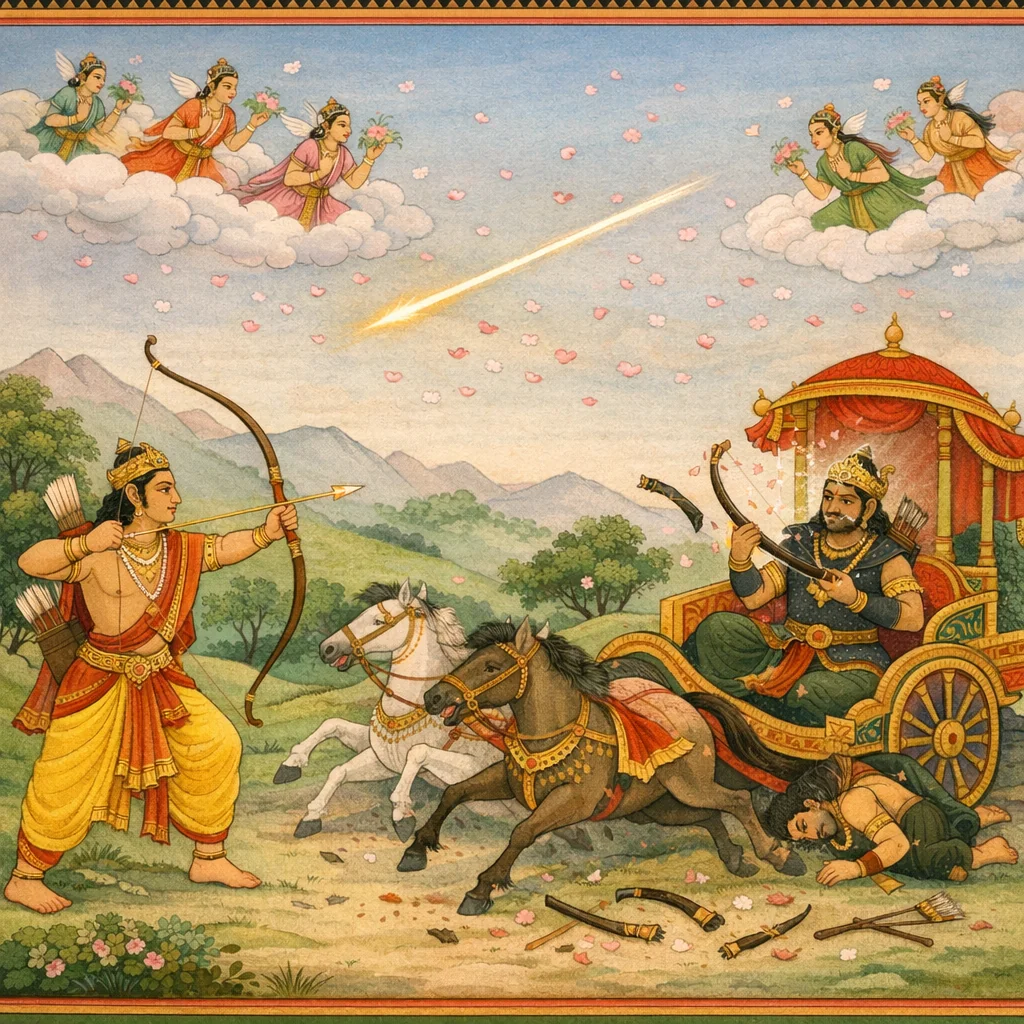
Sarga 91 stages the decisive duel between Lakṣmaṇa (Saumitrī) and Indrajit (Rāvaṇi), embedding battlefield action within a framework of astric escalation and moral resolve. Indrajit re-enters combat after preparing a gold-adorned chariot and assails Lakṣmaṇa and Vibhīṣaṇa, striking Vānara leaders with massive arrow-volley displays of lāghava (martial dexterity). Lakṣmaṇa counters by severing Indrajit’s bows, wounding him repeatedly, and disrupting his chariot’s command structure (including the charioteer), causing the horses to wheel without guidance. Vibhīṣaṇa engages directly, and Indrajit, driven by wrath and fate, deploys increasingly formidable missiles: fire-based, then an Asura missile manifesting as a shower of weapons. Lakṣmaṇa repels these with Saurya and Māheśvara countermeasures, while celestial beings witness and protect him. The climax arrives as Lakṣmaṇa fits the undefeated Aindra missile, verbally consecrating its truth-conditional efficacy, and releases it to sever Indrajit’s head—ending the terror of the worlds and triggering cosmic acclamation, flower-rain, and the rout of the Rākṣasa forces.
Shlokas
Verse 1
स हताश्वोमहातेजाभूमौतिष्ठन्निशाचरः ।इन्द्रजित्परमक्रुद्धस्सजज्वालतेजसा ।।।।
Indrajit, the night-ranging warrior—his horses slain—stood on the ground in blazing fury, flaring with radiant energy.
Verse 2
तौधवनिनौजिघांसन्तवन्योन्यमिषुभिर्भृशम् ।विजयेनाभिनिष्क्रान्तौवनेगजवृषाविव ।।।।
Both archers, burning to slay one another and striking fiercely with arrows, sallied forth seeking victory—like two lordly elephants in a forest.
Verse 3
निबर्हयन्तश्चान्योन्यंतेराक्ष्वनौकसः ।भर्तारं न जहुर्युद्धेसम्पतन्तस्ततस्ततः ।।।।
Rākṣasas and the forest-dwellers (Vānara warriors), slaying one another and surging everywhere, did not abandon their leader in the battle—again and again rushing to his side.
Verse 4
ततस्तान् राक्षसान् सर्वान् हर्षयन् रावणात्मजः ।स्तुवानोहर्षमाणश्चइदंवचनमब्रवीत् ।।।।
Then Rāvaṇa’s son (Indrajit), cheering all those Rākṣasas and praising them, spoke these words to raise their spirits.
Verse 5
तमसाबहुलेनेमास्सम्सक्तांसर्वतोदिशः ।नेहविज्ञायतेस्वोवापरोवारक्षसोत्तमाः ।।।।
These directions are choked on every side by dense darkness; here it is impossible to tell who is one’s own and who is the other—O foremost of Rākṣasas.
Verse 6
धृष्टंभवन्तोयुध्यन्तुहरीणांमोहनायवै ।अहंतुरथमास्थायआगमिष्यामिसंयुगे ।।।।
“Fight boldly, to bewilder the Vānara forces. As for me, mounting my chariot, I shall come into the battle.”
Verse 7
तथाभवन्तःकुर्वन्तुयथेमेहिवनौकसः ।न युध्येयुर्दुरात्मानःप्रविष्टेनगरंमयि ।।।।
“Act in such a way that, while I enter the city, these wicked-minded forest-dwellers do not engage (me) in battle.”
Verse 8
इत्युक्त्वारावणसुतोवञ्चयित्वावनौकसः ।प्रविवेशपुरींलङ्कांरथहेतोरमित्रहा ।।।।
Having spoken thus, Rāvaṇa’s son—slayer of foes—deceived the Vānaras and entered the city of Laṅkā, seeking to obtain his chariot.
Verse 9
स रथंभूषयित्वाथरुचिरंहेमभूषितम् ।प्रासासिशरसंयुक्तंयुक्तंपरमवाजिभिः ।।।।अधिष्ठितंहयज्ञेनसूतेनाप्तोपदेशिना ।आरुरोहमहातेजारावणिःसमतिञ्जियः ।।।।
Then Rāvaṇa’s son—radiant and victorious in battle—had his splendid chariot adorned with gold, fitted with spears, swords, and arrows, and yoked to excellent horses. Driven by a charioteer skilled in horses and sound counsel, he mounted it.
Verse 10
स रथंभूषयित्वाथरुचिरंहेमभूषितम् ।प्रासासिशरसंयुक्तंयुक्तंपरमवाजिभिः ।।6.91.9।।अधिष्ठितंहयज्ञेनसूतेनाप्तोपदेशिना ।आरुरोहमहातेजारावणिःसमतिञ्जियः ।।6.91.10।।
Then Rāvaṇa’s son—radiant and a conqueror in battle—had a splendid chariot adorned with gold and equipped with spears, swords, and arrows made ready. Yoked to excellent horses and driven by a charioteer skilled with horses and capable of sound counsel, he mounted it.
Verse 11
स राक्षसगणैर्मुख्यैर्वृतोमन्दोदरीसुतः ।निर्ययौनगरावदीरःकृतान्तबलचोदितः ।।।।
The heroic son of Mandodarī, surrounded by the foremost rākṣasa hosts, went forth from the city—driven onward by the compelling force of destiny.
Verse 12
सोऽभिनिष्क्रम्यनगरादिन्द्रजित्परवीरहा ।अभ्ययाज्ञवनैरश्वैर्लक्ष्मणंसविभीषणम् ।।।।
Indrajit—famed for slaying enemy champions—set out from the city, and, borne by swift horses, rushed to assail Lakshmana along with Vibhishana.
Verse 13
ततोरथस्थमालोक्यसौमत्रीरावणात्मजम् ।वानराश्चमहावीर्याराक्षसश्चविभीषणः ।।।।विस्मयंपरमंजग्मुर्लाघवात्तस्यधीमतः ।
Then, seeing Ravana’s son seated in his chariot, Lakshmana, the mighty Vanaras, and the Rakshasa Vibhishana were struck with great wonder at the speed and deftness of that intelligent warrior.
Verse 14
रावणिश्चापिसङ्क्रुद्धोरणेवानरयूथपान् ।।।।पातयामासबाणौघैःशतशोऽथसहस्रशः ।
Indrajit too, enraged in the battle, brought down the Vanara leaders with volleys of arrows—by the hundreds and then by the thousands.
Verse 15
मण्डलीकृतधनूरावणिःसमतिञ्जयः ।।।।हरीनभ्यहनत्कृद्धःपरंलाघवमास्थितः ।
Indrajit, conqueror in battle, whirled his bow in a circle; wrathful and displaying supreme quickness, he struck the Vanaras repeatedly.
Verse 16
तेवध्यमानाहरयोनाराचैर्भीमविक्रमैः ।।।।सौमित्रिंशरणंप्राप्ताःप्रजापतिमिवप्रजाः ।
Those Vanaras—though of dreadful prowess—being struck by the sharp arrows, sought refuge in Lakshmana, just as people seek refuge in the Lord of creatures.
Verse 17
ततःसमरकोपेनज्वलितोरघुनन्दनः ।।।।चिच्छेदकार्मुकंतस्यदर्शयन् पाणिलाघवम् ।
Then the delight of the Raghu line, blazing with battle-wrath, cut down his bow, displaying the quick mastery of his hand.
Verse 18
सोन्यऽत्कार्मुकम् मादायसज्जंचक्रेत्वरन्निव ।।।।तदप्यस्यत्रिभिर्बाणैर्लक्ष्मणोनिरकृन्तत ।
He seized another bow and, as if in haste, made it ready; but Lakshmana cut that too apart with three arrows.
Verse 19
अथैवंछिन्नधन्वानमाशीविषविषोपमैः ।।।।विव्याधोरसिसौमित्रीरावणिंपञ्चभिःशरैः ।
Then, as his bow had been cut, Lakshmana pierced Indrajit in the chest with five arrows, like the venom of a deadly serpent.
Verse 20
तेतस्यकायंनिर्भिद्यमहाकार्मुकनिस्सृताः ।।।।निपेतुर्धरणींबाणारक्ताइवमहोरगाः ।
Those arrows, released from Lakshmana’s mighty bow, tore into his body and then fell to the earth like great red serpents.
Verse 21
भिन्नवर्मारुधिरंवमन्वक्त्रेणरावणिः ।।।।जग्राहकार्मुकश्रेष्ठंदृढज्यंबलवत्तरम् ।
With his armour split and blood welling up from his mouth, Rāvaṇa’s son (Indrajit) seized his finest bow—powerful and strung with a taut, stout bowstring.
Verse 22
सःलक्ष्मणंसमुद्धिश्यपरंलाघवमाश्रितः ।।।।ववर्षशरवर्षाणिवर्षाणीवपुरन्दरः ।
Fixing Lakṣmaṇa as his target and relying on swift, effortless speed, he poured down showers of arrows—like Purandara (Indra) sending down rain-clouds.
Verse 23
मुक्तमिन्द्रजितातत्तुशरवर्षमरिन्दमः ।।।।अवारयदसम्भ्रान्तोलक्ष्मणःसुदुरासदम् ।
But the arrow-storm released by Indrajit—hard to withstand—was calmly checked by Lakṣmaṇa, the subduer of foes, without the least disturbance.
Verse 24
संदर्शयामासतदारावणिंरघुनन्दनः ।।।।असम्ब्रान्तोमहातेजेस्तदद्भुतमिवाभवत् ।
Then the mighty and unshaken Lakṣmaṇa—delight of the Raghu line—made his prowess plain to Rāvaṇa’s son; it appeared truly wondrous.
Verse 25
तस्तान् राक्षसान् सर्वांस्त्रिभिरेकैकमाहवे ।।।।अविध्यत्परमक्रुद्धश्शीघ्रास्त्रंसम्प्रदर्शयन् ।राक्षसेन्द्रसुतंचापिबाणौघैस्समताडयत् ।।।।
Then, in fierce anger, he struck all those rākṣasas in the fight—each one with three arrows—displaying swift weapon-skill; and even the son of the rākṣasa-king he battered with torrents of shafts.
Verse 26
तस्तान् राक्षसान् सर्वांस्त्रिभिरेकैकमाहवे ।।6.91.25।।अविध्यत्परमक्रुद्धश्शीघ्रास्त्रंसम्प्रदर्शयन् ।राक्षसेन्द्रसुतंचापिबाणौघैस्समताडयत् ।।6.91.26।।
This verse is a duplicated transmission in the provided input (Southern Recension witness): it repeats 6.91.25 verbatim, again stating that Lakṣmaṇa, in great anger, struck each rākṣasa with three arrows and battered Indrajit with floods of shafts.
Verse 27
सोऽतिविद्धोबलवताशत्रुणाशत्रुघातिना ।असक्तंप्रेषयामासलक्ष्मणायबहून् शरान् ।।।।
Though grievously pierced by that powerful foe—Lakṣmaṇa, slayer of enemies—he nonetheless kept sending many arrows at Lakṣmaṇa without pause.
Verse 28
तानप्राप्तान् शितैर्भाणैश्चिच्छेदपरवीरहा ।सारथेरस्य च रणेरथिवोरघुसत्तमः ।।।।शिरोजहारधर्मात्माभल्लेनानतपर्वणा ।
Before those arrows could reach him, the foe-slaying Lakṣmaṇa cut them down with keen shafts; and in the battle the righteous best of the Raghus struck off the head of that chariot-warrior’s charioteer with a broad-headed arrow whose joints were not bent.
Verse 29
सूतास्तेहयास्तत्ररथमूहुरविक्लबाः ।।।।मण्डलान्यभिधावन्तस्तदद्भुतमिवाभवत् ।
There, though the charioteer was gone, the horses—unconfused—kept carrying the chariot, running in circles as they moved; it seemed a marvel.
Verse 30
अमर्षवशमापन्नःसौमित्रिर्दृढविक्रमः ।।।।प्रत्यविद्ध्यद्धयांस्तस्यशरैर्वित्रासयन् रणे ।
Saumitri (Lakṣmaṇa), steadfast in prowess and overcome by battle-fury, struck Indrajit’s horses with his arrows in order to panic them and bring them down in the fight.
Verse 31
अमर्षमाणस्तत्कर्मरावणस्यसुतोबली ।।।।विव्याथदशभिर्बाणैस्सौमित्रिंतममर्षणम् ।
Rāvaṇa’s mighty son, unable to endure that deed, angrily struck Saumitri with ten arrows.
Verse 32
तेतस्यवज्रप्रतिमाःशरास्सर्पविषोपमाः ।।।।विलयंजग्मुरागत्यकवचंकाञ्चनप्रभम् ।
Those arrows of his—thunderbolt-like and venomous as serpents—struck the golden-glinting armor and, on impact, shattered and fell away.
Verse 33
अभ्येद्यकवचंमत्वालक्ष्मणंरावणात्मजः ।।।।ललाटेलक्ष्मणंबाणैस्सुपुङ्खैस्त्रिभिरिन्द्रजित् ।अविध्यत्परमक्रुद्धःशीघ्रमस्त्रंप्रदर्शयन् ।।।।
Realizing that Lakṣmaṇa’s armor could not be pierced, Indrajit—Rāvaṇa’s son—furious and swift, displayed his weapon-skill and struck Lakṣmaṇa on the forehead with three well-feathered arrows.
Verse 34
अभ्येद्यकवचंमत्वालक्ष्मणंरावणात्मजः ।।6.91.33।।ललाटेलक्ष्मणंबाणैस्सुपुङ्खैस्त्रिभिरिन्द्रजित् ।अविध्यत्परमक्रुद्धःशीघ्रमस्त्रंप्रदर्शयन् ।।6.91.34।।
This verse is a duplicated/carry-over presentation of the preceding unit in the provided Southern Recension extract: Indrajit, knowing Lakṣmaṇa’s armor to be unpierceable, swiftly and in great anger struck his forehead with three well-feathered arrows while displaying his weapon-skill.
Verse 35
तैःपृषत्कैर्ललाटस्थैश्शुशुभेरघुनन्दनः ।रणाग्रेसमरश्लाघीत्रिशृङ्गइवपर्वतः ।।।।
With those arrows lodged in his forehead, Lakṣmaṇa—the joy of the Raghu line, eager for the contest—shone at the battle-front like a mountain with three peaks.
Verse 36
स तथाह्यर्दितोबाणैराक्षसेनतदामृधे ।तमाशुप्रतिविव्याधलक्ष्मणःपञ्चभिःशरैः ।।।।विकृष्वेन्द्रजितोयुद्धेवदनेशुभकुण्डले ।
Thus wounded by the rākṣasa’s arrows in that combat, Lakṣmaṇa at once drew his bow and struck Indrajit—his face adorned with fine earrings—with five arrows in return.
Verse 37
लक्ष्मणेन्द्रजितौवीरौमहाबलशरासनौ ।।।।अन्योन्यंजघ्नतुर्बाणैर्विशिखैर्मीविक्रमौ ।
Lakṣmaṇa and Indrajit—both heroes of immense strength, bearing mighty bows and dreadful prowess—struck one another with sharp arrows.
Verse 38
ततःशोणितदिग्धाङ्गौलक्ष्मणेन्दजितावुभौ ।।।।रणेतौराजतुर्वीरौपुष्पिताविवकिंशुकौ ।
Then, both Lakṣmaṇa and Indrajit—smeared over their limbs with blood—shone in the battle like two blossoming kiṁśuka trees.
Verse 39
तौपरस्परमभ्येत्यसर्वगात्रेषुधवनिनौ ।।।।घोरैर्विव्यधतुर्भाणैःकृतभावावुभौजये ।
Closing upon each other, the two bowmen—both intent on victory—pierced one another across all their limbs with dreadful arrows.
Verse 40
ततःसमरकोपेनसम्वृतोरावणात्मजः ।।।।विभीषणंत्रिभिर्बाणैर्विव्याथवदनेशुभे ।
Then Rāvaṇa’s son, seized by battle-rage, struck Vibhīṣaṇa on his fair face with three arrows.
Verse 41
अयोमुखैस्त्रिभिर्विद्ध्वाराक्षसेन्द्रंविभीषणम् ।।।।एकैकेनाभिविव्याथतान्सर्वान् हरियूथपान् ।
After piercing Vibhīṣaṇa, the lord among Rākṣasas, with three iron-pointed arrows, he further struck all the Vānara leaders, one arrow to each.
Verse 42
तस्मैदृढतरंक्रुद्धोजघानगदयाहयान् ।।।।विभीषणोमहातेजारावणेस्सदुरात्मनः ।
Then mighty Vibhīṣaṇa, angered, struck that evil-minded Rāvaṇeya (Indrajit)—and his horses—with a heavy mace-blow.
Verse 43
पहताश्वादवाप्लुत्यरथान्निहतसारथे: ।।।।रथशक्तिंमहातेजाःपितृव्यायमुमोच ह ।
When his horses were slain and his charioteer killed, the radiant Indrajit leapt down from the chariot and hurled a chariot-javelin at his uncle.
Verse 44
तामापततनींसम्प्रेक्ष्यसुमित्रानन्दवर्धनः ।।।।चिच्छेदनिशितैर्बाणैर्धशथापातयद्भुवि ।
Seeing the javelin rushing toward him, Lakṣmaṇa—Sumitrā’s joy-increaser—cut it with sharp arrows into ten pieces and brought it down to the ground.
Verse 45
तस्मैदृढतनुःक्रुद्धोहताश्वायविभीषणः ।।।।वज्रस्पर्शसमान् पञ्चससर्जोरसिसायकान् ।
Then strong-bodied Vibhīṣaṇa, enraged at the horse-slaying Indrajit, launched five arrows into his chest—each striking like a thunderbolt.
Verse 46
तेतस्यकायंभित्वातुरुक्मपुङ्खानिमित्तगाः ।।।।बभूवुर्लोहितादिग्धारक्ताइवमहोरगाः ।
Those arrows, their golden shafts and red-feathered ends, penetrated his body; smeared with blood, they looked like great serpents reddened all over.
Verse 47
सःपितृव्यस्यसङ्क्रुद्धःइन्द्रजिच्छरमाददे ।।।।उत्तमंरक्षसांमध्येयमदत्तंमहाबलम् ।
Indrajit, enraged at his uncle, took up—amid the Rākṣasas—a supreme, immensely powerful arrow, a gift once given by Yama.
Verse 48
तंसमीक्ष्यमहातेजामहेषुंतेनसंहितम् ।।।।लक्ष्मणोऽप्याददेबाणमद्यभदीमपराक्रमः ।
Perceiving that mighty, blazing shaft set in readiness by him, Lakṣmaṇa too—terrible in valor—took up another arrow, resolved for the encounter.
Verse 49
कुबेरेणस्वयंस्वप्नेयद्दत्तममितात्मना ।।।।दुर्जयंदुर्विषह्यं च सेन्द्रैरपिसुरासुरैः ।
That arrow—gifted in a dream by Kubera, the mighty-souled Lord of Wealth—was irresistible and hard to overcome, even for gods and demons, Indra included.
Verse 50
तयोस्तुधनुषीश्रेष्ठेबाहुभिःपरिघोपमैः ।।।।विकृष्यमाणेबलवत् क्रौञ्चविवचुकूजतुः ।
But when those two superb bows were drawn with great force by arms like iron bars, they rang out like the cry of krauñca birds.
Verse 51
ताभ्यांतुधनुषिश्रेष्ठेसंसितौसायकोत्तमौ ।।।।विकृष्यमाणेवीराभ्यांभृशंजज्वलतुःश्रिया ।
Upon those excellent bows, the two finest arrows were set; and as the heroes drew the strings, the missiles blazed with brilliant splendor.
Verse 52
तौभासयन्तावाकाशंधनुर्भ्यांविशिखौच्युतौ ।।।।मुखेनमुखमाहत्यसन्निपेततुरोजसा ।
The two arrows, released from their bows, lit up the sky; striking head to head, they collided with blazing force.
Verse 53
सन्निपातस्तयोश्चासीच्छरयोर्घोररूपयोः ।।।।सधूमविस्फुलिङ्गश्चतज्जोऽनगिर्दारुणोऽभवत् ।
The collision of those two dreadful arrows produced a terrible fire—smoke-laden and showering sparks.
Verse 54
तौमहाग्रहसङ्काशावन्योन्यंसन्निपत्य च ।।।।सङ्ग्रामेशतधायातौमेदिन्यांचैवपेततुः ।
Like mighty planets, the two missiles smashed into each other in battle, shattered into a hundred fragments, and fell upon the earth.
Verse 55
शरौप्रतिहतौदृष्टवातावुभौरणमूर्धनि ।।।।व्रीडितौजातरोषौ च लक्ष्मणेन्द्रजितौतदा ।
Seeing their arrows rendered futile at the very front of battle, both Lakṣmaṇa and Indrajit felt ashamed—and anger rose in them.
Verse 56
सुसंरर्ब्धस्तुसौमित्रिरस्त्रंवारुमाददे ।।।।रौद्रंमहेन्द्रजिद्युद्धेऽप्यसृजद्युद्धनिष्ठितः ।
Then Saumitrī, fiercely enraged, took up Varuṇa’s weapon; and Indrajit—steadfast in battle, the conqueror of Mahendra—released the Rudra-empowered missile in the fight.
Verse 57
तेनतद्विहतंशस्त्रंवारुणंपरमाद्भुतम् ।।।।ततःक्रुद्धोमहातेजाइन्द्रजित्समितिञ्जयः ।आग्नेयंसन्दधेदीप्तं स लोकंसङ्क्षिपन्निव ।।।।
By that, the wondrous Varuṇa-weapon was struck down and nullified. Then Indrajit—wrathful, blazing with energy, victorious in battle—employed a radiant fire-missile, as though he would consume the world itself.
Verse 58
तेनतद्विहतंशस्त्रंवारुणंपरमाद्भुतम् ।।6.91.57।।ततःक्रुद्धोमहातेजाइन्द्रजित्समितिञ्जयः ।आग्नेयंसन्दधेदीप्तं स लोकंसङ्क्षिपन्निव ।।6.91.58।।
Then Indrajit—wrathful, radiant, and victorious in battle—set in motion a blazing Agni-weapon, as though he meant to consume the very world.
Verse 59
सौरेणास्त्रणतवदीरोलक्ष्मणःपर्यवारयत् ।अस्त्रंनिवारितंदृष्टवारावणिःक्रोथमूर्छितः ।।।।आददेनिशितंबाणमासुरंशत्रुदारुणम् ।
Then the hero Lakshmaṇa countered it with the Sūrya-weapon. Seeing his missile checked, Rāvaṇi (Indrajit), overcome by anger, took up a sharp Asura-arrow—terrible to enemies.
Verse 60
तस्माच्चापाद्विनिष्पेतुर्भास्वराःकूटमुद्गराः ।।।।शूलानि च मुशुण्ड्यश्चगदाःखङ्गा: परश्वथा: ।
From that bow there sprang forth shining bludgeons, tridents, muśuṇḍī missiles, maces, swords, and axes.
Verse 61
तद्दृष्टवालक्ष्मणःसङ्ख्येघोरमस्त्रंसुदारुणम् ।।।।अवार्यंसर्वभूतानांसर्वशस्त्रविदारणम् ।महेश्वरेणद्युतिमांस्तदस्त्रंप्रत्यवारयत् ।।।।
Seeing in battle that dreadful and most terrible missile—irresistible to beings and capable of shattering all weapons—the radiant Lakshmaṇa repelled it with the Maheśvara-weapon.
Verse 62
तद्दृष्टवालक्ष्मणःसङ्ख्येघोरमस्त्रंसुदारुणम् ।।6.91.61।।अवार्यंसर्वभूतानांसर्वशस्त्रविदारणम् ।महेश्वरेणद्युतिमांस्तदस्त्रंप्रत्यवारयत् ।।6.91.62।।
Between the two, an even-matched battle arose—hair-raising to behold; and the beings stationed in the sky watched as Lakshmaṇa warded off the onslaught.
Verse 63
तयोःसमुतुलंयुद्धंसम्बभूवारोमहर्षणम् ।गगनस्थानिभूतानिलक्ष्मणंपर्यवारयन् ।।।।
Between the two, an even-matched battle arose—hair-raising to behold; and the beings stationed in the sky watched as Lakshmaṇa warded off the onslaught.
Verse 64
भैरवाभिरुतेभीमेयुद्धेवानरक्षसाम् ।भूतैर्बहुभिराकाशंविस्मितैरावृतंबभौ ।।।।
As the fierce battle of Vānaras and Rākṣasas resounded with dreadful cries, the sky appeared covered with many astonished beings.
Verse 65
ऋषयःपितरोदेवागन्धर्वगरुडोरगाः ।शतक्रतुंपुरस्कृत्यररक्षुर्लक्ष्मणंरणे ।।।।
Sages, ancestral spirits, gods, Gandharvas, Garuḍas, and Nāgas—placing Śatakratu (Indra) at their head—protected Lakshmaṇa in the battle.
Verse 66
अथान्यंमार्गणश्रेष्ठंसन्दधेराघवानुजः ।हुताशनसमस्पर्शंरावणात्मजदारणम् ।।।।
Then Rāma’s younger brother fitted another, most excellent arrow—fire-like to the touch—capable of rending Rāvaṇa’s son.
Verse 67
सुपत्रमनुवृत्ताङ्गंसुपर्वाणंसुसंस्थितम् ।सुवर्णविकृतंवीरश्शरीरान्तकरंशरम् ।।।।दुरावारंदुर्विषहंराक्षसानांभयावहम् ।आशीविषविषप्रख्यंदेवसङ्घैःसमर्चितम् ।।।।
That heroic (Lakṣmaṇa) took up an arrow—beautifully feathered, well-proportioned in every part, expertly fashioned, firmly jointed, and adorned with gold—an arrow able to end a body’s life. Hard to ward off and hard to endure, it was a terror to the Rākṣasas, like the poison of a venomous serpent, and revered even by the hosts of gods.
Verse 68
सुपत्रमनुवृत्ताङ्गंसुपर्वाणंसुसंस्थितम् ।सुवर्णविकृतंवीरश्शरीरान्तकरंशरम् ।।6.91.67।।दुरावारंदुर्विषहंराक्षसानांभयावहम् ।आशीविषविषप्रख्यंदेवसङ्घैःसमर्चितम् ।।6.91.68।।
The arrow—fine-feathered, perfectly formed, expertly made, firmly joined, and gold-adorned—was a death-dealing shaft. Difficult to repel and difficult to endure, it struck fear into the Rākṣasas, poison-like as a deadly serpent, and was honored by the very hosts of gods.
Verse 69
येनशक्रोमहातेजादानवानजत्प्रभुः ।पुरादेवासुरेयुद्धेवीर्यवान् हरिवाहनः ।।।।
It was with this (same divine weapon) that mighty Śakra—Indra, of great splendor, unconquered lord, valiant and borne by green horses—once defeated the Dānavas in the ancient war between gods and asuras.
Verse 70
तदैन्द्रमस्त्रंसौमित्रिःसम्युगेष्वपराजितम् ।शरश्रेष्ठंधनु: श्रेष्ठेविकर्षन्निदमिब्रवीत् ।।।।लक्ष्मीवान् लक्ष्मणोवाक्यमर्थसाधकमात्मनः ।
Then Saumitri (Lakṣmaṇa), prosperous and intent on accomplishing his purpose, drew upon his excellent bow the foremost arrow—the Indra-weapon, undefeated in battles—and spoke these words.
Verse 71
धर्मात्मासत्यसन्धश्चरामोदाशरथिर्यति ।।।।पौरुषेचाप्रतिद्वन्द्वःशरैनंजसिरावणिम् ।
“If Rāma, son of Daśaratha, is truly righteous in soul, steadfast in truth, and unmatched in valor, then—by this arrow—slay the Rāvaṇi (Indrajit).”
Verse 72
इत्युक्त्वाबाणमाकर्णंविकृष्यतमजिह्मगम् ।।।।लक्ष्मणःसमरेवीरःससर्जेन्द्रजितंप्रति ।
Having spoken thus, the heroic Lakṣmaṇa in battle drew the arrow back to the ear on the straight-going bow and released it toward Indrajit.
Verse 73
ऐन्द्रास्त्रेणसमायुज्यलक्ष्मणःपरवीरहा ।।।।ततशिरःसशिरस्त्राणंश्रीमज्ज्वलितकुण्डलम् ।प्रमथ्येन्द्रजितःकायात्पातयामासभूतले ।।।।
Lakṣmaṇa, slayer of hostile heroes, having directed the Aindra weapon, shattered Indrajit’s head—helmeted and radiant with blazing earrings—and cast it down from the body onto the ground.
Verse 74
ऐन्द्रास्त्रेणसमायुज्यलक्ष्मणःपरवीरहा ।।6.91.73।।ततशिरःसशिरस्त्राणंश्रीमज्ज्वलितकुण्डलम् ।प्रमथ्येन्द्रजितःकायात्पातयामासभूतले ।।6.91.74।।
With the Aindra weapon aimed true, Lakṣmaṇa—slayer of enemy champions—broke away Indrajit’s splendid, helmeted head, bright with earrings, and brought it down from the body to the earth.
Verse 75
तद्राक्षसतनूजस्यभिन्नस्कन्धंशिरोमहत् ।तपनीयनिभंभूमौददृशेरुधिरोक्षितम् ।।।।
Then the great head of that rākṣasa-born prince, the neck severed, was seen upon the ground—bathed in blood, yet gleaming like gold.
Verse 76
हतः स निपपाताथधरण्यांरावणात्मजः ।कवचीसशिरस्त्राणोविद्धस्थशरासनः ।।।।
Then Rāvaṇa’s son fell slain upon the earth—armoured, with shield and helmet, and with his bow and weapon-gear shattered and pierced.
Verse 77
चुक्रुशुस्तेततःसर्वेवानराःसविभीषणाः ।हृष्यन्तोनिहतेतस्मिन् देवावृत्रवधेयथा ।।।।
Then all the Vānaras, together with Vibhīṣaṇa, shouted in triumph—rejoicing as the gods rejoiced when Vṛtra was slain.
Verse 78
अथान्तरिक्षेभूतानामृषीणां च महात्मनाम् ।जज्ञेऽथजयसन्नादोगन्धर्वाप्सरसामपि ।।।।
Then, in the sky, a roar of victory arose—from celestial beings and great sages, and also from the Gandharvas and Apsarases.
Verse 79
पतितंतमभिज्ञायराक्षसीसामहाचमूः ।वध्यमानादिशोभेजेहरिभिर्जितकाशिभिः ।।।।
Realizing that he had fallen, that great Rākṣasa host—assailed by the Vānaras eager for victory—broke and scattered in all directions.
Verse 80
वानरैर्वध्यमानास्तेशस्त्रानुत्सृज्यराक्षसाः ।लङ्कामभिमुखास्सस्रुर्भ्रष्टसंज्ञाःप्रधाविताः ।।।।
Struck down by the Vānaras, those Rākṣasas cast away their weapons and ran toward Laṅkā—panic-swept and losing all presence of mind.
Verse 81
दुद्रुवुर्भहुधाभीताराक्षसाश्शतशोदिशः ।त्यक्त्वाप्रहरणान्सर्वेपट्टसासिपरश्वधान् ।।।।
Terrified, the Rākṣasas fled in many groups, by the hundreds, in every direction—abandoning their weapons: sharp spears, swords, and axes.
Verse 82
केचिल्लङ्कांपरित्रस्ताःविष्टावानरार्दिताः ।समुद्रेपतिताःकेचित्केचित्पर्वतमाश्रिताः ।।।।
Hounded by the Vānaras, some in terror forced their way into Laṅkā; some fell into the ocean; and some took refuge upon the mountain.
Verse 83
हतमिन्द्रजितंदृष्टवाशयानं च रणक्षितौ ।राक्षसानांसहस्रेषु न कश्चित्प्रत्यदृश्यत ।।।।
Seeing Indrajit slain and lying upon the battlefield ground, not a single one among the thousands of Rākṣasas remained visible there.
Verse 84
यथास्तङ्गतआदित्येनावतिष्ठन्तिरश्मयः ।तथातस्मिन्निपतितेराक्षसास्तेगतादिशः ।।।।
As the sun’s rays do not remain once the sun has set, so too, when he fell, those Rākṣasas departed—gone to every direction.
Verse 85
शान्तरश्मिरिवादित्योनिर्वाणइवपावकः ।बभूव स महाबाहुर्व्यपास्तगतजीवितः ।।।।
Bereft of life, the broad-armed Indrajit lay still—like the sun whose rays have grown cool, like a fire after it has gone out.
Verse 86
प्रशान्तपीडाबहुलोविनष्टारिःप्रहर्षवान् ।बभूवलोकःपतितेराक्षसेन्द्रसुतोतदा ।।।।
Then, when the son of the lord of the Rākṣasas fell, the world became greatly relieved—its oppression stilled, its enemy destroyed—and it rejoiced.
Verse 87
हर्षं च शक्रोभगवान् सहसर्वैर्महर्षिभिः ।जगामनिहतेतस्मिन्राक्षसेपापकर्मणि ।।।।
When that Rākṣasa of sinful deeds was slain, the glorious Śakra (Indra), together with all the great sages, was filled with joy.
Verse 88
आकाशेचापिदेवानांशुश्रुवेदुन्दुभिस्वनः ।नृत्यद्भिरप्सरोभिश्चगन्धर्वैश्चमहात्मभिः ।।।।
In the heavens, too, the sound of drums was heard—amid the dancing Apsarases and the noble-souled Gandharvas.
Verse 89
ववर्षुःपुष्पवर्षाणितदद्भुतमिवाभवत् ।प्रशशंसुर्हतेतस्मिन्राक्षसेक्रूरकर्मणि ।।।।
They rained down showers of flowers—it seemed a marvel—and they praised the deed, now that the cruel-doing Rākṣasa had been slain.
Verse 90
शुद्धाआपोनभश्चैवजहृषुर्देवदानवाः ।आजग्मुःपतितेतस्मिन्सर्वलोकभयावहे ।।।।
With that terror to all worlds brought down, the waters and the sky became pure; Devas and Dānavas rejoiced and gathered there.
Verse 91
ऊचुश्चसहितास्तुष्टादेवगन्धर्वदानवाः ।विज्वराश्शान्तकलुषाब्राह्मणाविचरन्त्विति ।।।।
Pleased and assembled, the Devas, Gandharvas, and Dānavas declared: “Let the Brāhmaṇas move about free from fevered distress, their troubles stilled, without fear.”
Verse 92
ततोऽभ्यनन्दन्सम्हृष्टास्समरेहरियूथपाः ।तमप्रतिबलंदृष्टवाहतंनैरृतपुङ्गवम् ।।।।
Then the leaders of the Vānara hosts exulted on the battlefield; seeing that foremost of the Rākṣasas—of unmatched might—lying slain, they greeted (Lakṣmaṇa) with acclaim.
Verse 93
विभीषणोहनूमांश्चजाम्बवांश्चर्क्षयूथपः ।विजयेनाभिनन्दन्तसुष्टुवुश्चापिलक्ष्मणम् ।।।।
Vibhīṣaṇa, Hanūmān, and Jāmbavān—the leader of the bears—congratulated Lakṣmaṇa on his victory and praised him as well.
Verse 94
क्ष्वेळन्तश्चप्लवन्तश्चगर्जन्तश्चप्लवङ्गमाः ।लब्दलक्षारघुसुतंपरिवार्योपतस्थिरे ।।।।
Having attained their objective, the monkeys—leaping, sporting, and roaring—gathered around Lakṣmaṇa, the son of Raghu, and stood in attendance.
Verse 95
लाङ्गूलानिप्रविध्यन्तस्स्फोटयन्तश्चवानराः ।लक्ष्मणोजयतीत्येवंवाक्यंविश्रावयंस्तदा ।।।।
Then the vānaras, wagging and snapping their tails, loudly proclaimed: “Lakṣmaṇa is victorious!”
Verse 96
अन्योन्यं च समालशिष्यहरयोहृष्टमानसाः ।चक्रुरुच्चावगुणाराघवाश्रयसजा: कथा: ।।।।
The monkeys, their hearts delighted, embraced one another and spoke many stories—rich with varied praises—born of their devotion to the house of Rāghava.
Verse 97
तदसुकरमथाभिवीक्ष्यहृष्टाःप्रियसुहृदोयुधिलक्ष्मणस्यकर्म ।परममुपलभन्मनःप्रहर्षंविनिहतमिन्द्ररिपुंनिशम्यदेवाः ।।।।
Seeing that deed of Lakṣmaṇa—so difficult to accomplish in battle—the devas rejoiced; and on hearing that Indra’s foe had been slain, they experienced the highest exultation of heart for their beloved ally.
Frequently Asked Questions
The chapter presents escalatory warfare where both sides deploy catastrophic astras; the ethical pivot lies in Lakṣmaṇa’s controlled, purpose-bound use of the Aindra missile—aimed to end a destabilizing threat rather than to indulge vengeance—framed through a truth-invocation aligning victory with dharma.
Speech acts function as moral instruments: Lakṣmaṇa’s consecratory statement links efficacy to righteousness, implying that power (astra, skill, valor) is legitimate when yoked to satya (truth), maryādā (norms), and the protection of the wider world-order.
Laṅkā is the operational backdrop (city exit, battlefield perimeter), while the ‘antarikṣa’ (sky-realm) becomes a cultural-theological stage where devas, ṛṣis, gandharvas, and apsarases witness, protect, and ritually acclaim the turning point of Indrajit’s fall.