Sarga 71
अतिकायवधः (The Slaying of Atikāya)
युद्धकाण्ड
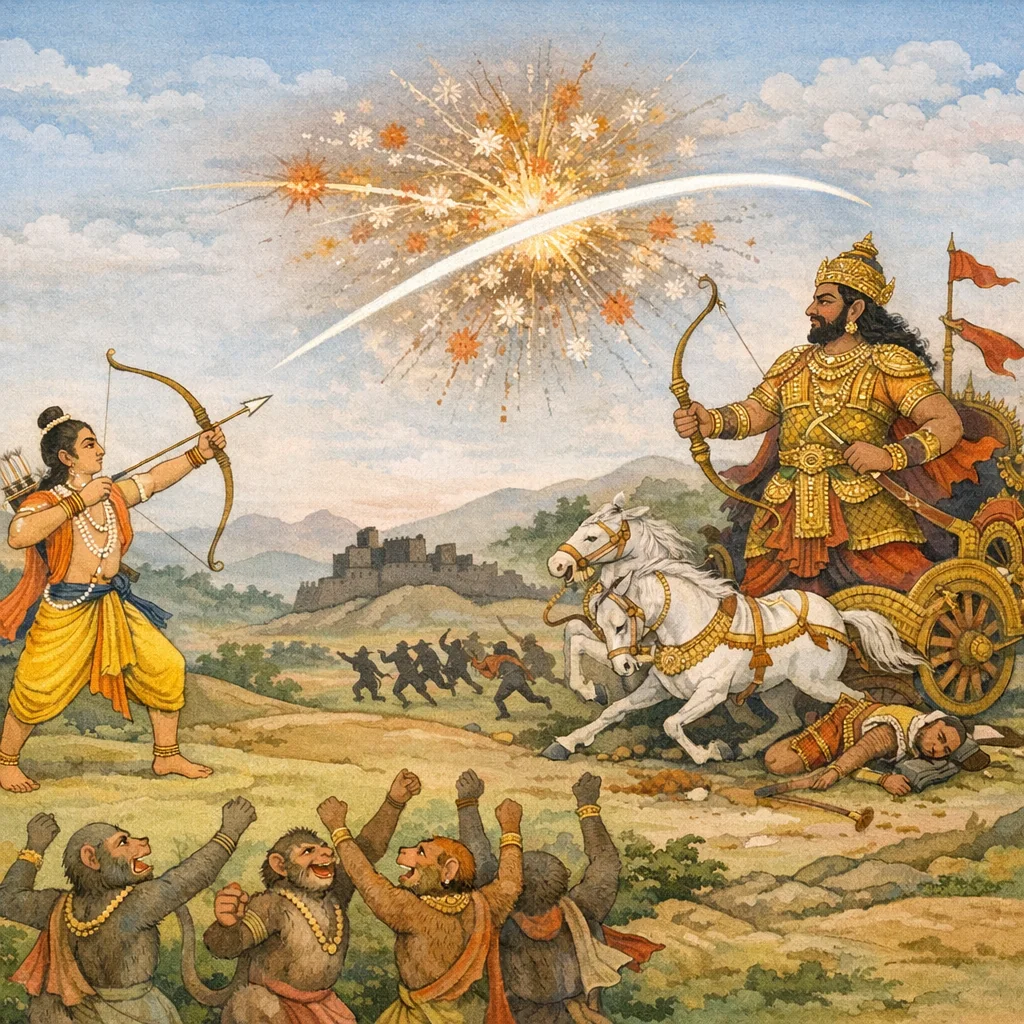
Sarga 71 introduces Atikāya—Rāvaṇa’s son, mountain-like and Brahmā-boon-protected—who enters the battlefield enraged after seeing the rākṣasa host and his kin struck down (6.71.1–3). Rāma observes the immense chariot-borne warrior from afar and queries Vibhīṣaṇa, who identifies Atikāya, recounts his lineage (son of Dhānyamālinī), his astravidyā, and the protective boon and armor that render him effectively invulnerable to ordinary weapons (6.71.10–36). Atikāya terrorizes the Vānara formations and challenges for a worthy duel; Lakṣmaṇa answers, and a formal exchange of boasts and ethical assertions frames valor as action rather than speech (6.71.37–64). The duel escalates through successive astras (Agni, Sūrya, Indra, Vāyu, Yama, Tvaṣṭṛ/Iṣīka), with arrows colliding in the sky and failing against Atikāya’s impenetrable kavaca (6.71.84–97). Lakṣmaṇa is briefly stunned by a serpent-like shaft but regains composure and dismantles Atikāya’s chariot elements (horses, charioteer, pole) (6.71.98–100). Vāyu then reveals the crucial tactical-theological constraint: only the Brāhma (Brahmā’s) weapon can break the boon-protected armor (6.71.102–103). Lakṣmaṇa invokes the Brāhma astra; the cosmos trembles as it is charged, and the missile, overriding Atikāya’s countermeasures, severs his crowned head (6.71.104–111). The surviving rākṣasas panic and flee toward Laṅkā, while the Vānara host celebrates Lakṣmaṇa, who returns swiftly to Rāma’s side (6.71.112–116).
Shlokas
Verse 1
स्वबलंव्यथितंदृष्टवातुमुलंरोमहर्षणम् ।भ्रातृ़ंश्चनिहतान् दृष्टवाशक्रतुल्यपराक्रमान् ।।।।पितृव्यौचापिसनृदृश्यसमरेसन्निघादितौ ।युद्धोन्मत्तं च मत्तं च भ्रातरौराक्षसर्षभौ ।।।।चुकोप च महातेजाब्रह्मदत्तवरोयुधि ।अतिकायोऽद्रिसङ्काशोदेवदानवदर्पहा ।।।।
Seeing his own forces shattered—amid a tumult that sent shudders through the body—and seeing his brothers, whose prowess was like Indra’s, lying slain; and seeing too his uncles, those bull-like chiefs among the Rakṣasas, cut down together in the battle—Yuddhonmatta and Matta, his two brothers—Atikāya, of great splendor, mountain-like in form, endowed with boons granted by Brahmā, and a crusher of the pride of Devas and Dānavas, blazed up in wrath on the battlefield.
Verse 2
स्वबलंव्यथितंदृष्टवातुमुलंरोमहर्षणम् ।भ्रातृ़ंश्चनिहतान् दृष्टवाशक्रतुल्यपराक्रमान् ।।6.71.1।।पितृव्यौचापिसनृदृश्यसमरेसन्निघादितौ ।युद्धोन्मत्तं च मत्तं च भ्रातरौराक्षसर्षभौ ।।6.71.2।।चुकोप च महातेजाब्रह्मदत्तवरोयुधि ।अतिकायोऽद्रिसङ्काशोदेवदानवदर्पहा ।।6.71.3।।
Seeing his own forces shattered—amid a tumult that sent shudders through the body—and seeing his brothers, whose prowess was like Indra’s, lying slain; and seeing too his uncles, those bull-like chiefs among the Rakṣasas, cut down together in the battle—Yuddhonmatta and Matta, his two brothers—Atikāya, of great splendor, mountain-like in form, endowed with boons granted by Brahmā, and a crusher of the pride of Devas and Dānavas, blazed up in wrath on the battlefield.
Verse 3
स्वबलंव्यथितंदृष्टवातुमुलंरोमहर्षणम् ।भ्रातृ़ंश्चनिहतान् दृष्टवाशक्रतुल्यपराक्रमान् ।।6.71.1।।पितृव्यौचापिसनृदृश्यसमरेसन्निघादितौ ।युद्धोन्मत्तं च मत्तं च भ्रातरौराक्षसर्षभौ ।।6.71.2।।चुकोप च महातेजाब्रह्मदत्तवरोयुधि ।अतिकायोऽद्रिसङ्काशोदेवदानवदर्पहा ।।6.71.3।।
Seeing his own forces shattered—amid a tumult that sent shudders through the body—and seeing his brothers, whose prowess was like Indra’s, lying slain; and seeing too his uncles, those bull-like chiefs among the Rakṣasas, cut down together in the battle—Yuddhonmatta and Matta, his two brothers—Atikāya, of great splendor, mountain-like in form, endowed with boons granted by Brahmā, and a crusher of the pride of Devas and Dānavas, blazed up in wrath on the battlefield.
Verse 4
स भास्करसहस्रस्यसङ्घातमिवभास्वरम् ।रथमास्थायशक्रारिरभिदुद्राववानरान् ।।।।
Crowned and blazing like the combined radiance of a thousand suns, the foe of Śakra mounted his chariot and charged straight at the Vānaras.
Verse 5
स विस्फार्यमहाचापंकिरीटीमृष्टकुण्डलः ।नामविश्रावयामासननाद च महास्वनम् ।।।।
Crowned and wearing polished earrings, he twanged his great bow, proclaimed his own name aloud, and let out a mighty roar.
Verse 6
तेनसिंहप्रणादेननामविश्रावणेन च ।ज्याशब्देन च भीमेनत्रासयामासवानरान् ।।।।
With that lion-like roar, with the proclamation of his name, and with the terrifying twang of his bowstring, he struck the Vānara hosts with fear.
Verse 7
तेदृष्टवादेहमाहात्म्यंकुम्भकर्णोऽयमुथतितः ।भयार्तावानरास्सर्वेसंश्रयन्तेपरस्परम् ।।।।
Seeing the sheer enormity of that body, the vānaras thought, “This is Kumbhakarṇa risen again,” and, stricken with fear, all clung to one another for support.
Verse 8
तेतस्यरूपमालोक्ययथाविष्टोस्त्रिविक्रमे ।भयाद्वानरयूधास्तेविद्रवन्तिततस्ततः ।।।।
Seeing his form—as though he were possessed by the Trivikrama might—those troops of Vānara warriors, in fear, scattered and fled in all directions.
Verse 9
तेऽतिकायंसमासाद्यवानरामूढचेतसः ।शरण्यंशरणंजग्मुर्लक्ष्मणाग्रजमाहवे ।।।।
Confronting Atikāya, the Vānara warriors grew bewildered; in the battle they went for refuge to Rāma, the elder brother of Lakṣmaṇa—the true protector.
Verse 10
तोऽतिकायंकाकुत्स्थोरथस्थंपर्वतोपमम् ।ददर्शधवनिनंदूराद्गर्जन्तंकालमेघवत् ।।।।
Then, the descendant of Kakutstha saw Atikaya from a distance. Standing upon his chariot, he resembled a mountain, wielding a bow and roaring like a thundercloud at the time of universal dissolution.
Verse 11
स तंदृष्टवामहात्मानंराघवस्तुविसिस्मिये ।वानरान् सान्त्वयित्वा च विभीषणमुवाच ह ।।।।
Seeing him—the great-souled one—Rāghava was filled with wonder. After reassuring the vānaras, he spoke to Vibhīṣaṇa.
Verse 12
कोऽसौपर्वतसङ्काशोधनुष्मान्हरिलोचनः ।युक्तेहयसहस्रेणविशालेस्यन्दनेस्थितः ।।।।
Who is that yellow-eyed warrior, mountain-like in stature, holding a bow, seated in a vast chariot drawn by a thousand horses?
Verse 13
य एषनिशितैश्शूलैस्सुतीक्णैःप्रासमुद्गरैः ।अर्चिष्मद्भिर्वृतोभातिभूतैरिवमहेश्वरः ।।।।
Who is that one who shines, surrounded by blazing, razor-sharp tridents, spears, and maces—like Maheśvara encircled by his attendant beings?
Verse 14
कालजिह्वाप्रकाशाभिर्यएषोऽतिविराजते ।आवृतोरथशक्तीभिर्विद्युद्भिरिवतोयदः ।।।।
Who is that one who blazes exceedingly, wrapped about with javelins that gleam like the tongues of Time—like a rain-cloud encircled by lightning?
Verse 15
धनूंषिचास्यसज्जानिहेमपृष्ठानिसर्वशः ।शोभयन्तिरथश्रेष्ठंशक्रचापमिवाम्बरम् ।।।।
And his ready bows—gold-backed on every side—adorn that excellent chariot, like Indra’s rainbow beautifying the sky.
Verse 16
क एषरक्षश्शार्दूलोरणभूमिविराजयन् ।अभ्येतिरथिनांश्रेष्ठोरथेनादित्यतेजसा ।।।।ध्वजशृङ्गप्रतिष्ठेनराहुणाभिविराजते ।सूर्यरमशिनिभैर्बाणैर्दिशो दश विराजयन् ।।।।
Who is this tiger among the rākṣasas, the foremost of chariot-warriors, advancing and lighting up the battlefield with a chariot radiant as the sun? His banner, fixed atop the flagstaff, gleams with a Rāhu emblem; and with arrows like sunbeams he makes the ten directions shine.
Verse 17
क एषरक्षश्शार्दूलोरणभूमिविराजयन् ।अभ्येतिरथिनांश्रेष्ठोरथेनादित्यतेजसा ।।6.71.16।।ध्वजशृङ्गप्रतिष्ठेनराहुणाभिविराजते ।सूर्यरमशिनिभैर्बाणैर्दिशो दश विराजयन् ।।6.71.17।।
His bow too shines—three-curved, thunderous like a cloud, gold-backed and ornamented—famed like the bow of Śatakratu (Indra).
Verse 18
त्रिणतंमेघसन्नादंहेमपृष्ठमलङ्कृतम् ।शतक्रतुधनुःप्रख्यंधनुश्चास्यविराजते ।।।।
His bow too shines—three-curved, thunderous like a cloud, gold-backed and ornamented—famed like the bow of Śatakratu (Indra).
Verse 19
स ध्वजस्सपताकश्चसानुकर्षोमहारथः ।चतुस्सादिसमायुक्तोमेघस्तनितानि ।।।।
That great chariot—with its standard and flag, and with its fittings—was equipped with four charioteers and rumbled like the thunder of clouds.
Verse 20
विंशतिर्दशचाष्टौ च तूण्योऽस्यरथमास्थिताः ।कार्मुकानि च भीमानिज्याश्चकाञ्चनपिङ्गळाः ।।।।
On his chariot were set twenty quivers; and ten fearsome bows; and eight bowstrings, tawny-golden in hue.
Verse 21
द्वौ च खडगौरथगतौपार्श्वस्थौपार्श्वशोभितौ ।चतुर्हस्तत्सरुयुतौव्यक्तहस्तदशायतौ ।।।।
And on the chariot were two swords, hung at the sides as ornaments—each furnished with a hilt, four cubits in measure, and clearly ten cubits in length.
Verse 22
रक्तगण्ठगुणोधीरोमहापर्वतसन्निभः ।कालःकालमहावक्त्रोमेघस्थइवभास्करः ।।।।
Wearing a red garland at his neck, steadfast and mountain-like in stature—terrible as Death, dark and vast-mouthed—he appeared like the sun obscured by clouds.
Verse 23
काञ्चनाङ्गदनद्धाभ्यांभूजाभ्यामेषशोभते ।शृङ्गाभ्यामिवतुङ्गाभ्यांहिमवान् पर्वतोत्तमः ।।।।
With both arms bound in golden armlets, he shone—like the lordly Himālaya with its two lofty peaks.
Verse 24
कुण्डलाभ्यांतुयस्यैतद्भतध्भातिशुभेक्ष ।पुनर्वस्वन्तरगतंपूर्णंभिंबमिवैंदवम् ।।।।
O fair-eyed one, his face shines between the two earrings like the full orb of the moon set amid the Punarvasu stars.
Verse 25
आचक्ष्वमेमहाबाहोत्वमेनंराक्षसोत्तमम् ।यंदृष्टवावानरास्सर्वेभयार्ताविद्रुतादिशः ।।।।
Tell me, O mighty-armed one, who this foremost of Rākṣasas is—on seeing whom all the Vānara hosts, stricken with fear, fled in every direction.
Verse 26
स पृष्टोराजपुत्रेणरामेणामिततेजसा ।आचचक्षेमहातेजारघवायविभीषणः ।।।।
Questioned by the prince Rama of boundless splendor, the mighty Vibhīṣaṇa then explained it to Rāghava.
Verse 27
दशग्रीवोमहातेजाराजावैश्रवणानुजः ।भीमकर्मामहोत्साहोरावणोराक्षसाधिपः ।।।।
Rāvaṇa—ten-necked, of great splendor—the king, younger brother of Vaiśravaṇa, doer of dreadful deeds and of immense enterprise, is the lord of the Rākṣasas.
Verse 28
तस्यासीद्वीर्यवान्पुत्रोरावणप्रतिमोरणे ।वृद्धसेवीश्रुतिधरस्सर्वास्त्रविदुषांवरः ।।।।
To him was born a valiant son, a match for Rāvaṇa in battle—one who served the elders, retained what he had heard, and was foremost among those skilled in every weapon.
Verse 29
अश्वपृष्ठेरथेनागेखडगेधनुषिकर्षणे ।भेदेसान्त्वे च दाने च नयेमन्त्रे च सम्मतः ।।।।
He was esteemed as proficient on horseback, in chariots and on elephants; skilled with sword and bow, and also adept in dissension, conciliation, gifts, policy, and counsel.
Verse 30
यस्यबाहूसमाश्रित्यलङ्कावसतिनिर्भया ।तनयंधान्यमालिन्याअतिकायमिमंविदुः ।।।।
Know him as Atikāya, the son of Dhānyamālinī—on whose arms Laṅkā, taking refuge, dwells without fear.
Verse 31
एतेनाराधितोब्रह्मोतपसाभावितात्मना ।अस्त्राणिचाप्यवाप्तानिरिपवश्चपराजिताः ।।।।
By austere penance and a disciplined spirit, he propitiated Brahmā; and he obtained celestial weapons—by which his foes were brought low.
Verse 32
सुरासुरैरवध्यत्वंदत्तमस्मैस्वयम्भुवा ।एतच्चकवचंदिव्यंरधश्चैषोऽरभास्वरः ।।।।
The Self-born (Brahmā) granted him invulnerability against gods and demons; and he also possesses this divine armor and a chariot radiant like the sun.
Verse 33
एतेनशतशोदेवादानवाश्चपराजिताः ।रक्षितानि च रक्षांसियक्षाश्चापिनिषूदिताः ।।।।
By him, hundreds of gods and Dānavas were defeated; the Rākṣasas were protected, and even the Yakṣas were slain.
Verse 34
वज्रंविष्टम्भितंयेनबाणैरिन्द्रस्यधीमतः ।पाशस्सलिलराजस्यरणेप्रतिहतस्तथा ।।।।एषोऽतिकायोबलवान्राक्षसानामथर्षभः ।रावणस्यतोधीमान्देवदानवदर्पहा ।।।।
With his arrows he checked the thunderbolt of wise Indra; and in battle he likewise repelled the noose of Varuṇa, lord of the waters.
Verse 35
वज्रंविष्टम्भितंयेनबाणैरिन्द्रस्यधीमतः ।पाशस्सलिलराजस्यरणेप्रतिहतस्तथा ।।6.71.34।।एषोऽतिकायोबलवान्राक्षसानामथर्षभः ।रावणस्यतोधीमान्देवदानवदर्पहा ।।6.71.35।।
This is Atikāya—mighty, a bull among the Rākṣasas—wise son of Rāvaṇa, who crushes the pride of gods and Dānavas.
Verse 36
तदस्मिन्क्रियतांयत्नःक्षिप्रंपुरुषपुंगव ।पुरावानरसैन्यानिक्ष्यंनयतिसायकैः ।।।।
Therefore, O best of men, act swiftly against him—before, with his arrows, he brings the monkey-host to ruin.
Verse 37
ततोतिकायोबलवान्प्रविश्यहरिवाहिनीम् ।विष्फारयामासधनुर्ननाद च पुनःपुनः ।।।।
Then mighty Atikāya entered the vānara ranks; he twanged his bow and roared again and again.
Verse 38
तंभीमवपुषंदृष्टवारथस्थंरथिनांवरम् ।अभिपेतुर्महात्मानोयेप्रधानावनौकसः ।।।।
Seeing him of dreadful form, stationed on his chariot—the foremost of chariot-warriors—the great-souled leading Vānaras rushed toward him.
Verse 39
कुमुदोद्विविदोमैन्दोनीलश्शरभएव च ।पादपैर्गिरिशृङ्गैश्चयुगपत्समभिद्रवन् ।।।।
Kumuda, Dvivida, Mainda, Nīla, and Śarabha too—together charged at him at once, wielding trees and mountain-peaks.
Verse 40
तेषांवृक्षांश्चशैलांश्चशरैःकाञ्चनभूषणैः ।अतिकायोमहातेजाश्चिच्छेदास्त्रविदांवरः ।।।।
Atikāya—radiant with great prowess, foremost among weapon-knowers—shattered with gold-adorned arrows the trees and rocks hurled by them.
Verse 41
तांश्चैवसर्वान् स हरीन् शरैस्सर्वायसैर्बली ।विव्याथाभिमुखस्सङ्ख्येभीमकायोनिशाचर ।।।।
That powerful night-roamer of dreadful form, facing them in the thick of battle, pierced all those Vānaras with iron arrows.
Verse 42
तेऽर्दितांबाणवर्षेणभिन्नगात्राःप्लवङ्गमाः ।न शेकुरतिकायस्यप्रतिकर्तुंमहारणे ।।।।
Pressed hard by Atikāya’s rain of arrows, the Plavaṅgamas—bodies torn and wounded—could not mount any effective resistance in that great battle.
Verse 43
तत् त्सैन्यंहरिवीराणांत्रासयामासराक्षसः ।मृगयूथमिवक्रुद्धोहरिर्यौवनदर्पितः ।।।।
That rākṣasa terrified the host of Vānara heroes—like an enraged lion, proud in youthful vigor, scattering a herd of deer.
Verse 44
सराक्षसेन्द्रोहरिसैन्यमध्येनायुध्यमानंनिजघानकञ्चित् ।उपेत्यरामंसधम: कलापी स गर्वितंवाक्यमिदंबभाषे ।।।।
In the midst of the Vānara host, the lord of rākṣasas did not strike down anyone who was not fighting; then, bow in hand and quiver on his back, he approached Rāma and spoke these proud words.
Verse 45
रथेस्थितोहंशरचापपाणिर्नप्राकृतंकञ्चनयोधयामि ।यस्यास्तिकश्चिद्व्यवसाययुक्तोददातुमेक्षिप्रमिहाद्ययुद्धम् ।।।।
"Seated in my chariot with bow and arrows in hand, I do not fight with ordinary warriors. If anyone here is resolved and capable, let him quickly grant me battle today."
Verse 46
तत्तस्यवाक्यंब्रुवतोनिशम्यचुकोपसौमित्रिरमित्रहन्ता ।अमृष्यमाणश्चसमुत्पपातजग्राहचापं च ततस्स्मयित्वा ।।।।
Hearing him speak those words, Saumitrī—the slayer of foes—grew angry; unable to endure the arrogance, he sprang up and, smiling, took up his bow.
Verse 47
क्रुद्धस्सौमित्रिरुत्पत्यतूणादाक्षिप्यसायकम् ।पुरस्तादतिकायस्यविचकर्षमहद्धनुः ।।।।
Furious, Saumitrī sprang up, drew an arrow from the quiver, and, standing before Atikāya, pulled back his great bow to the full.
Verse 48
पूरयन् स महींशैलानाकाशंसागरंदिशः ।ज्याशब्दोलक्ष्मणस्योग्रस्त्रासयन् रजनीचरान् ।।।।
The terrible twang of Lakṣmaṇa’s bow filled earth and mountains, sky and ocean, and all directions—striking fear into the night-roamers.
Verse 49
सौमित्रेश्चापनिर्घोषंश्रुत्वाप्रतिभयंतदा ।विसिष्मियेमहातेजाराक्षसेन्द्रात्मजोबली ।।।।
Then the mighty, radiant son of the lord of the Rākṣasas, hearing the thunderous twang of Saumitri’s bow, was himself struck with fear—and stood astonished.
Verse 50
अथातिकायःकुपितोदृष्टवालक्ष्मणमुत्थितम् ।आदायनिशितंबाणमिदंवचनमब्रवीत् ।।।।
Then Atikāya, angered on seeing Lakṣmaṇa rise to meet him, took up a sharp arrow and spoke these words.
Verse 51
बालस्त्वमसिसौमित्रेविक्रमेष्वविचक्षणः ।गच्छकिंकालसदृशंमांयोधयतुमिच्छसि ।।।।
“Saumitri, you are young; though spirited, you lack discernment in deeds of prowess. Go—why do you wish to fight me, who am like Death itself?”
Verse 52
न हिमद्बाहुसृष्टानामस्त्राणाहिमवानपि ।सोढुमुत्सहतेवेगमन्तरिक्षमथोमही ।।।।
“Indeed, even Himavān cannot endure the onrush of the weapons loosed by my arm—nor can the midspace, nor even the earth bear their force.”
Verse 53
सुखप्रसुप्तंकालाग्निंविबोधयितुमिच्छसि ।न्यस्यचापंनिवर्तस्वमाप्राणान् जहिमद्गतः ।।।।
“Do you wish to rouse the fire of dissolution that lies asleep in ease? Lay down your bow and turn back—do not lose your life by coming against me.”
Verse 54
अथवात्वंप्रतिष्टब्धो न निवर्तितुमिच्छसि ।तिष्ठप्राणान् परित्यज्यगमिष्यसियमक्ष्यम् ।।।।
“Or if, obstinate, you refuse to turn back—then stand your ground; giving up your life, you will go to Yama’s realm.”
Verse 55
पश्यमेनिशितान्बाणानरिदर्पनिषूदनान् ।ईश्वरायुधसङ्काशांस्तप्तकाञ्चनभूषणान् ।।।।
“Look at my keen arrows—destroyers of an enemy’s pride—resembling the weapons of the Lord, adorned with ornaments of heated gold.”
Verse 56
एषतेसर्पसंकाशोबाणःपास्यतिशोणितम् ।मृगराजइवक्रुद्धोनागराजस्यशोणितम् ।।।।इत्येवमुक्त्वासंक्रुद्धश्शरंधनुषिसंदधे ।
“This arrow of mine, serpent-like, will drink your blood—just as an enraged lion drinks the blood of a kingly elephant.” Saying so, furious, he set the arrow upon his bow.
Verse 57
श्रुत्वातिकायस्यवचस्सरोषंसगर्वितंसम्यतिराजपुत्रः ।स सञ्चुकोपातिबलोमनस्वीरुवाचवाक्यं च ततोमहार्थम् ।।।।
Hearing Atikāya’s wrathful and prideful words on the battlefield, the prince—strong and high-minded—grew enraged in turn and then spoke a reply of great import.
Verse 58
न वाक्यमात्रेणभवान् प्रधानो न कत्थनात्सत्पुरुषाभवन्ति ।मयिस्थितेधन्विनिबाणपाणौनिदर्शयस्वात्मबलंदुरात्मन् ।।।।
You are evil-minded: mere words do not make one a leader, nor does boasting make one a good man. Since I stand here with bow in hand and arrows ready, show your own strength.
Verse 59
कर्मणासूचयात्मानं न विकत्थितुमर्हसि ।पौरुषेणतुयोयुक्तस्सतुशूरइतिस्मृतः ।।।।
Make yourself known by deeds; you ought not to brag. The one who is truly endowed with prowess—he alone is remembered as a hero.
Verse 60
सर्वायुधसमायुक्तोधन्वीत्वंरथमास्थितः ।शरैर्वायदिवाप्यस्त्रैर्दर्शयस्वपराक्रमम् ।।।।
Though you sit in your chariot as an archer equipped with every weapon, that display alone proves nothing. By arrows—or by any weapons—show your valor.
Verse 61
ततश्शिरस्तेनिशितैःपातयिष्याम्यहंशरैः ।मारुतःकालसम्पक्वंवृन्तात्ताळफलंयथा ।।।।
Then, with keen arrows, I shall bring down your head—just as the wind knocks a time-ripened palm fruit from its stalk.
Verse 62
अद्यतेमामकाबाणास्तप्तकाञ्चनभूषणाः ।पास्यन्तिरुधिरंगात्राद्बाणशल्यान्तरोत्थितम् ।।।।
Today my arrows, adorned with gleaming gold, will drink the blood that wells up from your body through the wounds made by their barbed points.
Verse 63
बालोऽयमितिविज्ञाय न मावज्ञातुमर्हसि ।बालोवायदिवावृद्धोमृत्युंजानीहिसंयुगे ।।।।बालेनविष्णुनालोकास्त्रयःक्रान्तास्त्रिविक्रमैः ।
Do not despise me thinking, ‘He is only a youth.’ Whether one is young or old, know this: in battle I am death. For even as a youthful Viṣṇu, in his Trivikrama form, strode across the three worlds in three steps.
Verse 64
लक्ष्मणस्यवचश्श्रुत्वाहेतुमत्परमार्थवत् ।।।।अतिकायःप्रचुक्रोधबाणंचोत्तममाददे ।
Hearing Lakṣmaṇa’s words—well-reasoned and true in their import—Atikāya flared up in anger and took up an excellent arrow.
Verse 65
ततोविद्याधराभूतादेवादैत्यामहर्षयः ।।।।गुह्यकाश्चमहात्मानस्तद्युद्धंद्रष्टुमागमन् ।
Then Vidyādharas, Bhūtas, Devas, Daityas, great sages, and noble Guhyakas came to witness that battle.
Verse 66
तोऽतिकायःकुपितश्चापमारोप्यसायकम् ।।।।लक्ष्मणायप्रचिक्षेपसङ्क्षिपन्निवचाम्बरम् ।
Then Atikāya, enraged, set the arrow upon his bow and hurled it at Lakṣmaṇa, as though he were cleaving the very sky.
Verse 67
तमापतन्तंनिशितंशरमाशीविषोपमम् ।।।।अर्धचन्द्रेणचिच्छेदलक्ष्मणःपरवीरहा ।
Lakṣmaṇa—slayer of hostile champions—cut down the sharp, serpent-venom-like arrow as it flew toward him, using a half-moon–shaped shaft.
Verse 68
तंनिकृत्तंशरंदृष्टवाकृत्तभोगमिवोरगम् ।।।।अतिकायोभृशंक्रुद्धःपञ्चबाणान् समाददे ।
Seeing his arrow cut apart—like a serpent with its coils severed—Atikāya flared up in fierce anger and took up five arrows.
Verse 69
तान्शरान् सम्प्रचिक्षेपलक्ष्मणायनिशाचरः ।।।।तानप्राप्तान् शरैस्तीक्ष्णैश्चिच्छेदभरतानुजः ।
The night-roaming rākṣasa hurled those arrows at Lakṣmaṇa; but Bharata’s younger brother shattered them with sharp shafts before they could reach him.
Verse 70
सतान् छित्त्वाशितैर्बाणैर्लक्ष्मणःपरवीरहा ।।।।आददेनिशितंबाणंज्वलन्तमिवतेजसा ।
After splitting those missiles with keen arrows, Lakṣmaṇa—crusher of enemy champions—took up another sharp shaft, blazing as if with its own radiance.
Verse 71
तमादायधनुश्श्रेष्ठेयोजयामासलक्ष्मणः ।।।।विचकर्ष च वेगेनविससर्ज च वीर्यवान् ।
Taking that arrow, valiant Lakṣmaṇa set it to his excellent bow, drew it back with speed, and released it.
Verse 72
पूर्णायतविसृषेनशरेणनतपर्वणा ।।।।ललाटेराक्षसश्रेष्ठमाजघान स वीर्यवान् ।
With an arrow loosed at full draw—its joints bent along the curve—he, the heroic one, struck the foremost of the rākṣasas on the forehead.
Verse 73
सललाटेशरोमग्नस्तस्यभीमस्यरक्षसः ।।।।ददृशेशोणितेनाक्तःपन्नगेन्द्रइवाचले ।
The arrow sank into the forehead of that dreadful rākṣasa; smeared with blood, it looked like a lordly serpent upon a mountain.
Verse 74
राक्षसःप्रचकम्पे च लक्ष्मणेषुप्रपीडितः ।।।।रुद्रबाणहतंघोरंयथात्रिपुरगोपुरम् ।
Pressed hard by Lakṣmaṇa’s arrows, the rākṣasa shook violently—dreadful as the gate-tower of Tripura when struck by Rudra’s missile.
Verse 75
चिन्तयामासचाश्वास्यविमृश्य च महाबलः ।।।।साधुबाणनिपातेनश्लाघनीयोऽसिमेरिपुः ।
Regaining his breath, the mighty one pondered and reflected: “Well done—by this fall of arrows, you are an enemy worthy of praise to me.”
Verse 76
विधायैवंविनम्यास्यंनियम्य च भुजावुभौ ।।।।स रथोपस्थमास्थायरथेनप्रचचार ह ।
Having done so, lowering his face and setting both shoulders firm, he took his place on the rear of the chariot and drove forward.
Verse 77
कंत्रीन्पञ्चसप्तेतिसायन्राक्षसर्षभः ।।।।आददेसन्दधेचापिविचकर्षोत्ससर्ज च ।
That bull among the Rākṣasas took arrows—one, then three, then five, then seven—set them on his bow, drew, and released them.
Verse 78
तेबाणाःकालसङ्काशाराक्षसेन्द्रधुनुश्च्युताः ।।।।हेमपुङ्खारविप्रख्याश्चक्रुर्दीप्तमिवाम्बरम् ।
Those arrows, like Time itself, shot from the lordly Rākṣasa’s bow—gold-feathered and sun-bright—made the sky seem as though it were aflame.
Verse 79
तस्तान्राक्षसोत्सृष्टान्शरौघान्राघवानुजः ।।।।असम्ब्रान्तःप्रचिच्छेदनिशितैर्बहुभिश्शरैः ।
Then Rāghava’s younger brother, unshaken, cut down those torrents of arrows shot by the Rākṣasa with many keen shafts of his own.
Verse 80
तान् शरान्युधिसम्प्रेक्ष्यनिकृत्तान्रावणात्मजः ।।।।चुकोपत्रिदशेन्द्रारिर्जग्राहनिशितंशरम् ।
Seeing in battle that those arrows had been cut down, Rāvaṇa’s son—Indra’s foe—grew enraged and took up another sharp shaft.
Verse 81
ससन्धायमहातेजास्तंबाणंसहसोत्सृजत् ।।।।तेनस्सौमित्रिमायान्तमाजघानस्तनान्तरे ।
That mighty one set the arrow and released it with force; with it he struck advancing Saumitri between the breasts.
Verse 82
अतिकायेनसौमित्रिस्ताडितोयुधिवक्षसि ।।।।सुस्रावरुधिरंतीव्रंमदंमत्तइवद्विपः ।
Struck on the chest in battle by Atikāya, Saumitri’s blood flowed swiftly—like the ichor of a rutting elephant.
Verse 83
सचकारतदात्मानंविशल्यंसहसाविभुः ।।।।जग्राह च शरंतीक्ष्णमस्त्रेणापिचसन्दधे ।
Then the mighty one quickly made himself free of the barb: he seized the sharp arrow and, by a weapon-spell as well, set himself to respond.
Verse 84
आग्नेयेनतदाऽस्त्रेणयोजयामाससायकम् ।।।।स जज्वालतदाबाणोधनुष्यस्यमहात्मनः ।
Then, invoking the Agni-astra, he empowered the arrow; and at once the great-souled warrior’s shaft on the bow blazed.
Verse 85
अतिकायोतितेजस्वीसौरमस्त्रंसमादधे ।।।।तेनबाणंभुजङ्गाभंहेमपुङ्खमयोजयत् ।
Atikāya, blazing with energy, took up the solar missile; and with it he set an arrow—serpent-like in form, and fitted with golden feathers—upon his bow.
Verse 86
तदस्त्रंज्वलितंघोरंलक्ष्मणश्शरमाहितम् ।।।।अतिकायायचिक्षेपकालदण्डमिवान्तकः ।
Lakṣmaṇa, having set that dreadful, blazing missile upon an arrow, hurled it at Atikāya—like Death himself casting down the rod of Time.
Verse 87
आग्नेयेनाभिसंयुक्तंदृष्टवाबाणंनिशाचरः ।।।।उत्ससर्जतदाबाणंदीप्तंसूर्यास्त्रयोजितम् ।
Seeing the arrow empowered by the fire-missile, the night-ranging warrior then released a blazing arrow, charged with the solar astra.
Verse 88
तावुभावम्बरेबाणावन्योन्यमभिजघ्नतुः ।।।।तेजसासंप्रदीप्ताग्रौक्रुद्धाविवभुजंगमौ ।
High in the sky, those two arrows struck one another, their tips blazing with radiance—like two enraged serpents clashing.
Verse 89
तावन्योन्यंविनिर्दह्यपेततुर्धरणीतले ।।।।निरर्चिषौभस्मकृतौ न भ्राजेतेशरोत्तमौ ।तावुभौदीप्यमानौस्म न भ्राजेतेमहीतले ।।।।
Burning each other away, the two arrows fell to the earth; their flames quenched, reduced to ash, those finest shafts no longer shone. Though they had blazed before, on the ground they did not gleam.
Verse 90
तावन्योन्यंविनिर्दह्यपेततुर्धरणीतले ।।6.71.89।।निरर्चिषौभस्मकृतौ न भ्राजेतेशरोत्तमौ ।तावुभौदीप्यमानौस्म न भ्राजेतेमहीतले ।।6.71.90।।
Burning each other away, the two arrows fell to the earth; their flames quenched, reduced to ash, those finest shafts no longer shone. Though they had blazed before, on the ground they did not gleam.
Verse 91
ततोऽतिकायस्सङ्कृद्धस्त्वस्त्रमैषीकमुत्सृजत् ।तत्प्रचिच्छेदसौमित्रिरस्त्रमैन्द्रेणवीर्यवान् ।।।।
Then Atikāya, inflamed with anger, discharged the Aiṣīka missile, charged through Tvaṣṭṛ; but the valiant Saumitrī (Lakṣmaṇa) cut it down with an Indra-charged weapon.
Verse 92
ऐषीकंनिहतंदृष्टवारुषितोरावणात्मजः ।याम्येनार्स्तेणसङ्कृद्धोयोजयामाससायकम् ।।।।
Seeing the Aiṣīka missile destroyed, Rāvaṇa’s son grew furious; in anger he yoked his arrow with the Yāma (Yama-governed) weapon-charge.
Verse 93
ततस्तदस्त्रंचिक्षेपलक्ष्मणायनिशाचरः ।वायव्येनतदस्त्रेणनिजघान स लक्ष्मणः ।।।।
Then the night-ranging warrior hurled that missile at Lakṣmaṇa; and Lakṣmaṇa struck it down with the Vāyu-governed (vāyavya) weapon-charge.
Verse 94
अथैनंशरधाराभिर्धाराभिरिवतोयदः ।अभ्यवर्षत्सुसङ्कृद्धोलक्ष्मणोरावणात्मजम् ।।।।
Then Lakṣmaṇa, fiercely enraged, showered Rāvaṇa’s son with streams of arrows, as a rain-cloud pours down torrents of water.
Verse 95
तेऽतिकायंसमासाद्यकवचेवज्रभूषिते ।भग्नाग्रशल्यास्सहसापेतुर्बाणामहीतले ।।।।
But when those arrows struck Atikāya’s armor—hard as diamond—their tips shattered at once, and the arrows fell to the ground.
Verse 96
तान्मोघानभिसम्प्रेक्ष्यलक्ष्मणःपरवीरहा ।अभ्यवर्षन्महेषूणांसहस्रेणमहायशाः ।।।।
Seeing those arrows rendered futile, Lakṣmaṇa—slayer of enemy champions, famed for his prowess—rained down a thousand mighty shafts.
Verse 97
स वृष्यमाणोबाणौघैरतिकायोमहाबलः ।अवध्यकवचस्सङ्ख्येराक्षसोनैवविव्यथे ।।।।
Though deluged by a flood of arrows, the mighty rākṣasa Atikāya—armored beyond piercing—did not flinch in the press of battle.
Verse 98
शरंचाशीविषाकारंलक्ष्मणायव्यपासृजत् ।स तेनविद्धस्सौमित्रिर्मर्मदेशेशरेण ह ।।।।मुहूर्तमात्रंनिस्संज्ञोह्यभवच्छत्रुतापनः ।
Atikāya loosed at Lakṣmaṇa an arrow like a venomous serpent. Struck by that shaft in a vital spot, Saumitrī—scorcher of foes—lost consciousness for a brief while.
Verse 99
ततःस्संज्ञामुपालभ्यचतुर्भिस्सायकोत्तमैः ।।।।निजघानहयान्सङ्ख्येसारथिं च महाबलः ।ध्वजस्योन्मथनंकृत्वाशरवर्षैररिन्दमः ।।।।
Then, regaining consciousness, the mighty subduer of foes struck down in battle the horses and the charioteer with four excellent arrows; and with a rain of shafts he also shattered the chariot’s banner-staff.
Verse 100
ततःस्संज्ञामुपालभ्यचतुर्भिस्सायकोत्तमैः ।।6.71.99।।निजघानहयान्सङ्ख्येसारथिं च महाबलः ।ध्वजस्योन्मथनंकृत्वाशरवर्षैररिन्दमः ।।6.71.100।।
Then the mighty subduer of enemies, regaining consciousness and rising again, shattered the chariot’s standard/pole with a rain of arrows; and on the battlefield he struck down the horses and the charioteer with four excellent shafts.
Verse 101
असम्भ्रान्तस्ससौमित्रिस्तान्शरानभिलक्षितान् ।मुमोचलक्ष्मणोबाणान्वधार्थंतस्यरक्षसः ।।।।
That son of Sumitra, Lakshmana, remaining unagitated and composed, released those well-aimed arrows for the purpose of slaying that demon.
Verse 102
न शशाकरुजंकर्तुंयुधितस्यनरोत्तमः ।अथैनमभ्युपागम्यवायुर्वाक्यमुवाच ह ।।।।
The best among men [Lakshmana] was unable to cause any injury to him [Atikaya] in the battle. Then, the Wind-god [Vayu] approached him and spoke these words.
Verse 103
ब्रह्मदत्तवरोह्येषअवध्यकवचावृतः ।ब्राह्मेणास्त्रेणभ्निथ्येनमेषवध्योहिनान्यथा ।।।।अवध्यएषह्यन्येषामस्त्राणांकवचीबली ।
This one has a boon granted by Brahmā and is covered in an inviolable armor. Strike him with the Brahmā-weapon—only then can he be slain, not otherwise. For, being armored and mighty, he is invulnerable to all other weapons.
Verse 104
ततस्तुवायोर्वचनंनिशम्यसौमित्रिरिन्द्रप्रतिमानवीर्यः ।समाददेबाणममोघवेगंतद्ब्राह्ममस्त्रंसहसानियोज्य ।।।।
Then Saumitra—whose prowess was like Indra’s—having heard the words of Vāyu, swiftly set the Brahmā-weapon in action and took up an arrow of unfailing, irresistible speed.
Verse 105
नियुज्यमानेसौमित्रिणाबाणवरेशिताग्रे ।दिशश्चचन्द्रर्कमहाग्रहाश्चनभश्चतत्रासचचालचोर्वी ।।।।
As Saumitrī set in motion that foremost arrow with its razor-sharp point, the directions trembled; the moon, the sun, and the great planets, the very sky, and the earth too were struck with fear and shook.
Verse 106
तंब्रह्मणोऽस्त्रेणनियुज्यचापेशरंसुपुङ्खंयमदूतकल्पम् ।सौमित्रिरिन्द्रारिसुतस्यतस्यससर्जबाणंयुधिवज्रकल्पम् ।।।।
Stringing onto his bow that well-feathered arrow—charged with Brahmā’s weapon and like a messenger of Death—Saumitri, in the thick of battle, released that thunderbolt-like shaft at him, the son of Indra’s enemy (Atikāya).
Verse 107
तंलक्ष्मणोत्सृष्टममोघवेगंसमापतन्तंज्यलनप्रकाशम् ।सुपर्णवज्रोत्तमचित्रपुङ्खंतदाऽतिकायस्समरेददर्श ।।।।
Then Atikāya, on the battlefield, saw that arrow released by Lakṣmaṇa—unerring in speed, rushing straight at him, blazing like fire, and fitted with splendid, variegated feathers like Garuḍa’s wings.
Verse 108
तंप्रेक्षमाणस्सहसाऽतिकायोजघानबाणैर्निशितैरनेकैः ।स सायकस्तस्यसुपर्णवेगस्तदातिकायस्यजगामपार्श्वम् ।।।।
As Atikāya watched, Lakṣmaṇa suddenly struck him with many keen arrows. One shaft, swift as Garuḍa, sped on and reached Atikāya’s side.
Verse 109
तमागतंप्रेक्ष्यतदातिकायोबाणंप्रदीप्तान्तककालकल्पम् ।जघानक्त्यृष्टिगदाकुठारैशूलैर्हुलैश्चाप्यविपन्नचेता ।।।।
Seeing that arrow rushing toward him—blazing like Death and Time—Atikāya, undaunted, struck it down with javelins, spears, maces, axes, tridents, and even with other missiles.
Verse 110
तान्यायुधान्यद्भुतविग्रहाणिमोघानिकृत्वा स शरोऽग्निदीप्तः ।प्रगृह्यतस्यैवकिरीटजुष्टम् ततोऽतिकायस्यशिरोजहार ।।।।
Making those wondrously formed weapons futile, that arrow—blazing like fire—then seized and carried off Atikāya’s head, adorned with its crown.
Verse 111
तछचिरस्सशिरस्त्राणंलक्ष्मणेषुप्रपीडितम् ।पपातसहसाभूमौशृङ्गंहिमवतोयथा ।।।।
Crushed by Lakṣmaṇa’s arrows, that head—still bearing its head-gear—fell suddenly to the ground like a peak of Himavat.
Verse 112
तंभूमौनिपतितंदृष्टवाविक्षिप्तभूषणम्बभूवुर्व्यथितास्सर्वेहतशेषानिशाचराः ।।।।
Seeing him fallen on the ground, with ornaments scattered, all the surviving rākṣasas were shaken with distress.
Verse 113
तेविषण्णमुखादीनाःप्रहारजनितश्रमाः ।विनेदुरुच्चैर्बहवस्सहसाविस्वरैस्स्वरैः ।।।।
With faces cast down and spirits broken, wearied by blows, many of them suddenly cried out aloud in harsh, discordant voices.
Verse 114
ततस्तेत्वरितंयातानिरपेक्षानिशाचराः ।पुरीमभिमुखाभीताद्रवन्तोनायकेहते ।।।।
Then, their leader slain, the frightened rākṣasas—heedless and in haste—ran toward the city of Laṅkā.
Verse 115
प्रहर्षयुक्ताबहवस्तुवानराःप्रबुद्दपद्मप्रतिमाननास्तदा ।अपूजयन्लक्ष्मणविष्टभागिनंहतेरिपौभीमबलेदुरासदे ।।।।
Then many vānaras, filled with delight, their faces like lotus-blooms, honored Lakṣmaṇa—now gladdened—because the formidable, unapproachable enemy of dreadful might had been slain.
Verse 116
अतिबलमतिकायमभ्रकल्पंयुधिविनिपात्य स लक्ष्मणःप्रहृष्टः ।त्वरितमथतदा स रामपार्श्वंकपिनिवहैश्चसुपूजितोजगाम ।।।।
Having felled in battle the exceedingly strong Atikāya, cloud-like in mass, Lakṣmaṇa—rejoicing and duly honored by hosts of vānaras—then hastened to Rama’s side.
Frequently Asked Questions
The chapter presents a means-and-ends constraint: Atikāya is protected by a Brahmā-granted boon and unbreakable armor, so ordinary valor and conventional weapons are insufficient; dharma-yuddha here requires selecting the precise sanctioned means (Brāhma astra) rather than escalating indiscriminately.
Efficacy in righteous action depends on discriminative knowledge (viveka) and guidance: Lakṣmaṇa’s courage is necessary but must be paired with correct upāya. Vāyu’s counsel illustrates that even the best warrior must align effort with the governing law of boons/astravidyā to restore moral and tactical order.
The action is set on the Laṅkā battlefield with prominent war-culture markers: the vast chariot drawn by a thousand horses, the Rāhu emblem on the standard, and the ritualized invocation of named divine astras—features that map the epic’s martial material culture and its cosmological weapon-theology.