Sarga 107
आदित्यहृदयम् (Aditya Hridayam Upadeśa — Agastya’s Instruction to Rāma)
युद्धकाण्ड
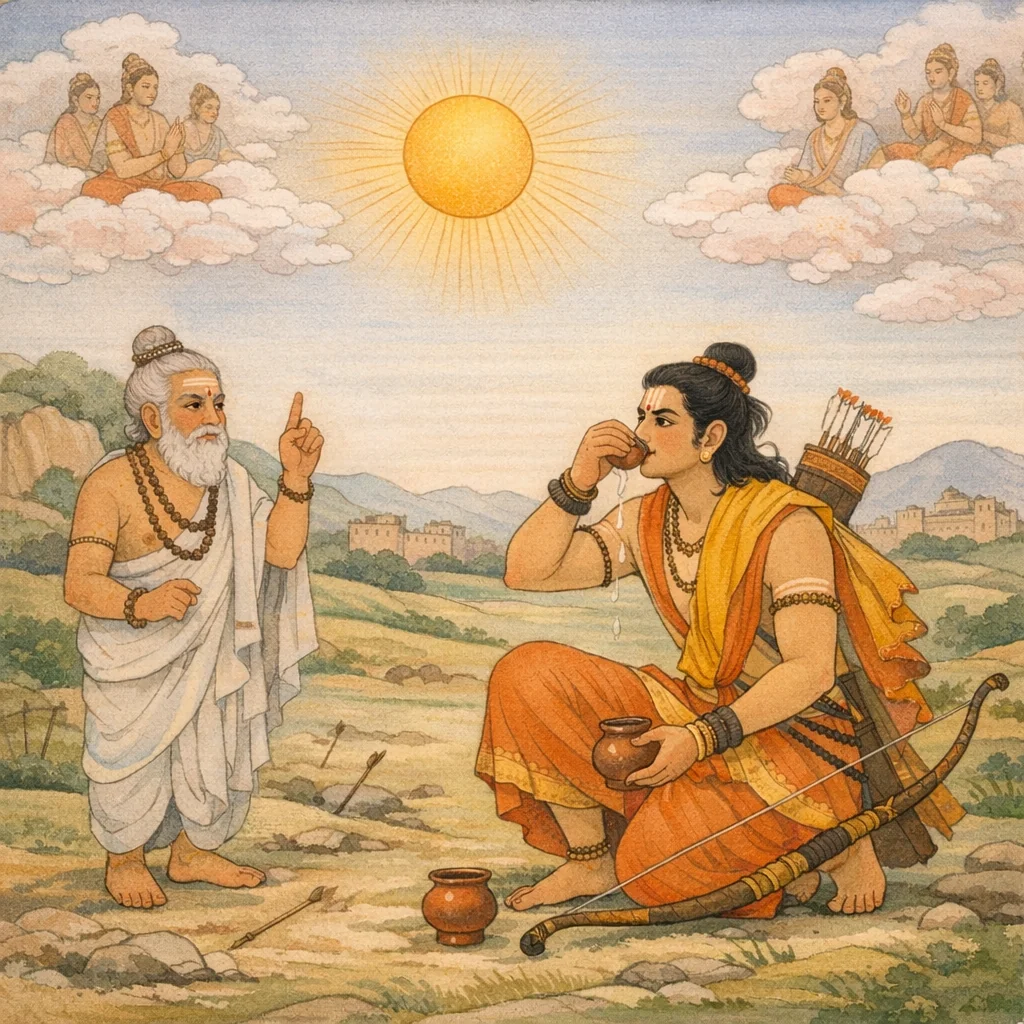
Sarga 107 situates Rāma on the battlefield, momentarily burdened by the intensity of the conflict as Rāvaṇa stands prepared before him. The r̥ṣi Agastya arrives with assembled deities to witness the decisive encounter and offers an “eternal secret” (guhyaṃ sanātanam): the Aditya-hṛdaya hymn. The discourse frames Sūrya/Āditya as cosmic regulator and the inner principle sustaining gods, beings, and sacrificial order—creator and destroyer, dispeller of darkness and cold, lord of luminaries, and the source and fruit of Vedic rites. Agastya prescribes concentrated worship and thrice-daily recitation as a means to dissolve grief, remove anxiety, and secure victory. Rāma performs ācamana, contemplates Āditya, chants the hymn, regains clarity and delight, takes up his bow, and advances with renewed determination to slay Rāvaṇa. The sarga closes with the Sun-god’s approving urgency, signaling imminent success in the war.
Shlokas
Verse 1
ततोयुद्धपरिश्रान्तंसमरेचिन्तयास्थितम् ।रावणंचाग्रतोदृष्टवायुद्धायसमुपस्थितम् ।।6.107.1।।दैवतैश्चसमागम्यद्रष्टुमभ्यागतोरणम् ।उपागम्याब्रवीद्राममगस्त्योभगवान् ऋषिः ।।6.107.2।।
Then, seeing Rāma—wearied by battle—standing in the midst of combat and reflecting, and seeing Rāvaṇa stationed before him ready for war, the venerable sage Agastya arrived together with the gods to witness the battle; approaching, he spoke to Rāma.
Verse 2
ततोयुद्धपरिश्रान्तंसमरेचिन्तयास्थितम् ।रावणंचाग्रतोदृष्टवायुद्धायसमुपस्थितम् ।।6.107.1।।दैवतैश्चसमागम्यद्रष्टुमभ्यागतोरणम् ।उपागम्याब्रवीद्राममगस्त्योभगवान् ऋषिः ।।6.107.2।।
Then, seeing Rāma—wearied by battle, standing in the midst of war, intent in thought—and seeing Rāvaṇa before him, ready for combat, the blessed sage Agastya arrived with the gods to witness the battle; approaching, he spoke to Rāma.
Verse 3
राम राम महाबाहो शृणुगुह्यंसनातनम् ।येनसर्वानरीस्वत्ससमरेविजयिष्यसे ।।6.107.3।।
“Rāma, O mighty-armed one—listen, dear child, to this ancient and secret teaching, by which you will conquer all enemies in battle.”
Verse 4
आदित्यहृदयंपुण्यंसर्वशत्रुविनाशनम् ।जयावहंजपेन्नित्यमक्षय्यंपरमंशिवम् ।।6.107.4।।सर्वमङ्गलमङ्गल्यंसर्वपापप्रणाशनम् ।चिन्ताशोकप्रशमनमायुर्वर्धनमुत्तमम् ।।6.107.5।।
“This holy ‘Heart of the Sun’ hymn destroys every enemy. Recite it always: it brings victory, is unfailing, and supremely auspicious. It is the best among blessings, it destroys sin, calms anxiety and grief, and increases one’s life and strength.”
Verse 5
आदित्यहृदयंपुण्यंसर्वशत्रुविनाशनम् ।जयावहंजपेन्नित्यमक्षय्यंपरमंशिवम् ।।6.107.4।।सर्वमङ्गलमङ्गल्यंसर्वपापप्रणाशनम् ।चिन्ताशोकप्रशमनमायुर्वर्धनमुत्तमम् ।।6.107.5।।
“This holy ‘Heart of the Sun’ hymn destroys every enemy. Recite it always: it brings victory, is unfailing, and supremely auspicious. It is the best among blessings, it destroys sin, calms anxiety and grief, and increases one’s life and strength.”
Verse 6
रस्मीमन्तंसमुद्यन्तंदेवासुरनमस्कृतम् ।पूजयस्वविवस्त्वन्तंभास्करंभुवनेश्वरम् ।।6.107.6।।
“Worship the Sun—radiant with rays, rising at the horizon, revered by gods and asuras alike—Vivasvān, Bhāskara, the lord who governs the worlds.”
Verse 7
सर्वदेवात्मकोह्येषतेजस्वीरस्मीभावनः ।एषदेवासुरगणान्लोकान्पातिगभस्तिभिः ।।6.107.7।।
“For he is truly the very self of all the gods—brilliant, the maker and bearer of rays. With his beams he protects the hosts of gods and asuras, and all the worlds.”
Verse 8
एषब्रह्मा च विष्णुश्चशिवःस्कन्धःप्रजापतिः ।महेन्द्रोधनदःकालोयमःसोमोह्यपांपतिः ।।6.107.8।।
He is Brahmā the creator; he is Viṣṇu; he is Śiva; he is Skanda and Prajāpati; he is Mahendra, Dhanada (Kubera), Time itself, Yama, Soma, and Varuṇa, lord of the waters.
Verse 9
पितरोवसवस्साध्याअश्विनौमरुतोमनुः ।वायुर्वह्निःप्रजाःप्राणऋतुकर्ताप्रभाकरः ।।6.107.9।।
He is the Pitṛs (manes), the Vasus and Sādhyas; he is the Aśvins and the Maruts and Manu; he is Vāyu and Agni; he is the beings themselves and their very life-breath; he is the maker of seasons and the radiant Sun.
Verse 10
आदित्यःसवितासूर्यःखगःपूषागभस्तिमान् ।सुवर्णसदृशोभानुर्हिरण्यरेतादिवाकरः ।।6.107.10।।
You are Āditya, Savitṛ, the Sun—moving through the sky; the nourisher Pūṣan, radiant with rays; Bhānu of golden splendor, the golden-seeded one, the maker of day.
Verse 11
हरिदश्वस्सहस्रार्चिस्सप्तसप्तिर्मरीचिमान् ।तिमिरोन्मथनश्शम्भुस्त्वष्टामार्तण्डकोऽंशुमान् ।।6.107.11।।
You are the one whose horses are green, whose flames are a thousand; drawn by seven steeds, rich in rays; the churner-away of darkness, the auspicious giver of well-being; Tvaṣṭṛ, Mārtaṇḍa, and the radiant Aṃśumān.
Verse 12
हिरण्यगर्भश्शिशिरस्तपनोभास्करोरविः ।अग्निगर्भोऽदितेःपुत्रःशङ्घश्शिशिरनाशनः ।।6.107.12।।
You are Hiraṇyagarbha; coolness and heat alike; Tapana, Bhāskara, Ravi; the fire-wombed one, Aditi’s son—blissful—and the destroyer of cold.
Verse 13
व्योमनाथस्तमोभेदीऋग्यजुस्सामपारगः ।घनवृष्टिरपांमित्रोविन्ध्यवीथीप्लवङ्गमः ।।6.107.13।।
You are the lord of the sky, the splitter of darkness, the knower of the far shore of the Ṛg, Yajus, and Sāman; the bringer of dense rain, the friend of waters, and the swift traveler along the Vindhya path.
Verse 14
आतपीमण्डलेमृत्युःपिङ्गलस्सर्वतापनः ।कविर्विश्वोमहातेजारक्तस्सर्वभवोद्भव: ।।6.107.14।।
You are the blazing one with the circle (of rays); death to foes; tawny-hued; the all-scorching; the seer-poet, the all-pervading, of great splendor; the beloved, and the source from which all becoming arises.
Verse 15
नक्षत्रग्रहताराणामधिपोविश्वभावनः ।तेजसामपितेजस्वीद्वादशात्मन्नमोऽस्तुते ।।6.107.15।।
You are the lord of constellations, planets, and stars; the creator-sustainer of the universe; the most splendid among the splendid—O twelve-formed one, homage be to you.
Verse 16
नमःपूर्वायगिरयेपश्चिमायाद्रयेनमः ।ज्योतिर्गणानांपतयेदिनाधिपतयेनमः ।।6.107.16।।
Homage to you who rise upon the eastern mountain; homage to you who set upon the western mountain; homage to the lord of hosts of lights, homage to the lord of day.
Verse 17
जयायजयभद्रायहर्यश्वायनमोनमः ।नमोनमस्सहस्रांशोआदित्यायनमोनमः ।।6.107.17।।
Homage, homage to you who grant victory and the auspicious good born of victory; homage, homage to you of the green horses. Homage, homage to you of a thousand rays—to Āditya, homage, homage.
Verse 18
नमउग्रायवीरायसारङ्गायनमोनमः ।नमःपद्मप्रबोधायमार्ताण्डायनमोऽस्तुते ।।6.107.18।।
Salutations to you—terrible in might and heroic; salutations again and again to the One hailed as Sāraṅga. Salutations to the awakener of the lotus; to Mārtaṇḍa (the Sun), salutations be to you.
Verse 19
ब्रह्मेशानाच्युतेशायसूर्यायादित्यवर्चसे ।भास्वतेसर्वभक्षायरौद्रायवपुषेनमः ।।6.107.19।।
Salutations to the Lord who is master of Brahmā, Īśāna (Śiva), and Acyuta (Viṣṇu); to Sūrya of Āditya-like radiance; to the shining one, the all-consuming one, whose form is fierce like Rudra.
Verse 20
तमोघ्नायहिमघ्नायशत्रुघ्नायामितात्मने ।कृतघ्नघ्नायदेवायज्योतिषांपतयेनमः ।।6.107.20।।
Salutations to the dispeller of darkness and cold, the destroyer of enemies, the one of immeasurable essence; salutations to the divine punisher of ingratitude, the lord of lights.
Verse 21
तप्तचामीकराभायहरयेविश्मकर्मणे ।नमस्तमोभिनिघ्नायरुचयेलोकसाक्षिणे।।1.107.21।।
Salutations to him whose splendor is like heated gold; to Hari; to the maker of the universe. Salutations to the one who strikes down darkness, to the very radiance, the witness of the world.
Verse 21
तप्तचामीकराभायहरयेविश्मकर्मणे ।नमस्तमोभिनिघ्नायरुचयेलोकसाक्षिणे।।1.107.21।।
Salutations to him whose splendor is like heated gold; to Hari; to the maker of the universe. Salutations to the one who strikes down darkness, to the very radiance, the witness of the world.
Verse 22
नाशयत्येषवैभूतंतदेवसृजतिप्रभुः ।पायत्येषतपत्येषवर्षत्येष गभस्तिभिः ।1.107.22।।
This Lord indeed destroys beings—and this very one creates them. He alone makes them drink (draws forth thirst), he alone burns, and he alone sends rain by his rays.
Verse 22
नाशयत्येषवैभूतंतदेवसृजतिप्रभुः ।पायत्येषतपत्येषवर्षत्येष गभस्तिभिः ।1.107.22।।
This Lord indeed destroys beings—and this very one creates them. He alone makes them drink (draws forth thirst), he alone burns, and he alone sends rain by his rays.
Verse 23
एषसुप्तेषुजागर्तिभूतेषुपरिनिष्ठितः ।एषचैवाग्निहोत्रं च फलंचैवाग्निहोत्रिणाम् ।।6.107.23।।
He remains awake among those who sleep, established within all beings. He himself is the Agnihotra rite, and he himself is the fruit gained by those who perform Agnihotra.
Verse 24
वेदश्चक्रतवश्चैवक्रतूनांफलमेव च ।यानिकृत्यानिलोकेषुसर्वेषुपरमप्रभुः ।।6.107.24।।
He is the Veda, and the sacrifices; he is also the fruit of sacrifices. Whatever duties are performed in all the worlds—he is the supreme Lord over them.
Verse 25
एनमापत्सुकृच्छ्रेषुकान्तारेषुभयेषु च ।कीर्तयन्पुरुषःकश्चिनावसीदतिराघव ।।6.107.25।।
O Rāghava, any person who praises him in calamities, hardships, wilderness, and fears does not sink into despair.
Verse 26
पूजयस्वैनमेकाग्रोदेवदेवंजगत्पतिम् ।एतत्त्रिगुणितंजप्त्वायुद्धेषुविजयिष्यसि ।।6.107.26।।
Worship him with a concentrated mind—the God of gods, the Lord of the world. Having recited this (hymn) threefold, you will be victorious in battles.
Verse 27
अस्मिन् क्षणेमहाबाहोरावणंत्वंवधिष्यसि ।एवमुक्त्वाततोऽगस्त्योजगाम स यथागतम् ।।6.107.27।।
“This very moment, O mighty-armed one, you shall slay Rāvaṇa.” Having spoken thus, Agastya then departed, going back the way he had come.
Verse 28
एतच्छ्रुत्वामहातेजानष्टशोकोऽभवत्तदा ।धारयामाससुप्रीतोराघवःप्रयतात्मवान् ।।6.107.28।।
Hearing this, the radiant Rāghava then became free of sorrow. Greatly pleased and composed in mind, he held the teaching firmly (and set himself to its remembrance).
Verse 29
आदित्यंप्रेक्ष्यजप्त्वातुपरंहर्षमवाप्तवान् ।त्रिराचम्यशुचिर्भूत्वाधनुरादायवीर्यवान् ।।6.107.29।।रावणंप्रेक्ष्यहृष्टात्मायुद्धार्थंसमुपागमत् ।सर्वयत्नेनमहतावधेतस्यधृतोऽभवत् ।।6.107.30।।
Gazing upon the Sun and reciting (the hymn), the valiant Rāma was filled with supreme joy. Sipping water thrice and becoming purified, he took up his bow. Fixing his eyes on Rāvaṇa, exultant at heart, he advanced to fight—firmly resolved, with great and total effort, to bring about his death.
Verse 30
आदित्यंप्रेक्ष्यजप्त्वातुपरंहर्षमवाप्तवान् ।त्रिराचम्यशुचिर्भूत्वाधनुरादायवीर्यवान् ।।6.107.29।।रावणंप्रेक्ष्यहृष्टात्मायुद्धार्थंसमुपागमत् ।सर्वयत्नेनमहतावधेतस्यधृतोऽभवत् ।।6.107.30।।
Gazing upon the Sun and reciting (the hymn), the valiant Rāma was filled with supreme joy. Sipping water thrice and becoming purified, he took up his bow. Fixing his eyes on Rāvaṇa, exultant at heart, he advanced to fight—firmly resolved, with great and total effort, to bring about his death.
Verse 31
Then the Sun, beholding Rāma, delighted at heart and filled with great joy, and knowing the destruction of the lord of the night-rangers (Rāvaṇa) to be certain, spoke from amid the assembled gods: “Hurry on!”
Frequently Asked Questions
The pivotal action is Rāma’s re-centering before a decisive act of lethal force: Agastya directs him to employ disciplined worship (Aditya-hṛdaya) to remove grief and hesitation, aligning battlefield action with dharma rather than impulsive anger.
The upadeśa presents Āditya as both cosmic governor and inner witness: the same principle that sustains worlds and Vedic rites also stabilizes the warrior’s mind. Victory is framed as the fruit of clarity, devotion, and alignment with ṛta (order).
The scene is the Laṅkā battlefield (contextual war-ground), while the cultural landmarks are ritual-ethical: ācamana (purificatory sipping), agnihotra and Vedic sacrifice imagery, and the stotra tradition embodied by Aditya-hṛdaya.